In This Article
A sleep timer ceiling fan is a ceiling fan with a built-in or remote-controlled countdown that switches the motor off automatically after a set period, usually between one and eight hours. It lets you fall asleep in moving air without paying to run the fan until morning.

Britain used to treat bedroom fans as a freak-weather accessory. Then summers got hotter, loft conversions became bedrooms, and half the country started lying awake at 2am, arguing with the duvet. Calm, comfortable bedroom conditions sit near the top of the NHS-backed Every Mind Matters sleep guidance. Moving air is one of the cheapest ways to get there.
The catch is that a fan left running all night can be noisy, chilly by 4am, or simply wasteful. A sleep timer ceiling fan fixes that by front-loading the breeze for the hours when you’re dropping off, then going silent. Add quiet night operation from a DC motor and you have a bedroom appliance you can forget about. Some listings also promise gradual speed reduction, and I’ll be straight about which claims hold up.
One honest note on method. I haven’t tested these fans in person. Everything below comes from manufacturer datasheets, retailer listings and aggregated reviewer sentiment, and I say so whenever a detail couldn’t be verified. All prices are ranges, so check current prices before buying.
Quick Comparison: Sleep Timer Ceiling Fan Options at a Glance
Here are the seven products covered in this guide. The timer intervals shown are the ones published in the sources I found, and where a listing was silent I’ve said so.
| Product | Timer options listed | Motor | Light | Best For |
|---|---|---|---|---|
| Beacon Lucci Touch | Timer function (intervals not stated) | Controls compatible AC fans | Controls existing light kit | Owners of compatible Lucci Air, Bayside or Fanaway fans |
| HOMCOM 50cm Ceiling Fan Light | 2h / 4h | Copper DC (wattage varies by listing) | Integrated LED, 3 colour temperatures | Small bedrooms on a tight budget |
| Philips Bliss 35+28W | Two timers (2h / 4h reported; check fan vs light) | DC | Integrated LED, 3 settings | Style-led bedrooms wanting light and breeze |
| 112cm DC Ceiling Fan with Timer | Timer (intervals not stated) | DC | None | Medium bedrooms wanting a simple fan |
| Eglo Cabarita | 1h / 4h / 8h | BLDC (DC) | Light-free version | Hot sleepers who want a long 8h option |
| Lucci Air Airfusion Akmani | Timer on some listings (verify) | DC | Optional on some versions | Large bedrooms and open-plan spaces |
| Lucci Air Climate IV | Sleep timer listed | DC | GX53 LED bulb, 3 dim levels | Light sleepers wanting the lowest published noise |
Looking at the table, the Eglo Cabarita is the only model with a clearly published 8-hour option. The Lucci Air Climate IV pairs a listed sleep timer with the lowest noise figures I found. If you already own a compatible AC fan, the Beacon Lucci Touch is the budget shortcut, while the HOMCOM 50cm Ceiling Fan Light is the cheapest complete fan with a timer.
💬 Just one click — help others make better buying decisions too!😊
Top 7 Sleep Timer Ceiling Fan Picks: Expert Analysis
1. Beacon Lucci Touch — turns an existing fan into a night timer ceiling fan
The cheapest sleep timer ceiling fan isn’t a fan at all. It’s a remote kit that adds an auto off fan for sleeping to the fan you already own. The Beacon Lucci Touch is a remote, wall cradle and receiver set made for AC fans from Lucci Air, Bayside and Fanaway.
It gives you three speeds, light control and a timer, though the listing doesn’t state the timer intervals. The receiver measures roughly 12.5 × 8 × 2.8 cm, so check that your fan’s canopy has room. The retailer also says to remove any existing wall fan control and fit a two-pole switch, and not to share wiring with sensitive kit such as infrared sensor lights.
My take is that this suits owners of compatible fans who want a night timer ceiling fan without a new hole in the ceiling. The trade-off is that AC motors tend to be louder and offer fewer low speeds than DC ones, so you gain convenience rather than silence. I couldn’t find enough verified UK reviews of this exact kit to summarise sentiment fairly, so I won’t invent any.
Pros:
- ✅ Upgrades a fan you already own
- ✅ Wall cradle plus remote included
- ✅ Light and fan controlled separately
Cons:
- ❌ Only suits specific AC fan brands
- ❌ Timer intervals not published
Expect around £45–£55. It’s good value only if your fan is on the compatibility list.
2. HOMCOM 50cm Ceiling Fan Light — cheapest complete fan with a timer
Budget buyers rarely get a fan and a timer in one box, so the HOMCOM 50cm Ceiling Fan Light earns its place on price alone. One B&Q marketplace listing describes a 2/4-hour timer, six speeds with a breeze mode, a reversible motor and a remote with roughly 10 metres of range.
The 50cm span is the key spec. It suits a small bedroom or box room, not a big master suite. Listings also disagree on motor wattage (figures from 20W to 45W appear), which is a reason to read the exact variant’s spec sheet. Sister models list around 50 dB of noise, so don’t expect true quiet night operation at the higher speeds.
Reviewer evidence is mixed. A UK test site, Testix, praised the value of a similar HOMCOM model but noted its remote had no timer or scheduling, and that airflow fades in larger rooms. Retailer text for other variants does list a timer, so timer support depends on the variant. Confirm before you buy.
Pros:
- ✅ Lowest entry price of the complete fans
- ✅ Light and fan work independently
- ✅ Six speeds plus breeze mode
Cons:
- ❌ Small span suits only compact rooms
- ❌ Timer support varies between variants
Expect under £100. It’s decent value for a small room, provided you’ve verified the timer on your variant.
3. Philips Bliss 35+28W — retractable transparent blades with built-in lighting
The headline feature of the Philips Bliss 35+28W is its see-through blades that fold away into the light fitting when not in use, so you don’t get spinning shadows overhead.
Philips lists six speeds, summer and winter modes, a Natural Breeze setting and three SceneSwitch light colours. Retailers report a span of about 106 cm and noise below 50 dB. The fan-versus-light wattage split is reported differently by different retailers, so treat the “35+28W” in the name as a label rather than a precise breakdown.
Here is the timer detail that matters most. The Philips UK page describes two timers that switch off the light, and several retailer listings say the same (2 or 4 hours). A manual summary suggests the fan can also be timed. If you want a proper sleep mode ceiling fan, confirm whether the timer cuts the fan before you buy.
On aggregated sentiment, Testix ranked it best in test after analysing around 2,100 reviews across UK retailers (its own claim, which I haven’t independently checked). Its main gripe was an installation manual that’s vague about UK wiring.
Pros:
- ✅ Blades retract out of sight
- ✅ Three light colour settings
- ✅ Summer and winter airflow modes
Cons:
- ❌ Timer may control light, not fan
- ❌ Installation manual reported as unclear
Expect around £120–£190. It’s good value if you want light and breeze in one fixture.
4. 112cm DC Ceiling Fan with Timer — a plain, light-free DC fan
A lesser-known option worth watching is the 112cm DC Ceiling Fan with Timer, a light-free, three-blade fan with a copper DC motor. It comes with both a remote and a wall switch, which matters if you want a manual fallback when the remote batteries die.
The listing describes six speeds, a winter airflow mode and a timer for automatic shut-off, pitched at night-time use. A 112cm span suits a medium bedroom of roughly 12–16 m², and my reasoning is that the lack of a light kit means fewer parts to rattle. I’d expect a DC motor to give better quiet night operation than the AC-based alternatives, but the listing publishes no decibel figure, so that’s an inference, not a measurement.
This is also the least-documented product here. I found no verified customer reviews and no stated timer intervals. The listing showed as out of stock when I checked, so availability may vary.
Pros:
- ✅ Remote plus wall switch backup
- ✅ DC motor with six speeds
- ✅ No light kit to rattle or fail
Cons:
- ❌ No published noise figures
- ❌ Timer intervals unspecified
Expect around £200–£250. Hold off until you can verify the timer and stock.
5. Eglo Cabarita — the clearest 1/4/8-hour timer in the group
The Eglo Cabarita has the most transparent timer spec here: 1, 4 and 8 hours from the remote. For a hot sleeper, that 8-hour option is the difference between waking at 3am and sleeping through.
Eglo’s datasheet shows a BLDC motor, a 127 cm span, six speeds and a Natural Breeze mode. Power draw ranges from 4W at 78 rpm (about 2,520 m³/h) to 34W at 174 rpm (about 10,080 m³/h). In practice, the lowest setting uses almost nothing, so an all-night run on low costs pennies. The 30 cm drop and 13° slope tolerance make it workable in many UK bedrooms.
On review sentiment, the praise I could find came from Australian retailer pages, where buyers highlighted the breeze mode, timer, low-speed settings and styling. That’s useful but not UK-specific, so treat it as indicative. I found no verified noise figure on the datasheet.
Pros:
- ✅ Clear 1h, 4h and 8h timer
- ✅ 4W lowest setting is very frugal
- ✅ Natural Breeze mimics outdoor air
Cons:
- ❌ No published decibel figure
- ❌ Light-free version needs separate lighting
Expect in the region of £200–£300 (indicative). It’s good value for anyone who wants a long, clearly documented timer.
6. Lucci Air Airfusion Akmani — big-room cooling with a whisper-level ceiling
Large bedrooms and open-plan loft suites need a big span, and the Lucci Air Airfusion Akmani brings 152 cm of it. Published specs include six speeds from 40 to 175 rpm, a 36W maximum draw and a peak sound pressure of 32 dB(A). That’s quiet for something this size.
A bigger blade span lets the fan move air at lower rpm, which is the main reason large DC fans can feel calmer than small ones. The remote offers six speeds, direction change and a natural breeze mode. The product also sits 30 cm below the ceiling and tolerates slopes up to 20°.
The timer is the caveat. Some retailer pages list a timer for the Akmani, but the spec bullets I found don’t mention one, so verify it on the exact variant you’re buying. Verified customer reviews weren’t available either, and I won’t paper over that.
Pros:
- ✅ 152 cm span for large rooms
- ✅ Peak noise of 32 dB(A) published
- ✅ Tolerates ceilings sloping to 20°
Cons:
- ❌ Timer not confirmed in core specs
- ❌ Overkill for small bedrooms
Expect roughly £250–£400 (indicative). It’s worth it for large rooms, once the timer is confirmed.
7. Lucci Air Climate IV — the quietest published figures
If quiet night operation is your top priority, the Lucci Air Climate IV has the best numbers I found. Its sound pressure at 3 metres is listed at 32, 20 and 16 dB(A) depending on speed, and the DC motor draws between 3 and 35W.
A 16 dB(A) low setting is, on paper, close to inaudible in a typical bedroom. Combined with the “sleep timer” feature tag on a Swiss retailer’s listing, that makes it the strongest sleep mode ceiling fan candidate here. The 132 cm, three-blade design is rated for rooms up to about 25 m², and the supplied GX53 LED is dimmable across three levels. There’s even an anti-burglary interval mode for the light, which you’ll want to switch off at night.
Exact timer intervals weren’t stated in the sources I found. The only popularity signal is a retailer sales rank of 49 out of 4,006 fans, which isn’t the same as review sentiment.
Pros:
- ✅ 16 dB(A) at the lowest speed
- ✅ Sleep timer feature listed
- ✅ Dimmable integrated light
Cons:
- ❌ Highest price of the seven
- ❌ Timer intervals not published
Expect around £350–£450 (indicative). It’s premium, but arguably the best fit for light sleepers.
Side-by-Side: The Seven at a Glance
| Product | Size | Published noise | Indicative price | Best For |
|---|---|---|---|---|
| Beacon Lucci Touch | Receiver 12.5 × 8 × 2.8 cm | Not applicable | Around £45–£55 | Upgrading compatible AC fans |
| HOMCOM 50cm Ceiling Fan Light | 50 cm | Around 50 dB (sister models) | Under £100 | Compact bedrooms |
| Philips Bliss 35+28W | About 106 cm | Below 50 dB | Around £120–£190 | Light plus breeze |
| 112cm DC Ceiling Fan with Timer | 112 cm | No figure given | Around £200–£250 | Simple medium bedrooms |
| Eglo Cabarita | 127 cm | No figure given | £200–£300 (indicative) | Long 8h timer needs |
| Lucci Air Airfusion Akmani | 152 cm | Up to 32 dB(A) | £250–£400 (indicative) | Large rooms |
| Lucci Air Climate IV | 132 cm | 32/20/16 dB(A) at 3 m | £350–£450 (indicative) | Light sleepers |
Read the noise column with care, because “around 50 dB” and “dB(A) at 3 metres” aren’t measured the same way, so the Lucci Air figures aren’t directly comparable with the HOMCOM or Philips ones. Even so, the gap between the two Lucci Air fans and the budget picks is large enough to take seriously. Price tracks span and motor quality reasonably well, so you’re paying for silence and size, not gimmicks.
How to Set Up a Sleep Timer Ceiling Fan for a Full Night’s Rest
A good sleep timer ceiling fan only helps if it’s configured sensibly. Most of the “it doesn’t work for me” complaints come down to setup, not hardware.
A Sleep Mode Setting That Works for Most Bedrooms
- Pair and park the remote. Keep it on the bedside table or in its wall cradle, with fresh batteries.
- Start low. Pick speed 2 or 3 of six as you settle down, because low DC speeds are often near silent.
- Set the timer to match the room. On a mild night, 1–4 hours is plenty. On a stifling night, use the longest option available (the Eglo Cabarita offers 8h).
- Switch the light off. A dimmed integrated light still counts as light.
- Try breeze mode. Natural Breeze varies the speed so the air doesn’t feel like a constant draught.
Maintenance and the First 30 Days
Wipe the blades every few weeks, because dust makes them heavier and noisier. Check the canopy screws after the first month, as new mounts can settle. Replace remote batteries before they die at midnight, and keep in mind that installation guidance from UK lighting retailers suggests blades at least 2.3 m above the floor and 200 mm clear of obstructions.
Common first-month mistakes include setting the fan to maximum “just to be safe”, leaving the light dimmed rather than off, and assuming the timer controls the fan when it only controls the light. Test each function once in daylight.

Real-World Scenarios: Matching a Night Timer Ceiling Fan to Your Bedroom
Here are three reader profiles and the products I’d match to each. They’re illustrative scenarios built from specs, not personal anecdotes.
The Loft Bedroom Sleeper
A 14 m² loft bedroom with a sloped ceiling gets hot after dark and holds heat well into the early hours. The key requirements are slope tolerance and a long timer. The Eglo Cabarita handles slopes up to 13° and offers 8 hours of auto-off. If your sloped ceiling exceeds that, the Lucci Air Airfusion Akmani copes with up to 20°, though you’d need to confirm the timer.
The Couple in a Large Main Bedroom
At 22 m² with two people who disagree about temperature, you need broad, gentle airflow rather than a focused blast. The Lucci Air Climate IV is rated for rooms up to about 25 m², and its low-speed noise figures suit light sleepers. For bigger spaces, the Lucci Air Airfusion Akmani brings 152 cm of span.
The Child’s Room or Older Relative’s Room
The Sleep Charity’s guidance, as reported by Medical News Today, suggests children and older adults may sleep better in a slightly warmer room. That argues for the lowest speeds and a short timer. A compact HOMCOM 50cm Ceiling Fan Light is adequate for a small room, provided you’ve verified its timer.
Problem → Solution Guide: Fixing the Most Common Night Timer Ceiling Fan Gripes
Most owner complaints about auto off fan for sleeping setups fall into five buckets. Each has a practical fix.
Problem 1: The timer only switches off the light. This is the biggest trap with a fan-and-light combination such as the Philips Bliss 35+28W, where Philips describes light timers. Solution: test it once before relying on it, and if it only times the light, use the remote’s off button at bedtime or choose a model with a documented fan timer like the Eglo Cabarita.
Problem 2: You wake up cold at 4am. The fan ran too fast for too long. Solution: drop one speed step and shorten the timer, then use sleep mode setting experiments over a few nights to find your sweet spot.
Problem 3: A faint hum or wobble. Loose canopy screws or dusty blades are the usual culprits. Solution: tighten fixings and wipe blades. If a HOMCOM 50cm Ceiling Fan Light still hums, check the mounting bracket.
Problem 4: The remote loses signal. Solution: replace the batteries first, then move the remote closer to the receiver. For retrofits such as the Beacon Lucci Touch, remember the receiver sits inside the canopy, so metal fittings can interfere.
Problem 5: The fan stops abruptly and the sudden silence wakes you. Solution: this is the case for gradual speed reduction, which I cover below. In practice, the fix is to step the speed down manually before sleep.
How to Choose a Sleep Timer Ceiling Fan
Choosing the right sleep timer ceiling fan comes down to six decisions. Take them in order.
- Check timer scope first. Does the timer stop the fan, the light, or both? This single spec decides whether it works as an auto off fan for sleeping.
- Prefer DC motors for bedrooms. DC fans typically offer lower minimum speeds and quieter running. CHOICE Australia’s published spec tables show a Lucci AC model drawing 11W on low versus 5W for a DC model from the same brand (both discontinued, so it’s a comparison of technologies, not a buying tip).
- Match span to floor area. About 50 cm suits very small rooms, 112–132 cm suits typical bedrooms, and 152 cm suits large spaces.
- Look for published noise figures. Real dB(A) data at a stated distance beats “silent” marketing.
- Count timer intervals. One, four and eight hours covers most needs. A fan offering only one long setting is less flexible.
- Check ceiling height and slope. Aim for blades roughly 2.3–2.8 m above the floor, and note each model’s slope limit.
If a model fails the first check, move on.

Sleep Mode Ceiling Fan: What Does a Sleep Mode Setting Actually Do?
“Sleep mode” is a marketing label, not a standard. None of the seven fans I researched published a feature called sleep mode in its core spec list. What exists instead is a bundle of behaviours that retailers sometimes group under that name: a low speed, a timer, a light that switches off, and occasionally a breeze pattern.
What to Look For in Place of the Label
- A real sleep timer or auto-off. The Lucci Air Climate IV carries a “sleep timer” tag on one retailer listing, while the Eglo Cabarita documents its 1/4/8 hour intervals.
- Low minimum speed. The Eglo Cabarita draws 4W on its lowest setting.
- Natural breeze. It varies speed to avoid the “wind tunnel” feel.
- Independent light control. So the room stays dark.
You can build your own sleep mode setting with those four ingredients on almost any fan with a decent remote. That’s more reliable than trusting a label that means different things on different boxes. It also explains why the HOMCOM 50cm Ceiling Fan Light can feel like a sleep mode ceiling fan on paper while delivering less in practice.
Sleep Timer Ceiling Fan vs Pull-Cord Fans and Tower Fans
A sleep timer ceiling fan competes with two older approaches: the pull-cord ceiling fan and the portable tower fan with a timer.
| Option | Auto-off? | Noise | Floor space | Best For |
|---|---|---|---|---|
| Pull-cord ceiling fan, no timer | No — someone has to get up | Often louder on AC motors | None | Conversion with the Beacon Lucci Touch if the fan is compatible |
| Tower or pedestal fan with timer | Yes | Varies by model | Takes floor space | Renters who can’t alter wiring |
| Sleep timer ceiling fan | Yes | As low as 16 dB(A) at 3 m on the Lucci Air Climate IV | None | Most bedrooms with a suitable ceiling |
The table makes the trade-off clear. A tower fan is the easy renter’s answer, but it eats floor space and sits at the wrong height for a bed. A ceiling fan with a timer circulates air across the whole room, and a DC model does it more quietly. If your existing fan is on the compatibility list, the Beacon Lucci Touch is the cheapest way to upgrade, though it won’t change an AC motor’s noise.
Gradual Speed Reduction: Does Any Ceiling Fan Really Do It?
Gradual speed reduction is the feature people imagine when they hear “sleep mode”: the fan eases down through its speeds over the night and then switches off, with no abrupt silence. It’s a lovely idea, and it’s the one I could least verify.
None of the spec sheets and listings I reviewed for these seven fans describes an automatic step-down. The timers I found simply cut the motor at the end of the countdown. The closest relative is Natural Breeze mode (listed for the Eglo Cabarita, the Philips Bliss 35+28W and the HOMCOM 50cm Ceiling Fan Light), which varies speed to imitate outdoor air, but that isn’t the same as a planned fade.
How to Fake It Properly
Combine a low starting speed with a timer. Because the Eglo Cabarita runs from 4W on speed 1 to 34W on speed 6, you can start at speed 3, get into bed, then drop to speed 1 with the remote once you’re drowsy. The room cools, the noise falls, and the timer finishes the job. If a manufacturer claims gradual speed reduction, ask them to document it, because I wasn’t able to confirm it on any model here.
Quiet Night Operation: Noise, Speed and What the dB Figures Mean
Quiet night operation is where a good sleep timer ceiling fan separates itself from a cheap one, and decibel figures are the quickest way to compare them.
The best published numbers belong to the Lucci Air Climate IV, at 32, 20 and 16 dB(A) at 3 metres across its speeds, and the Lucci Air Airfusion Akmani, at up to 32 dB(A). By contrast, the Philips Bliss 35+28W is listed below 50 dB and the HOMCOM 50cm Ceiling Fan Light at around 50 dB on sister models. Different measurement methods make those figures only roughly comparable, but a gap that wide is unlikely to be an artefact.
Why Fans Can Still Disturb Sleep
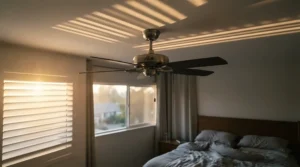
Medical News Today notes that while a fan can help cool a room before and during sleep, some people find the noise of a fan disruptive. Its summary of Sleep Charity guidance puts the ideal bedroom temperature at about 15.6–18.3°C, so you may need less airflow than you think. Lower speeds and larger blades are usually the quieter route, which is why a 132–152 cm DC fan at speed 2 often beats a 50 cm fan at speed 4.
Safety, Wiring and UK Regulations for Your Auto Off Fan for Sleeping
A ceiling fan is a heavier, more dynamic load than a light fitting, so installation deserves care.
Mounting and Clearances
Retailer guidance suggests blades at least 2.3 m from the floor and 200 mm from any obstruction. Fans like the Eglo Cabarita weigh around 6 kg and need a secure fixing, not just a ceiling rose. The Lucci Air Airfusion Akmani is heavier still at about 6.2 kg.
Electrical Work and Part P
In England, electrical work in dwellings falls under Approved Document P, which explains when work must be notified and who should carry it out. Swapping like for like on an existing fitting is often straightforward for a competent person, but adding new wiring or a new point is a different matter. When in doubt, use a qualified electrician.
Retrofit Cautions
The Beacon Lucci Touch listing warns against sharing control wiring with voltage-sensitive devices such as infrared sensor lights and recommends a two-pole switch for isolation. Wales, Scotland and Northern Ireland have their own rules, so check locally.
Long-Term Cost and Running Costs of a Sleep Timer Ceiling Fan
Running costs for a sleep timer ceiling fan are tiny, which is part of the appeal. The arithmetic is simple: watts × hours ÷ 1,000 = kWh.
Take the Eglo Cabarita. Eight hours on its 4W lowest setting uses about 0.032 kWh, while eight hours at its 34W maximum uses about 0.27 kWh. At an illustrative 25p per kWh (swap in your own tariff), that’s under 1p versus roughly 7p a night. Over 30 nights, the low setting costs pennies and the high setting a couple of pounds.
Where Cost Really Differs
DC motors typically draw less. One Lucci Air listing claims about 40% less energy than an equivalent AC fan, though that’s a manufacturer claim. A timer also stops the fan running all night when you only needed it for two hours.
The bigger costs are upfront and one-off: the fan itself, a down rod if your ceiling is high, and an electrician if you need one. Add replacement remote batteries and a little cleaning, and the lifetime cost of a sleep mode ceiling fan is dominated by the purchase price. That’s why the cheapest route, the Beacon Lucci Touch on a compatible fan, can be the most economical overall.

FAQs
❓ Can I add a sleep timer to an existing ceiling fan?
❓ What timer length is best for a bedroom ceiling fan?
❓ Is a DC sleep timer ceiling fan quieter than an AC one?
❓ How much does it cost to run a ceiling fan all night?
❓ Do I need an electrician to fit a ceiling fan with a timer?
Conclusion
The best sleep timer ceiling fan is the one that cools you while you fall asleep and then politely gets out of the way. For most people that means a DC motor, a timer that genuinely controls the fan, and a published noise figure you can trust.
If I had to simplify the seven: the Beacon Lucci Touch is the budget upgrade for compatible fans, and the HOMCOM 50cm Ceiling Fan Light is the cheapest complete option, provided you verify its timer. The Philips Bliss 35+28W suits lighting-led bedrooms (check whether its timer reaches the fan). The 112cm DC Ceiling Fan with Timer is one to watch once stock and timer details are confirmed. The Eglo Cabarita has the clearest timer spec, and the Lucci Air Airfusion Akmani and Lucci Air Climate IV are the premium picks for large rooms and the quietest nights respectively.
Remember what I couldn’t confirm: gradual speed reduction, several timer intervals and most verified reviews. Where the evidence runs out, the honest move is to check the exact variant before you click buy.
Recommended for You
- Ceiling Fan With Smart Timer App Control: 7 Best UK Picks (2026)
- Timer Ceiling Fans: 7 Best Budget Picks For UK Homes (2026)
- Ceiling Fan With Remote Timer: 7 Best Picks For UK Homes (2026)
Disclaimer: This article contains affiliate links. As an Amazon Associate, I earn from qualifying purchases. If you purchase products through these links, we may earn a small commission at no additional cost to you.
✨ Found this helpful? Share it with your friends! 💬🤗
