In This Article
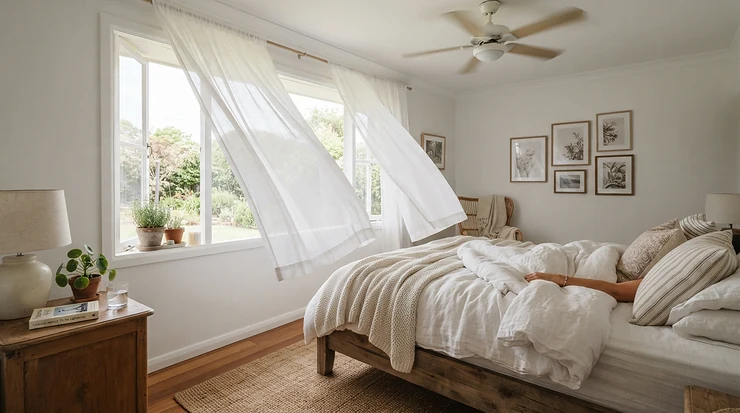
It’s 2 a.m. The duvet is on the floor, then back on, then off again, and your pillow has become a warm flannel. A bedroom ceiling fan with sleep timer is one of the few gadgets that works the night shift for you. It moves air while you drift off, then quietly clocks out so you’re not shivering by dawn.
This guide walks through seven real models, from a screw-in budget fan to premium DC motors from Fantasia and Westinghouse. It explains what the spec-sheet numbers mean in an actual bedroom. One honesty note first: nothing here comes from hands-on testing. It’s spec analysis, manufacturer literature and the buyer feedback I could genuinely verify, and where the evidence was thin, I say so.
A ceiling fan cools you by speeding up the air across your skin, not by lowering the room’s temperature. That’s why the best fan for bedroom night use isn’t the one that shifts the most air. It’s the one that shifts just enough, silently, for exactly as long as you need. Along the way we’ll cover bedroom size fit, blade finish and night-time noise level, the three things spec sheets tend to gloss over.
What is a bedroom ceiling fan with sleep timer?
A bedroom ceiling fan with sleep timer is a ceiling-mounted fan, usually remote-controlled, that switches itself off after a preset period, commonly one to eight hours. It cools you by moving air across your skin rather than lowering room temperature, so you can drift off comfortably without leaving it running all night.
Quick Comparison: Bedroom Ceiling Fan With Sleep Timer at a Glance
Here’s the whole field on one screen, before we dig into the details. Prices are ranges at the time of research, so check current price and availability before buying.
| Fan | Motor | Timer options | Blade span | Price range | Best For |
|---|---|---|---|---|---|
| Fantasia Sirocco 54″ | DC | 1/3/6 hr | 54″ (137 cm) | Premium band; check current price | Large bedrooms, silence-seekers |
| Westinghouse Josef 122 cm | DC | 1/4/8 hr (maker literature) | 48″ (122 cm) | Premium-mid; check current price | Light sleepers, long timers |
| Fantasia Darwin 44″ | AC | 1/3/6 hr plus auto-off | 44″ (112 cm) | Darwin range roughly £290-£365 at 52″; 44″ typically less | Standard bedrooms, UK support |
| Westinghouse 7316740 142 cm | DC | Timer on remote (lengths not stated) | 56″ (142 cm) | £140-£150 range | Value DC in bigger rooms |
| Artika Aiden 24″ | DC | 1 or 4 hr | 24″ (61 cm) | Around £185 | Small rooms, low ceilings |
| Artika Alton 24″ Wood Accent | DC | 1 or 4 hr | 24″ (61 cm) | Around £240 | Warm, wood-look bedrooms |
| Six-Blade E27 Fan Light (1h/2h/4h Timer) | Brushless DC | 1/2/4 hr | Compact (size varies) | Budget tier; check current price | Renters on a budget |
The pattern is clear. The two Fantasia models and the Westinghouse Josef 122 cm suit proper-sized bedrooms, while the Artika pair and the budget Six-Blade E27 Fan Light (1h/2h/4h Timer) suit compact rooms. I haven’t included star ratings, because I couldn’t verify a reliable review pool for most of these exact models and won’t invent one.
💬 Just one click — help others make better buying decisions too!😊
Top 7 Bedroom Ceiling Fan With Sleep Timer Picks: Expert Analysis
Each pick below covers specs with real-world meaning, who it suits, and what the available buyer evidence says. Availability varies by seller, so check whether each model is currently listed on Amazon UK.
1. Fantasia Sirocco 54″ — near-silent DC motor for big bedrooms
The headline feature is the low-energy DC motor, which Fantasia says is almost silent on the lower settings. It has a 54-inch span, a dimmable 20W LED light and a remote with a 1, 3 and 6-hour timer. Fantasia says the motor draws just 35W at top speed, roughly 60% less than a standard fan. On paper that’s a few pennies a night, and far less at the gentle settings you’d use for sleeping.
Based on the spec comparison, this suits a large main bedroom or a loft conversion where a smaller fan would be working flat out. In a boxroom it’s overkill. The big sweep is the point: a large span turning slowly tends to give a softer breeze than a small fan spinning fast.
On reviews, I couldn’t verify a meaningful pool of independent owner feedback for this exact model, so there’s no aggregated sentiment to report. What is verifiable is the support package: a 10-year motor guarantee and a 2-year remote guarantee.
Pros:
- ✅ Very low-draw DC motor
- ✅ 1/3/6-hour timer plus dimmable light
- ✅ 10-year motor guarantee
Cons:
- ❌ 54″ span needs a genuinely big room
- ❌ Premium money for a fan
Prices varied by retailer at the time of research, so check current price. It’s good value if it will run nightly for years.

2. Westinghouse Josef 122 cm — six speeds and the longest timer
The standout is an eight-hour timer option. Westinghouse’s literature for the Josef range lists 1, 4 and 8-hour settings, so confirm this on the UK listing you buy from. It’s a 48-inch DC fan with six speeds, a dimmable 17W warm-white LED (about 560 lumens), a stated maximum noise level of 56 dB(A) and a top speed of 233 rpm.
That 56 dB(A) is a top-speed rating you’d rarely sleep at. Six steps matter more, because they give you a bottom rung that can genuinely be gentle. Blades sit 27 cm below the ceiling, so on a 2.4 m ceiling they hang at roughly 2.13 m. The fan weighs 8.5 kg and tolerates ceiling slopes up to 15°, which makes it a sensible loft candidate.
Reviews were thin: one buyer comment praising build quality, which is too small a sample to call a consensus.
Pros:
- ✅ Six speeds and an eight-hour timer option
- ✅ DC motor with dimmable warm LED
- ✅ Copes with ceiling slopes up to 15°
Cons:
- ❌ At 8.5 kg, it needs solid fixing
- ❌ 56 dB(A) maximum isn’t whisper-quiet at full tilt
UK prices weren’t consistent across sellers, so check current price. The value verdict depends on whether you’ll use that long timer.
3. Fantasia Darwin 44″ — the sensible AC option with UK backing
The standout is dual mounting: flush to the ceiling, or on the supplied 6-inch drop rod. The remote offers a 1, 3 and 6-hour timer plus auto switch-off. The motor is AC, which the retailer confirms is not DC, and the light can be blanked off with the supplied cap if you only want airflow.
In practice, an AC motor typically draws more at low speed than a DC one, but you save money up front. Fantasia’s own chart suggests 36″ to 42″ for a 12 ft by 12 ft bedroom, so 44″ sits at the generous end of that room. Fantasia says its fans on the lowest setting emit a noise equivalent to a modern fridge, according to the specialist retailer’s Q&A. That’s a manufacturer-side claim, not an independent measurement.
Buyer questions on the retailer’s page mostly concern using it without the light, DC motors and drop rods. That’s useful context but not a star rating.
Pros:
- ✅ Flush-mount option for lower ceilings
- ✅ 10-year motor guarantee, 2-year remote
- ✅ Light can be blanked off entirely
Cons:
- ❌ AC motor draws more than DC
- ❌ Longest timer is six hours
The 52-inch version sat between roughly £290 and £365 at the time of research, and the 44-inch typically undercuts it. It’s decent value for UK-supported simplicity.
4. Westinghouse 7316740 142 cm — DC motor value in a 56-inch sweep
The standout is a DC motor in a 142 cm white three-blade fan that stays reasonably priced. The listing describes an RF remote with a timer and four speeds, plus a pull-cord switch, and says Westinghouse backs it with up to 10 years’ guarantee. The fan is 48 cm tall overall.
That height deserves attention. On a 2.4 m ceiling, the lowest point would sit about 1.92 m from the floor, which is too low for comfort in many rooms. So this one is for higher ceilings or rooms where you can use the specs to confirm clearance. The pull cord is a handy backup if the remote battery dies at midnight. The listing doesn’t state timer lengths, a noise rating or an integrated light, so check these before buying.
I found no verifiable owner reviews tied to this exact model.
Pros:
- ✅ DC motor with remote and timer
- ✅ Big 56″ sweep for large rooms
- ✅ Pull-cord backup if remote fails
Cons:
- ❌ 48 cm overall height rules out low ceilings
- ❌ No stated timer lengths or noise rating
At the £140-£150 range it’s the budget route into DC, if your ceiling can take it.
5. Artika Aiden 24″ — compact fandelier for small bedrooms
Its standout is the compact 61 cm ring-style body, which keeps the room open while delivering light and airflow together. Specs include three speeds, reversible direction, a 30W DC motor, 2,000 lumens of dimmable light with eight white colour settings, and a timer of 1 or 4 hours. The listing mentions sealed ball bearings and a quiet motor.
In practice, small blades move less air, which suits a 9 ft by 10 ft room or a bed-focused breeze better than a 14 ft master suite. The two-option timer is simple. The listing publishes no decibel figure, though, so “quiet” remains marketing copy until someone measures it.
No verified UK owner reviews surfaced, so I can’t report buyer sentiment.
Pros:
- ✅ Compact, suits small bedrooms
- ✅ Dimmable 2,000-lumen light, eight white settings
- ✅ DC motor with ball bearings
Cons:
- ❌ No published decibel figure
- ❌ Only 1-hour or 4-hour timer choices
At around £185, it’s fair value if space is the main constraint.
6. Artika Alton 24″ Wood Accent — warm wood look, same compact brain
The standout is the wood-accent finish. Under the skin it matches the Aiden: 24 inches, three speeds, a 30W DC motor, light up to 2,000 lumens, direction control and a timer of 1 or 4 hours, all from one remote.
The listing doesn’t say whether the accent is real wood or wood-effect, which matters for weight, wobble and dust. Visually, though, a warm finish suits a bedroom better than stark white plastic. It also shows less fine dust than glossy dark blades (more on this under blade finish below). Treat the “silent operation throughout the night” wording as marketing, because I found no independent noise measurement.
The same review caveat applies: no verified owner sentiment turned up.
Pros:
- ✅ Wood accent softens a bedroom’s look
- ✅ Fan, light, timer and direction on one remote
- ✅ Compact DC motor
Cons:
- ❌ Pricier than near-identical Aiden specs
- ❌ Finish material isn’t specified
Around £240 at the time of research. You’re paying for looks, so it’s good value only if the finish matters to you.
7. Six-Blade E27 Fan Light (1h/2h/4h Timer) — screw-in budget option for renters
The standout is simplicity. The UK listing describes an E27 screw base that goes into a standard lampholder, six detachable blades, three speeds, a brushless DC copper motor, adjustable 3000K-6500K light and a one-button night-light mode. The timer runs 1, 2 or 4 hours.
Detachable blades make cleaning easy, and the screw-in design appeals to renters, since landlords tend to tolerate it more than rewiring. One caution: an E27 lampholder wasn’t designed to carry a spinning load, so follow the maker’s fixing instructions precisely. Also note this is an unbranded marketplace listing, which makes warranty and spares murkier, and check for UKCA or CE marking before buying.
I found no verifiable reviews tied to this exact product.
Pros:
- ✅ Screw-in install suits many pendant fittings
- ✅ Three timer lengths (1/2/4 hours)
- ✅ Detachable blades for easy cleaning
Cons:
- ❌ Unbranded, so warranty and spares are unclear
- ❌ Compact blades move limited air
It sits in the budget tier, so check current price. It’s good value for a small rented room if the fixing instructions are followed to the letter.
✨ Ready to Sleep Cooler?
🔍 Click any highlighted product name above to check current pricing and availability on Amazon UK. Pick the one that fits your room, and let the timer do the night shift.
How to Set Up and Maintain Your Bedroom Ceiling Fan With Sleep Timer (First 30 Days)
A good fan installed badly is just an expensive wobble. Here’s the practical sequence that Amazon listings rarely spell out.
Day one: fit it properly.
- Switch off at the consumer unit, not just the wall switch.
- Confirm the fixing is rated for the fan’s weight. The Westinghouse Josef 122 cm is 8.5 kg, so it needs a joist or a proper fan-rated bracket, not plasterboard alone.
- Pair the remote before you hang the fan, because it’s easier on the floor than from a stepladder.
- Check blade-to-floor clearance against the room.
First night: go gently. Start on the lowest speed with the timer at four hours (or the nearest option, such as 3 hours on a Fantasia Darwin 44″). If you wake feeling chilly, shorten the timer rather than raising the speed.
Week one: listen. Wobble, ticking or a faint hum usually means a loose blade screw, an unbalanced blade or a tired remote battery. Tighten the screws once, and if the wobble persists, contact the seller rather than improvising.
Day 30: check and clean. Re-check every screw. Wipe blades with a soft dry cloth, since abrasive cleaners scratch finishes. Detachable-blade designs, like the Six-Blade E27 Fan Light (1h/2h/4h Timer), are easiest.
Common first-month mistakes: buying on blade span alone and ignoring drop height, running high speed “to get it over with”, and forgetting that the remote’s timer button is the actual sleep control.
Which Fan for Which Bedroom? Three Real-World Scenarios
Spec sheets don’t sleep in your bedroom, so here are three realistic profiles matched to products, with reasoning.
Scenario 1: the renter in a top-floor flat. The room is 10 ft by 10 ft with a 2.4 m ceiling and a landlord who frowns at DIY. The budget is £100-£200 and the fan runs nightly from June to September. A Six-Blade E27 Fan Light (1h/2h/4h Timer) or an Artika Aiden 24″ fits the scale. In both cases, check the fixing instructions and get permission before swapping any ceiling fitting.
Scenario 2: the couple with a light sleeper. The main bedroom is 12 ft by 14 ft, with a budget of £150-£300 and nightly use through summer. The Westinghouse Josef 122 cm (six speeds, long timer option) suits the light sleeper, who can sit on a low, slow setting. The Fantasia Darwin 44″ is the simpler alternative if DC isn’t a priority.
Scenario 3: the loft conversion. Sloping ceilings, summer heat that collects overhead, and a large floor area. The Westinghouse Josef 122 cm is rated for slopes up to 15°. For a bigger loft, the Fantasia Sirocco 54″ gives a gentler sweep. Check each fan’s maximum slope and overall drop before ordering, because the numbers vary.
Bedroom Size Fit: Matching Blade Span to Your Room
Bedroom size fit comes down to two measurements, floor area and ceiling clearance. Fantasia’s chart suggests 36″ to 42″ for a 12 ft by 12 ft bedroom, and its brochure frames 42″ to 52″ as typical for a single fan in a standard bedroom, with 52″ to 56″ for larger rooms. The 9 ft by 10 ft row below is my own rule of thumb.
| Bedroom (approx.) | Blade span guide | From this list | Best For |
|---|---|---|---|
| 9 × 10 ft (boxroom) | 24″-36″ | Artika Aiden 24″, Artika Alton 24″ Wood Accent, Six-Blade E27 Fan Light (1h/2h/4h Timer) | Renters, small rooms |
| 12 × 12 ft | 36″-42″ | Fantasia Darwin 44″ (slightly above) | Compact doubles |
| 12 × 14 ft | 42″-52″ | Westinghouse Josef 122 cm | Standard doubles |
| 14 × 16 ft and up | 52″-56″ | Fantasia Sirocco 54″, Westinghouse 7316740 142 cm | Master suites, lofts |
Bigger isn’t automatically better. An oversized fan in a small room means more breeze than you want, and a tiny fan in a big room works hard and still falls short. Ceiling height matters just as much. CHOICE, an Australian consumer group, lists 2.1 m from floor to blades as its recommended minimum in its test data. On a 2.4 m ceiling, that leaves only about 30 cm for the fan’s drop.
Night-Time Noise Level: What a Quiet Bedroom Timer Fan Really Means
“Silent” is the most abused word in fan marketing. Here’s how to read the claims.
- Decibel figures. The Westinghouse Josef 122 cm lists 56 dB(A) as its maximum, a top-speed figure. Most listings, including the Artika pair, publish nothing at all, which tells you the claim isn’t measured.
- Lowest-speed behaviour. CHOICE’s testers have flagged fans whose slowest setting was too strong to sleep through. That’s why six speeds beat three for night use.
- Mechanical noise. Ticking, wobble and remote beeps wake people more than steady airflow does. Some remotes beep on every press, so check before buying.
- Motor type. DC motors are generally quieter and run with fewer hum problems than AC.
The environment matters too. An NHS hospital trust’s wellbeing guidance notes it’s generally easier to sleep when a room is quiet, dark and cool, and that the right setup is personal. A quiet bedroom timer fan helps with the quiet and cool parts, but only if it isn’t adding its own disturbance. If a retailer’s quiet claim has no number behind it, treat it as a hope, not a spec.
Bedroom Fan Sleep Timer: Which Timer Lengths Actually Help
A bedroom fan sleep timer has one job: stop the fan once it’s done its work. Timer menus across our seven picks vary widely: 1/3/6 hours on the Fantasias, 1/4/8 on the Westinghouse Josef 122 cm, 1/2/4 on the budget Six-Blade E27 Fan Light (1h/2h/4h Timer) and just 1 or 4 on the Artikas.
Think of timers in two jobs. A short timer (1-2 hours) helps you fall asleep, while a four-hour timer covers the early part of the night, and a six or eight-hour timer is essentially “all night”. There’s a subtle trap too. A fan switching off at 3 a.m. can wake some people simply because the room goes quiet. If that’s you, a longer timer on a low speed is the safer bet.
If your fan lacks a timer, universal add-ons exist. The Westinghouse 77874 RF thermostat and timer remote is sold as compatible with most remote-capable ceiling fans, but wiring a receiver into the canopy is electrician territory. Before you buy, check whether the timer also switches the light off, as listings rarely say.
Blade Finish: Matt, Wood or Clear — Does It Matter?
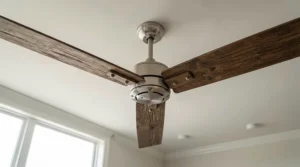
Blade finish affects looks, dust and sometimes noise. Matt white hides dust well and blends with most ceilings, which is why it’s so common. A wood accent, as on the Artika Alton 24″ Wood Accent, adds warmth and tends to mask fine dust better than glossy dark blades. Clear polycarbonate, as on the Westinghouse Josef 122 cm, looks sleek but shows fingerprints and dust more readily. Rattan, as on the Artika Kalani 24″, is decorative but may be harder to wipe.
Some consumer guides also warn that heavily textured blades can be noisier than smooth ones. Blade pitch matters too: the Josef’s 51° pitch is designed to move plenty of air per rotation. For maintenance, a soft dry cloth does the job, and detachable blades make it quicker. The best blade finish is the one you’ll actually clean, so pick on dust-visibility as much as colour.

How to Choose a Bedroom Ceiling Fan With Sleep Timer
Follow these seven steps and you’ll avoid the usual regrets.
- Measure the room and ceiling. Floor area sets blade span, and ceiling height sets how much drop you can afford.
- Choose the blade span. Match it to your room using the size guide above rather than guessing.
- Pick the motor. DC costs more up front, but draws very little and usually offers more speed steps.
- Check the timer and remote. You want timer lengths that suit how you sleep, and a remote you can operate in the dark.
- Verify the noise claim. Look for a decibel figure and ask about the lowest speed, not just the maximum.
- Choose the blade finish. Pick one that suits your decor and your tolerance for dusting.
- Check warranty and safety marking. Look for UKCA or CE marking and a clear guarantee, such as the 10-year motor warranties on Fantasia Darwin 44″ and Fantasia Sirocco 54″.
Best Fan for Bedroom Night Use: Ceiling vs Pedestal vs Tower
The best fan for bedroom night use depends on whether your ceiling can take one. UK ceilings are often low, which is why a pedestal or tower fan is sometimes the only option.
| Option | Floor footprint | Typical timer | Noise character | Best For |
|---|---|---|---|---|
| Fantasia Darwin 44″ (ceiling) | None | 1/3/6 hr | Steady, low airflow hum | Higher ceilings, whole-room breeze |
| Silentnight Airmax 18″ Pedestal | Yes | 9 hr | Motor plus oscillation | Targeted airflow, low ceilings |
| Tower fan (typical) | Yes, slim | 7-12 hr in retail roundups | Higher-pitched whoosh | Small spaces, quick moves |
The Silentnight Airmax 18″ Pedestal is listed as a 50W fan with five speeds, 90° oscillation, a Sleep Mode and a 9-hour timer. It makes sense where a ceiling fan can’t go. A ceiling fan wins on floor space, cable-free tidiness and gentle all-room circulation. Pedestal and tower fans win on flexibility and on not needing any installation.
Long-Term Cost: What a Bedroom Ceiling Fan With Sleep Timer Really Costs to Run
Electricity prices move every quarter. For standard variable tariffs paid by Direct Debit, Ofgem’s price cap averages 26.32p per kWh from 1 October to 31 December 2026, with VAT temporarily removed from domestic electricity. If you’re on a fixed deal, your rate will differ.
The table uses each fan’s rated motor power (my arithmetic, not a measured figure), and it excludes the LED light.
| Fan | Rated motor draw | 8 h at top speed | 4 h at top speed | Best For |
|---|---|---|---|---|
| Fantasia Sirocco 54″ | 35W | About 7.4p | About 3.7p | Large rooms |
| Westinghouse Josef 122 cm | 34W | About 7.2p | About 3.6p | Long timer users |
| Artika Aiden 24″ | 30W | About 6.3p | About 3.2p | Small rooms |
| Typical DC at low speed | About 5W | About 1.1p | About 0.5p | Everyday nightly use |
Even at top speed for eight hours, the Fantasia Sirocco 54″ costs about £7.40 per 100 nights, and a low-speed DC night costs roughly £1.05 per 100 nights. Published specs from CHOICE show the gap between motor types. The Lucci Airfusion Airlie II (AC) lists 11W, 25W and 45W across its three speeds, while the Lucci Airfusion Fraser (DC) lists 4W, 8W and 30W. Because you’ll mostly use low speeds, DC’s low-end efficiency matters more than its headline top-speed figure. Either way, the running cost is trivial next to the purchase price.
Safety, Wiring and Regulations Guide
Ceiling fans are heavy things spinning above your head, so the safety basics matter. The fixing must be rated for the fan’s weight. The Westinghouse Josef 122 cm is 8.5 kg, so plasterboard alone won’t do. Check the maximum ceiling slope too (the Josef allows 15°), and confirm UKCA or CE marking on the product.
On wiring, England’s Approved Document P covers electrical safety in dwellings, including when work needs to be notified and who should carry it out. It expects anyone doing electrical work to be competent. Swapping a like-for-like fitting is treated differently from adding circuits, but the rules are detailed, so check the document or ask a registered electrician if you’re unsure. Wales and Scotland have their own regulations. This is general information, not professional advice.

FAQ
❓ How much does a bedroom ceiling fan with sleep timer cost in the UK?
❓ Can I add a sleep timer to a ceiling fan that doesn't have one?
❓ Is a DC motor worth paying extra for in a quiet bedroom timer fan?
❓ Which fan suits a low UK ceiling?
❓ Do ceiling fans with sleep timers come with long warranties?
Conclusion
Choosing a bedroom ceiling fan with sleep timer comes down to a short list of honest questions. How big is the room, how high is the ceiling, how quiet does it need to be, and how long should it run? Match those answers to the specs, and the right fan tends to pick itself.
For large bedrooms and silence-seekers, the Fantasia Sirocco 54″ is the premium choice. For light sleepers who want long timers, the Westinghouse Josef 122 cm stands out. The Fantasia Darwin 44″ is the UK-supported, simpler option, and the Westinghouse 7316740 142 cm is the budget DC route for higher ceilings. Small rooms suit the Artika Aiden 24″ or the Artika Alton 24″ Wood Accent if you prefer a warmer look. The Six-Blade E27 Fan Light (1h/2h/4h Timer) is the stripped-back renter’s option, with the unbranded-warranty caveat.
One last point: where reviews were thin, I’ve said so rather than papering over it. Check current prices and fixing instructions before you buy.
Recommended for You
- Sleep Timer Ceiling Fan: 7 Best Picks For UK Bedrooms (2026)
- Ceiling Fan With Smart Timer App Control: 7 Best UK Picks (2026)
- Timer Ceiling Fans: 7 Best Budget Picks For UK Homes (2026)
Disclaimer: This article contains affiliate links. As an Amazon Associate, I earn from qualifying purchases. If you purchase products through these links, we may earn a small commission at no additional cost to you.
✨ Found this helpful? Share it with your friends! 💬🤗
