
In This Article
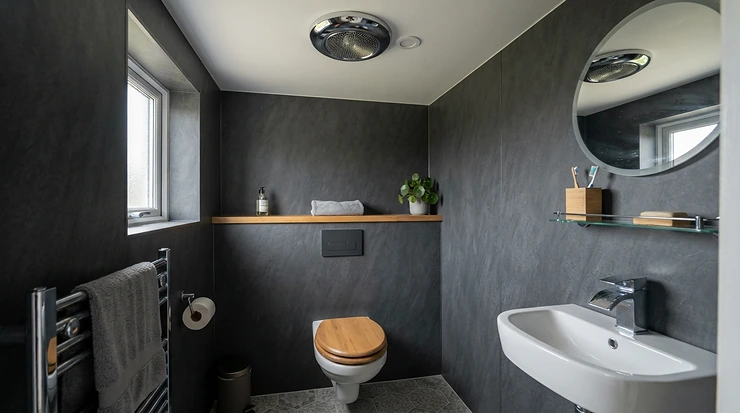
A polished chrome fan for small bathroom ceiling use is a compact, ceiling-mounted ventilation unit, almost always an axial extractor. It has a reflective chrome-effect front cover, an ingress rating suited to damp rooms, and enough airflow to clear steam from a tight space. It does the unglamorous job of moving moisture out, and it looks like jewellery while doing it.

Now the honest bit. When shoppers search for a polished chrome fan for small bathroom ceiling installs, they often picture a paddle fan like the one in the lounge. In UK bathrooms, though, the product that actually helps is a ceiling-mounted extractor. A paddle fan stirs damp air around and removes none of it. The chrome part is purely cosmetic, but it is the part that decides whether the fan looks deliberate or like an afterthought bolted above your taps.
Ventilation is not just a style choice either. Under the building regulations guidance in Approved Document F, intermittent extraction for a bathroom is generally set at 15 litres per second. That is roughly 54 m³/h, and a windowless room also needs a 15-minute overrun. Plenty of chrome fans look stunning and then just scrape past that figure on paper.
So I compared seven real, currently listed options on airflow, noise, IP rating and control type. Each is judged on what the spec means in a small room, not on how pretty the grille looks.
Quick Comparison: 7 Chrome Bathroom Fans at a Glance
| Fan | Duct Size | Airflow (listed) | IP Rating | Control | Best For |
|---|---|---|---|---|---|
| Manrose LP100STC | 100 mm | 23 l/s | IP44 | Adjustable timer | Manrose LP100STC: tight budgets and slim profiles |
| Sensio Remy | 100 mm | 54 m³/h | IPX4 | On/off + LED light | Sensio Remy: one-hole light-and-fan combo |
| Sensio Drax | 100 mm | Not listed | IP45 | Humidistat + timer | Sensio Drax: hands-off humidity control |
| Blauberg Calm Design Hi-Tech | 100 mm | ~90 m³/h | IP45 | Pull cord | Blauberg Calm Design Hi-Tech: bright, polished face-plate |
| Airflow iCON 15 | 100 mm | Up to 68 m³/h | IPX4 | Modular | Airflow iCON 15: quiet, silent-shutter design |
| Awenta Escudo 125 | 125 mm | 145 m³/h | IPX4 | Timer, humidity or motion | Awenta Escudo 125: strong extraction, bigger rooms |
| Xpelair AL100 | 100 mm | Not listed | IPX4 | Remote switch | Xpelair AL100: over-shower, in-void installs |
Looking at the table, the Sensio Remy is the only unit here that gives you a built-in light, which matters if your ceiling has room for one hole and no more. The Awenta Escudo 125 has far more raw airflow than a small room needs, so it suits steamy family bathrooms best. Budget buyers should note that the Manrose LP100STC clears the regulatory minimum comfortably for very little outlay, but the sleek finish is the trade-off for a plainer feature set.
💬 Just one click — help others make better buying decisions too!😊
Top 7 Polished Chrome Fans for Small Bathroom Ceilings: Expert Analysis
1. Manrose LP100STC — slimmest chrome face on a budget
The standout here is a front cover only about 10 mm deep, so it barely rises off the ceiling surface. It is a square chrome-fronted 100 mm axial fan with an adjustable electronic timer and a long-life motor, listed at IP44 and 23 l/s.
What does that mean in a small room? A 23 l/s rating clears the 15 l/s guideline with real headroom. That headroom matters because long or kinked ducting always steals airflow. The timer fixes the biggest flaw of cheap fans, which is stopping the second the light goes off.
Check the zone wording before buying. The listing doesn’t state a bathroom zone, so treat it as a zone 2 or outside-zones fan unless the manufacturer’s instructions say otherwise, and ask a registered electrician if it’s going anywhere near the shower. Also check you’re ordering the timer variant, because related listings include non-timer versions.
I couldn’t verify a meaningful pool of independent reviews for this exact chrome variant, so I won’t characterise buyer sentiment.
Pros:
- ✅ Ultra-slim front sits almost flush
- ✅ Healthy airflow for the price bracket
- ✅ Adjustable timer included
Cons:
- ❌ Zone suitability not clearly stated
- ❌ Plainer feature set than pricier rivals
Price range: under £35, so check current price. Excellent value if a basic chrome look is all you need.
2. Sensio Remy — chrome extractor with built-in LED light
This is the closest thing to a chrome ceiling fan with light for bathroom spaces that I found among genuine ventilation products. It combines a 3W cool-white GU10 downlight with a 100 mm axial fan in a chrome finish.
The listing gives 54 m³/h, which is 15 l/s, so it matches the regulatory figure exactly rather than beating it. It also lists 36 dB, IPX4, a five-year guarantee and UKCA/CE marking. Meeting the minimum exactly is fine with a short, straight duct, but any bends will eat into that margin.
There is no timer. It’s simple on/off, so wiring it to the light switch means steam lingers once you leave. If your bathroom has no window, consider whether that suits you. One more detail: the retailer’s product title says “Wall” while the description says ceiling, so verify the exact listing before ordering.
Sentiment-wise, I couldn’t verify enough independent reviews to summarise, so I’d rather say that than guess.
Pros:
- ✅ Fan and light in one ceiling hole
- ✅ Five-year guarantee listed
- ✅ IPX4 suits zone 2
Cons:
- ❌ Airflow only just meets 15 l/s
- ❌ No overrun timer
Price range: around £85-£95. Fair value if you’d otherwise buy a separate fan and spotlight.
3. Sensio Drax — set-and-forget humidity sensing
The standout is the adjustable humidistat. According to the retailer listing, it starts the fan automatically when humidity climbs above 60%, and a variable run-on timer keeps it going afterwards. It carries an IP45 rating and mounts on wall or ceiling.
For a small bathroom, this is the clever one. Humidity-triggered fans suit people who forget, or households where somebody always showers last. The spec sheet won’t tell you this, but a humidistat is only as good as its position, so a spot away from the door and close to the shower serves it best.
I couldn’t find a stated airflow figure on the listing I reviewed. Before buying, check the manufacturer’s data sheet confirms at least 15 l/s. Independent review data wasn’t verifiable at research time either.
Pros:
- ✅ Automatic humidity-triggered running
- ✅ IP45 and wall or ceiling mounting
- ✅ Variable run-on timer
Cons:
- ❌ Airflow figure not shown on listing
- ❌ Priciest of the budget-to-mid group
Price range: around £110-£125. Worth it if automation matters more than the lowest price.
4. Blauberg Calm Design Hi-Tech — mirror-bright face-plate
The standout is a polished chrome face-plate that looks a notch more premium than most. It’s a 100 mm fan with a rated airflow of about 90 m³/h (roughly 25 l/s), a built-in backdraught shutter and an IP45 rating. The retailer lists it for zones 1 and 2 with wall or ceiling mounting.
That airflow comfortably beats the 15 l/s guideline. The shutter blocks cold draughts when the fan is off, which is useful if your duct run is short. The version I reviewed is the pull-cord model, which saves running a switched live. But there’s no overrun, so for a windowless room that needs the 15-minute run-on, the pull-cord version may not comply on its own.
Think hard about the dangling cord too. Some people love the retro simplicity, while others hate cleaning around it.
Independent review sentiment couldn’t be verified at research time.
Pros:
- ✅ Polished chrome face-plate looks premium
- ✅ Strong airflow for its size
- ✅ Backdraught shutter included
Cons:
- ❌ Pull cord means no automatic overrun
- ❌ Price not verified on listing
Price range: check current price, since the listing I found didn’t show one.
5. Airflow iCON 15 — quiet fan with silent iris shutter
The standout is the round iris shutter, which opens and closes slowly and quietly. The listed spec is up to 19 l/s (68 m³/h), 28.8 dB(A), 9.4 W, IPX4 and a three-year warranty. Control modules for timer, humidity or motion snap in separately.
The chrome cover is an optional extra, and listings say coloured covers suit recessed mounting only. That means you need a core-drilled hole and a recessed install, so surface-mounted won’t work. At 19 l/s, it still beats the guideline.
Retail-listing reviewers consistently mention easy fitting, a tidy low-profile look and the shutter cutting backdraughts. A common complaint is cost, with one buyer calling it about three times a standard fan. Another reported the shutter blades sticking while swapping covers.
Pros:
- ✅ Whisper-quiet at 28.8 dB(A)
- ✅ Interchangeable control modules
- ✅ Three-year warranty
Cons:
- ❌ Chrome cover costs extra
- ❌ Chrome only on recessed installs
Price range: the fan itself ran roughly £55-£100 depending on retailer, while chrome covers I saw ranged from the mid-£80s into the £130s. Budget comfortably over £100 combined.
6. Awenta Escudo 125 — heavy-duty airflow, chrome front
The standout is airflow. The Awenta System Silent Escudo Chrome 125 is listed at 145 m³/h from a 9 W motor, with 32 dB(A) at 3 m. It has an ABS chrome front panel and an IPX4 rating, with a non-return valve and wall or ceiling mounting. Variants add a 3-30 minute timer (T), a humidity sensor (H) or a motion sensor (M).
That 145 m³/h works out at roughly 40 l/s, nearly triple the guideline. In a small bathroom that’s generous. It clears steam quickly and may well run for less time.
The catch is the 125 mm spigot. Most bathroom ducting is 100 mm, so you’ll need compatible duct or a reducer. The front panel is also 208 x 188 mm, a bigger visual footprint than the slim rivals above. Order the right letter for the controls you want.
Verified independent reviews weren’t available for me to summarise.
Pros:
- ✅ Very high airflow for the money
- ✅ Timer, humidity or motion variants
- ✅ Low listed noise at 32 dB(A)
Cons:
- ❌ 125 mm duct complicates installs
- ❌ Larger front panel on a small ceiling
Price range: check current price, since the listing didn’t show a figure. Good value on airflow alone.
7. Xpelair AL100 — shower-safe fan hidden in the ceiling void
The standout is that the fan itself sits remotely in the loft or ceiling void. Only a square louvre grille shows in the room. The kit is listed at IPX4 and suited to zone 1, with ducting included, 40 dBA at 3 m and single-speed operation. The finish is listed as white/chrome, so check which trim you actually receive.
Mounting the motor away from the room is the best extractor fan alternative to a conventional face-mounted unit. It’s also the sneakiest way to put ventilation right over a shower without a bulky housing. The spec sheet won’t state the airflow here, so confirm 15 l/s before buying.
There is no overrun function, so pair it with a separate timer or switched circuit if your bathroom has no window. It also needs accessible loft space, which flats often lack.
Independent review sentiment wasn’t verifiable at research time.
Pros:
- ✅ Quieter in-room thanks to remote motor
- ✅ Suitable for zone 1 per listing
- ✅ Ducting and fixings included
Cons:
- ❌ Needs loft or ceiling void access
- ❌ No overrun function
Price range: check current price. It’s a solid pick where a chrome-effect grille is enough and silence matters.
Spec and Price Snapshot
| Fan | Noise (listed) | Standout Spec | Approx. Price | Best For |
|---|---|---|---|---|
| Manrose LP100STC | Not listed | 10 mm slim profile | Under £35 | Budget buyers |
| Sensio Remy | 36 dB | 3W LED downlight | £85-£95 | Light-and-fan combo |
| Sensio Drax | Not listed | 60% humidity trigger | £110-£125 | Automation fans |
| Blauberg Calm Design Hi-Tech | Not listed | ~90 m³/h, pull cord | Check price | Polished style seekers |
| Airflow iCON 15 | 28.8 dB(A) | Iris shutter | £100+ with cover | Quiet-obsessed buyers |
| Awenta Escudo 125 | 32 dB(A) at 3 m | 145 m³/h | Check price | Larger or steamier rooms |
| Xpelair AL100 | 40 dBA at 3 m | Remote in-void motor | Check price | Zone 1 installs |
Reading the table sideways, the Airflow iCON 15 is the quietest listed option, but you pay for it once the chrome cover is added. The Sensio Remy and Sensio Drax share a brand yet solve different problems, light versus humidity control. For raw performance per pound, the Awenta Escudo 125 and Manrose LP100STC are hard to beat, though they ask different compromises on size and features.
Installation Guide: Getting Your Chrome Fan Working Properly
Fitting is where a lovely fan turns into a rattling disappointment. Here’s a practical order of work that Amazon-style listings never spell out.
Before you start: Isolate the circuit and use a registered electrician for anything near zones 1 and 2. For a deeper reason than politeness, see the zones section below.
- Choose the position. Place it high and as far from the door as practical, so air sweeps across the room.
- Keep the duct short and straight. Every bend and metre of flexible ducting reduces airflow. A fan rated at 15 l/s can deliver far less after a long, kinked run.
- Slope the duct slightly outward. This lets condensation drain outside rather than back into the fan.
- Check the wiring for your control type. Timer models typically need a permanent live as well as a switched live, so confirm against the manual before pulling cable.
- Seal the gaps. Use sealant around the spigot and wall or ceiling opening to stop warm air leaking into the void.
Common mistakes in the first 30 days: setting the timer too short, forgetting to fit an external grille and leaving the duct unsupported so it sags. Wipe the chrome with a soft damp cloth, never an abrasive pad.
Problem → Solution: Fixing Common Chrome Fan Headaches
Even a good fan can disappoint. These are the five complaints worth solving.
Problem 1: Steam still lingers. Check duct length first. Then consider whether an overrun or humidistat would help, as with the Sensio Drax.
Problem 2: Condensation on the chrome. Chrome is cold and reflective, so it shows moisture quickly. A fan running longer after showers usually resolves it.
Problem 3: Rattling. Usually loose fixings or a duct touching timber. Re-secure it.
Problem 4: Cold draughts when off. Choose a model with a backdraught shutter, such as the Blauberg Calm Design Hi-Tech or Airflow iCON 15.
Problem 5: Persistent mould. A fan helps, but it isn’t a cure-all. Official government guidance on damp and mould stresses identifying underlying causes such as inadequate ventilation or structural issues. If mould keeps returning, investigate the cause rather than just buying a bigger fan.
Real-World Scenarios: Which Fan for Which Bathroom?
Scenario 1: The renter in a windowless en suite. Budget is tight and the landlord permits a like-for-like swap. The Manrose LP100STC gives timer function and decent airflow cheaply. Run-on solves the windowless rule, and the slim chrome front looks sharper than the white box it replaces.
Scenario 2: The tidy-minded couple redoing a compact bathroom. They want one ceiling hole, a coordinated chrome look and decent lighting. The Sensio Remy fits, as long as they accept no timer and wire it carefully.
Scenario 3: The family of four with a long morning queue for the shower. The bathroom is small but steams solidly for an hour. The Awenta Escudo 125 brings the airflow, and the humidity variant takes the decision out of everyone’s hands. The Sensio Drax is a lower-airflow-spec alternative if the 125 mm duct is awkward.
Tailor to your own routine: how often, how long, and whether a window exists.
✨ Don’t Miss These Exclusive Deals!
🔍 Take your bathroom ventilation to the next level with these carefully selected fans. Click on any highlighted product to check current pricing and availability. These picks will help you create a fresher, mould-free bathroom your whole household will notice!
How to Choose a Polished Chrome Fan for Small Bathroom Ceiling Spaces
Picking the right polished chrome fan for small bathroom ceiling use comes down to six decisions, in this order.
- Check the airflow. Aim for at least 15 l/s (54 m³/h) at the fan, with headroom if the duct is long. The Planning Portal’s Part F guidance is a good starting point for what building control expects.
- Match the IP rating to your zone. Over the bath or shower, IPX4 is the floor, and the manufacturer’s stated zone suitability still matters.
- Choose the control type. Timers suit windowless rooms, humidistats suit forgetful households, pull cords suit simple installs.
- Measure the ceiling and duct size. Most are 100 mm, but the Awenta Escudo 125 needs 125 mm.
- Compare noise. Anything near 30 dB(A) is notably quiet, while 40 dBA and above is audible in a small room.
- Judge the finish. A true polished look is nice, but airflow and safety come first.
Do the maths on running costs too. A 9 W motor running a few hours a day costs pennies, so efficiency rarely decides the purchase.
Mirror Finish Chrome Ceiling Fan: What the Shine Really Means
A mirror finish chrome ceiling fan sounds impressive, but listings rarely say what the finish actually is. The Awenta front panel is listed as ABS plastic, for instance, so a chrome-effect coating is likely rather than solid metal. The Blauberg is described as a polished chrome face-plate, but I couldn’t confirm the base material.
Why does it matter? Chrome-effect plastic is lighter, cheaper and won’t corrode, but harsh cleaners can dull or strip the coating. Real metal faces cost more and can stain if water sits on them.
If you want a mirror finish chrome ceiling fan, match it to your taps. Cheap chrome plating can look slightly blue or yellow beside quality brassware, so compare in daylight if possible.
Fingerprints and water spots show readily on any mirror finish chrome ceiling fan, but a high ceiling keeps hands away. Wipe with a soft, damp cloth and dry immediately.
Chrome Ceiling Fan With Light for Bathroom: What Are Your Options?
A chrome ceiling fan with light for bathroom use is a rarer find than you’d expect. Among genuine ventilation products, the Sensio Remy is the clearest example I found, with its integrated GU10 LED downlight.
Why so few? Combining fan and lamp demands more careful heat and moisture handling, so manufacturers tend to keep things separate.
For a chrome ceiling fan with light for bathroom installs, think about lighting quality too. A single 3W downlight won’t illuminate a whole room, so plan it as accent or supplementary lighting. In a tiny cloakroom, though, it might be all you need.
If you do want stronger lighting, buy a separate IP44-rated chrome fitting rather than demanding one unit do everything. Decorative IP44 chrome ceiling lights are widely sold, and zone 2 suitability is straightforward to check on each listing.
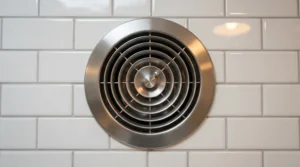
IP Rated Fan: Bathroom Zones Made Simple
An IP rated fan carries a code that tells you how well it resists solids and water. In bathrooms, the second digit is the one that counts.
Per advice from NICEIC, IPX4 is splash-proof and relevant to bathroom zones 1 and 2, while IP44 is usually the minimum rating for a bathroom appliance. A fan directly above a bath or shower is typically a zone 1 installation, otherwise it might sit in zone 2 or outside the zones.
Not every IP rated fan is suitable for zone 1, even with the right digits. That’s why the Xpelair AL100 specifically lists zone 1 suitability, while the Sensio Remy is described for zone 2.
A sensible rule: choose an IP rated fan with the zone stated on the product page, protect the circuit with an RCD, and have a registered electrician fit it. It’s the one area where cutting corners can hurt people.
Moisture Resistant Motor: What to Look For
A moisture resistant motor isn’t a standardised label, so treat it as marketing until the spec backs it up. Look for an IPX4 or IP45 rating, ball-bearing motors, thermal protection and a long warranty.
The Airflow iCON 15 is listed with a three-year warranty, and the Sensio Remy with five. Those numbers suggest manufacturer confidence in motor longevity, though warranties don’t prove durability.
A moisture resistant motor matters because steam condenses inside housings. Sealed bearings and double-insulated Class II construction reduce failure risk. The Manrose listing mentions a long-life motor, though without a stated hours figure.
Low-wattage DC motors, like the 6.1 W iCON 15S variant, run cooler and use less power but cost considerably more. For most small bathrooms, a standard AC unit with a sensible warranty is perfectly adequate.
Extractor Fan Alternative: What Else Could Ventilate a Small Bathroom?
Sometimes a conventional fan won’t fit. If you’re searching for an extractor fan alternative, here are the realistic options.
| Alternative | How It Works | Best For |
|---|---|---|
| Xpelair AL100 inline kit | Remote motor in void | Zone 1, quiet rooms |
| Window trickle vent | Passive airflow | Rooms with windows |
| Dehumidifier | Removes moisture without ducting | No outside wall |
| Whole-house ventilation | Central system | New builds, renovations |
The first extractor fan alternative is simply a different style of extractor, like the Xpelair AL100. A dehumidifier treats symptoms without exchanging air, so it can’t replace proper extraction in a windowless room.
Passive vents help but rely on weather. Whole-house systems are efficient yet expensive.
The honest conclusion is that no extractor fan alternative matches a well-chosen ducted fan for steam removal in a small room. Use alternatives to supplement, not replace.
Common Mistakes When Buying a Polished Chrome Fan for Small Bathroom Ceiling Spaces
Buying on looks alone. A gorgeous face with 10 l/s of real airflow will leave you with a fogged mirror.
Ignoring duct size. The 125 mm Awenta Escudo 125 won’t connect to a 100 mm spigot without an adapter.
Skipping the timer. Windowless bathrooms generally need a run-on. A pull-cord Blauberg Calm Design Hi-Tech may not satisfy that alone.
Misreading IP ratings. IP44 isn’t the same as zone approval. Always read the stated zone.
Overlooking cover costs. The Airflow iCON 15 fan looks reasonable until the chrome cover is added.
Trusting unverified claims. Where listings don’t show airflow, as with the Sensio Drax and Xpelair AL100, ask for the data sheet.
Avoid these and you’ll sidestep most regrets.
Long-Term Cost & Maintenance
Most of these fans draw under 10-20 watts, so electricity cost is negligible next to purchase price. The bigger cost is replacement if cheap fans fail early.
Think in total ownership terms. A fan around £30 that lasts five years costs roughly £6 a year. A premium unit at £120 needs a decade to match that, though a longer warranty and quieter running may justify it.
Maintenance is simple: wipe the chrome monthly, vacuum dust from the grille, and check the shutter moves freely. Clean the impeller gently if your model allows. A neglected fan loses airflow quietly, so notice if steam begins to linger.
The Airflow iCON 15 lets you swap control modules instead of the entire fan, which adds long-term flexibility. In practice, buying a Manrose LP100STC and replacing it later is the cheaper path for many households.

FAQ
❓ What size polished chrome fan for small bathroom ceiling use do I need?
❓ Can I fit a chrome fan directly above the shower?
❓ Does a humidity sensor beat a timer?
❓ Will chrome show water marks and fingerprints?
❓ Is a pull-cord fan acceptable in a windowless bathroom?
Conclusion
Choosing a polished chrome fan for small bathroom ceiling spaces is really about three things: enough airflow, the right IP rating for your zone, and a control type that fits your routine. The chrome face is the cherry on top, not the cake.
If you’re on a budget, the Manrose LP100STC gets you a slim chrome look with a timer. If you want fan and light in one hole, the Sensio Remy is the clear fit, while the Sensio Drax automates the whole job. For a showier face-plate, the Blauberg Calm Design Hi-Tech delivers, and the Airflow iCON 15 wins on quiet and modularity. Need serious airflow? The Awenta Escudo 125 has it, and the Xpelair AL100 suits remote, over-shower installs.
Whatever you pick, check the listing for stated airflow, zone suitability and duct size before you commit. Prices change, so check current price on each product page.
✨ Ready to upgrade your bathroom?
🛁 Compare the highlighted fans above, check current pricing and availability, and pick the polished chrome fan for small bathroom ceiling spaces that suits your room, your routine and your budget. Your mirror (and your walls) will thank you!
Recommended for You
- Satin Chrome Ceiling Fan For Modern Kitchen: 7 Best Picks (2026)
- Brushed Nickel Ceiling Fan with Light For Low Ceiling: 7 Best (2026)
- Programmable Ceiling Fan: 7 Best Smart Picks For UK Homes (2026)
Disclaimer: This article contains affiliate links. As an Amazon Associate, I earn from qualifying purchases. If you purchase products through these links, we may earn a small commission at no additional cost to you.
✨ Found this helpful? Share it with your friends! 💬🤗
