
In This Article
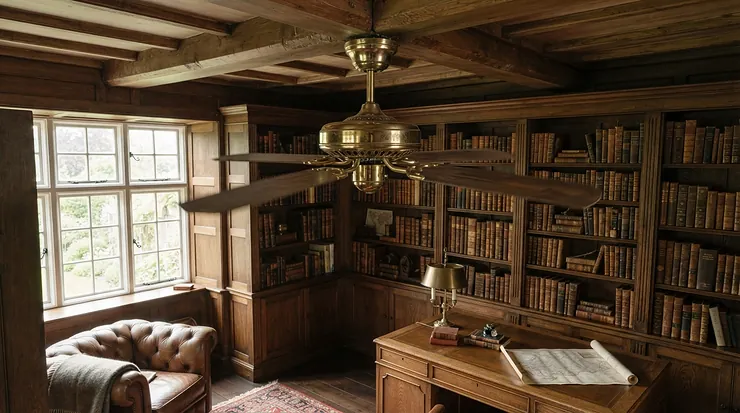
An antique brass ceiling fan for period property is a traditionally styled fan with an aged-brass housing, reversible wooden blades and, often, an integrated light. It circulates air without clashing with Georgian, Victorian or Edwardian interiors. It cools you in summer and, in reverse, pushes trapped warm air back down in winter.
Period homes have a problem modern ones don’t: height. Those generous ceilings look glorious, but they quietly funnel your heating towards the cornicing while you sit in a chilly draught at sofa level. A ceiling fan is the old fix. Punkah-style fans date back to India around 500 BC, and the electric ceiling fan arrived in 1882. The trouble is that the bargain-bin version, all white plastic and chrome, looks like a drone has landed in your drawing room.
That’s where finish earns its keep. Antique brass with oak-and-cane blades reads as furniture, not appliance. Pick well and you get a traditional antique brass fan with light, a victorian style fixture that looks as if it has hung there since the house was built. It also adds a little vintage lighting glow while it works.
Below you’ll find seven real models, with their published specs translated into everyday meaning. There’s also a plain-English guide to the extended downrod you’ll need for an antique brass fan for high ceiling rooms, plus fitting advice for older houses. One honest note: I haven’t installed or tested any of these. Everything here comes from manufacturer specifications, retailer listings and the questions buyers actually ask. I’ve used price ranges rather than exact prices, because they change constantly.
Quick Comparison: Antique Brass Ceiling Fan for Period Property at a Glance
Here are the seven fans side by side, ordered roughly from budget to premium. Prices are ranges at the time of research (October 2026), so check current prices.
| Fan | Blade span | Light | Mounting | Price range | Best For |
|---|---|---|---|---|---|
| Westinghouse Princess Trio | 105 cm | 3 opal-glass lamps | Dual mount, extension advised from 3.5 m | £100-£150 | Budget buyers wanting light included |
| Hunter Beacon Hill 107cm | 107 cm | 3-light kit | 7.62 cm rod, slopes up to 35° | £140-£190 | Sloping or attic ceilings |
| Fantasia Classic 52″ | 132 cm | Optional kit | Dual mount, 27 mm rod | £150-£200 | Mixed ceiling heights |
| CasaFan Classic Royal 132 | 132 cm | None (light can be attached) | Rod or flush | £175-£225 | Large living rooms |
| CasaFan Classic Flat III | 75, 103 or 132 cm | None | Flush, about 16 cm drop | £200-£250 | Low cottage ceilings |
| Fantasia Mayfair Combi 42″ | 107 cm | Integrated light kit | Flush mount | £300-£360 | Compact rooms with a light |
| CasaFan Eco Genuino 152 | 152 cm | None | Rod, longer rod possible | £500-£600 | Big rooms, quiet DC running |
Reading across, the Westinghouse Princess Trio is the cheapest way to get a fan and lights in one box. The Fantasia Classic 52″ is the flexible workhorse, because it takes a short rod or an extended downrod. The CasaFan Classic Flat III and Fantasia Mayfair Combi 42″ sit tight to the ceiling, while the CasaFan Eco Genuino 152 justifies its premium in a big room. I’ve left star ratings out deliberately: scores differ by retailer, and I couldn’t verify a consistent UK pool.
💬 Just one click — help others make better buying decisions too!😊
Top 7 Antique Brass Ceiling Fan for Period Property Picks: Expert Analysis
Each pick below covers what the specs mean in practice, who it suits, and where the compromises sit.
1. Westinghouse Princess Trio — best light-included value
The three-lamp cluster is the star. Frosted opal glass on an antique brass-finish body gives you a ready-made traditional antique brass fan with light, with no separate kit to buy.
At 105 cm across, with four reversible blades (oak-and-rattan one side, mahogany the other), it suits rooms up to roughly 15 m² according to retailer listings. The motor draws 26-45 W across three speeds and moves around 94 m³/min. That’s modest but plenty for a bedroom or snug. The lights take three E14 bulbs (max 60 W each, bulbs not included), so choose LED.
Westinghouse recommends an extension fitting for ceilings of 3.5 m or more, so treat this as a standard-height fan that can stretch with an extended downrod, not a dedicated high-ceiling machine. At about 4.7 kg it’s gentle on older ceilings, though a joist fixing is still wise. Retailer pages describe it as quiet enough for bedrooms, which is a manufacturer-side claim worth checking against the returns policy. I couldn’t verify a pooled UK star rating.
Pros:
- ✅ Three opal-glass lights included in the price
- ✅ Light body is kind to older ceilings
- ✅ Summer/winter reverse switch on the housing
Cons:
- ❌ Steel-and-plastic build, not solid brass
- ❌ Pull-switch control only, no remote
Expect roughly £100-£150, making it the cheapest fan-and-light route here. Check current price.
2. Hunter Beacon Hill 107cm — best for sloping ceilings
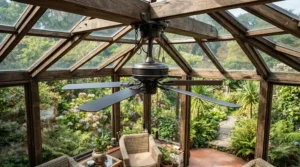
Most fans fear a sloped ceiling; this one is rated for slopes up to 35°, which suits attic bedrooms and vaulted period rooms.
Hunter’s antique brass version has four reversible rosewood/medium oak blades and a three-light kit on independent pull chains. Published figures put the motor at 17-57 W, airflow around 96 m³/min and noise at up to 46 dB(A). Ceiling to blades is about 27.4 cm. The included rod is 7.62 cm, and the finish suits indoor use only.
The catch is weight. At around 8.2 kg it’s the heaviest fan here bar none, so a proper joist fixing isn’t optional. The slope rating is the real differentiator. If your ceiling follows the roofline, the rival fans on this list mostly can’t match it (the Princess Trio manages 18°).
Hunter backs the motor with a limited lifetime warranty, which is a manufacturer claim worth reading in full. I couldn’t find enough verified UK review data to summarise, so check the live review section.
Pros:
- ✅ Handles slopes up to 35°
- ✅ Three lights on separate pull chains
- ✅ Limited lifetime motor warranty (manufacturer claim)
Cons:
- ❌ Heavy at around 8.2 kg
- ❌ Indoor use only, pull chains only
Roughly £140-£190. Good value if your ceiling slopes; check current price.
3. Fantasia Classic 52″ — best for building your own look
Its party trick is dual mounting. Bolt it flush in a low room, or hang it from the supplied 6-inch rod (27 mm diameter) and step up to an extended downrod later.
The 52-inch span has reversible matt mahogany and matt oak-and-cane blades, enough for a bedroom or average reception room. Fantasia’s own brochure points a standard bedroom towards a single 42-52 inch fan and stresses fixing to a ceiling joist. At 7.4 kg, that advice matters. Three speeds run from a pull cord, with a remote upgrade available.
It ships without a light, which I’d call a feature. Add Fantasia’s Florence antique brass kit (G9 bulbs) or the Amorie three-arm kit with adjustable heads and opal glass, and you choose the vintage lighting mood, or leave it bare. A retailer Q&A shows a buyer asking whether it suits a 12 x 12 ft bedroom and whether a full remote version exists. Sizing and controls are the recurring decisions.
Pros:
- ✅ Dual mount suits flush or rod fitting
- ✅ Wide range of matching Fantasia light kits
- ✅ 10-year motor guarantee from Fantasia
Cons:
- ❌ No light included, so the kit adds cost
- ❌ 7.4 kg demands a joist fixing
Around £150-£200 for the fan, plus roughly £60-£110 for a light kit. The best all-rounder for mixed ceilings.
4. CasaFan Classic Royal 132 — best for large living rooms
This is the big, calm option: a 132 cm span that CasaFan rates for rooms up to about 25 m².
Published figures for the Classic Royal 132 platform put the motor at up to 64 W and 180 rpm, with airflow up to roughly 149 m³/min and about 31 dB(A) sound pressure at 3 m. Five reversible blades with a rattan inlay can be run as two, four or five, so you can tone down the look. Ceiling-to-blade is about 28 cm with the rod, or around 20-21 cm without. Weight is 6.9 kg, and a remote can be retrofitted. An antique brass finish is listed by UK retailers; I’ve taken the specs from the platform’s other finishes, so confirm them on your chosen listing.
The remote matters more than it sounds. If you add an extended downrod, pull cords dangle uselessly high, so a remote retrofit is the practical answer. I couldn’t verify a robust UK review pool.
Pros:
- ✅ Rated for rooms up to about 25 m²
- ✅ Run with two, four or five blades
- ✅ Remote retrofit option for tall rooms
Cons:
- ❌ No light included
- ❌ Specs vary slightly between listings
Roughly £175-£225. Strong value for a big living room; check current price.
5. CasaFan Classic Flat III — best for low cottage ceilings
It’s built to hug the ceiling. The housing is about 20.9 cm tall, and the listing gives a distance to ceiling of just 16.4 cm.
That makes it the one to consider if your period property is a low-beamed cottage rather than a grand terrace. It comes in 75, 103 and 132 cm spans, rated for roughly 8, 15 and 25 m² respectively. The antique brass housing pairs with reversible reclaimed oak/maple blades, and it has forward/reverse running. Weight is about 4.5-4.7 kg for the smaller sizes.
Two honest limits. First, it’s for flat ceilings only, as the listing shows no roof-slope allowance. Second, there’s no light, so you’ll want separate wall or pendant lighting. In a low room, though, that restraint is a strength. Fewer dangling parts means fewer head-height worries. I couldn’t verify enough UK reviews to summarise.
Pros:
- ✅ Very low profile suits cottage ceilings
- ✅ Three blade spans for different room sizes
- ✅ Reversible blades in reclaimed oak/maple
Cons:
- ❌ Flat ceilings only
- ❌ No light, and not for an antique brass fan for high ceiling use
Roughly £200-£250. Pricey for a plain flush fan, but unmatched for headroom.
6. Fantasia Mayfair Combi 42″ — best compact fan with light
A 42-inch (1,070 mm) flush mount with an integrated light kit makes this the neat choice for smaller rooms.
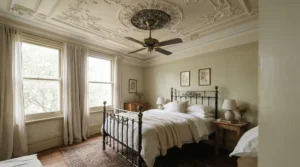
The antique brass housing carries reversible gloss mahogany and gloss oak-with-cane blades. Independent pull cords control the three speeds and the light, and Fantasia’s 10-year motor guarantee applies. A retailer’s Q&A confirms it has an AC motor with three speeds, and that the M3 remote is sold separately. Fantasia’s own Mayfair listings note that a drop rod needs a conversion kit, which is a reminder that this fan wants low or standard ceilings.
For a Victorian box bedroom or study, that makes sense. For a double-height hallway, it doesn’t. Buyers on retailer pages have asked about remote pricing and blade finish variants, so confirm the exact blade finish and control option you’re buying.
Pros:
- ✅ Compact flush design for modest rooms
- ✅ Independent fan and light pull cords
- ✅ Remote available as an add-on
Cons:
- ❌ Rod fitting needs a conversion kit
- ❌ Highest price per square metre here
Fantasia’s Mayfair Combi range has been listed at roughly £300-£360. Confirm the antique brass finish price.
7. CasaFan Eco Genuino 152 — best quiet DC luxury
This is the premium, whisper-quiet choice. A patented DC motor draws just 4-29 W, with six speeds and a remote included.
The caveat on finish: it’s brushed brass, a lighter and more modern tone than aged antique brass, though it works well with warm timber. The 152 cm span is rated for rooms up to around 35 m². Ceiling to blades is 28.5 cm (19 cm with the short rod), and weight is 7 kg. CasaFan’s listings mention a longer ceiling rod, which makes this the strongest base for an antique brass fan for high ceiling rooms once you add an extended downrod.
Noise figures vary across retailers: about 20 dB(A) sound pressure at 3 m, versus 40.6 dB(A) sound power. They’re different measures, so don’t compare them with other fans’ numbers. Retailers cite a motor guarantee of up to 25 years, which is worth reading in detail.
Pros:
- ✅ Very low running wattage with six speeds
- ✅ Remote with direction control included
- ✅ Longer ceiling rod possible
Cons:
- ❌ Brushed brass, not true antique brass
- ❌ Premium price tag
Roughly £500-£600 in UK listings. Pay it if the fan runs for hours daily.
How to Choose an Antique Brass Ceiling Fan for Period Property
Treat this as a checklist. Work through it in order and the shortlist almost writes itself.
- Measure your ceiling height. Most manufacturers want blades well clear of heads, typically around 2.1-2.3 m above the floor, but check your manual. This sets whether you need a flush fan or an extended downrod.
- Match blade span to floor area. CasaFan’s listings pair 75, 103 and 132 cm spans with roughly 8, 15 and 25 m². Too small and you’ll feel nothing; too big and the room feels crowded.
- Pick the mounting type. Flush for low ceilings; rod for standard heights; extended downrod for tall rooms.
- Decide on the light. Built-in kits are tidy. Separate kits let you tune the vintage lighting. No light suits rooms with good existing fittings.
- Choose your control. Pull cords look authentic. A remote becomes the sensible option once the fan hangs low on a long rod.
- Check structure and finish. Confirm a joist fixing is possible, and ask whether “antique brass” means aged, lacquered or brushed. Finishes vary between brands.
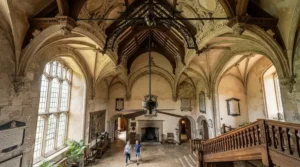
Antique Brass Fan for High Ceiling: Getting the Extended Downrod Right
Tall rooms are where period homes show off, and where a badly chosen fan fails. Mount a fan flush on a 3.6 m ceiling and the blades push air around the cornicing, while you feel nothing. That’s why an extended downrod is the hero accessory for any antique brass fan for high ceiling use.
The simple sum
Aim for blades roughly 2.4-2.7 m above the floor. Subtract that from your ceiling height to get the drop you need. A 3.6 m ceiling wants about 0.9-1.2 m between ceiling and blades. If a fan’s body adds around 0.28 m, a 30-inch (76 cm) rod brings blades to about 2.56 m. That’s a rule of thumb, not a guarantee.
What’s on offer
Fantasia’s trade price list shows antique brass rods in 12, 18 and 30 inch lengths. Westinghouse suggests an extension from 3.5 m. CasaFan’s listings note a longer rod for the Eco Genuino. Always use a rod made for your exact model, because diameter and wiring length must match.
The wobble warning
Longer rods exaggerate any imbalance. A retailer Q&A on a Fantasia fan shows a buyer asking about wobble and whether a fan-rated box was used. Fix to a joist, tighten everything, and consider a remote because dangling pull cords become awkward.
Traditional Antique Brass Fan With Light: Getting the Glow Right
A traditional antique brass fan with light replaces a ceiling pendant with one fixture. The trick is choosing the right light for the room.
Built-in vs add-on
The Westinghouse Princess Trio and Hunter Beacon Hill 107cm come with three-lamp clusters. The Fantasia Mayfair Combi 42″ has an integrated kit. The Fantasia Classic 52″ takes add-ons such as the Florence kit (around £100) or the Amorie three-arm kit (around £60-£90).
Choosing bulbs
Bulb bases differ. The Princess Trio uses E14, the Hunter Beacon Hill 107cm lists E27 and Fantasia’s Florence kit uses G9. Warm-white LEDs suit vintage lighting, but check the maximum wattage. CasaFan’s manual warns that light kits can run very hot, so keep clear of blades and shades.
The real saving
Three 60 W filament bulbs draw 180 W, nearly three times a fan motor’s draw. Swapping to LED trims that to roughly 15-25 W, which is the bigger energy win.
Genuine vintage lighting
Authentic pieces cost serious money. A specialist dealer lists a 19th-century brass three-arm fitting at roughly £480, while a handcrafted brass ceiling light based on 1900 patterns lists at around £200 elsewhere. A fan with a light kit gets you the look for far less.
Victorian Style Fixture: Matching the Fan to Your Architecture
A victorian style fixture works best when the fan is the quiet one and the light does the talking. Match your fan to the house.
- Georgian: restrained and symmetrical. Plain brass, simple blades, minimal ornament.
- Victorian: richer and darker. Mahogany-toned blades and an ornate light kit suit the cornicing.
- Edwardian: lighter and airier. Oak-and-cane blades work nicely.
- 1930s: modest brass with simple shades.
Mind the plasterwork
Decorative plaster roses aren’t designed to carry a spinning fan. Assume the fixing goes to a joist or fan-rated support, with the canopy concealing the join. Historic England’s advice on installing services says most service upgrades can be done without harming what makes a building special. It also suggests choosing a professional used to fitting modern life into old layouts for listed buildings.
Pair that with a victorian style fixture mindset: let the fan echo existing brass door furniture and hinges, and keep blade tones close to the room’s timber.
Antique Brass Ceiling Fan vs Chandelier vs Pedestal Fan
The real alternatives aren’t other fans. They’re what you’d otherwise do about stuffy rooms and chilly drafts.
| Option | Summer cooling | Winter benefit | Period look | Install effort | Best For |
|---|---|---|---|---|---|
| Antique brass ceiling fan | Good breeze | Reverse redistributes heat | Strong when finish matches | Joist fixing, electrician advised | Everyday use, e.g. Fantasia Classic 52″ |
| Chandelier or pendant alone | None | None | Excellent | Moderate | Formal rooms with good ventilation |
| Pedestal fan | Good, portable | None | Poor | None | Short heatwaves, renters |
| Fan with integrated light | Good | Reverse mode | Strong | Joist fixing | Single-fixture rooms, e.g. Westinghouse Princess Trio |
A chandelier is lovely, but it won’t move a cubic metre of air. A pedestal fan is cheap and flexible, but it trips you up and spoils the period look. The ceiling fan wins on year-round usefulness, which is why an antique brass ceiling fan for period property earns its place. In low or small rooms, the CasaFan Classic Flat III keeps the look without the clutter.
Features That Actually Matter (And Those That Don’t)
Worth paying for
- Reverse function. Without it, you lose the winter benefit. Every fan here has it.
- Motor guarantee. Fantasia and Westinghouse cite 10-year motor guarantees; Hunter cites a limited lifetime guarantee; CasaFan retailers cite up to 25 years on the Eco Genuino. Read the terms.
- Remote control. Essential with an extended downrod; optional otherwise.
- Slope rating. The Hunter Beacon Hill 107cm handles 35°; the Westinghouse Princess Trio manages 18°; the CasaFan Eco Genuino 152 manages 16°.
Not worth obsessing over
- Blade count. Four versus five blades matters less than blade span and pitch.
- Raw airflow numbers. Listings use different test methods.
- Smart-home claims. Fantasia’s listings mark several models as not smart-home compatible, and for a pull-cord period fan that’s no loss.
- Noise figures. As the CasaFan Eco Genuino 152 listings show, sound pressure and sound power aren’t comparable.
Common Mistakes When Buying an Antique Brass Ceiling Fan for Period Property
Most regrets come from the same handful of errors.
- Buying on looks alone. A beautiful fan on a 3.6 m ceiling with no extended downrod just stirs cornicing.
- Ignoring weight. The Hunter Beacon Hill 107cm at around 8.2 kg needs a joist. A plaster rose will not do.
- Assuming “brass” means the same everywhere. The CasaFan Eco Genuino 152 is brushed brass. Fantasia sells polished and antique brass, and some are very different in tone.
- Forgetting the slope. Check the roof-slope rating before ordering.
- Underestimating the room. A 75 cm fan in a 20 m² lounge disappoints.
- Skipping the electrician. Older wiring needs checking before adding a heavy, constantly moving load.
- Overlooking light bulbs. Bulb bases differ, and the bulbs often aren’t included.
Safety, Regulations and Listed Building Guide
Safety isn’t glamorous, but it protects both you and your plasterwork.
Structure
Fix to a joist or fan-rated support, never to a decorative rose. Ask about blade height too, since most manufacturers want clearance well above head height.
Electrics
Fans draw modest power but are heavy and run for hours. In England, Part P of the Building Regulations covers fixed electrical work in dwellings, and some work is notifiable. A registered electrician can tell you what applies. Old rubber- or cloth-insulated wiring should be assessed before any fan goes up.
Heat and fittings
CasaFan’s manual warns that optional light kits can become very hot, so follow the clearance guidance. Check products carry UKCA or CE marking.
Listed buildings
Changes to building services often don’t need consent, but you should confirm with your local authority’s conservation team if your home is listed. Choose an electrician who is used to older properties.
✨ Ready to Find Your Fan?
🔍 Click any highlighted fan name above to check current pricing and availability. The right fan makes your period room cooler in summer and warmer in winter, without ever looking out of place!
Long-Term Cost and Maintenance
The purchase price is only part of the story. Running costs are small, but they differ.
Running costs (illustrative)
A 64 W motor like the CasaFan Classic Royal 132 running eight hours uses roughly 0.5 kWh. At an illustrative 30p per kWh (check your own tariff), that’s around 15p a day. A DC motor like the CasaFan Eco Genuino 152, drawing 4-29 W, might use closer to 4-7p. The light kit often costs more to run than the fan, so choose LED.
| Fan | Price range | Light included | Motor guarantee (as stated by seller/maker) | Value verdict |
|---|---|---|---|---|
| Westinghouse Princess Trio | £100-£150 | Yes | 10 years | Best budget bundle |
| Fantasia Classic 52″ | £150-£200 | No | 10 years | Best flexibility |
| Hunter Beacon Hill 107cm | £140-£190 | Yes | Limited lifetime | Best for slopes |
| CasaFan Eco Genuino 152 | £500-£600 | No | Up to 25 years (retailer listing) | Best for heavy use |
On paper, the Westinghouse Princess Trio wins on upfront cost, while the CasaFan Eco Genuino 152 wins if the fan runs most days for years. The Fantasia Classic 52″ sits in between, and its light-kit options mean you can spread the spend.
Maintenance
Dust blades monthly, check screws after the first week, and follow the maker’s advice for cleaning brass finishes. Avoid abrasive polish on lacquered brass.
Practical Guide: Fitting and Setting Up Your Fan in an Older Home
Before you start
- Choose the right rod length, using the sum above.
- Have a registered electrician check the circuit and the ceiling fixing.
- Locate the joist. Fantasia’s brochure repeats “always fix to a ceiling joist”.
On the day
- Switch off at the consumer unit.
- Fit the fan-rated bracket to the joist.
- Assemble blades and rod, route the wiring, and secure the canopy.
- Set summer/winter mode on the housing switch.
First 30 days
- Re-check screws after a week, because vibration loosens fixings.
- Run on low in winter, with the fan set to reverse, to avoid a draught.
- Watch for wobble. If it appears, stop and have it checked rather than ignoring it.
Seasonal routine
Switch direction in spring and autumn. Wipe dust from the blades monthly. Check light bulbs for heat marks on shades.
Real-World Scenarios: Which Fan Fits Which Home?
Victorian terrace living room (3.1 m ceiling, about 18 m²)
You want a traditional antique brass fan with light, a victorian style fixture, and some vintage lighting warmth. The Fantasia Classic 52″ with the supplied rod plus a Florence or Amorie kit fits. Budget roughly £250-£300 including the kit, plus electrician time.
Georgian drawing room (3.6 m ceiling, about 25 m²)
This needs a big span and an extended downrod. The CasaFan Classic Royal 132 with a longer rod (confirm availability for your model) lands blades around 2.5 m. Add a remote, because pull cords won’t reach comfortably.
Cottage bedroom (2.3 m ceiling, about 10 m²)
Headroom rules. The CasaFan Classic Flat III in 103 cm, with its low profile, is the safer bet. Check the blade clearance against your manual.
FAQ
❓ How much does an antique brass ceiling fan with light cost in the UK?
❓ Do I need an electrician to fit a ceiling fan in an old house?
❓ Can I add an extended downrod to any ceiling fan?
❓ Is a DC motor fan worth it in a period home?
❓ What light bulbs suit antique brass fan light kits?
Conclusion
A good antique brass ceiling fan for period property does three jobs. It cools you in summer, returns trapped warmth in winter, and looks as though it belongs. Choose by ceiling height first, then room size, then light and control.
If you want the simplest budget route, the Westinghouse Princess Trio bundles fan and lights. For mixed ceilings and an extended downrod, the Fantasia Classic 52″ is the flexible pick. The Hunter Beacon Hill 107cm handles sloping ceilings, the CasaFan Classic Flat III suits low rooms, and the CasaFan Classic Royal 132 and CasaFan Eco Genuino 152 cover big living spaces. The Fantasia Mayfair Combi 42″ keeps small rooms neat.
Remember the essentials: an antique brass fan for high ceiling rooms needs the right rod and, ideally, a remote. A traditional antique brass fan with light should match your bulbs and your vintage lighting scheme. Any victorian style fixture needs a joist fixing and a qualified electrician. Prices are ranges at the time of research, so check current prices.
✨ Ready to cool down and warm up in style?
🔍 Click through to check current pricing and availability, then pick the fan that fits your ceiling, your room and your period charm!
Recommended for You
- Polished Chrome Fan For Small Bathroom Ceiling: 7 Best Picks (2026)
- Satin Chrome Ceiling Fan For Modern Kitchen: 7 Best Picks (2026)
- Brushed Nickel Ceiling Fan with Light For Low Ceiling: 7 Best (2026)
Disclaimer: This article contains affiliate links. As an Amazon Associate, I earn from qualifying purchases. If you purchase products through these links, we may earn a small commission at no additional cost to you.
✨ Found this helpful? Share it with your friends! 💬🤗
