In This Article
You’ve likely stood in the lighting aisle of your local home improvement store, staring at ceiling fan boxes, wondering what on earth the difference is between AC and DC motors. I’ve been there myself, mate, and trust me – it’s not just marketing fluff. The motor type in your ceiling fan genuinely impacts everything from your monthly electricity bill to whether you’ll actually be able to hear your telly over the whirring blades.
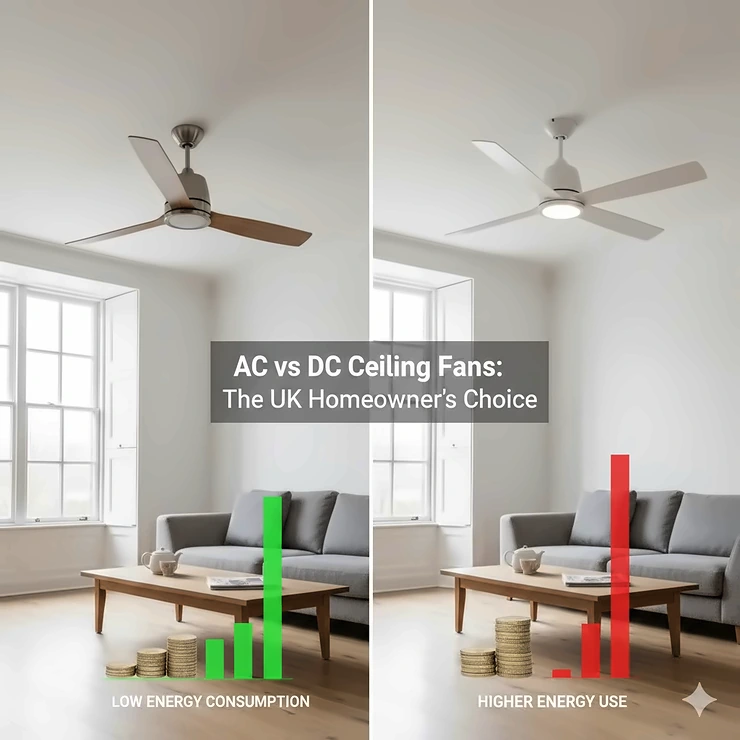
Here’s the thing: AC vs DC ceiling fan which is better isn’t a straightforward answer. DC motor vs AC motor ceiling fan comparisons reveal that whilst DC fans consume up to 70% less energy according to industry research, AC motors offer reliable performance at budget-friendly prices. Should I buy DC ceiling fan or stick with traditional AC? That depends entirely on your priorities – whether that’s slashing energy bills, achieving whisper-quiet operation, or simply getting decent cooling without breaking the bank.
In this comprehensive guide, we’ll dissect motor efficiency comparison data, examine ceiling fan motor types in detail, analyse ceiling fan power consumption patterns, and calculate long-term ceiling fan costs. By the end, you’ll know exactly which motor suits your needs and budget. Let’s dive in.
Quick Comparison Table: AC vs DC Ceiling Fans
| Feature | AC Motor Fans | DC Motor Fans |
|---|---|---|
| Energy Efficiency | 60-100W average consumption | 15-30W (70% less energy) |
| Noise Level | 35-50dB (moderate hum) | 25-35dB (whisper-quiet) |
| Speed Settings | 3-4 speeds typically | 6-8+ speeds with precise control |
| Initial Cost | £60-£150 | £120-£350+ |
| Annual Running Cost* | £18-£30 | £5-£9 |
| Control Options | Pull cord, wall switch, remote | Remote control, smart app integration |
| Lifespan | 10-15 years | 15-20+ years |
| Motor Size | Bulkier, heavier | Compact, lightweight |
💬 Just one click – help others make better buying decisions too!😊
Top 7 Ceiling Fans: Expert Analysis
1. Dreo Smart Ceiling Fan 521S ⚡
Price Range: £179-£229
The Dreo Smart Ceiling Fan 521S represents brilliant value in the DC motor category. This 52-inch beauty features app control, works seamlessly with Alexa and Google Home, and delivers an impressive 2,400 lumens of adjustable LED lighting (2700K-6500K colour temperature range).
Key Specifications:
- 6-speed DC motor operating below 35dB
- Smart app integration with voice control
- Reversible motor for year-round use
- 1-8 hour timer function
UK Customer Feedback: British buyers consistently praise its straightforward installation and remarkably quiet operation. One London-based reviewer mentioned running it overnight in their bedroom without any disturbance – quite impressive given their previous AC fan woke them regularly.
Pros:
✅ Exceptional energy efficiency saves £15-20 annually vs AC models
✅ Smart home integration works flawlessly with UK Wi-Fi
✅ Three colour temperatures perfect for different moods
Cons:
❌ Remote batteries not included
❌ Slightly higher upfront investment
2. Dreo 44-Inch Reversible DC Ceiling Fan
Price Range: £146-£189
The Dreo 44-inch model offers the same quality DC motor technology in a more compact package, ideal for bedrooms, home offices, or smaller living rooms up to 20 square metres.
Key Specifications:
- 6-speed whisper-quiet DC motor
- 5 adjustable colour temperatures
- Remote control with memory function
- Quick 4-step installation process
UK Customer Feedback: Verified UK purchasers highlight the easy installation (most managed DIY in under 40 minutes) and appreciate the memory function that remembers their preferred settings.
Pros:
✅ Perfect sizing for standard UK rooms
✅ Pre-installed components simplify setup
✅ Reversible mode redistributes heat in winter
Cons:
❌ No wall control option available
❌ Smaller blade span limits coverage
3. Fantasia Commercial Sweep 48-Inch (AC Motor)
Price Range: £85-£125
For those prioritising budget over bells and whistles, the Fantasia Commercial Sweep delivers reliable AC motor performance with a 15-year motor guarantee – exceptional reassurance from a respected UK brand.
Key Specifications:
- 3-speed AC motor (traditional reliability)
- Includes 12-inch and 24-inch drop rods
- Pull cord and wall control options
- Suitable for ceilings up to 3.3 metres
UK Customer Feedback: British customers value the robust construction and Fantasia’s reputation for standing behind their guarantees. Many mention using these fans in conservatories and covered outdoor areas with excellent results.
Pros:
✅ Significantly lower initial investment
✅ Multiple drop rod options for varied ceiling heights
✅ Trusted UK brand with extensive support network
Cons:
❌ Higher running costs (approximately £20-25 annually)
❌ Limited speed precision compared to DC alternatives
4. EGLO LED Ceiling Fan (AC Motor)
Price Range: £95-£145
EGLO, a well-established UK lighting manufacturer, combines their LED expertise with AC ceiling fan technology. This model integrates energy-efficient LED lighting with traditional AC motor reliability.
Key Specifications:
- AC motor with 3-speed settings
- Integrated LED light kit (typically 15-18W)
- Reversible operation for seasonal efficiency
- Classic design suits traditional and modern décor
UK Customer Feedback: UK buyers appreciate the brand’s reputation and the quality of the integrated LED lighting. Several mention achieving 40% summer cooling cost reduction when using it instead of air conditioning.
Pros:
✅ Combines lighting and cooling in one fixture
✅ Widely available through UK retailers
✅ Straightforward installation process
Cons:
❌ AC motor increases energy consumption
❌ Fewer speed options than DC equivalents
5. Hunter Mosley 60-Inch DC Ceiling Fan
Price Range: £280-£350
The Hunter Mosley represents premium DC motor engineering from one of the industry’s most respected names. This 60-inch powerhouse earns ENERGY STAR certification and comes backed by Hunter’s comprehensive warranty.
Key Specifications:
- 6-speed DC motor with SureSpeed Guarantee
- Wall control included (pre-paired)
- ENERGY STAR certified (64% more efficient than standard fans)
- Suitable for large rooms and covered outdoor spaces
UK Customer Feedback: Whilst primarily sold through specialist importers in the UK, those who’ve purchased praise the exceptional build quality and whisper-quiet operation even at maximum speed.
Pros:
✅ Premium construction with extended warranty
✅ Damp-rated for covered patios and conservatories
✅ Powerful airflow for larger UK reception rooms
Cons:
❌ Higher price point
❌ May require specialist supplier for UK delivery
6. Fanimation Modern DC Ceiling Fan (42-52 inches)
Price Range: £220-£320
Fanimation’s DC motor range offers contemporary aesthetics without compromising performance. Available in multiple blade spans, these fans suit various room sizes across UK homes.
Key Specifications:
- Efficient DC motor (uses 25-35W)
- 6-speed operation with remote control
- Sleek, minimalist design options
- Available in brushed nickel, matte black, and white finishes
UK Customer Feedback: Design-conscious UK buyers love the modern aesthetic that complements contemporary interiors. Several mention the fan becoming a statement piece rather than just functional equipment.
Pros:
✅ Outstanding design credentials
✅ Multiple finish options match UK décor trends
✅ Energy savings offset higher initial cost within 3-4 years
Cons:
❌ Premium pricing
❌ Some finishes require special order
7. Kichler 52-Inch Casual AC Ceiling Fan
Price Range: £125-£185
Kichler strikes a lovely balance with this AC motor fan that doesn’t compromise on features whilst maintaining accessible pricing. It’s particularly suitable for UK homes wanting reliable performance without the DC motor premium.
Key Specifications:
- 3-speed WhisperWind AC motor
- Includes LED light kit (compatible with UK dimmers)
- Remote control functionality
- Multiple blade finish options
UK Customer Feedback: British purchasers value the included remote control (not always standard on AC models) and report satisfactory noise levels for lounges and dining rooms, though most wouldn’t recommend it for bedrooms.
Pros:
✅ Mid-range pricing with quality construction
✅ Remote control included as standard
✅ LED light kit compatible with UK electrical systems
Cons:
❌ AC motor uses 3-4x more electricity than DC equivalents
❌ Moderate noise levels unsuitable for bedrooms
Motor Technology Explained: How They Actually Work
AC Motors: Traditional Workhorses
AC (Alternating Current) motors have powered ceiling fans for decades. They connect directly to your home’s electrical supply and use the alternating current exactly as provided by UK mains (230V, 50Hz). The motor regulates speed by controlling the frequency of the electrical current.
How AC Motors Function: The alternating current constantly changes direction (50 times per second in the UK), creating a rotating magnetic field that drives the motor’s rotor. This tried-and-tested technology requires minimal electronic components, explaining the lower manufacturing costs and retail prices.
According to research from Pelonis Technologies, traditional AC ceiling fan motors typically consume 60-100 watts during operation, with larger models occasionally exceeding 100 watts on maximum speed.
DC Motors: Modern Efficiency Champions
DC (Direct Current) motors represent newer technology in ceiling fan applications. They include a built-in converter that transforms your home’s AC power into DC, enabling significantly more efficient operation.
How DC Motors Function: The direct current flows consistently in one direction through the motor circuit, creating a constant magnetic field. This interacts with permanent magnets mounted on the rotor, causing smooth, efficient rotation. The constant flow eliminates the energy losses associated with constantly reversing current direction.
Studies show DC ceiling fan motors use approximately 70% less energy than comparable AC motors to generate identical airflow. A 25-watt DC motor can match the performance of a 100-watt AC motor, as documented by industry specialists.
Energy Efficiency: The Real Cost Comparison
Understanding Power Consumption
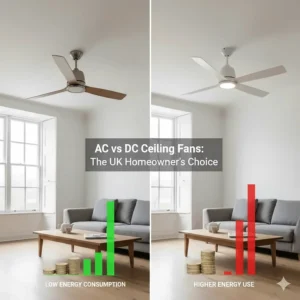
Let’s examine actual numbers relevant to UK households. Based on the current average UK electricity rate of £0.27 per kWh (January 2026):
AC Motor Fan (75W average):
- Hourly cost: £0.020
- Daily cost (8 hours): £0.16
- Annual cost (240 days): £38.40
DC Motor Fan (20W average):
- Hourly cost: £0.0054
- Daily cost (8 hours): £0.043
- Annual cost (240 days): £10.32
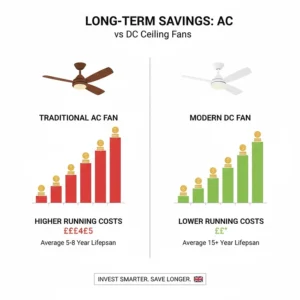
Over a typical 10-year lifespan, an AC fan costs approximately £384 to operate, whilst a DC fan costs just £103 – a saving of £281 that more than offsets the higher purchase price.
ENERGY STAR Certification
Look for ENERGY STAR certified ceiling fans, which are 20% more efficient at moving air than non-certified models. This certification ensures the fan meets strict energy efficiency guidelines established by the U.S. Environmental Protection Agency, though these standards are recognised globally, including in the UK.
Noise Levels: Silence is Golden
Decibel Comparisons
Understanding noise levels helps choose appropriate fans for different rooms:
AC Motor Fans:
- Low speed: 35-40 dB (quiet library level)
- Medium speed: 40-45 dB (moderate conversation)
- High speed: 45-50 dB (normal conversation volume)
DC Motor Fans:
- Low speed: 25-28 dB (whisper quiet)
- Medium speed: 28-32 dB (very quiet room)
- High speed: 32-35 dB (quiet library)
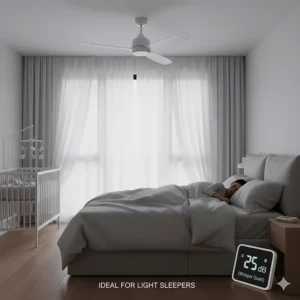
The difference proves significant in bedrooms or home offices where concentration and sleep quality matter. Manufacturers like Dreo achieve sub-35dB operation across all speeds with their DC motor technology.
Why DC Motors Run Quieter
DC motors produce less noise because the constant current flow eliminates the vibrations created by rapidly changing current direction. Additionally, DC motors typically employ brushless designs, removing another source of friction and noise.
Speed Control: Precision Matters
AC Motor Speed Options
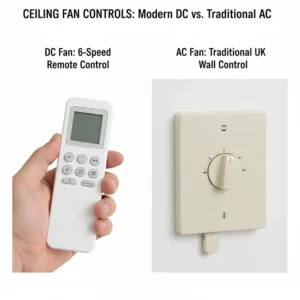
Traditional AC ceiling fans typically offer 3-4 fixed speeds controlled through:
- Pull chains (most basic)
- Wall-mounted switches (common in UK installations)
- Remote controls (increasingly standard)
Speed changes can feel abrupt, and you’re limited to preset options.
DC Motor Speed Advantages
DC motor fans commonly provide 6-8 speed settings with much finer control. Many models feature:
- Gradual speed transitions
- Precise airflow adjustment
- Smart app control with custom speed programming
- Integration with home automation systems
This precision allows you to find exactly the right airflow for your comfort without settling for “close enough.”
Installation Considerations for UK Homes
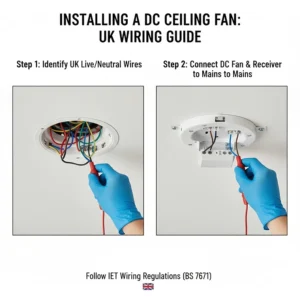
Electrical Requirements
AC Motors:
- Connect directly to UK 230V mains
- Simpler wiring (no converter required)
- Compatible with most existing ceiling rose installations
- May require wall switch installation
DC Motors:
- Built-in converter handles AC-DC transformation
- Remote control receiver must be accommodated
- Usually supplied with comprehensive installation guides
- May require ceiling void space for converter unit
Ceiling Height Guidelines
For optimal performance in UK homes:
- Blades should sit 2.1-2.7 metres (7-9 feet) above floor level
- Minimum 20cm (8 inches) clearance from ceiling to blade tips
- Use drop rods (extension poles) for higher ceilings
- Standard 2.4-metre UK ceilings work well with flush-mount designs
The Energy Saving Trust recommends ensuring proper clearances to maximise air circulation efficiency.
Smart Features: The Digital Advantage
Remote Control Capabilities
Basic Remote Functions (common to both motor types):
- Fan speed adjustment
- Light dimming and colour temperature
- Timer settings (1-8 hours typically)
- Reversible direction switching
Advanced DC Motor Features:
- Smartphone app control
- Voice activation (Alexa, Google Home)
- Scheduling and automation
- Integration with home energy management systems
Wi-Fi Connectivity
Modern DC ceiling fans increasingly include Wi-Fi connectivity, allowing control from anywhere via smartphone apps. This proves particularly useful for:
- Activating fans before arriving home
- Setting weekly schedules
- Monitoring energy consumption
- Creating scenes with other smart home devices
Seasonal Efficiency: Year-Round Savings
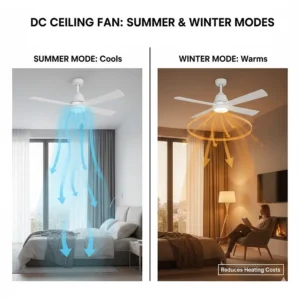
Summer Operation (Counter-Clockwise)
Running fans counter-clockwise pushes cool air downward, creating a wind-chill effect. This allows you to:
- Raise thermostat settings by 2-3°C without discomfort
- Reduce air conditioning usage by up to 40%
- Enjoy natural cooling in moderate temperatures
- Maintain comfort whilst consuming minimal energy
Winter Operation (Clockwise)
Reversing to clockwise rotation gently pulls cool air upward and redistributes warm air that naturally collects near the ceiling. Benefits include:
- More even temperature distribution throughout rooms
- Reduced heating system workload
- Potential 10% reduction in heating costs
- Improved comfort in rooms with high ceilings
Research from EGLO UK confirms that proper ceiling fan usage can reduce summer cooling costs by 40% and winter heating expenses by 10%.
Durability and Maintenance
Component Longevity
AC Motors:
- Expected lifespan: 10-15 years
- More mechanical components subject to wear
- Brushes may require replacement
- Generally robust and proven technology
DC Motors:
- Expected lifespan: 15-20+ years
- Brushless design reduces wear points
- Fewer moving parts mean less maintenance
- Electronic components generally reliable
Maintenance Requirements
For Both Motor Types:
- Dust blades monthly to maintain efficiency
- Check and tighten mounting screws annually
- Inspect electrical connections periodically
- Clean motor housing to prevent overheating
DC Motor Specific:
- Ensure converter unit has adequate ventilation
- Replace remote control batteries as needed
- Update firmware if applicable (smart models)
Environmental Impact
Carbon Footprint Considerations
Choosing an energy-efficient DC ceiling fan contributes to reducing your household carbon emissions. Over a 10-year lifespan:
AC Motor Fan (75W):
- Total energy consumption: 1,440 kWh
- CO₂ emissions: approximately 340 kg
- (Based on UK grid average 236g CO₂/kWh)
DC Motor Fan (20W):
- Total energy consumption: 384 kWh
- CO₂ emissions: approximately 91 kg
- Reduction of 249 kg CO₂ compared to AC motor
Sustainable Materials
Many modern ceiling fans incorporate:
- Recycled materials in blade construction
- Sustainably sourced wood options
- RoHS-compliant electronic components
- Recyclable packaging materials
Budget Analysis: Total Cost of Ownership
Initial Investment vs Long-Term Savings
Let’s examine three 10-year ownership scenarios:
Budget AC Fan (£100 purchase + £384 electricity):
- Total 10-year cost: £484
Mid-Range DC Fan (£180 purchase + £103 electricity):
- Total 10-year cost: £283
- Savings vs AC: £201
Premium DC Fan (£300 purchase + £103 electricity):
- Total 10-year cost: £403
- Savings vs budget AC: £81
The mid-range DC fan offers the best value proposition for most UK households, delivering significant savings without premium pricing.
✨ Don’t Miss These Exclusive Deals!
🔍 Take your home comfort to the next level with these carefully selected ceiling fans. Click on any highlighted item to check current pricing and availability on Amazon.co.uk. These fans will help you create the perfect atmosphere your family will love, year-round!
Design Aesthetics: Form Meets Function
AC Motor Design Limitations
AC motors’ larger size historically restricted design possibilities:
- Bulkier motor housings
- Limited ultra-slim profile options
- Fewer contemporary minimalist designs
- Traditional aesthetic dominance
DC Motor Design Freedom
DC motors’ compact size enables:
- Ultra-thin flush-mount profiles perfect for lower UK ceilings
- Contemporary minimalist aesthetics
- Innovative blade configurations
- Wider range of finish options matching modern UK interiors
Room Size Recommendations
Blade Span Guidelines
Choose appropriate blade spans for optimal performance:
Small Rooms (up to 12m²):
- Blade span: 76-107cm (30-42 inches)
- Suitable for small bedrooms, bathrooms, home offices
Medium Rooms (12-20m²):
- Blade span: 107-132cm (42-52 inches)
- Ideal for master bedrooms, standard living rooms, dining rooms
Large Rooms (20-30m²):
- Blade span: 132-152cm (52-60 inches)
- Best for large reception rooms, open-plan spaces, conservatories
Very Large Spaces (30m²+):
- Blade span: 152cm+ (60+ inches) or multiple fans
- Recommended for great rooms, commercial spaces
Common Misconceptions Debunked
“Ceiling Fans Cool Rooms”
Reality: Ceiling fans cool people, not rooms. They create air movement that enhances evaporative cooling on your skin – similar to wind-chill effect. The actual air temperature remains unchanged, which is why running fans in empty rooms wastes energy.
“More Blades Equal Better Performance”
Reality: Blade pitch (angle) and motor power matter far more than blade count. A 3-blade fan with optimal pitch and a powerful motor outperforms a poorly designed 5-blade alternative. Modern aerodynamic designs prove this consistently.
“Bigger Always Means Better”
Reality: Oversized fans in small rooms create uncomfortable drafts and turbulence. Proper sizing according to room dimensions ensures optimal comfort and efficiency.
Should I Buy DC Ceiling Fan? Decision Framework
Choose DC Motors If You:
✅ Use ceiling fans extensively (6+ hours daily)
✅ Prioritise long-term energy savings
✅ Need whisper-quiet operation (bedrooms, offices)
✅ Want precise speed control
✅ Appreciate smart home integration
✅ Plan to keep the fan 10+ years
✅ Live in areas with high electricity costs
Choose AC Motors If You:
✅ Have strict budget constraints
✅ Use fans occasionally (seasonal use only)
✅ Prefer simple pull-chain operation
✅ Want traditional, proven technology
✅ Need immediate availability from local retailers
✅ Don’t mind moderate operating noise
✅ Prioritise lowest upfront cost
Future Trends in Ceiling Fan Technology
Emerging Innovations
Enhanced Energy Recovery: New DC motor designs promise even greater efficiency, potentially reaching 80% energy savings compared to traditional AC motors.
Advanced Materials: Manufacturers experiment with carbon-fibre composites and aerospace-grade aluminium for lighter, stronger blades that move more air with less energy.
Integrated Air Quality Monitoring: Smart ceiling fans increasingly incorporate air quality sensors, automatically adjusting operation based on detected pollutants or humidity levels.
Solar Integration: Some manufacturers develop ceiling fans capable of operating on solar power during daylight hours, further reducing grid electricity consumption.
Frequently Asked Questions
❓ How much does it cost to run a DC ceiling fan in the UK per year?
❓ Can I replace my AC ceiling fan with a DC motor model?
❓ Are DC ceiling fans quieter than AC motors?
❓ Will a ceiling fan reduce my air conditioning costs?
❓ Do ceiling fans work in winter for UK homes?
Conclusion: Making Your Decision
After examining AC vs DC ceiling fan which is better from every angle, the answer becomes clear: DC motors represent superior technology for most UK households in 2026. The 70% energy savings, whisper-quiet operation, precise control, and extended lifespan justify the higher initial investment for anyone using their fan regularly.
However, AC motors still serve budget-conscious buyers well, particularly for occasional use or secondary rooms. They provide reliable cooling at accessible prices with proven longevity.
Consider your specific circumstances:
- For primary bedrooms and living spaces: Invest in quality DC motor fans
- For guest rooms or seasonal use: Budget AC fans suffice
- For long-term value: DC motors pay for themselves within 3-4 years through energy savings
- For immediate affordability: AC motors provide functional cooling without stretching budgets
The motor efficiency comparison clearly favours DC technology, but your individual ceiling fan power consumption, usage patterns, and long-term ceiling fan costs ultimately determine which represents your best choice.
Whether you select AC or DC, ensure proper installation, maintain the unit regularly, and use it wisely throughout the year. A quality ceiling fan – regardless of motor type – provides comfortable, energy-efficient climate control whilst adding style to your UK home.
Recommended for You
- 7 Best Bathroom Ceiling Fan with Light UK 2026
- 7 Best Conservatory Ceiling Fan Outdoor Rated UK 2026
- 7 Best Kitchen Ceiling Fan Quiet Options UK 2026
Disclaimer: This article contains affiliate links. If you purchase products through these links, we may earn a small commission at no additional cost to you.
✨ Found this helpful? Share it with your mates! 💬🤗
