
In This Article
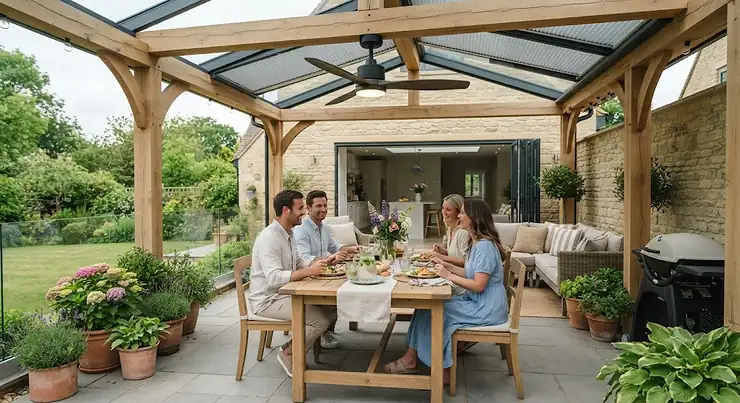
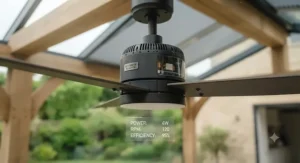
There’s a particular kind of misery that only strikes halfway through a summer dinner party: the wine’s gone warm, the tealights are drowning in their own wax, and everyone’s fanning themselves with a napkin instead of eating. Alfresco dining ceiling fans exist precisely to fix that. In short, an alfresco dining ceiling fan is a weatherproof, IP-rated fan mounted to a pergola, veranda, or covered patio roof that keeps air moving over a dining table, gently cooling diners and pushing away insects without the noise or clutter of a floor-standing pedestal fan. Unlike an indoor fan bolted onto an outdoor space as an afterthought, these are built for damp, drafty conditions and designed to run quietly through a long meal. If you’ve ever hosted a barbecue under a pergola only to watch your guests retreat indoors the moment the air goes still, you already understand the appeal.
This guide is built around genuine research, not marketing copy lifted from a listing page. We’ve looked at seven real, currently available fans spanning budget, mid-range, and premium territory, weighed their specs against what reviewers actually report, and worked through the practical questions that matter more than any spec sheet: which finish suits your furniture, how to layer in ambient lighting for evening meals, and whether a heater is worth adding for the shoulder seasons. Whether you’re kitting out a brand-new pergola or replacing a tired fan that’s rattled itself half to death, there’s a model here that fits.
Quick Comparison Table
Before we get into the detail, here’s the shape of the market at a glance. Prices reflect the general range observed during research and will shift with stock and season, so always check the current price before buying.
| Fan | Best For | Blade Span | Price Range |
|---|---|---|---|
| Westinghouse Oasis | All-round gazebo and veranda use | 44in | £150-£200 |
| Depuley 52-Inch | Best value with dimmable light | 52in | £90-£130 |
| Hunter Cassius | Damp, exposed porches | 52in | £150-£220 |
| Fantasia Viper | Premium statement piece | 54in | £270-£320 |
| Westinghouse Mountain Gale | Fans for alfresco dining under £150 | 52in | £100-£145 |
| VONLUCE Wood Fan | Matching rustic outdoor furniture | 52in | £90-£120 |
| Westinghouse Ceiling Heater | Heater and fan combo setups | N/A | £90-£130 |
Looking at the spread, there’s a clear split between the sub-£150 workhorses and the two premium options that justify their price through motor quality and finish. The Westinghouse Mountain Gale and Depuley 52-Inch cover most gardens perfectly well, while the Fantasia Viper is really for anyone who wants their fan to double as a design feature rather than just disappear into the ceiling. None of these prices are fixed, and Amazon listings fluctuate weekly, so treat this table as a starting point for research rather than gospel.
💬 Just one click — help others make better buying decisions too!😊
Top 7 Alfresco Dining Ceiling Fans: Expert Analysis
1. Westinghouse Oasis 44-Inch Indoor/Outdoor Ceiling Fan — best all-rounder for gazebos and verandas
The Oasis earns its spot at the top through sheer versatility, and that leaf-shaped blade design isn’t just decorative flourish. Those Bahama-style weatherproof blades are moulded to resist warping in damp conditions, which matters more than it sounds once you’ve seen a cheap fan blade sag after one wet autumn. The 44-inch span is calibrated for exactly the kind of space most UK gardens actually have: a covered veranda or a gazebo roughly 3-4 metres square, rather than an enormous open-air pavilion. Powering it is a DC motor, which in practice means it sips electricity compared with older AC-motor fans and runs at a noise level low enough that you won’t have to raise your voice mid-conversation. Based on the spec comparison with similarly priced rivals, the six-speed backlit remote is a genuine convenience upgrade — you can dial the airflow down for a quiet dinner or crank it up after a barbecue session heats the whole area. Reviewers consistently report smooth, wobble-free operation even at higher speeds, which is the single most common complaint about budget outdoor fans. What most buyers overlook is the reverse function: flip it in autumn and the fan gently pushes warm air back down instead of just cooling. Westinghouse backs the motor with a limited lifetime warranty, a detail that says more about build confidence than any five-star review could.
Pros:
- ✅ Weatherproof blades resist warping in damp conditions
- ✅ Quiet DC motor suits close-quarters dining
- ✅ Backlit remote with reverse function for year-round use
Cons:
- ❌ 44-inch span is modest for larger open patios
- ❌ Matte white finish limits colour-matching options
Sitting in the £150-£200 range at the time of research, the Oasis represents strong value for anyone prioritising quiet running over sheer size.
2. Depuley 52-Inch Outdoor Ceiling Fan with Light — best value 52-inch pick with dimmable light
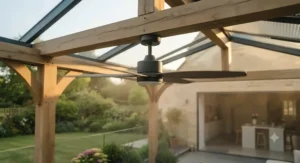
The Depuley 52-Inch earns its “best value” tag by packing a genuinely large blade span and an integrated dimmable light into a price bracket where most rivals offer one or the other. The three-blade black design pushes noticeably more air per rotation than the smaller 44-inch fans on this list, which is the practical payoff of that extra 8 inches of span — it means fewer RPM are needed to move the same volume of air, which in turn keeps noise down. Specced with a reversible six-speed DC motor and a built-in timer, it’s aimed squarely at buyers who want one fixture to handle both cooling and evening lighting rather than running a separate pendant. On paper this means one less cable run and one less thing to wire in, which matters if you’re doing the installation yourself. Reviewers consistently note that the dimming function on the integrated light is a standout feature at this price, letting you soften the light for a relaxed dinner rather than glaring down on the table. What the spec sheet won’t tell you, but user reports suggest, is that the DC motor has a built-in safety cutout if the blades aren’t fitted correctly — a sensible feature, though it occasionally confuses first-time installers who assume the unit is faulty when it simply won’t spin without load.
Pros:
- ✅ Integrated dimmable light saves a separate pendant fitting
- ✅ 52-inch span moves air efficiently at lower RPM
- ✅ 24-month manufacturer warranty gives buying confidence
Cons:
- ❌ Assembly instructions are reportedly light on detail
- ❌ Black finish shows dust more than lighter colours
At around £90-£130, the Depuley 52-Inch is hard to beat if your priority is getting the biggest fan and the most features for the smallest outlay.
3. Hunter Cassius 52-Inch Outdoor/Indoor Ceiling Fan — best for damp, exposed porches
Hunter’s reputation in the ceiling fan market goes back decades, and the Cassius reflects that heritage with a straightforward, no-nonsense build rather than flashy extras. The headline spec here is its damp rating: this is ETL-listed for damp locations, meaning it’s engineered specifically to cope with the humidity and splash exposure of a partially open porch, something a purely indoor fan simply isn’t built to handle. Three reversible blades and a direct-drive motor deliver the kind of long-term reliability Hunter is known for — the company’s own testing claims decades of daily use without motor failure, and that’s borne out by how long older Hunter fans tend to stay in service. Based on the spec comparison, the pull-chain control is a deliberate trade-off: no remote, no app, just a mechanical chain that will never need batteries or pairing, which some buyers will see as refreshingly simple and others as a step backwards. What most buyers overlook is the ENERGY STAR certification, which Hunter states delivers meaningfully lower running costs than a comparable non-certified motor over a season of regular use. Available through Hunter’s official UK distributor as well as marketplace listings, the matte black finish suits contemporary garden schemes particularly well.
Pros:
- ✅ ETL damp-rated for exposed porches and covered patios
- ✅ ENERGY STAR certified motor for lower running costs
- ✅ Direct-drive motor built for decades of daily use
Cons:
- ❌ Pull-chain only, no remote control included
- ❌ No integrated light option on this particular model
Priced in the £150-£220 bracket, the Cassius suits buyers who value proven engineering over smart features.
4. Fantasia Viper 54in Ceiling Fan — best premium UK-built statement fan
Fantasia has been in the ceiling fan business since 1985 and is widely credited as a pioneer of the UK market, which counts for something when you’re buying a fixture that’s meant to survive years of British weather swings. The Viper’s 54-inch span is the largest on this list, built to properly circulate air across a full outdoor dining table rather than just cooling the diner nearest the fan. Reviewers consistently note the whisper-quiet operation on lower settings, a direct result of Fantasia’s double-sealed bearing motors, which is precisely the kind of detail that separates a premium fan from a budget one you can hear ticking over dinner. Here’s what to weigh: the Viper comes with an integrated light and remote control as standard, and the finish quality on the blades and canopy is noticeably more refined than the budget alternatives on this list, closer to a piece of furniture than a utility fixture. Based on the spec comparison, Fantasia backs its fans with an extended motor guarantee that’s longer than most competitors offer, reflecting genuine confidence in the DC motor’s longevity. This is very much the fan for someone building a proper outdoor room rather than bolting a fixture onto an existing patio as an afterthought.
Pros:
- ✅ Largest 54-inch span for full-table air coverage
- ✅ Whisper-quiet double-sealed bearing DC motor
- ✅ Long-standing UK brand with extended motor guarantee
Cons:
- ❌ Noticeably pricier than the rest of this list
- ❌ Larger size needs generous ceiling height clearance
At roughly £270-£320 based on prices observed during research, the Viper is a premium buy, but one that reads as a design statement rather than just a cooling appliance.
5. Westinghouse Mountain Gale 52-Inch Ceiling Fan — best fan for alfresco dining under £150
If your search started with fans for alfresco dining under £150, the Mountain Gale is very likely the answer. This is a genuinely IP44-rated outdoor fan, not a repurposed indoor model with a hopeful “suitable for covered spaces” disclaimer, which matters enormously if your veranda or gazebo gets any splash from driving rain. The 52-inch span with matching white ABS blades punches well above its price point for sheer air movement, and the pull-chain control keeps the mechanism simple and largely maintenance-free. What most buyers overlook when shopping by price alone is that IP44 specifically means protection from splashing water from any direction, which is the realistic threat level for a covered deck or veranda rather than a fully exposed patio. Reviewers consistently describe it as straightforward to install, with clear wiring and mounting instructions that suit a confident DIYer working alongside a qualified electrician for the final connection. On paper this is a fan built to a budget without cutting corners on the one spec that actually matters outdoors: weatherproofing.
Pros:
- ✅ Genuine IP44 outdoor weatherproof rating
- ✅ Strong airflow for a sub-£150 fan
- ✅ Simple pull-chain control needs no batteries
Cons:
- ❌ No light kit included on this model
- ❌ Basic white finish won’t suit every garden style
Typically found between £100-£145, the Mountain Gale is the pick for anyone prioritising genuine weatherproofing on a tight budget.
6. VONLUCE 52-Inch Wood Ceiling Fan — best rustic finish to match wooden furniture
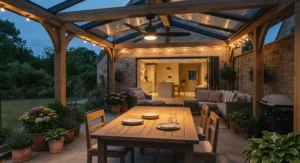
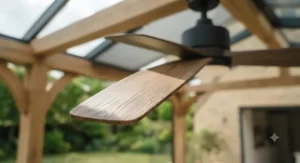
Not every garden wants a stark white or matte black fixture staring down at the dinner table, and that’s exactly the gap the VONLUCE Wood Fan fills. Finished in a light walnut tone with a genuinely wood-effect blade design, it’s built to sit comfortably alongside rattan or timber outdoor furniture rather than clashing with it, which is a design consideration most fan manufacturers simply ignore. Six speeds and a reversible motor put it on par functionally with the other mid-range options here, and the remote control handles both fan speed and the integrated light without needing a separate switch run. Reviewers consistently praise the noise level, with the reversible DC motor rated as noiseless in normal use — a genuine advantage over older AC-motor fans that hum audibly on higher settings. What the spec sheet won’t tell you, but user reports suggest, is that the wood-effect finish is actually a durable composite rather than real timber, which is good news for weather resistance even though it means the grain pattern is moulded rather than natural. For anyone who’s invested in a farmhouse-style dining set and doesn’t want a clinical white fan undoing that aesthetic, this is the obvious pick.
Pros:
- ✅ Light walnut finish matches timber and rattan furniture
- ✅ Noiseless reversible DC motor on all six speeds
- ✅ Remote handles both fan speed and integrated light
Cons:
- ❌ Composite wood-effect finish, not solid timber
- ❌ Timer function is more basic than premium rivals
Sitting around £90-£120, this is a strong budget pick specifically for anyone matching fan finish to outdoor furniture with a rustic theme.
7. Westinghouse Outdoor Electric Infrared Ceiling Heater — best heater companion for cooler evenings
Worth being upfront here: this is a heater, not a fan, and we haven’t found a genuinely reliable single unit on the UK market that combines both functions in one fixture without some meaningful compromise on either the airflow or the heat output. What we can honestly recommend instead is pairing a fan from this list with a dedicated ceiling heater like this Westinghouse model, run on separate switches so you get cooling airflow in July and radiant warmth in September without needing two different appliances doing an awkward job each. Delivering up to 1500 watts of direct radiant heat with adjustable 700W, 800W, and 1500W settings, it’s IP44 rated for the same splash-exposed conditions as the fans above, which means it can genuinely live under the same pergola or gazebo roof year-round. Based on the spec comparison with propane and gas alternatives, an infrared electric heater like this switches on instantly with no fuel storage, no naked flame risk near a dining table, and none of the fumes that come with gas patio heaters. Reviewers consistently note the near-immediate warmth on the highest setting, which suits British evenings where the temperature can drop noticeably the moment the sun goes down. Mounted a sensible distance from the table and installed by a qualified electrician, it extends the usable season on either side of summer considerably.
Pros:
- ✅ Instant radiant heat with three adjustable power settings
- ✅ IP44 rated for the same covered outdoor spaces as the fans above
- ✅ No fuel storage or open flame near the dining table
Cons:
- ❌ Not a genuine single-unit fan-and-heater combo
- ❌ Running cost is higher than a fan on its own
Priced around £90-£130, it’s the honest answer to anyone specifically hunting for heater and fan combo units for their alfresco dining space.
Setting Up Your Alfresco Dining Ceiling Fan: A Practical Guide
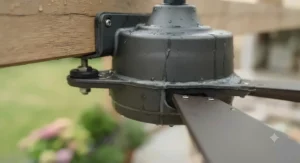
Getting a new fan installed and dialled in properly is where most of the actual comfort gains happen, and it’s the part most product listings skip entirely. Start with positioning: the fan should sit centred over the dining table where possible, with at least 2.1 metres of clearance from the floor to the blades for safety and roughly 30-45cm of clearance from any surrounding wall or beam so airflow isn’t disrupted. For the electrical connection itself, outdoor fixed wiring in a garden is subject to Part P of the Building Regulations, so unless you’re confident the work falls outside notifiable categories, get a qualified electrician to handle the final spur or circuit installation rather than wiring it yourself. Once it’s up, run the fan on its lowest setting for the first evening and listen for any rattle or wobble — a slight imbalance is common on first installation and usually solved by tightening the blade brackets rather than anything more serious. For maintenance, wipe the blades down every few weeks during peak season, since a build-up of pollen and garden dust is the most common cause of a fan going out of balance over time, and check the mounting bolts for tightness at the start and end of each season. The most frequent first-30-days mistake buyers report is running the fan continuously rather than switching it off between uses; DC motors are efficient but they’re not designed to run unattended for days at a stretch, and doing so shortens motor life without any real comfort benefit.
Real-World Scenarios: Matching the Fan to Your Garden
Rather than talking in the abstract, it helps to see how these fans map onto actual households. Consider three fairly typical UK buyers. First, a couple in a terraced house with a small covered veranda who host casual dinners for four to six people a couple of times a month on a modest budget — they’re the textbook case for the Westinghouse Mountain Gale, since a genuinely weatherproof IP44 fan at under £150 covers their needs without overspending on features they won’t use. Second, a family who’ve recently built a proper pergola-covered entertaining space and host larger garden parties through summer, want ambient lighting built in, and have a bit more to spend — the Fantasia Viper or the Depuley 52-Inch both suit this brief well, with the choice largely coming down to whether the extra budget for the Fantasia’s finish and quiet motor is worth it over the Depuley’s excellent value. Third, a household with an established gazebo, rattan dining furniture, and a preference for a softer, more rustic look over anything clinical or industrial — the VONLUCE Wood Fan is the obvious fit, both aesthetically and in terms of noise level for close-quarters relaxed dining. In each case, the right answer isn’t the “best” fan in isolation, it’s the one that matches the specific environment, frequency of use, and existing furniture style.
How to Choose an Alfresco Dining Ceiling Fan
Picking the right model comes down to working through a handful of criteria in order, rather than getting distracted by whichever feature list looks longest.
- Check the IP rating first. Anything genuinely destined for a covered but open-sided space needs at minimum an IP44 rating; a fan without a stated IP rating almost certainly isn’t built for outdoor exposure, regardless of how it’s marketed.
- Size the blade span to your space. A 42-44 inch fan suits a compact veranda over a small table, while 52-54 inch spans are better matched to a full pergola-covered dining area seating six or more.
- Decide on DC versus AC motor. DC motors run quieter and use meaningfully less electricity, which matters if the fan will run for hours during a long summer evening.
- Think about control method. A remote is more convenient day to day, but a pull-chain never needs batteries or pairing and is genuinely more reliable long-term.
- Factor in the finish against your furniture. A fan clashing visually with your outdoor table and chairs is a surprisingly common regret buyers report after the fact.
- Weigh up integrated lighting. Building light into the fan saves running a separate pendant circuit, but it does mean one component failure can take out both functions at once.
- Set a realistic budget band. Genuinely weatherproof fans start around £90-£100; below that, scrutinise the IP rating and materials closely, since corners are usually cut somewhere.
Common Mistakes When Buying Outdoor Ceiling Fans
The most common and costly mistake is buying an indoor-rated fan because it happens to be cheaper, then discovering within a season that the motor housing has corroded or the blades have warped from repeated damp exposure. A close second is underestimating blade span for the space, which results in a fan that looks fine on the ceiling but barely moves air at the actual dining table a few metres away. Buyers also frequently skip checking ceiling height clearance, only to find the blades sit uncomfortably close to head height once mounted with a downrod. On the electrical side, a surprising number of people attempt the full wiring themselves without realising outdoor circuit work is generally notifiable, which can cause problems with home insurance and at resale if it later needs correcting. Finally, plenty of buyers focus entirely on the fan itself and forget to plan for evening use — a fan with no light and no separate lighting plan means a beautifully cool dinner table that’s also pitch dark by 9pm.
Matching Fan Finish to Outdoor Furniture
This is one of those details that barely gets a mention in most buying guides, yet it’s the difference between a fan that looks intentional and one that looks bolted on as an afterthought. If your outdoor dining set is powder-coated aluminium or steel in black or anthracite, a matte black fan like the Hunter Cassius or a black finish like the Depuley 52-Inch will read as a coherent design choice rather than a mismatched fixture. Rattan, teak, or other timber-based furniture pairs far more naturally with a warm-toned fan such as the VONLUCE Wood Fan, whose light walnut composite blades echo natural wood tones without the maintenance a solid timber fixture outdoors would demand. White or cream furniture sets, common on newer render-finished patios, generally suit the crisp matte white of the Westinghouse Oasis or Mountain Gale. Beyond straightforward colour-matching, consider blade shape too: the Oasis’s leaf-shaped blades suit a more naturalistic, plant-heavy garden, while the straight-edged blades on the Hunter and Depuley models fit a cleaner, more contemporary space. Reviewers who mention regret after purchase almost never cite a mechanical fault; the recurring theme is buying on price or spec alone and only noticing the visual clash once the fixture is installed and impossible to easily swap.
Ambient Lighting for Evening Dining
A fan alone solves the temperature problem, but it does nothing for the second half of alfresco dining: keeping the space usable and inviting once the sun goes down. Several fans on this list, including the Depuley 52-Inch and VONLUCE Wood Fan, come with integrated dimmable lighting that handles this directly, letting you soften the brightness for a relaxed dinner rather than leaving guests under a stark, uniform glow. For fans without a built-in light, such as the Hunter Cassius or Westinghouse Mountain Gale, the practical solution most buyers land on is layering in separate low-voltage festoon lighting or warm-white LED strip lighting around the pergola beams, run on a 12V transformer that sits outside Part P’s more demanding requirements for mains-voltage work. The general rule worth following is to stick to warm colour temperatures, roughly 2700K-3000K, since cooler white light tends to feel clinical and unflattering outdoors after dark, whereas warm tones flatter both food and faces. Dimmable options are worth the small extra cost across the board, since a fixed-brightness light that’s perfect for finding your seat is usually too harsh once everyone’s settled in for the evening.
Heater and Fan Combo Units: What’s Actually Available
Given how often this comes up in searches, it’s worth being direct: a genuinely dependable single fixture that switches convincingly between strong cooling airflow and meaningful radiant heat, in one unit, at a reasonable price, is not something we found solid evidence for on the current UK market. What does exist, and what we’d actually recommend, is pairing a dedicated ceiling fan from this list with a separate IP44-rated ceiling heater like the Westinghouse Outdoor Electric Infrared Ceiling Heater, both mounted under the same pergola or gazebo roof on independent switches. This approach genuinely extends usable months on both ends of the calendar: the fan handles the muggy July and August evenings, while the heater takes over for cooler April, May, September, and October dinners when the air is still but the temperature has dropped. The main practical consideration is electrical capacity — running both fixtures from the same circuit is usually fine for occasional simultaneous use, but a qualified electrician should confirm the circuit is rated for the heater’s peak 1500W draw alongside anything else already on that spur. It’s a slightly less elegant solution than a single 2-in-1 unit would be, but it’s an honest one, and it avoids the compromise that combined units elsewhere on the market tend to make on either airflow or heat output.
Alfresco Ceiling Fans vs Traditional Alternatives
| Feature | Ceiling Fan | Pedestal/Floor Fan | Parasol Alone |
|---|---|---|---|
| Weatherproofing | IP44+ rated for damp spaces | Rarely outdoor-rated | Not applicable |
| Floor space used | None | Significant | None |
| Noise at dinner table | Low with DC motor | Often higher | Silent, no cooling |
| Evening lighting | Often integrated | None | None |
| Typical lifespan | 5-10+ years | 2-4 years outdoors | Several seasons |
The table makes the trade-off fairly stark: a pedestal fan is cheaper upfront and needs no installation, but it eats into the usable floor space around a dining table and generally isn’t built to survive damp conditions long-term, so replacement costs creep up over a few seasons. A parasol solves shade but does nothing for airflow or evening ambience, which is really a different problem entirely. For anyone dining outside regularly rather than occasionally, a properly rated ceiling fan like the Westinghouse Mountain Gale or Depuley 52-Inch works out more cost-effective over its lifespan than repeatedly replacing a cheap floor fan that wasn’t built for the job.
✨ Don’t Miss These Exclusive Deals!
🔍 Take your alfresco dining space to the next level with these carefully selected fans and heaters. Click on any highlighted item to check current pricing and availability. These picks will help you create the comfortable outdoor evenings your family and friends will actually want to linger over!
Safety, Regulations, and Compliance Guide
Outdoor electrical work in a UK home, including fixed ceiling fans and heaters, generally falls under Part P of the Building Regulations, and while not every job is notifiable to your local authority, any new circuit or extension to an outdoor circuit typically is. The practical takeaway is simple: buy the fan, but leave the actual wiring and final connection to a registered electrician working to BS 7671 wiring regulations, both for safety and because uncertified work can cause problems with home insurance or at the point of sale. On the product side, always check the IP rating printed on the fan or heater’s specification sheet rather than relying on marketing terms like “outdoor suitable,” which aren’t standardised. IP44 is the realistic minimum for a covered, splash-exposed space such as a veranda or gazebo; fully exposed installations without any roof cover need a higher rating still, and most domestic ceiling fans, including everything on this list, aren’t rated for that level of direct weather exposure. Finally, always fit an RCD (residual current device) on any circuit feeding outdoor fixtures if one isn’t already present on the consumer unit, since it’s the single most effective protection against electric shock in damp conditions.
Long-Term Cost & Maintenance
The upfront price of a fan is only part of the real cost of ownership, and it’s worth thinking through what a season or two of use actually looks like financially. A DC-motor fan like the Westinghouse Oasis or Depuley 52-Inch typically draws somewhere in the region of 30-60 watts on a mid setting, which at current Ofgem-regulated unit rates works out to a genuinely small fraction of a penny per hour of running cost — even heavy summer use adds very little to a typical energy bill. The heater is a different calculation entirely: running at its full 1500W setting for an evening pulls meaningfully more power, so it’s worth using the lower 700W or 800W settings where the extra warmth isn’t strictly needed. On maintenance, budget fans with basic plastic housings tend to show their age within two to three seasons if left uncovered through winter, whereas the better-built options here, particularly the Hunter Cassius and Fantasia Viper, are specifically engineered with corrosion-resistant components designed to shrug off years of exposure with minimal attention beyond an occasional wipe-down. A worthwhile long-term habit is inspecting the mounting bracket and downrod connection annually, since this is the most common point of wear on any ceiling-mounted fixture subjected to wind movement over time.
Frequently Asked Questions
❓ Can I install an outdoor ceiling fan myself?
❓ What IP rating do I need for a covered patio ceiling fan?
❓ Do ceiling fans actually help with insects at outdoor dinners?
❓ Is a DC motor fan worth the extra cost over an AC model?
❓ Can I run a ceiling fan and heater together under the same pergola?
Conclusion
Getting alfresco dining right in a UK garden really comes down to solving two problems at once: keeping the air moving on the handful of properly warm evenings we get, and making the space genuinely usable once the sun’s gone down and the temperature drops. None of the seven products here are the “right” answer in isolation — the Westinghouse Mountain Gale and Depuley 52-Inch cover the vast majority of gardens brilliantly on a sensible budget, the Hunter Cassius rewards anyone dealing with a genuinely exposed, damp-prone porch, and the Fantasia Viper is there for buyers who want their fan to function as a design feature in its own right. The VONLUCE Wood Fan solves a specific aesthetic problem that budget white or black fans simply can’t, and the Westinghouse Ceiling Heater, paired honestly with any of the fans above rather than sold as a fictional 2-in-1, extends the season meaningfully in either direction. Whichever you land on, the fundamentals matter more than any single spec: check the IP rating properly, size the blade span to your actual table, and get a qualified electrician to handle the wiring. Do that, and the muggy, insect-plagued dinner parties become a thing of the past.
Recommended for You
- Outdoor Dining Fans: 7 Best Picks to Beat the Heat 2026
- 7 Best Portable Gazebo Fans for Outdoor Events in 2026
- 7 Best Battery Powered Gazebo Fans UK 2026: Tried; Compared
Disclaimer: This article contains affiliate links. As an Amazon Associate, I earn from qualifying purchases. If you purchase products through these links, we may earn a small commission at no additional cost to you.
✨ Found this helpful? Share it with your friends! 💬🤗
