In This Article
Picture this: it’s a sweltering August afternoon in your London flat, and you’re desperately trying to keep cool without racking up astronomical energy bills. Or perhaps it’s a chilly November evening, and you’re watching your heating costs soar as warm air pools uselessly near the ceiling. Sound familiar? You’re not alone—millions of UK homeowners face this exact dilemma every year.
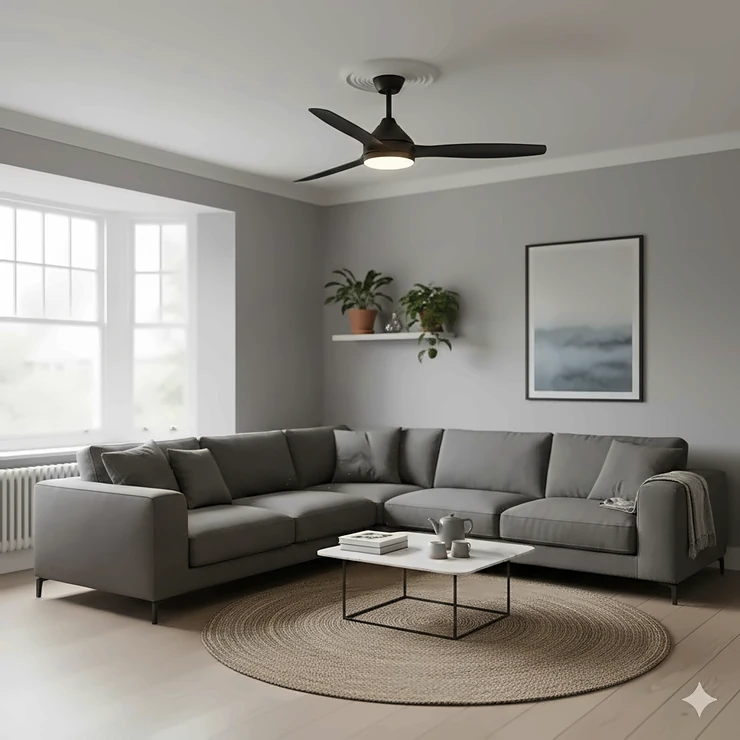
Here’s the brilliant news: ceiling fans with lights offer an elegant solution that British homes have been adopting at record rates. These dual-purpose fixtures don’t just circulate air; they provide ambient lighting, reduce energy consumption by up to 40%, and serve as stunning design statements that elevate any room’s aesthetic appeal.
In 2026, the UK market has exploded with innovative options featuring smart controls, whisper-quiet DC motors, and sleek LED integration. Whether you’re furnishing a compact Brighton bedsit or a sprawling Birmingham manor, there’s a ceiling fan with lights perfectly suited to your space. This comprehensive guide examines seven exceptional models available on Amazon.co.uk, compares their specifications, and reveals exactly what you should know before clicking “buy now.”
Quick Comparison Table
| Model | Size | Price Range (£) | Motor Type | LED Lumens | Speed Settings | Rating |
|---|---|---|---|---|---|---|
| VOLISUN 50cm Smart | 50cm | £79.99-£99.99 | DC | 1,200-1,400 | 6 speeds | 4.5/5 |
| Newday 48″ (122cm) | 122cm | £89.99-£119.99 | DC | 1,245-1,423 | 6 speeds | 4.3/5 |
| NIORSUN 60cm Modern | 60cm | £94.99-£129.99 | DC | 1,500+ | 6 speeds | 4.6/5 |
| CHANFOK Smart 20″ | 50cm | £69.99-£89.99 | DC | 1,000-1,200 | 6 speeds | 4.4/5 |
| CJOY 42″ (107cm) | 107cm | £109.99-£139.99 | DC | 1,300-1,500 | 6 speeds | 4.5/5 |
| IZOWE 50cm Bladeless | 50cm | £84.99-£104.99 | DC | 1,100-1,300 | 6 speeds | 4.2/5 |
| Westinghouse Bendan | 132cm | £149.99-£189.99 | DC | 1,800+ | 6 speeds | 4.7/5 |
💬 Just one click – help others make better buying decisions too! 😊
Top 7 Ceiling Fans with Lights: Expert Analysis
1. VOLISUN 50cm Smart Ceiling Fan with LED Lights
The VOLISUN 50cm represents exceptional value for UK buyers seeking modern aesthetics without premium pricing. Available in both white and black finishes, this bladeless design seamlessly integrates into contemporary interiors whilst delivering impressive airflow for rooms up to 20 square metres.
Key Specifications:
- Diameter: 50cm (19.7 inches)
- LED Output: 1,200-1,400 lumens
- Colour Temperature: 3000K-6500K (adjustable)
- Airflow: 4,200 CFM
UK Customer Feedback: Buyers rave about the 2-hour timer function and the remote’s reliability. One verified purchaser from Manchester noted, “Brilliant alternative to aircon for hot UK nights—keeps the bedroom perfectly comfortable at a fraction of the cost.” The adjustable colour temperature proves particularly valuable for British homes, allowing warm 3000K lighting during grey winter months and cool 6500K during summer.
✅ Pros:
- Flush-mount design ideal for standard UK ceiling heights
- Virtually silent operation below 30dB
- Energy-efficient DC motor reduces electricity costs by approximately 60%
❌ Cons:
- Slight electrical hum when switched off (though light remains functional)
- App connectivity can be temperamental with certain routers
Price Range: £79.99-£99.99 | Best For: Modern flats and bedrooms with 8-foot ceilings
2. Newday 48-Inch Black Ceiling Fan with DC Motor
The Newday 48-inch (122cm) strikes an ideal balance between coverage and compact design. This four-blade model with integrated 18W LED lighting suits both indoor spaces and covered patios—a versatility rarely found at this price point.
Key Specifications:
- Diameter: 122cm (48 inches)
- Weight: 5.1kg
- Motor: Reversible DC (summer/winter modes)
- RPM Range: 103-198
UK Customer Feedback: Installation proves straightforward, with most UK buyers completing setup within an hour. A Birmingham homeowner reported excellent performance: “Easy to fit, looks brilliant, and the reverse function genuinely helps redistribute heating in winter.”
✅ Pros:
- Memory function remembers preferred light temperature and fan speed
- Suitable for sloped ceilings up to 15 degrees
- Three timer settings (1/3/6 hours) perfect for overnight use
❌ Cons:
- Some units develop knocking noise after extended use
- LED brightness could be stronger for larger rooms
Price Range: £89.99-£119.99 | Best For: Living rooms and covered outdoor spaces
3. NIORSUN 60cm Modern Smart LED Fan
For those seeking premium features at mid-range pricing, the NIORSUN 60cm delivers exceptional performance. Its larger diameter provides superior air circulation for spacious UK living rooms whilst maintaining whisper-quiet operation.
Key Specifications:
- Diameter: 60cm (23.6 inches)
- LED Output: 1,500+ lumens
- Noise Level: Under 28dB
- Coverage: Up to 25 square metres
UK Customer Feedback: UK buyers consistently praise the build quality and powerful airflow. A verified purchaser from Edinburgh shared, “Bought four for different rooms—absolutely brilliant even on level 1. The nightlight setting is perfect for children’s bedrooms.”
✅ Pros:
- Powerful airflow encompasses entire rooms effectively
- Stepless colour temperature adjustment for precise ambiance control
- Easy-clean design—centre unscrews for quick maintenance
❌ Cons:
- Slightly higher price point than competitors
- Remote requires line-of-sight positioning
Price Range: £94.99-£129.99 | Best For: Master bedrooms and living rooms requiring robust circulation
4. CHANFOK Smart 20″ with Alexa Integration
The CHANFOK Smart brings cutting-edge technology to UK homes, offering full compatibility with Alexa and Google Assistant. This compact 50cm model perfect demonstrates how ceiling fans with lights have evolved into genuine smart home devices.
Key Specifications:
- Diameter: 50cm (20 inches)
- Smart Features: WiFi, app control, voice commands
- LED: RGB colour-changing capability
- Installation: Low-profile flush mount
UK Customer Feedback: Tech-savvy buyers appreciate the seamless smart home integration. One London resident noted, “The app control works brilliantly—can adjust everything from bed without getting up. Voice commands through Alexa are spot-on.”
✅ Pros:
- Six-speed reversible motor adapts to seasonal requirements
- RGB ambient lighting creates customisable atmospheres
- Compact footprint suits smaller UK bedrooms and studies
❌ Cons:
- Requires stable WiFi for smart features
- Initial app setup can be fiddly for non-technical users
Price Range: £69.99-£89.99 | Best For: Tech enthusiasts and compact smart homes
5. CJOY 42-Inch Ceiling Fan with 3-Blade Design
The CJOY 42-inch (107cm) exemplifies minimalist elegance with its three-blade configuration and woodgrain finish options. This model appeals to UK homeowners seeking a natural aesthetic that complements Scandinavian or rustic interior schemes.
Key Specifications:
- Diameter: 107cm (42 inches)
- Blade Material: ABS with woodgrain finish
- LED: Tri-colour dimmable (3000K/4000K/6500K)
- Motor: Ultra-quiet DC with memory function
UK Customer Feedback: Buyers commend the aesthetic versatility and quiet operation. A Surrey homeowner reported, “The woodgrain finish adds warmth to our open-plan kitchen-diner. Runs silently even on higher speeds.”
✅ Pros:
- Sleep mode gradually reduces speed for comfortable overnight use
- Reversible motor optimises heating efficiency during winter months
- Memory function stores preferred light and speed settings
❌ Cons:
- Limited to three blades (some prefer traditional five-blade designs)
- Woodgrain finish may not suit all décor styles
Price Range: £109.99-£139.99 | Best For: Open-plan living spaces and master bedrooms
6. IZOWE 50cm Bladeless Ceiling Fan Light
The IZOWE 50cm features innovative bladeless technology that challenges conventional ceiling fan design. This contemporary option particularly appeals to families with young children, eliminating traditional blade-related safety concerns.
Key Specifications:
- Diameter: 50cm (19.7 inches)
- Design: Enclosed bladeless with rotatable air guides
- LED: Integrated with adjustable colour temperature
- Airflow: Omni-directional circulation
UK Customer Feedback: Parents appreciate the child-safe design whilst enjoying robust performance. A Bristol buyer shared, “Perfect for the nursery—no exposed blades to worry about, and the light doubles as a nightlight.”
✅ Pros:
- Bladeless design eliminates dust accumulation on blades
- Rotatable air guides direct airflow precisely where needed
- Sleek, futuristic aesthetic suits ultra-modern interiors
❌ Cons:
- Light output slightly lower than traditional designs
- Airflow pattern differs from conventional blade-based circulation
Price Range: £84.99-£104.99 | Best For: Nurseries, children’s rooms, and contemporary spaces
7. Westinghouse Bendan 132cm Premium Fan
The Westinghouse Bendan represents the premium tier of ceiling fans with lights, offering superior build quality, extended warranty coverage, and performance that justifies its higher price point. This five-blade 132cm model suits larger UK homes and commercial spaces.
Key Specifications:
- Diameter: 132cm (52 inches)
- Blade Finish: Reversible light maple/white
- LED: Dimmable with opal frosted glass
- Warranty: 10 years manufacturer coverage
UK Customer Feedback: Despite the investment, UK buyers consistently rate this as exceptional value for premium features. One homeowner commented, “Yes, it’s pricier, but the quality is immediately apparent. Silent operation and the ten-year warranty sealed the deal.”
✅ Pros:
- Premium materials ensure longevity and reliability
- Suitable for both low and high UK ceiling configurations
- Reverse function dramatically improves winter heating efficiency
❌ Cons:
- Higher initial investment than budget alternatives
- Cannot be extended with additional downrods
Price Range: £149.99-£189.99 | Best For: Large living rooms, commercial spaces, and premium home installations
✨ Don’t Miss These Exclusive Deals!
🔍 Take your home comfort to the next level with these carefully selected products. Click on any highlighted item to check current pricing and availability on Amazon.co.uk. These ceiling fans with lights will help you create the perfect atmosphere your family will love whilst significantly reducing energy costs!
Understanding Ceiling Fans with Lights: What Makes Them Essential?
Ceiling fans with lights have evolved from basic air circulators into sophisticated home comfort systems that address multiple needs simultaneously. At their core, these fixtures combine two essential home elements—climate control and illumination—into a single, space-efficient installation.
The fundamental principle remains elegantly simple: rotating blades create airflow that either cools through evaporative effect during summer or redistributes warm air from ceiling level during winter. Modern iterations incorporate energy-efficient LED lighting that provides adjustable illumination ranging from warm 3000K for cosy evenings to cool 6500K for task-oriented activities.
What distinguishes today’s ceiling fans with lights from their predecessors? Primarily, the integration of DC motors that consume up to 70% less electricity than traditional AC alternatives whilst operating at near-silent levels. According to recent energy efficiency studies, modern ceiling fans can reduce overall heating and cooling costs by 30-40% when used strategically throughout the year.
British homes particularly benefit from ceiling fans with lights due to our moderate climate. Unlike extreme climates requiring constant air conditioning, UK weather allows ceiling fans to serve as the primary cooling method for most of the year, with heating assistance during colder months—making them remarkably cost-effective investments for our specific conditions.
Types of Ceiling Fans with Lights for UK Homes
Standard Downrod Ceiling Fans
Traditional downrod models remain the most versatile option for UK properties. These fans suspend from the ceiling via adjustable metal rods, accommodating various ceiling heights from standard 2.4-metre (8-foot) residential spaces to lofty 6-metre (20-foot) converted barns or period properties with high ceilings.
The adjustable downrod allows optimal positioning—typically 2.1-2.4 metres (7-8 feet) from floor to blade tips—ensuring maximum efficiency regardless of original ceiling height. For UK homes with older plasterwork or unconventional ceiling structures, standard downrod fans offer the easiest installation path.
Flush-Mount (Hugger) Ceiling Fans
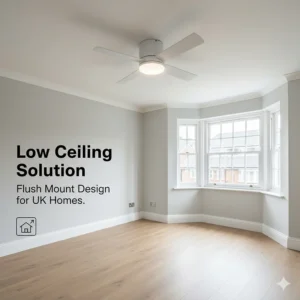
Flush-mount designs, often called “hugger” fans, sit directly against the ceiling with minimal gap. These models specifically address the common challenge of lower UK ceiling heights, particularly in flats, conversions, and post-war housing where 2.3-metre (7.5-foot) ceilings are standard.
Despite their compact profile, modern flush-mount ceiling fans with lights deliver impressive performance. Advanced motor technology and optimised blade angles ensure robust airflow even without extended downrods. For British homeowners in compact spaces, flush-mount models represent the ideal balance between functionality and clearance requirements.
Smart Ceiling Fans with Voice Control
The smart home revolution has thoroughly transformed ceiling fans with lights. Models featuring WiFi connectivity, smartphone apps, and voice assistant integration (Alexa, Google Home) allow unprecedented control convenience.
Imagine adjusting your bedroom fan’s speed without leaving bed on a chilly night, or scheduling your living room fan to start circulating air thirty minutes before you arrive home from work. Smart ceiling fans with lights integrate seamlessly with existing home automation systems, often featuring energy monitoring that helps UK households track electricity consumption and identify optimisation opportunities.
Outdoor-Rated Ceiling Fans
British weather may be unpredictable, but our love for garden entertaining remains steadfast. Outdoor-rated ceiling fans with lights extend comfortable living spaces into conservatories, covered patios, and garden rooms—spaces increasingly popular in UK homes.
These specialised models feature weather-resistant materials, sealed motors, and corrosion-proof finishes capable of withstanding our damp climate. UK Building Regulations classify outdoor areas as either “damp-rated” (covered spaces protected from direct rain) or “wet-rated” (fully exposed locations). Selecting the appropriate rating ensures longevity and safety whilst maintaining manufacturer warranty coverage.
Benefits of Installing Ceiling Fans with Lights
Energy Efficiency and Cost Savings
Perhaps the most compelling reason UK homeowners invest in ceiling fans with lights is the dramatic reduction in energy costs. Traditional heating and cooling methods consume substantial electricity—a typical portable heater draws 1,500-2,000 watts hourly, whilst ceiling fans operate on merely 15-75 watts depending on speed settings.
The maths becomes even more favourable when considering LED integration. Whereas traditional ceiling light fixtures with incandescent bulbs consume 240-360 watts for adequate room illumination, modern LED-equipped ceiling fans with lights achieve superior brightness using just 18-30 watts. For a UK household running ceiling fans three hours daily, annual savings typically range from £150-£300 compared to conventional heating/cooling and separate lighting fixtures.
Moreover, ceiling fans reduce reliance on central heating during transitional autumn and spring months. By redistributing warm air that naturally rises to ceiling level, homeowners maintain comfortable temperatures whilst setting thermostats 2-3 degrees lower—translating to approximately 15% heating cost reduction according to energy efficiency research.
Year-Round Versatility for British Climate
Britain’s temperate maritime climate creates unique challenges: warm summers without extreme heat, cold winters without Arctic temperatures, and endless transitional periods where neither heating nor cooling seems quite right. Ceiling fans with lights address all three scenarios brilliantly.
During summer months, forward-spinning blades (anti-clockwise when viewed from below) create downward airflow that produces cooling through increased air circulation and evaporative effect on skin. This “wind chill” effect can make a room feel 4-6 degrees cooler without actually lowering temperature—perfect for British summers that hover around 20-25°C.
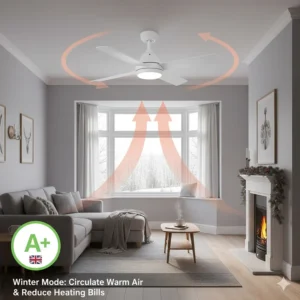
Winter operation reverses blade direction (clockwise viewed from below), gently pulling cool air upward whilst pushing accumulated warm air downward from ceiling level. This circulation eliminates stratification—the phenomenon where valuable heated air pools uselessly near ceilings whilst occupants shiver at floor level. UK households using this winter mode report noticeable comfort improvements and reduced heating bills.
Space-Saving Dual Functionality
Square footage comes at premium pricing throughout much of the UK, particularly in urban centres where property values have skyrocketed. Ceiling fans with lights maximise limited space by combining two essential fixtures into one ceiling footprint—eliminating the need for separate overhead lighting plus floor/table fans that consume precious floor space.
For compact flats, studios, and converted properties, this consolidation proves invaluable. A single ceiling fan with lights replaces what previously required a central ceiling light, supplementary lamps, and portable cooling devices—freeing both physical space and electrical outlets for other purposes.
Improved Air Quality and Circulation
Beyond temperature control, ceiling fans with lights significantly enhance indoor air quality—a concern that’s gained prominence following recent public health awareness. Stagnant air allows pollutants, allergens, cooking odours, and humidity to accumulate in specific zones, creating unhealthy indoor environments.
Continuous air circulation disperses these contaminants, reducing localised concentrations and promoting fresher indoor atmospheres. For UK homes prone to dampness—a perpetual battle in our maritime climate—ceiling fans help manage moisture levels that otherwise lead to mould growth, particularly in bathrooms, kitchens, and poorly-ventilated bedrooms.
Research from UK ventilation standards organisations confirms that proper air circulation complements mechanical ventilation systems, supporting overall indoor air quality goals whilst reducing condensation issues common in British properties.
Key Features to Look for in Modern Ceiling Fans with Lights
DC Motor vs AC Motor Technology
The motor represents the heart of any ceiling fan, and the DC versus AC debate significantly impacts performance, efficiency, and long-term costs. Direct Current (DC) motors dominate modern ceiling fans with lights for excellent reasons—they consume 70% less electricity than traditional Alternating Current (AC) motors whilst delivering superior torque and broader speed ranges.
DC motors achieve variable speeds through electronic control rather than mechanical resistance, allowing precise adjustments across six or more settings compared to AC motors’ typical three-speed limitation. This granularity proves particularly valuable for UK climate where subtle airflow adjustments often provide optimal comfort.
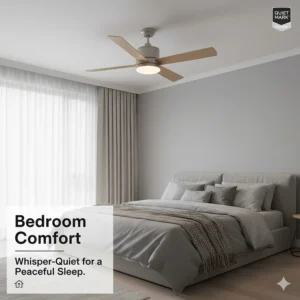
Additionally, DC motors operate virtually silently—typically under 30 decibels even at maximum speed—compared to AC motors that produce noticeable humming and blade whooshing. For bedroom installations, this quiet operation proves essential for undisturbed sleep.
LED Lighting Options and Colour Temperature
Modern ceiling fans with lights feature integrated LED technology that revolutionises both energy consumption and lighting versatility. LED fixtures consume approximately 80% less electricity than traditional incandescent bulbs whilst lasting 25,000-50,000 hours—effectively eliminating bulb replacement hassles for decades.
Colour temperature selection dramatically affects room ambiance and functionality. Expressed in Kelvin (K), lighting ranges from warm 2700-3000K (cosy, yellowish tones ideal for relaxation) through neutral 4000K (balanced daylight equivalent) to cool 5000-6500K (crisp, bluish-white perfect for task lighting).
The best ceiling fans with lights offer adjustable colour temperature, allowing homeowners to shift from warm evening ambiance to bright morning illumination with remote control convenience. This flexibility particularly benefits UK households where long winter darkness demands versatile lighting solutions.
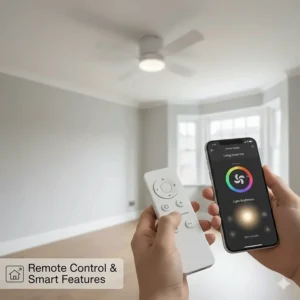
Remote Control and Smart Features
Gone are the days of pull-chain operation that required standing beneath fans to adjust settings. Contemporary ceiling fans with lights universally include remote controls offering comprehensive functionality: multiple fan speeds, lighting on/off, brightness dimming, colour temperature adjustment, and timer programming—all from the comfort of your armchair.
Smart-enabled models extend convenience further with smartphone apps and voice control integration. Setting schedules, monitoring energy consumption, and creating automated routines transforms ceiling fans with lights from passive fixtures into active participants in smart home ecosystems. UK homeowners increasingly value this integration, particularly as smart home adoption accelerates across British households.
Reversible Operation for Seasonal Use
The reversible motor function represents one of the most valuable yet underutilised features in ceiling fans with lights. This capability fundamentally alters blade rotation direction, completely changing airflow patterns to suit seasonal requirements.
Summer operation (anti-clockwise rotation viewed from below) creates direct downward airflow for cooling effect. Winter operation (clockwise rotation) generates gentle upward pull that redistributes warm ceiling-trapped air downward without creating uncomfortable drafts. This seasonal versatility maximises year-round utility and justifies the initial investment through continuous benefit.
Most models include simple reverse switches on the motor housing or within remote controls, making seasonal adjustments straightforward. For maximum efficiency, UK households should reverse fan direction twice annually—typically late October for winter mode and early April for summer operation.
How to Choose the Right Size Ceiling Fan with Lights
Room Size and Blade Diameter Guidelines
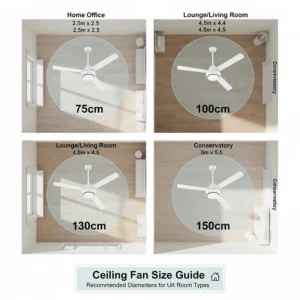
Selecting appropriate ceiling fan size represents the most critical decision affecting performance and satisfaction. Undersized fans struggle to circulate sufficient airflow, whilst oversized fans create uncomfortable drafts and appear visually disproportionate.
General sizing guidelines for UK rooms:
- Small rooms (up to 10m²/108 sq ft): 76-107cm (30-42 inch) diameter
- Medium rooms (10-15m²/108-162 sq ft): 107-122cm (42-48 inch) diameter
- Large rooms (15-25m²/162-270 sq ft): 122-137cm (48-54 inch) diameter
- Very large spaces (over 25m²/270 sq ft): 137cm+ (54+ inch) diameter or multiple fans
These specifications assume standard 2.4-metre (8-foot) ceilings. Higher ceilings may accommodate larger fans effectively, whilst particularly spacious open-plan layouts often benefit from multiple strategically positioned fans rather than single oversized units.
Ceiling Height Considerations
Optimal ceiling fan installation maintains 2.1-2.4 metres (7-8 feet) clearance between floor and blade tips—balancing safety requirements with maximum airflow efficiency. UK Building Regulations mandate minimum 2.1-metre (7-foot) clearance in habitable rooms, though many building control officers recommend the higher 2.3-metre (7.5-foot) standard for enhanced safety margins.
For standard UK ceiling heights around 2.4 metres (8 feet), flush-mount or low-profile ceiling fans with lights provide the only viable option. Fortunately, modern flush designs deliver excellent performance despite minimal gap between fan and ceiling.
Properties with higher ceilings—common in period conversions, barn renovations, or architect-designed new builds—benefit from downrod-mounted fans suspended at optimal heights. Adjustable downrods typically range from 15cm to 180cm, accommodating virtually any ceiling configuration whilst maintaining proper clearance.
Airflow Capacity (CFM) Requirements
Cubic Feet per Minute (CFM) measures actual airflow volume a ceiling fan delivers—the truest performance indicator beyond blade diameter. Higher CFM values indicate more robust air circulation, though efficiency (CFM per watt) provides better value comparison between models.
For UK rooms, target CFM values by size:
- Small bedrooms (10m²): 2,000-3,000 CFM minimum
- Medium living rooms (15m²): 3,000-4,500 CFM recommended
- Large open-plan areas (25m²): 5,000+ CFM for adequate circulation
Most manufacturers prominently list CFM specifications, allowing direct performance comparisons. However, blade pitch (angle), number of blades, and motor quality significantly influence actual delivered airflow beyond simple diameter measurements.
Installation Tips for Ceiling Fans with Lights in UK Homes
Electrical Requirements and Safety Standards
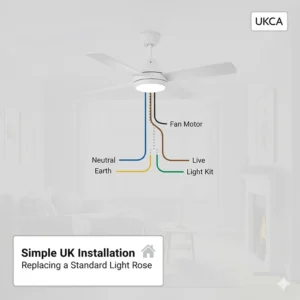
UK electrical installations follow strict Building Regulations Part P, which governs all electrical work in domestic properties. Ceiling fan installation typically constitutes “notifiable work” requiring either qualified electrician completion or formal Building Control notification and inspection.
Most ceiling fans with lights connect to standard UK 230V mains electricity via ceiling roses or junction boxes. However, proper support becomes crucial—ceiling fans generate dynamic forces during operation that exceed typical light fixture loads. Standard ceiling roses designed for lightweight pendant lights cannot safely support ceiling fan weight and vibration.
Professional installation ensures:
- Adequate ceiling joist mounting or supplementary bracing
- Proper electrical earthing and circuit protection
- Compliance with BS 7671 wiring regulations
- Safe clearance from windows, doors, and obstacles
Whilst confident DIY enthusiasts may handle mechanical assembly, engaging certified Part P electricians for electrical connections ensures safety, maintains home insurance validity, and satisfies building regulations—typically costing £80-£150 for straightforward installations.
Mounting Options for Different Ceiling Types
UK properties feature diverse ceiling constructions, each presenting unique mounting challenges. Modern plasterboard ceilings over timber joists require locating solid joists for secure fixing—ceiling fans demand robust support exceeding lightweight plaster anchor capabilities.
For timber-joisted ceilings, ideal mounting involves screwing directly into joists with appropriate lag bolts. When ceiling roses don’t align with joist positions, installing supplementary bracing between joists creates secure mounting points. This often necessitates accessing ceiling voids from above (loft spaces) or below (ceiling removal).
Concrete ceilings in flats and modern builds require different approaches. Chemical anchors or expansion bolts rated for dynamic loads provide secure fixing in solid concrete. Professional installers assess concrete thickness and condition before selecting appropriate fixing methods.
Period properties with lath-and-plaster ceilings demand particular care. Traditional lath construction often lacks sufficient strength for modern ceiling fans with lights, potentially requiring additional support framework installation before fan mounting proceeds.
Optimal Positioning for Maximum Efficiency
Beyond secure mounting, positioning significantly affects ceiling fan performance and room aesthetics. Ideally, fans should mount centrally in square/rectangular rooms, ensuring equal airflow distribution to all areas. Open-plan spaces may benefit from multiple fans positioned to provide overlapping coverage without creating conflicting airflow patterns.
Maintain minimum clearances:
- 18 inches (45cm) from walls for unobstructed blade rotation
- 30 inches (75cm) from adjacent ceiling fans to prevent interference
- 7 feet (2.1m) from floor for safety compliance
Avoid positioning fans directly above beds where direct airflow might prove uncomfortable during sleep, or too close to doorways where circulation patterns might interfere with natural ventilation pathways. Strategic placement considers furniture arrangement, window locations, and existing HVAC vent positions for harmonious operation.
Comparing Ceiling Fans with Lights to Alternative Cooling Methods
| Method | Initial Cost (£) | Annual Running Cost (£) | Effectiveness | UK Climate Suitability | Heating Capability |
|---|---|---|---|---|---|
| Ceiling Fan with Lights | £70-£190 | £15-£30 | Excellent | Perfect | Yes (reverse mode) |
| Portable Air Conditioning | £250-£600 | £150-£300 | Very Good | Moderate | No |
| Split-System Air Con | £1,500-£3,000+ | £180-£400 | Excellent | Moderate | Some models |
| Standing Fans | £20-£100 | £25-£50 | Fair | Good | No |
| Evaporative Coolers | £80-£200 | £40-£80 | Moderate | Poor (humid UK climate) | No |
| Central Air Conditioning | £4,000-£8,000+ | £300-£600+ | Excellent | Excessive | Yes (heat pump systems) |
Energy Efficiency and Running Costs in the UK
Calculating Annual Electricity Consumption
Understanding actual running costs helps UK homeowners make informed decisions about ceiling fans with lights. Modern DC motor fans typically consume 15-75 watts depending on speed settings, whilst integrated LED lighting adds 18-30 watts.
Sample calculation for moderate use:
- Fan operation: 50 watts (medium speed)
- LED lighting: 24 watts
- Total consumption: 74 watts
- Daily use: 4 hours
- Annual consumption: 74W × 4h × 365 days = 108kWh
- UK average electricity rate: £0.28/kWh (2026 estimate)
- Annual cost: 108kWh × £0.28 = £30.24
Compare this to portable air conditioning consuming approximately 1,200 watts hourly:
- Daily use: 4 hours
- Annual consumption: 1,200W × 4h × 365 days = 1,752kWh
- Annual cost: 1,752kWh × £0.28 = £490.56
The £460+ annual savings quickly offset ceiling fan initial investment, achieving payback within 4-6 months of summer use alone—before accounting for winter heating efficiency improvements.
Comparing Smart vs Standard Models
Smart ceiling fans with lights command £20-£40 premiums over comparable non-smart alternatives. Do enhanced features justify additional costs? For many UK households, absolutely.
Smart capabilities enable:
- Scheduling: Automatically start circulation 30 minutes before arriving home
- Energy monitoring: Track consumption and optimise usage patterns
- Integration: Coordinate with smart thermostats for holistic climate management
- Remote access: Adjust settings whilst away, preventing energy waste
These features typically recover their premium through optimised operation within 12-18 months. Moreover, smart home integration increasingly influences UK property values—homes equipped with modern automation command market premiums that encompass smart ceiling fan investments.
Environmental Impact and Carbon Footprint
Beyond personal economics, ceiling fans with lights contribute meaningfully to environmental sustainability. Reduced electricity consumption directly correlates with lower carbon emissions from UK power generation—currently averaging 0.233kg CO₂ per kWh.
Annual carbon savings comparison:
- Ceiling fan: 108kWh × 0.233kg = 25kg CO₂ annually
- Portable air con: 1,752kWh × 0.233kg = 408kg CO₂ annually
- Net reduction: 383kg CO₂ saved (equivalent to driving approximately 1,500 miles)
As the UK progresses toward net-zero targets, individual choices like selecting energy-efficient ceiling fans with lights aggregate into significant national impact. For environmentally-conscious British homeowners, this alignment with climate goals provides additional motivation beyond pure economics.
Design Trends for Ceiling Fans with Lights in 2026
Minimalist and Contemporary Styles
Modern British interior design increasingly embraces minimalism—clean lines, uncluttered spaces, and functional elegance. Ceiling fans with lights have evolved accordingly, shedding ornate Victorian styling for sleek contemporary profiles that complement rather than dominate room aesthetics.
Popular 2026 design trends include:
- Bladeless designs with enclosed housing for ultra-modern appeal
- Matte finishes in black, white, or brushed nickel eliminating reflective glare
- Three-blade configurations offering architectural simplicity
- Low-profile fixtures that virtually disappear against ceilings
These minimalist ceiling fans with lights particularly suit urban flats, new-build properties, and Scandinavian-influenced interiors prevalent throughout UK homes. The emphasis shifts from fans as decorative statements to fans as invisible comfort providers—present yet unobtrusive.
Smart Home Integration Features
Technology integration represents perhaps the most significant design evolution in ceiling fans with lights. Modern models function as connected devices within broader smart ecosystems rather than standalone fixtures.
2026 innovations include:
- Voice control via Alexa, Google Assistant, or Apple HomeKit
- Geofencing that adjusts settings based on proximity detection
- Weather integration automatically responding to forecast changes
- Energy dashboards tracking consumption and suggesting optimisations
For UK households increasingly adopting smart home technology—currently over 40% according to recent market research—ceiling fans with lights represent logical additions that enhance overall system value whilst providing tangible comfort and efficiency benefits.
Natural Materials and Sustainable Finishes
Environmental consciousness permeates contemporary design, with ceiling fans with lights increasingly featuring sustainable materials and eco-friendly production methods. Bamboo blades, reclaimed wood finishes, and recycled metal housings appeal to UK buyers prioritising environmental responsibility.
Beyond materials, efficiency credentials matter enormously. Models with A+++ energy ratings, recyclable components, and extended warranties reducing replacement frequency align with circular economy principles gaining traction throughout British society. Manufacturers highlighting sustainable practices and transparent supply chains enjoy competitive advantages with environmentally-aware consumers.
Maintenance and Care for Optimal Performance
Regular Cleaning Schedule
Ceiling fans accumulate dust on blades and housing despite continuous operation—indeed, spinning action actually attracts airborne particles. Regular cleaning maintains both performance and appearance whilst preventing dust circulation throughout rooms.
Monthly maintenance routine:
- Switch off power at wall switch
- Use long-handled duster or slightly damp microfibre cloth
- Wipe each blade top and bottom surfaces
- Clean motor housing and light fixtures
- Check for loose screws or wobbling
For ceiling fans with lights in kitchens, grease accumulation necessitates more frequent cleaning using mild detergent solutions. Avoid harsh chemicals that might damage protective finishes or LED components.
Troubleshooting Common Issues
Despite robust construction, ceiling fans with lights occasionally develop problems. Understanding common issues and solutions saves costly professional calls:
Wobbling or shaking:
- Check blade mounting screws for tightness
- Verify blades aren’t warped or damaged
- Balance blades using adhesive weights (often included)
- Ensure ceiling mount remains secure
Unusual noises:
- Tighten all visible screws and connections
- Lubricate bearings if accessible (consult manual)
- Check for objects obstructing blade rotation
- Verify light glass fixtures aren’t loose
Remote control failure:
- Replace remote batteries first
- Reset receiver following manufacturer instructions
- Ensure remote frequency matches fan receiver
- Check for interference from other electronic devices
Reduced airflow:
- Clean accumulated blade dust
- Verify reverse switch position matches season
- Check motor hasn’t shifted to lower speed setting
- Assess whether increased room clutter blocks circulation
When to Call Professional Help
Whilst basic maintenance proves straightforward, certain issues demand qualified electrician attention. Never attempt electrical work beyond your competence—UK Building Regulations and insurance policies both require professional intervention for electrical problems.
Contact certified electricians for:
- Motor humming without blade rotation
- Burning smells or visible smoke
- Sparks or electrical arcing
- Dimming house lights when fan operates
- Tripped circuit breakers upon fan activation
These symptoms indicate serious electrical faults requiring immediate professional assessment. Continued operation risks property damage, personal injury, or fire hazards—switch off power immediately and engage qualified help.

Frequently Asked Questions
❓ How much does it cost to run ceiling fans with lights in the UK?
❓ Can ceiling fans genuinely help reduce heating bills during winter?
❓ Are ceiling fans suitable for UK climate or only hot countries?
❓ Do I need Building Regulations approval to install ceiling fans with lights?
❓ What size ceiling fan do I need for a standard UK bedroom?
Conclusion: Finding Your Perfect Ceiling Fan with Lights
Selecting the right ceiling fan with lights transforms how you experience home comfort whilst simultaneously reducing energy costs and environmental impact. The UK market in 2026 offers exceptional diversity—from budget-friendly flush-mount models perfect for compact flats to premium smart fans delivering whisper-quiet performance in spacious family homes.
The seven models we’ve examined represent carefully curated selections balancing price, performance, features, and UK-specific requirements. Whether prioritising ultra-quiet DC motors for bedrooms, smart home integration for tech enthusiasts, or simply robust airflow for larger spaces, suitable options exist at every price point.
Remember that initial cost represents merely one factor in total ownership value. Energy-efficient ceiling fans with lights recover their investment through reduced electricity bills within months, then continue delivering savings for decades. Factor in enhanced comfort, improved air quality, aesthetic appeal, and property value enhancement—the return on investment becomes overwhelmingly positive.
As British summers grow warmer and energy costs remain elevated, ceiling fans with lights represent intelligent investments for present comfort and future sustainability. They exemplify how thoughtful product selection—choosing quality, efficiency, and appropriate sizing—creates win-win scenarios benefiting both households and environment.
Your perfect ceiling fan with lights awaits on Amazon.co.uk. Use this guide’s insights, compare specifications against your specific requirements, read customer reviews from fellow UK buyers, and make confident selections that will serve your home beautifully for years to come.
Recommended for You
- 7 Best Ceiling Fans UK 2026: Top Rated Expert Reviews
- 7 Best Black Ceiling Fans With Lights UK 2026 | Expert Guide
- 7 Best LED Lights Ceiling Fans UK 2026 – Save £2,000 Yearly
Disclaimer: This article contains affiliate links. If you purchase products through these links, we may earn a small commission at no additional cost to you. Prices shown are approximate and may vary.
✨ Found this helpful? Share it with your mates! 💬🤗
