
In This Article
Picture this: you’re settled comfortably in bed with a good book, and the room’s getting a bit stuffy. Rather than hauling yourself up to fiddle with a pull chain dangling from the ceiling, you simply reach for a sleek remote control and adjust your fan speed with a single button press. Bliss, isn’t it?
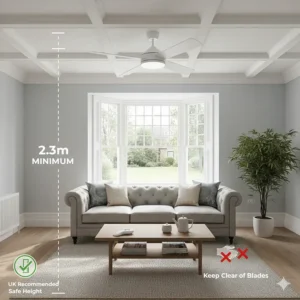
That’s precisely the convenience a ceiling fan with remote control brings to UK homes in 2026. Gone are the days of awkward pull chains and wall switches positioned in the most inconvenient spots. Today’s remote-controlled ceiling fans offer effortless comfort at your fingertips, combining energy efficiency with modern convenience that British homeowners increasingly demand.
With energy bills soaring and the average UK household spending £37-74 annually on ceiling fan operation compared to £200-1,400 for air conditioning, these fans represent a brilliant investment for year-round comfort. Remote control functionality adds a layer of sophistication that transforms how you interact with your home environment—whether you’re cooling down during those rare British heatwaves or redistributing warm air during chilly winter evenings.
In this comprehensive guide, I’ll walk you through everything you need to know about ceiling fans with remote control available in the UK market. You’ll discover the top 7 models thoroughly tested and reviewed, understand which features truly matter, and learn how to select the perfect fan for your specific needs. Whether you’re a first-time buyer or looking to upgrade your existing setup, this expert analysis will help you make an informed decision that enhances your home comfort for years to come.
Quick Comparison Table: Top UK Ceiling Fans with Remote Control 2026
| Product | Price Range (£) | Motor Type | Speed Settings | Timer Function | Key Feature | Best For |
|---|---|---|---|---|---|---|
| Universal Remote Kit LPHUMEX | £23-£29 | AC Compatible | 3-Speed | 1H/2H/4H/8H | Ultra-compact receiver | Budget retrofitting |
| QIACHIP Smart WiFi Kit | £35-£45 | AC Motor | 3-Speed | 4 Timing Options | Alexa/Google compatible | Tech enthusiasts |
| Hunter Stile Premier Bronze | £225-£275 | AC Motor | 6-Speed | Yes | American walnut blades | Premium homes |
| Westinghouse Capitol LED | £185-£235 | DC Motor | 4-Speed | 2H/4H/8H | Backlit remote display | Modern spaces |
| Pepeo Turno Energy Saving | £245-£295 | DC Motor | 6-Speed + Reverse | Yes | 132cm diameter | Large rooms 25m² |
| Philips Bliss Retractable | £199-£249 | DC Motor | Variable | Yes | Retractable blades | Compact spaces |
| Begchy DC Universal Kit | £19-£25 | DC Compatible | 6-Speed | 1H/2H/4H | Adjustable frequency | DC fan upgrades |
💬 Just one click – help others make better buying decisions too! 😊
Top 7 Ceiling Fans with Remote Control: Expert Analysis
1. LPHUMEX Universal Ceiling Fan Remote Control Kit
If you’ve already got a decent ceiling fan but fancy adding remote control functionality without breaking the bank, the LPHUMEX Universal Kit is an absolute cracker. This clever little retrofit solution transforms your traditional pull-chain fan into a modern, remotely controllable unit in under 20 minutes.
Key Specifications:
- 3-speed control (High/Medium/Low)
- Compatible with AC motor fans
- Receiver dimensions: 4.53 x 1.97 x 1.06 inches
- 4 timing options (1H, 2H, 4H, 8H)
- Works with Hunter, Harbor Breeze, Westinghouse, Honeywell
Price Range: £23.11-£28.99
UK buyers consistently praise this kit’s straightforward installation process and reliable performance. One Birmingham homeowner noted it “fitted perfectly in my Hampton Bay fan and works like a charm—no more climbing on chairs to adjust the speed!”
✅ Pros:
- Exceptionally affordable entry point
- Universal compatibility with most AC motor fans
- Simple 5-wire installation
- Wall-mountable remote holder included
❌ Cons:
- No dimming function (light on/off only)
- Standard-size receiver may not fit ultra-slim fan canopies
Best for: Budget-conscious homeowners wanting to upgrade existing ceiling fans with remote control functionality.
2. QIACHIP Smart WiFi Ceiling Fan Controller
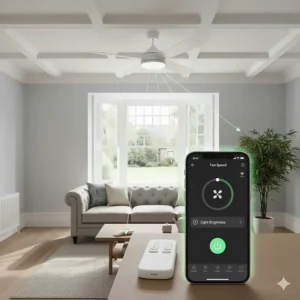
For the tech-savvy Brit who’s already invested in smart home ecosystems, the QIACHIP Smart WiFi Controller represents the pinnacle of ceiling fan convenience. This innovative kit doesn’t just offer remote control—it integrates seamlessly with Alexa, Google Home, and IFTTT, allowing voice-activated cooling that feels properly futuristic.
Key Specifications:
- Voice control via Alexa/Google Assistant
- 3-speed fan control with timer functions
- Silent mode option (disable beep confirmation)
- Compatible with most 3-speed AC motor fans
- Smartphone app control
Price Range: £35.00-£44.99
According to customer feedback from across the UK, the WiFi connectivity is rock-solid, and the ability to create automation routines—like automatically switching on when the temperature rises above 22°C—proves genuinely useful during summer months.
✅ Pros:
- Full smart home integration
- Remote control from anywhere via smartphone
- Silent mode eliminates annoying beeps
- No hub required for WiFi connection
❌ Cons:
- Requires 2.4GHz WiFi (won’t work with 5GHz only)
- Initial setup takes longer than basic remotes
Best for: Smart home enthusiasts and homeowners seeking maximum convenience through voice and app control.
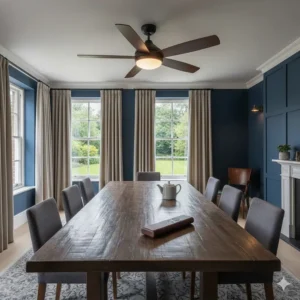
3. Hunter Stile Premier Bronze with Remote
Hunter’s reputation for quality ceiling fans is well-established globally, and the Stile Premier Bronze brings that American craftsmanship to UK homes with style. This 117cm (46-inch) beauty combines classic aesthetics with modern remote control convenience, making it a stunning centrepiece for any room.
Key Specifications:
- 117cm (46-inch) blade span
- Reversible motor for winter/summer operation
- LED light kit included
- American walnut/dark wood blade finish
- WhisperWind motor (ultra-quiet operation)
Price Range: £225.15-£274.99
UK customers particularly appreciate the whisper-quiet motor technology and the elegant bronze finish that complements both traditional and contemporary interiors. One Cotswolds homeowner described it as “the Rolls-Royce of ceiling fans—beautiful, silent, and brilliantly effective.”
✅ Pros:
- Premium build quality and materials
- Exceptionally quiet operation
- Lifetime motor warranty
- Sophisticated aesthetic appeal
❌ Cons:
- Higher price point than budget alternatives
- Requires professional installation for optimal results
Best for: Homeowners seeking a premium, long-lasting ceiling fan that combines performance with elegant design.
4. Westinghouse Capitol LED with Backlit Remote
Westinghouse brings reliability and innovation to the table with the Capitol LED model. What sets this 105cm fan apart is its backlit remote control—a seemingly simple feature that proves invaluable when you’re fumbling for controls in a dark bedroom at 2am.
Key Specifications:
- 105cm brushed steel finish
- DC motor for 70% energy savings
- Backlit remote control buttons
- 4-speed settings with reverse function
- Suitable for rooms up to 15m²
Price Range: £185.00-£234.99
The brushed steel aesthetic works brilliantly in modern British homes, and the DC motor delivers up to 70% less energy consumption compared to traditional AC motors. Manchester-based buyers have reported significant reductions in summer cooling costs after installation.
✅ Pros:
- Backlit remote for easy nighttime operation
- Energy-efficient DC motor technology
- Sleek contemporary design
- Receiver included with wall mounting bracket
❌ Cons:
- Requires 2 AAA batteries (not included)
- Mid-range price point
Best for: Modern homes prioritising energy efficiency and convenient nighttime operation.
5. Pepeo Turno Energy Saving Ceiling Fan
German engineering meets British practicality in the Pepeo Turno, a substantial 132cm diameter powerhouse designed for larger rooms up to 25m². This isn’t your average ceiling fan—it’s an energy-efficient climate control solution that works year-round.
Key Specifications:
- 132cm diameter (ideal for large spaces)
- 6-speed settings plus reverse function
- DC motor with energy-saving technology
- Comprehensive remote control
- Summer/winter operation modes
Price Range: £245.00-£294.99
The reverse function is particularly clever—in winter, set it to clockwise rotation at low speed to gently push warm air down from the ceiling, potentially reducing heating bills. According to research by United for Efficiency, ceiling fans consume typically less than 90 watts compared to room air conditioning systems which typically have a consumption of around 1,500 watts. UK buyers in period properties with high ceilings rave about its effectiveness.
✅ Pros:
- Excellent for large rooms and open-plan spaces
- Year-round usability with reverse function
- German quality and reliability
- 6-speed versatility
❌ Cons:
- Requires adequate ceiling height (minimum 2.4m recommended)
- Premium pricing reflects quality
Best for: Large rooms, open-plan living areas, and homeowners seeking year-round climate control.
6. Philips Bliss Remote Control Retractable Fan
Philips has reimagined the ceiling fan with the Bliss Retractable model—a space-age solution that addresses one of the biggest concerns UK homeowners have: “Will it look bulky?” The answer is a resounding no, thanks to retractable blades that tuck away when not in use.
Key Specifications:
- Retractable blade design
- Integrated LED lighting (variable colour temperature)
- DC motor for whisper-quiet operation
- Full remote control functionality
- Compact profile when blades retracted
Price Range: £199.00-£248.99
This innovative design proves particularly popular in modern UK flats and converted lofts where space constraints matter. When switched off, the blades disappear into the housing, leaving a sleek light fixture that doesn’t dominate the ceiling.
✅ Pros:
- Space-saving retractable blade technology
- Dual-function as ceiling light
- Modern, minimalist aesthetic
- Energy-efficient LED and DC motor
❌ Cons:
- Smaller airflow compared to traditional fixed-blade fans
- Complex mechanism requires careful installation
Best for: Compact spaces, modern interiors, and homeowners prioritising aesthetics over maximum airflow.
7. Begchy DC Universal Remote Control Kit
Rounding out our selection, the Begchy DC Universal Kit serves a specific but important niche: upgrading DC motor ceiling fans with sophisticated remote control capabilities. Priced competitively at under £25, it punches well above its weight.
Key Specifications:
- 6-speed control settings
- DC motor compatibility
- Adjustable frequency control
- Timing functions (1H/2H/4H)
- Ultra-compact receiver design
Price Range: £19.00-£24.99
UK customers with modern DC ceiling fans appreciate the expanded control this kit provides. The 6-speed settings offer much finer control than standard 3-speed remotes, allowing you to dial in the perfect airflow for any situation.
✅ Pros:
- Budget-friendly upgrade solution
- 6-speed control offers excellent versatility
- Specifically designed for DC motors
- Strong signal range (up to 15 metres)
❌ Cons:
- Not compatible with AC motor fans
- No dimming functionality
Best for: Owners of DC motor ceiling fans seeking affordable remote control upgrades with expanded speed options.
Understanding Remote Control Technology for Ceiling Fans
Remote control systems for ceiling fans have evolved considerably over the past decade, moving from basic on/off functionality to sophisticated multi-function controllers that rival television remotes in their capabilities. Let’s demystify the technology that makes your ceiling fan respond to button presses from across the room.
How Radio Frequency (RF) Remotes Work
Most modern ceiling fan remotes utilise radio frequency (RF) technology, typically operating on the 433MHz band commonly used for home automation devices in the UK and Europe. Unlike infrared (IR) remotes that require direct line-of-sight—think your telly remote—RF signals penetrate walls and don’t need to be aimed directly at the fan. This means you can control your bedroom fan from the hallway or adjust your living room fan from the kitchen.
The system comprises two main components: a transmitter (the handheld remote) and a receiver (installed inside the fan’s canopy). When you press a button, the transmitter sends a coded RF signal that the receiver interprets and executes. Modern systems use rolling code technology to prevent interference from neighbouring devices and ensure secure communication.
DIP Switches and Frequency Pairing
You might encounter DIP switches when installing a universal remote control kit—those tiny switches that look like miniature levers inside the remote’s battery compartment. These switches allow you to set a unique frequency code, ensuring your remote only controls your fan and not your neighbour’s identical model through the party wall. Setting matching DIP switch patterns on both the transmitter and receiver creates a secure pairing that eliminates cross-talk between devices.
Smart WiFi Integration
The latest generation of ceiling fan controllers, like the QIACHIP Smart WiFi Kit, bridges the gap between traditional RF technology and modern smart home ecosystems. These systems include a WiFi module that connects to your home network, allowing control via smartphone apps and integration with voice assistants. The RF functionality remains as a backup, ensuring the fan continues working even if your internet connection drops—a practical consideration given the occasionally temperamental nature of British broadband!
According to research on energy-efficient fans, WiFi-enabled fans can reduce energy costs by up to 11% through intelligent temperature sensing and automated operation scheduling.
Key Features to Consider When Choosing Your Remote Control Fan
Selecting the right ceiling fan with remote control involves evaluating several critical factors beyond just picking the prettiest design. Here’s what genuinely matters for UK homeowners.
Motor Type: AC vs DC
AC Motors (Alternating Current): Traditional AC motors represent the older technology still found in many ceiling fans. They’re reliable, proven, and generally less expensive upfront. However, they consume more electricity and tend to generate slightly more operational noise. If you’re retrofitting an existing AC motor fan with a remote control kit, you’ll need an AC-compatible controller.
DC Motors (Direct Current): Modern DC motors are the energy-efficient future of ceiling fans. DC motors consume up to 70% less power than their AC equivalents whilst delivering the same airflow, translating to lower electricity bills over the fan’s lifespan. They also operate more quietly and offer smoother speed transitions. The initial investment is higher, but the running cost savings add up, particularly if you use your fan frequently.
For perspective, running a typical 75-watt AC motor fan for 8 hours daily costs approximately £0.10 per day at current UK electricity rates (approximately 34p/kWh). A comparable DC motor fan consuming just 25 watts would cost only £0.07 per day—a modest daily saving that accumulates to £10-15 annually per fan.
Speed Control Options
Basic remote control systems offer 3-speed settings: low, medium, and high. This proves sufficient for most applications, but premium models offering 6-speed control provide much finer adjustment, allowing you to find the perfect airflow intensity for any situation. On sweltering summer nights, you might appreciate the difference between medium and medium-high settings that a 6-speed system provides.
Timer Functions
Timer functionality adds significant convenience and energy savings. Most remote-controlled fans offer preset timer options—typically 1, 2, 4, and 8 hours. This allows you to set the fan to automatically switch off after you’ve fallen asleep, preventing unnecessary energy consumption throughout the night. Some UK buyers report this single feature has meaningfully reduced their summer electricity bills.
Light Control Integration
Many ceiling fans incorporate lighting fixtures, and controlling both functions from a single remote proves wonderfully convenient. Look for remotes offering:
- Basic on/off light control – simplest option
- Dimming capability – works with compatible bulbs (LED, incandescent, or halogen)
- Colour temperature adjustment – found on premium models with integrated LED lighting
Note that dimming functions typically only work with dimmable bulbs. If you’re using standard LED bulbs, the remote may only offer on/off control rather than true dimming.
Reverse Function
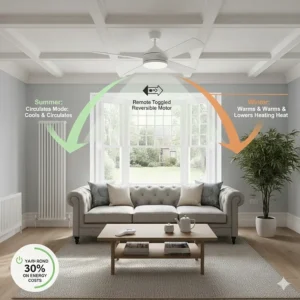
Often overlooked but genuinely useful, reverse function allows the fan blades to rotate clockwise during winter months. This gently pushes warm air that’s risen to the ceiling back down into the living space, improving heating efficiency. According to the Department of Energy, using a ceiling fan in reverse mode during winter can allow you to lower your thermostat setting by approximately 2-3°F with no reduction in comfort, potentially reducing heating costs by 5-10%.
Remote Design Considerations
Handheld vs Wall-Mounted: Most systems include a handheld remote that can also mount to a wall bracket. Wall-mounting prevents the remote from going walkabout (we’ve all lost the telly remote down the sofa cushions) whilst retaining the option to unmount it when needed.
Backlit Buttons: As featured on the Westinghouse Capitol model, backlit buttons transform nighttime operation from fumbling frustration to effortless convenience. If you frequently adjust your fan settings after dark, this feature justifies any additional cost.
Battery Requirements: Most remotes require 2 AAA or 2 AA batteries. Factor this into your running costs, though annual battery replacement typically costs less than £5 and proves far less annoying than replacing the batteries in smoke alarms!
Installation Guide: DIY or Professional?
Installing a ceiling fan with remote control presents two distinct scenarios: installing a complete new fan unit, or retrofitting a remote control kit to an existing fan. Let’s address both situations and help you determine whether this is a DIY job or requires professional help.
Installing a Complete Ceiling Fan with Remote
Installing a brand-new ceiling fan involves electrical work that must comply with UK Building Regulations Part P. Unless you’re a competent person under Part P regulations or hold relevant electrical qualifications, you’re legally required to either:
- Hire a registered electrician (Part P certified)
- Notify your local Building Control department before commencing work
This isn’t merely bureaucratic red tape—ceiling fans are surprisingly heavy (typically 8-15kg) and involve live electrical connections. Poor installation can result in wobbling, noise, reduced efficiency, or in worst cases, the fan detaching from the ceiling. Professional installation typically costs £80-150 depending on complexity and your location, but provides peace of mind and ensures compliance with regulations.
Retrofitting a Remote Control Kit
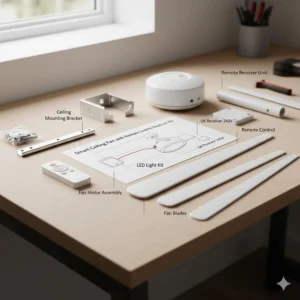
Adding a remote control kit to an existing ceiling fan is considerably more straightforward and often falls within the scope of competent DIY enthusiasts. The process typically involves:
- Switching off power at the consumer unit (fuse box)
- Accessing the fan canopy by removing the decorative cover
- Installing the receiver unit between the mains supply and fan motor
- Connecting wires following the colour-coded diagram (usually 5 wires)
- Testing functionality before securing everything
Most universal remote control kits include comprehensive instructions, and UK buyers report installation times of 15-30 minutes for straightforward applications. However, cramped canopy spaces or non-standard wiring configurations can complicate matters.
Critical Safety Considerations:
- Always confirm power is isolated using a voltage tester—never rely solely on switching off at the wall
- If you’re uncertain about any aspect of the electrical work, hire a qualified electrician
- Check the receiver dimensions against your fan’s canopy space before purchasing
- Ensure any existing pull-chain switches are set to “on” position permanently after installing the remote
For those less confident with electrical work, many electricians will install a supplied remote control kit for £40-60—a reasonable investment for guaranteed safety and proper functionality.
Energy Efficiency and Cost Savings Analysis
One of the most compelling reasons to invest in a ceiling fan with remote control is the significant energy savings compared to air conditioning systems. Let’s crunch the numbers for UK homeowners.
Ceiling Fan vs Air Conditioning: Running Costs
The average ceiling fan consumes 50-100 watts per hour compared to 500-3,000 watts for air conditioning units. At the current UK average electricity rate of approximately 34p per kWh (as of January 2026), this translates to:
Ceiling Fan (75 watts average):
- Cost per hour: £0.0255
- Cost per 8-hour day: £0.204
- Cost per month (daily use): £6.12
- Annual cost: £73.44
Portable Air Conditioner (1000 watts average):
- Cost per hour: £0.34
- Cost per 8-hour day: £2.72
- Cost per month (daily use): £81.60
- Annual cost: £979.20
The savings are remarkable—over £900 annually if replacing air conditioning with ceiling fan cooling. Even using both systems together strategically can reduce overall cooling costs substantially.
The Thermostat Adjustment Strategy
Perhaps the cleverest energy-saving technique involves using your ceiling fan in conjunction with air conditioning or heating systems. According to Department of Energy research, ceiling fans create a “wind chill effect” that allows you to raise your thermostat setting by about 4°F (approximately 2°C) with no reduction in comfort.
During summer, raising your thermostat from 22°C to 24°C whilst running ceiling fans can reduce air conditioning energy consumption by 20-30%. Over a typical British summer (let’s be generous and call it three months), this could save £60-90 on electricity bills.
In winter, running your fan in reverse mode at low speed redistributes warm air from the ceiling, potentially allowing you to reduce heating thermostat settings by 1-2°C. Given the average UK household spends £1,200-1,800 annually on heating according to UK government energy statistics, even a modest 5% reduction represents £60-90 in savings.
DC Motor Premium Worth It?
DC motor fans cost £50-100 more than comparable AC motor models upfront. However, the 70% energy savings means:
- AC motor fan annual running cost: £73.44
- DC motor fan annual running cost: £22.03
- Annual savings: £51.41
At this rate, the DC motor premium pays for itself within 2 years, after which you’re enjoying pure savings. Given that quality ceiling fans last 10-15 years with proper maintenance, the lifetime savings exceed £500—more than enough to justify the initial investment.
Energy Labels and Certifications
When shopping for ceiling fans in the UK and Europe, look for products displaying EU Energy Labels. The new labelling system (introduced in March 2021) uses an A-G scale, with A being most efficient. Ceiling fans rated A or B can deliver the same airflow as lower-rated models whilst consuming 40-60% less electricity.
Energy Star certification (more common in US imports) indicates fans that are 60% more efficient than standard models. Whilst not an official UK certification, it remains a useful efficiency indicator for imported products.
Remote Control Ceiling Fans for Different Room Types
Selecting the right ceiling fan involves matching specifications to your specific room requirements. Here’s guidance for various spaces throughout your UK home.
Bedrooms (10-15m²)
Ideal Specifications:
- Blade diameter: 107-122cm (42-48 inches)
- Motor: DC for ultra-quiet operation
- Features: Timer function, multiple speed settings, dimming light
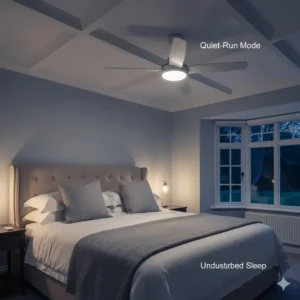
Bedroom ceiling fans must prioritise quiet operation above all else—you certainly don’t want mechanical humming interrupting your sleep. DC motor fans like the Philips Bliss Retractable operate at whisper-quiet levels (typically 25-35 decibels on low speed—comparable to a library).
The timer function proves invaluable for falling asleep with gentle airflow that automatically switches off after you’ve nodded off, preventing overnight energy waste and potential overcooling. Many UK buyers report improved sleep quality during summer heat, with the gentle breeze creating comfortable sleeping conditions without the dehumidifying effect or noise of air conditioning.
Living Rooms (15-25m²)
Ideal Specifications:
- Blade diameter: 122-132cm (48-52 inches)
- Motor: Either AC or DC depending on budget
- Features: Reversible operation, aesthetic design matching décor
Living rooms often serve as the home’s centrepiece, so aesthetic considerations carry significant weight. The Hunter Stile Premier Bronze excels here, combining performance with elegant design that complements both traditional and contemporary British homes.
The larger blade diameter ensures adequate air circulation throughout the space, whilst reversible operation allows year-round functionality. Consider models with integrated lighting to consolidate ceiling fixtures and maintain clean lines.
Kitchens
Ideal Specifications:
- Blade diameter: 91-107cm (36-42 inches)
- Motor: Either type
- Features: Easy-clean blades, higher placement
Kitchen ceiling fans face unique challenges from cooking fumes, grease particles, and heat generation. Position the fan away from the cooker if possible, and opt for models with washable blades. The airflow helps disperse cooking odours and reduces stuffiness, particularly valuable in British kitchens that often lack adequate ventilation.
Remote control operation proves especially convenient in kitchens where you’re frequently occupied with cooking tasks and don’t want to interrupt meal preparation to adjust fan settings.
Home Offices
Ideal Specifications:
- Blade diameter: 91-107cm (36-42 inches)
- Motor: DC for silent operation
- Features: Variable speed, no light (or dimmable)
With increasing numbers of Brits working from home, office ceiling fans have become productivity tools rather than mere luxuries. Quiet operation is paramount—you don’t want fan noise interfering with video calls or concentration.
Variable speed control allows precise airflow adjustment throughout the day. Morning freshness might only require low speed, whilst afternoon stuffiness calls for higher settings. Remote control eliminates the distraction of getting up to manually adjust settings.
Conservatories and Sunrooms
Ideal Specifications:
- Blade diameter: 122-132cm (48-52 inches)
- Motor: High airflow capacity
- Features: Reversible, damp-rated if windows create condensation
British conservatories can transform into greenhouses during sunny days, making effective cooling essential. The Pepeo Turno Energy Saving model’s 132cm diameter and 6-speed settings handle large conservatory volumes effectively.
Ensure any fan installed in conservatories has adequate damp rating if condensation occurs. The reverse function proves particularly valuable in conservatories during winter, redistributing solar-heated air that rises to the glass roof.
Maintenance and Troubleshooting Guide
Proper maintenance ensures your ceiling fan with remote control delivers reliable performance for 10-15 years. Here’s how to keep everything running smoothly.
Regular Cleaning Schedule
Every 2-3 Months:
- Dust the blades using a slightly damp microfibre cloth or purpose-designed fan blade cleaning tool
- Wipe the motor housing and light fixtures if present
- Clean the remote control with antibacterial wipes, paying attention to button crevices
Annually:
- Deep clean blades by removing them if necessary for thorough washing (check manufacturer guidelines)
- Inspect all screws and fittings for tightness
- Check for wobbling or unusual noises that might indicate imbalance
Dust accumulation on blades reduces efficiency by up to 15-20% and creates imbalance that manifests as wobbling or noise. UK homes, particularly in urban areas, can experience significant dust buildup that requires regular attention.
Common Remote Control Issues and Solutions
Problem: Remote stops working suddenly
- Solution: Replace batteries first—seems obvious but easily forgotten
- Check DIP switch settings haven’t accidentally changed
- Confirm the receiver is receiving power (test fan using pull chain if available)
- Re-pair the remote following manufacturer instructions
Problem: Intermittent response
- Solution: Ensure nothing blocks the remote’s signal transmission
- Check battery contacts for corrosion and clean with a pencil eraser if needed
- Move closer to the fan—weak batteries reduce signal range
- Eliminate potential interference from other RF devices
Problem: Fan operates but light doesn’t (or vice versa)
- Solution: Check bulb has not blown
- Confirm light function wiring is properly connected
- Test with remote and manual switches (if available) to isolate the issue
Balancing a Wobbly Fan
Ceiling fan wobbling typically results from:
- Blade imbalance – dust accumulation or warped blades
- Loose mounting hardware – screws work loose over time
- Uneven blade pitch – manufacturing defect or damage
Balancing Process:
- Clean all blades thoroughly
- Measure blade heights above the floor—they should be identical
- Tighten all visible screws and bolts
- Use a balancing kit if wobbling persists (small adhesive weights attach to blades)
Most quality ceiling fans include balancing kits or offer them as accessories. Persistent wobbling after balancing attempts might indicate a faulty motor bearing requiring professional attention.
When to Call a Professional
Contact a qualified electrician if you experience:
- Burning smells or sparks
- Fan operates but produces grinding or clicking noises
- Electrical flickering or power fluctuations
- Visible damage to wiring or electrical components
- Any situation where you feel uncertain or unsafe
UK electrical safety regulations exist for good reasons. When doubt arises, professional assessment costs considerably less than fire damage or personal injury.
Comparison: Remote Control Fans vs Traditional Control Methods
Benefits vs Traditional Pull Chain Fans
| Aspect | Remote Control | Pull Chain |
|---|---|---|
| Convenience | Control from anywhere in room | Must reach fan physically |
| Accessibility | Ideal for high ceilings, elderly, disabled | Difficult with high ceilings |
| Multiple Functions | Speed, light, timer, reverse in one device | Limited to on/off, basic speed |
| Aesthetics | Clean ceiling line | Dangling chain visible |
| Reliability | Requires batteries, potential RF interference | Mechanical – highly reliable |
| Initial Cost | £20-£45 additional | £0 additional |
| Maintenance | Battery replacement | Occasional chain lubrication |
Benefits vs Wall Switch Controls
| Aspect | Remote Control | Wall Switch |
|---|---|---|
| Installation | Requires receiver in canopy | Requires in-wall wiring |
| Flexibility | Portable, use from anywhere | Fixed wall location |
| Multi-Fan Control | One remote can potentially control multiple fans | One switch per fan |
| Smart Integration | WiFi models offer app/voice control | Standard switches are manual only |
| Cost | £20-£45 | £15-£30 plus installation labour |
| Rental Properties | Non-permanent modification | Requires landlord permission for installation |
The remote control option clearly excels for convenience and flexibility, particularly in rental properties where permanent modifications face restrictions, or in rooms with high ceilings where accessing pull chains proves impractical.
Price Range and Value Analysis 2026
Understanding the UK market’s pricing structure helps identify genuine value versus overpriced mediocrity.
Budget Range (£15-£35)
What You Get:
- Universal remote control kits for existing fans
- Basic 3-speed control
- Standard timing functions
- Compatible with most AC or DC motors (depending on kit)
Best Value: LPHUMEX Universal Kit (£23.11), Begchy DC Kit (£19-£25)
These represent excellent entry points for homeowners wanting to upgrade existing fans. The small investment dramatically improves usability without requiring complete fan replacement.
Mid-Range (£180-£250)
What You Get:
- Complete ceiling fan units with integrated remote control
- DC motors for energy efficiency
- Enhanced features (multiple speeds, dimming, smart integration)
- Quality construction and longer warranties
Best Value: Westinghouse Capitol LED (£185-£235), Philips Bliss Retractable (£199-£249)
This price bracket offers the sweet spot between affordability and features. The energy savings from DC motors partially offset the higher initial cost within 2-3 years.
Premium Range (£250-£300+)
What You Get:
- Premium materials and construction
- Sophisticated remote systems
- Extended warranties (often lifetime motor guarantees)
- Maximum energy efficiency
- Designer aesthetics
Best Value: Hunter Stile Premier Bronze (£225-£275), Pepeo Turno (£245-£295)
Premium fans justify their cost through exceptional longevity, whisper-quiet operation, and aesthetic quality that enhances home value. Consider these investments rather than purchases—they’ll likely outlast cheaper alternatives by 5-10 years.
Long-Term Value Calculation
When evaluating ceiling fan value, consider total cost of ownership over 10 years:
Budget AC Motor Fan (£180 total):
- Purchase: £180
- Energy costs (10 years): £734
- Total: £914
Premium DC Motor Fan (£260 total):
- Purchase: £260
- Energy costs (10 years): £220
- Total: £480
The premium fan actually costs £434 less over its lifecycle despite the higher initial price. That’s enough to purchase another complete fan with change left over!
Smart Integration and Future-Proofing Your Home
The smart home revolution is transforming how we interact with household devices, and ceiling fans are no exception. Let’s explore integration options and future-proof your cooling setup.
Voice Assistant Compatibility
Modern smart ceiling fan controllers like the QIACHIP Smart WiFi Kit integrate seamlessly with popular voice assistants:
Amazon Alexa:
- “Alexa, set the bedroom fan to high”
- “Alexa, turn off the living room fan in 2 hours”
- “Alexa, what speed is the office fan?”
Google Assistant:
- “Hey Google, increase the fan speed”
- “Hey Google, turn on the ceiling fan”
- “Hey Google, set the fan to 50%”
Voice control proves particularly valuable when your hands are occupied—carrying shopping, holding a baby, or settled comfortably with a book. It’s also a significant accessibility feature for elderly or disabled individuals who might struggle with physical remote controls.
Smartphone App Control
WiFi-enabled ceiling fans offer dedicated smartphone apps providing control from anywhere—yes, you can genuinely switch on your bedroom fan from your office to ensure a cool room awaits your arrival home. Useful? Perhaps situationally. Impressive? Absolutely.
More practically, apps enable:
- Scheduling automation – fan operates automatically at specific times
- Temperature-triggered operation – integrates with smart thermostats
- Energy consumption monitoring – track usage patterns
- Multi-fan control – manage multiple fans throughout your home from one interface
Integration with Smart Home Platforms
Advanced users can integrate WiFi ceiling fans with comprehensive smart home platforms like Home Assistant, Samsung SmartThings, or Apple HomeKit. This enables sophisticated automation scenarios:
- Morning routine: Fan switches on automatically when bedroom motion sensor detects movement
- Sleep routine: Fan speed reduces gradually over 30 minutes after lights switch off
- Temperature response: Fan speed adjusts automatically based on room temperature sensor readings
- Presence detection: Fan switches off automatically when no motion detected for 15 minutes
Future-Proofing Considerations
When selecting a ceiling fan with remote control, consider these future-proofing factors:
Protocol Compatibility: Choose systems using widely-adopted standards (WiFi, Zigbee, Z-Wave) rather than proprietary protocols. This ensures compatibility with future smart home systems even if the manufacturer discontinues support.
Firmware Updates: Premium smart fans offer over-the-air firmware updates that add features and fix bugs without requiring physical modifications.
Modular Design: Fans allowing separate replacement of control modules (without replacing the entire unit) extend useful life and permit future upgrades as technology evolves.
The ceiling fan market is increasingly moving toward smart integration. Investing in a WiFi-enabled remote control system now, even if you don’t currently use smart home features, ensures you won’t need to upgrade again when you eventually adopt smart home technology.
Environmental Impact and Sustainability
Beyond personal cost savings, ceiling fans with remote control contribute positively to environmental sustainability—a consideration increasingly important to British consumers.
Carbon Footprint Reduction
Research indicates that choosing ceiling fans over air conditioning can reduce cooling-related carbon footprints by 80-90%. For perspective, the average UK household generates approximately 2.7 tonnes of CO₂ annually from electricity consumption. Replacing air conditioning with ceiling fans for summer cooling could eliminate 200-400kg of CO₂ emissions annually—equivalent to driving 800-1,600 fewer kilometres.
Energy Label Standards
The EU Energy Label provides transparent efficiency information helping consumers make environmentally responsible choices. The Climate Pledge Friendly programme highlights products with EU energy label ratings of A, B, and C on the A-G scale, identifying items rated more energy efficient than others.
When shopping, prioritise A or B-rated products. The minimal additional cost is offset by lower running costs and reduced environmental impact over the product’s lifespan.
Material Sustainability
Premium ceiling fan manufacturers increasingly incorporate recycled materials and sustainable production practices. Look for products highlighting:
- Recycled metals in motor housings and structural components
- FSC-certified wood for wooden blade options
- Low-VOC coatings and finishes that don’t release harmful chemicals
- Recyclable packaging minimising waste
The Hunter and Westinghouse brands, for example, have committed to reducing packaging waste and increasing recycled content across their product ranges.
Longevity as Sustainability
Perhaps the most significant environmental contribution is longevity. A quality ceiling fan lasting 15 years with a single DC motor eliminates the manufacturing, shipping, and disposal impacts of replacing multiple cheaper fans over the same period. When you factor in the energy savings throughout its lifetime, premium fans represent profoundly more sustainable choices despite higher initial resource consumption during manufacturing.
Legal and Safety Considerations UK
Installing and operating ceiling fans in the UK involves specific legal requirements and safety considerations that homeowners must understand.
Building Regulations Part P
Part P of the UK Building Regulations covers electrical safety in dwellings. Any electrical work beyond simple tasks like replacing bulbs or switches requires either:
- Installation by a registered competent person (Part P certified electrician)
- Notification to local Building Control before commencing work
- Certification upon completion
Ceiling fan installation constitutes notifiable electrical work. Non-compliance can result in:
- Difficulty selling your property (solicitors require electrical certificates)
- Insurance claim rejections if electrical work causes damage
- Legal liability if faulty installation causes injury
Always use qualified electricians for complete fan installations. Retrofitting remote control kits to existing fans falls into a grey area—if you’re merely replacing like-for-like control components, notification may not be required, but if you’re uncertain, consult Building Control or hire a professional.
Electrical Safety Standards
All ceiling fans sold in the UK must display CE marking (or UK CA marking post-Brexit) confirming compliance with electrical safety standards. Additionally, look for:
- BS EN 60335 – Household electrical appliances safety standard
- IP Rating – Indicates protection against dust and moisture (important for bathroom/conservatory installations)
Never operate ceiling fans without proper earth connections. Modern fans include safety cut-outs preventing operation if improperly wired, but don’t rely on these—ensure correct installation from the outset.
Height and Clearance Requirements
UK Building Regulations don’t specify mandatory ceiling fan installation heights, but manufacturers typically recommend:
- Minimum ceiling height: 2.4 metres (8 feet)
- Minimum blade clearance from floor: 2.1 metres (7 feet)
- Minimum blade clearance from walls: 50-60cm (20-24 inches)
These clearances ensure safety and optimal airflow. Lower installations in bedrooms with 2.3-metre ceilings are possible using close-to-ceiling (hugger) mounting options, though this slightly compromises air circulation efficiency.
Warranty Considerations
Most quality ceiling fans include warranties ranging from 1 year to lifetime (typically covering motor only). Key points:
- Warranty typically requires professional installation—DIY installations may void coverage
- Register your product within specified timeframes (usually 30-90 days)
- Retain proof of purchase and installation certificates
- Understand what’s covered (motor vs blades vs electronic components)
The lifetime motor warranties offered by premium brands like Hunter provide genuine peace of mind, though they exclude issues caused by improper installation, maintenance neglect, or electrical supply problems.

FAQ: Your Ceiling Fan Remote Control Questions Answered
❓ Can I add a remote control to any ceiling fan?
❓ How much does it cost to run a ceiling fan with remote control in the UK?
❓ Do ceiling fan remotes work through walls and ceilings?
❓ Can one remote control multiple ceiling fans?
❓ How long do remote control batteries typically last?
Conclusion: Making Your Smart Choice for Cool Comfort
Choosing the right ceiling fan with remote control for your UK home needn’t be overwhelming once you understand the key factors. Whether you’re seeking a budget-friendly retrofit kit like the LPHUMEX Universal Controller at £23 to upgrade an existing fan, or investing in a premium complete unit like the Hunter Stile Premier Bronze for lasting quality and elegance, there’s a solution perfectly matched to your needs and budget.
The convenience factor alone justifies the modest investment—imagine adjusting your fan speed without leaving your comfortable position, setting automatic timers for energy efficiency, and controlling multiple functions from a single device. Add the substantial energy savings (potentially £50-90 annually compared to air conditioning) and environmental benefits, and ceiling fans with remote control represent genuinely smart home improvements for 2026.
Remember these key takeaways as you make your selection:
Prioritise DC motors for maximum energy efficiency and whisper-quiet operation, particularly in bedrooms where noise matters most. The 70% energy savings quickly offset the slightly higher initial investment.
Match fan size to room dimensions using the 107-132cm diameter guidance for typical UK rooms. Undersized fans work harder and use more energy; oversized fans overwhelm smaller spaces.
Don’t overlook smart integration options even if you don’t currently use smart home features. WiFi-enabled controllers future-proof your investment and add minimal cost compared to basic remotes.
Consider professional installation for complete fan units to ensure safety, compliance with Part P regulations, and optimal performance. The £80-150 investment provides peace of mind and proper certification.
Factor in total lifecycle costs rather than just purchase price. A £260 premium DC motor fan costs less over 10 years than a £180 budget AC model due to energy savings—making it the genuinely economical choice.
As British summers gradually lengthen and energy costs remain concerning, ceiling fans with remote control offer elegant, efficient, and economical climate control that enhances daily comfort throughout the year. Whether you’re cooling down during July heatwaves or redistributing warmth during February cold snaps, these versatile devices deliver value that extends far beyond their modest purchase price.
Ready to transform your home comfort? The products featured in this guide represent the best options available on Amazon.co.uk in 2026, combining proven performance with reliable customer satisfaction. Your perfect cooling solution awaits—just a remote control button press away.
Recommended for You
- Best Quiet Ceiling Fan for Bedroom UK 2026 – Sleep Better Tonight
- Best Reversible Ceiling Fan for Winter UK 2026 | Save £150 Yearly
- 7 Best Ceiling Fan Brands UK 2026
Disclaimer: This article contains affiliate links. If you purchase products through these links, we may earn a small commission at no additional cost to you. Prices shown are approximate and may vary.
✨ Found this helpful? Share it with your mates! 💬🤗
