
In This Article
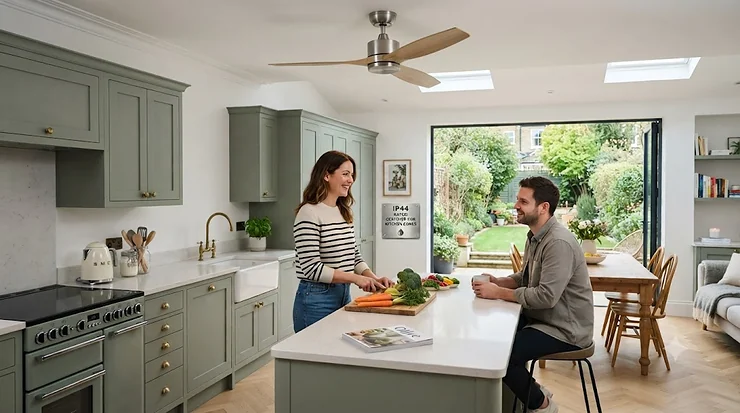
Somewhere between “it’s under a roof, so it’ll be fine” and “it rains sideways here every October,” most people buying an outdoor ceiling fan discover they’ve been asking the wrong question. It isn’t whether a fan is “outdoor rated” — plenty of marketing copy claims that loosely — it’s specifically whether it’s rated IP44 or IP54, and whether that rating actually matches where you’re hanging it. In short, IP44 vs IP54 ceiling fans comes down to this: IP44 protects against splashing water from any direction but assumes some shelter overhead, while IP54 adds genuine dust protection and copes better with driving rain and airborne moisture in a fully exposed spot. Get that distinction wrong and, at best, you’ve overpaid for protection you didn’t need; at worst, you’ve hung an under-rated fan somewhere British weather will eventually find its way into the motor housing.
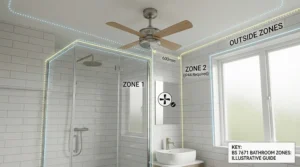
This guide compares seven real damp and wet-rated ceiling fans currently available to UK buyers, spanning budget picks for a covered patio through to premium wet-rated fans built for fully exposed pergolas and coastal gardens. We’ll cover pricing in ranges rather than exact figures, since prices shift too often to quote reliably, and we’ll walk through how IP ratings actually work, not just what the box says. It’s worth grounding this in UK conditions specifically: the Met Office records the UK experiencing well over 150 days of measurable rainfall in an average year, which is precisely why “it’s outdoor rated” is nowhere near specific enough a claim to install anything electrical on.
Quick Comparison Table
| Fan | IP Rating | Best Setting | Price Range | Best For |
|---|---|---|---|---|
| Depuley Outdoor IP44 Fan | IP44 | Covered patio, small conservatory | Under £100 | Budget-conscious, sheltered spots |
| reiga 52″ Smart IP44 Fan | IP44 | Covered patio, garden room | £90-£140 range | Budget-mid, fan plus light |
| reiga 72″ IP44 Fan | IP44 | Large covered veranda | £150-£220 range | Bigger sheltered spaces |
| Fantasia Palm 52″ IP54 | IP54 | Exposed pergola, open patio | £150-£190 range | Genuine weather exposure |
| Hunter Maribel IP44 Wet-Rated | IP44 | Fully exposed conservatory | £250-£350 range | Premium build, coastal-adjacent |
| Hunter Outdoor Element WBOD | IP44 | Large covered veranda | £300-£450 range | Colonial style, long warranty |
| KlassFan Modulo Exterior | IP44 | Exposed terrace, coastal garden | £280-£380 range | Smart control, anti-corrosion |
Scanning this table, the pattern worth noticing is that IP44 dominates the line-up — it’s genuinely the more common rating for domestic outdoor fans, since IP54’s extra dust-tightness matters most in gritty, sandy or genuinely exposed environments rather than a typical back garden. IP54 only earns its premium where a space is properly open to the elements — think an uncovered pergola rather than a roofed veranda — and buyers regularly over-spend on IP54 for spots that would have suited a cheaper IP44 fan perfectly well.
💬 Just one click — help others make better buying decisions too!😊
Top 7 Damp & Wet-Rated Ceiling Fans: Expert Analysis
1. Depuley Outdoor IP44 Ceiling Fan — most affordable genuine IP44 pick
For anyone whose outdoor space is a covered patio rather than a fully open terrace, the Depuley Outdoor answers the brief without overspending on protection you won’t use. It’s IP44 rated, meaning it’s tested against water splashed from any angle, and its 107cm diameter suits small-to-medium covered spaces without dominating the ceiling visually. Based on the spec comparison against premium rivals in this guide, the motor housing uses simpler sealing than something like the Hunter Maribel, which is exactly why it costs roughly a third of that fan’s price — a sensible trade-off if your patio has a solid roof overhead. Reviewers consistently note that the fan performs well for the price, with the main criticism being that airflow feels noticeably less powerful in spaces approaching the upper end of its coverage range. What most buyers overlook is that “IP44” on a budget fan means exactly the same tested protection as IP44 on an expensive one — the price difference reflects build quality and finish, not the water-resistance claim itself.
Pros:
- ✅ Genuine IP44 rating at a genuinely budget price
- ✅ Suits small-to-medium covered patios well
- ✅ Straightforward installation, no smart features to configure
Cons:
- ❌ Airflow feels weaker in larger covered spaces
- ❌ Basic finish compared with premium alternatives
Priced under £100, this is the clearest damp rated ceiling fans under £100 recommendation in this guide for a genuinely sheltered spot.
2. reiga 52″ Smart IP44 Ceiling Fan — best budget-mid pick with integrated light
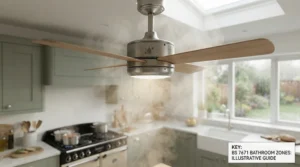
Sitting a notch above pure budget territory, the reiga 52″ pairs an IP44-tested motor with a dimmable LED light kit offering three colour temperatures, giving covered patio owners lighting and cooling from a single fixture. The six-speed DC motor is a genuine step up in refinement from basic single-speed budget fans, and reviewers consistently flag it as notably quiet even at higher speeds — a detail that matters more outdoors than you’d expect, since garden acoustics carry sound differently to an enclosed room. Here’s what to weigh: reiga markets this fan as suitable for “indoor/outdoor” use broadly, but the IP44 testing specifically implies covered outdoor placement rather than full exposure, so a sheltered pergola or roofed veranda is the sensible ceiling here rather than an open terrace. Aggregated customer sentiment highlights the remote control’s reliability and the lighting memory function (which retains your preferred brightness and colour temperature) as genuinely useful touches rarely found at this price point.
Pros:
- ✅ Integrated dimmable LED light with three colour temperatures
- ✅ Six-speed DC motor, quieter than typical budget fans
- ✅ Reversible airflow for both cooling and mild winter circulation
Cons:
- ❌ IP44 still requires a covered installation spot
- ❌ Remote range can be inconsistent at the edge of larger patios
Expect a price in the £90-£140 range depending on finish, making it a strong middle-ground pick between the cheapest options and full premium builds.
3. reiga 72″ IP44 Ceiling Fan — best for larger covered verandas
Where the 52″ model suits an average patio, the reiga 72″ scales up for genuinely large covered spaces — think a wide veranda or an open-sided garden room — with six aluminium blades and a reversible DC motor delivering the airflow volume smaller fans simply can’t manage. Based on the spec comparison, the larger blade sweep translates into meaningfully better air movement across a wide area without needing to run the motor at maximum speed constantly, which in turn means a quieter typical operating experience despite the fan’s size. The IP44 rating carries the same testing standard as the smaller reiga model, so the same rule applies: this suits a properly covered space, not one exposed to direct rain. Reviewers of the larger reiga fans consistently praise the timer function and six-speed control for fine-tuning airflow to the room, though a few note that a fan this size benefits from professional installation given its weight and the ceiling bracing required.
Pros:
- ✅ Genuinely strong airflow for large covered spaces
- ✅ Six-speed control with reversible motor for year-round use
- ✅ Timer function for automatic switch-off
Cons:
- ❌ Weight and size make professional installation advisable
- ❌ Overkill (and overspend) for a small patio
Typically priced in the £150-£220 range, this is a sensible upgrade once a smaller fan clearly can’t move enough air across your space.
4. Fantasia Palm 52″ Outdoor Ceiling Fan (IP54) — best for genuinely exposed patios
This is where the IP44 vs IP54 ceiling fans distinction stops being theoretical. The Fantasia Palm carries an IP54 rating specifically, meaning it’s tested for dust ingress as well as water splashed from all directions — a genuinely higher bar than IP44’s water-only testing. Fantasia, a British brand manufacturing ceiling fans since 1985, builds the Palm with a four-blade colonial design and acrylic blades that resist warping in humidity, paired with a virtually silent motor and a ten-year manufacturer motor guarantee. What most buyers overlook about IP54 fans specifically is that the rating matters most in spaces with genuine airborne dust or grit exposure — coastal gardens, gravelled patios, or pergolas without solid roofing — rather than a fully enclosed conservatory, where IP44 is already sufficient. Reviewers and UK installers consistently note this model withstands “years of British weather extremes” without the bearing failures common in cheaper alternatives, a meaningful claim given how many budget outdoor fans fail within a couple of wet seasons.
Pros:
- ✅ Genuine IP54 rating — dust and splash protection combined
- ✅ Ten-year manufacturer motor guarantee
- ✅ Acrylic blades resist warping in humid conditions
Cons:
- ❌ No remote control when used outdoors (only indoors, per manufacturer guidance)
- ❌ Premium price for the added IP54 protection
Priced in the £150-£190 range, this represents the sensible ceiling for a patio genuinely exposed to weather, rather than merely “outside.”
5. Hunter Maribel IP44 Wet-Rated Ceiling Fan — premium build for fully exposed conservatories
Hunter’s reputation in the UK ceiling fan market runs deep, and the Maribel is their answer to conservatories and garden rooms that get the full brunt of British weather — opening roof sections, condensation, and occasional direct rain. Despite being IP44 rather than IP54, Hunter’s own guidance is explicit that this specific model is wet-rated for genuine outdoor use, distinguishing it from Hunter’s other IP23 “damp-rated” fans, which are only suitable for covered, sheltered spots. Based on the spec comparison against budget IP44 fans in this guide, the difference isn’t the headline rating — it’s the sealing quality behind it, plus a motor built to Hunter’s wider reliability standards. Here’s what to weigh: professional installers frequently recommend the Maribel specifically for coastal or heavily exposed UK properties, where salt-laden air accelerates corrosion on lesser fans — a genuinely useful detail if you’re anywhere near the coast. Reviewer sentiment on Hunter’s premium range consistently praises long-term reliability over cheaper alternatives, which matters given how much more this fan costs upfront.
Pros:
- ✅ Genuinely wet-rated, not just “damp-rated” like Hunter’s other IP23 models
- ✅ Recommended by installers for coastal and heavily exposed properties
- ✅ Backed by Hunter’s long-standing UK reliability reputation
Cons:
- ❌ Significant premium over budget IP44 alternatives
- ❌ Overkill for a genuinely sheltered patio
Expect to pay in the £250-£350 range, positioning this firmly as a considered long-term investment rather than a casual purchase.
6. Hunter Outdoor Element WBOD — colonial-style pick with a 20-year motor warranty
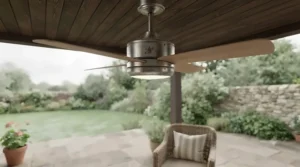
For a larger covered veranda or colonial-style outdoor space, the Hunter Outdoor Element WBOD pairs a bronze-finished motor with UV-treated teak-composite blades across a substantial 132cm span, suited to spaces roughly 25-40 square metres. It’s IP44 rated and can be installed on ceilings sloping up to 38 degrees, a detail that matters more than it sounds for anyone with an angled veranda roof rather than a flat ceiling. What the spec sheet won’t tell you outright is just how unusual a twenty-year motor warranty is in this category — most rivals, including several in this guide, offer ten years at best, and that warranty length alone signals real confidence in the build. The fan includes a summer/winter reversible function, genuinely useful for anyone whose covered veranda doubles as a three-season space rather than purely a summer spot. Reviewers highlight the self-balancing system, which minimises vibration even at higher ceiling heights — a common complaint with cheaper large-diameter fans.
Pros:
- ✅ Twenty-year motor warranty, unusually long for the category
- ✅ Installs on sloped ceilings up to 38 degrees
- ✅ Self-balancing system reduces vibration at speed
Cons:
- ❌ Among the most expensive fans in this guide
- ❌ Large 132cm span needs genuinely spacious coverage to suit
Priced in the £300-£450 range, this sits at the top end but is a defensible spend for a genuinely large, well-used outdoor space.
7. KlassFan Modulo Exterior — best smart, anti-corrosion pick for coastal gardens
The KlassFan Modulo Exterior takes a different approach entirely, building smart functionality — WiFi control, an integrated thermostat, and dimmable lighting — into an IP44-rated, anti-corrosion-treated housing specifically engineered for exposed and coastal conditions. Based on the spec comparison, the anti-corrosion treatment is the standout detail here: motors on standard outdoor fans can degrade faster near the coast due to salt-laden air, and KlassFan’s specific engineering around this issue is a genuine point of difference rather than marketing language. The fan’s built-in transformer allows it to connect directly to standard AC mains without a separate low-voltage setup, simplifying installation versus some smart outdoor fixtures that require additional wiring. What most buyers overlook with smart outdoor fans generally is that WiFi reliability outdoors depends heavily on router placement and garden layout — worth checking signal strength at the intended mounting point before committing to a smart model over a simpler remote-controlled alternative. Reviewer feedback on the Modulo range consistently praises the near-silent “hyper-silence” motor mode and the convenience of thermostat-controlled automatic operation.
Pros:
- ✅ Anti-corrosion treatment genuinely suited to coastal exposure
- ✅ WiFi and thermostat control for automatic operation
- ✅ Built-in transformer simplifies mains connection
Cons:
- ❌ WiFi reliability depends on garden router coverage
- ❌ Premium pricing reflects the smart feature set
Typically priced in the £280-£380 range, this is the pick for anyone prioritising smart convenience alongside genuine weather resilience.
Top 7 Products: Full Specification Comparison
| Fan | IP Rating | Size | Motor | Price Range | Best For |
|---|---|---|---|---|---|
| Depuley Outdoor IP44 Fan | IP44 | 107cm | Standard AC | Under £100 | Budget covered patio |
| reiga 52″ Smart IP44 Fan | IP44 | 132cm | 6-speed DC | £90-£140 | Budget-mid, fan plus light |
| reiga 72″ IP44 Fan | IP44 | 183cm | 6-speed DC | £150-£220 | Large covered veranda |
| Fantasia Palm 52″ IP54 | IP54 | 132cm | Silent AC | £150-£190 | Genuinely exposed patio |
| Hunter Maribel IP44 | IP44 | Varies | Wet-rated AC | £250-£350 | Fully exposed, coastal-adjacent |
| Hunter Outdoor Element WBOD | IP44 | 132cm | Bronze AC, 20yr warranty | £300-£450 | Large covered veranda |
| KlassFan Modulo Exterior | IP44 | Varies | Smart DC, anti-corrosion | £280-£380 | Coastal, smart control |
Reading across the table, the clearest signal is that price scales more with build quality, motor sophistication and warranty length than with the IP rating itself — several IP44 fans here cost more than the single IP54 model, precisely because IP54’s extra dust protection is a narrower requirement than general build durability. If your outdoor space is genuinely coastal or gritty, prioritise the Fantasia Palm or KlassFan Modulo Exterior; if it’s simply a roofed patio in an ordinary UK garden, most of the IP44 options here will serve you well without overspending.
✨ Don’t Miss These Exclusive Deals!
🔍 Take your outdoor space to the next level with any of the damp-rated fans above. Click through on a highlighted model to check today’s price and stock before committing — availability on outdoor fan ranges shifts noticeably as the weather warms up each spring.
IP Rating Chart Explained: What IP44, IP54 and Other Codes Mean
What is an IP rating? An IP (Ingress Protection) rating is a two-digit code defined by the international standard IEC 60529, where the first digit indicates protection against solid objects and dust, and the second indicates protection against water. IP44 means protection from solid objects over 1mm and water splashed from any direction; IP54 adds genuine dust protection alongside the same splash resistance.
Here’s how the ratings relevant to ceiling fans break down in practice:
| Rating | Solid/Dust Protection | Water Protection | Typical Ceiling Fan Use |
|---|---|---|---|
| IP20 | Basic, fingers/tools only | None | Indoor rooms only |
| IP23 | Basic | Light spray at an angle | Damp, sheltered covered spaces |
| IP44 | Objects over 1mm | Splashing from any direction | Covered patios, conservatories |
| IP54 | Dust protected | Splashing from any direction, plus dust | Exposed pergolas, coastal gardens |
| IP65 | Dust tight | Low-pressure water jets | Rarely needed for domestic ceiling fans |
Working through this chart, the practical takeaway for most UK gardens is that IP44 covers the majority of genuinely useful outdoor installations, and IP54 only becomes necessary once dust or grit exposure is a real factor alongside water — a distinction that’s easy to miss when browsing product listings that simply say “outdoor rated” without specifying which code applies.
IP44 vs IP54 Ceiling Fans: Which Should You Choose?
Boiling the whole IP44 vs IP54 ceiling fans question down to a single decision point: IP44 is correct for any outdoor space with a solid roof overhead — a proper veranda, covered patio, or conservatory with a sealed roof — since the rating’s splash protection handles blown rain and condensation without needing dust-tightness you’ll never test. IP54 earns its place specifically where a space is genuinely open above, such as an uncovered pergola with slatted rather than solid roofing, or where the location itself introduces dust and grit — coastal gardens with salt-laden air, or patios near gravel or dry countryside tracks. Here’s what to weigh: buying IP54 “to be safe” isn’t wrong, but it typically adds £50-£100 to the price for protection a covered space will never actually need, while under-buying with IP44 for a genuinely exposed, uncovered spot risks premature motor failure from sustained direct exposure. If you’re genuinely unsure which category your space falls into, the safer default leans toward IP54 rather than IP44 — the cost difference is generally smaller than the cost of replacing a motor that’s failed early from inadequate protection.
Covered vs Uncovered Patio Fan Requirements
The single biggest factor in choosing between IP44 and IP54 isn’t the fan at all — it’s whether your patio has a genuinely solid roof. A covered patio with a sealed, solid roof structure keeps direct rain off the fan entirely; what reaches the fan is splashback, blown moisture and humidity, which is exactly what IP44 is tested against. An uncovered patio, or one with a pergola-style slatted or retractable roof, exposes the fan to intermittent direct rainfall and, depending on location, wind-blown dust or garden debris — conditions that call for IP54’s added protection. A useful rule of thumb: if you could stand under the fan’s mounting point during moderate rain and stay completely dry, IP44 is very likely sufficient; if you’d get even lightly damp, lean toward IP54 or reconsider whether a ceiling fan is the right fixture for that spot at all. It’s also worth noting that fan placement relative to the roof edge matters — a fan mounted near an open side of a covered structure experiences meaningfully more weather exposure than one mounted centrally, even under an identical roof.
Installing a Damp Rated Ceiling Fan: A Practical Usage Guide
Getting a damp-rated fan installed correctly affects both its performance and its lifespan, so it’s worth doing properly from day one. Before purchase, measure your ceiling height and confirm downrod length suits your space — outdoor fans are frequently mounted higher than indoor equivalents, and an undersized downrod leaves the fan too close to head height. During installation, ensure the electrical supply feeding the fan is protected by a 30mA RCD, which is standard practice — and, per UK regulations, effectively mandatory — for any outdoor electrical circuit. In the first month of use, run the fan through its full speed range at least once to identify any unusual noise early, since minor installation issues (an unbalanced blade, a loose bracket) are far easier to fix before they become established vibration patterns. A common early mistake is leaving a fan running constantly through its first exposure to heavy rain “to test it” — instead, switch it off during genuinely severe weather even on a rated fan, since IP ratings describe resistance to specific test conditions, not indefinite endurance under storm-force rain. Finally, a light seasonal check of the blade fixings and motor housing for any sign of corrosion, particularly after winter, catches problems while they’re still a five-minute fix rather than a fan replacement.
Real-World Scenarios: Matching the Fan to Your Space
Rather than a single universal answer, the right choice genuinely depends on your specific outdoor space. Consider a family with a solid-roofed patio extension used for summer barbecues — here, a straightforward IP44 fan like the Depuley Outdoor or reiga 52″ covers the requirement completely, since the roof handles direct weather and the fan only needs splash protection from humidity and blown moisture. Compare that with a coastal property with an open pergola over the dining area — this genuinely calls for an IP54 fan like the Fantasia Palm, or a purpose-built anti-corrosion model like the KlassFan Modulo Exterior, given both the direct exposure and the accelerated corrosion risk from sea air. Then there’s a larger converted outbuilding or garden room with a solid but unheated roof, effectively a semi-outdoor space used year-round — a premium IP44 fan like the Hunter Maribel or Hunter Outdoor Element WBOD suits this profile well, since the priority shifts toward long-term reliability and warranty length over raw water resistance. Matching the fan to the actual exposure of your specific space, rather than assuming “outdoor” is a single category, is the single most useful step in this entire buying process.

Damp Rated Ceiling Fans Under £100: Best Budget Picks
Budget shouldn’t mean compromising on genuine IP44 certification, and thankfully it rarely has to — the Depuley Outdoor in this guide demonstrates that a properly tested rating is achievable under £100 without cutting corners on the specific thing that matters most: keeping water out of the motor. What you do sacrifice at this price point is typically airflow volume for larger spaces, smart features, remote range, and long-term warranty length compared with premium alternatives. For a small-to-medium covered patio used seasonally rather than year-round, this trade-off is entirely sensible; the fan does the one job it needs to do — move air safely in a splash-prone environment — without paying for features a casual user won’t notice missing. If you’re shopping specifically in this bracket, prioritise confirming the actual IP rating over trusting vague “weatherproof” or “outdoor suitable” marketing language, since not every budget listing is equally clear about which specific rating applies, and the difference between a genuinely tested IP44 fan and an untested “water-resistant” claim is significant for anything permanently wired outdoors.
Common Mistakes When Buying an Outdoor Ceiling Fan
The most frequent mistake is assuming any fan labelled “outdoor” automatically suits any outdoor space, when in practice the specific IP rating — and whether that rating matches covered or exposed conditions — is the detail that actually matters. A close second is under-estimating how exposed a space genuinely is; pergolas with slatted or retractable roofing are often mentally filed as “covered” when, from a weather-protection standpoint, they behave closer to fully exposed. Buyers also frequently overlook installation compliance, assuming any electrician-free DIY installation is fine outdoors, when UK regulations specifically require RCD protection and often notification for new outdoor circuits. Another common misstep is prioritising smart features or aesthetics over the actual rating and motor quality — a beautiful fan that fails within a wet season isn’t a bargain regardless of its original price. Finally, some buyers assume IP54 is simply “better” and worth the premium regardless of their specific space, when in fact a well-built IP44 fan correctly matched to a genuinely covered space will outlast an under-installed IP54 fan mounted incorrectly or wired without proper protection.
UK Weather Exposure Guidance for Outdoor Electricals
British weather is precisely why IP ratings matter more here than in drier climates — sustained damp, frequent light rain, and coastal salt exposure across large parts of the country all accelerate the failure of inadequately rated electrical fixtures. Beyond choosing the right fan, UK regulations set out specific requirements for any new outdoor electrical circuit: Part P of the Building Regulations requires that most new outdoor electrical work is either carried out by a registered electrician or notified to local authority building control, and BS 7671 (the UK wiring regulations) mandates RCD protection on outdoor circuits regardless of who installs them. Beyond the legal requirement, this genuinely matters for safety: a fault in an under-protected outdoor circuit poses a materially higher shock risk than an equivalent indoor fault, given how often people are in direct contact with damp ground nearby. Practically, this means budgeting for a qualified electrician’s time alongside the fan itself if you’re installing a new circuit rather than replacing an existing outdoor fitting like-for-like, and treating the fan’s IP rating as one part of a wider weatherproofing picture that includes correct cable specification, RCD protection and appropriate mounting height above ground level.
Long-Term Cost and Maintenance of Damp Rated Ceiling Fans
Total cost of ownership for an outdoor ceiling fan extends well beyond the purchase price, and it’s worth planning for that upfront. Motor warranty length varies enormously across this category — from standard one-to-two-year cover on budget fans through to the twenty-year warranty offered on the Hunter Outdoor Element WBOD — and a longer warranty period is a genuinely useful proxy for how confident the manufacturer is in long-term weather resistance. Routine maintenance is minimal but matters: an annual check of blade fixings, a wipe-down of the motor housing to prevent grime build-up, and prompt attention to any unusual noise, which often signals bearing wear before it becomes a full motor failure. Coastal properties should budget for more frequent inspection given accelerated corrosion risk, and may find that paying up for anti-corrosion-treated models like the KlassFan Modulo Exterior genuinely reduces total lifetime cost despite the higher purchase price. The single biggest cost-saving principle in this category is matching the rating correctly to the space in the first place — an under-rated fan that fails within two wet seasons costs more over time than a correctly specified fan that lasts a decade, however much cheaper it looked on the shelf.
Features That Actually Matter (And Those That Don’t)
Marketing copy on outdoor ceiling fans tends to foreground features that sound impressive but affect day-to-day performance less than the basics. Genuinely important: the correct, clearly stated IP rating for your specific space, motor warranty length as a proxy for build confidence, and blade material suited to your climate (acrylic and treated composites resist warping better than untreated wood in humid conditions). Less critical despite prominent marketing: exact blade count beyond four or five (airflow differences beyond this point are marginal for domestic use), app-based smart control if your garden WiFi coverage is patchy anyway, and elaborate finish options that don’t affect weather performance. A genuinely useful but under-marketed feature is a proper reversible motor function, which lets a fan aid air circulation in cooler months rather than sitting unused for three-quarters of the year — a detail that meaningfully improves the value case for an outdoor fan that might otherwise only earn its keep during a handful of warm British weeks. Ultimately, the rating and the installation quality behind it matter more to long-term satisfaction than any single headline feature on the box.

Frequently Asked Questions
❓ What's the actual difference between IP44 and IP54 ceiling fans?
❓ Can an IP44 ceiling fan get rained on directly?
❓ Do outdoor ceiling fans need a special electrical installation?
❓ Is IP54 always better than IP44 for outdoor use?
❓ How long do damp rated ceiling fans typically last?
Conclusion
Choosing between IP44 and IP54 ceiling fans ultimately comes down to being honest about how exposed your specific outdoor space really is, rather than defaulting to whichever rating sounds more impressive on the box. For a properly covered patio or conservatory, a well-built IP44 fan like the Depuley Outdoor or reiga models in this guide will serve for years without needing IP54’s extra dust protection. For genuinely open pergolas, coastal gardens, or spaces with real grit and dust exposure, stepping up to an IP54 fan like the Fantasia Palm, or a purpose-built anti-corrosion model like the KlassFan Modulo Exterior, is money well spent rather than unnecessary caution. Whichever rating suits your space, pair it with correct RCD-protected installation, and you’ve got an outdoor fan built to genuinely handle whatever a British summer — or the rain that inevitably interrupts it — throws at it.
✨ Ready to Kit Out Your Outdoor Space?
🌬️ Whichever rating suits your patio, click through on any of the fans above to check today’s availability and current price range. The right fan now means comfortable evenings outside for years, not a replacement after one wet season.
Recommended for You
- IP44 Rated Ceiling Fans Under £150: 7 Brilliant Picks for 2026
- 7 Best IP44 Rated Outdoor Ceiling Fans UK 2026
- 7 Best Budget Ceiling Fans Under £100 (2026 UK)
Disclaimer: This article contains affiliate links. As an Amazon Associate, I earn from qualifying purchases. If you purchase products through these links, we may earn a small commission at no additional cost to you.
✨ Found this helpful? Share it with your friends! 💬🤗
