
In This Article
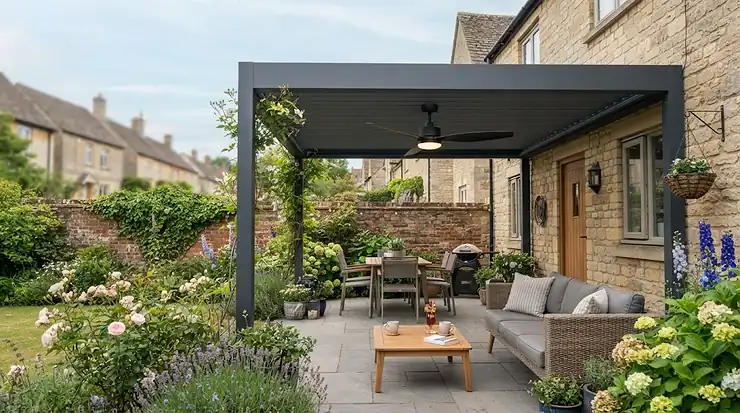
There’s a particular kind of stillness that settles over a garden at half six on a July evening — the kind where the wine’s gone warm, the ice has melted, and nobody’s moving because moving means sweating. If you’ve built a pergola, you already know the problem. You spent good money and several sore Saturdays putting up beautiful timber beams, and now the thing traps heat like a greenhouse with better Instagram potential. This is exactly where pergola ceiling fans earn their keep. They’re not a luxury bolt-on; they’re the difference between a pergola that gets used three evenings a week and one that becomes an expensive place to store garden furniture. A pergola ceiling fan is simply a wet or damp-rated ceiling fan engineered to hang from open beams or slatted roofing outdoors, moving enough air to drop the “feels like” temperature by several degrees without a single watt of refrigerant. Given that the Met Office confirmed 2025 as the UK’s warmest summer on record, with that heat trend expected to continue, treating pergola airflow as an afterthought is starting to look like a false economy. This guide walks through seven genuinely available pergola ceiling fans, how they stack up against ordinary patio fans, what your beam spacing needs to look like before you drill a single hole, and how to wire the whole thing without falling foul of UK electrical regulations. No fluff, no invented five-star reviews — just the research, laid out plainly.

Quick Comparison Table
Before diving into the full breakdown, here’s the short version for anyone in a hurry. This table ranks the seven fans by their standout strength rather than a single “best overall” — because the right pergola ceiling fans for a 3x3m aluminium frame and a rambling 6m oak structure are rarely the same fan.
| Fan | Size | Control | IP Rating | Best For |
|---|---|---|---|---|
| Depuley 52-Inch Outdoor Ceiling Fan | 52″ | App + remote | IP65 | Large pergolas on a budget |
| Fanbulous 24-Inch Smart Gazebo Fan | 24″ | App + remote | IP65 | Colourful mood lighting |
| Fantasia Palm 52-Inch | 52″ | Pull cord | IP54 | Traditional British gardens |
| Westinghouse Deacon 52-Inch | 52″ | Pull cord/wall switch | Wet-rated | Classic hardwired installs |
| Westinghouse Oasis 48-Inch | 48″ | Pull cord/wall switch | Wet-rated | Smaller covered pergolas |
| AHAWILL 20-Inch | 20″ | App + remote | Wet-rated | Compact corners, seating nooks |
| EDISHINE 52-Inch | 52″ | App + remote | IP65 | Maximum airflow, open structures |
Reading across this table, a pattern emerges quickly: plug-in app-controlled fans (Depuley, Fanbulous, AHAWILL, EDISHINE) suit renters and anyone who’d rather avoid an electrician’s callout fee, while the two Westinghouse models and the Fantasia Palm are built for a proper hardwired installation with a switched fused connection unit. Neither approach is objectively better — it comes down to whether your pergola already has power run to it, and whether you’re after a permanent fixture or something you could theoretically take with you if you move house.
💬 Just one click — help others make better buying decisions too!😊
Top 7 Pergola Ceiling Fans: Expert Analysis
Every model below is a real, currently available product. Prices shift constantly, so treat the ranges here as a guide for research purposes rather than gospel — always check the current price on the product page before buying.
1. Depuley 52-Inch Outdoor Ceiling Fan — best value large-space smart fan
The headline feature here is coverage: Depuley pitches this fan at spaces roughly 161 to 215 square feet, which comfortably spans most standard UK pergolas without needing a second fan at the far end. It runs on a six-speed reversible DC motor, meaning you can flip the airflow direction in winter to push warm air back down rather than mothballing the fan from October to April. The dimmable 3CCT light shifts between warm and cool white, which matters more than it sounds — a pergola used for dinner parties wants warm light, while one doubling as a home-office extension in summer wants something closer to daylight. Based on the spec comparison with similarly sized hardwired fans, what stands out about the Depuley 52-Inch is that it’s plug-in only, so there’s no electrician needed if you already have a weatherproof outdoor socket within cable reach. Reviewers consistently note that the app pairing process is fiddlier than the remote, and a handful mention the light’s colour temperature memory resetting after a power cut — a minor niggle rather than a dealbreaker. Aggregated buyer sentiment for this category of plug-in gazebo fan tends to praise the airflow-to-price ratio specifically; people expect a budget-friendly fan to feel weak, and this one generally doesn’t.
Pros:
- ✅ Covers large pergola footprints without a second unit
- ✅ Reversible motor extends usefulness into cooler months
- ✅ No hardwiring required if a socket is nearby
Cons:
- ❌ App connectivity reportedly needs a firmware update on first use
- ❌ Light settings can reset after a power interruption
Expect this fan to sit around £120-£160 depending on finish and whether the light kit is included — solid value for a 52-inch span, and the “check current price” caveat applies here more than most, since Depuley runs frequent promotional bundles.
2. Fanbulous Smart Gazebo Fan — brightest lighting, easiest app control
If the Depuley is the sensible choice, the Fanbulous is the one that gets a reaction from guests. Its standout feature is the RGB lighting ring, which turns the fan into ambient party lighting as much as a cooling device — genuinely useful if your pergola doubles as an evening entertaining space rather than a purely functional shade structure. The caged design isn’t just decorative; it’s a real safety consideration if you’ve got kids or a boisterous dog running underneath, since the blades sit fully enclosed rather than exposed. On paper, this means slightly reduced airflow efficiency compared with an open-blade design of the same diameter, because the cage introduces a small amount of resistance — but in practice, at a 20-inch to 24-inch span, that trade-off is barely noticeable against the safety upside. What most buyers overlook about caged gazebo fans generally is that the 3CCT dimmable light usually draws more current than the motor itself, which matters if you’re running it off a modest extension circuit. Reviewers consistently mention the app’s scene presets (a set colour-and-speed combination you can trigger with one tap) as a genuine convenience rather than gimmick, though a recurring complaint in user reviews concerns Bluetooth range dropping out beyond roughly eight metres from a router.
Pros:
- ✅ RGB lighting doubles as garden party ambience
- ✅ Caged blades are safer around children and pets
- ✅ App scene presets are genuinely convenient
Cons:
- ❌ Caged design trims a little airflow efficiency
- ❌ Bluetooth/app range can be inconsistent at distance
Pricing typically sits in the £70-£100 range for the compact sizes, making it one of the more accessible entries here — a sensible starter fan if you’re not yet sure how much use your pergola will actually get.
3. Fantasia Palm 52-Inch — best classic British-brand choice
Fantasia has been making ceiling fans in the UK since 1985, and the Palm is their answer to the “I want this to look intentional, not bolted on” brief. The Colonial-style acrylic blades in natural brown genuinely do read as furniture rather than equipment, which is worth something if your pergola sits somewhere you can see it from the kitchen window year-round. It carries an IP54 rating — protected against dust and splashing water from any direction, which is the sensible minimum for anything mounted under an open or partially open pergola roof. Here’s what to weigh: the Palm is pull-cord operated by default, giving you three fixed speeds rather than the stepless control you’d get from a DC app-controlled fan, and while it can be upgraded to remote control, that remote itself isn’t IP rated, so it’s genuinely indoor-use-only — a detail that catches people out. The spec sheet won’t tell you this, but user reports suggest the AC motor hums slightly more than the DC motors used in the Depuley or EDISHINE, which some buyers barely notice and others find mildly irritating on the top speed. For anyone who values a recognised UK brand with a genuine service history over the newest smart features, this is the one to shortlist.
Pros:
- ✅ Long-established UK brand with proven longevity
- ✅ IP54-rated, genuinely suitable for open pergola use
- ✅ Natural acrylic blades look like furniture, not equipment
Cons:
- ❌ Pull-cord control only unless upgraded (and that remote is indoor-only)
- ❌ AC motor is audibly louder than DC alternatives on high speed
Expect a price in the £150-£220 range depending on the light-kit variant — a fair premium for the brand pedigree and finish quality over the newer Chinese-manufactured plug-in fans on this list.
4. Westinghouse Deacon 52-Inch — best traditional wet-rated design
Westinghouse is a genuinely global lighting brand, and the Deacon is built specifically for wet locations — patios, verandahs, and gazebos, per the manufacturer’s own applications listing. The oil-rubbed bronze finish paired with dark walnut weatherproof blades gives it a heavier, more traditional look than the plug-in gazebo fans further up this list, and that’s very much the point: this is a fan designed to look like it’s always been there, hardwired into a proper lighting circuit rather than dangling from an extension lead. Key spec worth flagging: it’s compatible with Westinghouse’s damp-location light kits, so you can add illumination later without buying an entirely new fixture. Based on the spec comparison with the app-controlled fans on this list, what most buyers overlook about the wet-rated category specifically is that “wet-rated” is a genuinely higher bar than the IP44/54 splash ratings common on cheaper fans — it means the fixture is tested to withstand direct rainfall, not just splashing, which matters enormously if your pergola has an open lattice roof rather than a solid or louvred one. Aggregated review sentiment for this fan and its siblings in the Westinghouse outdoor range tends to highlight motor quietness and finish durability as the standout strengths, with occasional notes that installation requires a competent electrician rather than a DIY plug-and-play setup.
Pros:
- ✅ Genuine wet-rating, not just splash-resistant
- ✅ Traditional finish suits period or cottage-style gardens
- ✅ Expandable with matching damp-location light kits
Cons:
- ❌ Requires hardwiring by a qualified electrician
- ❌ Traditional styling won’t suit a modern minimalist pergola
Budget around £180-£250 for the fan itself, before factoring in installation — a hardwired fan is never just the sticker price, and that’s worth remembering when comparing it against the plug-in options above.
5. Westinghouse Oasis 48-Inch — best for smaller pergolas with light
The Oasis is the Deacon’s slightly smaller, more decorative sibling — same wet-location engineering, but built around an Arts and Crafts aesthetic with leaf-design mahogany-finish blades and an integrated LED light bulb included in the box. The 48-inch span makes it a smarter fit for compact pergolas (think 2.5m x 3m rather than a sprawling entertaining deck), where a full 52-inch fan can start to feel oversized relative to the headroom. Key spec with real-world meaning: the included LED bulb is a genuine cost saving over buying a separate outdoor-rated light fitting, and it’s a detail easy to miss when comparing raw fan specs across brands. Here’s what to weigh — the leaf-blade design is undeniably decorative, but decorative blade shapes can move marginally less air than a plain aerofoil blade of the same span, so if raw cooling power is your only priority, the plainer Depuley or EDISHINE will likely outperform it inch-for-inch. Reviewers consistently frame this fan as a “looks and light” purchase rather than a pure performance one, which tracks with how Westinghouse positions it in their own outdoor range.
Pros:
- ✅ Includes an LED light bulb, saving a separate purchase
- ✅ Compact 48-inch span suits smaller pergola footprints
- ✅ Wet-rated for genuine outdoor exposure
Cons:
- ❌ Decorative leaf blades trade a little raw airflow for style
- ❌ Still requires professional hardwiring
Price typically falls between £160-£230, putting it just under the Deacon — sensible if your pergola is on the smaller side and you don’t need the extra blade span.
6. AHAWILL 20-Inch Outdoor Ceiling Fan — lightest, best for compact corners
Not every pergola is a full entertaining pavilion — plenty of UK gardens have a modest 2m x 2m corner structure over a bench or a small dining set, and that’s exactly where the AHAWILL earns its place on this list. At just 20 inches, it’s sized for spaces around 20-25 square feet, which sounds small until you remember that’s roughly the footprint of a compact two-seater pergola nook. The copper DC motor is worth calling out specifically: copper-wound motors typically run cooler and quieter over long periods than the cheaper aluminium-wound alternatives found in some budget fans, which matters for something that might run for hours on a summer evening. It’s plug-in with an 8.2-foot cord, dimmable across a warm-to-cool colour range, and controllable via both remote and app. What most buyers overlook about compact fans like this one is that airflow scales roughly with the square of the blade diameter, so a 20-inch fan genuinely can’t compete with a 52-inch model on raw cooling power — it’s simply a different tool for a different scale of space, not a weaker version of the bigger fans on this list.
Pros:
- ✅ Purpose-built for small pergola nooks and corners
- ✅ Quiet, cooler-running copper DC motor
- ✅ Simple plug-in installation with generous cord length
Cons:
- ❌ Limited airflow coverage compared with 48-52 inch fans
- ❌ Six-speed range feels less useful on such a compact blade span
Expect a price around £60-£90, making this the most accessible entry point on the list for anyone testing whether a pergola fan is worth the investment at all.
7. EDISHINE 52-Inch Outdoor Ceiling Fan — best raw airflow for large open pergolas
For genuinely large, open-sided pergolas — the kind with no walls at all, just posts and beams — raw airflow matters more than styling, and the EDISHINE is built around exactly that priority. It shares the six-speed reversible DC motor architecture common to the better plug-in fans on this list, paired with a full 52-inch blade span and app-plus-remote control. The matte black finish is deliberately neutral, designed to disappear against dark timber or powder-coated aluminium framing rather than draw attention to itself. Based on the spec comparison with the more decorative options here, what stands out about the EDISHINE is that it’s engineered as a workhorse rather than a showpiece — dimmable LED lighting is included, but the marketing and design language is squarely focused on CFM (cubic feet per minute of air moved) rather than aesthetics. Reviewers in this fan’s category consistently note that open-sided pergolas benefit disproportionately from higher airflow fans, since there’s no wall to trap and recirculate the breeze the way a partially enclosed structure would. If your pergola is more “outdoor room” than “sheltered nook,” this is the fan worth prioritising over anything smaller.
Pros:
- ✅ Full 52-inch span built for maximum air movement
- ✅ Neutral matte black finish suits most pergola materials
- ✅ Reversible DC motor for year-round use
Cons:
- ❌ Overkill for smaller or partially enclosed pergolas
- ❌ Less decorative than the Fantasia or Westinghouse ranges
Price generally lands in the £130-£180 range — solidly mid-market, and arguably the best pounds-per-CFM figure on this list for open, unsheltered structures.
Practical Usage Guide: Installing and Getting the Most from Your Fan
Buying the right fan is half the job. The other half is installing it properly and not making the same mistakes almost everyone makes in the first month. Before switching anything on, confirm your beam or mounting point can genuinely bear the fan’s weight in motion — a static hook test isn’t enough, since a spinning fan introduces vibration load that a simple hanging weight doesn’t replicate. For plug-in models like the Depuley or AHAWILL, route the cable so it’s never pooling water at a low point; even IP65-rated plugs shouldn’t be treated as fully submersible. Pair the app with your home wifi before mounting the fan at height — it’s far easier to troubleshoot a Bluetooth handshake standing on solid ground than balanced on a stepladder. In the first 30 days, the most common mistake is running a new DC motor fan flat-out on the highest speed constantly; most manufacturers recommend a gentle break-in period on lower settings to seat the bearings properly. Set a seasonal maintenance reminder: wipe blades every six to eight weeks during pollen season, check that any pull-cord mechanism moves freely, and — for hardwired models like the Westinghouse Deacon — have an electrician test the RCD protection annually, since outdoor circuits see far more wear than indoor ones. One optimisation trick that rarely appears on Amazon listings: running the fan on its lowest setting continuously, rather than switching it fully off between uses, keeps air moving enough to discourage wasps and midges from settling under the pergola roof — a small win that has nothing to do with cooling at all.
Real-World Scenarios: Matching a Fan to Your Setup
Abstract specs only get you so far, so here are three genuinely common UK pergola situations and the reasoning behind a sensible pick for each. First: a young couple with a compact 2.5m x 2.5m aluminium pergola over decking, used mainly for morning coffee and the occasional evening drink — for this footprint and light usage pattern, the AHAWILL 20-Inch makes more sense than anything larger, since the space simply doesn’t need 52 inches of blade span, and the lower price frees up budget for decent outdoor furniture instead. Second: a family that’s turned a large 4m x 5m oak pergola into their main summer dining and entertaining space, hosting barbecues most weekends from May through September — here the calculus flips entirely, and either the Depuley 52-Inch or the EDISHINE 52-Inch earns its keep through sheer airflow coverage, with the Depuley‘s superior lighting flexibility edging it ahead for anyone who eats outdoors after dark regularly. Third: a homeowner in a period cottage with a traditional timber pergola who cares more about the garden looking “finished” than about smart-home features — for this profile, the Fantasia Palm or Westinghouse Deacon fit the brief precisely, trading app connectivity for a finish and pedigree that won’t look dated in five years’ time. None of these are rigid rules; they’re a starting framework for narrowing seven options down to two or three worth comparing properly on the actual product pages.
Problem → Solution: Common Pergola Cooling Headaches
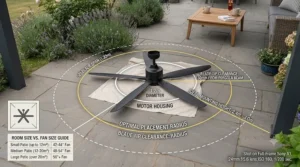
A handful of issues come up again and again once people actually start using pergola ceiling fans, so it’s worth addressing them directly. Problem one: the fan moves air but the space still feels stifling, usually because the pergola roof is fully solid rather than slatted, trapping rising heat with nowhere to escape — the fix here isn’t a stronger fan, it’s adding roof ventilation or switching to a louvred panel if the structure allows it. Problem two: insects seem to gather more, not less, once the fan’s installed — counterintuitively, a fan running too slowly can actually create a pocket of still, warm air at its edges that attracts midges, so nudging the speed up one notch usually solves it. Problem three: the remote or app stops responding reliably after a few weeks — nine times out of ten this is a wifi range or Bluetooth interference issue rather than a fan fault, and repositioning a home router or adding a mesh extender near the garden door usually resolves it faster than contacting support. Problem four: condensation or light moisture appears inside a plug-in connector after heavy rain — this is a genuine safety issue, not a cosmetic one, and the solution is always the same: disconnect immediately, dry thoroughly, and consider a weatherproof IP-rated enclosure for the plug itself rather than relying on the fan’s own rating alone. Problem five: the fan feels underpowered despite being the “right” size on paper — often this comes down to open-sided versus partially enclosed structures; a fan rated for a given square footage assumes some degree of enclosure, so a fully open pergola may need sizing up a notch from what the manufacturer’s coverage chart suggests.
How to Choose Pergola Ceiling Fans
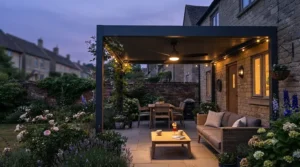
What is a pergola ceiling fan? A pergola ceiling fan is a weather-rated ceiling fan, typically IP44 or higher, engineered to mount on open or partially covered outdoor beam structures. Unlike standard indoor fans, its motor housing, wiring, and blade materials are built to resist moisture, UV degradation, and temperature swings without corroding or seizing.
Choosing between the seven fans above (or any others you find during your own research) comes down to working through these criteria in order:
- Measure your actual coverage area first. A fan sized for 100 square feet in a 200-square-foot pergola will always feel weak, regardless of how good the reviews are.
- Check the IP or wet rating against your roof type. A fully open lattice roof needs a genuine wet rating, not just splash resistance, because rain hits the fixture directly.
- Decide on plug-in versus hardwired before you fall in love with a fan. This single decision eliminates roughly half the market immediately and saves wasted research time.
- Weigh blade material against your local conditions. Coastal gardens should lean toward corrosion-resistant finishes over untreated metal, given salt-air exposure.
- Confirm control type matches how you’ll actually use it. App control sounds appealing until you’re standing outside with wet hands trying to unlock a phone; a pull cord or physical remote sometimes wins on pure practicality.
- Factor in light output separately from fan performance. Some of the strongest movers of air, like the EDISHINE, treat lighting as an afterthought; if ambience matters more to you, prioritise it explicitly.
- Budget for installation, not just the unit price. A £180 hardwired fan with a £150 electrician’s callout costs more than a £160 plug-in model — do that maths before deciding.
| Comparison Point | Budget Pick | Mid-Range Pick | Premium Pick |
|---|---|---|---|
| Model | AHAWILL 20-Inch | Fanbulous Smart Gazebo Fan | Westinghouse Deacon 52-Inch |
| Price Range | Under £90 | £70-£100 | £180-£250 |
| Installation | Plug-in | Plug-in | Hardwired |
| Best For | Small nooks | Entertaining with mood lighting | Permanent, traditional installs |
Looking at this three-tier breakdown, the real dividing line isn’t price at all — it’s installation type and coverage area, which is why jumping straight to “which is the best fan” without measuring your space first tends to produce buyer’s remorse.
✨ Don’t Miss These Exclusive Deals!
🔍 Take your outdoor entertaining space to the next level with these carefully selected fans. Click on any highlighted pick above to check current pricing and availability. These fans will help you create genuinely usable outdoor evenings your family and friends will actually want to hang around for!
Patio Ceiling Fan vs Pergola Fan
These two terms get used interchangeably online, and that’s a genuine source of confusion when you’re trying to search for the right product. A patio ceiling fan is usually mounted under a solid, permanent roof structure — an extension, a solid-roofed veranda, or a covered patio with proper eaves — and while it needs to handle humidity, it rarely faces direct rainfall. A pergola fan, by contrast, is frequently mounted beneath open beams, slatted roofing, or a partially retractable canopy, meaning it’s exposed to considerably more direct weather. In practice this means the IP rating bar is higher for genuine pergola use than for a sheltered patio: a splash-resistant IP44 fan might be entirely adequate under a solid patio roof but genuinely undersized for an open pergola lattice that lets rain straight through. There’s also a structural difference worth noting — patios typically offer a solid ceiling joist or ceiling rose to mount into, whereas pergola beams are often more widely spaced and may need a mounting bracket spanning two beams rather than fixing directly into one. If you’re shopping using “patio ceiling fan” as a search term but actually have an open pergola, it’s worth double-checking the specific wet rating on any product you’re considering rather than assuming patio-rated automatically means pergola-rated — the two aren’t always the same thing, even though retailers frequently blur the distinction in product titles.
Pergola Fans for Outdoor Entertaining
If your pergola’s main job is hosting people rather than just providing shade, a few extra considerations move up the priority list. Noise matters far more during a dinner party than it does when you’re pottering about the garden alone — a fan that hums audibly on high speed becomes genuinely distracting once six people are trying to hold a conversation underneath it, which is one reason the DC motor fans on this list (Depuley, Fanbulous, AHAWILL, EDISHINE) tend to suit entertaining spaces better than AC alternatives. Lighting control becomes a real feature rather than a nice-to-have: being able to dim from bright white for serving food down to warm amber for after-dinner drinks, without getting up to fiddle with a separate lamp, genuinely changes how an evening feels. Multiple-fan setups are worth considering for pergolas over roughly 20 square metres — rather than one oversized fan straining to cover the whole space, two mid-sized fans (say, two Fanbulous units at either end) often distribute airflow more evenly and let you run just one on quieter occasions. Finally, think about sound from the app itself: some smart fans chime or vibrate their phone notification on schedule changes, which is exactly the kind of thing nobody notices in a shop but everybody notices halfway through a barbecue.
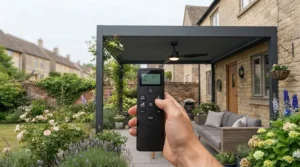
Pergola Beam Spacing
Fan installation and beam spacing are more connected than most buyers realise, and it’s worth understanding the basics even if you’re hiring someone to do the actual fitting. Standard UK pergola construction typically spaces main beams somewhere between 400mm and 600mm apart for a rafter-style roof, though this varies considerably depending on timber section size and whether the structure is load-bearing for climbing plants as well. A ceiling fan mounting point generally needs a single solid beam or a properly fitted noggin (a horizontal timber brace fixed between two joists) capable of supporting several times the fan’s static weight, to account for vibration and wind load during operation — this is exactly the kind of structural check that shouldn’t be skipped, regardless of how straightforward the fan’s own installation instructions look. According to the Planning Portal’s official guidance, most domestic pergolas fall under permitted development rights and don’t need planning permission — but that’s a separate question from whether the structure is engineered to carry additional fixed weight like a ceiling fan, which is a matter of building competence rather than planning law. If your pergola was bought as a flat-pack kit rather than custom-built, check the manufacturer’s maximum point-load rating before assuming it can take a fan at all; some lighter aluminium kit pergolas are explicitly rated for lighting only, not for anything with a motor and moving blades.
Fan Wiring for Outdoor Timber Structures: Safety & Compliance
This is the section to read properly even if you skim everything else, because outdoor electrics carry genuinely higher stakes than the indoor equivalent. Any new electrical circuit installed for a hardwired pergola fan — like the Westinghouse Deacon or Westinghouse Oasis — is notifiable work under Part P of the Building Regulations in England and Wales, meaning it should be carried out or certified by a registered competent person rather than attempted as a casual DIY job. Every outdoor circuit, without exception, needs 30mA RCD protection, whether that’s built into your consumer unit, a dedicated RCBO, or, for simpler retrofit situations, an RCD-protected socket outlet. Electrical Safety First’s own garden safety guidance is unambiguous on this point: water and electricity genuinely don’t mix, and the risk of a fatal shock outdoors is measurably higher than indoors because damp ground and wet skin both reduce electrical resistance. For plug-in fans like the Depuley or AHAWILL, this doesn’t mean you’re exempt from thinking about safety — the socket itself still needs to be a genuinely outdoor-rated, RCD-protected unit, not an indoor socket accessed via a trailing extension lead threaded out through a door. Cable routed through or along a timber structure should be mechanically protected, kept clear of anywhere it could be pierced by a screw or nail during future maintenance, and never left in standing water at a low point. If in doubt on any of this, the cost of a qualified electrician’s assessment is trivial compared with the cost of getting it wrong.
Entertaining Space Cooling Ideas
A ceiling fan is the highest-impact single addition, but it works best as part of a wider approach rather than in isolation. Shade management matters more than most people assume — even a well-specified fan struggles to overcome direct afternoon sun beating through a sparse pergola roof, so pairing the fan with a retractable canopy, shade sail, or well-established climbing plant cover genuinely multiplies its effectiveness. Ground-level airflow helps too: a portable oscillating fan positioned at seating height, working alongside the overhead unit rather than instead of it, tackles the layer of warm air that tends to pool just above head height on very still evenings. Evaporative elements — a small water feature, or even a simple mist attachment on a hose — can meaningfully drop perceived temperature in low-humidity conditions, though this matters less in the UK’s generally damp climate than it would somewhere like Spain or southern France. Colour and material choices play a quieter role too: dark-stained decking and dark cushion fabrics absorb noticeably more heat than lighter equivalents, so a lighter palette underneath the pergola reduces the ambient heat the fan has to work against in the first place. None of these replace a decent fan, but combined with one, they’re the difference between a pergola that’s merely tolerable in a heatwave and one that’s genuinely pleasant to sit in.
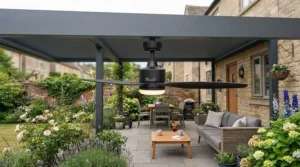
Common Mistakes When Buying Pergola Ceiling Fans
The single most common mistake is buying based on diameter alone without checking the wet rating — a gorgeous 52-inch fan that’s only splash-resistant will corrode or fail within a season or two under a genuinely open pergola roof, regardless of how much airflow it promises on the box. Close behind is underestimating installation cost for hardwired models; people compare the Westinghouse Deacon‘s sticker price directly against the Depuley‘s without factoring in that one needs a qualified electrician and the other needs a plug socket, which skews the real cost comparison considerably. A third recurring error is buying a fan sized for the pergola’s footprint without accounting for how open or enclosed the structure actually is — an open-sided pergola loses airflow to the surrounding garden in a way an enclosed patio never does, so the manufacturer’s stated coverage figures should generally be treated as a best-case scenario rather than a guarantee. Fourth, people frequently overlook noise levels entirely until the fan’s already installed and running during a dinner party, at which point AC motor hum becomes impossible to ignore; testing decibel claims against genuine buyer feedback before purchase avoids this. Finally, a subtler mistake: choosing a fan purely on smart features without checking whether the app actually works reliably at typical garden-to-router distances in the UK, where solid brick walls and standard wifi routers don’t always reach comfortably to the bottom of a garden.
Long-Term Cost & Maintenance
Total cost of ownership for a pergola ceiling fan extends well past the purchase price, and it’s worth running the numbers before committing to any single model. A DC motor fan, like the Depuley or EDISHINE, typically uses meaningfully less electricity per hour of runtime than an older-style AC motor fan such as the Fantasia Palm, which adds up over a full summer of regular evening use, even though the difference per hour is small. Hardwired fans carry a higher upfront cost once installation is included, but they also tend to last longer in situ, since a properly wired, RCD-protected circuit removes the wear-and-tear risk that comes from repeatedly plugging and unplugging an outdoor connector across a damp UK autumn. Maintenance costs are generally low across the board — an annual visual check, occasional blade cleaning, and (for hardwired models) a periodic RCD test are the bulk of it — but replacement parts availability varies by brand, and a well-established name like Westinghouse or Fantasia is more likely to still stock compatible spares in three or four years’ time than a newer plug-in brand that may have moved on to a different model range entirely. Factor in, too, that a genuinely wet-rated fan left permanently outdoors will simply survive longer than a splash-rated one pushed slightly beyond its intended use case, meaning the cheaper fan on paper isn’t always cheaper across a five-year horizon once early replacement is factored in.
Safety, Regulations & Compliance Guide
Beyond the wiring detail already covered, a few compliance points are worth summarising in one place. Any structural alteration to support a heavier fan fixture, if it involves changing the pergola’s roof or load-bearing beams significantly, may edge outside simple permitted development and into territory where building regulations apply — this is separate from planning permission and worth checking with a local building control body if your pergola project involves anything beyond a straightforward fan retrofit onto existing beams. All outdoor light fittings and fan-mounted lighting should carry a genuine IP rating appropriate to their mounting position, not just a manufacturer’s general “suitable for outdoor use” claim, since UK trading standards distinguish between marketing language and tested IP certification. If your property is in a conservation area or is a listed building, additional restrictions may apply even to something as apparently minor as a ceiling fan installation, particularly if visible cabling or a mounting bracket would alter the external appearance of a protected structure. Finally, always retain the electrical installation certificate from whoever carries out hardwired work — beyond being sensible practice, it’s frequently requested during home sales, and its absence has been known to hold up conveyancing on properties with visible garden electrics.

FAQ
❓ Do pergola ceiling fans need to be waterproof?
❓ Can I install a pergola ceiling fan myself?
❓ What size fan do I need for my pergola?
❓ How much does a pergola ceiling fan cost to run?
❓ Will a pergola fan work in winter too?
Conclusion
Pergola ceiling fans sit in that satisfying category of home improvement where a relatively modest spend genuinely changes how often you use an existing space. Whether that means the budget-friendly reach of the AHAWILL 20-Inch for a small seating nook, the raw airflow of the EDISHINE 52-Inch for a sprawling open structure, or the traditional pedigree of the Westinghouse Deacon for a garden that’s meant to look finished rather than fitted-out, the right choice comes down to honestly measuring your space, understanding your beam structure, and being realistic about whether you want a plug-in fan or a proper hardwired installation. None of that requires guesswork — the specs, IP ratings, and wiring rules covered here should be enough to shortlist two or three genuine contenders rather than scrolling endlessly through search results. Get the beam spacing checked, get the wiring done properly if you’re going hardwired, and the rest is simply choosing the finish that suits your garden.
Recommended for You
- Ceiling Fans for Covered Patios: 7 Best Picks for 2026
- Patio Ceiling Fans 2026: 7 Best Outdoor Fans
- Waterproof Ceiling Fan IP54 with Remote: 7 Best Picks 2026
Disclaimer: This article contains affiliate links. As an Amazon Associate, I earn from qualifying purchases. If you purchase products through these links, we may earn a small commission at no additional cost to you.
✨ Found this helpful? Share it with your friends! 💬🤗
