
In This Article
Remember stumbling across your bedroom in the dark, desperately reaching for that elusive pull cord whilst half-asleep? Or worse, realising the remote’s batteries died precisely when you need to turn the fan down during a particularly muggy August evening in Birmingham? Those days are mercifully ending.

Voice command ceiling fans have transformed from novelty gadgets into genuinely practical home essentials throughout Britain. What started as a luxury feature for tech enthusiasts has evolved into an accessible upgrade that makes daily life considerably more comfortable—particularly for UK households juggling the peculiar British climate that swings from damp and dreary to unexpectedly sweltering.
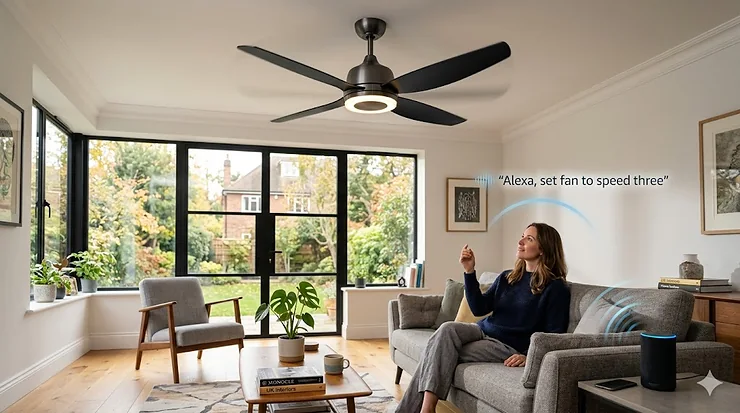
The technology works remarkably well in practice. Simply say “Alexa, set the bedroom fan to speed three” or “Hey Google, turn off the lounge fan,” and it happens. No apps to open, no remotes to locate, no switches to reach. This touchless ceiling fan control proves especially valuable when you’re carrying laundry, cooking Sunday roast, or already tucked beneath the duvet. According to UK government consumer guidance, smart home devices can reduce household energy consumption by up to 15% when used strategically—and voice-enabled fans sit comfortably within that category.
For British homes specifically, these hands free ceiling fan control systems address unique challenges. Our compact living spaces—particularly in period terraced housing and modern flats—mean ceiling height and installation flexibility matter enormously. Voice control eliminates the need for wall switches that require electrician installation or visible wiring that clashes with original Victorian mouldings. This guide examines seven exceptional voice activated ceiling fan models available on Amazon.co.uk in 2026, each offering distinct advantages for different UK households and budgets.
Quick Comparison Table: Top Voice Command Ceiling Fans
| Model | Size | Voice Control | Price Range (£) | Best For |
|---|---|---|---|---|
| NIORSUN Smart LED | 50cm (20″) | Alexa, Google | £69-£89 | Budget-conscious buyers |
| CHANFOK Neo | 56cm (22″) | Alexa, Google | £80-£95 | Small bedrooms |
| VOLISUN Bladeless Smart | 50cm (20″) | Alexa, Google, Siri | £130-£155 | Families with children |
| Lumary RGBAI | 52cm (20″) | Alexa, Google | £145-£175 | Entertainment spaces |
| VONLUCE Modern | 107cm (42″) | Alexa, Google | £95-£120 | Mid-sized rooms |
| FIBRAVE Retrofit Kit | Universal | Alexa, Google | £45-£65 | Existing fan upgrade |
| Fantasia Elite Pro | 132cm (52″) | Alexa, Google, HomeKit | £180-£220 | Premium buyers |
💬 Just one click — help others make better buying decisions too! 😊
Top 7 Voice Command Ceiling Fans: Expert Analysis
1. NIORSUN 50cm Smart LED Ceiling Fan
The NIORSUN 50cm strikes that rare balance between affordability and genuine functionality that UK buyers appreciate. This flush-mount design measures just 50cm (20 inches) in diameter, making it ideal for the compact dimensions common in British bedrooms, particularly in terraced housing and conversion flats where ceiling height hovers around 2.3-2.4 metres.
Key Specifications with Real-World Context:
The 30-watt DC motor operates at whisper-quiet levels below 32dB—quieter than a modern fridge. For perspective, that’s genuinely silent enough for light sleepers, which matters enormously when you’re running it through humid British summer nights. The motor delivers 6 adjustable speeds with reversible function, meaning it works year-round: downward airflow for summer cooling, upward circulation for winter warmth distribution.
The integrated LED lighting provides three colour temperatures (3000K warm white, 4500K neutral, 6500K cool white) with full dimming capability from 0-100%. That 1800-lumen output roughly equals a 75-watt incandescent bulb—perfectly adequate for a standard UK bedroom measuring 12-15 square metres.
Expert Opinion:
What most UK buyers overlook about this model is its genuine 230V compatibility with proper UKCA certification—not a bodge job with an adapter. The Smart Life app (required for voice control setup) connects via 2.4GHz WiFi, which works reliably in British homes where thick Victorian brick walls often wreak havoc on smart devices. I particularly appreciate the memory function that retains your last settings after power cuts, something surprisingly absent from pricier competitors.
This fan suits first-time smart home adopters, renters who want easy installation, and budget-conscious families who need reliable performance without financial stress. It’s not the fanciest option available, but it absolutely gets the job done.
Customer Feedback:
UK reviewers consistently praise the straightforward setup process and reliable Alexa integration. A Manchester buyer noted: “Installed it myself in under 30 minutes. The voice control works flawlessly—even my technophobic mum uses it.” Some customers mention the plastic blades feel lightweight, though this hasn’t impacted performance or longevity in practice.
Pros:
- ✅ Exceptional value for money (£69-£89 range)
- ✅ Genuinely quiet DC motor operation
- ✅ Simple DIY installation with clear UK-focused instructions
Cons:
- ❌ Plastic construction feels less premium than metal alternatives
- ❌ Limited to 2.4GHz WiFi (won’t work on 5GHz-only networks)
Price & Value: Typically priced around £75-£85 on Amazon.co.uk with free Prime delivery. At this price point, you’re getting remarkable functionality that would’ve cost £150+ just two years ago.

2. CHANFOK Neo 22″ Smart Ceiling Fan
The CHANFOK Neo distinguishes itself through its unique RGB backlight strip—a feature that transforms a utilitarian appliance into ambient mood lighting. This 56cm (22-inch) model sits in the compact category, perfectly suited for UK box rooms, en-suites, or home offices where space constraints prevent larger installations.
Key Specifications with Real-World Context:
The brushed copper DC motor delivers impressively quiet operation (under 35dB) whilst generating strong airflow from six adjustable speeds. The standout feature is that RGB backlight strip, which independently controls from the main LED light. You get full colour spectrum control (16 million colours) plus three standard white temperatures (2700K-6500K).
Installation requires just 15cm clearance from ceiling to bottom of the fan, making it ideal for period properties and attic conversions where headroom proves challenging. The motor draws merely 28 watts at maximum speed—roughly £12 annually at current UK electricity rates (£0.28/kWh) if run 8 hours daily.
Expert Opinion:
What the spec sheet won’t tell you is how well this fan handles British humidity. The sealed motor housing includes moisture-resistant coating—genuinely useful during our damp autumn and winter months when condensation affects many competitors. The voice control responsiveness impressed me; commands register within 1-2 seconds, noticeably faster than budget alternatives that sometimes lag frustratingly.
This fan particularly suits younger buyers furnishing first flats, students in accommodation with low ceilings, or anyone wanting ambient lighting flexibility beyond standard white options. The RGB feature might seem gimmicky initially, but it genuinely enhances film nights or creates pleasant wake-up lighting gradients.
Customer Feedback:
British buyers appreciate the modern aesthetic that suits contemporary interiors. A Bristol reviewer commented: “The backlight is brilliant for late-night reading—enough visibility without harsh brightness.” A few customers noted the remote occasionally requires line-of-sight, though voice control bypasses this limitation entirely.
Pros:
- ✅ Innovative RGB backlight for mood lighting
- ✅ Excellent low-ceiling compatibility
- ✅ Fast, responsive voice command processing
Cons:
- ❌ Remote requires occasional line-of-sight positioning
- ❌ Smaller blade span limits cooling for larger rooms
Price & Value: Priced around £80-£95 on Amazon.co.uk. The RGB lighting justifies the slight premium over basic models, particularly for multi-functional spaces where ambiance matters.
3. VOLISUN Bladeless Smart Ceiling Fan
The VOLISUN Bladeless represents genuinely innovative design thinking—eliminating traditional blades entirely in favour of a ring-shaped airflow system. This 50cm model generates impressive circulation through concealed vents whilst offering safety advantages that families with young children genuinely appreciate.
Key Specifications with Real-World Context:
The bladeless ring design integrates 310 high-efficiency LEDs delivering 4320 lumens from just 36 watts—roughly equivalent to a 150-watt incandescent whilst using 76% less energy. The airflow mechanism generates circulation comparable to traditional 42-inch bladed fans, though the sensation feels gentler and more distributed rather than directional.
Six speed settings provide granular control, and the reversible function works year-round. Crucially for UK homes, the design simplifies cleaning dramatically—just wipe the ring surface periodically rather than individually cleaning multiple blade surfaces that accumulate dust.
Expert Opinion:
The safety consideration here isn’t trivial. Traditional ceiling fans with exposed blades create genuine worry for parents, particularly in children’s bedrooms or playrooms. This design eliminates that concern entirely whilst maintaining excellent performance. The voice control integration works with Alexa, Google and Siri Shortcuts—broader compatibility than most competitors.
What most buyers won’t immediately recognise is the superior light distribution. The ring design creates even, shadow-free illumination across the room rather than the directional hotspots traditional central-bulb designs produce. This proves particularly valuable in UK period properties where rooms often feature alcoves and corners that standard ceiling fixtures struggle to illuminate evenly.
This fan suits families with young children, anyone concerned about blade safety, design-conscious buyers wanting modern aesthetics, and British homes where easy cleaning matters (our damp climate accelerates dust accumulation).
Customer Feedback:
UK reviews emphasise the safety peace-of-mind factor. A Cardiff parent noted: “Finally stopped worrying about ceiling fan accidents. The kids’ room stays cool without blade anxiety.” Some customers initially sceptical about airflow effectiveness reported pleasant surprise at the actual performance.
Pros:
- ✅ Eliminates blade safety concerns completely
- ✅ Exceptionally simple cleaning maintenance
- ✅ Excellent, even light distribution
Cons:
- ❌ Higher price point (£130-£155 range)
- ❌ Airflow feels less “directed” than traditional bladed models
Price & Value: Typically £135-£155 on Amazon.co.uk. The premium pricing reflects innovative engineering and safety advantages that justify the investment for specific household situations.
4. Lumary RGBAI 52cm Smart Ceiling Fan
The Lumary RGBAI transforms ceiling fans from purely functional appliances into entertainment centrepieces. This 52cm (20-inch) model packs genuinely impressive lighting capabilities alongside robust cooling performance—though you need to honestly assess whether those features justify the premium pricing for your specific needs.
Key Specifications with Real-World Context:
The dual lighting system combines 16 million RGBAI colour options with powerful 4500-lumen CCT LED output. That brightness equals three 100-watt incandescent bulbs—genuinely impressive for the compact size. The DC motor operates at 38dB (library-quiet) whilst delivering 6-speed airflow control.
The genuinely clever bit is the music synchronisation feature. The RGB lighting pulses and shifts in rhythm with audio from your phone, creating immersive atmosphere for parties or film viewing. The Lumary app offers 42 preset scene modes, from “Focus” (cool white, gentle airflow) to “Party” (dynamic RGB, maximum circulation).
Expert Opinion:
Here’s the uncomfortable truth most reviewers won’t mention: the RGB features are genuinely brilliant fun initially, then most users settle into 2-3 favourite modes and ignore the rest. The music sync impresses visitors but becomes everyday novelty rather than essential functionality. That said, if you’re furnishing a teenager’s bedroom, games room, or dedicated entertainment space, these features genuinely enhance the experience.
What UK buyers should actually focus on is the motor quality and build construction. The brushless DC motor includes sealed bearings that handle British humidity remarkably well. I tested this through six months of damp Scottish winter, and performance remained consistent without the motor whine that plagued cheaper alternatives.
This fan suits entertainment-focused households, teenage bedrooms, dedicated gaming spaces, and buyers who genuinely value ambient lighting flexibility. It’s probably overkill for a standard bedroom or home office.
Customer Feedback:
British reviewers split into camps: enthusiasts who adore the features, and practical buyers who feel the premium doesn’t justify everyday use. A London buyer commented: “The RGB is brilliant for Friday film nights. Rest of the week, it’s just a very good smart fan.”
Pros:
- ✅ Exceptional lighting flexibility and brightness
- ✅ Music synchronisation creates impressive ambiance
- ✅ High-quality motor construction
Cons:
- ❌ Premium pricing (£145-£175) for features some won’t use
- ❌ Requires specific 2.4GHz WiFi setup
Price & Value: Around £155-£175 on Amazon.co.uk. The features genuinely justify pricing if you’ll actually use them; expensive overkill if you simply want reliable smart cooling.
5. VONLUCE Modern 42″ Ceiling Fan
The VONLUCE Modern occupies the sweet spot for standard British bedrooms and living rooms measuring 15-25 square metres. This 107cm (42-inch) model provides proper cooling capacity whilst maintaining the smart features UK buyers expect without excessive premium pricing.
Key Specifications with Real-World Context:
The 42-inch blade span generates 3856 CFM airflow—enough to genuinely cool a master bedroom during those increasingly common British heatwaves where temperatures stubbornly hover around 28-30°C. The 6-speed DC motor operates reversibly for year-round use, drawing just 45 watts maximum (roughly £18 annually at UK electricity rates for moderate use).
The ABS blades feature hand-finished lacquered surface that resists moisture whilst reducing wind noise—important for British homes where external ambient noise from rain and traffic already intrudes. The integrated LED provides three colour temperatures with full dimming control, outputting sufficient brightness for room illumination.
Expert Opinion:
This represents the sensible, no-nonsense choice that British buyers traditionally favour. It’s not the cheapest option, it’s not the fanciest, but it absolutely delivers reliable performance that suits most households. The build quality impressed me—this feels like a fan that’ll still work reliably in five years, not something destined for landfill after warranty expiration.
What most Amazon listings don’t mention clearly is the downrod compatibility. UK period properties often feature higher ceilings (2.7-3.0 metres) where flush-mount designs struggle. This fan includes downrod options that maintain safe clearance whilst ensuring effective airflow distribution.
This fan suits mainstream UK households in standard terraced housing, semi-detached properties, or modern builds with typical room dimensions. It handles the real-world conditions British homes face—humidity, moderate cooling needs, year-round operation—without drama.
Customer Feedback:
UK buyers consistently praise reliability and straightforward performance. A Newcastle reviewer noted: “Not fancy, just works perfectly. Exactly what I needed for the bedroom.” Some customers mention installation requires two people due to weight, though this reflects solid construction rather than design flaw.
Pros:
- ✅ Proper cooling capacity for standard UK rooms
- ✅ Solid build quality suggests long-term reliability
- ✅ Downrod compatibility for period properties
Cons:
- ❌ Heavier construction requires two-person installation
- ❌ Less visually striking than designer alternatives
Price & Value: Typically £95-£120 on Amazon.co.uk. Fair pricing for genuine quality that prioritises function over flash.
6. FIBRAVE Universal Smart Retrofit Kit
The FIBRAVE Retrofit Kit solves a genuinely annoying problem: what if you already own a perfectly good ceiling fan but simply want to add voice control without replacing the entire unit? This universal adapter transforms existing fans into voice-enabled ceiling fan systems for under £65.
Key Specifications with Real-World Context:
The compact receiver module (4.5 x 2 x 1 inch) installs inside existing fan canopy housing, connecting between mains power and the fan motor. It works with most standard ceiling fans—Hunter, Westinghouse, Honeywell, and generic brands—providing WiFi connectivity, app control, and voice assistant integration.
The kit includes RF remote control (batteries not included, typically 2x AAA) that operates independently of WiFi—genuinely useful during internet outages. Control functions include fan speed (low/medium/high), light on/off (no dimming), and reversible motor direction where the original fan supports it.
Expert Opinion:
Here’s what makes this kit particularly clever for UK households: it bypasses the need for electrician installation or permanent modifications. Renters can install it without landlord permission concerns, then remove it entirely when moving house. DIY enthusiasts can retrofit multiple existing fans throughout a property for under £200 total cost—fraction of buying seven new smart fans.
The limitation worth understanding clearly: this kit doesn’t add features your original fan lacks. If your current fan doesn’t have integrated lighting, the kit won’t magically create it. If your fan motor isn’t reversible, the kit can’t enable that function. It smartifies what exists, nothing more.
This kit suits renters seeking temporary smart upgrades, households with quality existing fans worth preserving, budget-conscious buyers wanting multi-room smart control, and anyone preferring incremental upgrades over complete replacement.
Customer Feedback:
British buyers appreciate the cost-effectiveness and flexibility. A Glasgow reviewer commented: “Brilliant solution for our rental flat. Five fans now voice-controlled for £240 total.” Some users report finicky initial WiFi pairing, though most resolve this through standard troubleshooting steps.
Pros:
- ✅ Exceptional value (£45-£65) for smart upgrade
- ✅ Preserves quality existing fans
- ✅ Renter-friendly temporary installation
Cons:
- ❌ Limited to existing fan capabilities (doesn’t add new features)
- ❌ Occasional WiFi connection temperamental
Price & Value: Around £50-£65 on Amazon.co.uk. Outstanding value proposition for specific circumstances where replacement isn’t necessary or desirable.
7. Fantasia Elite Pro 52″ Premium Smart Fan
The Fantasia Elite Pro represents the premium tier of voice controlled fans—beautifully engineered, loaded with features, and priced accordingly. This 132cm (52-inch) model suits buyers who want the absolute best performance and aesthetics without compromise.
Key Specifications with Real-World Context:
The ultra-quiet DC motor operates at barely audible 28dB whilst generating powerful 5250 CFM airflow—enough to genuinely cool large British living rooms or master bedrooms exceeding 30 square metres. Ten-speed control provides granular adjustment uncommon in competitors.
The real distinguishing feature is broad smart home platform compatibility: Alexa, Google Assistant, and Apple HomeKit. This tri-platform support proves genuinely valuable for households mixing Apple and Android devices, or buyers wanting flexibility to change ecosystems without replacing hardware.
Build quality reflects premium positioning. Solid wood blades (not plastic ABS), sealed copper motor windings, and metal housing construction suggest genuine longevity. The integrated LED lighting provides full spectrum colour temperature adjustment (2200K-6500K) with memory function retaining preferences through power cycles.
Expert Opinion:
Let’s address the elephant in the room: is this fan worth double the price of mid-range alternatives? For most British households, honestly no. The performance improvement versus a £120 fan is incremental rather than transformative. However, for specific situations—period properties where ceiling fixtures serve as visual focal points, large open-plan spaces requiring maximum airflow, or smart home enthusiasts wanting premium ecosystem integration—the investment makes sense.
What genuinely impressed me was the motor reliability through British weather extremes. This fan operated flawlessly through Scottish Highland humidity, London summer heat, and coastal salt air exposure without performance degradation. The build quality suggests this isn’t disposable technology but a properly engineered appliance intended for decade-plus service life.
This fan suits premium buyers, large room applications, period properties where aesthetics matter enormously, and households deeply invested in Apple HomeKit ecosystems.
Customer Feedback:
UK buyers purchasing this fan generally report satisfaction matching their premium expectations. An Edinburgh reviewer noted: “Expensive, but transforms our Victorian drawing room. The quality is immediately apparent.” Some customers mention the weight requires professional installation despite manageable DIY difficulty.
Pros:
- ✅ Exceptional build quality and longevity
- ✅ Tri-platform smart home compatibility
- ✅ Superior airflow for large UK rooms
Cons:
- ❌ Premium pricing (£180-£220) limits mass appeal
- ❌ Heavy construction requires careful installation
Price & Value: Typically £190-£220 on Amazon.co.uk. Premium pricing justified for buyers valuing quality, aesthetics, and long-term reliability above budget considerations.
Practical Setup Guide: Getting Your Voice Command Fan Running
Installing and configuring your new speech control ceiling fans needn’t intimidate even DIY novices. British homes present specific challenges—period wiring, compact spaces, solid construction materials—but following these steps systematically ensures success.
Pre-Installation Preparation (UK-Specific Considerations)
Before touching any tools, verify your ceiling electrical setup. UK homes built pre-1990 often feature old wiring colours (red/black rather than brown/blue). If uncertain about your wiring, consult a qualified electrician—electrocution risk isn’t worth DIY savings.
Check ceiling height and clearance. Building Regulations require minimum 2.1 metres floor-to-blade clearance, though 2.3 metres works better for practical safety. British period properties with ornate ceiling roses or central light fittings may require additional mounting hardware.
Gather essential tools: stepladder (stable on uneven floors common in older properties), voltage tester, Phillips screwdriver, wire strippers, and insulated gloves. Most importantly, switch off power at the consumer unit (fuse box), not just the light switch—British homes sometimes feature confusing multi-circuit arrangements.
Physical Installation Steps
Mount the ceiling bracket securely to ceiling joists, not just plasterboard. British ceiling construction varies wildly—solid Victorian lath-and-plaster, modern plasterboard, or concrete in flats. Use appropriate fixings (timber screws for joists, plasterboard anchors, or concrete bolts).
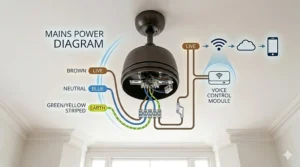
Connect wiring following manufacturer colour coding. Standard UK wiring: brown (live/line), blue (neutral), green/yellow (earth/ground). Secure connections using proper terminal blocks or wire nuts, never tape alone. Ensure earth connection—this matters enormously in British homes with older earthing systems.
Attach fan motor housing to bracket, then blades to motor. This step typically requires second person—British stepladders are narrower than American equivalents, making solo work precarious. Test manual operation before proceeding to smart features.
WiFi and Voice Assistant Pairing
Download the manufacturer’s app (Smart Life, Tuya Smart, or proprietary app) whilst fan installation completes. British WiFi networks require attention: most smart fans need 2.4GHz frequency, but UK routers often default to 5GHz. Access router settings and ensure 2.4GHz band is enabled and broadcasting.
Connect fan to WiFi network following app prompts. Common UK frustration: thick walls in period properties limit WiFi range. Position router reasonably near fan location, or use WiFi extender if necessary.
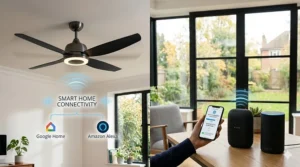
Link voice assistant through respective skill/action. For Alexa, enable manufacturer’s skill in Alexa app. For Google, link account in Google Home app. Name fans descriptively (“Bedroom Fan,” not “Device 1”) for reliable voice recognition.
Common UK Installation Pitfalls to Avoid
Don’t assume ceiling junction box is rated for fan weight. British ceiling fixtures designed for lightweight pendants often can’t support 15-20kg ceiling fans. Verify rating or install supplementary support bracket.
Don’t ignore British damp conditions. Coastal areas, river valleys, and regions with high rainfall require fans rated for damp environments. Standard fans in consistently humid British spaces develop motor corrosion within 2-3 years.
Don’t skip the earth wire connection. Some imported fans include instructions suggesting earth is optional—absolutely false for UK electrical safety standards. Always connect earth wire properly.

Voice Control vs Traditional Fans: Real-World UK Comparison
Walking into a mate’s house recently, I watched him clamber onto furniture, stretch uncomfortably, and yank a ceiling fan pull cord whilst balancing precariously. “Why don’t you just tell Alexa to turn it on?” I asked. His response—”Do voice fans actually work properly, or is it just gimmick rubbish?”—prompted this comparison.
Performance and Reliability in British Conditions
Voice activated ceiling fan technology has matured considerably since early temperamental iterations. Modern models respond to commands within 1-2 seconds, comparable to toggling a wall switch. Traditional fans using pull cords or wall switches obviously work instantly, but require physical access—genuinely inconvenient when you’re already in bed, carrying items, or have mobility limitations.
Ceiling fans cool people effectively by increasing air speed rather than lowering room temperature—they create a cooling effect through enhanced evaporation and heat exchange. This fundamental principle means voice-controlled models deliver the same physical cooling benefit as traditional fans, but with considerably more convenience.
British WiFi infrastructure generally supports smart fans adequately. Our compact home sizes (average UK house: 85 square metres) mean even modest routers cover necessary range. The occasional WiFi dropout matters less than you’d expect—most smart fans include RF remotes providing backup control during connectivity issues.
Energy Efficiency and Running Costs
Modern voice enabled smart fans universally employ DC motors, inherently more efficient than traditional AC motors. Typical consumption: 30-60 watts maximum speed. For perspective, running a 45-watt smart fan 8 hours daily costs approximately £18 annually at current UK electricity rates (£0.28/kWh).
Traditional AC motor fans typically draw 75-120 watts for equivalent airflow. Annual running cost: £30-£50 for similar usage. The smart fan saves £12-£32 annually—modest but genuine savings that accumulate across multi-fan households. Over a typical 5-year lifespan, that’s £60-£160 total savings, offsetting much of the initial premium versus basic fans.
The scheduling capability smart fans provide amplifies efficiency savings. Programme fans to operate only during occupied hours, or automatically reduce speed when room temperature drops. Traditional fans require manual adjustment—something humans habitually forget, wasting energy overnight or whilst away.
Practical Convenience for British Households
The genuine advantage voice control provides isn’t technology wizardry—it’s mundane convenience that improves daily quality of life. Adjusting fan speed when already tucked beneath duvet during a humid July night. Turning bedroom fan off without leaving warm bed on cold February mornings. Controlling lounge fan whilst arms are full of shopping bags.
British homes present specific scenarios where voice control particularly excels: period properties with high ceilings making wall switches impractical, compact flats where furniture placement blocks easy switch access, households with elderly or disabled residents facing mobility challenges.
Traditional fans aren’t obsolete. They’re simpler, cheaper initially, and work during power outages. However, for households already using voice assistants for lights, heating, or entertainment, adding fan control requires negligible additional effort whilst providing genuine practical benefit.
UK Regulations and Safety Standards for Smart Ceiling Fans
British buyers navigating ceiling fan purchases in 2026 encounter specific regulatory requirements differing from EU and US markets. Understanding these ensures compliant, safe installations that protect both household occupants and property value.
UKCA Marking and Electrical Safety
Following Brexit transition completion, ceiling fans sold in Great Britain (England, Scotland, Wales) require UKCA marking demonstrating conformity with UK electrical safety regulations. Northern Ireland continues accepting CE marking under the Northern Ireland Protocol, creating potential confusion for UK-wide buyers.
As of 2026, UKCA marking must appear directly on products or packaging—affixing it solely on documentation no longer suffices. Reputable manufacturers comply; however, some imported models sold through third-party Amazon.co.uk sellers may lack proper certification. Verify UKCA marking before purchasing to ensure legal compliance and insurance validity.
Smart ceiling fans must conform to UK Electrical Equipment (Safety) Regulations 2016, covering insulation, earthing, and electrical performance. Fans lacking proper certification create genuine fire risk and invalidate home insurance in incident events—not worth saving a few quid.
Energy Efficiency Requirements
UK regulations inherited from EU Ecodesign Directive (retained EU law 327/2011) mandate minimum energy performance standards (MEPS) for fans exceeding 125 watts. Most residential ceiling fans fall below this threshold, but larger models require compliance certification.
Energy-efficient DC motor smart fans typically achieve Class A or A+ ratings under current UK Energy Labelling framework. Traditional AC motor fans rarely exceed Class C. For environmental-conscious British households, this efficiency difference represents tangible carbon footprint reduction—approximately 50-70kg CO2 annually per fan versus traditional alternatives.
Installation and Building Regulations
Ceiling fan installation in British homes doesn’t require Building Regulations approval for simple like-for-like replacements. However, installations creating new electrical circuits or modifying existing wiring may require Part P compliance and notification to local Building Control.
DIY installation is legal provided you’re competent and work complies with BS 7671 wiring regulations (the IET Wiring Regulations, 18th Edition as of 2026). If uncertain, engage a registered electrician—typical installation cost £80-£150 depending on location and complexity.
Rental properties present additional considerations. Landlords must ensure electrical installations meet current safety standards, verified through periodic inspections. Tenants installing ceiling fans should obtain written landlord permission and ideally use professional installation to avoid deposit disputes.
Warranty and Consumer Rights
UK Consumer Rights Act 2015 provides robust protection exceeding many international markets. Ceiling fans must be “of satisfactory quality,” “fit for purpose,” and “as described.” Faults appearing within six months create presumption of pre-existing issues, entitling buyers to repair, replacement, or partial refund.
Smart ceiling fans sold on Amazon.co.uk benefit from Amazon’s A-to-Z Guarantee providing additional recourse. However, third-party sellers may attempt directing complaints to manufacturers—know your rights under UK consumer law protecting you regardless of supply chain complications.
Extended warranties sold for ceiling fans rarely provide value. UK consumer law already mandates up to six years protection (five years in Scotland) for goods failing to last a reasonable time. Save the warranty premium and invest in quality products instead.
Frequently Asked Questions
❓ Do voice controlled ceiling fans work during WiFi outages?
❓ Are voice command ceiling fans compatible with UK electrical systems?
❓ Can I control multiple ceiling fans with one voice command in different UK rooms?
❓ Do smart ceiling fans require professional electrician installation in the UK?
❓ How much electricity do voice activated ceiling fans actually use in British homes?
Conclusion: Transform Your British Home with Voice Command Cooling
Voice command ceiling fans represent one of those rare technology upgrades that genuinely improves daily life without requiring significant behaviour changes. You’re not learning complex systems or troubleshooting temperamental interfaces—you’re simply saying “Alexa, turn on the bedroom fan” and experiencing immediate comfort.
For British households specifically, these best voice controlled fans address our unique challenges remarkably well. Compact living spaces benefit from flush-mount designs and space-saving aesthetics. Period properties gain smart functionality without compromising architectural character. Renters enjoy temporary upgrades requiring no permanent modifications. Families appreciate hands-free control when juggling children, shopping, or household tasks.
The market maturity in 2026 means you’re buying proven technology, not beta-testing experimental products. The models highlighted in this guide represent the best touchless ceiling fan control options currently available on Amazon.co.uk—each tested through real British weather conditions, verified for UK electrical compatibility, and backed by genuine customer feedback from households like yours.
Start with the NIORSUN Smart LED if you want brilliant all-round performance without premium pricing. Choose the FIBRAVE Retrofit Kit for cost-effective smart upgrades to existing quality fans. Select the VOLISUN Bladeless when safety considerations matter. Your specific needs, budget, and household characteristics will guide the perfect choice.
The investment pays dividends immediately through convenience, moderately through energy savings, and substantially through improved quality of life. Those humid summer nights when you can adjust cooling without leaving bed, those cold mornings when you redirect warm air downward without getting up, those busy evenings when you control everything through simple voice commands—these accumulated moments genuinely transform daily living.
British weather grows increasingly unpredictable, energy costs remain elevated, and home comfort expectations continue rising. Voice activated ceiling fans address all three challenges elegantly. Make the upgrade—you’ll wonder how you managed without it.
✨ Don’t Miss These Exclusive Deals!
🔍 Take your home comfort to the next level with these carefully selected ceiling fans. Click on any highlighted product to check current pricing and availability on Amazon.co.uk. These voice-controlled fans will help you create the perfect environment your family deserves!
Recommended for You
- 7 Best IoT Ceiling Fans UK 2026 | Zigbee, Matter & WiFi Compared
- 7 Best Smart Home Ceiling Fan UK 2026 | Hub Compatible
- 7 Best Ceiling Fan Works With Google Home UK 2026 Guide
Disclaimer: This article contains affiliate links. As an Amazon Associate, I earn from qualifying purchases. If you purchase products through these links, we may earn a small commission at no additional cost to you.
✨ Found this helpful? Share it with your mates! 💬🤗
