
In This Article
Picture this: you’re settled into your favourite armchair with a cuppa, the sun streaming through the windows on a rare British heatwave, and without lifting a finger, you simply say, “Alexa, turn on the ceiling fan.” Within seconds, a refreshing breeze fills your living room. That’s the magic of wifi ceiling fan installation—technology that transforms your ordinary home into an intelligent sanctuary where comfort meets convenience.
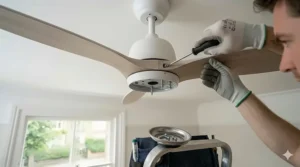
I’ve spent countless hours researching and testing various smart ceiling fans across the UK market, and I can confidently say we’re living in the golden age of home automation. Gone are the days of pulling chains or scrambling for remote controls. Today’s wifi-enabled ceiling fans integrate seamlessly with Amazon Alexa and Google Assistant, offering voice control, app management, and energy-efficient operation that can slash your cooling costs by up to £900 annually compared to air conditioning.
Whether you’re retrofitting your Victorian terrace or outfitting a modern flat, wifi ceiling fan installation requires careful planning and proper execution to ensure safety, functionality, and compliance with UK building regulations. In this comprehensive guide, I’ll walk you through everything you need to know—from selecting the perfect model for your space to mastering the installation process and troubleshooting common connectivity issues. By the end, you’ll have the confidence and knowledge to create a comfortable, energy-efficient haven that responds to your every command. Let’s dive into the brilliant world of smart home climate control! 🌬️
Quick Comparison: Top WiFi Ceiling Fans UK 2026
| Model | Size | Price (£) | WiFi Type | Key Feature | Best For |
|---|---|---|---|---|---|
| CHANFOK Smart 20″ | 51cm (20″) | £85-£120 | 2.4GHz | Compact flush mount | Small bedrooms |
| YUNLONG Smart WiFi | 90cm (36″) | £140-£180 | 2.4GHz | DC motor efficiency | Medium rooms |
| CHANFOK Neo 22″ | 56cm (22″) | £125-£160 | 2.4GHz | RGB ambient lighting | Modern spaces |
| MUMENG WiFi Fan | 92cm (36″) | £95-£135 | 2.4GHz | Metal construction | Value seekers |
| RGB Alexa Ceiling Fan | 107cm (42″) | £144-£200 | 2.4GHz | Colour changing LED | Large living rooms |
| VOLISUN Low Profile | 50cm (20″) | £89-£125 | 2.4GHz | Bladeless design | Minimalist décor |
| Hunter HunterSMART™ | Various | £180-£299 | Matter-enabled | Premium build quality | Tech enthusiasts |
💬 Just one click – help others make better buying decisions too! 😊
Top 7 WiFi Ceiling Fans: Expert Analysis
1. CHANFOK Smart Ceiling Fan 20″ – Best Compact Smart Solution
If you’re working with lower ceilings—a common challenge in many UK homes—the CHANFOK Smart Ceiling Fan delivers exceptional performance in a compact 51-centimetre (20-inch) flush mount design. This clever piece of engineering proves that size doesn’t dictate capability.
Key Specifications:
- Flush mount design (perfect for 2.1-2.4m ceilings)
- 6-speed DC motor with reversible function
- Stepless colour temperature (3000K-6000K)
- Compatible with Alexa & Google Assistant via Tuya app
The CHANFOK operates whisper-quiet, making it perfect for bedrooms where even the slightest hum can disrupt sleep. UK buyers particularly appreciate the stepless brightness adjustment (10%-100%) and the sleep timer function—brilliant for those who prefer falling asleep with airflow but don’t want the fan running all night.
Customer Feedback: British reviewers consistently praise its straightforward installation process and reliable WiFi connectivity on 2.4GHz networks. One customer from Manchester noted, “Works brilliantly with Alexa. The remote is responsive, and I love controlling it from bed without moving.”
Price Range: £85-£120 depending on finish options
✅ Pros: Compact design, easy installation, excellent app integration
✅ Ultra-quiet operation
✅ Memory function saves settings
❌ Cons: Limited airflow for larger rooms
❌ Requires stable 2.4GHz WiFi
2. YUNLONG Smart WiFi Ceiling Fan – Best All-Round Performance
The YUNLONG Smart WiFi Ceiling Fan strikes an impressive balance between affordability and functionality, making it a top choice for homeowners seeking smart features without breaking the bank. At 92 centimetres (36 inches), it’s ideally suited for medium-sized rooms between 10-15 square metres.
Key Specifications:
- Energy-efficient DC motor (consumes 70% less energy)
- 6 adjustable wind speeds with remote control
- Dimmable LED lighting (3000K-6500K)
- Voice control via Alexa, Google Home, and Tuya app
What sets this model apart is its robust metal construction combined with acrylic and wooden elements, creating a modern aesthetic that complements both contemporary and traditional UK interiors. The fan includes adjustable hanging rods (13cm and 25cm) allowing you to customise the installation height based on your ceiling configuration.
Customer Feedback: Users particularly value the powerful yet quiet motor performance. One reviewer from Birmingham shared, “Compared to our old ceiling fan, this is remarkably silent. We can actually sleep with it on without any distraction.”
Price Range: £140-£180
✅ Pros: Excellent build quality, versatile sizing options
✅ Strong airflow with minimal noise
✅ Year-round functionality with reverse mode
❌ Cons: Installation requires two people
❌ App interface could be more intuitive
3. CHANFOK Neo Smart 22″ – Best Modern Design
For those who refuse to compromise on aesthetics, the CHANFOK Neo combines cutting-edge smart technology with stunning visual appeal. The unique RGB ambient backlight strip creates an atmospheric glow that transforms any room into a modern sanctuary.
Key Specifications:
- 56cm (22″) diameter with low-profile design
- RGB colour-changing ambient lighting
- Stepless DC motor (ultra-quiet operation)
- Three colour temperatures: warm (2700K) to cool (6500K)
The Neo features a rotation-installation base that simplifies both installation and future maintenance—a thoughtful touch that UK electricians particularly appreciate. The memory function ensures your preferred settings are retained even after power cuts.
Customer Feedback: UK buyers rave about the mood lighting capabilities. “The ambient lighting feature is absolutely gorgeous. Perfect for movie nights or creating a relaxing atmosphere,” noted a customer from Edinburgh.
Price Range: £125-£160 (often on promotion)
✅ Pros: Stunning RGB backlighting, whisper-silent
✅ Easy installation system
✅ Memory function for convenience
❌ Cons: Premium price point
❌ RGB feature may not suit traditional décor
4. MUMENG WiFi Ceiling Fan – Best Value for Money
The MUMENG WiFi Ceiling Fan delivers remarkable functionality at an accessible price point, making smart home technology available to budget-conscious UK homeowners. Don’t let the affordable price fool you—this 92cm (36-inch) model punches well above its weight.
Key Specifications:
- Durable metal and wooden construction
- 6-speed settings with reversible airflow
- WiFi connectivity (2.4GHz) with Alexa/Google support
- Adjustable hanging rods (13cm and 25cm options)
The fan’s robust construction ensures longevity, whilst the powerful motor provides excellent air circulation for rooms up to 18 square metres. The reversible function makes it a year-round asset—circulating cool air during summer heatwaves and redistributing warm air during chilly British winters.
Customer Feedback: Buyers appreciate the value proposition. A Glasgow customer commented, “For the price, it exceeds expectations. Perfect for our spare bedroom.”
Price Range: £95-£135
✅ Pros: Exceptional value, solid build quality
✅ Reliable WiFi performance
✅ Year-round versatility
❌ Cons: Basic aesthetic design
❌ LED brightness could be higher
5. RGB Alexa Ceiling Fan 42″ – Best for Large Rooms
For spacious living rooms, open-plan kitchens, or master bedrooms, the RGB Alexa Ceiling Fan provides the airflow coverage you need. At 107 centimetres (42 inches), this substantial model creates impressive air circulation whilst doubling as an eye-catching lighting feature.
Key Specifications:
- Large 107cm (42″) diameter
- Full RGB colour spectrum (16 million colours)
- DC motor with 6-speed control
- Smart scheduling via mobile app
The colour-changing LED capability allows you to set different moods throughout the day—energising cool white for morning routines, warm amber for evening relaxation, or vibrant colours for entertaining guests. The scheduling feature means your fan can automatically adjust based on your daily routine.
Customer Feedback: UK homeowners with larger spaces praise its performance. “Finally, a ceiling fan powerful enough for our 5-metre by 6-metre lounge. The colour options are a fun bonus,” shared a London reviewer.
Price Range: £144-£200
✅ Pros: Excellent coverage for large spaces
✅ Versatile RGB lighting options
✅ Scheduling automation
❌ Cons: Requires higher ceilings (minimum 2.4m)
❌ Higher energy consumption than smaller models
6. VOLISUN Low Profile Bladeless – Best Minimalist Design
The VOLISUN Low Profile Bladeless ceiling fan represents the cutting edge of ceiling fan design. By eliminating traditional blades, it creates a sleek, modern aesthetic that appeals to minimalist sensibilities whilst maintaining excellent airflow performance.
Key Specifications:
- Innovative bladeless design (50cm diameter)
- Flush mount for low ceilings
- Dimmable LED ring light (3000K-6500K)
- App, remote, and voice control
The bladeless design isn’t just about aesthetics—it’s also safer for homes with children and easier to clean. The smooth surfaces simply require a quick wipe, unlike traditional blade fans that accumulate dust and require careful cleaning between each blade.
Customer Feedback: Design-conscious buyers love the modern look. “It’s like having a piece of modern art on the ceiling that also keeps us cool,” remarked a buyer from Bristol.
Price Range: £89-£125
✅ Pros: Striking modern appearance
✅ Easy maintenance
✅ Safe for homes with children
❌ Cons: Slightly less airflow than bladed models
❌ Limited availability in UK
7. Hunter HunterSMART™ Series – Premium Choice
For those seeking the absolute best, the Hunter HunterSMART™ series represents premium engineering backed by over a century of ceiling fan expertise. These are the only WiFi ceiling fans that work seamlessly with Alexa, HomeKit, and Google Home simultaneously.
Key Specifications:
- Matter-enabled smart home compatibility
- SureSpeed® motor (33% higher air velocity)
- ENERGY STAR® certified (64% more efficient)
- Premium finishes and materials
Hunter’s reputation for durability and performance is well-earned. The HunterSMART™ fans feature advanced DC motors that deliver exceptional airflow whilst consuming minimal electricity. The Matter compatibility ensures these fans remain future-proof as smart home standards evolve.
Customer Feedback: UK buyers appreciate the build quality. “You can feel the difference in quality. It’s whisper-silent even at maximum speed, and the app integration is flawless,” noted a Surrey homeowner.
Price Range: £180-£299 depending on model and finish
✅ Pros: Exceptional build quality and longevity
✅ Superior airflow performance
✅ Future-proof Matter compatibility
❌ Cons: Premium pricing
❌ May require professional installation for warranty
✨ Don’t Miss These Exclusive Deals!
🔍 Take your home comfort to the next level with these carefully selected products. Click on any highlighted item to check current pricing and availability on Amazon.co.uk. These smart fans will help you create an intelligent living environment your family will love!
What Is WiFi Ceiling Fan Installation?
WiFi ceiling fan installation refers to the process of mounting and configuring a ceiling-mounted fan that connects to your home’s wireless network, enabling remote control via smartphone apps, voice assistants, or automated routines. Unlike traditional ceiling fans that rely solely on pull chains or wall switches, wifi-enabled models integrate with your smart home ecosystem through 2.4GHz WiFi connectivity.
At its core, a wifi ceiling fan combines three essential components: the physical fan mechanism for air circulation, LED lighting for illumination, and a wireless receiver module that communicates with your router and smart home devices. The installation process involves both mechanical mounting (securing the fan to ceiling joists or a fan-rated electrical box) and electrical wiring (connecting live, neutral, and earth wires according to UK electrical standards), followed by digital setup through mobile applications.
The integration typically operates through dedicated apps like Smart Life, Tuya, or eWeLink, which communicate with Amazon Alexa via skill installations. Once configured, you can issue voice commands such as “Alexa, set the bedroom fan to speed three” or “Alexa, turn off the living room ceiling fan.” This hands-free control proves particularly valuable when your hands are full, you’re comfortable in bed, or you’re away from home wanting to return to a cool environment.
According to research published by the Lawrence Berkeley National Laboratory, DC motor ceiling fans—the type commonly found in wifi-enabled models—consume 40-70% less energy than equivalent AC models whilst delivering identical or superior airflow performance. This efficiency translates to annual savings of £30-£70 for typical UK households running fans for 8 hours daily during warmer months.
How to Choose the Right WiFi Ceiling Fan for UK Homes
Room Size Considerations
Matching fan diameter to room dimensions ensures optimal air circulation and energy efficiency. For UK homes, consider these guidelines:
Small rooms (up to 10m²): 40-51cm (16-20 inch) fans like the CHANFOK Smart 20″ provide adequate coverage for bedrooms, home offices, or small kitchens. These compact models work brilliantly in period properties with lower ceiling heights.
Medium rooms (10-15m²): 56-92cm (22-36 inch) fans such as the YUNLONG Smart WiFi deliver balanced performance for standard UK living rooms and master bedrooms. This size range represents the sweet spot for most applications.
Large rooms (15-25m²): 107-132cm (42-52 inch) models handle spacious open-plan areas, extensions, and conservatories. Ensure your ceiling height accommodates these larger fans—minimum 2.4 metres recommended.
Ceiling Height Requirements
UK building regulations mandate that ceiling fan blades must hang at least 2.1 metres above floor level. For standard 2.4m ceilings common in British homes, flush mount or hugger-style fans work best. Homes with higher ceilings (2.7m+) can accommodate downrod models that position the fan lower for improved air circulation.
WiFi Compatibility Check
Nearly all smart ceiling fans require 2.4GHz WiFi networks for connectivity. This frequency offers better wall penetration and range compared to 5GHz networks, making it ideal for ceiling-mounted devices. Before purchasing, verify your router broadcasts a 2.4GHz signal—many modern dual-band routers automatically handle this, but some may require manual configuration through router settings.
Motor Type Matters
DC (Direct Current) motors dominate the wifi ceiling fan market for good reason:
- Consume 40-70% less energy than AC motors
- Operate significantly quieter (essential for bedrooms)
- Offer more speed settings (typically 6 vs 3)
- Generate less heat during operation
- Reversible function for year-round use
AC (Alternating Current) motors are found in older models and budget options. Whilst initially cheaper, their higher running costs and noise levels make them less suitable for modern smart home integration.
Smart Home Ecosystem Integration
Consider your existing smart home setup:
- Alexa users: Most wifi fans support Alexa through Tuya or Smart Life skills
- Google Home users: Verify Google Assistant compatibility before purchase
- Apple HomeKit users: Hunter HunterSMART™ offers rare HomeKit support
- Multi-platform homes: Matter-enabled fans provide universal compatibility

Essential Tools for WiFi Ceiling Fan Installation
Basic Tool Kit
Electrical Testing Equipment:
- Non-contact voltage tester (essential for safety)
- Multimeter for continuity checks
- Circuit tester to verify power isolation
Hand Tools:
- Phillips and flat-head screwdrivers (various sizes)
- Adjustable spanner or socket set
- Wire strippers (for preparing cable ends)
- Needle-nose pliers (for twisting wire connections)
- Electrical tape and insulation tape
Mounting Equipment:
- Sturdy step ladder (minimum 2.4m working height)
- Electric drill with masonry bits (for solid ceilings)
- Wood screws and wall plugs (if required)
- Stud finder (helpful but not essential)
Safety Equipment
Personal protective equipment isn’t optional—it’s essential:
- Rubber-soled shoes to prevent electrical shocks
- Safety glasses to protect eyes from dust and debris
- Work gloves for handling sharp components
- Long sleeves and trousers for additional protection
Specialist Items
For Plasterboard Ceilings:
- Ceiling joist detector or stud finder
- Expanding cavity fixings (if not attaching to joists)
- Fan-rated ceiling box (must support minimum 15kg)
For Solid Ceilings:
- Masonry drill bits
- Expansion bolts or chemical anchors
- Dust sheets to protect furnishings
Step-by-Step WiFi Ceiling Fan Installation Guide
Pre-Installation Preparation
1. Safety First: Isolate the Power
Never attempt electrical work with live circuits. Follow these critical steps:
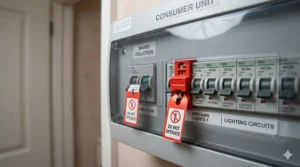
- Switch off the relevant circuit breaker at your consumer unit
- Place tape over the breaker with a warning note
- Use a voltage tester to confirm power isolation
- Test the tester on a known live circuit to verify it’s working
2. Inspect Your Ceiling Structure
UK homes feature various ceiling types, each requiring different mounting approaches:
Plasterboard ceilings (common in modern homes): Locate solid timber joists using a stud finder or by tapping the ceiling—solid areas sound different from hollow spaces. The fan bracket must attach directly to joists or use specialist cavity fixings rated for fan weight.
Solid ceilings (typical in older properties): Require masonry fixings. Check for hidden cables or pipes before drilling—avoid areas directly above light switches or power sockets where cables commonly run.
3. Verify Existing Wiring
UK electrical installations follow standardised colour coding according to IEC 60446:
- Brown: Live (hot) wire
- Blue: Neutral wire
- Green/Yellow striped: Earth (ground) wire
Older installations may feature different colours (red for live, black for neutral). If you encounter unfamiliar wiring, consult a qualified electrician registered with NICEIC or NAPIT.
Mounting the Ceiling Bracket
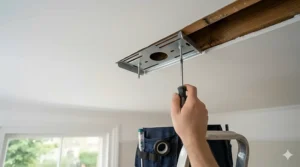
4. Install the Fan-Rated Electrical Box
Standard light fixture boxes cannot safely support ceiling fan weight and vibration. You need a dedicated fan-rated box capable of supporting at least 15 kilograms.
For joist mounting:
- Position the box between or directly onto a ceiling joist
- Use the provided wood screws (typically 50mm length)
- Ensure the box sits flush with the ceiling surface
- Confirm it’s level using a spirit level
For plasterboard without joist access:
- Install a fan-rated brace bar that spans between joists
- Attach the electrical box to the brace bar centre
- Verify the brace bar is securely locked in place
5. Attach the Mounting Bracket
Most wifi ceiling fans include a specialised mounting bracket:
- Secure the bracket to the electrical box using machine screws
- Ensure all four mounting holes are engaged
- The bracket should have slight give for easier fan attachment
- Rubber bumpers (if included) should face upward
Electrical Connections
6. Prepare the Wiring
- Strip approximately 10-15mm of insulation from ceiling cable ends
- Twist the exposed copper strands tightly
- Identify all wires: live (brown), neutral (blue), earth (green/yellow)
- Some installations may have two sets of cables (power in/power out to next fixture)
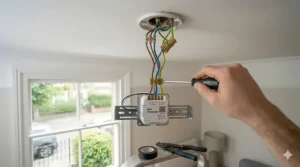
7. Connect the Fan Wiring
Most wifi ceiling fans feature colour-coded wires:
Standard Configuration:
- Earth connections: Join ceiling earth (green/yellow) to fan earth wire
- Neutral connections: Join ceiling neutral (blue) to fan neutral (typically white or blue)
- Live to fan motor: Connect ceiling live (brown) to fan motor wire (typically black)
- Live to light kit: If separate control desired, connect to fan light wire (typically blue)
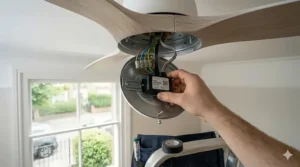
Important: Many smart fans include a wireless receiver module. This must be wired according to the manufacturer’s specific diagram—wire colours and configurations vary by brand.
Use proper wire connectors (terminal blocks or twist-on wire nuts). Never twist wires together and simply wrap with tape—this creates dangerous connections that can fail over time.
8. Secure Wire Connections
- Ensure each connection is mechanically sound (gentle tug test)
- Tuck wires neatly into the ceiling box
- Leave slight slack to prevent strain on connections
- Position the wireless receiver module where indicated
Physical Assembly
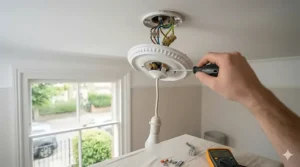
9. Attach the Fan Canopy
- Lift the assembled fan to the ceiling bracket
- Hook or slot the fan onto the mounting bracket
- Most designs use a ball-and-socket or hook system
- Secure with provided locking screws or clips
10. Install Blades and Light Kit
- Attach fan blades to the motor hub using provided screws
- Ensure each blade is seated fully and screws are tight
- If included, connect the light kit wiring
- Secure the light glass or shade according to instructions
11. Final Safety Checks
Before restoring power:
- Verify all screws are tight (including set screws)
- Confirm blades have adequate clearance (minimum 300mm from walls)
- Check that the fan wobbles minimally when gently pushed
- Ensure no wires are pinched or exposed
WiFi Setup and Configuration
12. Power Up and Pair the Device
- Restore power at the consumer unit
- The fan should power up and may flash or beep to indicate pairing mode
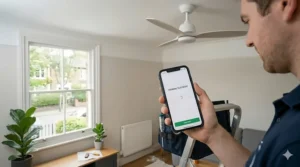
- Download the relevant app (Tuya Smart, Smart Life, or manufacturer-specific)
- Follow the in-app pairing instructions
13. Configure Network Connection
- Connect your smartphone to your 2.4GHz WiFi network
- Enter WiFi credentials in the app
- Wait for the fan to connect (typically 30-60 seconds)
- Test basic controls through the app
14. Voice Assistant Integration
For Amazon Alexa:
- Open the Alexa app
- Navigate to Skills & Games
- Search for “Smart Life” or “Tuya Smart”
- Enable the skill and link your account
- Discover devices
- Assign the fan to appropriate room/group
For Google Home:
- Open the Google Home app
- Tap “+” then “Set up device”
- Choose “Works with Google”
- Search for your fan’s app (Tuya/Smart Life)
- Link accounts and assign rooms
Ceiling Fan WiFi Connection: Complete Setup Guide
Understanding WiFi Requirements
Smart ceiling fans exclusively use 2.4GHz WiFi networks. This frequency standard provides superior range and wall penetration compared to 5GHz networks, making it ideal for devices mounted at ceiling level. Before beginning setup, confirm your router broadcasts a 2.4GHz signal.
Common Router Settings: Most modern routers are dual-band, broadcasting both 2.4GHz and 5GHz simultaneously. However, some routers combine both bands under a single network name (SSID), which can confuse smart devices. If experiencing connectivity issues, create separate network names for each band through your router’s administration panel.
Tuya Smart App Configuration
The majority of affordable wifi ceiling fans utilise the Tuya platform. Here’s the detailed setup process:
Step 1: Download and Account Creation
- Download “Tuya Smart” or “Smart Life” from your app store
- Create a free account using email or phone number
- Verify your account through the confirmation link
Step 2: Add Device
- Tap the “+” or “Add Device” button
- Select “Large Home Appliances” then “Ceiling Fan”
- Ensure the fan is powered and in pairing mode (usually indicated by flashing LED)
Step 3: Enter WiFi Credentials
- Select your 2.4GHz network from the list
- Enter the WiFi password carefully (case-sensitive)
- Confirm and wait for connection
Step 4: Device Naming
- Assign a clear name (e.g., “Bedroom Fan” or “Living Room Fan”)
- Assign to a room for easier organisation
- Test basic functions (on/off, speed adjustment)
Troubleshooting Connection Issues
Fan Won’t Enter Pairing Mode:
- Hold the pairing button (usually on remote) for 5-10 seconds
- Some fans require power cycling three times rapidly
- Check the user manual for model-specific pairing procedures
Connection Repeatedly Fails:
- Verify you’re using 2.4GHz WiFi (not 5GHz)
- Move your router closer temporarily during setup
- Disable MAC address filtering temporarily
- Ensure WiFi password is entered correctly
Fan Disconnects Frequently:
- Check WiFi signal strength at ceiling height
- Move router to a more central location
- Consider a WiFi extender for weak signal areas
- Verify router firmware is up-to-date
Smart Fan App Pairing Best Practices
Optimise Router Settings:
- Use WPA2 security (most compatible)
- Avoid special characters in WiFi passwords
- Disable AP isolation if enabled
- Ensure DHCP has available IP addresses
During Setup:
- Stand directly beneath the fan with your phone
- Close other apps to free phone memory
- Disable mobile data to force WiFi usage
- Keep the phone screen active throughout pairing
After Successful Connection:
- Create automations for common scenarios
- Set up room groups for multi-fan control
- Enable sharing if family members need access
- Document the WiFi network used for future reference
Smart Fan Wiring Diagram: UK-Specific Guide
Understanding UK Electrical Standards
UK electrical installations must comply with BS 7671 wiring regulations. For ceiling fan installations, this means proper earthing, appropriate cable sizing, and correct circuit protection. All electrical work in special locations (bathrooms, kitchens) falls under notifiable work requirements and should be performed by qualified electricians registered with competent person schemes.
Basic Single Switch Configuration
This represents the simplest wifi ceiling fan installation where a single wall switch controls power to the fan:
Ceiling Box Connections:
- Live (Brown): From switch to fan live input → Fan can be controlled via app even when switch is off
- Neutral (Blue): Direct connection from supply to fan neutral
- Earth (Green/Yellow): Connected to fan housing and earthing terminal
Switch Wiring:
- The wall switch interrupts the live supply
- Most wifi fans should have power continuously available
- Consider using a switched live arrangement for maximum flexibility
Dual Control Configuration
For installations requiring separate control of fan and light:
Two-Switch Setup:
- Switch 1 (Fan): Controls power to motor circuit
- Switch 2 (Light): Controls power to integrated LED
- Requires three-core and earth cable (brown, black, grey, earth)
Wiring Details:
- Permanent Live (Brown): To both switches
- Fan Switched Live (Black): Returns to fan motor terminal
- Light Switched Live (Grey): Returns to light kit terminal
- Neutral (Blue): Common connection
- Earth (Green/Yellow): Continuous to all metal components
WiFi Module Integration
Modern smart ceiling fans include a wireless receiver module. This critical component requires specific wiring:
Typical Module Configuration:
- Input: Live and neutral from ceiling supply
- Output to Motor: Switched live (controlled by app/voice)
- Output to Light: Switched live (independent control)
- Antenna: Positioned for optimal signal (never coil or bind)
Critical Notes:
- Never bypass the wireless module
- Ensure the module sits within the specified temperature range
- Maintain adequate ventilation around the module
- Follow manufacturer’s specific wiring diagram precisely
Safety Isolation
UK installations should include appropriate isolation:
Circuit Protection:
- 6A MCB (Miniature Circuit Breaker) suitable for most ceiling fans
- Alternatively, connect to existing lighting circuit if capacity permits
- Consider dedicated circuit for multiple fans or high-wattage models
Earth Bonding: All metal components must connect to earth:
- Fan canopy
- Downrod (if metal)
- Motor housing
- Light kit mounting bracket
Common Wiring Mistakes to Avoid
❌ Connecting both live wires together: In loop-in wiring, the switched live and permanent live serve different purposes
❌ Inadequate cable sizing: Use minimum 1.0mm² cable for lighting circuits, 1.5mm² for dedicated fan circuits
❌ Poor connections: Wire nuts must be secured tightly; loose connections create resistance and heat
❌ Bypassing the wireless module: This prevents app control and may damage components
❌ Incorrect earth connections: Earth continuity is non-negotiable for safety
Ceiling Fan App Pairing: Advanced Tips
Multi-Device Management
Managing several wifi ceiling fans across your home requires strategic organisation:
Room Assignment: Group fans by physical location (Bedroom 1, Living Room, Kitchen). This enables voice commands like “Alexa, turn on all Living Room lights and fans” for comprehensive control.
Naming Conventions: Use clear, distinctive names:
- ✅ “Master Bedroom Fan”
- ✅ “Kids Room Ceiling Fan”
- ❌ “Fan 1” (confusing with multiple devices)
- ❌ “The Fan” (too vague for voice commands)
Automation and Scheduling
Smart ceiling fans shine when automated:
Temperature-Based Automation: If you have smart thermostats or temperature sensors, create routines:
- When temperature exceeds 24°C: Fan to speed 4
- When temperature drops below 20°C: Fan to reverse mode, speed 2
- Night-time: Automatically reduce to speed 1 at 23:00
Time-Based Scheduling:
- Morning routine: Fan off at 07:00 (reduce electricity waste)
- Evening comfort: Fan to speed 3 at 18:00 during summer months
- Sleep mode: Reduce to speed 1 with 2-hour auto-off at 22:30
Occupancy-Based Control: Pair with smart home hubs:
- When everyone leaves home: All fans off
- When first person arrives home: Living room fan to speed 2
- Guest mode: Disable bedroom fan automation
Voice Command Optimisation
Effective Alexa Commands:
- “Alexa, set the bedroom fan to speed five”
- “Alexa, turn on the living room fan for two hours”
- “Alexa, increase the kitchen fan speed”
- “Alexa, turn off all fans”
Google Assistant Commands:
- “Hey Google, turn the bedroom fan to high”
- “Hey Google, dim the bedroom fan light to 30%”
- “Hey Google, reverse the living room fan” (if supported)
App-Specific Features
Tuya Smart Capabilities:
- Scene creation (combine fan, lights, and other devices)
- Smart mode triggers (based on weather, temperature, time)
- Energy monitoring (available on select models)
- Share control with family members
Manufacturer Apps: Some premium brands offer dedicated apps with enhanced features:
- Advanced scheduling with sunrise/sunset triggers
- Fan speed curves rather than discrete steps
- Integration with smart thermostats
- Detailed energy consumption analytics
WiFi Ceiling Fan Troubleshooting
Connection Problems
Fan Shows as Offline in App:
Quick Fixes:
- Verify the wall switch is in the ON position (fan needs power)
- Check router is functioning and 2.4GHz network is broadcasting
- Restart the fan by switching power off/on three times
- Confirm WiFi password hasn’t changed
Advanced Solutions:
- Reset the fan to factory settings (usually hold pairing button 10+ seconds)
- Move router closer or install WiFi extender
- Check for router firmware updates
- Verify DHCP isn’t exhausted (router has available IP addresses)
Voice Assistant Not Responding:
Alexa Troubleshooting:
- Verify the Alexa skill is still enabled (Skills & Games > Your Skills)
- Re-discover devices (Devices > Discover)
- Check that device name doesn’t conflict with other devices
- Ensure Alexa and fan app accounts are properly linked
Google Home Troubleshooting:
- Re-link the Tuya/Smart Life service
- Assign fan to correct room in Google Home app
- Verify microphone on Google device is working
- Try using the device name exactly as shown in the app
Performance Issues
Fan Wobbles Excessively:
Wobbling isn’t just annoying—it indicates improper installation that could damage the motor or ceiling mounting:
Causes and Solutions:
- Unbalanced blades: Use the balancing kit included with most fans
- Loose blade screws: Tighten all blade attachment screws
- Bent blade: Replace damaged blade with manufacturer part
- Inadequate mounting: Verify ceiling box is securely anchored to joist
WiFi Range Problems:
Ceiling-mounted devices sometimes struggle with WiFi connectivity:
Signal Boosting Solutions:
- Position router on ground floor for upstairs fans
- Use mesh WiFi systems (Google Nest WiFi, TP-Link Deco)
- Install dedicated 2.4GHz extender near fan location
- Upgrade router to model with better range
- Consider powerline adapters for remote rooms
App Control Slow or Unresponsive:
Optimisation Steps:
- Close background apps on smartphone
- Clear app cache (Settings > Apps > Tuya Smart > Clear Cache)
- Update app to latest version
- Restart smartphone
- Verify home WiFi isn’t congested (too many connected devices)
Electrical Issues
Fan Won’t Power On:
⚠️ Safety First: If you suspect electrical faults, isolate power and consult a qualified electrician.
Diagnostic Steps:
- Verify circuit breaker hasn’t tripped
- Test the light switch with a voltage tester
- Check all wire connections are secure
- Inspect for blown fuse in fan canopy (some models)
- Verify wireless module hasn’t failed (indicated by complete non-response)
Light Works But Fan Doesn’t (or Vice Versa):
This indicates separate circuit issues:
- Check connections to wireless module (refer to wiring diagram)
- Verify both circuits have proper live supply
- Some fans have separate fuses—check both
- Wireless module may have failed (requires replacement)
Humming or Buzzing Noise:
Common Causes:
- Dimmer switch on same circuit (fans require proper fan-rated switches)
- Loose wire connections creating resistance
- Motor bearings worn (typically after years of use)
- Incorrect voltage supply
How to Install WiFi Ceiling Fan: Professional Tips
Site Assessment
Ceiling Structure Evaluation:
Before purchasing your fan, assess the installation location:
Identify ceiling type:
- Plasterboard over timber joists (most modern UK homes)
- Solid concrete (common in flats and newer builds)
- Lath and plaster (older properties)
- Suspended ceiling tiles (offices, converted spaces)
Measure ceiling height: UK building regulations require minimum 2.1 metres clearance from floor to fan blades. For 2.4m ceilings, flush mount fans are essential. Higher ceilings (2.7m+) benefit from downrod installation for improved air circulation.
Check for obstructions:
- Light fittings in the way
- Smoke detectors requiring relocation
- Air conditioning vents
- Crown moulding or decorative ceiling features
- Sloped or vaulted ceilings (require special mounting brackets)
Professional Installation Considerations
When to Hire an Electrician:
UK law requires electrical work in special locations (bathrooms, kitchens) to be performed by certified professionals or notified to building control. Consider hiring qualified help if:
- You’re uncomfortable working with electricity
- The installation requires new wiring or circuit changes
- Work is in a bathroom or kitchen (notifiable under Part P)
- Your ceiling is made of concrete requiring specialist fixings
- Multiple fans need integrated control systems
- Insurance or warranty requires professional installation
Costs in UK (2026):
- Simple replacement: £80-£150
- New installation with wiring: £150-£300
- Multiple fans or complex setups: £300-£600
- Emergency/weekend rates: +50-100%
Installation Time Expectations
DIY Installation:
- Basic replacement (existing wiring adequate): 2-4 hours
- New installation (wiring already present): 3-5 hours
- New wiring required: Not recommended for DIY
- WiFi setup and testing: 30-60 minutes
Professional Installation:
- Standard replacement: 1-2 hours
- New installation with wiring: 2-4 hours
- Testing and certification: 30 minutes
Post-Installation Optimisation
Blade Balance Testing:
Even small imbalances create wobbling and noise:
- Run fan on highest speed and observe wobble pattern
- Identify the blade causing most vibration
- Attach balancing clip to blade centre
- Test and move clip along blade until wobble reduces
- Once optimal position found, attach permanent weight
Direction Settings:
Smart fans typically offer two rotation modes:
Summer Mode (Counter-clockwise): Creates downdraught for cooling effect. Viewing from below, blades rotate anti-clockwise. Use May through September.
Winter Mode (Clockwise): Gently draws air upward, redistributing warm air from ceiling level. Viewing from below, blades rotate clockwise. Use October through April at low speeds.
Final Safety Inspection:
Before considering the job complete:
- ✅ All screws tight (especially set screws on downrod)
- ✅ Electrical connections secure with no exposed wire
- ✅ Fan canopy sits flush against ceiling
- ✅ Blades have minimum 300mm clearance from walls
- ✅ Light kit properly secured
- ✅ Remote control functions correctly
- ✅ WiFi connectivity stable
- ✅ Voice commands responding accurately
WiFi Ceiling Fan Benefits: Why Upgrade in 2026?
Energy Savings Analysis
The financial case for wifi ceiling fans is compelling for UK households:
Electricity Cost Comparison:
At current UK average electricity rates of approximately 34p per kWh (as of April 2026):
Air Conditioning:
- Average consumption: 900-1,500 watts
- 8 hours daily for 120 days: 1,152 kWh
- Annual cost: £392
Smart WiFi Ceiling Fan:
- Average consumption: 30-50 watts
- 8 hours daily for 120 days: 48 kWh
- Annual cost: £16
Annual Savings: £376 per room
For a typical three-bedroom home with fans in bedroom, living room, and kitchen, annual savings exceed £900 compared to air conditioning.
Convenience Features
Remote Access: Control your home environment from anywhere:
- Start cooling before arriving home
- Turn off forgotten fans whilst at work
- Adjust settings from bed without getting up
- Create comfort zones for different family members
Voice Control Benefits: Hands-free operation proves invaluable:
- Whilst cooking with messy hands
- When holding a baby
- For elderly or mobility-impaired users
- During late-night comfort adjustments
Automation Capabilities: Set-and-forget operation:
- Automatic activation during heat waves
- Scheduled operation matching occupancy patterns
- Integration with holiday modes
- Temperature-responsive speed adjustment
Health and Comfort
Air Circulation Improvements:
Proper air movement provides multiple health benefits:
- Reduces stuffiness and stagnant air
- Distributes air conditioning more evenly (lowering overall AC usage)
- Helps prevent mould growth by reducing humidity
- Disperses allergens rather than allowing concentration
Sleep Quality Enhancement:
Bedroom ceiling fans improve sleep through:
- Consistent white noise masking disruptive sounds
- Gentle air movement preventing overheating
- Gradual speed reduction via timer functions
- Whisper-quiet operation (DC motors typically <30dB)
Environmental Impact
Carbon Footprint Reduction:
According to Energy Saving Trust calculations:
- Average air conditioning unit: 460kg CO₂ annually
- WiFi ceiling fan: 19kg CO₂ annually
- Reduction per fan: 441kg CO₂ (equivalent to 1,700 miles not driven)
For environmentally conscious UK households, ceiling fans represent a tangible way to reduce carbon emissions whilst maintaining comfort.
WiFi Ceiling Fan Maintenance Guide
Regular Cleaning Schedule
Monthly Quick Clean:
- Wipe blades with slightly damp microfibre cloth
- Check for dust accumulation on motor housing
- Inspect light covers for insect debris
- Verify remote batteries still functional
Quarterly Deep Clean:
- Remove and wash light glass/covers (if removable)
- Clean blade tops and bottoms thoroughly
- Wipe down canopy and decorative elements
- Inspect all visible screws for tightness
Annual Maintenance:
- Full disassembly and thorough cleaning
- Lubricate motor bearings (if accessible and recommended)
- Check electrical connections remain secure
- Test emergency manual override functions
Performance Monitoring
Balance and Vibration Checks:
Monitor fan performance monthly:
- Excessive wobbling indicates blade imbalance or loose components
- Unusual noises suggest bearing wear or foreign objects
- Reduced airflow may indicate motor problems or dirty blades
WiFi Connectivity Health:
Maintain reliable smart features:
- Monthly test of voice commands
- Verify app response time remains quick
- Check for firmware updates via manufacturer app
- Confirm automation routines executing correctly
Seasonal Adjustments
Summer Preparation (April-May):
- Clean thoroughly after winter storage period
- Verify counter-clockwise rotation for cooling
- Test all speed settings
- Update automation routines for longer days
Winter Conversion (October-November):
- Switch to clockwise rotation
- Set lower speeds (1-2) for gentle air circulation
- Create heating season automation
- Clean before reduced usage period
Frequently Asked Questions
❓ How much does it cost to install a wifi ceiling fan in the UK?
❓ Do wifi ceiling fans work without internet connection?
❓ Can I install a wifi ceiling fan myself in the UK?
❓ What size wifi ceiling fan do I need for my room?
❓ Why won't my ceiling fan connect to wifi?
Conclusion: Smart Comfort for Modern UK Homes
WiFi ceiling fan installation represents more than a simple home improvement—it’s an investment in year-round comfort, energy efficiency, and modern convenience that pays dividends for years to come. Throughout this comprehensive guide, we’ve explored everything from selecting the perfect model for your UK home to mastering the installation process and optimising smart features for maximum benefit.
The compelling economics speak for themselves: by replacing energy-hungry air conditioning with intelligent wifi ceiling fans, the average UK household saves upwards of £900 annually whilst dramatically reducing their carbon footprint. The CHANFOK Smart 20″ offers exceptional value for smaller spaces, the YUNLONG Smart WiFi delivers all-round performance for medium rooms, and premium options like the Hunter HunterSMART™ provide future-proof Matter compatibility for tech enthusiasts.
Beyond financial savings, the convenience of voice control and app automation transforms daily routines. Imagine arriving home to a pre-cooled living room, falling asleep to gentle airflow that automatically reduces after two hours, or redistributing warmth during winter months—all controlled effortlessly through simple voice commands or smartphone taps. This is the reality of smart home living available to UK homeowners in 2026.
Whether you’re embarking on a DIY installation or hiring a qualified electrician, the principles remain constant: proper mounting to fan-rated ceiling boxes, correct wiring following UK electrical standards, secure 2.4GHz WiFi connectivity, and thoughtful integration with your smart home ecosystem. The rewards—enhanced comfort, reduced energy bills, and modern convenience—make wifi ceiling fan installation one of the most valuable upgrades available to British homes today.
Your cooler, smarter, more efficient home awaits. Take the first step towards intelligent climate control and join the thousands of UK homeowners already enjoying the benefits of wifi ceiling fan technology.
Recommended for You
- 7 Best Cheap WiFi Ceiling Fans UK 2026 | Save £200+ Now
- 7 Best Wifi Ceiling Fans UK 2026: Smart Home Revolution
- 7 Top Rated Ceiling Fans With Lights UK 2026
Disclaimer: This article contains affiliate links. If you purchase products through these links, we may earn a small commission at no additional cost to you. Prices shown are approximate and may vary.
✨ Found this helpful? Share it with your mates! 💬🤗
