
In This Article
There’s a quietly catastrophic thing happening in thousands of British bathrooms right now. Not a leak. Not a broken tile. Just steam — thick, warm, relentless — rolling up from morning showers and settling into ceilings, grouting, and plasterboard like an uninvited houseguest who never leaves. Mould follows. Then peeling paint. Then a decorator’s bill you really didn’t budget for.
The culprit? A bathroom fan that either doesn’t exist, stopped working three winters ago, or was installed without a thought for IP ratings and quietly fizzing with every hot shower. Here’s the thing most people overlook: not all bathroom fans are created equal, and in the UK, where we manage to squeeze a shower, a bath, and occasionally a tumble dryer into a space the size of a wardrobe, getting the right IP44 bathroom ceiling fans matters enormously.
What is IP44, exactly? It stands for Ingress Protection 44 — a rating defined under the international IEC 60529 standard, where the first digit (4) means protection against solid particles larger than 1mm, and the second digit (4) means protection against water splashes from any direction. According to the IP code classification system, IP44 is the minimum rating required for bathroom Zone 2, which covers the area within 60cm horizontally of your bath or shower — and it’s where most ceiling fans end up sitting.
British Building Regulations Approved Document F requires a minimum of 15 litres per second (l/s) extraction in bathrooms. That’s the floor, not the target. This guide cuts through the spec sheets to give you seven genuinely excellent IP44 bathroom ceiling fans available on Amazon.co.uk — with honest opinions, UK-specific advice, and none of the breathless marketing copy.
Disclaimer: As an Amazon Associate, I earn from qualifying purchases.
Quick Comparison Table: Top IP44 Bathroom Ceiling Fans at a Glance
| Product | Noise Level | Airflow | Key Feature | Price Range | Best For |
|---|---|---|---|---|---|
| EnviroVent SIL100T | 26.5 dB | 26 l/s | Quiet Mark awarded | £40–£55 | Most UK bathrooms |
| Manrose QF100T | 27 dB | 22 l/s | Turning vane tech, 3yr warranty | £28–£38 | Budget-savvy buyers |
| Xpelair DX100BTS | ~28 dB | 25 l/s | 2 speeds + humidistat + timer | £45–£60 | Feature-hungry buyers |
| Vent-Axia Silent 100 (446659B) | 13 dB | 21 l/s | Ultra-quiet, energy-efficient 7.5W | £55–£70 | Light sleepers, en-suites |
| Airflow iCON 15 | 26 dB | 19 l/s | Modular iris shutter, multi-colour | £40–£55 | Design-conscious buyers |
| Xpelair C4HTSR Contour | ~28 dB | 22 l/s | Humidistat + timer, sleek design | £45–£60 | Families, humid bathrooms |
| CubeTECH CTQF100t | ~34 dB | ~85 m³/h | Smart LED, glass panel finish | £35–£50 | Modern, tech-forward bathrooms |
What this table tells you is that the silence vs. airflow trade-off is real. The Vent-Axia’s extraordinary 13 dB reading makes it virtually inaudible — remarkable for a ceiling fan — but you sacrifice some extraction capacity in return. The EnviroVent SIL100T threads the needle best for most people: powerful enough to clear steam in a family bathroom, quiet enough not to wake anyone in an adjacent bedroom. If budget is the deciding factor, the Manrose QF100T punches above its weight at every level.
💬 Just one click — help others make better buying decisions too! 😊
✨ Don’t Miss These Exclusive Deals!
🔍 Take your bathroom ventilation to the next level with these carefully selected IP44 bathroom ceiling fans. Click any highlighted product to check current pricing and availability on Amazon.co.uk. These picks will help you find exactly what you need!
Top 7 IP44 Bathroom Ceiling Fans: Expert Analysis
1. EnviroVent SIL100T Silent Axial Extractor Fan
The SIL100T is arguably the most trusted bathroom extractor fan in the UK, and the review count on Amazon.co.uk — running into the thousands — backs that up. At 26.5 dB, it qualifies for the Quiet Mark award, meaning it’s been independently assessed as genuinely quiet rather than just marketed as such. Crucially, it delivers an extraction rate of 26 l/s (96 m³/h), which handily exceeds the Building Regulations Part F minimum and means it’ll clear a steamy bathroom in under five minutes.
The IP44 rating covers Zone 2 installations, and the built-in backdraught shutter prevents cold air sneaking back in — a minor detail that makes a material difference in British winter. It’s compatible with 100mm ducting (the UK standard), runs on 230V/50Hz, and comes with everything you need for ceiling or wall installation.
In my experience, this is the fan to recommend to most people most of the time. It doesn’t have the design flair of the Airflow iCON or the extreme whisper-quietness of the Vent-Axia Silent, but it balances performance, noise, and value better than almost anything else at this price.
UK reviewers consistently praise the ease of installation and the fact that it just works, year after year. A few note the fascia could be more contemporary, which is fair.
✅ Quiet Mark certified
✅ 26 l/s — strong airflow for a family bathroom
✅ Backdraught shutter included
❌ Unremarkable aesthetic
❌ No humidistat on this model (timer version costs slightly more)
Price range: £40–£55. Excellent value for what it delivers.

2. Manrose QF100T 100mm Axial Bathroom Fan With Timer
Manrose is a British manufacturer, and the QF100T is a fan that earns its reputation through engineering rather than marketing. The standout feature — and it’s one that spec sheets rarely explain properly — is the patented turning vane technology, which redirects airflow inside the housing to reduce turbulence. Less turbulence means less noise, and at 27 dB, this unit is quieter than you’d expect for the price. It also means the fan performs better through longer duct runs, which matters enormously in older UK terraced houses where the duct might take two or three turns before reaching the outside.
The maximum power draw of just 4.8W is impressively low — about the same as an old-fashioned night light — and the overrun timer keeps the fan running after you’ve left the bathroom, clearing residual humidity before switching off. IP44 rated, backdraught shutter included, and backed by a three-year manufacturer’s warranty.
This is the pick for budget-conscious UK buyers who want British-built quality without the premium price tag. The ABS thermoplastic casing resists moisture and is easy to wipe clean — relevant in a country where bathroom ceilings attract more grease and condensation than most people care to admit.
UK reviewers are enthusiastic about the near-silent operation and straightforward installation.
✅ Turning vane tech genuinely reduces noise and improves performance
✅ Extremely energy-efficient at 4.8W
✅ Three-year warranty from a UK manufacturer
❌ Lower airflow (22 l/s) — fine for most, but not ideal for large bathrooms
❌ Basic appearance
Price range: £28–£38. Remarkable value — this is the smart budget choice.
3. Xpelair Simply Silent DX100BTS Bathroom Extractor Fan
The DX100BTS is Xpelair’s feature-laden offering, combining dual speeds, a humidistat, and an adjustable overrun timer in one relatively compact 100mm package. The Ghost Air Movement Technology reduces motor turbulence — Xpelair’s proprietary equivalent of Manrose’s turning vanes — and the result is a fan that UK testers have found impressively quiet in real-world use.
Here’s why the two-speed option actually matters. Most fans run at one speed, all the time. With the DX100BTS, you can set the fan to a low, near-silent background speed for continuous ventilation, then switch to higher output when the shower’s running. In a sealed bathroom without an openable window — increasingly common in UK new-builds — this continuous background ventilation is exactly what Building Regulations Approved Document F recommends. The humidistat function automates this, triggering the boost mode when moisture levels rise and returning to trickle when the air clears.
This is the fan for buyers who want to set it and forget it. It’s particularly well-suited to families in newer UK properties, where airtight construction means humidity management is an ongoing concern rather than a once-a-shower problem.
✅ Dual-speed operation for background and boost ventilation
✅ Humidistat + timer — fully automated moisture management
✅ IP44, wall or ceiling mount compatible
❌ Slightly pricier than simpler models
❌ More to go wrong with more electronics
Price range: £45–£60. Worth the premium if you want smart, hands-off ventilation.
4. Vent-Axia Silent 100 (446659B) Bathroom Extractor Fan
This is the one that makes audiophiles and light sleepers weep with relief. The Vent-Axia Silent 100 records 13 dB at three metres — a figure so low it borders on the physically improbable for a ventilation fan. For context, a quiet library runs at around 30 dB. This fan is quieter than a quiet library. If you’ve ever lain awake listening to a bathroom extractor fan grinding away in the small hours, this model is the solution.
At 7.5W, it’s also one of the most energy-efficient bathroom fans on the market, which matters when you consider that a fan running 24/7 on continuous mode adds up over the course of a British winter. The trade-off is airflow — at 21 l/s, it meets Part F minimum requirements but won’t win any extraction races. For a small to medium en-suite or a toilet, that’s absolutely fine. For a large family bathroom hosting three teenagers and their marathon showers, you might want something with a bit more grunt.
No timer or humidistat on the standard model — those are additional purchases — but the build quality is exceptional and reviewers consistently report multi-year reliability.
✅ 13 dB — the quietest fan on this list by a significant margin
✅ Only 7.5W power consumption
✅ Robust build quality, very reliable
❌ Lower airflow — not ideal for large, busy bathrooms
❌ Timer/humidistat modules extra cost
Price range: £55–£70. A premium price for genuinely premium silence.
5. Airflow iCON 15 Extractor Fan (72683501)
The iCON 15 is, frankly, the most stylish fan on this list — and in a market where most bathroom extractor fans look like they were designed by someone who’d never visited a bathroom, that’s worth something. Available in white, silver, anthracite, chrome, and navy blue, it’s the fan that designers and renovation enthusiasts reach for when they don’t want a clinical white disc interrupting an otherwise considered bathroom scheme.
But it’s not just pretty. The patented iris shutter — a slow-opening, slow-closing mechanism similar to a camera aperture — prevents backdraught silently, without the mechanical clunk you get from spring-loaded alternatives. At 19 l/s, airflow is adequate for smaller bathrooms, en-suites, and downstairs cloakrooms. The IP rating covers Zones 1 and 2, and the modular design means you can add a timer, humidistat, or PIR sensor later without replacing the entire unit.
The iCON 15 requires a 110mm core-drilled hole, not the standard 100mm, so check before ordering. Worth it for the aesthetic result. SFP (Specific Fan Power) compliant and meeting 2010 Building Regulations, it also makes sense in new-build and renovation projects where compliance documentation matters.
✅ Multiple colours — genuinely attractive for design-conscious bathrooms
✅ Unique iris shutter — silent backdraft prevention
✅ Modular: add timer/humidistat later
❌ Lower airflow (19 l/s) — best for smaller bathrooms
❌ 110mm hole required, not 100mm
Price range: £40–£55. The design premium is real but reasonable.
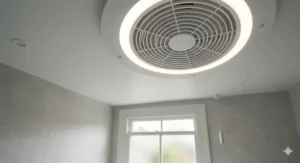
6. Xpelair Simply Silent Contour C4HTSR Extractor Fan
The C4HTSR sits in Xpelair’s Simply Silent Contour range, combining a humidistat, timer, and a notably sleek rectangular fascia that looks considerably more contemporary than the standard circular units. If you’re fitting a new bathroom and want the fan to blend into a more modern aesthetic, this is the one worth considering.
The humidistat automatically triggers the fan when relative humidity reaches a threshold, then keeps it running until the moisture clears — genuinely useful in British bathrooms where hot showers in cold weather create serious condensation problems. UK reviewers with bathroom damp issues report a marked improvement after installation, particularly in older Victorian terrace properties where plaster walls absorb moisture and take forever to dry out.
At around 22 l/s, airflow is solid without being excessive, and the ABS casing is built to handle the constant thermal cycling that British bathrooms — frequently freezing in the morning, steamy by 7:30am — put ventilation equipment through.
✅ Humidistat + timer — excellent automation for damp-prone UK homes
✅ Contemporary rectangular design
✅ IP44 rated, 230V compatible
❌ Slightly higher noise profile than the top performers on this list
❌ Humidistat calibration can require adjustment in very humid climates
Price range: £45–£60. A well-rounded mid-range choice with smart features.
7. CubeTECH CTQF100t Smart LED Bathroom Extractor Fan
The CubeTECH CTQF100t is the outlier on this list — a glass-panel LED-illuminated ceiling fan that looks like something out of a Scandi bathroom catalogue. Available in white and black glass finishes, it functions as both an extractor fan and a ceiling light, which makes it particularly appealing for smaller bathrooms where ceiling space is genuinely precious.
The built-in LED panel is cool-white and provides reasonable task lighting, though it’s supplemental rather than primary illumination in most settings. The timer overrun delay keeps the fan running after the light is switched off, clearing residual steam in the process. At around 34 dB, it’s the noisiest fan on this list — but “noisy” is relative; 34 dB is still quieter than normal conversation, and the airflow performance at approximately 85 m³/h is respectable.
The smart LED element makes this particularly appealing for loft conversions and basement bathrooms where a single ceiling penetration doing double duty is architecturally sensible.
✅ LED light + fan in one ceiling unit — useful for compact bathrooms
✅ Modern glass finish, genuinely attractive
✅ 240V compatible, ceiling mount
❌ Noisier than the silent-class fans
❌ LED panel is not replaceable separately if it fails
Price range: £35–£50. An inventive solution for tight spaces and modern aesthetics.
How to Install and Get the Best From Your IP44 Bathroom Ceiling Fan
Installation of an IP44 bathroom ceiling fan in Zones 1 or 2 must, under UK Building Regulations Part P, be carried out by a Part P-registered electrician or notified to your local authority building control. This isn’t box-ticking — water and electricity sharing a confined steamy space is genuinely hazardous, and Part P exists to prevent exactly the kind of amateur wiring that causes fires and shocks.
That said, here’s what you can do before the electrician arrives.
Measure your duct diameter first. UK bathrooms use 100mm or 125mm ducting as standard. A surprising number of people order a fan that won’t connect to their existing duct, then discover this after the electrician has turned up. Check before you buy — it takes two minutes and saves considerable grief.
Position matters. Fans should be positioned as far as possible from the main air inlet (window or trickle vent), so they draw fresh air across the full length of the room rather than short-circuiting. In a typical UK bathroom, this usually means fitting the fan above the shower area rather than above the door.
Use rigid ducting where possible. Flexible corrugated ducting creates flow resistance at every bend, reducing effective extraction by 20–30%. In a British terrace where the duct run might travel through two floors of a loft, this is the difference between a fan that works and a fan that merely hums.
Maintenance is simple. Every 12 months, remove the fascia cover, wipe the blades with a damp cloth, and check the backdraught shutter moves freely. In hard-water areas like London and the South East, limescale can build up on the shutter mechanism — a spray of white vinegar and a soft brush sorts it in minutes.
Real UK Bathrooms, Real Problems: Which Fan Fits Your Home?
Profile A: The Victorian terraced house in Manchester. Old plaster walls, minimal original ventilation, a bathroom the size of a large cupboard. The main problem is residual moisture — it lingers for hours. Best pick: EnviroVent SIL100T with the timer variant. The 26 l/s extraction rate tackles the volume of moisture, the timer keeps it running after showers, and the Quiet Mark certification means morning extraction isn’t waking the whole terraced row.
Profile B: The new-build apartment in Bristol. Airtight construction, no openable window in the ensuite, and a developer-installed fan that sounds like a small helicopter. Best pick: Xpelair DX100BTS. The dual-speed function provides the continuous background ventilation that airtight new-builds need, while the humidistat automates everything. One-person flats in Bristol, Sheffield, or Edinburgh’s new-build estates will find this setup transforms the bathroom within weeks.
Profile C: The master en-suite next to the bedroom in a Surrey semi. Two adults, early mornings, and a fan that wakes the non-showering partner every single time. Best pick: Vent-Axia Silent 100 (446659B). At 13 dB, it is genuinely inaudible through a wall. The peace of mind — and the uninterrupted sleep — justifies the slightly higher price tag entirely.
Profile D: The bathroom renovation with a design-led brief. Slate tiles, brushed brass taps, and an owner who spent three months on Instagram choosing a towel rail. Best pick: Airflow iCON 15 in anthracite or chrome. Pair it with the optional timer module, and you’ve got a fan that matches the aesthetic and handles the ventilation without looking like an afterthought.
How to Choose IP44 Bathroom Ceiling Fans in the UK
Here’s a practical framework for narrowing down the options without getting lost in specification tables.
- Confirm your IP zone. If the fan sits within 60cm of the shower or bath edge horizontally (Zone 2), IP44 is the minimum. Directly above the shower (Zone 1), you need IP45 or higher — not all fans on this list qualify for Zone 1, so check the product datasheet rather than the product title.
- Calculate the extraction rate you actually need. Room volume (length × width × ceiling height in metres) multiplied by the recommended air changes per hour (typically 8–15 ACH for a wet bathroom) gives you the m³/h figure. Building Regulations Part F requires 15 l/s (54 m³/h) as a minimum. Size up if you have a large family bathroom or a particularly steamy household.
- Decide on control mode. Timer-only is simpler and cheaper. Humidistat is smarter and more efficient — the fan runs only as long as moisture is present. For a continuously occupied family home, a humidistat is almost always worth the extra £15–20.
- Check your duct diameter and run length. Longer duct runs with more bends require higher-powered fans. If your duct run is over 3 metres with multiple bends, consider an inline fan (like the Manrose MF100S or Vent-Axia ACM100T) that sits in the loft space rather than in the ceiling itself.
- Factor in noise if you have bedrooms nearby. Anything under 26–27 dB is genuinely quiet. Above 35 dB becomes noticeable. In a detached house, this matters less; in a terraced house with thin walls, it matters a great deal.
- Budget for installation. A Part P electrician will typically charge £80–£150 for a straightforward fan swap, more for a new installation. Factor this into your total cost of ownership.
UK Zones, Safety Standards and Building Regulations You Can’t Ignore
British Standard BS 7671 Section 701 governs electrical installations in bathroom locations and defines the zone system that determines what you can install and where. It’s the framework behind every IP rating requirement you’ll encounter when shopping for bathroom fans, and ignoring it isn’t just inconvenient — it can invalidate your home insurance.
Zone 0 is inside the bath or shower tray. Zone 1 extends directly above the bath or shower to a height of 2.25 metres. Zone 2 covers the area within 60cm of those boundaries. Anything beyond Zone 2 is effectively the rest of the bathroom.
For most ceiling-mounted extractor fans, you’re working in Zone 1 or Zone 2 depending on exact placement. IP44 covers Zone 2; for Zone 1, you need IP45 minimum (protected against low-pressure water jets from all directions). Several fans on this list — including the Airflow iCON 15, explicitly rated for Zones 1 and 2 — exceed the IP44 baseline, which gives you more installation flexibility.
From a Building Regulations perspective, Approved Document F requires 15 l/s of extract ventilation for bathrooms, rising to 4 air changes per hour for bathrooms without external walls. If you’re in a windowless ensuite — increasingly common in UK loft conversions — your fan needs to be more powerful and ideally on continuous operation, not just triggered by the light switch.
Post-Brexit, UK products should carry UKCA marking rather than CE marking, though CE marking remains acceptable under transitional arrangements in 2026. Most established UK brands — Vent-Axia, Manrose, EnviroVent, Xpelair, Airflow — have updated their certifications appropriately.
What to Expect: Real-World Performance in British Conditions
Manufacturers quote noise levels in an anechoic chamber, which bears roughly the same relationship to your tiled bathroom as a Formula 1 test track does to the A406. Hard tile surfaces reflect sound; a fan rated at 26 dB in testing can appear 3–5 dB louder in a fully tiled UK bathroom. Budget for that difference.
Similarly, quoted extraction rates assume zero back pressure — no duct runs, no bends, no resistance. Every metre of rigid ducting, every 90-degree bend, and every metre of flexible corrugated ducting reduces effective airflow. A fan rated at 26 l/s might deliver 18–20 l/s through a typical UK terraced-house duct run. This isn’t marketing dishonesty; it’s physics. Size up accordingly.
British winter complicates things in one specific way: cold duct runs cause condensation inside the ductwork itself. Water droplets form, collect, and — if the duct isn’t properly insulated or sloped — drip back into the fan. Insulated ducting, available from most UK electrical wholesalers, solves this. It’s not expensive. It’s also never included in the box.
Finally, hard water areas — much of England south of the Midlands — see limescale buildup on the iris or backdraught shutter over time. This reduces airflow efficiency without being immediately visible. An annual clean is the fix; it takes minutes and extends fan life by years.
Common Mistakes When Buying IP44 Bathroom Ceiling Fans
Buying on noise alone. A whisper-quiet fan that can’t clear your bathroom isn’t doing its job. Match the extraction rate to the room volume first, then optimise for noise.
Ignoring the zone classification. “IP44 bathroom fan” on an Amazon listing doesn’t tell you whether the unit is certified for Zone 1. If you’re ceiling-mounting above a shower, check the product datasheet for explicit zone ratings. The Airflow iCON 15 and several Xpelair models are explicit about Zone 1 suitability; not all are.
Buying US or European 110V models. UK mains voltage is 230V/50Hz. Most fan listings on Amazon.co.uk are UK-compatible, but third-party sellers occasionally list products designed for US 110V circuits. Check the voltage specification before purchasing, particularly for any product shipped from outside the UK.
Underestimating duct run resistance. As discussed above: always size up one step if your duct run is long or includes multiple bends. The cost difference between fan models is trivial compared to the cost of a second installation visit.
Skipping the backdraught shutter. In a British winter, an unsupported duct hole is a cold air cannon pointed directly at your ceiling. Every fan on this list includes a backdraught shutter; if you’re considering a cheaper alternative, make absolutely certain it’s included or available as an accessory.
Features That Actually Matter (And Those That Don’t)
Features that matter:
- Backdraught shutter — non-negotiable in the UK climate
- Overrun timer — keeps the fan running after you leave; prevents residual moisture
- Humidistat — genuinely smart moisture management; pays for itself in reduced mould treatment
- Airflow rate (l/s) — match it to your room; don’t let marketing guide you
- IP zone rating — check the datasheet, not the product title
Features that are nice but not essential:
- LED indicator lights (mildly useful)
- Multiple colour options (genuinely nice for renovation projects)
- Smart home connectivity (useful if you’re building an integrated system; irrelevant if you’re not)
Features that don’t matter as much as brands suggest:
- Exactly which brand of ABS plastic casing — they all handle bathroom humidity
- Specific motor technology branding — “Ghost Air Movement” and “turning vanes” describe the same general concept with different names
- RPM specifications — what matters is actual airflow (l/s or m³/h), not how fast the motor spins
Long-Term Cost and Maintenance in the UK
The lifetime cost of a bathroom extractor fan is rarely what it appears at checkout. A £30 fan consuming 12W, running 6 hours a day, costs around £8–10 per year in electricity at current UK average rates. A premium 7.5W model running the same hours costs around £5–6 per year. Over a decade, that’s a meaningful difference — but it’s still not the biggest number.
The bigger cost is mould remediation. A poorly ventilated British bathroom accumulates mould behind tiles, in grouting, and in wall cavities within 18–24 months of inadequate extraction. Depending on severity, remediation costs from £200 to several thousand pounds. By that measure, even the most expensive fan on this list is cheap insurance.
Replacement parts are generally available for established UK brands. Vent-Axia, Manrose, EnviroVent, and Xpelair all have UK distribution networks and parts availability stretching back years. The CubeTECH CTQF100t’s integrated LED is the outlier — if the LED fails, you’re effectively replacing the whole unit, since the panel isn’t separately serviceable.
Amazon Prime members get next-day or same-day delivery on most stocked items, which is useful when you’re mid-renovation and the bathroom is out of service.

FAQ: IP44 Bathroom Ceiling Fans
❓ What does IP44 mean for a bathroom ceiling fan?
❓ Do I need a Part P electrician to install a bathroom ceiling fan in the UK?
❓ What extraction rate do I need for my UK bathroom?
❓ Can I install an IP44 bathroom ceiling fan in a wet room or shower enclosure ceiling?
❓ Are IP44 bathroom fans available with next-day delivery on Amazon.co.uk?
Conclusion
The right IP44 bathroom ceiling fan is less exciting than new tiles or a statement mirror, but it does more for the long-term condition of your bathroom than almost anything else you’ll buy. It keeps the mould at bay, the joinery intact, and the insurance policy valid. That’s not nothing.
For most UK homes, the EnviroVent SIL100T remains the benchmark — powerful, quiet, reliable, and reasonably priced. Budget buyers should look hard at the Manrose QF100T, which offers British-engineered quality at a price that doesn’t require a rethink. If noise is your primary concern, nothing on this list touches the Vent-Axia Silent 100 at 13 dB. And if you’re mid-renovation and the fan needs to earn its visual place in the room, the Airflow iCON 15 delivers both aesthetics and performance.
Whatever you choose, pair it with rigid ducting, a properly rated backdraught shutter, and a Part P-registered electrician. The fan does the work; the installation makes it worthwhile.
✨ Don’t Miss These Exclusive Deals!
🔍 Ready to upgrade? Click any highlighted product above to check current pricing and availability on Amazon.co.uk. Your bathroom — and your ceiling — will thank you.
Recommended for You
- Best IP44 Ceiling Fan with Light UK 2026: 7 Top Picks Reviewed
- Best Bathroom Ceiling Fans UK 2026: 7 Top Picks Reviewed
- 7 Best Ceiling Fan for Small Kitchen UK (2026 Guide)
Disclaimer: This article contains affiliate links. As an Amazon Associate, I earn from qualifying purchases. If you purchase products through these links, we may earn a small commission at no additional cost to you.
✨ Found this helpful? Share it with your mates! 💬🤗
