
In This Article
There’s a particular kind of morning ritual that happens in millions of British homes. You step out of the shower, reach for your towel, and notice — again — that the bathroom mirror is completely fogged, the ceiling is dripping with condensation, and the grout along the tiles has developed a suspiciously dark tinge. Sound familiar? Britain’s damp, mild climate is practically custom-designed to ruin bathrooms. We don’t get Texas heat or Canadian blizzards, but we do get relentless humidity, grey drizzle nine months of the year, and terrace houses with notoriously poor ventilation.
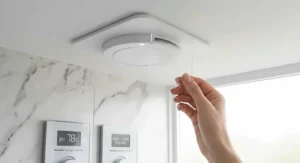
A decent bathroom ceiling fan is, quite genuinely, one of the best home investments you’ll make. A well-chosen, properly rated unit pulls moisture out before it settles into the plaster, prevents black mould from taking hold, and keeps that musty smell from greeting your guests. What is a bathroom ceiling fan? Simply put, it’s a ceiling-mounted extractor fan — rated to survive in damp environments — that mechanically removes humid air and odours from your bathroom and vents them outside. Get one right, and you’ll forget it exists (that’s actually the goal). Get one wrong, and you’ll be sanding mould off your ceiling by Christmas.
This guide covers seven real, verified picks available on Amazon.co.uk right now, covering every budget from a no-fuss £30 unit to a smart app-controlled system. We’ll also walk you through the UK regulations you’re legally required to meet, the IP ratings that actually matter, and the installation pitfalls that catch out even experienced DIYers. Let’s get into it.
Quick Comparison: Best Bathroom Ceiling Fans UK 2026
| Model | Type | Extraction Rate | Noise Level | IP Rating | Best For |
|---|---|---|---|---|---|
| Vent-Axia VASF100T | Axial, ceiling/wall | 54 m³/hr | 28 dB(A) | IP44 | Budget reliability |
| Manrose MF100T | Inline mixed flow | 245 m³/hr (hi) | 24 dB(A) | IP44 | Loft installation |
| Xpelair C4HTR | Axial with humidistat | 95 m³/hr | 29 dB(A) | IPX4 | Shower rooms |
| Airflow iCON 15S | Axial, smart | 25 l/s (90 m³/hr) | 26 dB(A) | IP45 | Modern bathrooms |
| Envirovent SIL100T | Axial, ultra-quiet | 86 m³/hr | 26 dB(A) | IPX4 | Noise-sensitive users |
| CubeTECH CTQF100t | Axial LED smart | 95 m³/hr | 34 dB(A) | IPX4 | Contemporary design |
| Bosch 1500 DH 100mm | Axial, auto-sensor | 95 m³/hr | 31 dB(A) | IP44 | Set-and-forget |
The table above reveals something worth noting immediately: extraction rate and noise level rarely peak together. The Manrose MF100T blows everything else out of the water on raw power, but it achieves this by living in your loft — not your bathroom. For standard-sized UK bathrooms (typically 4–6 m²), most 100mm fans at 85–100 m³/hr are more than sufficient. Bigger steam rooms or shower-room conversions? Size up to 150mm or consider inline. More on that below.
💬 Just one click — help others make better buying decisions too! 😊
✨ Don’t Miss These Exclusive Deals!
🔍 Take your bathroom ventilation to the next level with these carefully selected products. Click on any highlighted item to check current pricing and availability on Amazon.co.uk. These picks are chosen to help you find exactly what you need — for every bathroom size, budget, and building type.
Top 7 Bathroom Ceiling Fans UK 2026: Expert Analysis
1. Vent-Axia VASF100T Silent Fan with Timer
The Vent-Axia VASF100T is, for many UK tradespeople, the default recommendation — not because it’s flashy, but because it simply works, year after year. Vent-Axia is a British brand founded in 1936, and their Silent Fan series has been a staple of UK bathroom renovations for decades. The VASF100T delivers 54 m³/hr at a respectable 28 dB(A), which puts it firmly in “you’ll forget it’s running” territory. At 230V with a UK plug connection, it’s wired to the standards you’d expect, and its IP44 rating makes it appropriate for Zone 2 (within 60cm of a bath or shower but not directly above it).
What most UK buyers overlook about this model is the timer override functionality. The fan continues running for an adjustable period after the light switch goes off — typically 5 to 20 minutes — which is precisely when the heaviest moisture removal needs to happen (not while you’re in the shower, but in the five minutes after you step out). In a typical semi-detached or terrace with limited airflow through the house, that post-shower run-on can be the difference between a dry ceiling and a damp one by lunchtime.
UK reviewers consistently praise its build quality and ease of installation. A few note that the faceplate grille is on the larger side — which matters in a small en-suite where a bulky vent can look awkward.
✅ Trusted British brand with decades of UK market support
✅ Adjustable timer — essential for post-shower humidity control
✅ Straightforward to install; suits DIYers with basic wiring knowledge
❌ 54 m³/hr extraction rate is adequate but not powerful for large bathrooms
❌ Plain white aesthetic won’t suit premium bathroom designs
Price range: Under £50 — excellent value for a name-brand timer fan. Check current price on Amazon.co.uk.
2. Manrose MF100T 100mm Inline Mixed Flow Fan with Timer
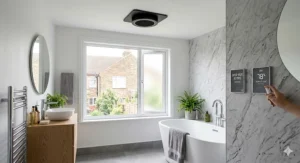
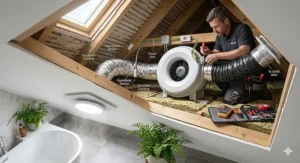
If you want the most powerful moisture extraction money can buy in this size class, the Manrose MF100T is almost absurdly capable. A 100mm fan pushing 245 m³/hr at high speed — that’s over four times the extraction rate of a standard axial unit — at just 24 dB(A). The secret is that it doesn’t sit in your bathroom ceiling at all. It mounts in the loft or ceiling void, connected via 100mm ducting to a simple grille in the bathroom. The motor noise stays up in the roof space; all you hear in the bathroom is the gentle whoosh of air moving.
This is the go-to solution for UK bathrooms that have awkward duct runs — through two floors, around multiple bends, or venting through a roof space rather than directly through an external wall. Standard axial fans lose performance rapidly with back pressure (bends in ductwork, long runs); the MF100T’s mixed flow design maintains strong extraction even with a challenging duct route.
It’s not a beginner install, though. You’ll need a permanent live, switched live, and neutral at the fan position — the instructions are UK-specific, but the wiring configuration catches people out. UK reviewers rave about the near-total silence and describe it as transformative for badly ventilated bathrooms.
✅ Extraordinary extraction rate (245 m³/hr) for a 100mm fan
✅ Near-silent operation — motor is hidden in loft, out of the room entirely
✅ Handles long or complex duct runs that defeat standard fans
❌ Loft or ceiling void installation required — not suitable for all bathrooms
❌ Requires correct 3-wire connection; not ideal for beginners
Price range: Around £60–£80 range — premium for an inline fan, but worth every penny for problematic ventilation situations.
3. Xpelair C4HTR Bathroom Extractor Fan with Timer and Humidistat
The Xpelair C4HTR is the fan recommended by electricians across UK forums with a frequency that borders on the evangelical. There’s a reason. It’s compact, quiet, elegantly minimalist in design, and the combination of timer and humidistat means it operates intelligently: the humidistat kicks in when steam rises even if the bathroom light is off (useful for bathers who prefer candlelight — yes, really), and the timer handles the post-shower run-on automatically. At around £55–£70, it occupies the sweet spot between budget and smart functionality.
The 95 m³/hr extraction is more than enough for a standard UK bathroom, and the faceplate is slim enough not to dominate the ceiling. The IPX4 rating (splash-proof from all directions) is technically a slightly different classification from IP44 — both are appropriate for Zone 2 installations under UK wiring regulations, but if you’re mounting directly above a shower enclosure (Zone 1), you’d want to verify Zone 1 suitability with your electrician. Per the IET Wiring Regulations (BS 7671), all electrical installations in bathroom zones must be carried out or verified by a qualified electrician.
UK buyers note the faceplate can be painted to match your wall colour — a small touch, but one that makes it virtually invisible once installed.
✅ Humidistat + timer combo provides truly automatic, intelligent operation
✅ Paintable faceplate — blends into any décor
✅ Strong UK availability with solid parts support
❌ IPX4 rather than IP44 — check zone suitability with your installer
❌ Slightly louder at 29 dB(A) than some premium competitors
Price range: £50–£75 — solid mid-range value for a fan that does the thinking for you.
4. Airflow iCON 15S Bathroom Extractor Fan
The Airflow iCON 15S is what you’d buy if your bathroom design actually matters to you. The Airflow iCON range has a genuinely contemporary look — slim, white, with clean Scandinavian-adjacent lines — and the iCON 15S backs it up with a QuietMark certification, which is one of the few independently verified noise ratings in the UK ventilation market (the Quiet Mark programme is administered by the Noise Abatement Society in the UK). Running at 26 dB(A), it’s genuinely one of the quietest ceiling-mount fans available on Amazon.co.uk.
The iCON 15S earns its IP45 rating — slightly superior to the standard IP44 — and the built-in self-sealing shutter means cold draughts don’t backdraft through the duct when the fan is off. In a British winter, when the temperature difference between inside and outside can be significant, a backdraft shutter earns its keep. You’ll stop noticing cold air whistling through your bathroom ceiling. For a flat with a west-facing bathroom in Edinburgh or a Victorian terrace in Manchester, this detail matters far more than the spec sheet suggests.
Available on Amazon.co.uk with Prime delivery, which means next-day installation is genuinely achievable if you’re mid-renovation.
✅ QuietMark certified — independently verified quiet operation
✅ IP45 rated — zone-robust protection
✅ Self-sealing shutter prevents cold backdrafts in winter
❌ On the pricier end of standard axial fans
❌ Smart features limited compared to humidistat-equipped rivals
Price range: £60–£90 — worth the premium if silence and aesthetics are priorities.
5. Envirovent SIL100T Silent Bathroom Extractor Fan with Timer
The Envirovent SIL100T is the unsung hero of this list. Less aggressively marketed than Vent-Axia or Xpelair, Envirovent is a Leeds-based British manufacturer that deserves more recognition. The SIL100T runs at 26 dB(A) — properly quiet — and the build quality is notably solid. The timer-only version suits bathrooms where a humidistat isn’t required; it’s as reliable and unfussy as they come.
What distinguishes the Envirovent range is the backdraught shutter, which is built in and smooth-operating — the kind of detail that gets ignored in spec sheets but matters enormously when your bathroom ventilates to a north-facing exterior wall in a Yorkshire winter. There’s also a brushed chrome faceplate option available, which transforms the look from “functional white box” to something you’d actually be pleased to show off in a refurbished bathroom.
UK reviewers frequently note it as a like-for-like replacement for older fans with minimal fuss. The 86 m³/hr extraction is on the lower end of this list, but entirely Building Regulations-compliant — Part F of the Building Regulations specifies a minimum of 15 l/s (54 m³/hr) for bathrooms without an opening window.
✅ British manufacturer — reliable UK parts and warranty support
✅ Chrome faceplate option for a premium finish
✅ Built-in backdraught shutter as standard
❌ 86 m³/hr extraction — lower than most rivals at this price point
❌ Timer-only (no humidistat) — less intelligent moisture response
Price range: Around £30–£50 — genuinely great value from a reliable British brand.
6. CubeTECH CTQF100t Smart LED Bathroom Extractor Fan with Timer
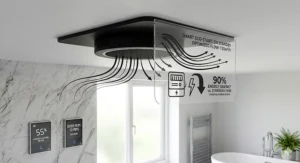
The CubeTECH CTQF100t is the one for anyone who’s looked at a bathroom extractor fan and thought “why does it have to look like something salvaged from a 1990s new-build?” It doesn’t. The CubeTECH features a black or groove-finish tempered glass faceplate with integrated LED lighting — slim, modern, and genuinely good-looking installed in a white ceiling. The LED adds ambient light that’s surprisingly useful in the middle of the night.
At 95 m³/hr and 34 dB(A), it’s not the quietest fan on this list — the LED circuitry and glass cover marginally increase the acoustic profile — but it’s hardly loud either. For most UK bathrooms, 34 dB(A) is less than a quiet conversation. The IPX4 rating and 240V/50Hz specification confirm it’s UK-compatible straight out of the box, and it installs via standard ceiling or wall mounting with 100mm ducting.
The real selling point here isn’t technical — it’s aesthetic. If you’ve spent three weeks choosing the right tiles and fitting a freestanding bath, a plain white plastic fan grille feels like a missed opportunity. The CubeTECH gives you a finished, designed look without demanding an architect’s budget.
✅ Genuinely attractive black glass aesthetic — stands out on the market
✅ Integrated LED light — useful nighttime ambient illumination
✅ Available in two finish variants — grooved and smooth glass
❌ Louder than most competitors at 34 dB(A)
❌ LED module adds complexity to long-term servicing
Price range: £40–£65 — reasonable premium for a design-led bathroom accessory.
7. Bosch 1500 DH 100mm Bathroom Extractor Fan with Humidistat and Timer
The Bosch 1500 DH 100mm is the set-it-and-forget-it option for buyers who want intelligent, automatic operation without fuss. Bosch’s entry into the bathroom fan market brings the kind of no-nonsense German engineering that shows up in the details: the humidity sensor is genuinely reactive, responding quickly to steam rather than lagging behind like the sensors in some cheaper rivals. The combined humidistat and timer means the fan wakes up when your shower does, runs until the moisture has cleared, and then shuts off without any human input whatsoever.
At 95 m³/hr and 31 dB(A), the performance numbers are broadly comparable with the Xpelair C4HTR — but Bosch’s sensor calibration feels more precise in practice. It’s IP44 rated and 100mm diameter, fitting standard UK duct runs without adaptor plates. UK buyers note the instructions could be clearer (a common Bosch criticism), but installation itself is straightforward for anyone comfortable with basic mains wiring.
Worth noting: as an EU-manufactured product, UK prices have shifted slightly post-Brexit due to import adjustments. You still benefit from full UK consumer protection under the Consumer Rights Act 2015, and Amazon.co.uk provides standard UK returns and warranty support regardless.
✅ Bosch reliability — sensor is accurate and reactive
✅ Combined humidistat + timer: truly automatic, hands-off operation
✅ Clean, professional appearance with compact 100mm footprint
❌ Price point reflects brand premium — not the most economical option
❌ Installation instructions could be more UK-specific
Price range: £50–£80 range — premium brand, justified by the sensor quality.
How to Choose Bathroom Ceiling Fans in the UK: A Step-by-Step Framework
Choosing a bathroom fan sounds simple until you’re standing in a builder’s merchant staring at twelve near-identical white boxes. Here’s a practical decision process:
1. Check your IP zone first. IP zones define where electrical fittings can legally be installed. Zone 0 is inside the bath or shower itself (IP67 minimum). Zone 1 is directly above the bath or shower tray (IP45 minimum). Zone 2 is within 60cm of any water source (IP44 minimum). Outside all zones is IP20 acceptable. Most bathroom ceiling fans are IP44 or IPX4 — appropriate for Zone 2. If you’re mounting directly above an enclosed shower, verify Zone 1 suitability.
2. Calculate your extraction rate requirement. Measure your bathroom in cubic metres (length × width × ceiling height). Aim for at least 15 l/s (54 m³/hr) per Approved Document F of the Building Regulations. For a steamy shower room without an opening window, shoot for 20–30 l/s to account for real-world back pressure and British damp conditions.
3. Measure your duct diameter. UK bathrooms use either 100mm or 125mm ducting. Fitting a 100mm fan to a 125mm duct requires an adaptor — the reverse is trickier. Check before ordering.
4. Count your bends. Every 90° bend in your duct run reduces effective extraction by roughly 20%. A fan rated at 95 m³/hr in open air might be delivering 65 m³/hr after two bends. Long or complex runs favour the Manrose MF100T inline approach.
5. Timer vs humidistat vs both. A basic timer runs for a set period after the light goes off — reliable and cheap. A humidistat responds to actual steam, which is smarter but slightly pricier. The sweet spot for most UK bathrooms is a combined unit (Xpelair C4HTR, Bosch 1500 DH) that handles both scenarios.
6. Consider noise vs extraction trade-off. Lower dB(A) generally means lower extraction. If your bathroom echoes and your bedroom is adjacent, a 24–26 dB(A) model like the Manrose inline or Airflow iCON earns its premium. If the fan is in a separate bathroom across the landing, 34 dB(A) is barely noticeable.
7. Commission a Part P registered electrician. Installation in Zones 0, 1, and 2 must be carried out by a Part P registered electrician or notified to your local authority building control. Doing it yourself and not notifying building control isn’t just potentially dangerous — it creates complications when you come to sell your home.
Real UK Homes, Real Scenarios: Which Fan Fits Your Bathroom?
Different UK living situations call for genuinely different solutions. Here are three profiles that map neatly onto real buyer decisions.
Profile A — Victorian terrace in Manchester, internal bathroom, no external wall. This is perhaps the most challenging scenario in UK domestic ventilation: a bathroom that sits in the middle of the house with a duct run that travels upward through the floor joists, across the loft, and out through the roof or eaves. Back pressure is high, the duct run is 3–5 metres with multiple bends. Here, the Manrose MF100T is the obvious choice — its mixed flow design and 200 Pa maximum working pressure laugh at long duct runs that would reduce a standard axial fan to a whisper. Budget around £70–£85 for the fan plus a few metres of 100mm insulated flexible duct.
Profile B — New-build flat in Bristol, en-suite with opening window, limited noise tolerance. The window means you already meet the legal minimum, but the neighbour through the plasterboard and the baby’s room next door mean noise is paramount. Airflow iCON 15S at 26 dB(A) with QuietMark certification. The IP45 rating adds a little extra protection for a compact en-suite where the shower is closer to the fan than you’d ideally like. Around £70–£90 — money well spent for a flat where sound travels.
Profile C — 1980s semi-detached in Leeds, family bathroom, moisture problems, elderly relatives visiting. You want intelligent, fully automatic operation — nobody should need to think about running a fan. The Bosch 1500 DH’s humidistat turns it on when the shower does and off when the air is genuinely dry again. No timers to set, no switches to remember. The consumer-friendly reliability of a Bosch appliance suits a household where the ventilation system needs to just work without intervention. The fan costs a touch more than comparable options, but the zero-maintenance operation justifies the spend.
Common Mistakes When Buying Bathroom Ceiling Fans in the UK
Even experienced DIYers make these errors. Forewarned is forearmed.
Buying a fan without checking the duct diameter. It sounds obvious. It catches people out constantly. UK bathrooms use either 100mm or 125mm duct, and they’re not directly interchangeable. Spend two minutes measuring before you click “Add to Basket.”
Ignoring the IP rating entirely. Not every fan sold on Amazon.co.uk includes the IP rating prominently in the listing title. A fan with IP20 (no moisture protection) installed above a shower enclosure is a safety hazard and a wiring regulation violation. Always verify IP44 as an absolute minimum for Zone 2.
Assuming a UK product sold on Amazon.com also ships to the UK correctly. Several North American brands sell through Amazon’s UK storefront but ship 120V/60Hz units. These will not work safely on UK 230V/50Hz mains and may not have a UK Type G plug. Always check voltage specification: you’re looking for 220–240V / 50Hz.
Underestimating back pressure from long duct runs. The extraction rates printed on boxes are measured at zero back pressure in a laboratory. In a real UK bathroom with a 3-metre flexible duct and two 45° bends, you’ll lose 25–40% of that rated performance. If your bathroom has persistent condensation problems despite having a fan, back pressure is usually the culprit — the solution is an inline fan or a shorter, straighter duct run.
Skipping the backdraught shutter. Without one, cold outdoor air flows back through the duct when the fan isn’t running — particularly noticeable in British winter. Some fans include it built-in (Envirovent, Airflow iCON); others require a separately purchased external grille with shutter. Check before installing.
DIY installation in bathroom zones without notification. Worth repeating. Building Regulations Part P in England requires electrical work in bathroom zones to be notified to building control or carried out by a registered installer. The Planning Portal has clear guidance on what triggers this requirement.
UK Regulations, Safety Standards, and What You’re Actually Required to Do
UK bathroom ventilation is governed by several overlapping frameworks, and understanding them helps you buy the right product and install it correctly.
Building Regulations Approved Document F mandates mechanical ventilation in any bathroom without an opening window. The 2026 edition (currently in force in England) specifies a minimum extraction rate of 15 l/s (54 m³/hr) for intermittent operation in bathrooms. That’s a floor, not a ceiling. For shower rooms with heavy steam use, aiming for 20–30 l/s gives real-world performance that actually prevents mould rather than barely complying with the minimum. The Scottish Building Standards (handled separately from England) have equivalent requirements, but the details differ slightly — if you’re in Scotland, check with your local authority building control.
IET Wiring Regulations (BS 7671) govern the electrical installation itself, including the IP zone requirements described earlier. This is why you need a qualified electrician for Zone 1 and Zone 2 work — it’s a legal requirement, not a suggestion.
UKCA marking replaced CE marking for products placed on the Great Britain market post-Brexit. Reputable brands like Vent-Axia, Manrose, Xpelair, and Airflow should carry UKCA marking on products sold in the UK market from 2023 onwards. For EU-manufactured products like the Bosch, ensure the product complies with UK market requirements rather than relying solely on EU CE marking.
Part P Competent Person Schemes allow qualified electricians to self-certify their own work, bypassing the need to notify building control — but the electrician must be registered with a Part P scheme (e.g., NICEIC, ELECSA, NAPIT). If you’re a confident DIYer doing a like-for-like replacement on an existing fan position (same wiring configuration, no zone changes), you may not require notification — but if in any doubt, check with your local council.
Long-Term Cost and Maintenance: What Nobody Tells You at the Point of Sale
Bathroom fans are usually purchased once and expected to last a decade. The total cost of ownership matters more than the purchase price.
A typical 10W bathroom extractor fan running for one hour per day costs roughly £0.60–£0.70 per month at current UK electricity rates (approximately 24–28p/kWh). Over ten years, that’s perhaps £80–£85 in running costs — more than the fan itself for a budget unit. Higher-wattage fans don’t extract much better than efficient DC motor models, but they cost more to run. The Vent-Axia PureAir Sense with continuous trickle operation uses as little as 2W on standby, making it far more economical in continuous-run applications.
Cleaning is the most neglected maintenance task. UK bathroom fans accumulate a layer of dust, fluff, and condensate residue on the impeller blades within six months. When blades become coated, extraction efficiency drops sharply — by 30–40% in some cases — and the fan works harder, shortening motor life. Every six months, remove the faceplate grille, wipe the blades with a dry cloth, and vacuum the motor housing. It takes five minutes and meaningfully extends service life.
Duct inspection every two to three years is worth doing, particularly for inline fans in loft spaces. Flexible duct can sag, kink, or develop small splits where it connects to rigid sections. A sagging section collects condensate — it then blocks the duct gradually, and you’ll start to see condensation creeping back into the bathroom before the fan stops working entirely.
Replacement parts (impellers, grilles, timer modules) for major UK brands — Vent-Axia, Manrose, Xpelair, Airflow — are generally available from UK electrical wholesalers and often on Amazon.co.uk itself. This is a genuine advantage of sticking with established British or European brands over cheaper unbranded alternatives that may be discontinued within two years.
✨ Don’t Miss These Exclusive Deals!
🔍 Ready to solve your bathroom moisture problem for good? Click on any highlighted product above to check live pricing and availability on Amazon.co.uk. Prime members get free next-day delivery — you could have a new fan fitted by the weekend.
FAQ: Bathroom Ceiling Fans UK
❓ What IP rating do I need for a bathroom ceiling fan in the UK?
❓ Do I need an electrician to fit a bathroom ceiling fan in the UK?
❓ What extraction rate is required by Building Regulations for a bathroom in England?
❓ Can I install a UK bathroom ceiling fan myself if I'm replacing an existing one?
❓ Do bathroom extractor fans available on Amazon.co.uk come with a UK plug and correct voltage?
Conclusion
Britain’s combination of damp weather, compact housing, and terrace construction makes bathroom ventilation more important here than in almost anywhere else in Europe. A bathroom ceiling fan isn’t a luxury — for many UK bathrooms, particularly internal ones without external walls, it’s a legal requirement and a direct line of defence against mould, structural damp, and the kind of musty odour that politely announces itself every time a visitor steps inside.
The seven options in this guide cover every realistic UK buyer scenario, from a £30 budget pick that just gets on with the job, to a smart sensor-equipped German unit that does the thinking for you, to a loft-mounted inline fan that transforms a hopelessly under-ventilated Victorian terrace bathroom. There isn’t one universally “best” fan — there’s the right fan for your specific duct diameter, zone requirement, noise tolerance, and bathroom size.
Buy by IP rating first. Size by extraction rate second. Then pick the one with the features you’ll actually use. Do that, and you’ll stop fighting the damp.
✨ Don’t Miss These Exclusive Deals!
🔍 Found your match? Click through to Amazon.co.uk to check current pricing and availability. With Amazon Prime, you could have your new bathroom ceiling fan delivered by tomorrow.
Recommended for You
- 7 Best Ceiling Fan for Small Kitchen UK (2026 Guide)
- 7 Best Farmhouse Kitchen Ceiling Fans UK 2026 (Rustic & Stylish)
- 7 Modern Kitchen Ceiling Fan Ideas for UK Kitchens (2026)
Disclaimer: This article contains affiliate links. As an Amazon Associate, I earn from qualifying purchases. If you purchase products through these links, we may earn a small commission at no additional cost to you.
✨ Found this helpful? Share it with your mates! 💬🤗
