In This Article
Mention ceiling fans to a Brit and you’ll get a raised eyebrow. We get three decent summer weeks and a boiler that works overtime for the other forty-nine, so who needs one? Quite a lot of us, as it happens. A reversible ceiling fan with light does two jobs most gadgets can’t. It moves air in July, and it nudges stranded warm air back down from the ceiling in January, all while doubling as the room’s main light.
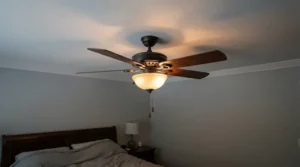
The physics fits in one breath. Warm air rises and loiters near the ceiling, a layering effect that this Wikipedia explainer on thermal destratification covers well. A fan running in reverse at low speed gently mixes that layer back into the room without whipping up a draught. Pair that with an efficient light and you’ve replaced two fittings with one.
This guide covers seven real models, from a compact bedroom fan to a 153cm living-room statement. I’ve worked from manufacturer spec sheets, retailer data and aggregated review sentiment where it could be verified. Then I’ve added what a product listing never will: what those numbers mean in an actual British semi. If you’re hunting for the best fan and light fixture for your home, start with the table below. Prices are ranges only, so check current price before you buy.
Quick Comparison: Reversible Ceiling Fan with Light at a Glance
| Model | Span | Light | How You Reverse It | Best For |
|---|---|---|---|---|
| Westinghouse Madeline 142cm | 142cm | 24W dimmable LED | Switch on motor housing | Large living rooms |
| Westinghouse Josef 122cm | 122cm | 17W dimmable LED | Remote | Quiet bedrooms, DC efficiency |
| Westinghouse Willa 153cm | 153cm | 17W dimmable LED | Switch on motor housing | Open-plan spaces |
| Lucci Air Bronx 132cm | 132cm | 18W LED | Remote (confirm per listing) | Mid-sized rooms, 6 speeds |
| Philips Bliss | 51cm | 28W LED, 3 colour temperatures | Summer/winter mode (confirm per listing) | Small rooms, hidden blades |
| VOLISUN 50cm Smart Ceiling Fan | 50cm | Dimmable, 3000K-6500K | Remote/app | Budget bedrooms |
| Westinghouse Jet Plus 105cm | 105cm | 3 spotlights | Reversible motor | Small rooms, spotlight look |
Span is the first filter. A 50cm fan and a 153cm fan are different tools, so match the span to your floor area before you worry about finish or brand. The Willa and Madeline suit big rooms, the Josef and Bronx cover the middle ground, and the Philips Bliss and VOLISUN keep small spaces tidy. Notice too that “reversible” means different things. On some fans it’s a switch you flip twice a year, on others it’s a button on the handset, and that difference matters more than it sounds.
💬 Just one click — help others make better buying decisions too!😊
Top 7 Reversible Ceiling Fan with Light Picks: Expert Analysis
1. Westinghouse Madeline 142cm — best all-rounder for big living rooms
The Westinghouse Madeline 142cm wins by being sensible rather than showy. It’s a clean white three-blade fan with integrated LED lighting and a remote that handles fan speed plus light on, off and dimming.
The light is a 24W dimmable LED producing around 1,030 lumens at 3000K, with a CRI of 90. In practice that’s a warm, flattering glow where food and faces look right. The motor draws roughly 14, 36 or 54W across its three speeds, moves about 6,674 cfm at full tilt and sits around 47 dB(A), conversation level rather than whisper.
Retailer listings claim up to 36 m², but Westinghouse’s own sizing chart points to 132cm-plus for 25-30 m², so treat the lower figure as the safe one. The catch is that summer/winter reversal is a manual switch on the motor housing, not a remote button. You’ll flip it twice a year, which is fine unless the fan lives on a very high ceiling.
Review sentiment: I couldn’t verify a meaningful pool of independent UK reviews for this exact model. UK retailer round-ups consistently position it as the safe all-rounder, and the spec sheet backs that up.
Pros:
- ✅ Bright, high-CRI dimmable LED
- ✅ Strong airflow for a three-blade design
- ✅ Neutral white finish suits most rooms
Cons:
- ❌ Reversing needs a manual housing switch
- ❌ AC motor is noisier than DC rivals
Price: roughly the £230-£330 range depending on retailer. Verdict: strong value for large rooms. Check current price and availability.

2. Westinghouse Josef 122cm — quietest, with a DC motor and remote reverse
The Westinghouse Josef 122cm is the one for people who hate hearing their own fan. Its DC motor is the headline, and the clear curved blades are a pleasing bit of theatre.
The handset gives six speeds, a 1, 4 or 8-hour timer, a reverse function and dimming for the 17W integrated LED. That timer is the underrated feature. Set four hours at bedtime and the fan switches itself off once you’re asleep. Because reversing lives on the remote, winter mode takes one button press from the sofa. That’s the main advantage over the manual-switch Westinghouse models.
At 122cm it suits bedrooms and medium living rooms. Westinghouse’s sizing chart puts 112-122cm fans at roughly 20 m². Retailer round-ups note a 10-year motor warranty, which is reassuring on a premium purchase, though confirm the terms at checkout.
Review sentiment: I couldn’t verify enough independent UK reviews to summarise. Retailer commentary praises its quietness and efficiency, but that’s sales copy, not user testimony.
Pros:
- ✅ Six speeds plus 1/4/8-hour timer
- ✅ Reverse function on the remote
- ✅ DC motor keeps running costs and noise low
Cons:
- ❌ Premium price for a 122cm span
- ❌ 17W light is modest for large rooms
Price: roughly the £350-£420 range. Verdict: worth it if you run it nightly. Check current price.
3. Westinghouse Willa 153cm — biggest span for open-plan spaces
The Westinghouse Willa 153cm is the statement piece, with six reversible wengue and beech blades, a brushed nickel body and a cage-and-glass light. At 153cm it’s the span to pick when a smaller fan would simply be outgunned.
Specs: 77W maximum motor draw, up to roughly 11,018 cfm, and about 48 dB(A). The 17W dimmable LED delivers somewhere between 900 and 1,200 lumens depending on the source, at 3000K. That’s cosy rather than task-bright, so a kitchen-diner will want extra lighting. The lamps also can’t be changed, so the light is committed for life.
The blades are reversible too, which has nothing to do with airflow direction and only changes the finish. Direction is a manual switch on the housing. With a 51cm drop and a 13.5kg body, this fan wants a solid fixing and a decent ceiling height.
Review sentiment: no verifiable independent review pool turned up. Retailer round-ups recommend it for big rooms and high ceilings, which matches the specs.
Pros:
- ✅ Huge airflow for 25 m²-plus rooms
- ✅ Reversible two-tone blade finishes
- ✅ Dimmable integrated LED lighting
Cons:
- ❌ Heavy, with a deep drop
- ❌ Light is soft for task use
Price: roughly the £350-£440 range. Verdict: justified only if the room is genuinely large. Check current price.
4. Lucci Air Bronx 132cm — six-speed DC value for mid-sized rooms
The Lucci Air Bronx 132cm pairs a DC motor with six speeds, an 18W LED light and a remote. Listings quote up to 180 m³/min of airflow and suitability for rooms around 25 m².
On paper this is the sweet spot between the Madeline and the Josef. You get DC efficiency and finer speed steps than a three-speed AC fan, which matters at night. The difference between speeds one and three on a DC fan is far more usable than “off, quiet, hurricane”. Lucci’s DC range generally handles direction through the handset, but confirm that on your exact listing before ordering.
Check the listing for the colour of the light and whether it’s dimmable, as Lucci’s range varies. The brand’s wider lineup includes both integrated and add-on lights.
Review sentiment: I couldn’t confirm enough UK customer reviews to summarise, so judge on specs and warranty terms.
Pros:
- ✅ DC motor with six fine-grained speeds
- ✅ Built-in 18W LED with remote
- ✅ Sized for larger bedrooms and lounges
Cons:
- ❌ Fewer independent UK reviews to lean on
- ❌ Dimming and reverse details vary by listing
Price: roughly £250-£300, based on European retail listings, so UK prices may vary. Verdict: promising mid-range value. Check current price.
5. Philips Bliss — hidden retractable blades for small rooms
The Philips Bliss looks like a flush ceiling light until you press the fan button, when three transparent blades extend. At 51cm it’s the neatest fan and light fixture here, and the retracting blades mean no spinning shadows when you only want light.
The light offers three SceneSwitch colour temperatures (2700K, 4000K and 5500K). Cooler 4000K suits a home office, warm 2700K suits bedtime. Listings mention a DC motor, timers and summer and winter modes, though sources conflict on how reversal works, so confirm before buying. It also needs a minimum mounting height of 2.3 metres to the floor and 0.5 metres clearance from walls with blades extended, which rules out many loft rooms.
Review sentiment: I couldn’t verify a robust UK review pool. One UK comparison site ranks it first, but its scoring method isn’t transparent, so treat that cautiously.
Pros:
- ✅ Blades retract out of sight
- ✅ Three selectable colour temperatures
- ✅ Remote plus wall-switch operation
Cons:
- ❌ Needs 2.3m ceiling clearance
- ❌ Small blades limit airflow to compact rooms
Price: from roughly £120 upwards depending on variant. Verdict: great design value for small rooms. Check current price.

6. VOLISUN 50cm Smart Ceiling Fan — cheapest way into app-controlled dimming
The VOLISUN 50cm Smart Ceiling Fan is the budget pick: a flush, low-profile fan-and-light that suits bedrooms and small lounges. It offers six speeds, brightness from 5% to 100%, and adjustable colour temperature from 3000K to 6500K, controlled by remote or app.
That colour range is unusually wide for the money. At 3000K it’s cosy, and at 6500K it’s harsh daylight. Compact blades mean modest airflow, so think “bedroom comfort”, not “heatwave rescue”. The Amazon UK listing is Energy Class E, and the flush profile (roughly 16cm deep) helps lower ceilings.
Review sentiment: on Amazon UK, one variant showed an average above 4.5 stars across a few hundred ratings at the time of research. Reviewers generally describe it as modern-looking and effective for small spaces. Treat it as a good sign, not proof.
Pros:
- ✅ Wide 3000K-6500K dimmable range
- ✅ Remote and app control
- ✅ Low-profile flush design
Cons:
- ❌ Limited airflow in larger rooms
- ❌ App adds complexity most people won’t use
Price: roughly the £60-£80 range. Verdict: excellent value for a bedroom. Check current price.
7. Westinghouse Jet Plus 105cm — spotlight look for small rooms
The Westinghouse Jet Plus 105cm adds a trio of directional spotlights to a brushed nickel body, with reversible wengue and silver blades and a remote with wall bracket. Listings suggest rooms of roughly 12-20 m².
Directional spots are handy over a desk or a reading chair, and it’s one of the cheaper ways to get a reversible ceiling fan with light plus task lighting. The catch is that the lamps are E14 R50 types that may not be supplied, so check the box contents. Dimming then depends on which compatible lamps you buy. A 105cm fan with three speeds is a modest performer, so think spare room or study.
Review sentiment: I couldn’t verify a reliable pool of independent reviews, so I’m not summarising ratings.
Pros:
- ✅ Adjustable spotlights for task lighting
- ✅ Reversible motor for winter use
- ✅ Remote included
Cons:
- ❌ Lamps may be sold separately
- ❌ Three speeds only
Price: roughly the low-£100s range, with listings varying. Verdict: decent value if you want spotlights. Check current price.
Top 7 Specification Comparison
| Model | Motor | Airflow / Noise | Light | Price Range | Best For |
|---|---|---|---|---|---|
| Westinghouse Madeline 142cm | AC | ~6,674 cfm / 47 dB(A) | 24W, ~1,030 lm | £230-£330 | Living rooms |
| Westinghouse Josef 122cm | DC | Quiet DC | 17W dimmable | £350-£420 | Bedrooms |
| Westinghouse Willa 153cm | AC | ~11,018 cfm / 48 dB(A) | 17W, 900-1,200 lm | £350-£440 | Open-plan |
| Lucci Air Bronx 132cm | DC | ~180 m³/min | 18W LED | ~£250-£300 | Mid-sized rooms |
| Philips Bliss | DC | 36-46 dB | 28W LED | From ~£120 | Small rooms |
| VOLISUN 50cm Smart Ceiling Fan | Not stated | Compact airflow | Dimmable 3000K-6500K | £60-£80 | Budget bedrooms |
| Westinghouse Jet Plus 105cm | AC | 3 speeds | 3 spotlights | ~£100-£160 | Study, spare room |
The table makes the trade-offs plain. The Madeline and Willa offer the most airflow, while the Josef, Bronx and Philips Bliss trade raw power for DC quietness. For most bedrooms I’d pick the Josef if you can stretch the budget and the VOLISUN if you can’t. Remember that the Jet Plus gives you flexible lighting but modest airflow.
What Is a Reversible Ceiling Fan with Light?
A reversible ceiling fan with light is a ceiling-mounted fan that spins in two directions, anticlockwise for a cooling downdraught and clockwise for a gentle winter updraught, with a built-in light fixture. Direction is set by a switch, remote or app, and the light is usually LED.
The “reversible” part is what separates it from a basic summer fan. In winter you run it clockwise at low speed. The blades pull air upward, pushing warmer ceiling air down the walls, so you feel the benefit without a breeze. The light matters just as much. Because the fitting replaces your ceiling light, it needs to be good enough as the room’s main source.
A fan light combo reversible in both airflow and brightness is more useful than one that only does half the job. That’s why dimming and direction control are worth checking before you buy.
How to Choose a Reversible Ceiling Fan with Light
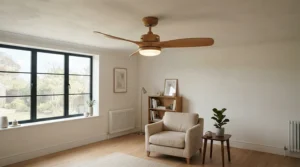
- Match span to floor area. Westinghouse’s sizing chart suggests 76-90cm up to about 12 m², 105cm for 15 m², 112-122cm for 20 m², and 132cm-plus for 25-30 m². Over 30 m², consider two fans.
- Check ceiling height. Look at the minimum blade height in the manual. The Philips Bliss, for instance, needs 2.3 metres. Low ceilings favour flush designs.
- Choose AC or DC. DC motors are quieter, offer finer speeds and draw less power. AC is cheaper and perfectly adequate for occasional use.
- Decide how you want to reverse. A manual switch is fine for twice-yearly changes. A remote button is better for people who flip modes often.
- Check the light, not just the watts. Look at lumens, colour temperature and CRI, and whether the light can be dimmed.
- Confirm what’s in the box. Some fans ship without bulbs, and some need a separate receiver or remote.
Fan Light Combo Reversible: Getting Summer and Winter Modes Right
A fan light combo reversible in airflow direction pays off most in the awkward shoulder seasons. Summer mode is simple: anticlockwise, medium or high speed, and the downdraught cools skin by speeding evaporation. Winter mode is where people go wrong.
Set the fan to clockwise on the lowest speed. If you can feel a breeze, it’s too fast. You’re aiming for barely perceptible mixing that brings the warm layer down the walls. In a room with a 2.4m ceiling the effect is modest, but with high or vaulted ceilings it’s far more noticeable.
How you reverse matters too. The Madeline and Willa use a slide switch on the motor housing, so you need steps and a few minutes. The Josef puts reverse on the remote. If you expect to change modes often, the remote route is the one to pay for.
A fan light combo reversible by remote also solves the “I forgot” problem, because you can fix it from your seat. Whichever you choose, change direction only after the blades have stopped.
Integrated LED Lighting: What the Numbers Actually Mean
Integrated LED lighting is built into the fitting rather than using replaceable bulbs. That’s convenient, because there’s nothing to change on a high ceiling, but it means a failed module can mean a failed light fitting. The Madeline‘s rated life is 25,000 hours, which is roughly 22 years at three hours a day. The Philips Bliss quotes 15,000 hours, around 13 years on the same assumption.
Compare lumens, not watts. The Energy Saving Trust’s lighting advice makes the same point for LED bulbs generally. A 24W LED at 1,030 lumens in the Madeline is a different proposition from a 17W unit at 900 lumens in the Willa.
Next, look at colour temperature. 2700K-3000K is warm and suits bedrooms and living rooms. 4000K is neutral and suits kitchens and offices. 5500K and above feels clinical in most homes, though it’s handy for tasks. The Philips Bliss and VOLISUN let you switch, while the Westinghouse models are fixed at 3000K.
Finally, check CRI. The Madeline quotes 90, the Willa 80. That gap is the difference between true-to-life skin tones and slightly flat ones.
Dimmable Light Kit: What to Check Before You Buy
A dimmable light kit sounds simple, but “dimmable” can mean several things. On fans with integrated LED lighting, dimming is handled by the fan’s own receiver, via remote or app. That’s the Madeline, Josef, Willa and VOLISUN.
Don’t try to dim a fan with a standard wall dimmer. Wall dimmers aren’t designed for fan motors or their receivers, and they can cause humming, flicker or damage. Stick with the supplied controls, and use a proper fan speed controller if the manual calls for one.
Where a fan uses replaceable lamps, as with the Jet Plus, dimming depends on the lamps. A dimmable light kit only works if the bulbs are marked dimmable and compatible with the fan’s receiver. Check the manual rather than guessing.
Look for a memory function as well. The fan remembers its last brightness when the power is switched off at the wall, which is useful if your household uses the wall switch rather than the handset. Without memory you may find the light snapping back to full brightness every time.
Fan-Light Remote Control: Handset, Wall Control or App?
Fan-light remote control options fall into three camps. A standard RF handset is the simplest: speed, light on/off, and sometimes dimming. A wall-mounted control suits households that dislike hunting for handsets. An app suits people who like schedules and voice control.
The Madeline and Willa come with a handset covering speed and light, but reversing stays manual. The Josef goes further with a timer and remote reverse. The VOLISUN adds app control, though for most people a good handset beats a clever app.
Consider battery type and range as well. Westinghouse’s own accessory remotes use AAA or 9V batteries depending on the model, so check what your handset takes before you’re stuck at midnight. Most handsets also need line of sight to work reliably.
If you have more than one fan, check whether the receivers can be set to different codes so one handset doesn’t control both. A fan-light remote control that works on the wrong room’s fan is a surprisingly common annoyance.
Smart features are fine, but they rarely beat reliability. Pick the control style you’ll actually use.
Best Fan and Light Fixture for Your Room: Three Real-World Scenarios
Choosing the best fan and light fixture depends on the room, so here are three scenarios with reasoning.
The light-sleeper’s bedroom (about 11 m², 2.4m ceiling). Quiet matters most. The Westinghouse Josef 122cm gives DC quietness, a four-hour timer and remote reverse, and Westinghouse’s sizing chart says 105cm suits 15 m², so a 122cm fan is comfortably adequate. On a tighter budget, the VOLISUN 50cm Smart Ceiling Fan keeps the cost down, with dimmable warm light for bedtime.
The open-plan kitchen-diner (about 28 m², 2.6m ceiling). You need span. The Westinghouse Willa 153cm or Westinghouse Madeline 142cm can cope, but keep fans well away from the hob, because grease coats blades and light fittings over time. Add task lighting for worktops, as neither fan’s built-in light is bright enough alone.
The loft room (about 14 m², 2.2m ceiling). Clearance is the issue. The Philips Bliss needs 2.3m, so it’s out. A flush fan like the VOLISUN or a hugger-style fixture is the safer bet. Always check the manual’s minimum blade height.
For all three, the best fan and light fixture is the one sized for the room and controlled the way you’ll actually use it.
Reversible Ceiling Fan with Light vs Alternatives
| Option | Year-Round Use | Built-in Lighting | Running Cost | Best For |
|---|---|---|---|---|
| Reversible ceiling fan with light | Yes (cool and mix) | Yes | Low | Bedrooms, living rooms |
| Standard ceiling fan + separate light | Partly | Separate | Low | Existing light fittings |
| Pedestal or tower fan | Summer only | No | Low | Renters, temporary cooling |
| Portable air conditioner | Cooling only | No | High | Heatwave rescue |
A reversible ceiling fan with light wins on versatility. It’s the only option here that earns its keep in winter, and it clears a floor space that a pedestal fan would occupy. A pedestal fan is cheaper and portable, and renters will prefer it. Portable air conditioning does genuinely cool the air, but it’s expensive to run and fairly noisy.
Ceiling fans don’t lower room temperature, they circulate air and cool people. If you want a cold bedroom in a heatwave, a fan won’t deliver that on its own. For the rest of the year, the combined fixture is hard to beat, and a fan light combo reversible by remote is the easiest to live with.
Long-Term Cost and Maintenance
| Model | Price Range | Value Verdict | Best For |
|---|---|---|---|
| VOLISUN 50cm Smart Ceiling Fan | £60-£80 | Excellent entry value | Small bedrooms |
| Westinghouse Jet Plus 105cm | ~£100-£160 | Good for spotlights | Studies |
| Philips Bliss | From ~£120 | Design premium | Small rooms |
| Westinghouse Madeline 142cm | £230-£330 | Strong all-rounder | Living rooms |
| Lucci Air Bronx 132cm | ~£250-£300 | Mid-range DC value | Mid-sized rooms |
| Westinghouse Josef 122cm | £350-£420 | Premium, pays back if used nightly | Bedrooms |
| Westinghouse Willa 153cm | £350-£440 | Only for large rooms | Open-plan |
Running costs are small. A fan drawing 36W for eight hours uses under 0.3 kWh, which at an illustrative 25p per kWh is roughly 7p a night. DC models shave that further, though the saving takes years to repay a price premium, so buy DC for quietness first and efficiency second.
Maintenance is light but real. Dust blades every few months, because a dusty blade is an unbalanced blade. Check blade screws at the start of each season. Remember that integrated LEDs can’t be swapped, so a failure may mean replacing the fitting, and keep the receipts and warranty documents. The Josef carries a 10-year motor warranty according to retailer listings, but terms vary, so confirm them before buying.
Installation and Safety Guide for UK Homes
Installation is where good fans go wrong. Ceiling fans are far heavier than standard light fittings and they vibrate, so they need a properly rated support, not a plain ceiling rose hook. Check the manual for the required fixing and the minimum blade height.
Part P of the Building Regulations covers electrical safety in dwellings. The Planning Portal’s Part P guidance explains who can do what. In England, replacing a light fitting is generally non-notifiable, but all electrical work must still meet BS 7671. If you’re not confident, hire a qualified electrician.
A practical first-30-days checklist:
- Tighten all screws after the first week, then again after a month.
- Test every speed and direction before fixing the blades’ final position.
- Keep fans out of bathrooms and above hobs unless the listing says otherwise.
- Use the winter setting on its lowest speed only.
- Stop the fan completely before reversing it.
Installers often fit a ceiling fan on an existing lighting circuit, which is usually fine, but a fan with a receiver needs the right live connections. If you’re unsure which wires are which, stop and call a professional.
Problem and Solution Guide: Common Fan-Light Headaches
The fan wobbles. Tighten blade screws and canopy fixings first, then check blade balance. Persistent wobble usually means a loose mounting.
The remote stops working. Replace the battery, then check the receiver is still wired correctly. If two fans respond to one remote, look for a code setting in the manual.
The light flickers when dimmed. Use only the fan’s own controls, not a wall dimmer. If flicker persists, the receiver or LED module may be faulty, so contact the seller.
There’s a draught in winter. Switch to reverse and drop to the lowest speed. If it still feels breezy, your ceiling is probably low, so try turning the fan off.
There’s no spare wiring for separate switching. Some fans need a switched live and a permanent live. Approved Document P on gov.uk sets out the safety framework, but rewiring is a job for a qualified electrician.
The Westinghouse Josef 122cm and Westinghouse Madeline 142cm both use receivers, so the same advice applies.

FAQ
❓ Can I fit a reversible ceiling fan with light to my existing ceiling light?
❓ Does a dimmable light kit need a special wall dimmer?
❓ Is a DC motor worth paying extra for?
❓ How much does a fan with integrated LED lighting cost to run?
❓ Can I control a fan-light remote control from my phone?
Conclusion
The best reversible ceiling fan with light is the one sized for your room and controlled the way you’ll actually use it. For most living rooms I’d lean towards the Westinghouse Madeline 142cm for its bright, high-CRI dimmable LED and strong airflow. For bedrooms, the Westinghouse Josef 122cm earns its premium with DC quietness, a timer and remote reverse. If space is the issue, the Philips Bliss hides its blades neatly, and if budget is, the VOLISUN 50cm Smart Ceiling Fan covers the basics for very little.
A few things are worth remembering. Reverse mode only matters if you’ll use it, so choose the control method accordingly. Integrated LED lighting is convenient but permanent, so check lumens and colour temperature rather than watts. A dimmable light kit should be controlled by the fan’s own receiver, never a wall dimmer. And whichever fan-light remote control you pick, get a proper installation.
Whichever model you choose, you’re replacing two fittings with one that earns its keep all year, and that’s the real appeal of a fan light combo reversible by design. Check current prices and availability before you buy.
Recommended for You
- Year-Round Ceiling Fan: 7 Best Proven Picks For UK (2026)
- Reversible Ceiling Fan For Living Room: 7 Best Picks (2026)
- Ceiling Fan With Heating Mode: 7 Best Picks For UK Homes (2026)
Disclaimer: This article contains affiliate links. As an Amazon Associate, I earn from qualifying purchases. If you purchase products through these links, we may earn a small commission at no additional cost to you.
✨ Found this helpful? Share it with your friends! 💬🤗
