In This Article
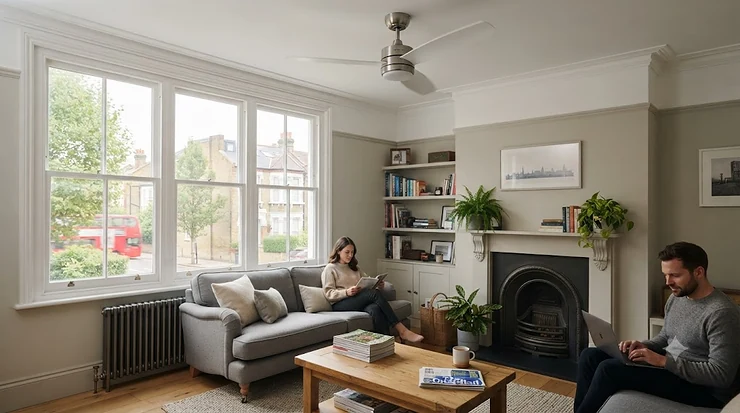
Here’s a confession most heating engineers won’t make in a glossy brochure: the average British loft, wall cavity and double-glazed window are all doing a stellar job of trapping warm air exactly where you don’t want it — hovering three feet above your head. Reversible ceiling fans exist to fix that particular injustice. Flip the motor one way and the blades throw a cooling downdraught across the room in July; flip it the other way and they gently nudge that stubborn pocket of warm ceiling air back down where your thermostat can actually take credit for it. It’s a genuinely clever bit of engineering hiding inside what looks, from the sofa, like a fairly ordinary spinning thing. Even NHS guidance on staying safe in hot weather notes that fans are a sensible first line of defence for cooling your home, provided you understand how they’re actually being used.

This guide walks through seven real, currently available reversible ceiling fans on amazon.co.uk, ranging from properly budget-friendly options through to smart, app-controlled models that wouldn’t look out of place in a design magazine. We’ll dig into what the spec sheets actually mean for your electricity bill and your comfort, compare them head-to-head, and cover the practical stuff nobody tells you — installation quirks, maintenance habits, and which type of buyer each fan genuinely suits. Whether you’re after a cheap dual mode ceiling fan for a rental or an entry-level reversible fan to test the waters before committing to something pricier, there’s a sensible pick here.
Quick Comparison Table
| Fan | Best For | Motor | Price Range |
|---|---|---|---|
| MiniSun 42″ | Tightest budget | AC, reversible | Under £50 |
| CJOY 22 inch | Small bedrooms | Reversible DC | Under £60 |
| LANMEL 52 Inch | Style on a mid budget | Reversible DC | £90-£110 |
| VONLUCE 52 Inch | Quiet living rooms | Reversible DC | £90-£110 |
| Ohniyou 52” | Smart home fans | Reversible DC, 30dB | £120-£150 |
| DREO 52 Inch | Precise speed control | Reversible DC, 12-speed | £150-£200 |
| Hunter Builder Elite | Longevity and pedigree | Reversible AC | £150-£220 |
Looking across this table, the split is really about motor type more than anything else. Every DC-motor fan here — from the budget CJOY 22 inch right up to the flagship DREO 52 Inch — sips less power and runs quieter than the older-style AC motor in the MiniSun 42″ or the Hunter Builder Elite, though that older tech is also part of why those two are cheaper or built to last decades respectively. If low running costs matter more to you than upfront price, that motor column is the one worth reading twice.
💬 Just one click — help other riders keep their frames rust-free too!😊
Top 7 Reversible Ceiling Fans: Expert Analysis
1. MiniSun 42″ — cheapest genuine reversible motor on the market
The MiniSun 42″ is proof that “reversible” doesn’t have to mean expensive — this 106cm blue-and-cream fan with its frosted opal light shade undercuts almost everything else in this guide while still offering a proper switchable motor. The blades are sized for smaller bedrooms and box rooms rather than open-plan living spaces, and the frosted glass shade does double duty as a genuinely usable ceiling light rather than a token bulb-holder. Based on the spec comparison, this is the fan for someone who wants the reverse-mode trick without paying a premium for smart features they’ll never open an app for. Reviewers consistently note that the light output is decent for the price, though a handful mention the pull-cord and light unit feel more basic than the fan’s price tag might suggest — which tracks, given the age of the AC motor design underneath.
Pros:
- ✅ Among the cheapest genuinely reversible fans available
- ✅ Frosted opal shade doubles as a proper ceiling light
- ✅ Compact size suits smaller UK bedrooms well
Cons:
- ❌ Older AC motor uses more power than DC rivals
- ❌ Remote and build quality feel basic at this price point
Typically found under £50 at the time of research, the MiniSun 42″ represents strong value if all you want is dual-mode airflow and a working light fitting — just don’t expect whisper-quiet running or app control at this end of the market.
2. CJOY 22 inch — brightest tri-colour LED for small rooms
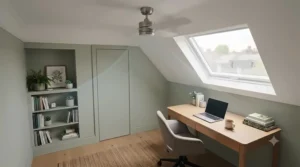
Don’t let the modest 22-inch blade span fool you — the CJOY 22 inch packs a genuinely useful tri-colour dimmable LED light alongside its reversible DC motor, and the five-blade design is aimed squarely at bedrooms, nurseries and kids’ rooms where a huge 52-inch fan would look absurd. What most buyers overlook about this model is that the DC motor isn’t just about energy savings; it also means finer control across six speeds rather than the usual three, so you can dial in exactly enough airflow to feel comfortable without turning the room into a wind tunnel. The tri-colour LED switches between warm, neutral and cool white, which is a genuinely practical touch for a child’s room used for both play and sleep.
Pros:
- ✅ Six-speed DC motor gives finer airflow control
- ✅ Tri-colour dimmable LED suits multi-use rooms
- ✅ Compact 22-inch span fits smaller ceilings neatly
Cons:
- ❌ Limited airflow reach for larger open-plan rooms
- ❌ Reviewers report the remote’s range is fairly short
Aggregated review sentiment for the CJOY 22 inch sits comfortably above 4 out of 5 stars, with feedback frequently praising the quiet running and light quality relative to its price. Sitting under £60 in most listings, it’s a smart, low-risk buy for a single small room rather than a whole-house solution.
3. LANMEL 52 Inch — best metal build under £100
Step up to the LANMEL 52 Inch and the first thing you notice is the metal construction — a silver-and-black low-profile flush mount that reads as considerably more expensive than its actual price bracket. Here’s what the spec sheet won’t tell you, but the design suggests: flush-mount fans like this one are specifically engineered for the lower ceilings common in Victorian conversions and modern new-builds alike, where a downrod-mounted fan would sit uncomfortably close to head height. The reversible DC motor and 3CCT dimmable LED give it genuine year-round usefulness, and at 52 inches it can actually move air across a proper living room rather than just the space directly beneath it.
Pros:
- ✅ Metal build feels sturdier than the price suggests
- ✅ Low-profile flush mount suits lower UK ceilings
- ✅ 52-inch span covers living-room-sized spaces properly
Cons:
- ❌ Limited colour options compared with pricier rivals
- ❌ No smart app control included at this tier
Reviewers consistently mention the quiet operation and modern look as standout points, with an aggregated rating around 4.4 out of 5. In the £90-£110 range, this is arguably the best balance of size, build quality and price on this list.
4. VONLUCE 52 Inch — quietest DC motor at mid-range money
The VONLUCE 52 Inch leans into the farmhouse-meets-modern aesthetic, with five blades available in a black or rustic brown finish and a reversible DC motor running across six speeds. Based on the spec comparison, what separates this from the LANMEL isn’t really size or price — it’s finish options and, per the aggregated review data, an unusually high satisfaction score for such a young listing. What most buyers overlook here is that “reversible DC motor” on paper doesn’t tell you how quiet a fan actually is in practice; DC motors vary quite a bit between manufacturers, and this one earns specific praise in review sentiment for being close to silent even at higher speeds — a genuine plus for anyone fitting a fan above a bed.
Pros:
- ✅ Reversible DC motor runs unusually quietly at speed
- ✅ Farmhouse-style finish options suit period and modern homes
- ✅ Six-speed control across summer and winter modes
Cons:
- ❌ Fewer verified reviews available than some rivals
- ❌ Energy label sits mid-table rather than top-tier
Priced in a similar £90-£110 bracket to the LANMEL 52 Inch, the VONLUCE 52 Inch is the one to pick if bedroom-quiet running matters more to you than metal-build ruggedness.
5. Ohniyou 52” — smartest app control for the price
This is where things get properly modern. The Ohniyou 52” pairs its reversible DC motor with both remote and smartphone app control, a 30dB noise rating that Ohniyou quotes as near-silent, and 3CCT dimmable lighting — all in a low-profile flush-mount body available in white or wood finishes. On paper this means you can schedule the fan to switch modes automatically as the seasons change, which is a genuinely useful trick if you’re the sort of person who forgets to flip the manual switch until you’re three weeks into a cold snap. Reviewers consistently note the app’s reliability as a strong point, with an aggregated rating around 4.5 out of 5 from a healthy pool of feedback — a good sign that the smart features actually work as advertised rather than gathering dust after week one.
Pros:
- ✅ App and remote control with scheduling options
- ✅ 30dB rating makes it genuinely bedroom-quiet
- ✅ Available in both white and wood finishes
Cons:
- ❌ App setup can be fiddly on first use
- ❌ Costs noticeably more than the non-smart options here
At around £120-£150, the Ohniyou 52” justifies its higher price primarily through the app ecosystem — if you’d never open the app, you’re paying for a feature set you won’t use.
6. DREO 52 Inch — most speed settings of any fan here
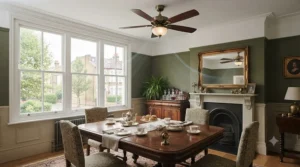
The DREO 52 Inch is the specification overachiever of this group: twelve speed settings controlled via app, three distinct fan modes, stepless colour-tone LED lighting, and a built-in timer running up to twelve hours. What most buyers overlook about twelve-speed control is that it’s not really about having twelve meaningfully different airflow levels — it’s about being able to nudge the fan up or down by tiny increments rather than jumping between three or six coarse settings, which matters a lot if you’re sensitive to draughts or sharing a room with someone who runs cold. DREO has built a reputation in the wider fan and air-treatment market for genuinely capable app software, and the “3 fan modes” here likely includes a natural-breeze setting that varies speed automatically rather than holding one flat airflow.
Pros:
- ✅ Twelve-speed control allows very fine adjustment
- ✅ Three fan modes including likely natural-breeze variation
- ✅ Stepless colour-tone LED and long-duration timer
Cons:
- ❌ Independent UK review volume was limited at research time
- ❌ Among the pricier options in this line-up
Honestly, verified aggregated review data specifically for the UK listing was thin at the time of research, so treat the sentiment claims here with a touch more caution than the other entries — the spec sheet, however, is unambiguously strong. Expect to pay somewhere in the £150-£200 range.
7. Hunter Builder Elite — the heirloom pick built to outlast you
Hunter has been making ceiling fans since 1886, and the Hunter Builder Elite (model 50567) is very much a product of that heritage — a 132cm fan with a pull-chain control, new bronze finish, and five reversible blades finished in Brazilian cherry on one side and yellow walnut on the other, so you can flip the blades themselves to match a room refresh without buying a new fan. Here’s what the spec sheet won’t tell you, but decades of Hunter’s reputation suggest: this is a fan built around mechanical simplicity and longevity rather than smart features, using a traditional AC motor that trades a little efficiency for the kind of bombproof reliability that keeps these fans running in American homes for twenty-plus years. If you want a fan you’ll still be using in 2040, the pedigree here counts for something that spec sheets alone can’t capture.
Pros:
- ✅ Reversible dual-finish blades match two decor styles
- ✅ Century-plus manufacturer reputation for mechanical durability
- ✅ Pull-chain control needs no batteries or app
Cons:
- ❌ AC motor costs more to run than DC rivals
- ❌ No app control or dimmable smart lighting
Specific UK customer review counts weren’t consistently available across listings at the time of research, so we’re leaning on Hunter’s long-standing brand reputation rather than aggregated star ratings here — which, for a company with this much history, is arguably a reasonable substitute. Pricing typically sits in the £150-£220 range depending on finish and retailer stock.
Practical Usage Guide: Setup, Speed and Your First 30 Days
Getting a reversible ceiling fan right isn’t just a case of screwing it to the ceiling and hoping for the best. First up: direction matters more than most people realise. In summer, you want the blades pushing air straight down, which creates that wind-chill effect on your skin even though the room’s actual temperature hasn’t budged. In winter, reverse the motor so the blades draw air upward at a gentle, low speed — this pulls warm air that’s pooled near the ceiling back down along the walls without creating a noticeable draught. Most fans, including several on this list, have either a manual toggle switch on the motor housing or a button on the remote or app; check which your model uses before you’re stood on a stepladder in November trying to work it out by trial and error.
A common first-month mistake is running the fan at full speed in winter mode, assuming faster equals warmer — it doesn’t. A gentle, low-speed reverse rotation is genuinely more effective than a high-speed one, because the goal is quiet redistribution rather than a breeze. Another frequent slip-up is forgetting to switch modes at all; a fan left in summer mode through winter will actively work against your heating, pulling warm air away from you rather than back down. This kind of seasonal switch-flipping sits alongside broader heating-control advice from local authority energy guidance worth building into a routine — the clock-change weekends in late March and late October are a handy, memorable trigger. For maintenance, wipe blades monthly with a dry or barely damp cloth (a pillowcase slipped over each blade traps the dust rather than scattering it across the room), and check that mounting screws haven’t worked loose after the first few weeks of use, particularly on lighter flush-mount models.
Real-World Scenarios: Which Fan Actually Suits You
Picture three fairly typical UK households. First, a student renting a converted terrace bedroom on a tight budget, who needs something cheap, easy to fit without drilling into a landlord’s nerves, and effective in a small space — the MiniSun 42″ or CJOY 22 inch cover exactly this brief, both sitting comfortably under £60 and sized for a single room rather than open-plan living. Second, a family in a 1930s semi with a low-ceilinged living room who want something that looks intentional rather than bolted-on as an afterthought — the LANMEL 52 Inch‘s flush-mount metal design and reasonable price make it the natural fit, offering enough blade span to actually shift air around a proper lounge.
Third, a couple who’ve just done up a new-build with smart lighting and heating already installed, who’d feel faintly embarrassed installing a fan they have to operate with a pull-chain — the Ohniyou 52” or DREO 52 Inch slot straight into that existing smart-home ecosystem, letting the fan schedule its own seasonal flip rather than relying on anyone remembering. None of these buyers need the most expensive fan on the list; they need the fan that matches their ceiling height, their budget, and how much faff they’re willing to tolerate at 11pm when they realise they’ve left it on the wrong setting.
How to Choose a Reversible Ceiling Fan
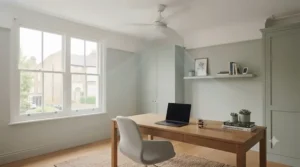
- Measure your room first, not the fan. As a rough guide, rooms up to around 12 square metres suit a 42-inch blade span; larger living rooms generally want 52 inches or more to actually move air across the whole space.
- Check your ceiling height. Standard 2.4m ceilings almost always need a flush or low-profile mount rather than a downrod, or you’ll be ducking every time you walk past.
- Prioritise DC motors if running costs matter. Reversible DC motor fans typically use meaningfully less electricity than older AC designs, and tend to run quieter too.
- Decide how much smart control you actually want. App scheduling is genuinely handy for automatic seasonal switching, but it’s an added cost you’re paying for whether you use it or not.
- Look at the light fitting, not just the fan. If it’s replacing an existing ceiling light, check the LED colour temperature options match what the rest of the room uses.
- Read aggregated review themes, not just star ratings. A 4.5-star fan with recurring complaints about remote range tells you more than the number alone.
- Factor in installation. A straight fan-for-light swap on an existing circuit is usually straightforward; anything involving a new circuit is worth budgeting a qualified electrician for.
Reversible Ceiling Fans vs Traditional Standing Fans
| Factor | Reversible Ceiling Fan | Standing/Tower Fan |
|---|---|---|
| Year-round use | Yes — summer and winter modes | Summer cooling only |
| Floor space used | None | Takes up room space |
| Running noise | Often quieter at distance | Can be intrusive up close |
| Best For | Whole-room comfort, year-round | Direct personal cooling, portability |
The core trade-off here is permanence versus flexibility. A ceiling-mounted option like the VONLUCE 52 Inch or Ohniyou 52” works the whole room evenly and, crucially, earns its keep in winter too — something a standing fan simply can’t do. A tower or pedestal fan wins on portability and zero installation faff, which matters if you’re renting somewhere you can’t drill into. For most homeowners planning to stay put, the ceiling option’s year-round usefulness tends to justify the extra upfront effort.
Affordable Reversible Fan Options: What You Actually Get for Less
Shopping specifically for an affordable reversible fan doesn’t have to mean sacrificing the core dual-mode functionality — it does mean accepting a few compromises elsewhere. Both the MiniSun 42″ and CJOY 22 inch prove that a genuine, switchable reversible motor is achievable well under £60; what you tend to give up at this price point is smart control, premium finishes, and sometimes a slightly noisier motor at top speed. Reviewers consistently note that budget reversible fans perform their core job — summer cooling, winter recirculation — perfectly adequately, with most complaints clustering around remote range or light brightness rather than the fan mechanism itself. If your priority is simply having working dual-mode airflow rather than app scheduling or a designer finish, there’s genuinely little reason to spend more.
Budget Summer Winter Fan Performance: What to Expect
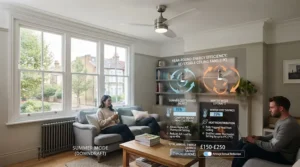
It’s worth being honest about what a budget summer winter fan will and won’t do. In summer mode, even the cheapest reversible fans here deliver a noticeable, comfortable breeze across a small-to-medium room — the physics of moving air doesn’t really change with price. Where budget models genuinely lag is winter mode subtlety: pricier DC motors tend to offer finer low-speed control, which matters because winter mode is only effective at low, gentle speeds. A budget AC-motor fan like the MiniSun 42″ can still be run on its lowest setting for winter recirculation, but the step between “off” and “on” is often coarser than on a six or twelve-speed DC model, so you may find winter mode feels slightly more draughty than ideal until you get used to it.
Cheap Dual Mode Ceiling Fans: Common Mistakes to Avoid
Buying a cheap dual mode ceiling fan is a sound decision, but a few recurring mistakes crop up in review sentiment across budget listings. First, people frequently order a fan sized for a much larger room than they have — a 52-inch fan crammed into a small box room looks and feels oversized. Second, some buyers skip checking whether their existing ceiling rose and wiring can take the fan’s weight, particularly with older housing stock; always confirm the fixing point is rated for the fan’s mass, not just the light fitting it’s replacing. Third, and most common of all, is forgetting the reversible motor exists at all — plenty of cheap fans get installed, used purely for summer cooling, and never switched into winter mode once, quietly wasting the exact feature that justified paying extra over a basic non-reversible fan in the first place.
Entry-Level Reversible Fans for Renters and First-Time Buyers
If you’re new to ceiling fans altogether, an entry-level reversible fan is a genuinely sensible way to dip a toe in without overcommitting financially or practically. Renters in particular should look for models that can swap directly onto an existing ceiling rose without new wiring — both the CJOY 22 inch and MiniSun 42″ are straightforward like-for-like replacements for an existing pendant light, which sidesteps most Part P notification concerns entirely (more on that below). First-time buyers should also resist the urge to chase every feature at once; a simple, well-reviewed budget model teaches you what you actually value — quiet running, light brightness, remote convenience — before you spend three times as much on your next fan armed with real experience rather than guesswork.
Long-Term Cost & Maintenance
The upfront price tag is only part of the equation. A reversible DC motor fan, run for a few hours daily across a UK year, typically costs only a few pounds in electricity — considerably less than a comparable AC motor model, and vastly less than running air conditioning to achieve similar comfort. Maintenance costs are minimal too: most reversible fans need nothing beyond the occasional blade wipe and, every year or two, a light tightening of the mounting screws as vibration works them gradually loose. The main long-term cost to budget for isn’t the fan at all — it’s the LED bulb or light kit, if it’s not a sealed unit, and the very occasional call-out if the reversing switch itself fails after years of use, which even Hunter-grade mechanical switches will eventually do.
Safety, Regulations and Installation Compliance Guide
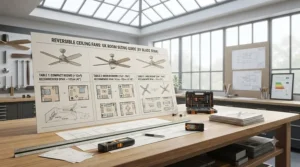
In England, electrical work in the home falls under Part P of the Building Regulations, and the good news for most reversible ceiling fan installations is that a straightforward, like-for-like swap of an existing ceiling light fitting for a fan on the same circuit generally isn’t notifiable work requiring formal sign-off. Where it does become notifiable is if you’re adding a new circuit or working in a “special location” such as a bathroom — situations that call for a registered electrician regardless of how confident you feel with a screwdriver. The full detail on what counts as notifiable work, and the competent-person schemes that let registered electricians self-certify, is laid out clearly by the government’s own building regulations guidance. If in doubt, a qualified electrician can typically fit a ceiling fan in under an hour, and it’s money well spent given the alternative is working with live wiring above your head.
Price Range & Value Analysis
| Budget Tier | Fans | What You Gain Moving Up |
|---|---|---|
| Under £60 | MiniSun 42″, CJOY 22 inch | Basic reversible function, small-room sizing |
| £90-£150 | LANMEL 52 Inch, VONLUCE 52 Inch, Ohniyou 52” | Bigger blade span, quieter DC motors, smart control |
| £150+ | DREO 52 Inch, Hunter Builder Elite | Fine-grained speed control or generational build quality |
The jump from the sub-£60 tier to the £90-£150 bracket buys you meaningfully more room coverage and a noticeably quieter motor — arguably the single best value jump in this entire list. The step beyond that, into £150-plus territory, is less about core performance and more about either precision (the DREO 52 Inch‘s twelve speeds) or longevity and heritage (the Hunter Builder Elite), so it’s worth asking honestly whether those specific extras matter to you before paying for them.
Frequently Asked Questions
❓ Do reversible ceiling fans actually save money in winter?
❓ Which way should a ceiling fan spin in summer UK?
❓ Can I fit a reversible ceiling fan myself?
❓ Are cheap reversible ceiling fans noisy?
❓ What size reversible ceiling fan do I need for my room?
Conclusion
Reversible ceiling fans occupy a genuinely useful niche in a British home — not glamorous, not something anyone’s going to compliment you on at a dinner party, but quietly doing double duty across two very different seasons for the price of one appliance. Whether you land on the properly budget MiniSun 42″, the design-led LANMEL 52 Inch, or the smart-home-ready DREO 52 Inch, the fundamentals matter more than the brand name on the box: get the size right for your room, understand your ceiling type before you buy, and — above everything else — actually remember to flip the switch when the clocks change. That last part costs nothing and is, embarrassingly often, the step people skip. Get it right, and you’ve got a fan that earns its keep in July and January alike.
Recommended for You
- Reversible Ceiling Fan: 7 Brilliant UK Picks For 2026
- A++ Rated Ceiling Fan: 7 Best Efficient Picks for UK (2026)
- Energy Saving Ceiling Fan: 7 Best Picks to Cut UK Bills (2026)
Disclaimer: This article contains affiliate links. As an Amazon Associate, I earn from qualifying purchases. If you purchase products through these links, we may earn a small commission at no additional cost to you.
✨ Found this helpful? Share it with your friends! 💬🤗
