
In This Article
An A++ rated ceiling fan is a fan advertised with an A++ efficiency class from the old energy-label scale. The catch: that scale was retired for most household products in 2021, and the published rules don’t give ceiling fans a coloured label of their own. So today’s “A++” is usually a seller’s badge, not an independent certificate.
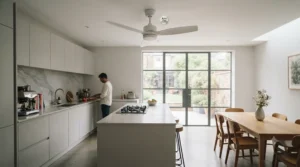
Yet the phrase keeps circulating, and it’s easy to see why. Search Amazon UK and you’ll find listings stamped A+++, A+ and E side by side, sometimes on near-identical fans. The EU energy label began as a plain ladder, sprouted extra rungs (A+, A++, A+++) to keep pace with technology, and was later reset. That history is exactly why an A++ rated ceiling fan can mean three different things depending on who’s talking.
Here’s the useful bit. Behind the badge, you want three things: a motor that sips power, blades that move air quietly, and numbers you can check. This guide puts the claim under the microscope using seven real fans, their published specifications and some straightforward arithmetic. It is analysis of listings, maker data and aggregated reviews, not lab testing, and prices are ranges seen during research, so check current price before you buy. By the end you’ll know how to spot a best rated efficient fan without trusting a single letter.
Quick Comparison: 7 Efficient Ceiling Fans at a Glance
Prices are approximate ranges at the time of research and change often. Power figures are as listed by makers or retailers.
| Fan | Motor | Rated power (as listed) | Blade span | Price range | Best For |
|---|---|---|---|---|---|
| CasaFan Eco Genuino 122 | DC/EC | About 11 W | 122 cm | £500–£620 | Quiet bedrooms up to roughly 16 m² |
| CasaFan Eco Aviatos 132 | DC | 33 W | 132 cm | £390–£450 | Living rooms wanting fan and light |
| CasaFan Eco Plano II 132 | DC | 3–29 W | 132 cm | £390–£440 | Low ceilings |
| Lucci Air Airfusion Climate II | DC | 35 W (3–34 W quoted) | 127 cm | £270–£300 | Fan-only comfort in bigger rooms |
| Dreo Smart Ceiling Fan 132 cm | DC | 54 W listed | 132 cm | £110–£140 (some variants to about £220) | Smart-home budget buyers |
| Klarstein Figo | AC | 55 W (about 9 W minimum) | 132 cm | £160–£190 | Budget fan with light |
| Depuley 52 Inch Flush Mount Ceiling Fan Light | Listed as DC | About 58 W listed | 132 cm | Check current price | Occasional-use budget |
Looking at the table, the pattern is hard to miss: the lowest wattages belong to the CasaFan models, and the price tags climb right alongside them. That’s the classic efficiency premium, and you’re paying for a lower-power motor and quieter running rather than for a shiny “A++”. Budget shoppers should note that the Klarstein Figo and the Depuley 52 Inch Flush Mount Ceiling Fan Light trade a higher power draw for a far lower entry price, while the Dreo Smart Ceiling Fan 132 cm sits in an interesting middle ground on features per pound.
💬 Just one click — help others make better buying decisions too!😊
Top 7 A++ Rated Ceiling Fan Contenders: Expert Analysis
None of these seven is an officially certified A++ rated ceiling fan, because no such official category exists for fans today. What they share is a claim worth testing: low power draw, tidy airflow and, in most cases, a DC motor. Every number below comes from published listings and maker data, so treat it as a comparison of claims rather than lab results.
1. CasaFan Eco Genuino 122 — lowest listed wattage of the seven
The CasaFan Eco Genuino 122 asks for roughly what a couple of LED bulbs draw, and that’s the whole pitch. Its DC/EC motor is listed at about 11 W, with price-comparison data quoting airflow near 6,627 m³/h and noise around 34 dB. In practice, that means a gentle, steady breeze across a bedroom of up to roughly 16 m², with a slow-motion setting for the small hours (the listing quotes a 50–144 rpm range). Divide airflow by power and the Genuino lands near 10 (m³/min) per watt by simple arithmetic, the strongest figure in this article. Based on the spec comparison, it’s the nearest thing here to a highest energy rating fan and a sensible best rated efficient fan for light sleepers. The trade-off is the 122 cm span, the smallest of the seven, so big living rooms want the 132 cm models. A meaningful pool of independent buyer reviews couldn’t be verified for this model; the strengths above come from maker and price-comparison listings, so treat the quiet-running claim as unconfirmed until UK owners weigh in.
Pros:
- ✅ Around 11 W listed draw, lowest here
- ✅ Very quiet at roughly 34 dB per listings
- ✅ Solid-wood-laminate blades plus slow-motion night setting
Cons:
- ❌ Premium price for a compact 122 cm span
- ❌ Best suited to rooms up to about 16 m²
Expect around £500–£620 depending on finish and seller (check current price). Value verdict: you’re paying for silence and thrift, not bill savings, and the cost section explains why.
2. CasaFan Eco Aviatos 132 — DC efficiency with a built-in light
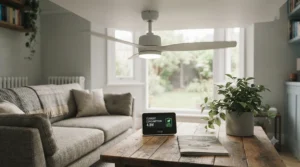
The CasaFan Eco Aviatos 132 is the practical one: a DC motor and a light fitting in a single fixture. Listings quote a 33 W motor, six speed settings, three blades on a 132 cm sweep, a 7.9 kg body and overload protection. Translate that: it draws about three times what the Genuino does, but you gain a larger span that suits living rooms, plus lighting without a second fitting. The catch is geometry. Listings put the gap between blades and ceiling at about 35 cm, which on a 2.4 m ceiling leaves the blades near 2.05 m off the floor, just under the roughly 2.1 m clearance commonly recommended. Measure before you buy. The light takes two E27 bulbs of up to 40 W each, so choose LEDs; old-style bulbs would quietly wreck the efficiency story. As with its siblings, a meaningful pool of independent reviews couldn’t be verified, so weigh the maker’s noise and airflow claims accordingly.
Pros:
- ✅ DC motor at a listed 33 W
- ✅ Generous 132 cm blade span
- ✅ Integrated light fitting saves a second fixture
Cons:
- ❌ 35 cm drop needs decent ceiling height
- ❌ Bulbs add to running load, so LED only
Around £390–£450 across finishes; check current price. Value verdict: fair for a fan-and-light combination, though hardly a bargain.
3. CasaFan Eco Plano II 132 — flat profile for low ceilings
When the ceiling is the problem, the CasaFan Eco Plano II 132 is the answer. Listings describe a total height of about 20 cm, a 132 cm span, four blades that can be fitted as two, three or four, and a DC motor spanning 3 W to 29 W across six remote-controlled speeds. That 3 W floor is the number to notice: it’s low enough to leave the fan turning through a sticky night without a second thought. The manufacturer says it covers rooms up to 25 m² and installs without a downrod, leaving roughly 16 cm to the ceiling, a real advantage in lofts and older homes where headroom is precious. The spec sheet suggests that fitting only two blades trades airflow for quiet, which makes it a tunable fan. A lamp is an optional extra (two E14 bulbs of up to 40 W). Some finishes showed no featured offers on Amazon UK at the time of research, and a verified review pool wasn’t available, so stock and reviews both deserve a check.
Pros:
- ✅ Only about 20 cm tall overall
- ✅ Listed 3–29 W power range
- ✅ Blades can be fitted as two, three or four
Cons:
- ❌ Some finishes hard to find on Amazon UK
- ❌ Lamp costs extra
Around £390–£440, with Wi-Fi variants sitting slightly higher; check current price. Value verdict: worth paying for when ceiling height is the constraint, otherwise a cheaper fan does the job.
4. Lucci Air Airfusion Climate II — the one wearing an “A++” badge
Here’s the fan that inspired this article’s headline. One Amazon UK listing for the Lucci Air Airfusion Climate II shows “Energy Class A++”, while the Dutch Amazon page for a different finish of the same fan shows “Energy Class A”. Same family, two letters, which suggests a seller-entered attribute rather than a certificate: by the listings, it’s an A rated ceiling fan and an A++ one at the same time. The real specifications are more interesting: a 127 cm span, three blades, a 35 W rated DC motor with 3–34 W consumption quoted across six remote-controlled speeds, and a receiver that cuts out above 80 W according to the manual. Airflow of about 156 m³/min from a distributor page works out near 4.5 (m³/min) per watt at full tilt. Savings claims vary too: the manual says up to 65% versus AC motors, while retail pages say about 40%, so treat both as marketing. Reviews on Amazon UK are small, roughly 4.0 to 4.4 out of 5 across two dozen to just over fifty ratings, and one overseas reviewer questions whether the price is justified given how long controller boards tend to last. It only works via its remote, so keep a spare.
Pros:
- ✅ Wide 3–34 W consumption range across speeds
- ✅ Six-speed remote with summer/winter mode
- ✅ Acrylic-style blades avoid warping, per distributor
Cons:
- ❌ Remote-only operation
- ❌ Small, mixed review pools on Amazon UK
Around £270–£300 depending on finish; check current price. Value verdict: decent rather than cheap, since you’re partly paying for the name.
5. Dreo Smart Ceiling Fan 132 cm — smart control at a friendly price
The Dreo Smart Ceiling Fan 132 cm is the crowd-pleaser, and the numbers back that up: 4.6 out of 5 from more than 500 ratings on Amazon UK, the largest verified review pool in this article. Its brushless DC motor offers six speeds on the remote and twelve in the app, plus Normal, Natural and Sleep modes, a dimmable LED light (2700–6500 K), Alexa and Google control and a 12-hour timer. Dreo claims 22 dB at the quietest setting. Listed airflow of 5,673 CFM converts to roughly 9,640 m³/h. The listing’s 54 W figure doesn’t separate motor from light, so read it as a ceiling for everything running, which makes airflow per watt (about 3) look modest beside the CasaFan range. The Amazon UK page also displays “Energy Class E”, the same lookalike-letter problem again, and its data table shows a 120 V field that looks like a listing slip. Confirm the UK 230 V specification before ordering. The star average is strong, but individual review text wasn’t available, so recurring complaints can’t be summarised here.
Pros:
- ✅ 4.6/5 across 500+ Amazon UK ratings
- ✅ Twelve speeds plus Natural and Sleep modes
- ✅ App, Alexa and Google control
Cons:
- ❌ Listed 54 W well above the CasaFan range
- ❌ Listing quirks: Energy Class E and a 120 V field
Around £110–£140 for the 132 cm model at the time of research (other variants rise towards £220); check current price. Value verdict: the strongest all-rounder for smart-home users who care more about features than watts.

6. Klarstein Figo — the AC benchmark
The Klarstein Figo is here as a control sample: an AC-motor fan with decent manners. Klarstein’s UK page lists 55 W at maximum, dropping to about 9 W at the lowest setting, with airflow up to 9,018 m³/h at 51 dB and a 132 cm span for rooms of 13–25 m². It comes with a remote, Wi-Fi, Alexa and Google support, pull cords and a light fitting for two E14 bulbs. The lesson is in the spread: 9 W at the bottom shows an AC motor can be frugal when slowed down, but at full tilt the airflow-per-watt figure is about 2.7, roughly a quarter of the Genuino‘s. On appliance labelling, note that the maker leans on plain-language claims about low running cost rather than an energy class letter, which is refreshingly honest. Ratings on Klarstein’s site are few (ten at the time of research) and the visible comments were positive about assembly, but that’s too small a sample to conclude much.
Pros:
- ✅ Low entry price for a smart-enabled fan
- ✅ Stepless speed control with app and voice
- ✅ Up to 9,018 m³/h of airflow
Cons:
- ❌ 55 W draw at full speed
- ❌ 51 dB at maximum is louder than DC rivals
Around £160–£190 depending on finish; check current price, and confirm the Amazon UK listing is live because Klarstein also sells direct. Value verdict: good value if the fan runs occasionally, less compelling if it runs nightly.
7. Depuley 52 Inch Flush Mount Ceiling Fan Light — the budget wildcard
The Depuley 52 Inch Flush Mount Ceiling Fan Light is the cheapest way in, and the one to read most carefully. Depuley’s UK page lists three reversible blades, a 132 cm span, adjustable light colour (3000–6000 K), a remote and two downrods so it can sit flush or hang lower. Manufacturer-style listing data for this flush-mount family quotes a 58 W fan-motor figure and three speeds, far above the DC picks, and a handy reminder that “DC” on a product page isn’t an efficiency certification. Buyer feedback on Depuley’s own site (roughly 17 ratings on the page reviewed) is mixed to positive: value and airflow get praise, while poor translated instructions, unclear wiring labels and a balancing kit that broke, causing wobble at higher speeds, are called out by several buyers. One stable UK price couldn’t be pinned down across variants and sellers, so check current price. For efficiency-minded buyers, this suits occasional use rather than nightly running.
Pros:
- ✅ Budget-tier price bracket
- ✅ Two downrods for flush or dropped mounting
- ✅ Adjustable 3000–6000 K light colour
Cons:
- ❌ Instructions and wiring labels widely criticised
- ❌ Listed 58 W far above efficient DC rivals
Budget bracket; check current price. Value verdict: the cheapest entry, but buy it for the light and the price, not for efficiency.
Top 7 Side by Side: Airflow, Power and Review Evidence
Airflow-per-watt figures below are simple arithmetic from published maximums, not official service values, and “not verified” means the data couldn’t be confirmed.
| Fan | Max airflow (as published) | Rated power | Airflow per watt | Noise (as published) | Review evidence | Best For |
|---|---|---|---|---|---|---|
| CasaFan Eco Genuino 122 | About 6,627 m³/h | About 11 W | About 10 (m³/min)/W | About 34 dB | Thin | Silent nights |
| CasaFan Eco Aviatos 132 | Not verified | 33 W | Not calculable | Not verified | Not verified | Living rooms |
| CasaFan Eco Plano II 132 | Not verified | 3–29 W | Not calculable | Not verified | Not verified | Low ceilings |
| Lucci Air Airfusion Climate II | About 9,360 m³/h | 35 W | About 4.5 | 45 dB (one listing) | Small pools, about 4.0–4.4/5 | Mid-range fan-only |
| Dreo Smart Ceiling Fan 132 cm | About 9,640 m³/h | 54 W listed | About 3.0 | 22 dB claimed | 4.6/5, 500+ ratings | Smart control |
| Klarstein Figo | Up to 9,018 m³/h | 55 W | About 2.7 | 51 dB max | 10 ratings on maker site | Occasional use |
| Depuley 52 Inch Flush Mount Ceiling Fan Light | Not verified | About 58 W listed | Not calculable | Not verified | Small, mixed | Budget light-and-fan |
Reading across, the Genuino is the clear winner on paper for efficiency, but the Dreo Smart Ceiling Fan 132 cm is the only one with a large, verified review base, which counts for a lot when you can’t test before buying. The Lucci Air Airfusion Climate II sits neatly between them on power and price, while the Klarstein Figo and Depuley win only on upfront cost. Missing data for the Aviatos and Plano II is itself a finding: if a maker won’t publish airflow, ask for it.
✨ Don’t Miss These Efficient Picks!
🔍 Take your summer comfort to the next level with these carefully researched fans. Click on any highlighted item to check current pricing and availability. These picks will help you create the calm, quiet, breezy rooms your family will love!
Setting Up and Running an Efficient Ceiling Fan: Your First-30-Days Playbook
Half of a fan’s efficiency is how you use it. Follow this sequence and even a mid-range model will behave like a frugal one.
- Check the fixing first. A light-fitting box isn’t automatically strong enough for a fan’s weight and constant movement. Have a qualified electrician confirm the fixing and handle the wiring, particularly given the instruction complaints attached to some budget models.
- Check clearance. Aim for blades roughly 2.1 m or more above the floor. This is where the flat CasaFan Eco Plano II 132 earns its keep and the deeper drop of the CasaFan Eco Aviatos 132 demands a taller ceiling.
- Tighten after week one. Vibration loosens screws. Recheck them, because wobble at medium and high speed is the classic first-month complaint.
- Live low and slow. Fan power rises steeply with speed (roughly with the cube, per the fan affinity laws), and the published figures agree: the Lucci Air Airfusion Climate II quotes 3–34 W, while the Klarstein Figo runs from about 9 W to 55 W. Low and steady wins.
- Set direction by season. Downdraught in summer; gentle recirculation on the lowest speed in winter. Check your remote’s manual for the right button.
- Switch off when you leave. Fans cool people, not rooms.
- Never use a standard wall dimmer to control fan speed. Use the remote or receiver.
Monthly upkeep is dull but effective: wipe the blades, check the screws and keep spare remote batteries. Remote-only models make a lost handset a genuine problem, so keep a spare.
Real-World Scenarios: Which Fan Fits Which Home?
Match the fan to the life, not the badge. Running costs below use the 26.32p per kWh average electricity rate explained later in this guide.
Scenario 1: the loft-conversion bedroom. Ceiling at 2.3 m, room around 12 m², budget £350–£450, fan running roughly eight hours on about 60 hot nights a year. Headroom is the enemy, so the CasaFan Eco Plano II 132 is the logical pick thanks to its roughly 20 cm profile. If the ceiling were higher and the room under 16 m², the CasaFan Eco Genuino 122 would be the quiet-sleeper alternative.
Scenario 2: the open-plan living and dining room. Around 22 m², evenings only (say four hours across 90 days), budget flexible. The Dreo Smart Ceiling Fan 132 cm suits you if app and voice control matter, costing roughly £5 a year even at listed maximum power. If you’d rather have quiet DC running and a built-in lamp, the CasaFan Eco Aviatos 132 works at roughly £3 a year, provided the ceiling is tall enough.
Scenario 3: the spare room or home office. Used perhaps 100 hours a year, budget under £200. At 55 W, the Klarstein Figo burns about 5.5 kWh in that time, or roughly £1.45. Here the efficiency premium is irrelevant, so the Klarstein Figo or the Depuley 52 Inch Flush Mount Ceiling Fan Light is perfectly sensible, provided you’re patient with the wiring instructions.

Energy Label Rating Explained: Why A++ Disappeared
The old scale: A+++ down to D
For years, household appliances sold in Britain carried an energy label running from A+++ (best) to D. Extra pluses were bolted on top of the ladder as technology improved, until nearly everything crowded into A+ and above. The result was a scale where mediocre products still wore a comforting A, and shoppers couldn’t tell great from merely fine.
The new scale: A to G, with A left empty
From 2021, many product groups were rescaled to a plain A to G ladder, deliberately leaving the top rung empty so future improvements have room. Retailer guides suggest that products once rated A++ may now land anywhere from C to E, depending on the category. Nothing got worse; the bar was raised. The key takeaway is that an energy label rating from an old listing and one from a new listing are not directly comparable.
Is an A rated ceiling fan better than an A++ rated ceiling fan?
It depends which decade the badge comes from. On the old scale, plain A was the weakest member of the A family, below A+, A++ and A+++. On the new scale, A is the very top. So an A rated ceiling fan could be the best or the humblest option in a shop, and an A++ rated ceiling fan is, by definition, an old-scale claim. Amazon UK’s own energy-label highlighting now focuses on A, B and C ratings on the A to G scale, yet a search for “a rated ceiling fan” still surfaces older-style and lower-class labels in the same results. Because fans have no dedicated rating of their own, those letters often relate to an integrated lamp or are entered by the seller. Ask two questions: which part of the product does this letter describe, and which scale is it using?
Appliance Labelling and Efficiency Certification: What Actually Applies to Fans
Appliance labelling: the rules on paper
GOV.UK publishes guidance on the energy labelling of products listing the categories covered by the energy information rules, and both comfort fans and lighting products appear there. What that means in practice is more specific than it sounds. The coloured A to G label is most visible on lighting, so a fan with an integrated lamp may carry a lamp label, while the comfort-fan rules concentrate on published performance data and standby limits. Campaigners have argued for bringing comfort fans into a combined label; whether and when that reaches Britain is worth checking on GOV.UK. Meanwhile, appliance labelling for a ceiling fan is patchy at best.
Efficiency certification: what you can actually check
No independent “A++” scheme certifies ceiling fans sold in the UK. What you can check falls into four buckets:
- UKCA or CE marking. This signals conformity and safety, not efficiency.
- Manufacturer technical data. Makers of comfort fans are expected to publish airflow, power input, sound power and standby figures.
- Overseas schemes. US Energy Star appears on American listings (one major brand’s US pages claim certified fans are about 64% more efficient than conventional ones), but that is a US-defined test, not a UK certificate.
- Standby limits. The ecodesign rules cap standby and off-mode draw at very low levels.
So whenever you meet the phrase efficiency certification on a listing, ask who certified it and against which test. If the answer is vague, treat it as a marketing claim.
Highest Energy Rating Fan: What “Highest” Actually Means
Nobody officially ranks ceiling fans, so the highest energy rating fan is a title you have to calculate. The closest objective yardstick is “service value”: maximum airflow divided by fan power, in (m³/min) per watt. It’s defined in the ecodesign regulation for comfort fans, which requires makers to publish it alongside power input, sound power and standby consumption in technical documentation and on their websites.
Using published maximums, simple arithmetic puts the fans like this: the CasaFan Eco Genuino 122 at around 10, the Lucci Air Airfusion Climate II near 4.5, the Dreo Smart Ceiling Fan 132 cm near 3.0 and the Klarstein Figo about 2.7. The CasaFan Eco Aviatos 132, CasaFan Eco Plano II 132 and Depuley 52 Inch Flush Mount Ceiling Fan Light publish too little to calculate.
Three warnings apply. These are maker claims at full speed, not lab results. Fans spend most of their lives at lower speeds, where the ranking can shuffle. And any lamp must be judged separately. Standby matters too: the rules cap it at 0.5 W (1 W with a display), and a remote-only fan like the Lucci Air Airfusion Climate II keeps its receiver on standby around the clock.

How to Choose the Best Rated Efficient Fan
Follow these seven steps and you’ll beat the badge every time.
- Measure the ceiling and the room. Aim for blades about 2.1 m or higher above the floor, and match the span to the room: about 16 m² for 122 cm, up to about 25 m² for 132 cm, per maker guidance.
- Demand airflow and watts. Divide airflow in m³/min by power in watts. If the maker won’t publish both, that’s a warning sign.
- Check the lowest-speed draw. A fan that quotes 3 W (CasaFan Eco Plano II 132, Lucci Air Airfusion Climate II) is cheaper to leave on overnight than one that bottoms out much higher.
- Pick the motor type deliberately. DC generally means lower draw and quieter running; AC means lower upfront cost.
- Read noise figures carefully. A claimed 22 dB and a measured 51 dB aren’t the same kind of number. Look for the measurement basis.
- Judge the light separately. An energy class letter on a fan-and-light listing may describe the lamp only.
- Check marks, support and spares. Look for UKCA or CE marking, a clear warranty and replaceable remotes.
DC vs AC Ceiling Fans: What the Numbers Say
A DC motor is the usual route to a lower-draw, quieter fan, but it isn’t free. Here’s how the two types compare using the fans in this guide.
| Factor | DC fan (Genuino, Climate II) | AC fan (Figo) | Best For |
|---|---|---|---|
| Rated power at maximum | About 11–35 W | 55 W | Low draw: DC |
| Lowest-speed draw | About 3 W quoted (Climate II) | About 9 W (Figo) | Overnight running: DC |
| Noise at maximum (published) | About 34 dB (Genuino) | 51 dB (Figo) | Bedrooms: DC |
| Upfront price | About £270–£620 | About £160–£190 | Tight budgets: AC |
| Speed control | Six-speed remote (Climate II) | Stepless (Figo) | Fine-tuning: AC |
The table shows DC winning on draw and noise, while the Klarstein Figo wins on price and smooth speed adjustment. Bear in mind the noise numbers come from different sources and may use different measurement methods, so treat them as directional. For a bedroom used nightly, DC is easy to justify; for a spare room used a few days a year, the Klarstein Figo is hard to argue with.
Long-Term Cost and Maintenance: The Uncomfortable Arithmetic
From 1 October 2026, the Ofgem price cap puts average electricity at 26.32p per kWh for Direct Debit customers. Take a worst case: maximum speed for eight hours across 60 hot nights, or 480 hours a year, using listed wattages.
- CasaFan Eco Genuino 122 (11 W): about 5.3 kWh, roughly £1.40
- CasaFan Eco Aviatos 132 (33 W): about 15.8 kWh, roughly £4.20
- Lucci Air Airfusion Climate II (35 W): about 16.8 kWh, roughly £4.40
- Klarstein Figo (55 W): about 26.4 kWh, roughly £6.95
- Depuley 52 Inch Flush Mount Ceiling Fan Light (58 W listed): about 27.8 kWh, roughly £7.30
The gap between the thriftiest and thirstiest is around £6 a year. Set that against a price difference of £300 or more and the electricity savings alone won’t repay the premium within any sensible lifetime, especially since real use is mostly at lower speeds. What DC genuinely buys is lower noise, finer speed steps and near-negligible draw at the bottom of the range. Maintenance is simple: dust the blades, recheck screws, keep a spare remote and read the warranty terms before you order.
Features That Actually Matter (And Those That Don’t)
Marketing pages stack up features like a buffet. Here’s what deserves a place on your plate.
What matters. Motor type and lowest-speed draw come first, because they drive both noise and running cost. Blade balance and build quality come next, since wobble is the most common complaint in the reviews we could see. A reliable remote or receiver matters a great deal for models that only work via remote, like the Lucci Air Airfusion Climate II. Reversible operation and a suitable mounting height round out the essentials, and a clear warranty is worth more than any extra colour mode.
What doesn’t. Twelve speeds instead of six sounds impressive, but power climbs steeply with speed, so the bottom few steps do most of the useful work. RGB ambient lighting, colour-temperature sliders and app scheduling are pleasant on the Dreo Smart Ceiling Fan 132 cm, yet none of them changes efficiency. Even smart features are worth having only if you’ll actually use timers and routines. And an energy class letter on the listing? As shown earlier, it may say more about the seller than the fan.
Common Mistakes When Buying an Efficient Ceiling Fan
- Trusting the letter. An “A++” or “A+++” badge on Amazon UK can be seller-entered, and the same fan family showed two different classes across marketplaces.
- Confusing lamp and fan. On a fan-and-light listing, the class may describe the light.
- Buying by wattage alone. A 33 W fan that moves plenty of air can beat a 20 W one that barely stirs the room. Look at airflow per watt.
- Ignoring ceiling height. The 35 cm drop on the CasaFan Eco Aviatos 132 matters on a standard 2.4 m ceiling.
- Mismatching span and room. A 122 cm fan in a large lounge will disappoint; a 132 cm fan in a tiny bedroom is overkill.
- Skipping the wiring plan. Complaints about instructions on budget models are common, so budget for a qualified electrician.
- Forgetting the remote. Remote-only fans leave you stuck if the handset goes missing.
FAQ
❓ How many watts does a ceiling fan use?
❓ Is a ceiling fan cheaper to run than an air conditioner?
❓ Can I fit a ceiling fan in a low-ceilinged room?
❓ Do ceiling fans help in winter?
❓ Where can I buy an efficient ceiling fan in the UK?
Conclusion
Let’s end with the honest answer: there’s no official A++ rated ceiling fan, and the badge is more marketing than measurement. The old A+++ to D scale was retired in 2021, ceiling fans have no dedicated coloured label, and the letters you see on listings often describe a lamp or come straight from the seller. Whatever the badge claims, the numbers underneath decide everything.
So shop like a sceptic. For pure efficiency and near-silence, the CasaFan Eco Genuino 122 leads on paper. For low ceilings, the CasaFan Eco Plano II 132 is the sensible fix. If you want a built-in lamp with DC running, the CasaFan Eco Aviatos 132 fits. The Lucci Air Airfusion Climate II is a solid mid-range option, the Dreo Smart Ceiling Fan 132 cm has the strongest verified reviews and smart features, and the Klarstein Figo and Depuley 52 Inch Flush Mount Ceiling Fan Light keep upfront cost down for occasional use. Since electricity savings between them are only pounds a year, choose for noise, headroom, reliability and features, then use it low and slow.
✨ Ready to Cool Down Smartly!
🔍 Compare your shortlist, check current pricing and availability on Amazon UK, and pick the fan that fits your ceiling, your room and your sleep. A quiet, breezy home is closer than you think!
Recommended for You
- Energy Saving Ceiling Fan: 7 Best Picks to Cut UK Bills (2026)
- Low Wattage Ceiling Fan: 7 Best Picks for UK Homes (2026)
- Cheapest Eco-Friendly Ceiling Fan to Run: 7 Best UK Picks (2026)
Disclaimer: This article contains affiliate links. As an Amazon Associate, I earn from qualifying purchases. If you purchase products through these links, we may earn a small commission at no additional cost to you.
✨ Found this helpful? Share it with your friends! 💬🤗
