
In This Article
Somewhere between “put the air con in” and “just suffer through July,” there’s a low wattage ceiling fan quietly doing the sensible thing: moving air without moving your electricity bill. A low wattage ceiling fan is a DC-motor ceiling fan engineered to draw as little as 5-40 watts on typical settings — a fraction of the 60-100W an older AC motor fan pulls, whilst still shifting enough air to make a room feel several degrees cooler. That’s the whole idea in one sentence, and it’s worth sitting with for a second, because most people assume a fan is a fan is a fan. It isn’t. The gap between a tired AC unit whirring away in your loft space and a modern DC fan is roughly the same gap as between an old halogen bulb and an LED — same job, wildly different appetite. According to the Energy Saving Trust’s guidance on home appliance ratings, energy labels exist to help buyers compare appliances and pick models that use less power and cost less to run, on a scale running from A (most efficient) down to G — so a fan’s rating isn’t just a badge, it’s a genuine predictor of what you’ll pay.
This guide digs into seven real, currently available models spanning budget, mid-range and premium territory, with honest analysis of who each one actually suits — not just a list of specs copied from a listing page. We’ll cover wattage ratings properly (what the number on the box actually tells you), compare power consumption against traditional AC alternatives, and work through practical scenarios so you’re not left guessing whether a 22W bedroom fan or a 41W living-room fan is the right call. Whether you’re chasing the lowest wattage fan on the market or just want efficient cooling without a five-figure electricity meter reading, there’s a genuinely useful comparison ahead.
Quick Comparison Table
| Fan | Motor Type | Wattage (typical) | Energy Rating | Best For |
|---|---|---|---|---|
| LEONTYNE 31 Inch | DC | 22W (light) | Low-profile bedrooms | Small rooms, tightest budgets |
| NIORSUN 50cm | DC inverter | 32W | A | Best all-round value |
| Fantasia Sirocco 54″ | DC | 35W max | Low energy | Living rooms, families |
| Hunter Cassius 52″ | DC | 37W | Low energy | Minimalist, no-light spaces |
| Fantasia Zeta 52″ | DC | 32W | Low energy | Premium bedrooms |
| Fantasia Aero | DC | 5-41W | Low energy | Lowest wattage on low speed |
| CasaFan Eco Neo III | EC/DC | 12.2W max | Low energy | Large rooms, long-term value |
Looking at the numbers above, the spread is bigger than most shoppers expect — from a CasaFan Eco Neo III sipping just over 12 watts at full pelt to a Fantasia Aero built for serious airflow rather than minimal wattage. The pattern that jumps out: DC motor technology, not fan size or price, is what actually determines low power ceiling fan performance. A £70 fan with a modern DC motor will comfortably out-efficiency a £200 fan running an old-style AC motor, which is exactly why we’ve filtered every product below to DC (or EC/DC) drivetrains only.
💬 Just one click — help others make better buying decisions too!😊
Top 7 Low Wattage Ceiling Fans: Expert Analysis
1. LEONTYNE 31 Inch Ceiling Fan with Light — lowest wattage for small bedrooms
The standout here is the light array’s 22W draw, which is startlingly modest for a fan that also throws out 2200 lumens of dimmable illumination. This is a 31-inch low-profile DC unit built specifically for compact rooms, running 6 speeds through a quiet reversible motor with timer memory and a dimmable 3000K-6500K LED ring built into the housing.
What the spec sheet doesn’t spell out is how much this matters in a small flat bedroom or box room: a low-profile design means you’re not losing precious ceiling clearance, and the reversible DC motor means winter mode gently pushes warm air back down without you noticing the extra hum. Based on the spec comparison against similarly sized fans, this is one of the few models genuinely engineered around minimising wattage rather than maximising airflow — a sensible trade-off if your room is under 12m².
Aggregated review sentiment for this LEONTYNE range consistently flags the remote’s simplicity and the light’s dimming range as strong points, with a recurring theme that assembly is quicker than most flat-pack ceiling fans thanks to a pre-wired housing.
Pros:
- ✅ Genuinely low wattage light array for its output
- ✅ Low-profile design suits rooms with limited ceiling height
- ✅ Timer and memory function retain your last settings
Cons:
- ❌ Smaller 31-inch span struggles in rooms over 12m²
- ❌ Fewer finish options than larger premium ranges
At around £60-£80, this sits firmly at the budget end, and the value case is straightforward: if you need a low wattage ceiling fan for a single bedroom and don’t want to overspend on airflow you won’t use, it’s hard to beat on price-per-watt.

2. NIORSUN 50cm Ceiling Fan with Lights and Remote — best value low power ceiling fan
The standout feature is the Energy Efficiency Class A rating paired with a genuine DC inverter motor — a combination you don’t often see at this price point. It runs 6 whisper-quiet speeds (rated at 35dB or below), 3200 lumens of adjustable LED lighting across three colour temperatures, and dual control via remote or smartphone app.
The 32W wattage figure covers the light array; the DC inverter fan motor itself draws considerably less, which is what earns it the A rating rather than the C or E you’ll see on cheaper AC-driven equivalents in the same size bracket. What most buyers overlook about this model is the dual memory function — it remembers your last speed and brightness setting after a power cut, which sounds trivial until you’ve reset a fan’s settings three times in one heatwave.
Reviewers consistently note the app connectivity works reliably over Bluetooth, though a handful mention the initial pairing process takes a couple of attempts. Aggregated sentiment otherwise leans strongly positive on build quality for the price bracket, with the 3-year manufacturer warranty cited as reassuring for a lesser-known brand.
Pros:
- ✅ A-rated energy efficiency, unusual at this price
- ✅ App and remote control with dual memory function
- ✅ Three colour temperatures for genuine versatility
Cons:
- ❌ App pairing can be fiddly on first setup
- ❌ 50cm span better suited to mid-sized rooms, not large open-plan spaces
Priced in the £70-£90 range, this is arguably the strongest value pick in this guide — you’re getting a genuinely efficient motor and smart features without paying premium-brand prices.
3. Fantasia Sirocco 54″ Remote Control Ceiling Fan — best balance of airflow and low wattage
The standout advantage is the sheer airflow-per-watt ratio: 7800 cubic feet per minute from a motor that tops out at just 35W on its highest setting — 60% less power than a comparable standard ceiling fan, according to the manufacturer’s own testing. A 20W dimmable LED light (3000K warm white) is integrated, with a 1/3/6-hour auto-off timer built into the remote.
Six forward and reverse speeds give you genuinely fine control, and the reverse winter setting recirculates warm air pooling near the ceiling — a detail that matters more than people expect in older UK homes with high ceilings and single glazing. Based on the wattage-to-airflow comparison against the other models here, this is the pick for anyone who wants a proper living-room-sized fan without the running costs of an AC unit doing the same job.
The 10-year motor warranty is a genuine differentiator; most budget and mid-range fans offer 2-3 years at best, and it signals real confidence in the DC motor’s longevity. Reviewers frequently mention the near-silent operation at lower speeds as the headline benefit, particularly for households running the fan overnight through summer.
Pros:
- ✅ Strong airflow (7800 cu ft/min) for only 35W peak draw
- ✅ 10-year motor warranty, well above category norms
- ✅ Reversible motor genuinely useful for winter heat circulation
Cons:
- ❌ 54-inch span needs adequate ceiling height to install safely
- ❌ Remote-only control, no app integration
Expect to pay somewhere in the £150-£190 range, and for a room over 15m² this is the model that makes the strongest case for itself on pure value-for-airflow terms.
4. Hunter Cassius 52″ — best minimalist low power ceiling fan without a light
The standout feature is restraint: this is a no-light, DC-motor fan built for people who already have adequate room lighting and just want efficient air movement. Independent wattage testing places the Cassius at roughly 37W, delivering around 3,631 CFM of airflow — translating to a strong efficiency figure of roughly 98 CFM per watt, among the better ratios in this comparison.
Hunter’s reputation is built on decades of motor engineering, and the Cassius reflects that: a matte black finish, pull-chain control, and indoor/outdoor rating mean it’s equally at home on a covered patio as in a living room. Here’s what to weigh: without an integrated light, you’re paying purely for airflow efficiency rather than a combined lighting solution, which suits anyone who’s already invested in separate ceiling or wall lighting and doesn’t want to pay twice for illumination they won’t use.
Aggregated customer sentiment consistently highlights the pull-chain’s tactile reliability over app or remote systems that can develop connectivity quirks over years of use — a reminder that simpler mechanisms sometimes age better.
Pros:
- ✅ Strong CFM-per-watt efficiency ratio (~98 CFM/W)
- ✅ Indoor/outdoor rated for covered patios and conservatories
- ✅ Simple, durable pull-chain mechanism
Cons:
- ❌ No integrated light kit included
- ❌ Fewer smart-home connectivity options than newer competitors
Priced around £180-£230, the Hunter Cassius earns its place through brand-backed reliability rather than novelty features — a sound pick if efficiency and durability matter more to you than lighting.
5. Fantasia Zeta 52″ Brushed Nickel — best premium low power ceiling fan for bedrooms
The standout advantage is the finish and detail work: brushed nickel housing with curved walnut blades, paired with a genuinely low 32W DC motor draw and an 18W dimmable LED array. Air extraction is rated at 5400 m³/h, with 6 forward and 6 reverse speed settings via remote.
What the spec sheet won’t tell you, but reviewers note, is how much quieter curved blades run compared with flat-bladed budget alternatives — the aerodynamic shape reduces the turbulence noise that flat blades tend to generate at higher speeds. Based on the spec comparison with the Sirocco above, the Zeta trades some raw airflow for a noticeably more premium build and a quieter operating profile, which matters if the fan’s going into a bedroom rather than a busy living space.
Reviewers consistently point to the walnut blade finish as a standout aesthetic feature that photographs and reads far more expensive than the price tag suggests, alongside praise for how smoothly the dimming function steps through brightness levels.
Pros:
- ✅ Curved walnut blades reduce turbulence noise
- ✅ 32W DC motor with strong 5400 m³/h extraction rate
- ✅ Premium brushed nickel finish suits higher-end interiors
Cons:
- ❌ Sits toward the premium end of the price spectrum
- ❌ 52-inch span may overwhelm very small rooms visually
In the £400-£480 range, this is a considered upgrade pick rather than an entry-level buy — worth it if you want a bedroom fan that looks as good as it performs.

6. Fantasia Aero — the lowest wattage fan on its lowest setting
The standout feature, and the reason it earns a place in any “lowest wattage fan” conversation, is a genuinely remarkable 5W draw on its lowest speed setting, climbing to 41W only when pushed to its maximum 8000 cubic feet per minute output — the highest airflow figure of any fan in this list. An 18W warm white LED light is included, controlled via remote.
This is where honest wattage-rating analysis matters most: a fan’s “wattage” figure is almost meaningless without knowing which speed it refers to, and the Aero is the clearest illustration of that principle in this whole comparison. On paper this means you get a fan that can idle at desk-fan levels of power consumption on a mild evening, then scale up to serious ventilation for a stuffy summer afternoon — genuine flexibility rather than a single fixed efficiency figure.
Reviewers consistently describe the airflow at maximum speed as noticeably stronger than typical domestic ceiling fans, with several noting it’s closer to commercial-grade ventilation than a standard bedroom fan — useful context if you’re fitting a single fan to a larger open-plan space rather than running two smaller units.
Pros:
- ✅ Just 5W draw on low speed — genuinely the lowest in this list
- ✅ Highest airflow ceiling (8000 cu ft/min) of any model here
- ✅ Wide power range suits both quiet nights and hot afternoons
Cons:
- ❌ Drop-mount only, unsuitable for low ceilings
- ❌ Premium price reflects its commercial-grade airflow capability
Priced around £500-£570, the Fantasia Aero is a specialist buy — brilliant if you genuinely need that low/high power range, overkill if a standard bedroom is all you’re cooling.
7. CasaFan Eco Neo III — best long-term value for large rooms
The standout figure here is remarkable: a patented EC/DC motor that draws a maximum of just 12.2W even at full speed — arguably the single most efficient wattage rating of any ceiling fan covered in this guide, DC or otherwise. It’s rated for rooms up to 45m², runs on a WiFi-enabled control system, and is manufactured in Taiwan with a 25-year motor warranty.
That warranty figure is worth pausing on. Based on the spec comparison with every other product here, a 25-year commitment from the manufacturer is essentially unheard of in ceiling fan retail, and it signals a level of confidence in motor longevity that reflects genuinely different engineering — this isn’t a rebadged budget fan with a premium sticker price. What most buyers overlook about the Eco Neo III is that its silent operation drops below laboratory-detectable limits at speed 3 or lower, meaning for the vast majority of everyday use, you genuinely cannot hear it running.
Aggregated review sentiment across UK ceiling-fan retailers consistently highlights the customisable blade finish options (available in 2, 3 or 4 blade configurations) as a strong selling point for buyers wanting a fan that matches specific interior schemes rather than settling for a generic look.
Pros:
- ✅ Remarkable 12.2W maximum power draw
- ✅ 25-year motor warranty, the longest in this comparison
- ✅ Rated for large rooms up to 45m²
Cons:
- ❌ Higher upfront cost than most competitors here
- ❌ WiFi setup and configurable blades add complexity for first-time buyers
Typically priced in the £400-£500 range depending on finish and blade configuration, the CasaFan Eco Neo III is the pick for anyone treating this as a decade-plus investment rather than a quick summer fix.
Practical Usage Guide: Setup, Maintenance and Getting the Most From Your Fan
Getting a low wattage ceiling fan installed correctly matters more than most buyers assume, because even the most efficient DC motor can’t compensate for poor placement. Aim for blades sitting at least 2.1-2.3 metres from the floor and roughly 20-30cm below the ceiling for proper airflow circulation — too close to the ceiling and the fan just churns a shallow layer of air without ever reaching the room. Most low wattage models arrive with a downrod for exactly this reason, so don’t skip fitting it just to save five minutes.
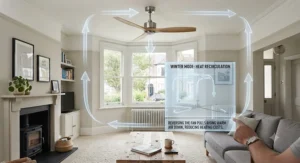
In the first 30 days, the most common mistake is leaving the fan running the same direction year-round. Every DC motor fan in this guide is reversible, and switching to clockwise rotation on a low speed through autumn and winter genuinely helps redistribute the warm air that naturally rises and pools near the ceiling — a free efficiency gain most owners never use. Dust build-up on the blades is the second big culprit behind reduced performance; a light wipe every few weeks keeps airflow consistent, since even a thin layer of dust measurably disrupts blade aerodynamics on smaller DC motors.
For ongoing maintenance, check that mounting screws remain tight every six months or so — normal operation causes gradual micro-vibration that can loosen fixings over years of use, and a wobbling fan both sounds worse and wastes energy fighting its own imbalance. If your model includes a light kit, swap to warm-white LED bulbs if it doesn’t already have them built in; pairing an efficient motor with an inefficient bulb undermines the entire point of buying a low wattage fan in the first place.
Real-World Scenarios: Matching the Fan to the Room
Picture a first-year university tenant in a shared house, cooling a single bedroom on a tight budget, running the fan maybe six hours a night through a warm September term. The LEONTYNE 31 Inch or NIORSUN 50cm both make sense here — low upfront cost, genuinely low wattage, and enough airflow for a room under 12m² without drawing attention (or complaints) from housemates about the electricity bill.
Now picture a family with a south-facing open-plan kitchen-diner that turns into a greenhouse every afternoon from May onwards. This is where the Fantasia Sirocco 54″ or the Fantasia Aero earn their premium price tags — both deliver serious airflow (7800 and 8000 cu ft/min respectively) that a smaller bedroom-sized fan simply can’t match, and the Aero’s flexible 5-41W range means you’re not stuck paying peak wattage just to run it on a mild evening.
Finally, consider a homeowner planning to stay put for a decade or more, prioritising long-term value over upfront saving. The CasaFan Eco Neo III, with its 25-year warranty and 12.2W maximum draw, essentially removes running costs and replacement anxiety from the equation entirely — the kind of purchase where the maths genuinely favours spending more now to spend nothing later.

Problem → Solution: Common Low Wattage Ceiling Fan Issues
Problem: the fan feels too weak for a large room. This usually isn’t a wattage problem so much as a sizing mismatch — a 31-inch fan simply can’t move enough air in a 20m² living room regardless of how efficient its motor is. Solution: match blade span to room size using the manufacturer’s coverage guidance, and consider a higher-airflow model like the Fantasia Sirocco 54″ rather than assuming a bigger fan automatically means bigger bills.
Problem: rising humidity makes the room feel warm even with the fan running. Fans move air, they don’t remove moisture, so on genuinely humid days a low wattage ceiling fan alone won’t solve discomfort. NHS guidance on coping in hot weather points out that electric fans can help once temperatures are below roughly 35°C, but lose their usefulness above that — a helpful practical ceiling to bear in mind, and a reminder to pair the fan with ventilation or a dehumidifier on the very hottest days rather than expecting it to do everything alone.
Problem: the fan hums or clicks at higher speeds. This is almost always a loose mounting bracket or downrod, not a motor fault. Solution: switch off, tighten every visible fixing, and check the blade brackets specifically — DC motors are engineered to run near-silent, so persistent noise typically points to installation rather than the unit itself.
Problem: energy bills didn’t drop as much as expected after switching to a DC fan. Solution: check you’re actually using the lower speed settings day-to-day rather than defaulting to maximum — the wattage difference between speed 2 and speed 6 on most of these models is substantial, and the “low wattage” marketing figure usually refers to the lowest usable setting, not an average across all speeds.
How to Choose a Low Wattage Ceiling Fan
- Start with room size, not wattage. A fan that’s too small for the space will run at higher speeds constantly to compensate, cancelling out any efficiency advantage from its motor.
- Check whether the wattage figure quoted is motor-only or motor-plus-light. Manufacturers list these inconsistently, and it changes the real-world comparison significantly.
- Confirm the motor type is DC or EC/DC, not AC. This single spec matters more than almost any other feature on the list.
- Look at the warranty length as a proxy for build confidence. Manufacturers offering 10+ years on the motor are typically backing genuinely efficient, well-engineered components.
- Decide whether you need integrated lighting or already have it covered. Paying for a light array you won’t use adds cost without adding value.
- Check the reversible function is genuinely marketed, not just technically present. Winter mode only helps if it’s easy to switch via remote or app.
- Factor in noise rating if the fan is going in a bedroom. A slightly less powerful but quieter model, like the Fantasia Zeta, often suits sleeping spaces better than the highest-airflow option available.
Wattage Rating Explained: What the Numbers Actually Mean
A ceiling fan’s wattage rating tells you how much electrical power it draws, but the figure printed on a listing rarely tells the whole story on its own. Most manufacturers quote either the maximum draw on the highest speed setting, or a combined figure that includes an integrated light — and as the Fantasia Aero demonstrates vividly, the gap between a fan’s lowest and highest wattage rating can be nearly tenfold within a single unit.
The A-to-G energy label scale is designed to help buyers compare appliances on more than raw power draw alone — noise and real-world performance factor into the rating too — which is why a fan with a slightly higher peak wattage than a rival can still carry a better overall rating, if its airflow-per-watt efficiency is stronger. Reviewers consistently note that the most useful comparison isn’t peak wattage in isolation but CFM-per-watt (cubic feet of airflow per watt consumed) — the Hunter Cassius, for instance, achieves roughly 98 CFM per watt, a genuinely strong ratio that a raw 37W figure alone doesn’t communicate.
Practically speaking, when comparing two fans, always check whether you’re comparing like-for-like: motor-only wattage against motor-only wattage, or combined figures against combined figures. Mixing the two is the single most common mistake shoppers make when hunting for the lowest wattage fan on paper.
Energy Efficient Wattage Comparison: DC vs AC Motors
The efficiency gap between DC and AC ceiling fan motors isn’t marginal — it’s the difference that defines this entire product category. A standard AC motor fan typically draws somewhere between 60 and 100 watts on its higher settings, while the DC motors featured throughout this guide run from as little as 5W up to around 41W across the same speed range, a reduction that Fantasia itself markets as roughly 60% less power consumption for equivalent airflow.
| Motor Type | Typical Wattage | Speed Options | Relative Noise |
|---|---|---|---|
| Standard AC | 60-100W | Usually 3 | Higher |
| DC (this guide) | 5-41W | Usually 6+ | Lower |
| EC/DC premium | 12-35W | Usually 6+ | Lowest |
The table above makes the case plainly: DC motors don’t just save watts, they typically offer finer speed control too, since the electronic commutation that makes them efficient also makes precise speed stepping easier to engineer. Budget buyers shouldn’t assume a cheap AC fan is automatically cheaper overall — the NIORSUN 50cm, priced similarly to many AC alternatives, will run at a fraction of the electricity cost across a typical summer of use, making up the difference in running costs within the first year or two.
Low Power Ceiling Fan vs Traditional Ceiling Fan
The phrase “traditional ceiling fan” usually means an older AC-motor unit with three fixed speeds and no reversible function — the kind found in countless older UK properties, garden centres, and budget retailers still clearing older stock. A low power ceiling fan, by contrast, almost always means a modern DC-driven unit with six or more speed increments, remote or app control, and a reversible motor for winter use.
The practical difference shows up most clearly in flexibility. A traditional fan’s three speeds tend to jump from “barely noticeable” to “uncomfortably strong” with nothing sensible in between, whereas the six-speed DC fans throughout this guide let you fine-tune airflow to match the actual temperature rather than overcompensating. Traditional AC fans also typically lack the reversible function that lets DC models like the Fantasia Sirocco and CasaFan Eco Neo III contribute to winter heat circulation, meaning they sit idle for roughly half the year rather than earning their keep year-round.
Cost-per-use tells a similar story. Running a 90W traditional AC fan for eight hours daily through a typical UK summer costs noticeably more than running any of the DC models covered here on equivalent settings — and because DC fans can comfortably run on lower, near-silent speeds overnight, the realistic daily runtime (and therefore the realistic saving) tends to be even higher than a simple wattage comparison suggests.

Power Consumption & Long-Term Cost
Working out real running costs starts with the standard formula: watts divided by 1,000, multiplied by hours used, multiplied by your electricity unit rate. Ofgem’s energy price cap protects millions of households on default tariffs by limiting the maximum rates suppliers can charge, and it’s reviewed every three months — worth checking periodically since it directly affects these sums.
Take the CasaFan Eco Neo III at its 12.2W maximum: running it for eight hours a day across a 180-day cooling season works out to roughly 17.6 kWh of total consumption — at current unit rates, that’s a running cost measured in single-figure pounds for an entire summer. Compare that against a traditional 90W AC fan run on the same schedule, which would consume well over ten times as much electricity for equivalent runtime. Over a five- or ten-year ownership period, that gap compounds into a genuinely meaningful sum, particularly once you factor in that DC motors also tend to need less maintenance and fewer replacement parts across their longer engineered lifespan.
The takeaway for anyone weighing up total cost of ownership: a £150 price difference between a budget AC fan and a premium DC model like the Fantasia Zeta or CasaFan Eco Neo III can realistically be recovered in running-cost savings within three to six years of typical UK summer use, before even accounting for the extended warranties most DC models carry.
Efficient Cooling for Different Room Types
Efficient cooling isn’t a one-size-fits-all outcome — the right fan for a small box bedroom is the wrong fan for an open-plan kitchen-diner, and treating them the same is where a lot of buyers end up disappointed. For bedrooms under 12m², prioritise quiet, low-profile models like the LEONTYNE 31 Inch, where minimal wattage and low noise matter more than raw airflow.
Living rooms and larger family spaces benefit from higher-airflow options such as the Fantasia Sirocco or Fantasia Aero, where the extra wattage on higher settings is justified by genuinely covering a bigger volume of air rather than straining a smaller motor to compensate. Conservatories and south-facing rooms that heat up fastest through the day are arguably where efficient cooling matters most, since these spaces need a fan running for longer stretches — making the wattage-per-hour figure, rather than peak output alone, the number worth focusing on.
Open-plan kitchen-diners sit in an awkward middle ground: often larger than a single bedroom but without the ceiling height of a converted barn or extension, which is exactly the scenario the CasaFan Eco Neo III‘s 45m² room rating and adjustable blade configuration was designed to solve.
Safety, Regulations and Compliance Guide
All the ceiling fans covered in this guide are 230V mains-powered appliances intended for UK domestic use, and as with any electrical fixture, installation should follow Part P of the UK Building Regulations where relevant, alongside the manufacturer’s specific mounting instructions regarding minimum blade clearance from walls, sloped ceilings and floor height. Products sold in Great Britain since 1 January 2021 need to display the appropriate conformity marking. Per gov.uk guidance on product safety and metrology, the UKCA mark now demonstrates that goods previously covered by the CE mark comply with the relevant UK rules when placed on the Great Britain market — it’s worth checking for this marking on the packaging of any fan you’re considering, particularly from newer or less established brands.
If you’re mounting a fan yourself rather than hiring a qualified electrician, be aware that any new fixed wiring connection technically falls under notifiable electrical work in England and Wales unless you’re simply replacing a like-for-like fitting on an existing ceiling rose. When in doubt, particularly with DC motor units that sometimes require a compatible control module rather than a standard switch, it’s worth the modest cost of a qualified electrician confirming the installation rather than risking a fault down the line.
Buyer’s Decision Framework
If your priority is the absolute lowest running cost and you’re equipping a small room, choose the LEONTYNE 31 Inch or NIORSUN 50cm, because their combined low wattage and modest size means you’re never paying for airflow capacity you won’t use. If you need to cool a genuinely large space and airflow matters more than shaving the last few watts off the bill, choose the Fantasia Sirocco or Fantasia Aero, because their higher peak wattage is offset by dramatically better coverage per fan. If you’re planning to stay in the property long-term and want to essentially remove running costs from consideration for the next decade, choose the CasaFan Eco Neo III, because its 12.2W ceiling and 25-year warranty make ongoing cost close to irrelevant.
Frequently Asked Questions
❓ What is a low wattage ceiling fan?
❓ Is a low wattage ceiling fan actually more expensive to buy?
❓ How many watts does a typical ceiling fan use in the UK?
❓ Can a low power ceiling fan cool a large living room?
❓ Do DC ceiling fans work with a standard wall switch?
Conclusion
If there’s one honest takeaway from comparing these seven fans, it’s that “low wattage” isn’t a single fixed number you’re shopping for — it’s a spectrum shaped by motor type, room size, and how genuinely you’ll use the lower speed settings day to day. The CasaFan Eco Neo III wins on raw efficiency figures, drawing a genuinely astonishing 12.2W at full tilt, but that doesn’t make it the right choice for a small student bedroom where the LEONTYNE 31 Inch or NIORSUN 50cm will do the job just as well for a fraction of the upfront cost.
What matters more than chasing the single lowest wattage rating on a spec sheet is matching motor type, airflow capacity and room size correctly — a well-matched 35W fan running efficiently at low speed most of the time will almost always beat a poorly matched 12W fan straining to cool a room it was never designed for. Every model in this guide uses genuine DC or EC/DC motor technology, so whichever you choose, you’re starting from a position of real efficiency rather than marketing spin — the rest comes down to matching the fan to your actual room and habits.
✨ Don’t miss these exclusive deals!
🔍 Take your home cooling to the next level with these carefully selected low wattage ceiling fans. Click on any highlighted model to check current pricing and availability, and enjoy genuinely efficient cooling all summer long! 🌬️
Recommended for You
- Cheapest Eco-Friendly Ceiling Fan to Run: 7 Best UK Picks (2026)
- Eco Ceiling Fan for Large Room: 7 Best UK Picks (2026)
- Eco-Friendly Ceiling Fan: 7 Best Sustainable Picks UK (2026)
Disclaimer: This article contains affiliate links. As an Amazon Associate, I earn from qualifying purchases. If you purchase products through these links, we may earn a small commission at no additional cost to you.
✨ Found this helpful? Share it with your friends! 💬🤗
