
In This Article
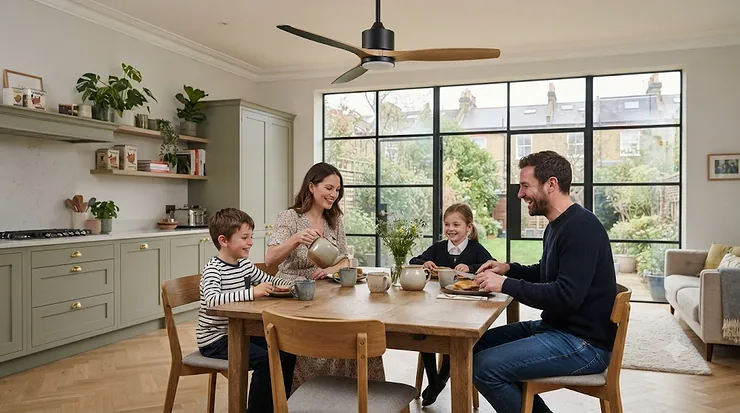
There’s a specific kind of dread that sets in on the first proper hot day of the year, when you realise the one room in the house that actually needs cooling is also the biggest one you own. An open-plan kitchen-diner, a converted loft lounge, a knocked-through Victorian double — these spaces swallow airflow whole, and a fan built for a bedroom simply gives up somewhere around the sofa.
So what is an eco ceiling fan for large room use, exactly? It’s a ceiling fan built around a DC (direct current) motor rather than the older AC type, paired with a blade span wide enough to move air across a genuinely large floor area, typically using a fraction of the electricity a traditional fan or portable air conditioner would draw. As the Wikipedia entry on ceiling fans explains, fans cool people rather than rooms, by speeding up evaporation and heat exchange from the skin — which is exactly why getting the size and motor type right matters more in a large space than almost anywhere else in the house.
This guide compares seven genuine DC-motor ceiling fans currently sold in the UK, from budget entry points to proper open-plan flagships, so you can match blade span and airflow to your actual square footage rather than guessing. One honesty note up front: exact running costs and CFM airflow figures vary by retailer and testing method, so treat the numbers below as a guide for comparison rather than guaranteed performance, and always check the current listing for the latest verified specification.
Quick Comparison Table
Here’s the shortlist at a glance before the full breakdown. Prices are approximate ranges based on research at the time of writing — always check current price, as retailer pricing on ceiling fans shifts with stock and season.
| Fan | Blade Span | Price Range | Best For |
|---|---|---|---|
| Fantasia Sirocco DC 54in | 137cm | £340-£420 range | Premium large-room flagship with light |
| Westinghouse Willa Widespan DC | 153cm | £340-£380 range | Largest span, open-plan specialist |
| Fantasia Zeta DC | 132cm | £320-£400 range | Trusted UK brand, A-rated efficiency |
| Philips LED Atlas DC Fan | 132cm | £150-£220 range | Recognisable global brand, dimmable LED |
| Dreo Smart 52-inch DC Fan | 132cm | £110-£140 range | App and Alexa control on a budget |
| Depuley Modern 52in DC Fan | 132cm | £125-£150 range | Farmhouse styling for open-plan rooms |
| MiniSun Dakota DC | 122cm | £95-£140 range | Cheapest genuine DC entry point |
The spread here runs from under £100 to over £400, and blade span is the first thing that changes as you move up that range — everything from the Dakota’s 122cm up to the Willa’s 153cm sits within genuine large-room territory, but the wider the span, the more air gets pushed per rotation at the same low speed. That matters more than motor wattage once a room passes roughly 25 square metres.
💬 Just one click — help others make better buying decisions too!😊
Top 7 Eco Ceiling Fans for Large Rooms: Expert Analysis
1. Fantasia Sirocco DC 54in — premium flagship with integrated light
Fantasia has been building ceiling fans for the UK market since 1985, and the Sirocco sits near the top of that range: a 137cm (54in) blade span paired with a DC motor and an integrated LED light kit, finished in matt white. That size genuinely earns the “large room” label rather than stretching for it — this is a fan built to move air across an open-plan space, not a bedroom fan sold in an oversized box.
The DC motor drops power draw dramatically compared with older AC designs; Fantasia’s own figures put its low-energy DC range as low as 30W, against an average AC fan motor closer to 65W, which on a fan running for several hours a day across a British summer adds up to a meaningful saving. A 10-year motor guarantee backs the build, reflecting a brand that’s been refining this exact category for four decades.
This is the pick for anyone treating the fan as a genuine light fixture and cooling solution in one, rather than adding a separate pendant light afterwards. Reviewers of Fantasia’s DC range consistently describe the motors as near-silent on lower speeds, a claim the brand itself leans on heavily in its marketing — worth confirming on a demo unit if silence in a bedroom-adjacent living space is a priority for you.
Pros:
- ✅ Full 137cm span genuinely suited to large or open-plan rooms
- ✅ Integrated dimmable LED removes the need for a separate light
- ✅ 10-year motor guarantee from an established UK brand
Cons:
- ❌ Among the pricier options on this list
- ❌ Larger size needs adequate ceiling height to hang safely
At around £340-£420 depending on finish and retailer, the Fantasia Sirocco DC 54in is the pick for buyers who want one purchase to cover both lighting and large-room airflow.
2. Westinghouse Willa Widespan DC — largest span, open-plan specialist
Where the Sirocco pairs size with a light kit, the Westinghouse Willa strips that back entirely and focuses purely on moving air across the widest possible floor area. At 153cm, it’s the largest blade span on this list, and it’s specifically marketed as the choice for very large or semi-commercial spaces rather than a standard living room.
The trade-off for that specialism is the missing light kit — this is a fan, not a fan-and-pendant combination, so you’ll need a separate ceiling light if the room doesn’t already have one. Westinghouse’s DC motor technology is pitched at up to 62% more efficient than a traditional AC motor across the brand’s range, a genuinely substantial gap that reflects how much waste heat and energy older AC ceiling fan motors generate in comparison.
This suits open-plan kitchen-diners, large loft conversions, or double-height living rooms where a wide, slow-turning blade span does more real work than a smaller fan spinning faster. It’s a specialist’s choice rather than an all-rounder, and it performs best when treated as exactly that.
Pros:
- ✅ Widest blade span on this list at 153cm
- ✅ Up to 62% more efficient DC motor than AC equivalents
- ✅ Purpose-built for large and semi-commercial spaces
Cons:
- ❌ No integrated light kit included
- ❌ Overkill for anything smaller than a genuinely large room
Priced around £340-£380, the Westinghouse Willa Widespan DC is the specialist’s pick when floor area, not styling, is the priority.
3. Fantasia Zeta DC — trusted UK brand, A-rated efficiency
The Zeta sits a notch below the Sirocco in Fantasia’s range at 132cm, but it carries something the flagship’s listing doesn’t always headline: a confirmed A energy efficiency rating on its retail listing, placing it among the most efficient ceiling fans available to UK buyers rather than merely “efficient” as a marketing claim.
Available in brushed nickel and white finishes, the Zeta runs on the same DC motor philosophy as the rest of Fantasia’s low-energy range, and benefits from the brand’s broader claim of up to an 80% reduction in energy consumption when paired with efficient LED bulbs on models that include lighting. As with the Sirocco, a 10-year motor guarantee applies across Fantasia’s current fan range.
This is the sensible mid-premium choice for buyers who want a genuinely A-rated fan without paying flagship prices, and who trust an established brand’s decade-long warranty over a newer entrant’s marketing claims. It suits large living rooms and open-plan spaces where 132cm is enough coverage without needing the full 137-153cm span of the two options above.
Pros:
- ✅ Confirmed A energy efficiency rating on the retail listing
- ✅ 10-year motor guarantee from an established UK brand
- ✅ Available in multiple finishes to suit different interiors
Cons:
- ❌ Smaller span than the Sirocco or Willa for the very largest rooms
- ❌ Premium UK-brand pricing versus newer budget entrants
At roughly £320-£400, the Fantasia Zeta DC rewards buyers who value a verified efficiency rating over unverified marketing claims from less established brands.
4. Philips LED Atlas DC Fan — recognisable global brand, dimmable LED
Philips needs no introduction, and its Atlas DC fan brings that same global lighting pedigree to the ceiling fan category, combining a 28W fan motor with a 35W dimmable LED light kit in a nickel finish. It’s a genuinely different proposition from the specialist UK fan brands above — this is a company built on lighting first, fans second.
Here’s an honesty note worth flagging directly: the retail listing for this model shows an Energy Efficiency Class of E, noticeably behind the A-rated Fantasia Zeta and the high-efficiency claims from Westinghouse’s DC range. That doesn’t make it a bad fan, but it does mean the “eco” case for choosing Philips here rests more on its dimmable, long-life LED than on the motor itself matching the very best DC performers on this list.
This suits buyers who specifically want a trusted, widely available lighting brand for the light kit half of the purchase, and who are happy to treat the fan function as a secondary benefit rather than the headline reason to buy. It’s a reasonable middle-ground pick, not a top efficiency performer.
Pros:
- ✅ Recognisable, widely trusted global lighting brand
- ✅ Dimmable 35W LED light kit built in
- ✅ Nickel finish suits a range of large-room interiors
Cons:
- ❌ E energy efficiency rating trails the A-rated options on this list
- ❌ Less specialised in ceiling fan engineering than dedicated fan brands
Typically found in the £150-£220 range depending on retailer, the Philips LED Atlas DC Fan is a sound pick for the light kit, with the fan efficiency itself as a secondary consideration.
5. Dreo Smart 52-inch DC Fan — app and Alexa control on a budget
Dreo’s 132cm smart ceiling fan punches well above its price point on features: 12 speed settings controllable via app, three fan modes, a dimmable LED with adjustable colour tones, and Alexa compatibility, all wrapped around a DC motor Dreo rates at a whisper-quiet 22dB. On Amazon UK, this specific listing has built up a genuinely large review base — over 500 verified ratings averaging 4.6 out of 5 stars, which is a meaningfully larger and more reassuring sample size than most of the newer entrants in this category.
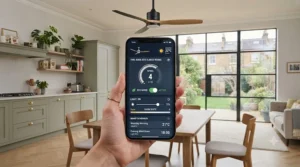
That combination of granular speed control and app scheduling is where the real efficiency gain hides: rather than choosing between “on” and “off” across a handful of fixed speeds, a stepless 12-speed system lets you dial in exactly enough airflow for comfort without overshooting into higher, less efficient settings. Aggregated buyer feedback on the listing consistently praises the quiet running and app reliability, though as with any smart-home device, a minority of reviews note occasional Wi-Fi reconnection niggles after a router change or power cut.
This is the fan of choice for tech-minded buyers who want granular control without paying premium UK-brand pricing, and who are comfortable relying on an app and Wi-Fi for day-to-day operation rather than a simple wall dial.
Pros:
- ✅ 12-speed app control for precisely dialled-in airflow
- ✅ Large, genuinely verified review base averaging 4.6/5
- ✅ Rated at a quiet 22dB on the retail listing
Cons:
- ❌ Relies on app/Wi-Fi for full functionality
- ❌ Occasional connectivity niggles reported after router changes
At around £110-£140, often discounted further during Amazon promotions, the Dreo Smart 52-inch DC Fan delivers smart-home convenience at a genuinely accessible price.
6. Depuley Modern 52in DC Fan — farmhouse styling for open-plan rooms
Depuley’s take on the 132cm DC fan leans into farmhouse and industrial styling — think exposed-look blades and a cage-adjacent aesthetic — while running a 30W DC motor pitched specifically at open-plan layouts increasingly common in British homes, where a kitchen, dining and living area share one continuous ceiling.
The 132cm span is explicitly positioned by retailers as suited to rooms between roughly 25 and 40 square metres, which covers a substantial number of UK open-plan extensions without stepping up to the largest 150cm-plus widespan models. At 30W on the fan motor, it sits comfortably within the low-energy DC bracket, broadly in line with the wattage claimed across most of the mid-range fans on this list.
This suits buyers who want a specific look — rustic, exposed, a talking point rather than a background appliance — without sacrificing the DC efficiency that makes a large-room fan worth running for hours at a time through summer.
Pros:
- ✅ 132cm span suited to 25-40m² open-plan rooms
- ✅ Distinctive farmhouse/industrial styling, not just a plain blade set
- ✅ 30W DC motor keeps running costs low
Cons:
- ❌ Styling won’t suit every interior
- ❌ Less established brand history than Fantasia or Westinghouse
Priced around £125-£150, the Depuley Modern 52in DC Fan is a strong pick if the fan is also meant to look like part of the room’s design.
7. MiniSun Dakota DC — cheapest genuine DC entry point
MiniSun’s Dakota answers a straightforward question: what’s the least you can spend and still get a proper 28W DC motor rather than an older, noisier, less efficient AC unit? At 122cm, it’s the smallest span on this list, but it still comfortably qualifies as a large-room fan rather than a bedroom-only unit, with six speed settings and a quoted 32dB noise level.
Published specification depth here is thinner than for the premium brands above — MiniSun doesn’t publish the same breadth of technical and warranty detail as Fantasia or Westinghouse — so the honest summary is that it delivers the fundamentals reliably at a genuinely low price, without extras like app control, a widespan blade set, or a decade-long motor guarantee.
This is the fan for buyers who want to test whether a DC ceiling fan actually changes how comfortable a large room feels in summer, without committing three or four times the budget to find out. It’s also a sensible second-fan choice for a spare room or home office that occasionally needs the same large-room treatment.
Pros:
- ✅ Lowest genuine DC-motor entry price on this list
- ✅ Six speed settings despite the budget positioning
- ✅ Quoted 32dB noise level is respectably quiet for the price
Cons:
- ❌ Smallest blade span here, less suited to the very largest rooms
- ❌ Thinner published warranty and spec detail than premium rivals
At roughly £95-£140, the MiniSun Dakota DC is the honest, low-risk way to find out whether a large-room eco fan earns its keep in your home.
Practical Usage Guide: Installing and Running Your Eco Ceiling Fan
Getting the installation and settings right in the first few weeks makes a bigger difference to comfort and running cost than most buyers expect. Ceiling fans, including every model above, need to be mounted with blade tips at least 18cm from any obstruction such as a sloped ceiling or beam, and blades should sit at least 2.3 metres from the floor — check this against your specific room before ordering a fan with a downrod if your ceiling is higher than standard.
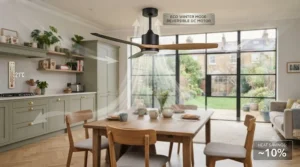
Once installed, the biggest everyday efficiency mistake is running a large-room fan on its highest speed permanently rather than adjusting through the day. A DC motor’s efficiency advantage is largest at low-to-mid speeds, so a 12-speed model like the Dreo genuinely earns its keep by letting you find the lowest setting that still feels comfortable, rather than jumping straight to maximum. Set blades to rotate anticlockwise in summer, pushing air straight down for a cooling breeze, and clockwise in winter on a low setting to gently redistribute risen warm air without creating a draught.
Common first-month mistakes include leaving the fan running in an empty room — fans cool people, not the air itself, so there’s no benefit once nobody’s there to feel it — and skipping the manufacturer’s recommended blade cleaning schedule, which affects both airflow efficiency and motor noise over time as dust builds up unevenly across blades.
Real-World Scenarios: Matching the Fan to Your Room
The open-plan kitchen-diner extension. Roughly 30-35 square metres, high summer heat gain from glazing and cooking, and a household that wants the fan running most evenings. The Depuley Modern 52in DC Fan or Fantasia Zeta DC both suit this well — enough span for genuine coverage without the premium price of the widest widespan models.
The double-height loft conversion. A large, tall living space where a smaller fan simply can’t move enough air to be felt at floor level. This is exactly the scenario the Westinghouse Willa Widespan DC is built for — the widest span here, purpose-designed for large or semi-commercial-scale rooms.
The budget-conscious first-timer. Wants to know if a DC ceiling fan genuinely changes comfort in a large room before spending big, and doesn’t need app control or a decade-long warranty to feel confident buying. The MiniSun Dakota DC or Dreo Smart 52-inch DC Fan both offer a low-risk way in, with Dreo adding smart control for a modest premium.
Open Plan Ceiling Fan: Special Considerations for Knocked-Through Spaces
An open plan ceiling fan has to work harder than one serving a single, enclosed room, because it’s often the only thing moving air across a space that combines cooking heat, large glazed areas, and multiple zones of activity under one continuous ceiling. The first practical decision is placement: a single large-span fan positioned over the most-used zone — typically the dining or living area rather than directly over the kitchen — usually outperforms two smaller fans fighting each other’s airflow.
Ceiling height matters more in open-plan conversions than standard rooms, since many involve vaulted or raised sections where a standard-length downrod won’t bring the blades low enough to be effective. Measure the specific mounting point, not just the room’s average height, before ordering — a fan hung too high moves air across the ceiling void rather than down towards the people using the room.
Finally, consider noise more carefully in open-plan spaces than you would in a bedroom-only purchase: sound carries further across an open floor plan, and a fan running for hours during dinner or a work-from-home afternoon benefits from the lower dB ratings on models like the Dreo (22dB) or MiniSun Dakota (32dB) far more than it would in a room you only occupy briefly.
Room Size Guide: What Blade Span Fits Which Space
Matching blade span to floor area is the single biggest factor in whether a ceiling fan actually feels effective, and it’s worth getting right before finish or price enters the decision at all.
| Room Size | Recommended Blade Span | Example From This List |
|---|---|---|
| Up to 15m² | 90-107cm | Not covered — smaller fans suit this range |
| 15-25m² | 107-122cm | MiniSun Dakota DC |
| 25-40m² | 122-137cm | Depuley Modern 52in DC Fan, Fantasia Zeta DC |
| 40m²+ / open-plan | 137-153cm+ | Fantasia Sirocco DC 54in, Westinghouse Willa Widespan DC |
The pattern here is straightforward: a fan sized correctly for its room can run at a lower, quieter, more efficient speed and still be felt clearly, while an undersized fan gets pushed to maximum speed constantly to compensate, undermining much of the energy saving a DC motor is supposed to deliver. If your room falls right on a boundary between two bands, size up rather than down — a slightly larger fan running slowly beats a slightly smaller one running flat out.
Large Room Ceiling Fan Efficient Features That Matter
Not every spec sheet claim translates into a genuinely large room ceiling fan efficient experience once it’s installed and running. DC motor technology matters enormously and is the single biggest lever here — the difference between a 65W average AC motor and a 28-35W DC equivalent is real, measurable, and compounds every hour the fan runs across a British summer.
Speed granularity matters more than headline top speed. A fan offering six or twelve distinct speeds, like the Dreo’s stepless app control, lets you find the lowest setting that still feels comfortable in a large space, whereas a basic three-speed fan often forces a jump straight to “high” to feel any effect at all. Reverse function for winter use is close to universal across this list and genuinely useful, gently redistributing risen warm air without the marketing fanfare it sometimes receives.
Conversely, RGB lighting, app-based colour tuning and Alexa integration are pleasant extras rather than efficiency features — they don’t change how much air moves or how little electricity the motor draws, and are worth paying for only if the smart-home functionality itself appeals to you independent of the fan’s core job.
High Airflow Eco Fan Technology: DC vs AC Motors Explained
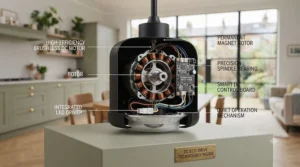
The single biggest technology shift behind every genuinely high airflow eco fan on this list is the move from AC to DC motors. A traditional AC ceiling fan motor runs at a small number of fixed speeds and wastes a meaningful share of its power draw as heat rather than airflow. A DC motor, by contrast, uses electronically commutated windings that allow far finer speed control and convert a much higher proportion of input power directly into blade rotation.
In practical terms, this is why Westinghouse can credibly claim up to 62% better efficiency for its DC range against AC equivalents, and why Fantasia’s low-energy DC models start as low as 30W against an average 65W AC motor. Neither company is claiming a marginal improvement — this is a genuine step-change in how the motor itself works, not just a marketing repackaging of an old design.
The practical takeaway for a large room specifically: because DC motors stay efficient across a wider range of speeds, you can run a wide-span fan slowly and still move a meaningful volume of air, rather than needing to run a smaller AC fan at full tilt to achieve the same felt effect — which is exactly the efficiency gap that matters most in the biggest room in the house.
Eco Ceiling Fan vs Air Conditioning: The Detailed Comparison
For UK homes without existing air conditioning, an eco ceiling fan is almost always the first and cheaper line of defence against summer heat, but it’s worth understanding exactly what each option does differently rather than assuming they’re interchangeable.
| Factor | Eco Ceiling Fan (DC) | Portable/Split Air Conditioning |
|---|---|---|
| Running cost per hour | Roughly 0.03-0.05 kWh | Roughly 1.0-2.5 kWh |
| Effect on room temperature | None — cools people via airflow, not the air itself | Actively lowers air temperature |
| Typical UK purchase cost | £95-£420 across this list | £250-£800+ |
| Best For | Everyday comfort, most UK summers | Genuine heatwave conditions, or homes needing measurable temperature drop |
A ceiling fan doesn’t lower the temperature of a room at all — it cools the people inside it by increasing evaporation and convective heat loss from the skin, which is why fans are effectively useless once nobody’s in the room to feel the airflow. Air conditioning, by contrast, genuinely changes the air temperature, at a running cost that can be twenty to fifty times higher per hour. For most UK homes and most summers, a correctly sized large-room fan delivers the bulk of the comfort improvement at a fraction of the running cost — air conditioning earns its keep mainly during genuine heatwave conditions or in rooms that structurally can’t be kept comfortable any other way.
What to Expect: Real-World Air Circulation and Performance
Spec sheets rarely capture what air circulation actually feels like on a genuinely hot day in a large room, so here’s the practical translation. A correctly sized DC fan running at a moderate speed creates a continuous, gentle breeze across the room rather than a single blast of air directly underneath it — this is why blade span matters more than raw motor wattage in a large space, since a wider span pushes air further outward from the centre point.
Expect the felt cooling effect to diminish noticeably towards the edges of a very large or irregularly shaped room, which is exactly why open-plan spaces sometimes benefit from a second, smaller fan over a distant seating area rather than relying on one large-span fan to cover the entire footprint alone. Humidity also affects how much relief a fan provides — air circulation helps most in dry heat by speeding up sweat evaporation, and provides somewhat less relief on the UK’s occasional humid, still summer days, when even fast-moving air struggles to evaporate moisture from skin efficiently.
Noise becomes more noticeable at higher speeds regardless of motor type, and this is where the dB ratings quoted across this list — from Dreo’s 22dB up to the high-30s on some budget AC-adjacent models elsewhere on the market — genuinely translate into a felt difference during quiet evening use.
Long-Term Cost & Maintenance: Running Costs Explained
A typical DC-motor ceiling fan on this list consumes somewhere in the region of 0.03-0.05 kWh per hour of running time, which at current UK electricity prices works out to a genuinely small fraction of a penny to a few pence per hour — a figure worth comparing directly against a portable air conditioner’s 1.0-2.5 kWh per hour draw when deciding which to reach for first on a hot day.
Maintenance costs stay low across every model here provided you keep to a simple routine: wipe blades regularly to prevent dust build-up affecting airflow balance, avoid running the fan continuously in an unoccupied room, and check mounting hardware annually, particularly on the wider-span models where the extra blade weight puts more strain on the ceiling fixing over time. Motor warranties vary meaningfully across this list — Fantasia’s 10-year guarantee sits well ahead of the shorter terms typically offered on newer budget entrants, and that warranty length is worth weighing against the upfront price difference if you’re planning to keep the fan for a decade or more.
Safety, Building Regs and Staying Cool: What UK Homeowners Should Know
Every fan on this list is designed for indoor use only, and none should be installed in a bathroom or other space with direct water exposure without a specifically rated model — always check the IP rating on the specific listing before installing in a kitchen with a shower room adjoining, a conservatory, or anywhere with high humidity. Standard installation height and clearance rules apply across the category: blade tips need at least 18cm clearance from any obstruction, and blades should sit no lower than roughly 2.3 metres from the floor.
On the health side, NHS guidance on coping with hot weather specifically notes that electric fans can help when room temperatures stay below 35°C, but recommends other cooling strategies — closed curtains during the day, cool showers, staying hydrated — as the temperature climbs higher, since a fan alone won’t prevent heat-related illness in genuinely extreme conditions. This is worth keeping in mind for anyone in a household with older residents, babies, or people with existing health conditions, who are more vulnerable during a heatwave regardless of how well-specified the fan is.
At end of life, ceiling fans count as electrical waste and must never go in general household rubbish — official UK government guidance on recycling batteries and electrical waste confirms they should be taken to a designated collection point or handled via a retailer take-back scheme instead, both to prevent landfill pollution and to recover the metals inside the motor.
FAQ
❓ What size blade span do I need for a large room?
❓ How much does an eco ceiling fan cost to run per day?
❓ Do DC ceiling fans actually cool a room, or just the person underneath?
❓ Can I use a large ceiling fan in an open plan kitchen-diner?
❓ Is a higher-priced DC fan always more energy efficient than a budget one?
Conclusion
Choosing the right eco ceiling fan for large room use comes down to matching blade span honestly to your actual floor area, rather than assuming bigger is automatically better or that price alone signals efficiency. The Fantasia Sirocco DC 54in and Westinghouse Willa Widespan DC earn their premium positioning through genuinely large blade spans and verified DC efficiency claims, while the Fantasia Zeta DC offers a confirmed A energy rating without the very top price tag.
Further down the budget scale, the Philips LED Atlas DC Fan brings trusted lighting pedigree with a more modest efficiency rating worth weighing honestly, while the Dreo Smart 52-inch DC Fan, Depuley Modern 52in DC Fan and MiniSun Dakota DC all deliver genuine DC-motor performance at accessible prices, each suited to slightly different room sizes and styling preferences. Whichever you choose, get the room size guide right before anything else — a correctly sized fan running slowly will always outperform an undersized one running flat out, both for comfort and for the electricity bill.
Recommended for You
- Eco-Friendly Ceiling Fan: 7 Best Sustainable Picks UK (2026)
- Inverter Ceiling Fan: 7 Best Quiet Picks for UK Homes (2026)
- Variable Speed DC Ceiling Fan: 7 Best UK Picks (2026)
Disclaimer: This article contains affiliate links. As an Amazon Associate, I earn from qualifying purchases. If you purchase products through these links, we may earn a small commission at no additional cost to you.
✨ Found this helpful? Share it with your friends! 💬🤗
