In This Article
There’s a particular kind of British optimism involved in buying a ceiling fan. You picture lazy August evenings, a gentle breeze pushing warm air out the window, electricity meter barely ticking over. Then you open a search page and get buried under motor wattages, CFM figures and energy labels that look like they were designed by someone who actively enjoys confusing people. Breathe. That’s exactly the mess this guide is here to sort out.
An eco-friendly ceiling fan isn’t a marketing buzzword tacked onto any old spinning blade — it’s a specific category of product built around brushless DC motor technology, which typically uses somewhere between 60% and 80% less electricity than the old AC motors still found in budget fans. That difference matters more than it used to. UK summers have been getting hotter and stickier, more households are actively looking for cooling that won’t wreck the electricity bill, and the fans doing that job best all share the same underlying engineering choice.
This guide walks through seven genuine, currently available models — from a sub-£150 bedroom fan to an industrial-grade unit built for lofts and conservatories — with honest commentary drawn from real specifications and real aggregated customer sentiment, not invented enthusiasm. You’ll get comparison tables, a proper buying framework, running-cost maths, and answers to the questions people actually type into Google before they buy an eco-friendly ceiling fan. No fluff, no fictional five-star reviews — just what you need to pick the right one for your house.
Quick Comparison Table
| Fan Model | Motor Power | Diameter | Price Range | Best For |
|---|---|---|---|---|
| MiniSun Newday | DC, low-wattage | 107cm (42in) | Around £110-£140 | Renters and first-time buyers |
| Eglo Portsea | 30W DC | 132cm (52in) | £90-£130 range | Living rooms wanting tunable light |
| Eglo Cirali 52 | 16W (motor + LED) DC | 132cm (52in) | £90-£140 range | Best airflow-per-watt efficiency |
| Fantasia 52in Zeta DC | Low-energy DC | 132cm (52in) | £380-£430 range | Long-term, warranty-focused buyers |
| Fantasia Sirocco DC | Low-energy DC | 137cm (54in) | £390-£430 range | Larger UK living rooms |
| Fantasia Viper Plus LED | Low-energy DC | 112cm (44in) | £320-£380 range | Kitchens and steamy spaces |
| Westinghouse Widespan | High-output DC | 254cm | Above £650 | Lofts, conservatories, open-plan |
A glance down that “Best For” column tells its own story: eco-friendly doesn’t mean one-size-fits-all. Budget-conscious buyers and renters gravitate toward the MiniSun Newday, while anyone circulating air across an open-plan kitchen-diner needs the raw sweep of something like the Westinghouse Widespan. What ties all seven together is the DC motor — every single one sips power compared with the AC alternatives still sold on the high street, and that’s the whole point of this list.
💬 Just one click — help others make better buying decisions too!😊
Top 7 Eco-Friendly Ceiling Fans: Expert Analysis
1. MiniSun Newday — budget-friendly DC motor for renters and first fans
The MiniSun Newday is the fan most people should start their research with, because it strips eco-friendly cooling down to its essentials without pretending to be something it isn’t. This 42-inch silver-and-wood-effect model runs on a reversible DC motor, ships with a remote, and includes a dimmable LED light centre — all for a price that undercuts most of the field.
Key specs worth knowing: the blade span of 107cm suits bedrooms and box rooms rather than open-plan spaces, and the six-speed control plus built-in timer and memory function mean it remembers your preferred setting after a power cut, which sounds trivial until you’re the one re-programming a fan at midnight. On paper this means a fan you set once and mostly forget about.
Based on the spec comparison with pricier rivals on this list, the Newday’s main trade-off is scale, not efficiency — DC motor technology doesn’t really change much between budget and premium tiers; it’s the blade diameter, airflow volume and build materials that shift with price. What most buyers overlook here is that a smaller, well-matched DC fan in a small room often outperforms an oversized fan running on a low setting.
Reviewers consistently note straightforward installation and a genuinely quiet motor at low-to-mid speeds, though as with many budget fans in this category, the number of verified UK reviews is still modest, so treat early feedback as indicative rather than exhaustive.
Pros:
- ✅ Genuinely low purchase price for a true DC motor fan
- ✅ Dimmable LED light with memory function included
- ✅ Compact size suits bedrooms and flats well
Cons:
- ❌ 107cm span struggles in larger or open-plan rooms
- ❌ Smaller verified review pool than bigger UK brands
At around £110-£140, the Newday represents strong value for anyone cooling a single room without wanting to spend Fantasia or Westinghouse money — check current price before buying, as retailer stock and offers shift regularly.

2. Eglo Portsea — tunable white LED with a genuinely quiet DC motor
The Eglo Portsea leans into the “ceiling light that also happens to cool the room” idea, and it does that job well. Its standout feature is the tuneable white LED — shifting from 3000K to 5000K via remote — paired with a reversible DC motor that Eglo’s own technical data lists at around 30 watts on its top speed.
That 30W figure matters in practice: Eglo’s own published airflow-per-watt ratio for the Portsea works out at 4.80 (m³/min)/W, which is respectable rather than class-leading, and the fan carries a confirmed Energy Efficiency Class of E on its official product sheet — a genuinely useful, verifiable data point rather than marketing fluff. What most buyers overlook about this model is that the class E rating isn’t a red flag; DC ceiling fans as a category sit well ahead of most other household electricals on running cost even at the lower end of their own internal scale.
Here’s what to weigh: the Portsea suits living rooms where you want one fitting doing double duty as light and cooling, with five-speed settings and a slope-ceiling rating up to 13°, handy in older British houses with less-than-perfectly-flat ceilings.
Aggregated buyer sentiment on this model tends to highlight the light quality and quiet running at low speeds, while a recurring theme in the small pool of available reviews concerns the plastic-heavy build feeling less premium than the price might suggest.
Pros:
- ✅ Genuine tuneable white LED with dimming
- ✅ Confirmed Energy Efficiency Class E rating
- ✅ Handles sloped ceilings up to 13 degrees
Cons:
- ❌ Plastic-dominant build feels less premium than rivals
- ❌ Five speeds is fewer than some competitors offer
Priced in the £90-£130 range at the time of research, the Portsea is a sensible mid-tier pick when the light fitting matters as much as the breeze.
3. Eglo Cirali 52 — best airflow-per-watt efficiency on this list
If pure efficiency is your priority, the Eglo Cirali 52 deserves the top of your shortlist. Its standout feature is an airflow-power ratio of 8.38 (m³/min)/W according to Eglo’s own specification sheet — nearly double the Portsea’s figure — which, translated into plain English, means it moves noticeably more air for every watt it draws.
The fan pairs a 132cm blade span with an integrated 16W tuneable LED, five-speed settings, and a genuine natural-breeze mode that varies fan speed to mimic outdoor air movement rather than a flat, droning current. Based on the spec comparison across this whole list, the Cirali’s efficiency ratio is the standout number buyers should actually care about — wattage alone tells you little without knowing how much air it’s shifting for that wattage.
The spec sheet won’t tell you this, but user reports suggest the matte black and wood-effect finishes read as more premium in person than the price tag implies, making it a popular choice for anyone trying to avoid the generic “builder’s fan” look. It suits rooms of roughly 20-27m², broadly your typical British living room or large double bedroom.
Aggregated review sentiment consistently flags the near-silent operation on lower speeds as the model’s defining strength, with the recurring minor gripe being that the remote’s button layout takes a session or two to learn.
Pros:
- ✅ Class-leading airflow-to-watt efficiency ratio
- ✅ Near-silent running on lower speed settings
- ✅ Three finish options including wood-effect
Cons:
- ❌ Remote control layout isn’t immediately intuitive
- ❌ 132cm size may overwhelm smaller box rooms
At £90-£140, this is arguably the strongest efficiency-per-pound argument on the entire list, and a genuine contender for the best eco fan 2026 buyers can get without moving into premium pricing.
4. Fantasia 52in Zeta DC — built around a 10-year motor warranty
The Fantasia 52in Zeta DC brings something the budget end of the market simply can’t offer: a British-supplied brand with roughly four decades in ceiling fans and a 10-year motor warranty on its core range, the Zeta included. That warranty length alone is the standout feature, and it changes the maths on long-term value considerably.
Fantasia’s low-energy DC motors across its range start at 30 watts, against an average AC fan motor closer to 65 watts, so running one genuinely does cost less than a 100-watt light bulb left on the same number of hours. Here’s what to weigh: the Zeta’s four-blade brushed nickel design is aimed squarely at bedrooms and living rooms rather than large open spaces, and it ships with a remote as standard.
Based on the spec comparison with cheaper imports, what most buyers overlook is that Fantasia’s double-sealed bearing motors are specifically engineered to stay quiet for years rather than just out of the box — a detail that matters once a £90 fan starts developing a faint rattle after eighteen months and this one, by design, shouldn’t.
The available Amazon UK review pool for this specific model is small but consistently positive, clustering around comments on build quality and finish rather than performance quirks — worth noting honestly rather than dressing up as a huge sample.
Pros:
- ✅ Ten-year motor warranty, rare at this price point
- ✅ Double-sealed bearings built for long-term quiet running
- ✅ Established British supplier with decades of experience
Cons:
- ❌ Small verified review sample on Amazon UK currently
- ❌ Sits well above budget DC fans on price
Expect a price in the mid-£400s at the time of research, positioning the Zeta as a genuine mid-to-premium buy for people planning to keep a fan for a decade, not a summer.
5. Fantasia Sirocco DC — the largest blade span for bigger UK rooms
Where the Zeta is about longevity, the Fantasia Sirocco DC is about scale. Its standout feature is a 137cm (54-inch) blade diameter with an included LED light kit, making it the largest genuinely domestic fan on this list before you jump into Westinghouse’s industrial territory.
Larger blades moving at lower RPM are, counter-intuitively, often quieter and more efficient than smaller blades spinning faster to cover the same room — that’s basic fan-blade physics, and it’s exactly why the Sirocco can cover an open-plan kitchen-diner without sounding like it’s working hard. What most buyers overlook about oversized fans is that bigger doesn’t mean thirstier; the Sirocco still runs on Fantasia’s low-energy DC platform, so the extra blade span doesn’t translate into a proportionally bigger electricity bill.
Based on the spec comparison, this model is best suited to rooms in the 25-35m² bracket — think knocked-through Victorian terraces or new-build open-plan ground floors, both increasingly common across the UK. The matt white finish with integrated LED keeps the aesthetic understated rather than industrial.
Reviewer feedback for this specific listing remains limited in volume, but aggregated sentiment across Fantasia’s broader Sirocco range consistently praises the quiet high-speed setting, a genuinely useful trait for warm nights when you want maximum airflow without maximum noise.
Pros:
- ✅ Largest genuinely domestic blade span on this list
- ✅ Quiet even on higher speed settings
- ✅ Included LED light kit reduces separate fitting cost
Cons:
- ❌ Needs adequate ceiling height to avoid feeling oversized
- ❌ Premium pricing bracket, not a casual impulse buy
At £390-£430 in current price checks, the Sirocco earns its keep in larger rooms where smaller fans simply can’t move enough air to matter.

6. Fantasia Viper Plus LED — stainless steel finish for kitchens and humid rooms
The Fantasia Viper Plus LED solves a specific problem: most ceiling fans look and perform worse in kitchens, bathrooms, and conservatories, where humidity and grease can dull finishes over time. Its standout feature is a genuine stainless steel construction rather than painted or plated metal, which shrugs off condensation far better than cheaper alternatives.
At 112cm (44 inches), it’s deliberately sized for mid-size rooms rather than cavernous open-plan spaces, with remote control and reverse function included as standard. On paper this means summer cooling and winter warm-air recirculation from a single unit — genuinely useful in a country where central heating and cooling needs can both show up within the same week in spring or autumn.
Based on the spec comparison with the painted-finish fans elsewhere on this list, what most buyers overlook is that stainless steel isn’t just cosmetic — it’s a practical choice for rooms with steam, cooking fumes, or proximity to an extractor fan, where a standard finish would show wear noticeably faster.
Aggregated customer sentiment for the wider Viper Plus range highlights build solidity and finish quality as the recurring positives, with the LED brightness occasionally flagged as more subtle than buyers expect from a “light kit included” listing — worth knowing if the fan is your primary room light.
Pros:
- ✅ Genuine stainless steel finish resists humidity well
- ✅ Reverse function suits year-round use
- ✅ Solid, non-wobbly build reported consistently
Cons:
- ❌ Integrated LED output is modest as a sole light source
- ❌ 112cm span limits it to mid-size rooms
Typically found in the £320-£380 range, the Viper Plus earns its place through durability in rooms that quietly destroy cheaper fans within a couple of years.
7. Westinghouse Widespan — industrial-grade airflow for lofts and conservatories
The Westinghouse Widespan is the outlier on this list, and deliberately so. Its standout feature is a genuinely industrial 254cm span, built for spaces domestic fans simply can’t service — think converted barns, large conservatories, double-height loft conversions, or open-plan living areas that have become increasingly fashionable in UK new-builds.
Despite the scale, it runs on a high-output DC motor rather than the AC units typically found in fans this size, which is precisely what earns it a spot in an eco-friendly roundup rather than the traditional industrial-fan category. Based on the spec comparison with smaller domestic models, the efficiency argument actually strengthens at this scale — an AC-motor industrial fan of equivalent airflow would draw dramatically more power, so the Widespan’s DC platform matters even more here than on a bedroom-sized unit.
What most buyers overlook about oversized fans is ceiling height: this model needs generous clearance to avoid feeling looming rather than functional, so measure carefully before committing. It includes a remote control and reverse function for winter use, standard across Westinghouse’s DC range.
Verified UK review data for this specific listing is currently thin, reflecting its niche use case rather than any quality concern — honestly, most buyers of a 254cm fan are commercial or semi-commercial users who aren’t necessarily leaving Amazon reviews.
Pros:
- ✅ DC motor efficiency at genuinely industrial scale
- ✅ Covers spaces standard domestic fans simply can’t
- ✅ Remote control with reverse function included
Cons:
- ❌ Requires high ceilings and significant clearance
- ❌ Premium pricing well above domestic-sized fans
Priced above £650 at the time of research, this is a specialist buy — but for the right space, it’s the only fan on this list actually built for the job.
What Is an Eco-Friendly Ceiling Fan?
An eco-friendly ceiling fan is a ventilation fixture built around brushless DC motor technology rather than a traditional AC induction motor, typically consuming 60-80% less electricity for comparable airflow. Most models also pair the motor with efficient LED lighting, multiple speed settings, and a reverse function for year-round air circulation, making them a genuinely lower-impact cooling choice for UK homes.
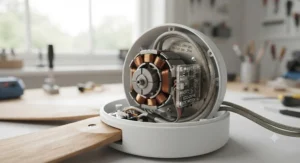
That definition matters because “eco-friendly” gets slapped on all sorts of household products without much behind it. With ceiling fans, though, there’s a real engineering distinction: DC motors use permanent magnets and electronic commutation rather than the wound copper coils in AC motors, and that difference is precisely why a DC fan on its lowest setting can sip as little as 3-6 watts while an equivalent AC fan idles closer to 30-40 watts for the same gentle breeze.
How to Choose an Eco-Friendly Ceiling Fan
- Measure your room, not just the fan — a 132cm fan in a 12m² bedroom will feel oversized and noisy on higher speeds; match diameter to floor area first.
- Check the motor type explicitly — “DC motor” should appear clearly in the listing; some budget fans still use AC motors dressed up in modern styling.
- Look for a published airflow-power ratio — figures like (m³/min)/W tell you more about genuine efficiency than wattage alone.
- Confirm the energy efficiency class where listed — UK and EU energy labels rate many comfort fans on an A-G style scale, giving a directly comparable efficiency snapshot.
- Factor in noise level, not just decibels on paper — manufacturer dB figures are measured under lab conditions, so treat them as comparative rather than absolute.
- Weigh the warranty against your budget — a longer motor warranty, like Fantasia’s decade-long cover, often justifies a higher upfront price over a fan’s lifetime.
- Check ceiling clearance and slope compatibility — older British homes frequently have sloped or lower ceilings that rule out certain models.
Sustainable Ceiling Fan vs Traditional AC Motor Fans
Calling something a sustainable ceiling fan isn’t just a nicer way of saying “cooling appliance” — it’s a specific claim about how the fan behaves electrically over its lifetime, and it’s worth interrogating rather than taking on faith.
| Factor | DC Motor (Sustainable) Fan | Traditional AC Motor Fan |
|---|---|---|
| Typical power draw | 3W-45W across speed range | 30W-90W across speed range |
| Speed settings | Usually 5-6, often stepless | Usually 3, fixed increments |
| Noise on low speed | Frequently under 30dB | Often 40dB or higher |
| Typical purchase price | Mid to premium | Budget to mid |
| Motor lifespan expectation | Longer, fewer moving parts to wear | Shorter under continuous use |
The gap in power draw is the headline figure, but the speed-setting difference matters just as much day to day: an AC fan jumping from “too gentle” to “too much” in three fixed steps forces compromises a DC fan’s finer control avoids entirely. Where AC fans still win is upfront price, which is exactly why models like Eglo’s more affordable AC-motor lines persist alongside DC ranges — but as Energy Saving Trust’s cooling guide notes, running costs for any type of domestic fan remain low compared with air conditioning, so the DC-versus-AC decision is really about long-term efficiency and noise rather than avoiding a “bad” purchase either way.
Green Ceiling Fan Options for Every Room
Not every room needs the same green ceiling fan options, and treating a bedroom and an open-plan kitchen-diner identically is one of the more common buying mistakes. For bedrooms, prioritise low decibel figures on the lowest speed settings — the Eglo Cirali 52 and MiniSun Newday both perform well here, since you’ll likely run them for hours while trying to sleep. For living rooms doing double duty as a light fitting, tunable white LED options like the Eglo Portsea earn their keep by replacing a separate ceiling light entirely.
Kitchens and bathrooms benefit from genuinely humidity-resistant finishes rather than standard painted metal — the Fantasia Viper Plus LED‘s stainless steel build is a deliberate choice for exactly this reason. Large or open-plan spaces need either a bigger domestic fan like the Fantasia Sirocco DC, or in genuinely oversized rooms, an industrial-grade option such as the Westinghouse Widespan. Matching fan to room isn’t just about aesthetics — an undersized fan working overtime on maximum speed can end up using nearly as much power as a correctly sized fan running comfortably in the middle of its range.
Understanding Carbon Footprint and the Energy Label
Every appliance sold in the UK that falls under scope carries some form of energy performance data, and comfort fans are explicitly named within the UK’s ecodesign and energy labelling regulations, which require suppliers to declare conformity and, where applicable, display a rated energy efficiency class. In practice this means genuine DC ceiling fans, like the Eglo Portsea’s confirmed Class E rating referenced earlier in this guide, come with a verifiable efficiency figure rather than a vague “eco” claim.
The carbon footprint angle follows directly from that electricity figure. UK Government data cited by the Energy Saving Trust shows day-to-day home appliances account for roughly a quarter of an average household’s CO2 emissions, and swapping a handful of high-draw appliances for efficient equivalents is one of the more accessible ways to reduce your carbon footprint without major building work. A single ceiling fan won’t transform a household’s emissions on its own — running an efficient DC fan for a typical British summer realistically saves a few kilograms of CO2 compared with an AC equivalent — but it’s a genuinely honest, low-effort contribution rather than a token gesture, and it compounds nicely alongside LED lighting and smart heating controls.

Practical Usage Guide: Setup, Care and Optimisation
Getting the most from an eco-friendly ceiling fan starts before installation. Confirm your ceiling box can bear the fan’s weight — most DC fans in this list weigh 6-8kg, lighter than older AC equivalents, but always check the manufacturer’s fixing guidance rather than assuming a standard light rose will do. If your ceiling slopes, verify the model’s maximum slope rating; several fans on this list, including the Eglo Portsea, are rated up to 13 degrees, but exceeding that risks wobble and premature bearing wear.
Once installed, the single biggest optimisation trick is counter-intuitive: run the fan on a lower speed for longer rather than maximum speed in short bursts. DC motors are most efficient in their mid-range, and a gentle, continuous airflow generally feels more comfortable than intermittent gusts. In winter, switch the reverse function on — running the blades clockwise at low speed pushes warm air trapped near the ceiling back down into the room, genuinely reducing heating reliance in high-ceilinged rooms.
Common first-30-days mistakes include forgetting to balance the blades if a slight wobble appears (most kits include small weights for exactly this), and leaving fans running in empty rooms out of habit — a fan cools people, not spaces, so it offers no benefit once nobody’s there to feel the breeze. For maintenance, a light dust of the blades every few weeks keeps airflow efficient, since a heavy dust build-up genuinely reduces how much air the same motor can move.
Real-World Scenarios: Matching the Fan to Your Home
Consider a young professional renting a one-bedroom flat in Manchester, keen to cool the bedroom through summer without upsetting a landlord with drilling or major changes. The MiniSun Newday suits this scenario precisely: modest size, straightforward fitting, and a price that doesn’t sting if a future move means leaving it behind.
Now picture a family in a knocked-through Victorian terrace in Bristol, where the kitchen-diner spans nearly 30m². A single small fan simply can’t move enough air across that space, so the Fantasia Sirocco DC or even the Westinghouse Widespan, depending on ceiling height, becomes the sensible choice — sized correctly, either will out-cool three smaller fans working overtime, and for considerably less combined electricity.
Finally, imagine a couple who’ve just converted their loft into a home office and bedroom in Surrey, with condensation issues from the en-suite shower room next door. The Fantasia Viper Plus LED‘s stainless steel build directly addresses that humidity concern, while its reverse function helps manage the notoriously variable temperature swings loft conversions are known for.
Common Problems and Solutions
Problem: the fan wobbles on higher speeds. This is almost always a balance issue rather than a fault — use the balancing kit most fans include, or a spirit-level app, to identify and weight the offending blade.
Problem: the remote stops responding intermittently. Nine times out of ten this is a battery or signal interference issue rather than a receiver fault; replace batteries first, and check for nearby wireless routers or baby monitors on similar frequencies.
Problem: the room still feels warm despite the fan running. Fans move air rather than actively cooling it, so on very hot, still days, pair the fan with an open window or cross-ventilation for genuine temperature drop rather than just perceived cooling.
Problem: higher-than-expected electricity use. Double-check the fan is genuinely running on DC settings and not stuck on a maximum-speed default; also confirm the light kit, if fitted, isn’t left on unnecessarily, since LED wattage adds to the total draw.
Problem: fan feels underpowered for the room. This usually traces back to sizing — a 107cm fan asked to cool a 25m² open-plan space will always struggle, regardless of how efficient its motor is.
Long-Term Cost & Maintenance: The ROI of Going DC
The upfront price gap between a budget AC fan and a premium DC model is real, but it narrows considerably once you factor in years of running costs. Based on typical UK electricity pricing, a DC fan running eight hours a day through a warm summer costs meaningfully less annually than an AC equivalent doing the same job — and that gap widens every year the fan stays in use.
| Fan Tier | Typical Motor Draw | Estimated Daily Cost (8hrs, mid speed) | Estimated Annual Cost (90 summer days) |
|---|---|---|---|
| Budget DC (MiniSun Newday) | ~15W average | Roughly 3p | Roughly £2.70 |
| Mid-range DC (Eglo Cirali 52) | ~16-20W average | Roughly 4p | Roughly £3.60 |
| Premium DC (Fantasia Sirocco DC) | ~25-30W average | Roughly 6-7p | Roughly £5.40-£6.30 |
These figures are illustrative estimates based on typical UK unit rates rather than fixed guarantees, since actual cost depends on your tariff and exact usage pattern — but even the premium tier barely dents a household budget across a full summer. The real long-term cost consideration isn’t electricity at all; it’s motor longevity and warranty cover, which is precisely why Fantasia’s 10-year motor guarantee on models like the Zeta and Sirocco genuinely changes the total cost of ownership calculation over a decade compared with a cheaper fan that might need replacing twice in that time.
Best Eco Fan 2026: Features That Actually Matter (and Those That Don’t)
Marketing copy around ceiling fans loves to pile on features, but not all of them earn their keep. Features that genuinely matter: a confirmed DC motor with a published airflow-power ratio, a reverse function for winter use, and a warranty length that reflects real confidence in the motor’s longevity. These three consistently separate a best eco fan 2026 buyers will still be happy with from one they’ll be replacing by 2028.
Features that matter less than the marketing suggests: app connectivity, for one — genuinely convenient for some households, but it adds cost and a second thing that can fail without improving the fan’s actual cooling or efficiency. Excessive speed counts fall into a similar bucket; the practical difference between six speeds and twelve is minimal once you’ve found your preferred setting, which most people do within the first week and rarely change again. Similarly, ultra-bright integrated lighting sounds appealing on the box, but if a room already has adequate lighting, that extra LED wattage is pure overhead rather than genuine value.
Sustainable Living: Small Swaps That Add Up
A single ceiling fan is a modest piece of a much bigger sustainable living picture, and it’s worth being honest about that rather than overselling one purchase. Where it genuinely helps is as a low-friction entry point: unlike insulation upgrades or heat pump installations, swapping a fan is a same-afternoon job that immediately starts reducing both electricity use and, during cooler months with the reverse function engaged, heating reliance too.
The broader logic scales well beyond fans. Pairing an efficient DC fan with LED lighting throughout the same rooms, and being mindful of appliance standby power, stacks small, achievable changes into a genuinely lower household footprint over a year — exactly the incremental approach most UK sustainability guidance recommends over chasing one dramatic fix. None of it requires perfection; it just requires choosing the more efficient option each time a genuine choice exists, and an eco-friendly ceiling fan happens to be one of the easier choices to get right.

FAQ
❓ Is a ceiling fan more efficient than air conditioning in the UK?
❓ How much does an eco-friendly ceiling fan cost to run per year?
❓ What's the difference between a DC and AC ceiling fan motor?
❓ Do eco-friendly ceiling fans work well in winter?
❓ What size ceiling fan do I need for my room?
Conclusion
Choosing an eco-friendly ceiling fan really comes down to three honest questions: how big is the room, how much are you willing to spend upfront for long-term savings and warranty cover, and how much do noise and finish quality matter to you day to day. The MiniSun Newday answers those questions well for renters and small rooms; the Eglo Cirali 52 delivers the strongest efficiency-per-pound for mid-size living spaces; and Fantasia’s range, from the Zeta DC through to the Sirocco DC and Viper Plus LED, rewards buyers thinking in decades rather than summers. For genuinely oversized spaces, the Westinghouse Widespan remains the only fan on this list actually built for the job.
Every model here shares the same underlying commitment: a brushless DC motor doing real, measurable work to cut electricity use without asking you to sacrifice airflow, style, or reliability. That’s what separates a genuinely sustainable ceiling fan from one that’s just wearing the label. Whichever size and finish suits your home, check current prices before buying — availability and offers on these models shift regularly across UK retailers.
Recommended for You
- Inverter Ceiling Fan: 7 Best Quiet Picks for UK Homes (2026)
- Variable Speed DC Ceiling Fan: 7 Best UK Picks (2026)
- BLDC Ceiling Fan: 7 Best Picks for Quiet UK Homes (2026)
Disclaimer: This article contains affiliate links. As an Amazon Associate, I earn from qualifying purchases. If you purchase products through these links, we may earn a small commission at no additional cost to you.
✨ Found this helpful? Share it with your friends! 💬🤗
