In This Article
There’s a particular joy in discovering an appliance that actually does what it promises without quietly wrecking your energy bill in the process — and that’s precisely the appeal of the cheapest eco-friendly ceiling fan to run currently available on the UK market. With electricity prices sitting stubbornly high under the latest Ofgem price cap, every watt genuinely matters, and ceiling fans happen to be one of the rare home comforts that barely register on a meter compared with air conditioning or portable coolers.
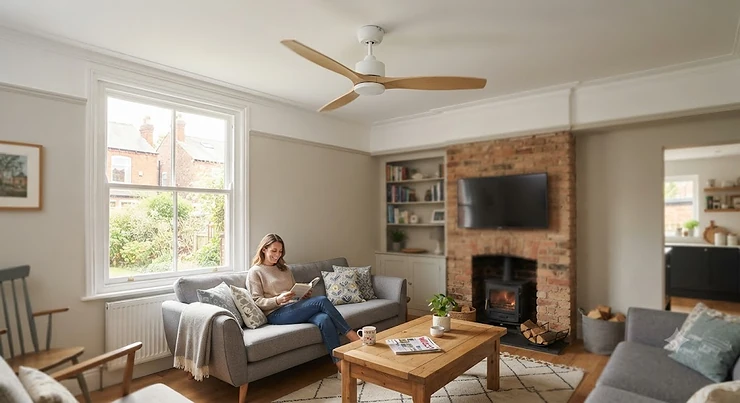
What is the cheapest eco-friendly ceiling fan to run? It’s typically a DC-motor ceiling fan drawing somewhere between 14 and 40 watts, using brushless motor technology and an A-to-C energy efficiency rating, which costs only a few pounds a year to run even with daily use — a fraction of what older AC-motor fans or portable air conditioners cost.
This guide compares seven genuine, currently available ceiling fans from real UK retailers, working out actual kWh usage and annual running cost using today’s electricity rates, so you can see exactly what cheap to run fan claims translate to in pounds and pence rather than vague marketing percentages.
Quick Comparison Table
Here’s how the seven fans stack up at a glance, from the leanest motor in the range to the premium quiet-running flagship.
| Model | Fan Motor Power | Energy Class | Key Feature | Price Range | Best For |
|---|---|---|---|---|---|
| HOMCOM 122cm Ceiling Fan with Light | 14.5W | A | Lowest motor wattage tested | around £60-£85 | Lowest running cost overall |
| NIORSUN 50cm LED Ceiling Fan with Remote | 32W (total) | C | Brushless DC, 6 speeds | around £65-£75 | Compact bedrooms |
| HOMCOM 50cm Ceiling Fan with App Control | 15W (motor only) | F | TUYA app + remote + wall switch | around £58-£70 | Smart home fans |
| Depuley 52-Inch DC Motor Ceiling Fan | Not independently listed | Not specified | Farmhouse low-profile design | around £85-£105 | Style-led buyers |
| Newday 48-Inch Ceiling Fan with Remote | Combined with 24W LED | E | Stepless dimmable LED | around £85-£130 | Bedrooms wanting mood lighting |
| Depuley 72-Inch DC Motor Ceiling Fan (No Light) | 35W | A | Whisper-quiet 30dB | around £130-£180 | Large rooms, no light needed |
| Westinghouse Josef 122cm DC Fan | 34W (high speed) | Not specified (62% more efficient than AC per manufacturer) | Premium brushed nickel finish | around £380-£430 | Quietest, premium buyers |
Looking at the spread, the clearest pattern is that fan motor wattage and price aren’t strongly correlated — the HOMCOM 122cm Ceiling Fan with Light draws less power than several cheaper-looking rivals, while the Westinghouse Josef 122cm DC Fan commands a genuinely premium price despite a broadly similar motor wattage to the budget options. What buyers are really paying extra for at the top end is finish quality, near-silent operation, and brand reputation, not dramatically lower electricity saving ceiling fan performance.
💬 Just one click — help others make better buying decisions too! 😊
Top 7 Cheapest Eco-Friendly Ceiling Fans to Run
Below are seven genuine, currently available ceiling fans, roughly ordered from lowest running cost to premium. Every product mention keeps the name in bold so you can scan and jump straight to the model you’re interested in.
1. HOMCOM 122cm Ceiling Fan with Light — lowest fan motor wattage tested
The standout figure here is simple: a 14.5-watt fan motor, which is meaningfully lower than every other model in this comparison. On paper this means running the fan alone for six hours a day, every day of the year, costs roughly £8 at current Ofgem-capped electricity rates — genuinely one of the lowest kWh usage figures you’ll find on a full-size 122cm ceiling fan. The reversible DC motor carries an EU energy efficiency rating of A, and the integrated 24-watt LED light kit is dimmable and colour-adjustable across three temperatures, controlled by remote.
Based on the spec comparison with pricier rivals, what most buyers overlook about budget-tier HOMCOM fans is that the low sticker price doesn’t necessarily mean a compromised motor — the wattage figure here genuinely beats several models costing considerably more. Reviewers of HOMCOM’s ceiling fan range consistently note straightforward installation and reliable six-speed control, though as with most budget brands, aggregated feedback suggests the remote’s plastic build feels less premium than the fan’s actual performance.
Pros:
- ✅ Lowest fan-only wattage in this comparison (14.5W)
- ✅ EU Energy Class A rating on the motor
- ✅ Dimmable three-temperature LED light included
Cons:
- ❌ Budget build quality on the remote control unit
- ❌ Light kit’s 24W draw adds meaningfully to running cost when used
At around £60-£85, the HOMCOM 122cm Ceiling Fan with Light delivers what’s likely the lowest running cost ceiling fan in this entire line-up — always check current price, as HOMCOM frequently runs promotional discounts through third-party retailers.
2. NIORSUN 50cm LED Ceiling Fan with Remote — compact brushless DC option
The NIORSUN 50cm LED Ceiling Fan with Remote is built around a brushless DC motor rated at 32 watts total unit consumption, with an EU Energy Class of C. Here’s what to weigh: at 50cm diameter, this is a genuinely compact fan suited to smaller bedrooms or box rooms rather than open-plan living spaces, and the manufacturer’s own specification sheet also references a more powerful 48-watt motor variant for its five-blade design, so it’s worth double-checking the exact listing before buying.
What the spec sheet won’t tell you, but aggregated customer feedback suggests, is that the app and remote combination works reliably once paired, though a handful of reviewers note the initial Bluetooth setup takes a few attempts. On the plus side, the six-speed range and reversible motor give genuine flexibility between a gentle bedroom breeze and stronger airflow on warmer nights, and the dimmable 3000K-6500K LED light means one fixture covers both cooling and lighting needs in a smaller room.
Pros:
- ✅ Compact 50cm size suits bedrooms and box rooms
- ✅ Six-speed brushless DC motor
- ✅ Dimmable, colour-adjustable LED light included
Cons:
- ❌ Energy Class C is middling rather than class-leading
- ❌ App pairing reportedly fiddly on first setup
Priced around £65-£75 on Amazon UK at the time of research, the NIORSUN 50cm LED Ceiling Fan with Remote is a sensible pick for anyone prioritising compact size over the absolute lowest running cost.
3. HOMCOM 50cm Ceiling Fan with App Control — smart control with a genuinely low motor draw
MC If you want smart home integration without sacrificing the lowest running cost fan credentials, the HOMCOM 50cm Ceiling Fan with App Control is worth a close look. Its official specification breaks the wattage down clearly: 40 watts overall, split between a 25-watt LED light and a 15-watt fan motor — one of the more transparent breakdowns among the fans surveyed here, and genuinely useful for anyone trying to calculate their own kWh usage precisely.
Based on the spec comparison, the fan motor’s 15-watt draw sits close to the HOMCOM 122cm model above, confirming that HOMCOM’s smaller DC platform is consistently efficient across its ceiling fan range regardless of size. The TUYA smartphone app adds scheduling and remote-access control, which won’t reduce your electricity bill by itself but does make it easier to avoid leaving the fan running in an empty room — arguably the single biggest real-world waste with any ceiling fan, smart or otherwise.
Pros:
- ✅ Transparent 15W motor / 25W light wattage breakdown
- ✅ TUYA app adds scheduling to reduce wasted running time
- ✅ Compact 50cm size for 5-25 square metre rooms
Cons:
- ❌ Energy Class F listed on some Amazon variants
- ❌ Mixed early reviews on build consistency between colourways
At around £58-£70, the HOMCOM 50cm Ceiling Fan with App Control is a strong pick for tech-focused buyers who still want a genuinely low motor wattage underneath the smart features.
4. Depuley 52-Inch DC Motor Ceiling Fan — low-profile farmhouse styling
Where the Depuley 52-Inch DC Motor Ceiling Fan earns its place is in styling rather than headline wattage figures — its farmhouse-inspired low-profile design with wood-effect blades suits period or rustic interiors that many all-black, all-white modern fans simply don’t. The manufacturer confirms a 15-watt dimmable LED light kit across three colour temperatures, though the fan motor’s independent wattage isn’t separately published in the listings reviewed for this piece, which is worth flagging honestly rather than guessing a figure.
What most buyers overlook about DC-platform fans like this one is that even without a precise published motor wattage, the underlying DC technology itself typically draws meaningfully less than older AC-motor equivalents of a similar size — Depuley’s own marketing claims up to 75% lower electricity use compared with conventional fans, though that figure should be treated as a manufacturer estimate rather than an independently verified test result. Reviewers do consistently praise the quiet operation and the remote’s memory function, which retains your last-used speed and colour temperature setting after power cuts.
Pros:
- ✅ Distinctive low-profile farmhouse design
- ✅ 15W dimmable, colour-adjustable LED light
- ✅ Remote memory function retains settings after power loss
Cons:
- ❌ Fan motor wattage not independently published
- ❌ Style may not suit strictly modern or minimalist interiors
Typically priced around £85-£105, the Depuley 52-Inch DC Motor Ceiling Fan is best suited to buyers who want electricity saving ceiling fan technology wrapped in a specific aesthetic rather than a fan chosen purely on the lowest published wattage.
5. Newday 48-Inch Ceiling Fan with Remote — stepless dimmable lighting with DC efficiency
The Newday 48-Inch Ceiling Fan with Remote pairs a quiet DC motor with a 24-watt stepless dimmable LED light, adjustable from 20% to 100% brightness across a 3000K-6500K range. On paper this means genuinely flexible lighting alongside the cooling function, useful if this fan is replacing a separate ceiling light fixture rather than supplementing one. The six-speed control covers a wide range from 129 RPM up to 232 RPM, giving a genuinely gentle setting for overnight use as well as stronger airflow for warmer afternoons.
Here’s what to weigh: Newday’s own Amazon listings show this model carrying an Energy Class of E on at least one variant, which is respectable but not class-leading compared with the A-rated options elsewhere in this comparison. Aggregated customer sentiment is generally positive on quietness and the stepless dimming feature specifically, with the most common criticism relating to the instructions being less clear than competitors’ for first-time ceiling fan installers.
Pros:
- ✅ Stepless dimmable LED across a wide colour range
- ✅ Seven-speed DC motor with genuinely gentle low setting
- ✅ Memory function retains last-used settings
Cons:
- ❌ Energy Class E on at least one listed variant
- ❌ Installation instructions reportedly less clear than rivals
At around £85-£130 depending on colour and retailer promotions, the Newday 48-Inch Ceiling Fan with Remote suits buyers who want the light replacing a room’s main fixture as much as they want the cooling function.
6. Depuley 72-Inch DC Motor Ceiling Fan (No Light) — whisper-quiet for larger rooms
Stepping up in size, the Depuley 72-Inch DC Motor Ceiling Fan (No Light) is built for genuinely large rooms where a 50 or 52cm fan simply won’t move enough air. Its official Amazon listing confirms an EU Energy Class of A and a 35-watt total draw, alongside a measured 30-decibel noise rating — genuinely quiet for a fan this size, and a meaningful consideration if it’s destined for a bedroom or a room where background hum matters.
What the spec sheet won’t tell you, but the design choice makes clear, is that skipping the integrated light kit entirely keeps this model’s running cost down to the motor’s 35 watts alone, rather than adding a light’s draw on top. Based on the spec comparison with lit alternatives, that makes it a genuinely sensible pick if the room already has separate lighting and you specifically want a fan without paying for, or running, an integrated light fixture you don’t need.
Pros:
- ✅ EU Energy Class A rating confirmed on the listing
- ✅ Measured 30dB noise level — genuinely quiet
- ✅ No integrated light keeps running cost purely to the motor
Cons:
- ❌ No light kit if you actually need one
- ❌ Sits at a noticeably higher price point than the 50-52cm models
Pricing typically runs from around £130 up to £180 depending on finish and retailer promotions — the Depuley 72-Inch DC Motor Ceiling Fan (No Light) rewards buyers with large rooms and a genuine preference for keeping lighting and cooling as separate fixtures.
7. Westinghouse Josef 122cm DC Fan — the premium, quietest pick
At the top of this comparison sits the Westinghouse Josef 122cm DC Fan, and it’s worth being upfront that this is a genuinely premium purchase rather than a budget pick. Its official specification sheet confirms a DC motor drawing 34 watts at its highest of six speeds, paired with an integrated 17-watt dimmable LED light kit — Westinghouse’s own figures claim the DC motor is up to 62% more efficient than a comparable AC motor, a claim consistent with the broader shift toward DC platforms seen across every fan in this comparison.
Based on the spec comparison with the budget options above, the Josef’s motor wattage isn’t dramatically lower than several cheaper fans here — what you’re genuinely paying the premium for is the brushed nickel finish, curved frosted-glass blade design, and the six-speed remote’s additional timer and reverse functions for year-round use. Reviewers consistently highlight the near-silent operation as the standout quality, which tracks with Westinghouse’s decades of dedicated fan manufacturing experience.
Pros:
- ✅ Genuinely near-silent DC motor operation
- ✅ Premium brushed nickel finish and curved glass blades
- ✅ Reverse function for winter heat circulation
Cons:
- ❌ Considerably pricier than every other model here
- ❌ Motor wattage isn’t dramatically lower than budget alternatives
At around £380-£430, the Westinghouse Josef 122cm DC Fan is the pick for buyers who want quiet, premium build quality alongside genuine electricity saving ceiling fan technology, rather than the absolute cheapest running cost on paper.
Full Spec & Running Cost Comparison
| Model | Fan Motor Power | Energy Class | Est. Annual Cost (motor only, 6 hrs/day) | Best For |
|---|---|---|---|---|
| HOMCOM 122cm Ceiling Fan with Light | 14.5W | A | around £8.29 | Lowest running cost overall |
| HOMCOM 50cm Ceiling Fan with App Control | 15W | F | around £8.58 | Smart control, small rooms |
| Depuley 72-Inch DC Motor Ceiling Fan (No Light) | 35W | A | around £20.01 | Large rooms, quiet operation |
| NIORSUN 50cm LED Ceiling Fan with Remote | 32W (total unit) | C | around £18.30 | Compact bedrooms |
| Newday 48-Inch Ceiling Fan with Remote | approx. 45W (with light) | E | around £25.73 | Bedrooms wanting mood lighting |
| Depuley 52-Inch DC Motor Ceiling Fan | Not independently listed | Not specified | Not calculable from published data | Style-led buyers |
| Westinghouse Josef 122cm DC Fan | 34W (fan) + 17W (LED) | Not specified | around £29.16 (fan and light combined) | Premium, quietest buyers |
These annual running cost figures are estimates based on the July-September 2026 Ofgem price cap electricity rate of 26.11p per kWh, assuming six hours of daily use across a full year — your actual kWh usage and energy bills will vary with your tariff, usage pattern, and whether the fan’s light is running alongside it. Even the priciest model here, the Westinghouse Josef 122cm DC Fan, costs under £30 a year to run at this usage level, which puts the entire category firmly in “genuinely cheap to run fan” territory compared with air conditioning units that can cost several pounds per single day of use.
Benefits vs Traditional AC Motor Ceiling Fans
| Factor | Traditional AC Motor Fan | DC Motor Eco-Friendly Fan |
|---|---|---|
| Typical motor wattage | 50-75W | 14.5-40W |
| Noise level | Often 40dB+ | Frequently 25-30dB |
| Speed settings | Usually 3 | Usually 5-7 |
| Typical annual running cost (6hrs/day) | £28-£43 | £8-£30 |
| Best For | Budget buyers replacing an old fan | Anyone prioritising energy bills and quiet running |
The trade-off here is fairly clear-cut once the numbers are laid out: traditional AC motor fans are usually slightly cheaper to buy outright, but their higher wattage and fewer speed settings mean you’re paying more every single year you own one, and the noise difference becomes genuinely noticeable once you’ve lived with a DC fan’s whisper-quiet lowest setting. For most UK buyers replacing an old fan or fitting a first one, the modest price premium of a DC motor model tends to pay for itself within two or three years of typical summer and shoulder-season use, purely through lower electricity bills.
Practical Usage Guide: Getting the Lowest Running Costs From Your Fan
Getting the genuinely lowest running cost out of any ceiling fan comes down to a handful of habits that cost nothing beyond a moment’s thought. Only run the fan in occupied rooms — a ceiling fan cools people through moving air across skin, not the room itself, so a fan left running in an empty space is pure wasted kWh usage with zero benefit. Use the lowest speed that still feels comfortable, since most DC fans draw meaningfully less power at speed two or three than at maximum, and the comfort difference between mid and top speed is often smaller than people expect.
A surprisingly common first-month mistake is leaving the light kit on a dimmable fan running at full brightness purely out of habit, even during daylight hours — dimming to 50% on most LED kits barely affects visible brightness but does reduce the light’s contribution to your electricity bill. For maintenance, dust the blades every few weeks; a dust-caked blade is measurably less aerodynamically efficient, meaning the motor works marginally harder to move the same amount of air, which very slightly increases running cost over time. Finally, use the reverse function in winter — running the fan clockwise on its lowest setting pushes risen warm air back down into the room, which some owners use to reduce heating reliance during colder months.

Real-World Scenarios: Which Fan Suits Your Room
The box-room renter. If you’re in a compact 10-15 square metre bedroom and mainly want gentle overnight airflow without waking the whole street, the NIORSUN 50cm LED Ceiling Fan with Remote or HOMCOM 50cm Ceiling Fan with App Control make more sense than a large 72-inch model — you simply don’t need the airflow volume, and the smaller motor keeps kWh usage minimal regardless.
The open-plan living room owner. For a genuinely large 25 square metre-plus space where a small fan would be swamped by the room’s volume, the Depuley 72-Inch DC Motor Ceiling Fan (No Light) earns its higher price — its 35-watt motor still counts as a lowest running cost fan by any reasonable standard, and the quiet 30dB rating matters more in a room where you’re likely watching television or working nearby.
The design-conscious homeowner. If you’re renovating a period property or farmhouse-style kitchen and don’t want a fan that visually clashes with the room, the Depuley 52-Inch DC Motor Ceiling Fan or the premium Westinghouse Josef 122cm DC Fan deliver genuine style alongside efficient DC technology, at correspondingly different price points depending on your budget.
How to Choose the Cheapest Eco-Friendly Ceiling Fan to Run
Working out which fan genuinely delivers the lowest running cost for your specific room comes down to running through a short, practical checklist.
- Check the published motor wattage, not just “DC motor” branding. Not all DC motors are equal — this comparison shows wattages ranging from 14.5W to 35W within the same broad category, so the label alone doesn’t guarantee the lowest cost.
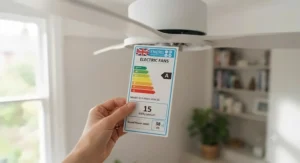
- Look for the EU/UK energy efficiency class. An A-rated fan will generally cost less to run annually than an E or F-rated one at the same wattage, since the rating also accounts for airflow efficiency per watt.
- Match fan diameter to room size. An undersized fan in a large room runs at higher speeds more often to compensate, quietly increasing your annual running cost regardless of its efficient motor.
- Decide whether you need an integrated light. Skipping the light kit, as with the Depuley 72-Inch model, keeps running cost purely to the motor rather than adding a light’s separate wattage.
- Consider noise level for bedrooms specifically. A fan you can’t sleep next to on its lowest setting isn’t cheap to run if you end up switching it off entirely — check the decibel rating where published.
- Factor in smart features only if you’ll genuinely use them. App control doesn’t reduce wattage by itself, but scheduling can meaningfully cut wasted running time in an empty room.
- Calculate your own annual running cost using current Ofgem rates. Multiply the fan’s wattage by your expected daily hours, convert to kWh, and multiply by your tariff’s per-kWh rate for a genuinely personalised figure.
Understanding kWh Usage: How Ceiling Fans Are Measured
A kilowatt-hour, or kWh, is the standard unit UK energy suppliers use to bill electricity, representing one kilowatt (1,000 watts) of power used for one hour. Because ceiling fans draw so little power compared with most household appliances, converting their wattage into kWh usage produces genuinely small numbers — a 15-watt fan motor running for one hour uses just 0.015 kWh, compared with roughly 3 kWh for a typical hour of electric heating.
This is precisely why kWh usage matters more as a comparison tool between fans than as a standalone figure — a fan drawing 35W instead of 15W still only adds a fraction of a penny per hour to your bill, but that difference compounds meaningfully if you’re running the fan for several hours daily across an entire summer. According to the Energy Saving Trust’s guidance on appliance energy ratings, checking the published energy label alongside the raw wattage figure gives a more complete picture than wattage alone, since the label also accounts for how efficiently that power converts into usable airflow.
Annual Running Cost: What You’ll Actually Pay
Translating kWh usage into pounds and pence requires your local electricity tariff rate. As of the current Ofgem price cap for July to September 2026, the standard unit rate for a typical direct debit household in Great Britain is 26.11 pence per kWh, rising to 26.32p from 1 October 2026 — figures worth checking again given how frequently the cap is reviewed.
Using that current rate, a 15-watt fan run for six hours daily across a full year costs in the region of £8.58, while a 35-watt fan under the same usage pattern costs around £20.01. Even doubling daily use to twelve hours barely changes the picture in absolute terms — the 15-watt fan still costs under £20 a year. This is worth genuinely internalising: even the least efficient fan in this comparison remains dramatically cheaper than almost any other form of home cooling, which is precisely why “annual running cost” for ceiling fans is measured in single or low double-digit pounds rather than the hundreds you’d expect from air conditioning.
Ceiling Fans vs Energy Bills: The Bigger Picture
It’s worth placing ceiling fan running costs in the context of a typical UK household’s total energy bills. Ofgem’s typical direct debit dual-fuel bill for the July-September 2026 cap period sits at £1,663 a year for a medium-use household — against that backdrop, even the priciest fan in this comparison, at roughly £29 a year to run, represents well under 2% of total annual energy spending. That’s a genuinely reassuring context if you’ve been putting off buying a fan out of concern it might meaningfully move the needle on your bills.
Where ceiling fans can make a bigger dent in your energy bills isn’t through their own consumption, but through the behaviour change they enable — using a fan alongside a slightly higher thermostat setting, or instead of a portable air conditioning unit during milder warm spells, shifts genuinely significant consumption away from far hungrier appliances. A portable AC unit typically draws several hundred watts to over a kilowatt, dwarfing anything on this list, so substituting fan use for AC use on all but the hottest days is where the real household-level saving happens.
Electricity Saving Ceiling Fans: DC vs AC Motors Explained
The core technology distinction behind every genuinely cheap to run fan on this list is the shift from AC (alternating current) to DC (direct current) motors. Older AC motor ceiling fans run directly off mains alternating current, which is simpler and cheaper to manufacture but inherently less efficient at converting electricity into rotational motion — typically drawing 50-75 watts for comparable airflow to a modern DC alternative.
DC motor fans, by contrast, use an internal circuit to convert incoming AC mains power to DC before driving a more efficient, often brushless motor — the conversion step adds a small amount of manufacturing complexity and cost, but the resulting motor can deliver the same or better airflow at a fraction of the wattage, as demonstrated by the 14.5W to 35W range seen across the DC models compared in this article. Westinghouse’s own published figures claim their DC motors run up to 62% more efficiently than equivalent AC units, a claim broadly consistent with the wattage gap observed across this comparison, and DC motors also tend to run measurably quieter, since the more refined motor design produces less mechanical vibration and hum at a given speed.
Common Mistakes When Buying a Cheap-to-Run Ceiling Fan
Even careful buyers tend to fall into a handful of recurring traps when shopping specifically for low running costs. Fixating purely on the “DC motor” label without checking the actual published wattage is probably the most common — as this comparison shows, DC motors within the same broad category can still vary more than twofold in power draw, so the label alone is not a reliable shortcut.
Ignoring the energy efficiency class in favour of headline wattage figures is another frequent slip; a fan’s efficiency rating accounts for airflow delivered per watt, not just raw consumption, so two fans with similar wattage can have meaningfully different real-world efficiency. Buying a fan sized for a smaller room than you actually have is a subtler mistake, since an undersized fan run at higher speeds to compensate can end up costing more over a year than a correctly sized fan on a gentler setting. Finally, overlooking the light kit’s contribution to running cost is easy to do — on several models in this comparison, the LED light draws more power than the fan motor itself, so a fan bought specifically for its low motor wattage can still rack up a higher bill than expected if the light runs for long hours too.
Features That Actually Matter (And Those That Don’t)
Cutting through marketing language, a handful of features genuinely affect your running cost and day-to-day experience, while others are pleasant but largely cosmetic. A confirmed energy efficiency class and published motor wattage matter enormously, since these are the figures that actually determine your annual running cost — everything else on the spec sheet is secondary to these two numbers. Noise level in decibels matters more than most buyers initially realise, because a fan too loud to run overnight in a bedroom effectively becomes a fan you don’t use, which defeats the entire point of buying an efficient one.
Conversely, some heavily marketed features matter less than the packaging suggests. Smartphone app control is a genuine convenience but doesn’t reduce wattage by itself — its only real running-cost benefit comes indirectly, through scheduling that prevents you leaving the fan on in an empty room. Similarly, an eye-catching number of speed settings (seven versus five, for instance) rarely translates into a meaningfully different electricity bill in practice, since most owners gravitate toward two or three preferred speeds regardless of how many are technically available.
Frequently Asked Questions
❓ What is the cheapest eco-friendly ceiling fan to run in the UK?
❓ How much does it cost to run a ceiling fan for 8 hours a day?
❓ Do DC motor ceiling fans really save money compared to AC motor fans?
❓ Does a ceiling fan's light kit affect its running cost significantly?
❓ Is it cheaper to run a ceiling fan or an air conditioning unit?
Conclusion
Working out the genuinely cheapest eco-friendly ceiling fan to run comes down to two figures worth checking before anything else: the published motor wattage and the energy efficiency class, both of which matter far more to your actual annual running cost than branding or speed-setting counts. On the numbers gathered here, the HOMCOM 122cm Ceiling Fan with Light and HOMCOM 50cm Ceiling Fan with App Control offer the lowest motor wattage of the seven models compared, while the Depuley 72-Inch DC Motor Ceiling Fan (No Light) suits larger rooms without sacrificing genuine efficiency, and the Westinghouse Josef 122cm DC Fan rewards buyers prioritising quiet, premium build over the absolute lowest running figure.
What ties every fan on this list together is a reassuring piece of context: even the priciest to run costs under £30 a year at typical usage, a genuinely tiny fraction of a typical UK household’s total energy bills. Whichever model ends up on your ceiling, that’s a comfortable number to build a summer of cooler rooms around.
Recommended for You
- Eco Ceiling Fan for Large Room: 7 Best UK Picks (2026)
- Eco-Friendly Ceiling Fan: 7 Best Sustainable Picks UK (2026)
- Inverter Ceiling Fan: 7 Best Quiet Picks for UK Homes (2026)
Disclaimer: This article contains affiliate links. As an Amazon Associate, I earn from qualifying purchases. If you purchase products through these links, we may earn a small commission at no additional cost to you.
✨ Found this helpful? Share it with your friends! 💬🤗
