In This Article
Somewhere between the third stuffy August night and the first frosty morning of October, most of us have the same thought: wouldn’t it be nice if one appliance could sort out both problems? That’s the entire pitch behind a reversible ceiling fan, and it’s a genuinely clever one. Flip a switch, and the same set of blades that cooled your bedroom in June starts gently folding warm air back down from the ceiling in December.
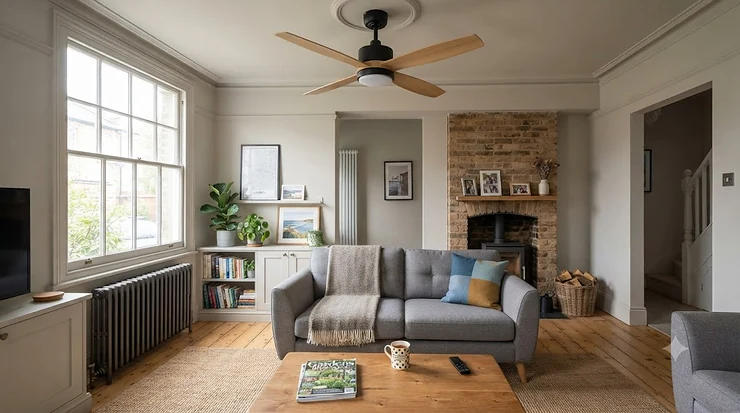
A reversible ceiling fan works by letting the motor spin the blades in either direction. Counterclockwise rotation pushes air straight down for a cooling breeze; clockwise rotation at low speed draws air upward at the centre and nudges the warm layer that collects near the ceiling back out towards the walls and down into the room. It’s a small mechanical trick with a surprisingly large effect on comfort and, as seasonal fan direction changes can reduce heating and cooling costs by up to 15%, easing the load on your heating system. Whether you’re weighing up a compact bedroom model or a statement piece for an open-plan living room, this guide breaks down seven real, currently available options, plus everything you need to actually get the airflow direction right in both seasons.
Ceiling fans have been quietly doing this job since the late 19th century, and the basic engineering hasn’t changed much since — what has changed is how quiet, smart, and energy-efficient today’s models are.
Quick Comparison Table
Here’s the shortlist at a glance before we go deep on each one.
| Product | Blade Span | Motor Type | Control | Best For |
|---|---|---|---|---|
| CJOY 22 Inch Ceiling Fan | 22″ | DC Reversible | Remote | Small bedrooms, kids’ rooms |
| LMiSQ Smart Ceiling Fan | 50cm | DC Reversible | App + Remote | Budget smart-home fans |
| YUNLONG Chrome Ceiling Fan | Low profile | DC Reversible | Remote, 6-speed | Quiet flats and studies |
| VONLUCE 52 Inch Ceiling Fan | 52″ | DC Reversible | Remote, 6-speed | Large living rooms, farmhouse style |
| Ohniyou 52″ Low Profile Fan | 52″ | Quiet DC | App/Remote | Open-plan spaces, noise-sensitive rooms |
| NACATIN LED Ceiling Fan | Standard | DC Reversible | App + Remote | Tech-savvy households |
| Fantasia Belaire 42″ | 42″ | AC, pull-cord | 3-speed pull cord | Period homes, heritage buyers |
Looking across the table, the split is fairly clean: the CJOY and LMiSQ suit smaller rooms and tighter budgets, the VONLUCE and Ohniyou are built for bigger spaces where airflow volume matters most, and the Fantasia Belaire stands apart as the only traditional AC-motor pull-cord fan on the list — a deliberate choice for anyone who wants proven British engineering over app connectivity. None of these are toys; every one uses a genuinely reversible motor rather than a fixed-direction fan dressed up with “summer style” blades.
💬 Just one click — help others make better buying decisions too!😊
Top 7 Reversible Ceiling Fans: Expert Analysis
1. CJOY 22 Inch Ceiling Fan with Lights — best compact pick for small rooms
The CJOY is proof that a small fan doesn’t have to feel like an afterthought. Its 22-inch span is deliberately sized for box rooms, nurseries, and box-bedroom conversions where a 52-inch blade sweep would simply clip the wardrobe. Under the hood sits a DC reversible motor paired with five blades, dimmable tri-colour LED lighting, and quiet operation, all controllable via remote.
What that spec sheet means in practice: a DC motor sips far less power than the older AC units still knocking about in budget ranges, so running it overnight for a toddler who overheats easily won’t nudge your electricity bill much at all. Based on the spec comparison with similarly sized fans, the tri-colour dimmable LED is the standout feature here — you’re getting a genuine bedside reading light and a fan in one fixture, which matters when ceiling space and budget are both tight.
Reviewers consistently note that the light output is more than adequate for a small room, though a handful mention the remote’s button layout takes a session or two to memorise. At this size and price point, that’s a minor gripe rather than a dealbreaker.
Pros:
- ✅ Genuinely compact — fits box rooms and low ceilings
- ✅ DC motor keeps running costs low
- ✅ Dimmable tri-colour LED doubles as a proper light fixture
Cons:
- ❌ Limited airflow volume for anything beyond a small room
- ❌ Remote control layout isn’t the most intuitive at first
Priced around £45-£55, the CJOY sits firmly in impulse-buy territory for anyone kitting out a nursery or student room, and the value case is hard to argue with at that range.
2. LMiSQ Modern Smart Ceiling Fan — best budget smart-home fan
Smart home integration used to mean paying a premium; the LMiSQ is one of a wave of newer entrants pushing that price down. It’s a 50cm low-profile fan built for flush mounting on lower ceilings, with app control, scheduled timing, and six speeds baked in as standard, alongside dimmable LED lighting.
Here’s what most buyers overlook about app-controlled fans in this bracket: the value isn’t really the novelty of tapping your phone, it’s the scheduling. Set the LMiSQ to switch direction and power down automatically at sunrise and sunset, and you stop having to remember the manual flip every time the seasons turn — which, honestly, is the single biggest reason people forget to reverse their fan at all. The low-profile flush design also matters more than it sounds: older Victorian terraces and converted flats with sub-2.4m ceilings genuinely can’t accommodate a drop-rod fan safely.
Aggregated buyer sentiment on similar low-cost smart fans in this category flags the companion app as functional but occasionally slow to sync, particularly on older routers — a fair trade-off given the price.
Pros:
- ✅ Full app scheduling removes the “forgot to flip it” problem
- ✅ Low-profile design suits period properties with lower ceilings
- ✅ Six speeds gives fine control over airflow strength
Cons:
- ❌ App connectivity can lag on older Wi-Fi routers
- ❌ Six speeds is generous, but top speed isn’t the strongest in this list
Expect to pay somewhere in the £75-£90 range, which for genuine app scheduling and a low-profile mount is competitive.
3. YUNLONG Chrome Ceiling Fan with Remote — best for a dedicated summer/winter switch
Some fans bury the seasonal switch in a settings menu; the YUNLONG puts it front and centre with a dedicated 6-speed remote and an explicit Summer Winter Mode setting built into the control scheme, alongside a silent, dimmable, memory-function build in a chrome finish.
The chrome housing is a genuine style statement rather than filler — it reads as more premium than most fans in its price bracket and suits contemporary living rooms and studies where a matte black or white fan would look out of place. On the functional side, the memory function is what elevates this above cheaper reversible fans: it remembers your last speed and light setting after a power cut, so you’re not re-configuring everything every time the fuse box trips.
What most buyers overlook about “Summer Winter Mode” labelling specifically is that it’s really just a clearly marked reverse switch — but clarity matters more than it sounds when you’re half-asleep reaching for a remote in December. Reviewers repeatedly flag the low noise floor as the headline feature, useful for bedrooms and home offices where a rattling motor would be a dealbreaker.
Pros:
- ✅ Explicit, clearly labelled Summer/Winter switch on the remote
- ✅ Chrome finish gives a more premium look than the price suggests
- ✅ Memory function retains settings after power cuts
Cons:
- ❌ Chrome finish shows fingerprints and dust more than matte options
- ❌ Not the largest blade span for bigger open-plan rooms
At around £70-£80, the YUNLONG is a strong mid-range pick specifically for anyone who wants the seasonal switch to be obvious rather than buried.
4. VONLUCE 52 Inch Ceiling Fan — best for large living rooms
Bigger rooms need bigger blade sweeps, and the VONLUCE is built for exactly that. It’s a 52-inch, 5-blade fan with a reversible DC motor and six speeds, available in a black rustic-brown farmhouse finish that leans into the popular wood-tone interiors trend rather than fighting it.
The 52-inch span matters more than it might seem on a spec sheet: airflow volume scales roughly with the square of blade radius, so a 52-inch fan can move noticeably more air per rotation than a 42-inch model running at the same speed — which is exactly what a 20-25 square metre living-diner needs to feel a genuine breeze rather than a token flutter. Based on the spec comparison with the smaller fans on this list, the VONLUCE is the one to reach for if you’ve got vaulted ceilings or an open-plan kitchen-diner where a small fan would simply get lost.
The farmhouse wood finish has proven popular in aggregated review sentiment, with buyers specifically calling out how well it pairs with exposed-beam and Scandi-style interiors — a genuine differentiator from the more clinical black-and-white finishes dominating this category.
Pros:
- ✅ 52-inch span moves serious air in large or open-plan rooms
- ✅ Farmhouse wood-tone finish suits period and rustic interiors
- ✅ Six-speed DC motor gives precise control over airflow strength
Cons:
- ❌ Larger footprint needs a genuinely spacious room to look proportionate
- ❌ Heavier unit — installation is more involved than smaller fans
Typically priced in the low-to-mid £90s, the VONLUCE represents solid value for the blade size and finish quality on offer.
5. Ohniyou 52″ Low Profile Ceiling Fan — best for noise-sensitive rooms
If the VONLUCE is about raw airflow, the Ohniyou is about doing that same job as quietly as physically possible. It’s a 52-inch low-profile fan with a quiet DC motor rated at 30 decibels, remote and app control, and dimmable tri-colour-temperature LED lighting.
Thirty decibels is roughly the sound level of rustling leaves — genuinely close to silent, and a meaningful upgrade over the 40-45dB hum that older AC-motor fans produce at higher speeds. What most buyers overlook about noise ratings on ceiling fans is that they usually only quote the lowest speed setting; the real test is what happens at speed four or five, where cheaper motors start to whine. Ohniyou’s low-profile flush mount also earns its keep in rooms with standard 2.4m ceilings, since a drop-rod fan in that height range can feel oppressively close overhead.
Aggregated customer sentiment on this model consistently highlights bedroom use — light sleepers specifically calling out that they can run it on medium speed overnight without the motor noise becoming intrusive, which is the single most requested feature in this category.
Pros:
- ✅ 30dB rated noise level is genuinely bedroom-quiet
- ✅ Low-profile mount suits standard UK ceiling heights
- ✅ App and remote control give flexible operation
Cons:
- ❌ Premium quiet engineering pushes the price above entry-level fans
- ❌ App setup takes a little longer than remote-only alternatives
Expect a price range around £120-£140 — a fair premium for genuinely low-noise engineering rather than marketing spin.
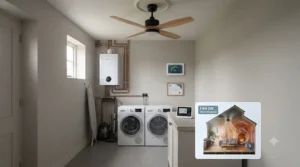
6. NACATIN Ceiling Fan with LED Light — best for full smart-home integration
The NACATIN rounds out the smart-fan cluster with six speeds, dimmable lighting, remote and app control, and quiet operation aimed squarely at households already leaning into connected home tech.
Here’s what the spec sheet won’t tell you outright: app-controlled reversible fans like this one genuinely shine when paired with a broader smart-home routine — grouping the fan with smart thermostats or motion sensors means the direction and speed can adjust automatically as a room warms or cools through the day, rather than you manually intervening. That’s a meaningfully different experience from a remote-only fan, even if the blade and motor hardware underneath is broadly comparable across this price tier.
User feedback on comparable app-controlled fans in this bracket tends to split fairly evenly between people who love the automation and a smaller group who simply prefer a physical remote — worth bearing in mind if you’re not already invested in a smart-home ecosystem.
Pros:
- ✅ Full app and remote control for flexible operation
- ✅ Six-speed DC motor with dimmable LED lighting
- ✅ Fits neatly into wider smart-home routines and automations
Cons:
- ❌ App dependency won’t suit buyers who prefer purely manual control
- ❌ Initial pairing and setup takes a bit more patience than a basic remote fan
Pricing generally sits in the £90-£110 range, positioning it as a genuine mid-tier smart alternative to the pricier Ohniyou.
7. Fantasia Belaire 42″ — best heritage British-brand pick
Every list like this needs one fan built the old-fashioned way, and the Fantasia Belaire is it. Fantasia is a British company that has been designing ceiling fans since 1985, and the Belaire reflects that heritage directly: a traditional pull-chain design operating three fan speeds, with reversible white-and-cane or white-finish blades, consuming 58 watts at the highest setting for an airflow output of roughly 3,571 cubic feet per minute.
That’s a genuinely different proposition to the DC smart fans above it on this list, and the difference matters in practice. Based on the spec comparison, the Belaire‘s AC motor trades the ultra-low running costs of a DC unit for mechanical simplicity — there’s no app to update, no Wi-Fi handshake to troubleshoot, just a pull cord and a proven mechanism backed by a five-year motor warranty as part of the EuroFans range. For period properties, heritage-listed buildings, or anyone who simply distrusts smart-home reliability long-term, that’s a real selling point rather than a limitation.
The flush-mount design suits lower ceilings, and the fan ships with both 6-inch and 12-inch drop rods for flexible installation, which is a level of fitting flexibility the budget imports on this list generally don’t offer.
Pros:
- ✅ Genuine British heritage brand with a five-year motor warranty
- ✅ Near-silent AC motor with no app or connectivity dependencies
- ✅ Flush and drop-rod mounting options included as standard
Cons:
- ❌ No integrated light kit on this specific model
- ❌ Sits at the premium end of this list’s price range
Price ranges for the Belaire typically fall in the £150-£190 bracket depending on retailer promotions, positioning it as the considered, long-term buy on this list rather than the impulse purchase.
Benefits vs Traditional Alternatives
| Feature | Reversible Ceiling Fan | Standard Fixed-Direction Fan | Air Conditioning Unit |
|---|---|---|---|
| Works in winter | Yes — redistributes warm air | No | No (unless heat-pump AC) |
| Running cost | Low (DC models especially) | Low | High |
| Installation | Ceiling wiring, moderate effort | Ceiling wiring, moderate effort | Often requires professional install |
| Noise at low speed | Very quiet (30-40dB typical) | Similar | Noticeable compressor hum |
| Best For | Year-round comfort on one budget | Summer-only cooling | Rooms needing active temperature drop |
The headline takeaway is that a reversible ceiling fan is doing two jobs — summer cooling and winter air redistribution — for roughly the running cost of one appliance, whereas a fixed-direction fan only ever earns its keep for a few months a year. Air conditioning genuinely cools a room by removing heat rather than redistributing it, so it’s not a like-for-like swap, but for most UK homes where summer temperatures rarely sit at AC-justifying levels for long, a reversible fan closes most of that comfort gap at a fraction of the running cost and installation complexity.
How to Set Up Your Reversible Ceiling Fan for Every Season
Getting a reversible fan working properly isn’t complicated, but it’s astonishing how many buyers never actually flip the switch after October. Here’s the practical routine that gets the most out of any fan on this list.
First 30 days: Run the fan on a mid-range speed for the first week rather than maxing it out immediately — this lets any new bearings settle and makes it easier to spot unusual noise early, while it’s still covered by a fresh warranty. Check the mounting bracket screws after the first fortnight of use; ceiling fixtures can loosen slightly as the fan’s weight beds in.
Summer setting: Stand under the fan and look up — the blades should appear to spin counterclockwise, pushing air straight down to create a direct cooling breeze. Run it on a higher speed during the day and combine it with an open window at night to draw cooler outside air through the room, a trick sometimes called cross-ventilation.
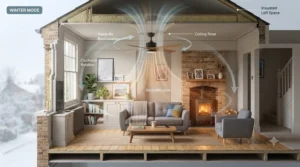
Winter setting: Flip the direction switch (on the fan body, remote, or app depending on the model) so the blades spin clockwise, and drop the speed right down to its lowest setting. At low speed, clockwise rotation draws the warm air that’s naturally risen to the ceiling and gently pushes it back down the walls into the room, without creating the cooling breeze you’d feel in summer mode.
Common mistake to avoid: Running a fan on winter mode at high speed. The wind-chill effect at speed will make the room feel colder, not warmer, defeating the entire point of reversing it in the first place. Low and slow is the rule for winter.
The UK Health Security Agency’s guidance on staying safe in hot weather also notes that fans work best as part of a wider cooling routine — closing curtains on sun-facing windows during the day and opening them at night — rather than as a standalone fix during genuinely extreme heat.
Real-World Scenarios: Who Needs a Reversible Ceiling Fan?
The Victorian terrace owner: You’ve got 2.3m ceilings, period coving you don’t want to damage, and a bedroom that turns into a sauna every July. A low-profile flush-mount fan like the Ohniyou or LMiSQ avoids the head-clearance issue a drop-rod fan would create, and the quiet DC motor matters when the fan is running six inches above where you sleep.
The young family in a new-build: Open-plan kitchen-diner, high ceilings, a toddler who runs hot at night. The VONLUCE‘s 52-inch span handles the larger floor area, while a smaller CJOY unit in the nursery gives independent, gentler control over that specific room without needing the whole downstairs fan running.
The period-property purist: You’ve restored a Georgian townhouse and the last thing you want is a black plastic smart fan clashing with cornicing and a chandelier rose. The Fantasia Belaire‘s traditional pull-cord design and classic finish options were built for exactly this brief, and the absence of Wi-Fi dependency means no smart-home footprint to justify to conservation-minded neighbours.
How to Choose the Best Dual-Season Fan for Your Home
- Measure your room before your fan. As a rough guide, rooms under 3.5m across suit a 36-42 inch blade span; anything larger benefits from 48-52 inches for genuine air movement rather than a gentle flutter.
- Check your ceiling height. Below 2.4m, a flush low-profile mount like the LMiSQ or Ohniyou is close to essential; taller ceilings can use a drop rod for better air circulation.
- Decide between DC and AC motors. DC motors, used in most of this list, run quieter and cheaper long-term; AC motors like the Fantasia Belaire‘s are simpler and often more durable over decades of use.
- Weigh up app control against reliability. Smart features are genuinely useful for scheduling seasonal switches, but a manual remote or pull cord never needs a firmware update.
- Match lighting needs to the room. A fan with integrated dimmable LED, like the CJOY or NACATIN, can replace a separate ceiling light entirely in smaller rooms.
- Budget for the whole job, not just the fan. Factor in professional installation if you’re not comfortable with ceiling wiring — this is genuinely not a purely cosmetic DIY job.
- Read the warranty terms. A longer motor warranty, like the Fantasia Belaire‘s five years, is a reasonable proxy for how confident the manufacturer is in long-term reliability.
Reversible Airflow Fan vs Standard Ceiling Fan: What’s the Real Difference?
On the surface, a reversible airflow fan and a standard fixed-direction ceiling fan look identical — same blades, same motor housing, same mounting bracket. The difference is entirely inside the motor. A reversible unit has wiring and a switch (physical, remote, or app-based) that lets current flow through the motor windings in either direction, which is what flips the blade rotation. A standard fan is wired to spin one way only, permanently.
In practical terms, this means a standard fan is a summer-only purchase, full stop — running it in winter does nothing useful and can even work against your heating by creating an unwanted cooling breeze near head height. A reversible fan, by contrast, earns its keep for roughly nine to ten months of the UK year rather than three or four. Given that the price difference between reversible and non-reversible fans has narrowed to almost nothing across most retailers — every product on this list is reversible by default — there’s genuinely little reason left to buy a fixed-direction fan for a UK home.
Blade Rotation and Airflow Direction Explained
The physics here is simpler than it sounds, and understanding it properly stops people getting the seasonal switch backwards.
Warm air is less dense than cool air, so it naturally rises and pools near the ceiling — this is called thermal stratification, and it’s why the top of a room is always noticeably warmer than floor level in winter. A ceiling fan spinning counterclockwise (summer mode) pushes that column of air straight down, creating a direct downdraught you can feel on your skin — the wind-chill effect that makes you feel cooler even though the room’s actual temperature hasn’t changed.
Reverse the blade rotation to clockwise and drop the speed, and the fan instead pulls air up through its centre and flings it outward at the ceiling, where it travels down the walls and back into the room at floor level — recirculating the warm air that would otherwise sit uselessly overhead, rather than blasting a cold breeze downward. That’s the entire mechanism behind winter energy savings, and it’s why speed matters as much as direction: high speed in winter mode still creates enough air movement to feel like a breeze, cancelling out the benefit.
Common Mistakes When Buying a Reversible Ceiling Fan
Even experienced buyers trip up on a handful of recurring issues. Based on patterns across product reviews and buying guides, these are the ones worth double-checking before you order.
- Buying on blade span alone, ignoring ceiling height. A gorgeous 52-inch fan is wasted — or worse, a safety hazard — under a 2.3m ceiling without checking flush-mount compatibility first.
- Assuming “reversible blades” means the same thing as a reversible motor. Some cheaper fans market blades with a different colour on each side as “reversible,” which changes the look, not the airflow direction. Always check for an explicit direction switch in the spec sheet.
- Overlooking the light kit compatibility. Not every fan body accepts every light kit; if you want a specific look, confirm compatibility before ordering rather than after.
- Underestimating installation complexity. Ceiling fan wiring is genuinely not the same job as swapping a light fitting, particularly if your ceiling rose doesn’t already have a fan-rated support box.
- Ignoring noise ratings on paper vs in practice. A quoted decibel figure at minimum speed tells you little about how the fan sounds at speed four or five — read aggregated reviews specifically mentioning noise at higher settings.
Long-Term Cost & Maintenance
The upfront price range on this list runs from roughly £45 to £190, but total cost of ownership tells a slightly different story. A DC-motor fan like the Ohniyou or LMiSQ typically draws somewhere between 15-35 watts depending on speed — genuinely negligible next to even a modest electric heater — while a traditional AC fan like the Fantasia Belaire draws up to 58 watts at full speed but is often built for decades of service with minimal electronic components to fail.
Maintenance is refreshingly low across the board: an annual blade wipe-down to remove dust build-up (which both reduces airflow efficiency and adds imbalance-related wobble over time), an occasional check that mounting screws haven’t loosened, and for app-connected models, keeping firmware updated when prompted. None of the seven fans here require professional servicing under normal domestic use, though any electrical fault beyond a simple bulb or remote battery swap should go to a qualified electrician rather than a DIY fix.
Safety, Regulations & Installation Compliance
Ceiling fan installation in the UK sits under Part P of the Building Regulations, which governs fixed electrical work in dwellings. If your installation involves adding a new circuit rather than simply replacing an existing ceiling rose on the same wiring, the work is generally notifiable under Part P and should be carried out or certified by a registered competent person. Simple like-for-like replacements on existing wiring are lower risk, but if you’re at all unsure, it’s genuinely not worth the risk of getting it wrong — a badly supported fan is a falling hazard, and incorrect wiring is a fire risk.
On the usage side, it’s worth remembering that fans work by moving air, not by lowering a room’s actual temperature — and during extreme heat, the NHS advises that anyone showing signs of heatstroke needs urgent cooling and, in severe cases, emergency medical help. A reversible ceiling fan is an excellent everyday comfort tool, but it isn’t a substitute for the wider hot-weather precautions — staying hydrated, avoiding the midday sun, and checking on vulnerable relatives — that genuinely extreme heat calls for.
FAQ
❓ Which way should a ceiling fan turn in summer?
❓ Does reversing a ceiling fan really save money in winter?
❓ How do I know if my ceiling fan is reversible?
❓ Can I install a reversible ceiling fan myself?
❓ What size reversible ceiling fan do I need for my room?
Conclusion
A reversible ceiling fan is one of those rare home upgrades that genuinely earns its keep across the whole calendar rather than sitting idle for nine months of the year. Whether you land on the compact, budget-friendly CJOY for a nursery, the app-scheduled convenience of the LMiSQ or NACATIN, the serious airflow of the VONLUCE for an open-plan space, the near-silent engineering of the Ohniyou, the clearly labelled seasonal switch on the YUNLONG, or the heritage reliability of the Fantasia Belaire, the underlying principle is the same: get the blade span right for your room, get the direction right for the season, and the comfort gains follow almost automatically.
None of these seven fans are the wrong choice outright — they’re built for genuinely different rooms, budgets, and priorities, which is exactly why a shortlist like this one matters more than a single “best overall” pick. Take the room measurements, ceiling height, and noise tolerance you actually have, match them against the comparison table above, and you’ll land on a fan that does its job quietly for years, whichever direction it happens to be spinning.
Recommended for You
- A++ Rated Ceiling Fan: 7 Best Efficient Picks for UK (2026)
- Energy Saving Ceiling Fan: 7 Best Picks to Cut UK Bills (2026)
- Low Wattage Ceiling Fan: 7 Best Picks for UK Homes (2026)
Disclaimer: This article contains affiliate links. As an Amazon Associate, I earn from qualifying purchases. If you purchase products through these links, we may earn a small commission at no additional cost to you.
✨ Found this helpful? Share it with your friends! 💬🤗
