
In This Article
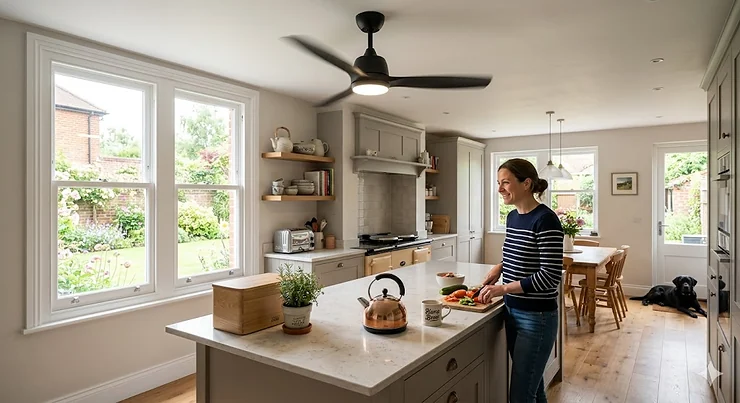
There’s a particular kind of misery that every British home cook knows. It arrives without invitation, usually in July — or, if you’re unlucky, a random Wednesday in March that decides to impersonate a heatwave. You’re halfway through a Sunday roast, the oven’s been on for two hours, steam is billowing from three hobs simultaneously, and the kitchen feels like the inside of a pottery kiln. You open the window. A wasp flies in.

This is precisely the problem that kitchen ceiling fans solve. Elegantly, quietly, and without the drama of a pedestal fan that tips over every time someone walks past. A well-chosen ceiling fan keeps air moving above the cooking zone, reduces heat stratification (that’s the technical phrase for “why your kitchen ceiling is fifteen degrees hotter than your feet”), and in modern homes where we’re sealing up draughts faster than ever, helps maintain the kind of indoor air quality your lungs actually appreciate. According to the UK’s Approved Document F building regulations, kitchens require extract ventilation at 60 litres per second when using a wall or ceiling-mounted fan — a standard that underlines just how seriously the government now takes kitchen airflow.
Whether you’re renovating a Victorian terrace in Leeds, fitting out a new-build flat in Bristol, or simply upgrading your mid-century semi in the Midlands, this guide walks you through the seven best kitchen ceiling fans currently available on Amazon.co.uk in 2026. We’ll cut through the spec-sheet noise, tell you what actually matters in a British kitchen context, and help you spend your money wisely.
Quick Comparison: Top Kitchen Ceiling Fans at a Glance
| Product | Blade Span | Motor Type | Light Included | Control | Price Range | Best For |
|---|---|---|---|---|---|---|
| RHEAFON 30″ Smart Fan | 76cm | DC (reversible) | ✅ LED | Remote + App | Under £80 | Small kitchens, flats |
| VONLUCE 52″ Walnut Fan | 132cm | DC (reversible) | ✅ LED | Remote + Alexa | £100–£160 | Open-plan kitchens |
| HARPER LIVING 50W LED Fan | ~50cm | AC | ✅ 4000LM LED | Remote | Under £70 | Bright, well-lit kitchens |
| Ohniyou 52″ Flush Mount | 132cm | DC (quiet) | ✅ Dimmable | Remote + App | £80–£130 | Low-ceiling kitchens |
| reiga 132cm White Fan | 132cm | DC (reversible) | ✅ LED | Remote | £90–£150 | Modern minimalist kitchens |
| Hunter Fan Industrie II | 132cm | AC | ❌ No light | Wall switch | £150–£220 | Traditional/heritage kitchens |
| BKZO Modern LED Fan | ~50cm | DC | ✅ Dimmable | Remote | Under £90 | Compact modern kitchens |
The table above makes one thing immediately clear: the DC motor models — VONLUCE, Ohniyou, and reiga especially — dominate the mid-range for good reason. DC motors are typically 30–50% more energy-efficient than traditional AC motors and substantially quieter, which matters enormously in a kitchen where you’re already competing with extractor fans, boiling pans, and the Radio 4 afternoon drama. If budget is your primary concern, the RHEAFON and HARPER LIVING sit in attractive sub-£80 territory. But if you’re going to spend money once and be done with it, the DC-motor crowd earns its extra £40–£60 back in lower electricity bills inside two years.
💬 Just one click — help others make better buying decisions too! 😊
✨ Don’t Miss These Exclusive Deals!
🔍 Take your kitchen to the next level with these carefully selected ceiling fans. Click any highlighted product to check current pricing and availability on Amazon.co.uk.
Top 7 Kitchen Ceiling Fans: Expert Analysis
1. RHEAFON 30-Inch Smart Ceiling Fan with Lights
If you’ve got a galley kitchen, a kitchen in a flat, or any culinary space under roughly 10 square metres, the RHEAFON 30-inch is the one to beat at its price point. The 76cm blade span doesn’t sound massive — and it isn’t — but in a compact British kitchen, a full 132cm fan would be genuinely impractical and quite frankly alarming when you’re reaching up to the top shelf.
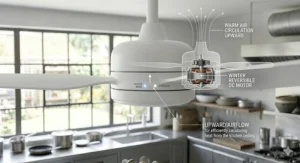
The DC reversible motor runs across six speeds and, crucially, sits below 35dB at most settings. That’s quieter than a library whisper. The reversible function means in winter it can gently push warm air downward from the ceiling — a quietly useful trick in the kind of poorly insulated kitchens that characterise older British housing stock. The integrated LED light operates across three colour temperatures (warm, neutral, cool) via remote or the companion app, which is a more thoughtful touch than the spec sheet lets on: warm light suits relaxed evening cooking; cool white suits the kind of precise prep work that requires seeing exactly what you’re doing.
UK buyers have noted in reviews that setup is straightforward, taking around 45 minutes with the included hardware and reasonably clear instructions. One note: check ceiling height before purchasing — the downrod adds around 25–30cm below the mounting point.
Pros:
- ✅ Ideal blade span for compact UK kitchens
- ✅ Whisper-quiet DC motor under 35dB
- ✅ Smart app and remote control
Cons:
- ❌ Not suitable for rooms larger than ~12 square metres
- ❌ App connectivity can require initial patience to configure
Price range: Under £80 | Verdict: Excellent value for money for smaller kitchen spaces. A sensible choice, not a compromised one.
2. VONLUCE 52-Inch Ceiling Fan with Lights and Remote, Alexa & Google Compatible — Walnut
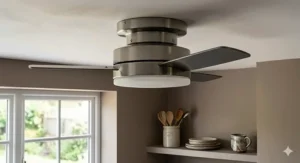
The VONLUCE 52-inch is the ceiling fan that open-plan kitchen-diner owners have been waiting for. Its 132cm blade span means it can shift a serious volume of air through a larger space — think combined kitchen and dining room in a 1990s semi — without needing to run at high speed constantly. At its quieter speeds, it’s essentially imperceptible; at full speed, it moves enough air to be genuinely felt.
The real selling point here is the smart integration. Alexa and Google Home compatibility means you can ask your kitchen fan to change speed hands-free, which sounds like a luxury until the moment you’ve got flour-covered hands, a timer going off, and no desire to touch anything electronic. It also supports the Tuya Smart app for scheduling — set it to run at low speed for an hour after cooking to clear residual heat, then switch off automatically. The lacquered ABS blades are treated against moisture, which is more relevant than it sounds: kitchens generate significant condensation and humidity, and untreated blades warp or delaminate faster than manufacturers admit.
For UK buyers, the walnut finish works beautifully in kitchens with warm wood cabinetry — Shaker-style kitchens in particular. The three-colour LED (3,000K to 6,500K range) covers everything from candle-warm ambience to clinical prep lighting.
Pros:
- ✅ Alexa/Google Home smart control
- ✅ Moisture-treated blades for kitchen environments
- ✅ Six-speed DC motor, genuinely quiet operation
Cons:
- ❌ 132cm span requires a minimum 4-metre ceiling clearance recommendation
- ❌ Walnut finish may not suit all kitchen colour schemes
Price range: £100–£160 | Verdict: Premium-feeling fan at a mid-range price. Worth every pound for open-plan spaces.
3. HARPER LIVING Ceiling Fan with Lights and Remote, 50W 4000LM Dimmable LED
HARPER LIVING has carved out a credible niche in the UK lighting market by focusing on what many budget brands overlook: actual light output. The 4,000 lumen output from this fan’s integrated LED is extraordinary for a ceiling fan — most comparable units manage 1,500 to 2,500lm. In practical terms, this means the HARPER LIVING can serve as a kitchen’s primary lighting source, not a supplement to it. For smaller kitchens without separate downlights or pendant fixtures, that’s a meaningful distinction.
The 50W power draw is honest and efficient; the six-speed AC motor is serviceable rather than exceptional. It won’t be as whisper-quiet as the DC alternatives on this list, but at lower speeds — which is where most people run their kitchen fan during cooking — the noise is perfectly acceptable. The three colour-change modes and timing function are controlled via an included remote that’s compact and intuitive. UK reviewers have praised the brightness enthusiastically, with several noting it transformed previously dim kitchen spaces.
What most buyers overlook: the IP rating matters in kitchens. Check the current listing carefully for IP44 or better if your kitchen layout places the fan directly above a hob — steam, grease, and moisture are a ceiling fan’s natural enemies.
Pros:
- ✅ Exceptional 4000LM light output
- ✅ Six speeds + timing function
- ✅ Attractive price for the specification
Cons:
- ❌ AC motor less efficient and slightly noisier than DC competitors
- ❌ Verify IP rating before positioning above hobs or sinks
Price range: Under £70 | Verdict: The best-lit ceiling fan at this price point in the UK. If kitchen illumination is your priority, look no further.
4. Ohniyou 52-Inch Low Profile Flush Mount Ceiling Fan with Dimmable Light, Remote & App
Low-ceiling kitchens — a staple of British housing — are where most ceiling fans become a liability. The Ohniyou 52-inch flush mount design is built precisely for this scenario. Where standard ceiling fans require 25–30cm of clearance via a downrod, the Ohniyou sits close to the ceiling surface, typically adding only 10–15cm in total depth. In a kitchen with a 2.3 or 2.4 metre ceiling (common in post-war British housing), this is the difference between a functional installation and a hazard to anyone taller than 5’8″.
The quiet DC motor is a genuine standout. Several UK reviewers describe it as essentially silent at low and medium speeds — and in a kitchen environment, where you want to hear what’s happening on the hob rather than a constant mechanical hum, this matters considerably. Remote and app control (via the standard Smart Life interface) covers six speeds and full dimming of the integrated LED across the 3,000K–6,000K colour range.
It’s worth noting that flush mount fans move slightly less air than downrod-mounted equivalents at the same blade span, simply due to reduced clearance above the blades. For most UK kitchen sizes, this is inconsequential; for a large, open-plan space, you might want to consider a downrod-equipped alternative.
Pros:
- ✅ Flush mount design for low-ceiling British kitchens
- ✅ Silent DC motor, app and remote control
- ✅ Full dimmable LED with colour temperature range
Cons:
- ❌ Slightly reduced airflow versus downrod-mounted fans
- ❌ 132cm span still requires a reasonable-sized room
Price range: £80–£130 | Verdict: The smart pick for British homes with lower ceilings. Solves a real problem elegantly.
5. reiga 132cm White Ceiling Fan with Lights and Remote — Reversible DC Motor
If you’re drawn to minimalist, Scandi-influenced kitchen design — the kind featuring white cabinetry, pale stone worktops, and an almost painful commitment to clean lines — the reiga delivers exactly the aesthetic you need without compromising on performance. The matte white finish on both the three blades and motor housing is consistent and well-executed, avoiding the slightly plasticky look that haunts cheaper white-finished fans.
The reversible DC motor at 132cm moves genuinely impressive volumes of air in summer cooling mode, and the winter reversal function — running the blades in the opposite direction at low speed to gently redistribute warm air — is particularly effective in British kitchens that lose heat rapidly in autumn and winter months. Energy consumption is low; running the fan on its lower settings adds very little to the electricity bill, which UK households have become reasonably attentive to since the energy price hikes of recent years.
What stands out in UK customer feedback: the installation is described as clean and the remote reliable. The integrated LED light is effective without being the star of the show — adequate task lighting, not the 4,000-lumen drama of the HARPER LIVING above.
Pros:
- ✅ Clean, minimalist white design suits modern British kitchens
- ✅ Reversible DC motor for year-round use
- ✅ Consistent UK reviews praising ease of installation
Cons:
- ❌ Light output more modest than some competitors
- ❌ Three blades can mean slightly less airflow uniformity than five-blade models
Price range: £90–£150 | Verdict: The one for the kitchen that’s already well-designed and deserves a fan that doesn’t ruin the view.
6. Hunter Fan Industrie II, 132cm Indoor Ceiling Fan with Wall Control
Hunter Fan Company has been making ceiling fans since 1886, and the Industrie II carries that heritage with something approaching dignity. This is the only model on this list without an integrated light fitting — and that’s not an oversight. It’s a deliberate design statement aimed at kitchens that already have well-considered downlighting or pendant fixtures and simply need effective, reliable airflow without adding another LED to the mix.
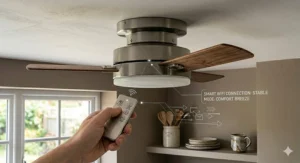
The 132cm span with three reversible blades (white and maple, or snow white and maple depending on the variant) delivers steady, consistent airflow via the AC motor. It’s not the most energy-efficient motor type available in 2026, but Hunter’s motors are built to last — the brand backs them with a notably generous warranty, which for a product installed in a kitchen environment (heat, grease, steam) is reassuring rather than just a marketing line. Wall control operation feels substantial and intuitive; there’s no remote to lose behind the sofa.
For heritage kitchens — exposed brick, Belfast sinks, original Victorian tiles — the Industrie II’s industrial aesthetic is genuinely complementary in a way that the sleek smart fans above simply aren’t. UK availability on Amazon.co.uk is solid, with Prime delivery available on most variants.
Pros:
- ✅ Heritage brand with excellent build reputation
- ✅ Reversible for seasonal use
- ✅ Works beautifully with kitchens that already have independent lighting
Cons:
- ❌ No integrated light fitting
- ❌ AC motor less efficient than modern DC alternatives
Price range: £150–£220 | Verdict: Buy this if you want a fan that will still be running in 2040 and doesn’t apologise for looking like proper engineering.
7. BKZO Modern LED Ceiling Fan with Dimmable Light, 24 Ventilation Speeds
Twenty-four ventilation speeds. Let that settle for a moment. While most ceiling fans offer three to six settings, the BKZO approaches speed selection with the kind of granularity usually reserved for industrial equipment or people who think about airflow considerably more than the average person. In practice, this means you can find the exact gentle circulation level that disperses cooking smells without making your kitchen feel like a wind tunnel — and then fine-tune it on warm evenings without disrupting a candle.
The integrated LED is continuously dimmable across a wide range, and the compact motor housing (around 50cm in total diameter) makes this a strong candidate for smaller kitchen spaces where the VONLUCE or Ohniyou 132cm spans would be architecturally inappropriate. DC motor operation keeps noise low, and the remote is included as standard.
What most buyers don’t consider with the BKZO: with that many speed settings available, the learning curve with the remote takes a week or so before you settle into your preferred two or three levels. That’s a small price to pay for the precision control, but worth knowing before you find yourself accidentally running the fan at speed seventeen on a Tuesday morning.
Pros:
- ✅ 24 speeds offers unprecedented precision airflow control
- ✅ Continuously dimmable LED for versatile lighting
- ✅ Compact size suits smaller kitchens
Cons:
- ❌ Many speed settings can initially feel overwhelming
- ❌ Compact blade span limits effectiveness in larger rooms
Price range: Under £90 | Verdict: A genuinely thoughtful design for those who like control. Unusual, and rather good for it.
How to Choose the Right Kitchen Ceiling Fan in the UK: A Practical Framework
Choosing a kitchen ceiling fan isn’t quite like choosing any other ceiling fan. Kitchens are hostile environments — humidity, grease-laden air, temperature fluctuations, and the occasional enthusiastic splashback conspire to challenge any ceiling-mounted product. Here’s what to actually weigh up, ranked by importance.
1. Room Size and Blade Span
The generally accepted rule: blade spans up to 76cm (30 inches) suit rooms up to about 10 square metres; 107–132cm (42–52 inches) are appropriate for 10–25 square metres; larger spans serve big open-plan spaces. Most British kitchens in terraced houses and semis fall into the 8–15 square metre range, meaning the mid-sized 107cm models often hit the sweet spot. According to Wikipedia’s overview of ceiling fans, proper blade span selection relative to room size is the single most important factor in effective air circulation — not motor wattage, not speed settings.
2. Ceiling Height
Standard British ceiling heights run from about 2.2 metres in post-war builds to 2.7–3 metres in Victorian and Edwardian properties. For ceilings under 2.4 metres, a flush-mount (low-profile) fan is not optional — it’s essential. Never mount a downrod fan where the blade tips will be closer than 2.1 metres from the floor, both for safety and because UK building regulations take a dim view of ceiling-mounted items that present a hazard to occupants.
3. DC vs AC Motor
DC motors cost slightly more upfront but use roughly 30–50% less electricity, produce significantly less noise, and typically run cooler — which in a hot kitchen environment extends the motor’s life considerably. For anyone planning to run the fan regularly through cooking sessions, DC pays for itself within two years on the energy saving alone.
4. IP Rating for Kitchen Use
An IP44 rating means the unit is splash-protected — sensible if the fan is anywhere near a hob or sink. Not every kitchen ceiling fan carries an appropriate IP rating, so check before purchasing. Many are rated for “dry indoor use only,” which is fine if the fan is positioned away from direct steam exposure.
5. Lighting Quality
If the fan is replacing your kitchen’s primary light source, lumen output matters. Look for 2,500lm minimum; 4,000lm if the kitchen is currently poorly lit. Colour temperature flexibility (warm/cool switching) adds genuine daily utility.
6. Smart Control vs Remote vs Wall Switch
Smart fans with app and voice control are genuinely useful in a kitchen context — hands-free operation when cooking is not a gimmick. Wall switches suit people who find apps an unnecessary complication, though they limit control flexibility.
7. Aesthetic Compatibility
This one matters more than it sounds. A sleek matte-black smart fan looks strange in a Shaker kitchen. A wood-blade walnut fan feels incongruous in a white gloss contemporary space. Choose a finish that works with what’s already there — a ceiling fan is not a feature piece, it’s a functional component.

Real UK Kitchens, Real Scenarios: Which Fan Suits You?
Profile 1: The Urban Flat in Birmingham, Under 10 Square Metres
Charlotte’s kitchen is perfectly functional and absolutely tiny. It shares a wall with the bathroom, has one narrow window, and regularly reaches uncomfortable temperatures during cooking. A 132cm fan would be architecturally absurd — and a fire hazard near the extractor hood. The RHEAFON 30-inch is the answer here: compact, quiet, smart-controlled, and specifically engineered for exactly this scenario. Under £80 on Amazon.co.uk with Prime delivery means it’s installed and working by Thursday.
Profile 2: The Open-Plan Kitchen-Diner in a 1990s Semi, Nottingham
James and Priya have an open-plan space of roughly 25 square metres that runs from the kitchen island through to the dining table. In summer, the south-facing glass extension turns the space into a greenhouse. A single pedestal fan creates arguments about direction. The VONLUCE 52-inch Walnut does actual work here — its 132cm span can circulate air across a genuinely large space, and Alexa integration means they can adjust speed from the dining table without getting up.
Profile 3: The Victorian Terrace Renovation in Edinburgh, Heritage Kitchen
Morag is restoring a tenement flat with 2.9 metre ceilings and an Aga-style range cooker that produces heat as a lifestyle. She wants function, not flashing LEDs. The Hunter Fan Industrie II is built for this: no integrated light (she has original pendants), industrial-meets-heritage aesthetic, and the kind of build quality that doesn’t ask to be replaced after three years. Scotland’s building standards align with England’s Part F requirements for kitchen ventilation, so compliance is straightforward.
Common Mistakes British Buyers Make When Choosing a Kitchen Ceiling Fan
🔴 Buying a fan sized for American rooms. Many ceiling fans on Amazon UK are described for “large rooms” using American room-size standards. A 132cm fan described as suitable for a “medium room” in a US context often refers to a space equivalent to what British buyers would call a large kitchen or dining room. Check square metres, not the marketing copy.
🔴 Ignoring the IP rating. Installing an IP20-rated (dry use only) fan directly above a hob in a small kitchen is the kind of mistake that works fine for eighteen months and then becomes an expensive insurance claim. Kitchens produce steam, grease, and condensation. Check IP ratings carefully — the product listing will specify this.
🔴 Underestimating installation complexity. Ceiling fans need a properly rated ceiling rose and electrical point. If you’re replacing a light fitting, the existing wiring may be adequate. If you’re adding a fan where there was none, you’ll likely need an electrician — and in a rented property, you’ll need landlord permission. Factor this into your budget (typically £80–£150 for a competent domestic electrician in most UK regions).
🔴 Assuming all fans on Amazon UK are UK-compatible. Most kitchen ceiling fans on Amazon.co.uk now come with UK Type G plugs and are rated for 230V/50Hz — but verify. Some grey-import listings ship European (Type C) plugs with adaptors, which is technically not compliant with UK wiring standards and practically irritating.
🔴 Forgetting the Part F ventilation requirements. As outlined by City Plumbing’s guide to UK ventilation regulations, a ceiling fan used as a kitchen’s primary extract system must achieve 60 litres per second airflow. Most domestic ceiling fans on this list are comfort fans rather than extract fans — they circulate existing air rather than expelling it externally. If you’re fitting a fan to meet Building Regulations Part F extract requirements, you need a dedicated extract fan in addition. This guide covers comfort ceiling fans; for extract ventilation compliance, refer to the official UK Government guidance on Approved Document F.
🔴 Skipping the blade pitch check. Blade pitch — the angle of the blades relative to horizontal — significantly affects airflow. A pitch under 12° is generally inefficient; 14–16° is considered optimal for residential use. Most brands don’t advertise this specification clearly, but higher-quality fans (Hunter, VONLUCE, reiga) tend to be engineered more carefully in this respect.
✨ Don’t Miss These Exclusive Deals!
🔍 Ready to transform your kitchen airflow? Browse these top-rated kitchen ceiling fans on Amazon.co.uk and check current pricing with Prime-eligible delivery options.
UK Regulations, Safety Standards & What You Actually Need to Know
British ceiling fan buyers have rather more to think about than their American counterparts, thanks to a building regulatory environment that has become meaningfully more rigorous in recent years.
Part F (Building Regulations, Ventilation) underwent significant updates in 2022 and is set for further revision under the Future Homes Standard, which becomes mandatory for new buildings in December 2026. While these regulations primarily target extract ventilation systems rather than comfort ceiling fans, they’ve raised awareness of indoor air quality across the sector. If your home is newly built or recently renovated, your kitchen likely already has an extract system; a ceiling fan supplements it rather than replaces it.
Electrical safety: Ceiling fan installation involving new wiring in England and Wales falls under Part P of the Building Regulations. Unless you’re a competent person registered under a scheme such as NAPIT or NICEIC, you’ll need a qualified electrician to carry out and certify new electrical work in a kitchen. This isn’t bureaucracy for its own sake — kitchens are the most electrically hazardous rooms in most homes.
UKCA Marking: Post-Brexit, the UK Conformity Assessed (UKCA) mark replaces the CE mark for products sold in Great Britain (England, Scotland, Wales). Products carrying only the CE mark remain legally saleable in GB until June 2025 under transitional provisions; from that point, UKCA is required for new products. Northern Ireland follows separate rules under the Windsor Framework and may accept CE-marked goods. Most ceiling fans now on Amazon.co.uk in 2026 should carry UKCA marking — check the product listing if you’re buying for a rented property or commercial premises where compliance documentation may be required.
Noise levels: No UK regulation specifically limits ceiling fan noise in residential settings, but the general duty under the Building Regulations to protect occupant health and wellbeing applies. In practice, a fan producing over 50dB at typical operating speeds would be commercially unviable. The DC-motor fans on this list operate well below that threshold.
Long-Term Cost & Maintenance in a British Kitchen
A ceiling fan installed in a kitchen faces conditions that a bedroom fan simply doesn’t. Grease-laden air gradually coats the blades, motor housing, and light fittings. In the typically damp British climate, where condensation from cooking combines with the thermal shock of opening a cold back door, fans work harder than their manufacturers assume when writing warranty literature.
Running costs are modest. A typical DC ceiling fan at moderate speed draws 15–25 watts — running it for three hours daily costs roughly £3–£5 per month at average 2026 UK electricity rates. The energy saving compared to portable air conditioning (which is environmentally daft in the UK climate anyway) is dramatic.
Blade cleaning matters more in a kitchen than any other room. Grease accumulates on blade surfaces and changes the aerodynamic profile, subtly reducing efficiency and increasing motor strain. A monthly wipe with a mild degreaser (avoiding anything abrasive on lacquered wood or ABS blades) is sufficient for most home kitchens. Using the Which? guidance on kitchen appliance maintenance as a general framework for cleaning cadence is sensible.
Motor longevity: DC motors in quality ceiling fans routinely last 10–15 years with minimal maintenance. AC motors in budget models may begin making noise within three to five years in a kitchen environment. The extra £40–£60 for a DC-motor fan is rarely regretted at the five-year mark.
Parts and warranty: EU-manufactured products may now carry higher UK prices post-Brexit import adjustments and can have more complicated warranty return logistics. Products sold and dispatched from Amazon.co.uk UK warehouses have the Consumer Rights Act 2015 behind them, providing 30 days for a full refund, six months’ reversed burden of proof, and up to six years’ coverage for latent defects. This is stronger protection than most manufacturers’ own warranty terms, and it’s worth knowing you have it.
FAQ: Kitchen Ceiling Fans UK
❓ Are kitchen ceiling fans suitable for UK homes with lower ceilings?
❓ Do kitchen ceiling fans meet UK Building Regulations Part F ventilation requirements?
❓ How do I clean a ceiling fan that's been installed above a hob?
❓ Are smart ceiling fans with Alexa and Google Home compatible with UK smart home setups?
❓ Can I install a kitchen ceiling fan myself, or do I need an electrician in the UK?
Conclusion: Cool Heads Prevail
The right kitchen ceiling fan doesn’t just move air. Done properly, it changes how you feel about cooking in that space — reducing the heat stress of a long Sunday roast, quietly dispersing the lingering scent of last night’s Thai curry, and adding enough lighting to make prep work genuinely comfortable. Britain’s kitchens are getting smaller (particularly in new builds), better insulated (particularly post-Future Homes Standard), and more thoughtfully designed. A ceiling fan is no longer an afterthought — it’s a considered component of a functional cooking space.
For compact kitchens and flats: the RHEAFON 30-inch hits the mark without breaking the budget. For open-plan spaces: the VONLUCE 52-inch is the quiet, smart, good-looking answer. For low ceilings: the Ohniyou flush-mount solves a real British problem. And for those who want something built to last a generation: the Hunter Fan Industrie II simply gets on with it, as it has been doing since the Victorians were worrying about different kinds of overheating.
Check current pricing and availability on Amazon.co.uk — Prime members get free next-day delivery on most of the above — and make the choice that suits your kitchen, your ceiling, and your patience with a wasp-riddled open window.
✨ Don’t Miss These Exclusive Deals!
🔍 Explore these hand-picked kitchen ceiling fans on Amazon.co.uk and find the perfect match for your home today. Check current pricing and Prime delivery availability with one click.
Recommended for You
- Best Ceiling Fan for Kitchen Diner UK 2026: 7 Expert-Tested Picks
- 7 Best Elegant Ceiling Fans for Dining Room UK (2026 Guide)
- 7 Best Dining Room Ceiling Fans UK 2026: Style Meets Cool
Disclaimer: This article contains affiliate links. As an Amazon Associate, I earn from qualifying purchases. If you purchase products through these links, we may earn a small commission at no additional cost to you.
✨ Found this helpful? Share it with your mates! 💬🤗
