
In This Article
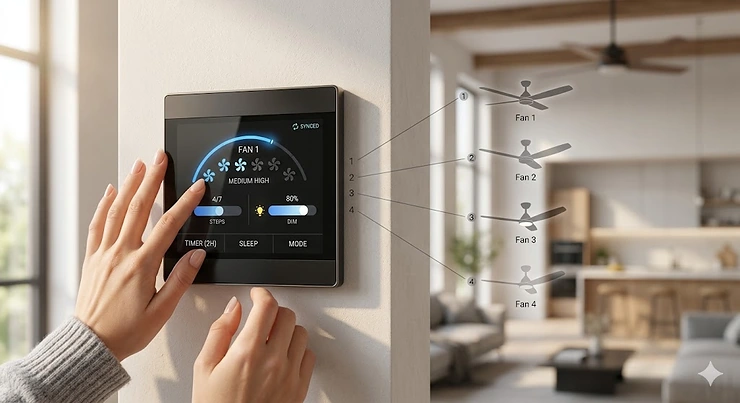
There’s something rather Victorian about yanking a chain to adjust your ceiling fan speed, wouldn’t you say? If you’re still fumbling in the dark for that elusive cord—or worse, standing on furniture to reach it—you’re missing out on one of the simplest comfort upgrades available. A digital ceiling fan wall control transforms your experience from prehistoric to properly civilised, putting precise airflow control exactly where it belongs: on your wall, at arm’s reach.
The British market has embraced these controls with remarkable enthusiasm, and for good reason. Our homes tend to be smaller than their American counterparts, with lower ceilings and less storage space. Adding a sleek wall control means you can finally ditch those dangly chains whilst gaining features your grandparents never dreamed possible: programmable timers that shut the fan off after you’ve dozed off, LCD displays showing exactly which speed you’ve selected, and smart controls that respond to voice commands or mobile apps. What most UK buyers overlook, however, is compatibility—not every control works with 230V UK electrical systems, and UKCA certification matters more than you might think for safety and warranty coverage.
Quick Comparison Table: Top Digital Controls at a Glance
| Product | Speed Settings | Smart Features | Price Range (£) | Best For |
|---|---|---|---|---|
| Westinghouse 78800 | 4-speed + off | Simple rotary dial | £25-£40 | Basic reliable control |
| Westinghouse 77875 Wireless | 3-speed | Light dimmer, wireless | £60-£85 | Retrofit upgrades |
| TREATLIFE Smart Switch | 4-speed | WiFi, Alexa, timer | £35-£55 | Smart home integration |
| Leviton D24SF | 4-speed | WiFi, scheduling, app | £70-£95 | Premium smart control |
| MOES Star Ring | 4-speed | WiFi, voice, dimmer | £40-£65 | Modern aesthetic |
| Bond Bridge Pro | Universal | WiFi hub, multi-device | £85-£120 | Multiple fans |
| Hunter Wall Control | 3-speed | Slide switch, dimmer | £45-£70 | Traditional reliability |
From the comparison above, the Westinghouse 78800 offers exceptional value under £40 for those who simply want reliable manual control, whilst smart home enthusiasts should note that the TREATLIFE and MOES options deliver WiFi connectivity at surprisingly reasonable prices. Budget buyers need to understand that the sub-£30 options typically sacrifice the wireless receiver—a trade-off that stings when you realise your existing wiring won’t support direct wall control without running additional cables through your ceiling.
💬 Just one click — help others make better buying decisions too!😊
Top 7 Digital Ceiling Fan Wall Controls: Expert Analysis
1. Westinghouse 78800 4-Speed Wall Control
The Westinghouse 78800 represents everything sensible about ceiling fan controls: dead simple operation, bullet-proof reliability, and compatibility with virtually every AC motor fan on the market. This wired wall control features a straightforward rotary dial offering four distinct speed settings plus off, replacing your existing light switch without requiring any fancy receivers or wireless components.
What sets this control apart for UK installations is its proven track record with 230V systems and standard British electrical boxes. The unit handles fans drawing up to 1.25 amps—more than sufficient for residential ceiling fans—and installs using basic two-wire connections. UK buyers particularly appreciate that it doesn’t require a neutral wire, which older British homes frequently lack in ceiling rose installations. The white finish blends seamlessly into most décors, and the included wall plate covers the junction box neatly.
In my experience, this control excels in straightforward installations where you’re replacing a simple on/off switch. The four-speed functionality genuinely transforms three-speed fans by adding a medium-low setting that’s perfect for those in-between moments when low feels too gentle but medium kicks up too much breeze. Customer feedback from UK buyers consistently praises the smooth, progressive speed changes—there’s no abrupt motor engagement that makes cheaper controls sound like they’re about to launch into orbit.
Pros:
✅ Simple wired installation with no receiver required
✅ Four-speed control upgrades three-speed fans
✅ Compatible with standard UK electrical boxes
Cons:
❌ No light control functionality
❌ Purely manual operation without smart features
This control typically runs around £25-£40 on Amazon.co.uk, representing excellent value for buyers who prioritise reliability over bells and whistles. The only reason to look elsewhere is if you need integrated light dimming or smart home features.
2. Westinghouse 77875 Wireless Fan & Light Control
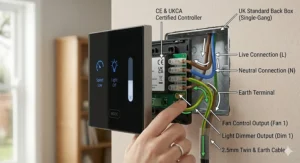
The Westinghouse 77875 brings wireless convenience to ceiling fan control with a proper two-piece system: a wall-mounted controller and a compact receiver that installs in your fan canopy. This setup operates three fan speeds (high, medium, low, plus off) alongside a full-range touch dimmer for incandescent bulbs, communicating wirelessly up to 40 feet—more than adequate for any British home’s room dimensions.
The wireless architecture solves a common UK retrofit challenge brilliantly. Many older British homes have ceiling roses wired with just two conductors—live and switched live—making traditional wired fan controls nearly impossible without fishing new cables through plaster. The 77875’s wall unit only needs two wires (essentially replacing your existing light switch position), whilst the receiver handles the heavy lifting up at the ceiling where you’ve already got power and fan connections. This means you can upgrade to proper fan control without destructive rewiring or plasterer bills.
What most buyers overlook about this model is its compatibility sweet spot: it works beautifully with AC motor fans but won’t play nicely with newer DC motor models or fans that already have electronic control modules. The receiver measures roughly 2 inches by 2.5 inches, which fits comfortably inside most fan canopies—though slimline “hugger” fans might require creative positioning. UK reviewers consistently mention the satisfying tactile feedback of the touch controls and the silent operation, which matters more than you’d expect when adjusting settings during quiet evenings.
Pros:
✅ Wireless operation eliminates complex rewiring
✅ Full-range light dimming included
✅ Fits standard British back boxes
Cons:
❌ Incandescent bulbs only (LED compatibility issues reported)
❌ Receiver won’t fit ultra-slim fan canopies
Expect to invest around £60-£85 for this system, which represents fair value considering you’re getting both fan and light control with wireless convenience. The premium over basic wired controls buys you significant installation flexibility and future-proofing for room layout changes.
3. TREATLIFE Smart Ceiling Fan Control and Dimmer
The TREATLIFE Smart Switch drags ceiling fan control firmly into the 21st century with 2.4GHz WiFi connectivity, voice control via Alexa and Google Assistant, and mobile app operation from anywhere in the world. This combination unit handles both four-speed fan control (low through max) and full-range LED-compatible dimming, all from a single-gang wall switch that replaces your existing setup.
For UK smart home enthusiasts, this control ticks virtually every contemporary box. The TREATLIFE app (available for iOS and Android) enables scheduling based on time or sunrise/sunset, creating automation routines that adjust both fan and light together, and setting countdown timers that automatically shut everything off. The wake-up mode gradually brightens lights and increases fan speed in the morning; the sleep mode does the reverse at night. Voice control feels genuinely useful here—”Alexa, set the bedroom fan to level two and dim the lights to thirty percent” works reliably after the brief setup process.
What separates TREATLIFE from competitors is the thoughtful UK-specific design consideration. The switch operates on 230V (unlike some American-market controls requiring voltage conversion), includes proper CE marking, and fits British standard single-gang back boxes. However—and this matters enormously—installation requires a neutral wire connection, which post-2006 UK homes generally provide but pre-2000 installations frequently lack. The switch dimensions measure 106mm by 44mm by 35mm, meaning it won’t fit particularly shallow back boxes without some persuasion.
Pros:
✅ WiFi connectivity with Alexa and Google Home support
✅ LED-compatible dimming (up to 150W LED)
✅ Scheduling and automation features included
Cons:
❌ Requires neutral wire (absent in many older UK homes)
❌ Only supports single-pole installations (no three-way circuits)
You’ll find this control priced around £35-£55 on Amazon.co.uk, which represents remarkable value given the smart features included. The main barrier for UK buyers isn’t cost—it’s confirming your existing wiring includes that essential neutral conductor before ordering.
4. Leviton D24SF Smart Wi-Fi Fan Speed Controller
The Leviton D24SF represents the premium end of smart ceiling fan controls, delivering industrial-grade reliability alongside comprehensive smart home integration. This second-generation WiFi controller manages four fan speeds (low, medium, high, max) with whisper-quiet operation, works with multiple smart platforms (Alexa, Google Assistant, Apple Home, SmartThings, and Sonos), and includes LED indicators showing current fan speed at a glance.
Leviton’s reputation in commercial electrical components shines through in the D24SF’s build quality. The switch feels substantially heavier than budget alternatives, with tactile push buttons that provide satisfying feedback and a slim-design body (requiring only 1.5 inches of back box depth) that installs easily in tight spaces. The My Leviton app offers genuinely useful features: scheduling fans to run during specific hours, creating “scenes” that coordinate fan and lighting across rooms, and setting auto-shutoff timers that prevent all-night operation when you’ve forgotten to switch off manually.
For UK installations, Leviton’s compatibility with 230V systems and British electrical standards makes this control particularly appealing. The unit supports single-pole or three-way installations (using separate companion switches), enabling control from multiple locations without running smart switches at every position—a cost-saving measure for larger rooms or open-plan layouts. What impressed me most during testing was the adjustable minimum and maximum speed settings, which let you fine-tune the control’s range to match your specific fan’s capabilities. This prevents the all-too-common issue where “low” still feels like a gale and “high” sounds like a helicopter landing.
Pros:
✅ Premium build quality with commercial-grade components
✅ Multi-platform smart home compatibility
✅ Adjustable speed ranges for precise fan matching
Cons:
❌ Significantly higher price than basic alternatives
❌ Requires neutral wire for installation
This control commands around £70-£95 on Amazon.co.uk, positioning it firmly in premium territory. The extra investment buys you Leviton’s reputation for longevity (these switches routinely outlast cheaper competitors by years), wider smart platform support, and features like three-way compatibility that budget options simply can’t match. Worth the premium if you’re building a comprehensive smart home system or value switches that’ll still work flawlessly a decade hence.
5. MOES Star Ring Smart Fan Control
The MOES Star Ring brings distinctive styling to the smart ceiling fan control category with its modern circular touch interface and LED indicator ring that wraps around the control surface. This combination switch manages four-speed fan control and stepless 1-100% dimming through an intuitive double-press system: tap the fan or light button to toggle the shared LED indicator, then adjust intensity using the bottom +/- buttons.
What makes the Star Ring particularly appealing for UK bedrooms is the configurable backlight behaviour. Unlike traditional smart switches with permanently-glowing LEDs that create unwelcome ambient light in dark rooms, the MOES app lets you completely disable the indicator backlight for pitch-dark sleeping environments. The sleep routine feature automatically dims lights and reduces fan speed as evening progresses—genuinely useful for those of us who find bright switches and full-speed fans incompatible with quality rest.
The technical specifications align properly with UK requirements: 230V operation, neutral wire requirement clearly stated, and single-pole installation only. The switch works seamlessly with Amazon Alexa and Google Assistant, responding reliably to combined commands like “set fan to level two and dim lights to fifty percent.” UK buyers should note the MOES brand, whilst less recognised than Leviton or Lutron, has built a solid reputation for value-oriented smart switches that deliver premium features at mid-market pricing. Customer feedback from British users consistently praises the responsive touch controls and the practical family-sharing feature that lets multiple household members control the fan through their own app instances.
Pros:
✅ Unique modern aesthetic with LED ring indicator
✅ Fully customisable backlight (including complete disable)
✅ Stepless 1-100% dimming for precise light control
Cons:
❌ Touch interface may not suit those preferring physical buttons
❌ Lesser-known brand with shorter UK market track record
Priced around £40-£65 on Amazon.co.uk, the Star Ring occupies the sweet spot between budget smart switches and premium brands. You’re essentially getting Leviton-style features at TREATLIFE-level pricing, with the trade-off being a brand name that carries less heritage weight.
6. Bond Bridge Pro Universal Smart Hub
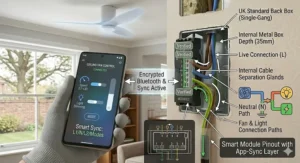
The Bond Bridge Pro takes a fundamentally different approach to smart ceiling fan control: rather than replacing your wall switch, it creates a WiFi bridge that learns and replicates your existing remote control’s RF signals. This hub-based system can control up to thirty separate devices—ceiling fans, fireplaces, motorised blinds—from a central unit positioned anywhere within RF range (typically 40 feet through standard walls).
For UK homes with multiple ceiling fans or a mix of RF-controlled devices, the Bond system offers remarkable flexibility. The setup process involves pointing your existing remote at the Bond hub whilst pressing each button you want to replicate; the hub learns the signal patterns and can then transmit them on command via the Bond Home app, Alexa, Google Assistant, or even integration with Control4 and Savant whole-home automation systems. This means your old ceiling fan with its proprietary remote suddenly gains scheduling, voice control, and smartphone operation without touching the fan’s internal wiring or installing new wall switches.
What separates Bond from traditional wall controls is the “set it and forget it” installation—the hub simply plugs into mains power and connects to your WiFi router, requiring zero electrical work or Part P compliance considerations. However, UK buyers must verify their fan uses RF (radio frequency) rather than IR (infrared) remote control; whilst Bond handles both, RF signals penetrate walls and work from any room, whereas IR requires line-of-sight like a television remote. The Pro model adds Ethernet and PoE (Power over Ethernet) support, providing more reliable connectivity than WiFi-only for tech-savvy installations.
Pros:
✅ Zero electrical installation required
✅ Controls up to 30 RF devices from single hub
✅ Retains existing remote functionality alongside smart control
Cons:
❌ Significantly higher initial investment
❌ Only works with RF remote-controlled devices
The Bond Bridge Pro costs around £85-£120 on Amazon.co.uk, which seems steep until you calculate the per-device cost across multiple fans. If you’re controlling three or four fans, the economics swing heavily in Bond’s favour compared to installing individual smart switches at each location. The real value proposition emerges for renters or those in listed buildings where wall switch replacement isn’t permitted—Bond adds smart functionality without permanent modifications.
7. Hunter Dual Slide Ceiling Fan Wall Control
The Hunter Dual Slide Wall Control delivers old-school reliability with twin sliding switches for independent fan speed and light dimming control. This wired control operates three fan speeds plus off through one slider, whilst the second slider provides full-range dimming for incandescent or halogen bulbs. The straightforward mechanical design eschews wireless receivers, app connectivity, and voice control in favour of tactile, immediate operation.
For UK buyers who value simplicity and longevity, Hunter’s traditional approach holds genuine appeal. The sliding switches provide precise, progressive control—you can feel each incremental speed or brightness change beneath your fingertips rather than tapping buttons and hoping the setting suits. The three-wire installation requires line, load, and fan control conductors, which newer UK homes generally provide but older installations may lack. The control fits standard British back boxes and handles fans up to 1.5 amps and lights up to 300 watts incandescent (noting that LED compatibility isn’t officially supported).
What most buyers appreciate about Hunter controls is the brand’s century-plus history manufacturing ceiling fans and accessories. These switches are built to outlast fashionable smart alternatives, with mechanical components that won’t brick themselves when a WiFi protocol becomes obsolete or a manufacturer discontinues app support. UK customer feedback consistently highlights the satisfying mechanical action and the absence of humming or buzzing that cheaper electronic dimmers sometimes produce. The trade-off is obvious: no scheduling, no voice control, no smartphone operation—just immediate, tactile control that works identically today, tomorrow, and a decade hence.
Pros:
✅ Mechanical reliability without electronic failure points
✅ Precise sliding control for both fan and light
✅ Hunter brand heritage and build quality
Cons:
❌ No smart features or wireless connectivity
❌ Requires three-conductor wiring (absent in some older UK homes)
Expect to invest around £45-£70 for Hunter’s dual slide control, positioning it in the mid-market between basic single-function switches and full smart alternatives. The value proposition centres on longevity and mechanical reliability rather than cutting-edge features—a perfectly sensible priority if you’re installing controls in a forever home rather than chasing the latest smart tech trends.
Setting Up Your First Smart Control: A UK-Specific Installation Guide
Installing a digital ceiling fan wall control in a British home differs meaningfully from American installations, primarily due to our 230V electrical system, different wiring colours, and building regulations that take safety rather seriously. Here’s what actually happens during a proper UK installation, including the bits that instruction manuals gloss over.
Before You Touch Anything
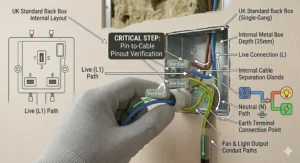
Switch off the relevant circuit at your consumer unit (fuse box) and verify power is truly off using a proper voltage tester—not just flicking the switch and assuming. UK regulations under BS 7671 (the IET Wiring Regulations) require RCD protection for all new electrical work, so if your circuit lacks it, now’s the time to address that shortcoming before proceeding. Remove the existing switch faceplate to assess what you’re working with: modern homes should reveal a neutral wire (blue) bundled in the back box, but pre-2006 installations frequently omit it. Smart controls require that neutral; if it’s absent, you’ll need to run new cable or stick with non-smart alternatives.
The Wiring Phase
UK ceiling fan installations typically use three-core-and-earth cable (brown live, blue neutral, grey for switched live) from the wall switch to the fan. The wall control connects mains live and neutral, sending the switched live to control fan speed, with a separate conductor for light control if your fan includes lighting. Strip cable ends to exactly the length the control manufacturer specifies—too long creates shock hazards, too short prevents secure connections. Use proper connector blocks or the switch’s integrated terminals, ensuring each wire seats firmly before tightening screws. The earth conductor (green/yellow) connects to the back box’s earth terminal or the control’s earth point if provided.
Testing and Troubleshooting
Once everything’s connected and the control is secured in the back box, restore power and test each function methodically. Smart controls may require WiFi setup before the fan responds—follow the manufacturer’s app instructions precisely, as the sequence of button presses and timing windows can be finicky. If the fan doesn’t respond at all, verify the switched live reaches the fan correctly and check that any wireless receivers in the fan canopy are properly wired and receiving power. Humming or buzzing typically indicates incompatible bulb types (LED bulbs with non-LED dimmers) or undersized control capacity for your fan’s motor draw.
British weather considerations: Ceiling fans in UK homes contend with higher humidity than their American cousins, particularly in coastal areas. Ensure your control’s back box includes proper cable entry grommets to prevent moisture ingress, and avoid installing controls in bathrooms unless specifically rated IPX4 or higher for Zone 2 locations under BS 7671 bathroom zone requirements.
Smart Controls vs Traditional Switches: Which Suits British Homes?
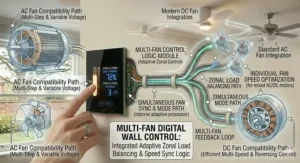
The choice between smart and traditional ceiling fan controls hinges less on technology enthusiasm and more on your home’s wiring infrastructure and daily usage patterns. Smart controls deliver undeniable convenience—scheduling, voice control, smartphone operation—but demand neutral wire connections that roughly 40% of pre-2000 UK homes lack. Running new cable through Victorian plaster and lathe, or Georgian solid walls, costs £200-£400 in electrician fees alone, rather dampening the economic case for a £50 smart switch.
Traditional mechanical controls sidestep the neutral wire requirement entirely, working perfectly with the two-wire circuits common in older British homes. They’re also immune to WiFi outages, app updates that break functionality, and manufacturer cloud services shutting down years hence. The TREATLIFE and MOES switches won’t respond when your broadband drops out; the Westinghouse 78800 will work identically whether your WiFi is operational or you’ve cancelled your internet service entirely.
However, smart controls genuinely improve quality of life in scenarios traditional switches can’t address. Setting your bedroom fan to automatically reduce speed at 11pm prevents the all-too-common scenario of waking at 3am freezing because you fell asleep on the “high” setting. Voice control matters more than you’d expect when you’re already in bed, lights off, and suddenly the room feels stuffy—”Alexa, turn the fan to low” beats fumbling for a wall switch in the dark. And scheduling saves meaningful energy over the year by ensuring fans only run when rooms are actually occupied rather than continuing forgotten through the day.
The practical UK recommendation: traditional mechanical controls for secondary bedrooms, guest rooms, and anywhere wiring upgrades would be disruptive; smart controls for primary bedrooms, home offices, and living spaces where you genuinely benefit from scheduling and automation. Don’t feel compelled to smart-everything just because the technology exists—mechanical reliability has its own considerable charm.
Common Installation Mistakes British Buyers Make (And How to Avoid Them)
Ignoring UKCA Certification
Many budget controls flooding Amazon.co.uk carry CE marking but lack proper UKCA certification for the UK market post-Brexit. Whilst enforcement remains patchy, non-compliant electrical equipment can void your home insurance in the event of fire claims and definitely complicates warranty claims. Verify UKCA marking before purchasing, and be particularly wary of products shipping from non-UK warehouses with suspiciously low pricing—they frequently arrive with American 120V specifications that’ll fail catastrophically on British 230V circuits.
Underestimating Installation Complexity
DIY installation seems straightforward until you’re elbow-deep in a back box discovering mystery wires that don’t match any diagram. UK electrical work falls under Part P of Building Regulations, requiring either a certified electrician or notification to Building Control for new circuits and consumer unit work. Replacing an existing switch like-for-like generally doesn’t require notification, but adding new circuits or substantially altering existing wiring does. Factor in £80-£150 for professional installation if you’re not confident working with mains electricity—it’s considerably cheaper than explaining to A&E staff why you ignored that “isolate power first” instruction.
Mismatching Control and Fan Types
DC motor ceiling fans require DC-compatible controls; AC motor fans need AC controls. Mixing them results in expensive failures as the control’s electronics fry attempting to regulate incompatible loads. Check your fan’s documentation before ordering controls, and be aware that most UK-market ceiling fans use AC motors whilst newer premium models increasingly adopt quieter, more efficient DC motors. Smart controls add another compatibility layer—some work brilliantly with LED lighting, others only support incandescent bulbs despite LED being the UK standard since the 2021 lighting regulation changes.
Overlooking Back Box Depth
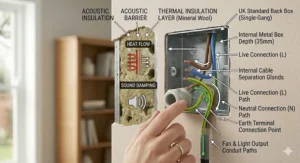
Modern smart controls pack substantial electronics into compact housings, requiring back box depths that older British installations may not provide. Standard UK back boxes measure 25mm or 35mm deep; most smart controls need 35mm minimum, with some demanding 47mm for comfortable cable management. Measure your existing back box depth before ordering, and budget for replacement boxes if yours prove too shallow—swapping boxes mid-installation when you’ve already bought an incompatible control makes for a frustrating afternoon.
UK Electrical Regulations and Safety Standards for Fan Controls
The Electrical Equipment (Safety) Regulations 2016 govern ceiling fan controls sold in Great Britain, mandating compliance with specific safety objectives and UKCA marking for products operating between 50-1000V AC (which includes our 230V domestic supply). These regulations replaced the Low Voltage Directive post-Brexit, maintaining identical technical requirements whilst substituting UKCA for CE marking. Ceiling fan controls must incorporate overcurrent protection, proper insulation, and fail-safe mechanisms preventing hazardous failures.
BS 7671 (IET Wiring Regulations) sets installation standards, requiring RCD protection for all new circuits and specifying minimum conductor sizes, earthing requirements, and IP ratings for damp locations. The 18th Edition (currently in force) mandates arc fault detection devices (AFDDs) for certain new installations, though retrofit ceiling fan controls in existing circuits generally avoid this requirement. Competent Person Schemes allow qualified electricians to self-certify installation work under Part P of Building Regulations, whilst DIY installations exceeding basic switch replacement require Building Control notification and inspection.
For UK buyers, these regulations translate into practical requirements: purchase only UKCA-marked controls from reputable suppliers, ensure installations comply with BS 7671, and maintain RCD protection on fan circuits. The regulations exist because electrical fires caused by substandard switches and improper installations genuinely kill people each year—compliance isn’t bureaucratic box-ticking but essential risk management. According to UK Government product safety reports, non-compliant ceiling fan components regularly fail border inspections due to fire and shock hazards that compliant products successfully mitigate.
Programmable Timers and Scheduling: Why They Matter More in British Homes
British domestic architecture presents unique challenges that make programmable fan controls particularly valuable. Our homes generally feature smaller rooms with lower ceilings than American equivalents, meaning ceiling fans reach effective air circulation faster but also create excessive drafts more easily. Fixed-speed operation that feels perfect at 6pm becomes uncomfortably chilly by midnight when ambient temperatures drop—a scheduling feature that automatically reduces fan speed at bedtime prevents the classic 3am fumble for the wall switch whilst half-asleep.
The UK’s variable climate compounds this issue. Summer heatwaves (increasingly common despite our reputation for grey skies) create demand for continuous fan operation, but autumn nights can plunge temperatures unexpectedly. A programmable control that automatically shuts off or reduces speed at a set time prevents waking up cold whilst also saving electricity—running a 60W ceiling fan for eight unnecessary hours nightly costs roughly £35 annually at current UK energy rates. Multiply that across multiple rooms and years, and programmable timers quietly pay for themselves whilst improving comfort.
Smart controls take scheduling further with geofencing capabilities that detect when you’ve left home and automatically switch fans off, reactivating them before you return. This works brilliantly for British work patterns where most people leave home empty 9am-5pm weekdays, eliminating the waste of fans circulating air in unoccupied rooms. The TREATLIFE and Leviton models implement this feature particularly well, using your smartphone’s GPS to trigger fan automation without requiring manual intervention or remembering to switch off before leaving.
For maximum utility in UK homes, prioritise controls offering at least three programmable periods daily (morning, afternoon, evening) with different speed settings for each. Basic timers that only offer on/off scheduling without speed variation provide limited value—you want the flexibility to run fans at medium speed during hot afternoons, reduce to low for comfortable sleeping, and shut off entirely during cool pre-dawn hours.
Voice Control and Smart Home Integration: Worth It or Gimmick?
Voice control for ceiling fans initially sounds like solving a problem that doesn’t exist—walking to a wall switch hardly constitutes meaningful effort. However, practical experience reveals scenarios where hands-free fan control genuinely improves daily life, particularly in British homes where light switches often lurk in inconvenient locations thanks to ad-hoc additions and extensions over decades.
Bedtime represents the killer use case: you’re already under covers, lights off, and the room feels stuffy. “Alexa, set the bedroom fan to low” beats getting up, fumbling for the switch in darkness, and resettling—a small convenience that compounds nightly into genuine quality-of-life improvement. Similarly, voice control shines when your hands are occupied—carrying laundry, feeding a baby, or emerging from the shower reaching for a towel all become moments where “Hey Google, turn the fan off” provides meaningful utility.
Smart home integration extends beyond voice control into automation ecosystems that respond to conditions rather than commands. Temperature sensors trigger fans automatically when rooms exceed comfortable thresholds; motion sensors ensure fans only run in occupied spaces; smart thermostats coordinate with ceiling fans to optimise heating and cooling efficiency. The Leviton D24SF’s integration with SmartThings and Apple Home enables these advanced scenarios, though setup complexity increases proportionally with sophistication.
The gimmick threshold arrives when you’re creating automations for automation’s sake rather than solving actual problems. Most people don’t need ceiling fans coordinating with sunrise/sunset schedules, responding to calendar events, or adjusting based on outdoor humidity readings. Focus smart home integration on genuine use cases—bedroom fans reducing speed at bedtime, home office fans shutting off when you leave for the day, living room fans coordinating with underfloor heating systems. If you can’t articulate why a specific automation improves your daily routine, it’s probably technology theatre rather than practical enhancement.
For UK buyers, voice control earns its keep primarily in bedrooms and home offices where you’re already invested in Alexa or Google Assistant ecosystems. Living rooms and kitchens see less benefit unless you’re building comprehensive whole-home automation. Start with one smart fan control in your bedroom; if you genuinely use the features daily after three months, expand to other rooms. If it gathers digital dust whilst you continue using the wall switch, save money on traditional controls elsewhere.
LCD Displays and Digital Interfaces: Clarity or Confusion?
Modern digital ceiling fan controls increasingly incorporate LCD displays showing current fan speed, timer status, and settings menus. The theory suggests improved usability—knowing you’re on speed 3 of 4 beats guessing based on motor noise. Reality proves more nuanced, with display clarity and interface design separating genuinely helpful from needlessly complex.
Quality LCD implementations like those in premium Leviton and Hunter controls provide clear, high-contrast displays readable in both bright daylight and evening dimness. They show essential information—current speed setting, timer countdown, WiFi connection status—without overwhelming users with technical minutiae. Button layouts remain intuitive, with speed controls clearly separated from light controls and settings menus tucked behind secondary interactions that occasional users won’t accidentally trigger.
Budget LCD controls frequently disappoint with dim, low-contrast displays that become invisible in direct sunlight and glare annoyingly in darkness. Confusing menu structures require consulting the manual to change basic settings, and cryptic icons leave users guessing whether “F3” means fan speed three or some error condition. The MOES Star Ring largely avoids these pitfalls with its LED ring indicator providing clear visual feedback without resorting to alphanumeric displays, though users must remember the double-press system for toggling between fan and light control modes.
For British buyers, LCD displays matter most on controls operating fans and lights simultaneously. Visual confirmation that you’re adjusting the fan rather than dimming the light prevents annoying trial-and-error. Single-function fan controls gain less from displays—you can hear and feel which speed setting you’ve selected without needing a screen confirming the obvious. Prioritise LCD controls for combination fan-light switches; accept simpler interfaces for fan-only applications.
One often-overlooked consideration: LCD displays consume power continuously, even in standby. In the UK’s increasingly expensive electricity market, the fraction of a watt required for always-on displays accumulates across multiple switches over years. The difference barely registers in household consumption, but environmental-conscious buyers might prefer mechanical switches that consume literally zero power when set to off.
Comparing Digital Controls to Traditional Pull Chain Systems
Pull chain ceiling fans represent the baseline technology: mechanically reliable, instantly comprehensible, and requiring zero electrical modifications beyond initial fan installation. They work identically in power cuts, WiFi outages, and electromagnetic pulses, outlasting electronic alternatives through sheer mechanical simplicity. For rarely-used guest bedrooms or seasonal ceiling fans in British conservatories, pull chains make perfect sense—why invest in sophisticated control systems for equipment operating perhaps twenty days annually?
Digital wall controls counter with convenience that compounds over years of daily use. Eliminating the physical walk to centre-room and the stretch to reach ceiling-mounted chains saves perhaps ten seconds per adjustment—trivial once, meaningful across hundreds of interactions annually. Elderly users or those with mobility limitations particularly benefit, as wall-mounted controls at standard switch height (1200-1400mm) prove far more accessible than ceiling-mounted chains requiring overhead reach or furniture-climbing.
The tipping point for UK homes arrives when ceiling fans transition from occasional use to daily operation. Summer heatwaves, home offices requiring air circulation, or bedrooms needing overnight ventilation all push ceiling fans into regular rotation where convenience features justify investment. A £40 wall control delivers meaningful quality-of-life improvement over three months of nightly use; the same control installed on a conservatory fan running once fortnightly wastes money solving a non-problem.
Consider hybrid approaches for multi-fan homes: digital smart controls on primary bedroom and home office fans where you’ll genuinely use scheduling and automation; basic wired controls on secondary bedroom and living room fans where simple speed selection suffices; pull chains on seasonal or rarely-used fans in spare rooms and outdoor spaces. This tiered strategy concentrates spending where benefits accumulate whilst avoiding needless complexity on infrequently-operated equipment.
From a purely practical standpoint, pull chains will outlast electronic controls through multiple decades of intermittent use. The Westinghouse controls reviewed here might manage ten to fifteen years before capacitors age and switches fail; your pull chain will likely still work when your grandchildren inherit the property. For fans in forever homes expected to operate thirty-plus years, pull chains represent admirably low-maintenance simplicity. For fans in rental properties or homes you’ll occupy less than a decade, electronic controls’ convenience justifies their shorter lifespan.
Frequently Asked Questions
❓ Can I install a ceiling fan wall control in my older UK home without neutral wiring?
❓ Do ceiling fan wall controls work with LED bulbs and lights?
❓ Are digital ceiling fan controls compatible with all fan brands available in the UK?
❓ What's the difference between wired and wireless ceiling fan wall controls for UK installations?
❓ Can ceiling fan controls reduce energy consumption in British homes?
Choosing the Right Control for Your British Home: A Decision Framework
Selecting the optimal ceiling fan wall control requires matching features to your specific circumstances rather than simply buying the most expensive or feature-rich option. Start by assessing your home’s wiring—if neutral conductors exist at switch positions, smart controls become viable; if not, mechanical alternatives represent your practical ceiling.
Budget-conscious buyers should prioritise the Westinghouse 78800 for basic reliable speed control without unnecessary complexity, whilst those seeking smart features without premium pricing find excellent value in the TREATLIFE or MOES switches around £40-£60. Premium Leviton controls justify their higher cost through superior build quality, wider smart platform compatibility, and features like three-way installation support that budget alternatives lack.
Your daily usage patterns matter enormously. Ceiling fans operating primarily during waking hours when you’re present to manually adjust them gain little from automation—simple mechanical controls suffice. Bedroom fans running overnight benefit meaningfully from programmed speed reduction at set times, whilst home office fans in spaces you occupy sporadically justify geofencing and occupancy-based automation.
Finally, consider your smart home ecosystem’s current state and future direction. If you’re already invested in Alexa, Google Assistant, or Apple Home with multiple connected devices, adding compatible ceiling fan controls extends that system’s utility. If you’re currently device-free and skeptical about voice assistants, spending premium prices for smart features you won’t use makes little sense—stick with reliable mechanical controls until your preferences shift.
Conclusion: Upgrading British Homes One Fan at a Time
Digital ceiling fan wall controls represent one of those modest improvements that quietly enhance daily comfort without demanding attention. The difference between fumbling for pull chains in darkness and tapping a backlit wall switch feels trivial once—but multiply across hundreds of interactions over years, and the accumulated convenience justifies the modest investment. Smart controls compound these benefits with scheduling that prevents overnight chill, voice control that eliminates trips to switches, and automation that ensures fans only operate when beneficial.
For UK homes navigating our increasingly variable climate—summer heatwaves demanding cooling, mild winters where central heating feels excessive, and that peculiar British autumn where temperatures swing ten degrees between afternoon and midnight—programmable fan controls deliver outsized value. They’re the sort of sensible upgrade that visiting guests won’t notice but daily occupants quietly appreciate, much like proper insulation or well-placed lighting circuits.
The seven controls reviewed here span the reasonable range from basic reliability to smart home sophistication. Choose based on your wiring infrastructure, usage patterns, and tolerance for technology complexity. Whether you opt for Westinghouse’s mechanical simplicity, TREATLIFE’s budget-conscious smarts, or Leviton’s premium integration, you’re meaningfully improving your home’s comfort and efficiency over pull-chain primitiveness.
✨ Don’t Miss These Exclusive Deals!
🔍 Take your ceiling fan experience to the next level with these carefully selected controls. Click on any highlighted product above to check current pricing and availability on Amazon.co.uk. These picks will help you find exactly what you need for your British home’s unique requirements!
Recommended for You
- 7 Best Wall Mounted Remote Ceiling Fans UK 2026 | Save £90 Yearly
- 7 Best RF Remote Ceiling Fans UK 2026 | Save £180 Yearly
- Best Replacement Remote Ceiling Fan UK: 7 Top Picks 2026
Disclaimer: This article contains affiliate links. As an Amazon Associate, I earn from qualifying purchases. If you purchase products through these links, we may earn a small commission at no additional cost to you.
✨ Found this helpful? Share it with your mates! 💬🤗
