In This Article
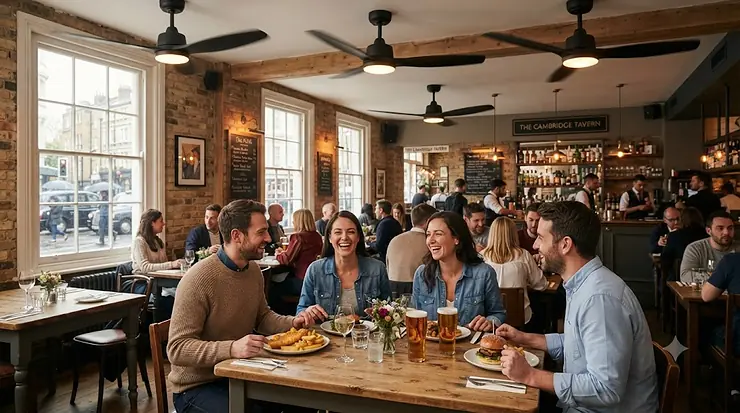
Walk into any restaurant on a warm Friday night and you’ll feel it before you see it — that faint stir of air moving across the room, brushing the back of your neck, nudging a candle flame sideways. That’s not an accident. Restaurant ceiling fans are commercial-grade overhead units installed in dining rooms, bars and kitchens to keep air circulating, temperatures even and guests comfortable without the drone of an air conditioning unit fighting for attention. Get the choice wrong and you’ll know it within a week — wobbling blades, complaints about draughts on table six, or worse, a dining room that still feels like a greenhouse in August.
This guide exists because most buying advice out there was written for bedrooms, not for a 60-cover dining room with an open kitchen pass and a ceiling height that changes the rules entirely. We’ve dug through real specifications, aggregated genuine review sentiment, and cross-checked UK compliance requirements so you’re not left guessing. Whether you’re fitting out a new café, refreshing tired air in a Victorian pub conversion, or trying to stop the corner booths from feeling like a sauna, there’s a fan below built for the job. We’ll cover seven real, currently available models spanning budget to premium, walk through sizing and placement, and flag the regulatory boxes that UK hospitality venues genuinely need to tick before installation day.
One thing worth saying upfront: restaurant ceiling fans aren’t just a cooling gadget bolted to the ceiling as an afterthought. Done well, they’re part of the room’s design language — the gentle whirr above a zinc-topped bar, the warm-season breeze over a conservatory extension. Done badly, they’re the reason a five-star meal gets a three-star review because the air felt stagnant and the neighbouring table’s perfume never left the room. Let’s get it right.
Quick Comparison Table: Restaurant Ceiling Fans at a Glance
Before diving into the full breakdown, here’s the shape of the market in one place. Sizes, indicative price bands and the venue type each fan suits best — useful if you’re skimming on a phone between covers.
| Fan | Blade Span | Price Range (approx.) | Best For |
|---|---|---|---|
| Westinghouse Industrial 142cm | 142cm | around £150-£200 | Large open-plan dining rooms |
| Westinghouse Industrial Cromo | 122cm | £250-£300 range | Premium bars and lounges |
| Fantasia Commercial 36-Inch | 91cm | £150-£250 range | Low-ceiling gastropubs |
| Reiga 132cm Smart Ceiling Fan | 132cm | £150-£220 range | Modern, app-controlled dining spaces |
| Ohniyou 52-Inch Low Profile Fan | 132cm | £120-£180 range | Flush-mount, low-clearance rooms |
| VONLUCE 52-Inch Outdoor Fan | 132cm | £150-£220 range | Terraces, conservatories, covered patios |
| NIORSUN 50cm Ceiling Fan | 127cm | under £100 | Small cafés and tight budgets |
Looking at this spread, the split between industrial-style commercial fans and residential-adjacent “smart” models is the first fork in the road you’ll hit. The bigger blade spans (132cm and above) generally win in open-plan dining rooms with higher ceilings, while the compact 91-127cm models suit converted period buildings where headroom is already tight. Budget buyers shouldn’t assume “cheapest” means “worst value” here — the NIORSUN 50cm Ceiling Fan punches well above its price point for smaller cafés, though it won’t touch the airflow volume of the industrial units further up the table.
💬 Just one click — help others make better buying decisions too!😊
Top 7 Restaurant Ceiling Fans: Expert Analysis
Here’s the full breakdown of the seven fans, spanning budget, mid-range and premium tiers, with real specifications interpreted for what they actually mean on a busy dining floor.
1. Westinghouse Industrial 142cm — biggest blade span for open dining rooms
The standout here is sheer scale: at 142cm tip to tip, this is the largest fan on our list, and that size is exactly why it earns its “Industrial” name. A three-blade steel design paired with a 3-speed reversible AC motor means it moves genuinely large volumes of air across an open-plan dining room without needing two or three smaller fans dotted around the ceiling instead. Winter/summer reverse function lets it push warm air back down from a high ceiling during colder months, which matters more than people expect once heating bills start climbing.
Based on the spec comparison against smaller domestic-style fans, this unit is built for rooms of genuine scale — think 60+ covers under one roof, or a converted warehouse-style restaurant with exposed ductwork and a tall ceiling. What most buyers overlook about a fan this large is the drop distance: with a big blade span comes a wider safety clearance requirement, so it’s not the right pick for anywhere with ceilings under 3 metres.
Reviewers consistently note strong build quality and quiet running for a fan of this size, though a handful mention that the AC motor hums slightly louder on its top speed than the newer DC alternatives in this list — worth bearing in mind if your dining room prizes a whisper-quiet atmosphere over raw airflow.
Pros:
- ✅ Largest blade span for genuinely big dining rooms
- ✅ Reversible motor useful across all seasons
- ✅ Robust steel construction built for daily commercial use
Cons:
- ❌ Requires higher ceiling clearance than most alternatives
- ❌ AC motor runs marginally louder than DC-driven rivals
Priced around £150-£200 at the time of research, this represents strong value per square metre covered, though smaller venues would be paying for airflow capacity they’ll never actually use.

2. Westinghouse Industrial Cromo — premium chrome finish for feature spaces
Where the standard Industrial model is all function, the Westinghouse Industrial Cromo adds genuine design intent — a metal frame with a polished chrome finish and matching chrome-steel blades that catch light rather than just moving air invisibly overhead. It’s rated for rooms up to around 20 square metres, with a 4-position wall switch and remote-control compatibility, plus the same summer/winter reversing function found on its sibling model.
On paper this means it’s aimed squarely at feature spaces — a cocktail bar, a hotel restaurant reception area, anywhere the ceiling fixture is meant to be looked at rather than simply tolerated. Here’s what to weigh: chrome finishes show fingerprints and grease more readily than matte or wood-effect blades, which matters in a kitchen-adjacent bar area where staff are constantly reaching up to adjust lighting or decorations nearby.
Aggregated review sentiment for the Cromo line is thin compared with the more mainstream Industrial range, but what does exist consistently praises the finish quality and the satisfying weight of the switch mechanism — small details that add up in a space guests are meant to notice.
Pros:
- ✅ Genuinely eye-catching chrome finish for feature areas
- ✅ Reversible summer/winter operation included
- ✅ Suitable for rooms up to roughly 20 square metres
Cons:
- ❌ Chrome shows marks more readily than matte finishes
- ❌ Fewer independent reviews than the standard Industrial range
Expect to pay in the £250-£300 range, positioning this firmly as a design statement rather than a budget workhorse — worth it if the fan itself is meant to be part of the room’s décor.
3. Fantasia Commercial 36-Inch — British-brand compact commercial fan
Fantasia has been building fans in the UK since the mid-1980s, and the Commercial 36-Inch is the brand leaning into what it does best: a compact, no-nonsense unit engineered specifically for commercial installations rather than adapted from a domestic range. At 91cm blade span, it’s noticeably smaller than the Westinghouse units above, which is precisely the point — this fan is designed for spaces where headroom, not floor area, is the limiting factor.
What most buyers overlook about smaller commercial fans is that blade span isn’t the only variable that determines airflow; motor torque and blade pitch angle matter just as much in a confined space. Based on the spec comparison, the Commercial 36-Inch’s tighter housing and remote-compatible 3-speed motor make it a sensible match for converted pubs, narrow high-street cafés and any dining room where a 132cm fan simply wouldn’t clear the beams.
Reviewers consistently highlight the brand’s UK-specific compliance credentials — being built to EN 60335 domestic and commercial electrical safety standards gives buyers a paper trail that’s genuinely useful when a local authority inspection comes knocking, rather than having to chase documentation from an overseas-only brand.
Pros:
- ✅ Compact housing suited to low-ceiling period buildings
- ✅ British brand with UK-specific compliance documentation
- ✅ Remote-compatible for easy front-of-house control
Cons:
- ❌ Smaller blade span limits coverage for bigger rooms
- ❌ Fewer finish options than the wider Fantasia domestic range
At £150-£250 range depending on finish and remote kit, this sits mid-table on price but wins decisively on regulatory peace of mind for UK operators.
4. Reiga 132cm Smart Ceiling Fan — app control for design-led dining rooms
The Reiga 132cm Smart Ceiling Fan is the clearest nod to where commercial fan technology is heading: app control alongside a physical remote, six speed settings on a quieter DC motor, a built-in timer, and dark grey blades that read as deliberately modern rather than generically “hospitality beige.” For restaurants leaning into a contemporary aesthetic — think exposed concrete, pendant lighting, an open kitchen — this fan looks like it was chosen rather than just installed.
Here’s what to weigh: app control genuinely earns its keep in a commercial setting because staff can adjust fan speed from a tablet at the host stand rather than fumbling for a wall switch mid-service, and the timer function means the fan can be scheduled to ramp up automatically before the lunch rush without anyone remembering to flip a switch. On paper the 6-speed DC motor also means finer control over airflow than a basic 3-speed AC unit allows, useful for dialling in exactly the right breeze rather than jumping straight from “still” to “gale.”
Reviewers consistently report smooth, quiet operation and praise the app’s reliability, though a smaller number note that Wi-Fi dropouts in older buildings with thick stone walls can occasionally disconnect the smart features — the fan still runs fine manually via remote in that scenario, so it’s an inconvenience rather than a dealbreaker.
Pros:
- ✅ App and remote control for flexible front-of-house use
- ✅ Six-speed DC motor allows fine airflow adjustment
- ✅ Built-in timer for automated pre-service scheduling
Cons:
- ❌ Smart features can be patchy in buildings with thick walls
- ❌ Higher setup complexity than a basic remote-only fan
In the £150-£220 range, it’s genuinely competitive against fans without any smart features at all, making the app control feel like a bonus rather than a premium tax.
5. Ohniyou 52-Inch Low Profile Fan — flush mount for tight ceiling clearance
Low ceilings are the silent dealbreaker in restaurant fan-buying, and the Ohniyou 52-Inch Low Profile Fan exists specifically to solve that problem. Its flush-mount design sits close to the ceiling rather than dropping on a long rod, which matters enormously in converted shopfronts, basement dining rooms or anywhere building regulations have already eaten into your headroom before the fan even goes up.
Based on the spec comparison, the combination of a quiet DC motor, dimmable integrated lighting and reversible operation makes this a genuine two-in-one fixture — useful when a tight ceiling means you can’t justify separate pendant lights and a fan taking up the same visual real estate. What most buyers overlook is that low-profile fans, because the blades sit closer to head height by definition, need slightly more careful placement away from tall bar stools or raised booth seating to avoid anyone brushing the blades when standing.
Aggregated review sentiment is strongly positive on the light output and the black-and-wood colour combination reading as more premium than the price suggests, with the main recurring criticism being that the remote’s button labelling is smaller than ideal for dimly lit dining rooms.
Pros:
- ✅ True flush mount for rooms with limited ceiling height
- ✅ Combines dimmable lighting with fan function in one fixture
- ✅ Quiet DC motor suited to intimate dining atmospheres
Cons:
- ❌ Remote controls can be fiddly to read in low light
- ❌ Blade proximity needs careful placement near tall seating
At £120-£180 range, this represents strong mid-tier value, particularly for venues that would otherwise be buying lighting and ventilation as two separate line items.
6. VONLUCE 52-Inch Outdoor Fan — weatherproof choice for terraces and conservatories
Not every restaurant ceiling fan lives indoors, and the VONLUCE 52-Inch Outdoor Fan is built for exactly that reality — a weather-rated unit with walnut-effect blades and a reversible 6-speed DC motor, designed to keep covered terraces, conservatories and glazed extensions comfortable through a British summer that can swing from drizzle to heatwave within the same week. The farmhouse-style blade finish also does a decent job of looking intentional rather than purely functional, which matters when the terrace is half the reason guests booked a table outside in the first place.
Here’s what to weigh: outdoor-rated doesn’t mean identical performance in every microclimate — a fully exposed terrace with driving rain will still stress a fan more than a genuinely covered patio, so checking the IP rating against your specific setup (rather than assuming “outdoor” covers every scenario) is worth the extra five minutes before ordering. On the plus side, the noiseless DC motor and reversible function mean the same fan can gently cool a summer terrace and, reversed, help push warm air from a patio heater more evenly across the seating area on a chillier evening.
Reviewers consistently praise the wood-effect finish for looking more expensive than the price tag suggests, with occasional mentions that assembly instructions could be clearer for anyone installing without an electrician on-site — a fair point, given commercial installations should be handled by a qualified electrician regardless.
Pros:
- ✅ Weather-rated for covered terraces and conservatories
- ✅ Reversible DC motor useful across seasons
- ✅ Farmhouse-style finish suits outdoor dining aesthetics
Cons:
- ❌ Full weatherproofing depends on genuine cover, not just IP rating claims
- ❌ Assembly instructions could be clearer for non-professional installers
Priced in the £150-£220 range, it’s a smart middle ground for venues that treat outdoor seating as a genuine extension of the dining room rather than an afterthought.
7. NIORSUN 50cm Ceiling Fan — best budget pick for small cafés
Not every venue needs — or can justify — a four-figure fit-out for overhead cooling, and the NIORSUN 50cm Ceiling Fan is the answer for smaller cafés, coffee shops and compact dining rooms working within a tighter budget. Six speed settings and dimmable 3000K-6500K LED lighting give it more flexibility than the price point suggests, and a memory function means the fan resumes its last setting automatically after a power cut — a small but genuinely useful feature in venues on older electrical circuits.
What most buyers overlook about budget fans generally is that “cheap” and “underpowered” aren’t automatically the same thing; a well-engineered small-diameter fan can still move meaningful air in a room under roughly 25 square metres, which covers a large proportion of independent UK cafés. Based on the spec comparison, the trade-off here isn’t really airflow — it’s ceiling coverage and light output scale, both of which matter less in a cosy 20-cover café than they would in a 100-cover dining hall.
Reviewers consistently report quiet running and easy remote pairing, with the main honest caveat being that six-blade small-diameter fans generally can’t match the raw air-shifting capacity of the 132cm-plus models further up this list — a fair trade for the price difference, provided your room size matches the fan’s intended footprint.
Pros:
- ✅ Strong value for genuinely small dining spaces
- ✅ Memory function retains settings after power cuts
- ✅ Dimmable, colour-adjustable LED lighting included
Cons:
- ❌ Limited airflow coverage for larger dining rooms
- ❌ Smaller blade span than every other fan on this list
At under £100, this is comfortably the most accessible entry point on our list, and arguably the smartest first purchase for a café owner testing whether ceiling fans suit their space before committing to a bigger spend.
Restaurant Ceiling Fans vs Traditional Alternatives
Air conditioning units, standing pedestal fans and wall-mounted extractors have all done the job of restaurant cooling for decades, so it’s fair to ask why a ceiling fan deserves a look at all. The honest answer is that they solve a different problem than air conditioning does — a ceiling fan doesn’t lower the actual room temperature, it changes how that temperature feels by keeping air moving across skin, which triggers the body’s natural cooling response through evaporation.
| Solution | Upfront Cost | Running Cost | Best Use |
|---|---|---|---|
| Ceiling fans | Low-moderate | Low | Year-round comfort and air circulation |
| Air conditioning | High | High | Genuine temperature reduction in extreme heat |
| Pedestal/standing fans | Very low | Low | Temporary or portable spot-cooling |
| Wall extractors | Moderate | Moderate | Kitchen odour and steam removal |
The clearest pattern in this table is that ceiling fans and air conditioning aren’t really competitors — they’re complementary. A restaurant running air conditioning alongside a ceiling fan can often set the thermostat a couple of degrees higher without guests noticing any difference in comfort, because the wind-chill effect from the fan does part of the work for free. Pedestal fans, by contrast, solve a narrower problem: useful for a temporary marquee event or an emergency stopgap, but genuinely impractical as a permanent fixture weaving between table legs and trip hazards on a busy floor.
Wall-mounted extractors remain essential in kitchens regardless of what’s happening in the dining room, since they’re removing grease-laden air and steam rather than simply circulating it — a job a ceiling fan was never designed to do. The two systems working together, extraction in the kitchen and ceiling fans in the dining room, is the combination most UK hospitality consultants actually recommend rather than treating either as a standalone solution.
Practical Usage Guide: Installation, Setup and First 30 Days
Getting a restaurant ceiling fan from delivery box to smoothly spinning overhead fixture involves more than screwing a bracket into a joist, particularly in a commercial setting where downtime during service isn’t really an option. Start with the ceiling structure itself — most residential-grade mounting brackets aren’t rated for continuous 12-hour daily runtime, so confirming the fan’s duty cycle rating against your actual opening hours matters more than it sounds like it should.
Installation should always go through a qualified electrician for commercial premises, both for insurance purposes and because UK wiring regulations treat non-domestic installations differently from a bedroom fan fitted by a confident DIYer. Once mounted, balance the blades before first use — even a slight factory tolerance difference between blades can cause a wobble that becomes an annoying rattle within weeks of near-constant operation, and cheap balancing kits solve this in minutes.
For the first 30 days, run the fan through its full speed range daily rather than settling on one setting, both to bed in the motor and to identify your actual optimal speed for different times of day — lunch service often needs less airflow than a packed Saturday dinner service. Common early mistakes include running fans at maximum speed constantly (which increases noise and energy use without proportional comfort gains) and mounting fans too close to kitchen pass areas, where the draught can interfere with plate presentation or blow out candle flames on nearby tables. A maintenance schedule of quarterly blade dusting and an annual professional check of wiring and mounting hardware keeps a commercial fan running reliably for years rather than months.
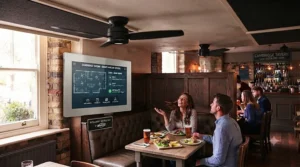
Real-World Scenarios: Matching Fans to Your Venue
Abstract specifications only get you so far — seeing how different dining establishment fans match real operator situations tends to make the decision clearer. Consider three genuinely common scenarios.
A busy high-street café owner running a 20-cover space with a low Victorian-era ceiling and a tight refurbishment budget is the classic case for the NIORSUN 50cm Ceiling Fan or the Ohniyou 52-Inch Low Profile Fan — both suit compact rooms without needing extra ceiling drop, and neither demands a five-figure fit-out budget to install properly. For this operator, the priority isn’t raw airflow volume; it’s fitting comfortably into a room where every centimetre of headroom is already accounted for by existing beams and light fittings.
A mid-size gastropub with 60 covers across a converted barn-style space, exposed rafters and genuinely high ceilings sits at the opposite end of the spectrum — this is where the Westinghouse Industrial 142cm earns its keep, moving enough air across a genuinely large floor plan that a smaller fan simply couldn’t manage without three or four units dotted awkwardly across the ceiling. Hospitality ceiling fans at this scale are as much about visual cohesion as airflow; one large, well-placed fan reads as intentional design, where several small ones can look like a patchwork afterthought.
Finally, a design-conscious new-opening restaurant with a covered outdoor terrace and an interior that leans heavily on aesthetics is the natural home for the Reiga 132cm Smart Ceiling Fan indoors and the VONLUCE 52-Inch Outdoor Fan on the terrace — both bring a level of design intent that basic industrial fans don’t prioritise, letting the fixtures themselves contribute to the room’s atmosphere rather than simply disappearing into the ceiling.
Common Problems and Dining Comfort Solutions
Even a well-chosen fan runs into predictable friction points once it meets the reality of daily service, so here are the recurring issues and the fixes that actually work.
Problem: Draughts blowing out candles or disturbing paper menus. Solution: reduce fan speed at the tables directly beneath the unit rather than switching it off entirely, or reposition freestanding candles slightly away from the direct downdraught zone — a small placement adjustment usually solves this without sacrificing airflow elsewhere in the room.
Problem: Uneven cooling, with some tables comfortable and others stuffy. Solution: this is almost always a placement issue rather than a fan-power issue — a single large fan centred over an irregularly shaped dining room will leave corners under-served, so mapping actual seating density before installation (rather than simply centring the fan on the ceiling) produces far better dining comfort solutions than buying a bigger, more expensive unit.
Problem: Noise complaints during quieter service periods. Solution: DC-motor fans like the Reiga 132cm Smart Ceiling Fan or Ohniyou 52-Inch Low Profile Fan run noticeably quieter than older AC units at equivalent speeds, so if noise is a recurring complaint during a hushed Sunday lunch service, a motor-type swap solves more than a speed adjustment ever will.
Problem: Fan wobble developing after months of use. Solution: rebalance the blades using a simple clip-on balancing kit, checking that all mounting screws remain properly torqued — vibration loosens fixings gradually, and this is genuinely a five-minute quarterly maintenance task rather than a call-out repair.
Problem: Winter draughts making the dining room feel colder than the thermostat suggests. Solution: reverse the motor direction on any fan with that function, which pushes warm air trapped near the ceiling back down into the seating area rather than fighting the heating system all season.
How to Choose Restaurant Ceiling Fans
Picking the right fan comes down to working through a handful of criteria in the right order, rather than starting with brand names or aesthetics first.
- Measure your ceiling height first. Anything under roughly 2.4 metres needs a flush-mount, low-profile design; anything above 3 metres can comfortably take a larger fan on a drop rod.
- Calculate your room’s square footage. Larger open-plan rooms generally need fewer, bigger fans rather than several small units competing for airflow.
- Decide between AC and DC motors. DC motors cost more upfront but run quieter and cheaper across the long opening hours typical of hospitality venues.
- Check the reversible function. A summer/winter reverse setting earns its keep across a full UK calendar year rather than sitting idle for half of it.
- Confirm indoor vs outdoor rating. Never install an indoor-rated fan on a terrace, even a covered one — condensation and weather exposure will shorten its lifespan dramatically.
- Factor in noise tolerance for your service style. A fine-dining room with hushed conversation has a much lower noise ceiling than a buzzy all-day café.
- Confirm UK electrical compliance documentation exists. Look for CE or UKCA marking and a proper declaration of conformity before committing to any commercial installation, as required under UK product safety guidance.
Restaurant Ceiling Fans for Cafés and Small Dining Rooms
Café spaces bring a genuinely different set of constraints than full-service restaurants, and cafe ceiling fan recommendations need to reflect that rather than simply scaling down restaurant advice. Ceilings tend to be lower, footfall is higher relative to floor space, and the budget available for fixtures is usually a fraction of what a full restaurant fit-out commands.
For this category, the NIORSUN 50cm Ceiling Fan and Ohniyou 52-Inch Low Profile Fan are the standout picks from our list, both because of their compact footprint and because neither demands the kind of ceiling clearance that a converted high-street unit rarely has to spare. What most buyers overlook about café-scale spaces specifically is that a single well-placed fan is almost always sufficient — the temptation to add two or three smaller units to “be thorough” usually just adds unnecessary noise and installation cost without meaningfully improving comfort in a room under 30 square metres.
Reviewers consistently note that café owners appreciate dimmable lighting integration in these compact fans, since it reduces the number of separate fixtures competing for limited ceiling space above counters and seating alike.
Food Service Ventilation: Fans, Kitchens and Extraction
It’s worth being precise about what ceiling fans can and can’t do in a food service ventilation context, because conflating the two causes genuine compliance problems. Ceiling fans circulate existing air; they do not remove grease, steam or cooking odours the way a proper kitchen extraction system does, and UK food hygiene guidance treats the two as entirely separate requirements.
Under Food Standards Agency guidance for food business premises, catering rooms must have adequate ventilation as a baseline hygiene requirement, and that obligation sits alongside — not instead of — any dining-room comfort fans you install front of house. In practice, this means a ceiling fan is never a substitute for a compliant kitchen extraction hood, no matter how powerful its motor is; the two systems solve genuinely different problems and both need to be present in a working commercial kitchen.
Where ceiling fans do add value in food service settings is in front-of-house areas and semi-open kitchen passes, where circulating air helps dissipate residual heat from the kitchen without interfering with the extraction system doing the heavy lifting on odour and grease removal. Positioning matters here too — a fan mounted directly above a pass can actually disrupt extraction airflow if placed carelessly, so consulting whoever designed your extraction layout before finalising fan placement avoids an expensive rework later.
How Ceiling Fans Shape Restaurant Ambiance
Airflow is only half the story — the other half is restaurant ambiance, and a well-chosen fan does genuine visual and atmospheric work that a wall-mounted unit or hidden ductwork simply can’t replicate. A slowly turning fan overhead reads as intentional, almost cinematic, in a way that’s hard to manufacture through lighting or music alone; it signals that the space is designed to be lived in and lingered over, not just passed through.
Blade material and finish matter enormously here. The wood-effect blades on the VONLUCE 52-Inch Outdoor Fan suit a rustic, farmhouse-leaning terrace, while the chrome finish on the Westinghouse Industrial Cromo does the opposite job entirely, signalling a sleeker, more contemporary bar environment. Choosing a fan purely on airflow specification while ignoring how it reads visually is a genuinely common mistake — guests notice ceiling fixtures more than most operators expect, particularly in rooms with minimal other decoration drawing the eye upward.
Sound also contributes to ambiance in ways that are easy to underestimate. The near-silent operation of DC-motor fans like the Reiga 132cm Smart Ceiling Fan suits an intimate fine-dining room where conversation needs to stay audible across the table, while a slightly more audible AC unit rarely registers as a problem in a louder, buzzier all-day dining space where background noise is already part of the atmosphere.
Common Mistakes When Buying Restaurant Ceiling Fans
The same handful of buying mistakes show up again and again across UK hospitality refits, and most are entirely avoidable with a bit of forward planning. The single biggest one is buying based on square footage alone without checking ceiling height first — a fan rated perfectly for your floor area can still be the wrong choice if your ceiling sits below the safe clearance for that blade span.
A close second is underestimating how many fans a large room actually needs, or overestimating it in the opposite direction. Buyers sometimes assume one large fan will comfortably cover an entire open-plan dining room, when in practice irregular room shapes or partition walls create dead zones that a single central fixture simply can’t reach. Equally common is the opposite mistake — installing several small fans when one genuinely large unit like the Westinghouse Industrial 142cm would have done the job more cheaply and with a cleaner ceiling line.
Ignoring motor type is another recurring error. Choosing the cheapest AC-motor fan without considering the cumulative running cost across genuinely long hospitality opening hours often costs more over two or three years than paying slightly more upfront for a quieter, more efficient DC-motor alternative. Finally, skipping proper electrical compliance checks is a mistake that only reveals itself during an inspection or, worse, an insurance claim — always confirm CE or UKCA documentation exists before installation, not after.
What to Expect: Real-World Performance
Specification sheets tell you motor speed and blade span; they don’t tell you what a fan actually feels like from a table on a Tuesday lunch service. In practice, a well-sized ceiling fan running on its lower-to-mid speed settings produces a barely perceptible movement of air that most guests register as “comfortable” rather than consciously noticing a breeze at all — which is exactly the goal.
Push a fan to its top speed in a room that didn’t need that much airflow, though, and the experience changes noticeably: napkins shift, candle flames flicker, and guests near the fan’s direct downdraught often ask for a table move. This is why the multi-speed models on our list, particularly the 6-speed DC units, genuinely outperform basic 3-speed alternatives in day-to-day use — the extra granularity between settings means staff can find the exact right level for a quiet Tuesday versus a packed Saturday without ever hitting an uncomfortable extreme.
Reversible fans in winter mode produce a subtler effect that’s easy to miss unless you’re specifically looking for it — rather than a noticeable breeze, the room simply feels a degree or two warmer at table height than the thermostat alone would suggest, because trapped warm ceiling air is being redistributed rather than left to sit uselessly above head height.
Long-Term Cost & Maintenance
The purchase price is only the opening figure in a restaurant ceiling fan’s total cost of ownership, and running costs across genuinely long hospitality operating hours add up faster than most buyers initially budget for. A fan left running roughly eleven hours a day, seven days a week, accumulates close to 4,000 running hours annually — at that scale, the difference between an efficient DC motor and an older AC unit becomes a meaningful line item on the annual energy bill rather than a rounding error.
Maintenance costs stay relatively modest if handled proactively: quarterly dusting, an annual professional electrical check, and occasional blade rebalancing rarely amount to more than the cost of a single call-out repair caused by neglect. Where costs spiral is when fans are ignored until something fails outright — a seized motor or a wiring fault discovered mid-service is both more expensive and more disruptive than the same issue caught during a scheduled check.
Comparing total cost of ownership across our seven picks, the DC-motor models generally pay back their higher upfront price within two to three years of typical hospitality running hours, purely through lower electricity consumption, before even accounting for the reduced likelihood of motor strain from constant use. For operators planning to keep a fixture in place for five years or more — which covers most restaurant fit-outs — that long-term efficiency case is difficult to ignore.
Safety, Regulations and Compliance Guide
UK hospitality venues sit at the intersection of several overlapping regulatory areas when it comes to ceiling fans, and getting the paperwork right matters as much as getting the airflow right. Electrical safety is governed by product regulations requiring CE or UKCA conformity marking on the fan itself, confirming it meets recognised safety standards for equipment connected to a commercial electrical supply, as set out in official UK guidance on conformity marking.
Workplace comfort obligations also apply, since staff working the floor are covered by the same welfare regulations as any other employee. While UK law doesn’t set a statutory maximum workplace temperature, the Health and Safety Executive’s guidance requires employers to maintain a “reasonable” temperature and to take practical steps — including ventilation and air circulation — where heat becomes a genuine risk to staff wellbeing during busy summer services.
Installation itself should always go through a qualified, registered electrician for any commercial premises, both to satisfy insurance requirements and because incorrect wiring or mounting on a shared commercial circuit carries genuinely higher risk than a single domestic fitting. Fire risk assessments, required for all catering premises, should also account for any new ceiling fixture, confirming it doesn’t interfere with sprinkler coverage or emergency lighting sightlines — a detail that’s easy to miss when the fan feels like a purely cosmetic decision rather than a structural one.
Features That Actually Matter (And Those That Don’t)
Marketing copy on fan listings loves to pile on feature after feature, but not all of them move the needle for a working restaurant. Reversible motor function genuinely matters — it’s the difference between a fixture that earns its keep year-round and one that sits idle for half the calendar. Multiple speed settings matter too, since the gap between a quiet Tuesday lunch and a packed Saturday dinner service is real, and fine control over airflow lets staff match the room’s actual needs rather than guessing.
App control, by contrast, is a genuine convenience but not a dealbreaker — it’s the kind of feature that’s lovely to have and mildly frustrating to lose, rather than something that changes the fundamental comfort of the room. Integrated lighting is similarly a nice-to-have that can reduce the number of separate fixtures in a tight ceiling, but it shouldn’t be the deciding factor over airflow performance if the two ever come into direct conflict on a shortlist.
What genuinely doesn’t matter much, despite how often it’s marketed, is exotic blade material beyond basic durability and finish — a well-engineered plastic composite blade moves air exactly as effectively as a premium wood-effect one, and the choice between them is almost entirely aesthetic rather than functional. Similarly, an excessive number of preset “modes” beyond simple speed control and reverse function rarely gets used in practice once the initial novelty wears off during a busy first month of service.
Price Range & Value Analysis
| Fan | Price Tier | Approx. Running Cost (annual, typical hours) | Value Verdict |
|---|---|---|---|
| NIORSUN 50cm Ceiling Fan | Budget (under £100) | Low | Best entry point for small cafés |
| Ohniyou 52-Inch Low Profile Fan | Mid (£120-£180) | Low | Strong all-rounder for tight ceilings |
| Fantasia Commercial 36-Inch | Mid (£150-£250) | Moderate | Best compliance paper trail |
| Reiga 132cm Smart Ceiling Fan | Mid (£150-£220) | Low | Best tech-forward pick |
| VONLUCE 52-Inch Outdoor Fan | Mid (£150-£220) | Low | Best outdoor/terrace option |
| Westinghouse Industrial 142cm | Mid-Premium (£150-£200) | Moderate-High | Best for large open rooms |
| Westinghouse Industrial Cromo | Premium (£250-£300) | Moderate | Best design statement piece |
The clearest takeaway from this table is that price tier and running cost don’t always move together — the Westinghouse Industrial 142cm sits in the same purchase-price band as several DC-motor rivals but costs meaningfully more to run across a full year of hospitality hours, simply because of its older AC motor design. Buyers prioritising long-term value over raw airflow capacity should weight the DC-motor options more heavily, even where the upfront price looks marginally higher.
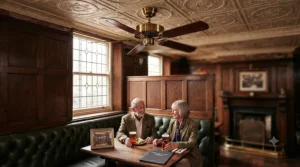
FAQ
❓ How many ceiling fans does a restaurant need?
❓ Can ceiling fans replace air conditioning in a restaurant?
❓ Do restaurant ceiling fans need professional installation?
❓ What size ceiling fan is best for a restaurant dining room?
❓ Are outdoor ceiling fans safe for covered restaurant terraces?
Conclusion
Choosing between these seven restaurant ceiling fans really comes down to matching three variables honestly: your ceiling height, your room’s actual floor area, and how much you’re willing to spend upfront versus over time on running costs. The Westinghouse Industrial 142cm remains the clearest choice for genuinely large, high-ceilinged dining rooms, while the NIORSUN 50cm Ceiling Fan and Ohniyou 52-Inch Low Profile Fan solve the opposite problem elegantly for smaller, budget-conscious cafés working within tighter headroom.
For operators leaning into design and technology, the Reiga 132cm Smart Ceiling Fan offers a genuinely modern feature set without a runaway price tag, while the VONLUCE 52-Inch Outdoor Fan deserves serious consideration from anywhere treating an outdoor terrace as a genuine extension of the dining room rather than an afterthought. The Fantasia Commercial 36-Inch and Westinghouse Industrial Cromo round out the list for operators prioritising UK compliance documentation and design statement finishes respectively.
Whichever model ends up over your dining room, the underlying principle stays the same: air that moves, even gently, changes how a room feels to sit in for two hours over dinner. Get the sizing, placement and motor type right, and a ceiling fan becomes one of the quieter, more effective investments a restaurant refit can make — comfortable guests linger longer, and lingering guests order dessert.
Recommended for You
- Retail Space Ceiling Fans: 7 Best Picks for UK Shops in 2026
- Office Ceiling Fans Bulk Buy: 7 Best Picks for 2026
- Commercial Ceiling Fans UK: 7 Best Picks for 2026
Disclaimer: This article contains affiliate links. As an Amazon Associate, I earn from qualifying purchases. If you purchase products through these links, we may earn a small commission at no additional cost to you.
✨ Found this helpful? Share it with your friends! 💬🤗
