In This Article
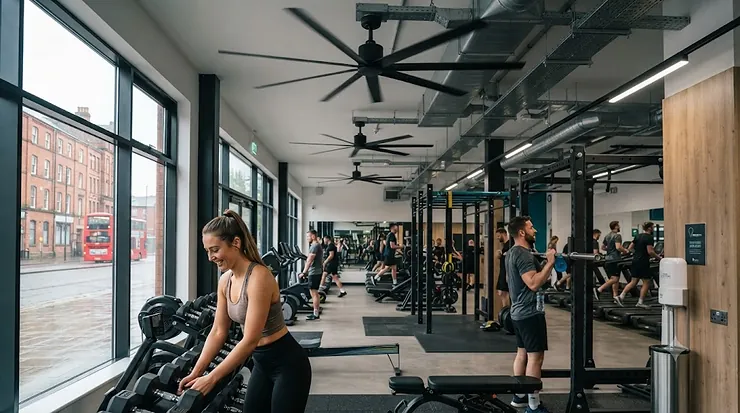
Anyone who has trained through the last ten minutes of a spin class in August knows the exact moment the air in the room stops being useful. It goes thick. Sweat stops evaporating. The mirrors fog. And somewhere near the back wall, a wheezing pedestal fan is doing absolutely nothing except moving warm air from one side of your face to the other. This is the problem gym ceiling fans exist to solve, and it’s a bigger deal than most facility owners admit until they’re standing in a training hall that smells like a locker room by 9am.
Gym ceiling fans aren’t the same animal as the £25 bedroom fan gathering dust in your loft. They’re built to shift serious volumes of air across open training floors, free-weight zones, and studio spaces without turning into a maintenance headache six months in. Get the wrong one and you’ll be back on a stepladder every few weeks, wondering why the blades wobble like a dodgy shopping trolley wheel. Get the right one and nobody in the room even thinks about it — they just notice the air feels breathable.
This guide walks through seven genuinely available fans that suit UK fitness spaces, from wallet-friendly workhorses to properly premium smart units, plus the research-backed thinking behind choosing one over another. We’ll dig into specs that actually matter, aggregated review patterns from real buyers, and the practical side nobody puts on the product page — installation height, noise at full pelt, and what happens to your energy bill in January.
What Is a Gym Ceiling Fan?
A gym ceiling fan is a commercial-grade, overhead-mounted fan engineered to move large volumes of air across open training spaces, reducing heat build-up, moisture, and stale air without the running costs of full air conditioning. Unlike domestic bedroom fans, gym-rated models use larger diameters, tougher motors, and mounting hardware rated for continuous daily use.
The category spans a surprisingly wide range. At one end you’ve got compact 36-inch industrial-style units suited to lower-ceilinged studios; at the other, properly large-diameter smart fans with app control that wouldn’t look out of place cooling a warehouse. What links them is purpose: shifting stale, humid air away from bodies working hard, and pulling cooler air down from higher up the room. That’s not marketing fluff — it’s basic physics, since warm air rises and pools near the ceiling unless something pushes it back down. Reversible motors matter here too, since the same fan that cools you in July can push trapped heat back down in January, which is one reason facility managers increasingly treat these as year-round kit rather than a summer-only purchase.
Quick Comparison Table
| Product | Diameter | Control | Best For |
|---|---|---|---|
| Westinghouse Industrial 142cm | 142cm | 4-speed wall control | Large open gym floors on a budget |
| AireRyder Zephyr | 122cm | 3-speed pull cord | Low-ceiling studios, tight budgets |
| Fantasia Commercial 36″ | 91cm | Wall/remote compatible | Compact spaces, low clearance |
| AireRyder FN43332 Classic | 122cm | Dual pull chain (fan + light) | Reception areas, multi-use rooms |
| Westinghouse Comet 132cm | 132cm | 3-speed pull chain | Mid-range, zero electronics to fail |
| Fantasia Cirrus 102cm | 102cm | Remote + integrated LED | Studios wanting smart lighting |
| Big Ass Fans i6 84″ | 213cm | WiFi app, Bluetooth, Alexa | Premium large studios, smart facilities |
Looking at this line-up, there’s a clear split between fit-and-forget mechanical fans and the newer wave of app-controlled smart units — and that split roughly tracks with price. If your priority is reliability over decades rather than novelty, the pull-chain and wall-control models earn their keep precisely because there’s less to go wrong. Facilities chasing energy reporting or remote scheduling, on the other hand, will find the smart end of this table does something the cheaper options simply can’t.
💬 Just one click — help others make better buying decisions too!😊
Top 7 Gym Ceiling Fans: Expert Analysis
1. Westinghouse Industrial 142cm Silver — best budget workhorse for open floors
The standout here is sheer coverage for the money — at 142cm across, this fan is built to move air over a genuinely large training floor rather than a single corner of it. The three-blade silver design pairs with a four-speed wall control, and Westinghouse rates it for rooms up to roughly 25 square metres, which covers most single-studio gyms without needing a second unit.
Key specs translate into real gym behaviour pretty directly: the wide blade span means slower rotation still shifts a lot of air, so you get circulation without the aggressive “wind tunnel” feel some smaller high-speed fans produce. The wall control (rather than a pull cord dangling above a squat rack) is a small detail that matters more than it sounds, since nobody wants to reach up through free weights to change fan speed.
Based on the spec comparison with rivals in this price bracket, this is the fan for gym owners who need maximum floor coverage without premium spend — it won’t win a beauty contest, but it isn’t trying to. Westinghouse’s industrial range carries a ten-year motor warranty, which is a genuinely useful signal of expected lifespan in continuous commercial use, not just occasional bedroom duty.
Aggregated review sentiment for Westinghouse’s industrial fan range consistently points to strong build quality and quiet running at lower speeds, with the AC motor only becoming noticeably audible on its top setting — a common trait of AC-motor fans generally, not a flaw unique to this model.
Pros:
- ✅ Large 142cm span covers big open training floors
- ✅ Wall control avoids reaching into weights areas
- ✅ Ten-year motor warranty signals commercial durability
Cons:
- ❌ AC motor gets audible at maximum speed
- ❌ No smart/app control if that’s a priority
At the time of research, expect a price in the £150-£190 range, and for the coverage-per-pound on offer, that represents strong value for larger single-room facilities.
2. AireRyder Zephyr — best compact pick for low ceilings
What most buyers overlook about the Zephyr is that its 122cm diameter and slim profile make it one of the better options for studios with genuinely low ceiling clearance, where a bulkier industrial fan simply won’t hang at a safe height. It’s finished entirely in chrome, giving it a cleaner look than most no-nonsense commercial fans.
The three-speed pull cord delivers 285, 230, and 130 RPM, with a rated maximum airflow around 8,640 cubic metres per hour — enough for rooms up to about 20 square metres. What that means in practice is a genuinely capable air-mover for a small-to-medium studio, spin room, or reformer Pilates space, without the bulk of the bigger units on this list.
Here’s what to weigh: the pull cord control keeps things mechanically simple (nothing to pair, nothing to update), but it does mean walking over to the unit — or fitting a separate wall/remote control, sold individually — to change speed mid-class. For a compact space that’s rarely a dealbreaker.
Reviewers consistently note this range runs impressively quietly for its size, with the housing itself staying cool during extended use — a small but reassuring detail for anyone mounting a fan directly above cardio equipment.
Pros:
- ✅ Slim profile suits low-ceiling studios
- ✅ Genuinely quiet three-speed AC motor
- ✅ Simple pull-cord control, nothing to malfunction electronically
Cons:
- ❌ No remote included as standard
- ❌ Smaller coverage than the larger units on this list
Around £120-£160 at the time of research, this sits firmly in budget territory while still feeling like a considered commercial product rather than a cut corner.
3. Fantasia Commercial Ceiling Fan 36″ — best for compact, low-clearance spaces
The standout feature on this one is right there in the name: it’s purpose-built for commercial and industrial installations, and at 91cm diameter it’s the most compact fan on this list — ideal for converted units, mezzanine studios, or any space where headroom is at a premium.
Fantasia has been manufacturing ceiling fans for the UK market for decades, and its commercial range leans into straightforward, low-maintenance engineering rather than flashy extras. The 36-inch size won’t move air across a full sports hall, but for boutique studios, small PT suites, or a home-gym-turned-business, it hits a genuinely useful middle ground between a domestic fan and full industrial kit.
What the spec sheet won’t tell you, but user reports on Fantasia’s broader ceiling fan range suggest, is that their pull-cord and simpler wall-control models tend to outlast the more feature-heavy remote units — one detailed buyer account described replacing a failed remote-controlled Fantasia fan with a simpler pull-cord model and finding it both more reliable and considerably cheaper to run.
That’s a genuinely useful data point for anyone choosing between Fantasia’s ranges: simplicity has a real reliability dividend here, not just a lower price tag.
Pros:
- ✅ Compact 91cm size suits tight, low-ceiling rooms
- ✅ Purpose-built for commercial/industrial installation
- ✅ Decades of UK brand history and parts availability
Cons:
- ❌ Limited coverage compared with 122cm+ models
- ❌ Remote-control variants reportedly less durable than pull-cord versions
Expect a price in the £150-£220 range depending on finish, making this a sensible mid-budget pick specifically for smaller commercial spaces.
4. AireRyder FN43332 Classic — best dual-purpose fan-and-light combo
The AireRyder FN43332 Classic‘s standout trick is doing two jobs at once: it’s a genuine light fitting and ceiling fan in one unit, controlled by two independent pull chains so you can run the light without the fan, or vice versa. For reception areas, changing rooms, or multi-use studio spaces that need lighting anyway, that’s one less fixture to install and maintain.
The AC motor runs at 100, 160, or 235 RPM in forward and reverse, and at just under 6kg it’s light enough to fit sloped ceilings up to 23 degrees — a spec that matters more than people expect in older UK buildings with anything but a flat ceiling. Reverse running lets it recirculate warm air in winter, effectively turning a summer cooling fan into a modest heating-cost reducer once the temperature drops.
Based on the spec comparison with pure fan units, the trade-off here is coverage for versatility: this isn’t the fan for a full training floor, but for a smaller multi-purpose room it removes the need for separate lighting infrastructure entirely.
Aggregated feedback on AireRyder’s Classic range highlights the independent pull-chain design as genuinely convenient day-to-day, though a handful of buyers note the light fitting requires a specific bulb type that isn’t always easy to source locally.
Pros:
- ✅ Combines ceiling fan and light fitting in one unit
- ✅ Independent controls for light and fan speed
- ✅ Suits sloped ceilings up to 23 degrees
Cons:
- ❌ Smaller coverage than dedicated large-diameter fans
- ❌ Replacement bulbs can be a specific, less common type
At the time of research, this typically sits around £130-£170, representing solid value once you factor in the lighting fixture it replaces.
5. Westinghouse Comet 132cm — best zero-electronics reliability pick
The Comet’s standout advantage is refreshingly unglamorous: there’s very little to break. A five-blade, 132cm chrome or titanium-finish fan controlled by a simple three-speed pull chain, it’s CE, RoHS, and GS certified, and rated for rooms up to around 20 square metres.
What most buyers overlook about this style of fan is that removing remote controls and smart electronics from the equation doesn’t just cut cost — it removes an entire category of failure points. No paired devices to lose sync, no remote batteries to die mid-class, no firmware to update. For a gym running fans for ten-plus hours a day, that mechanical simplicity is arguably a feature, not a limitation.
Here’s what to weigh: you lose the convenience of adjusting speed from across the room, and there’s no reverse-winter mode as standard on this particular finish, so this is best suited to gyms that mainly need reliable summer cooling rather than year-round climate management.
The spec sheet won’t tell you this, but user reports on Westinghouse’s pull-chain ceiling fan range consistently flag the ten-to-fifteen-year motor warranties as a genuine differentiator versus cheaper unbranded imports, several of which carry no meaningful warranty at all.
Pros:
- ✅ Simple pull-chain control with minimal failure points
- ✅ CE/RoHS/GS certified for commercial safety compliance
- ✅ Strong long-term motor warranty versus unbranded rivals
Cons:
- ❌ No remote control option built in
- ❌ Coverage limited to rooms around 20 square metres
Prices generally fall in the £160-£200 range, positioning it as a dependable mid-range choice for gyms that value longevity over gadgetry.
6. Fantasia Cirrus 102cm — best smart lighting integration
The Fantasia Cirrus 102cm‘s headline feature is its integrated LED lighting paired with full remote control — a genuinely modern take on the commercial ceiling fan that suits studios wanting a single fixture that handles both airflow and ambient lighting for evening classes.
At 102cm (roughly 40 inches), it sits in the middle of this list for coverage, but the remote-operated speed and light dimming make it considerably more flexible day-to-day than the pull-chain models further up. On paper this means less walking back and forth to adjust settings mid-session — genuinely useful in a studio running back-to-back classes.
Honest analysis here has to include a caveat drawn from Fantasia’s own broader review history: remote-controlled models across the brand’s range have, in some documented cases, suffered from remote units degrading over years of use — plastic yellowing, buttons sticking — which is a normal ageing pattern for electronics but worth budgeting a spare remote for in a heavily used commercial setting.
What most buyers overlook is that the integrated lighting reduces the need for separate ceiling spotlights in smaller studios, which can offset some of the higher upfront cost over the life of the fixture.
Pros:
- ✅ Integrated dimmable LED reduces need for separate lighting
- ✅ Full remote control of speed and light from across the room
- ✅ Modern styling suited to boutique fitness studios
Cons:
- ❌ Remote electronics have a documented ageing pattern over years
- ❌ Sits at a higher price point than pull-chain equivalents
Expect this one in the £270-£320 range, which reflects the added lighting hardware as much as the fan itself.
7. Big Ass Fans i6 84″ — best premium smart fan for large studios
The Big Ass Fans i6 84″ is the outlier on this list in the best possible sense: a genuinely commercial-grade smart fan, built by a manufacturer whose entire business is large-diameter fans for warehouses, gyms, and public venues. SenseME technology adjusts speed automatically based on room conditions, and it’s controllable via Bluetooth remote, WiFi app, or voice through Alexa and Google Assistant.
Diameter options run from 152cm up to 244cm, so the 213cm (84-inch) model reviewed here sits in genuinely large-coverage territory — the kind of single fan that can replace two or three smaller units on an open training floor. The manufacturer explicitly lists fitness centres among its target applications, which isn’t just marketing positioning; the company’s broader range extends into properly industrial territory, the same category covered by high-volume, low-speed fan designs — large-diameter fans engineered to move big volumes of air slowly rather than relying on raw motor power, a principle explained in more technical detail on Wikipedia’s overview of HVLS fan engineering.
What the spec sheet doesn’t fully convey is running cost: SenseME’s automatic adjustment means the fan isn’t running at full tilt constantly, which on paper should reduce energy draw compared with a fixed-speed industrial fan left on one setting all day.
Reviewers across Big Ass Fans’ smart range consistently praise the near-silent operation at moderate speeds and the genuine usefulness of app-based scheduling for facilities with predictable class timetables, though the premium price point is a recurring theme in buyer feedback too.
Pros:
- ✅ Automatic SenseME speed adjustment based on room conditions
- ✅ WiFi, Bluetooth, and voice control via Alexa/Google Assistant
- ✅ Commercial-grade build from an HVLS-fan specialist manufacturer
Cons:
- ❌ Significantly higher upfront cost than the rest of this list
- ❌ Best value realised only in larger, higher-ceiling spaces
At the time of research, pricing for this model typically runs from around £1,200 up to £1,800 depending on finish, positioning it well above the rest of this list — but for facilities managing multiple large studios, the automation and coverage can genuinely justify the spend.
Top 7 at a Glance: Specs, Price & Best-For
| Product | Diameter | Speeds/Control | Price Range | Best For |
|---|---|---|---|---|
| Westinghouse Industrial 142cm | 142cm | 4-speed wall | £150-£190 | Large open floors, budget |
| AireRyder Zephyr | 122cm | 3-speed pull cord | £120-£160 | Low ceilings, tight budget |
| Fantasia Commercial 36″ | 91cm | Wall/remote-ready | £150-£220 | Compact, low-clearance rooms |
| AireRyder FN43332 Classic | 122cm | Dual pull chain | £130-£170 | Reception, multi-use rooms |
| Westinghouse Comet 132cm | 132cm | 3-speed pull chain | £160-£200 | Reliability, no electronics |
| Fantasia Cirrus 102cm | 102cm | Remote + LED | £270-£320 | Studios wanting smart lighting |
| Big Ass Fans i6 84″ | 213cm | WiFi/Bluetooth/voice | £1,200-£1,800 | Premium large studios |
Read across the table and a pricing pattern jumps out: everything up to the Fantasia Cirrus 102cm clusters within a few hundred pounds of each other, while the Big Ass Fans i6 84″ sits in a different category entirely. That’s not a flaw in the line-up — it reflects a genuine market gap between “commercial fan” and “smart HVLS-adjacent system,” and most single-studio gyms will find everything they need well before reaching that top tier. Facilities with multiple large training halls are the ones most likely to see a real return on the premium jump.
✨ Don’t Miss These Exclusive Deals!
🔍 Take your gym’s airflow to the next level with these carefully selected fans. Click on any highlighted product to check current pricing and availability. The right fan makes every session feel lighter — for you and everyone training alongside you!
Practical Usage Guide: Setting Up and Maintaining Gym Ceiling Fans
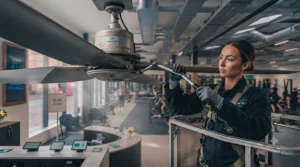
Getting a gym ceiling fan installed correctly matters more than which model you buy, because even the best fan performs badly if it’s mounted wrong. Industrial and commercial units generally need to hang at least 3 metres above the floor for safety and airflow spread, and downrod length should be chosen so the blades sit clear of any overhead equipment like pull-up rigs or suspended bags.
In the first 30 days, the most common mistake gym owners make is running a new fan at maximum speed constantly to “make the most of it.” Most AC and DC motors bed in more smoothly, and run quieter long-term, if they’re cycled through their speed range rather than left pinned at full pelt from day one. It’s also worth checking blade bolts after the first week of continuous running — vibration during transit and initial use can loosen fixings that were torqued correctly at the factory.
For maintenance, a rough quarterly schedule works well for most commercial spaces: wipe blades to remove dust and airborne chalk (a real issue in weightlifting areas), check mounting hardware for play, and for remote or app-controlled units, confirm firmware or app pairing hasn’t drifted after a WiFi router change. One optimisation trick rarely mentioned on product listings — running fans on reverse at low speed during closed hours in winter — helps redistribute heat that’s risen to the ceiling overnight, meaning the space feels warmer for the first class of the day without extra heating cost.
Exercise Space Cooling: Real-World Scenarios for Different Facilities
Scenario one: the converted-unit boutique studio. A Pilates and reformer studio operating from a converted retail unit with a 2.6-metre ceiling has limited headroom and a tight budget. Here, the compact Fantasia Commercial Ceiling Fan 36″ or AireRyder Zephyr make sense — both mount safely at lower clearances without eating into usable headroom, and neither demands a big spend for a room under 25 square metres.
Scenario two: the multi-purpose community gym. A council-run facility with a reception area, a small free-weights room, and a class studio needs different solutions per space. The AireRyder FN43332 Classic suits the reception (fan plus light in one fixture), while the Westinghouse Industrial 142cm handles the open free-weights floor where budget and coverage matter more than aesthetics.
Scenario three: the premium boutique chain. A fast-growing studio brand running back-to-back HIIT classes across several large sites, with automated scheduling and app-based facilities management already in place, is the clearest fit for the Big Ass Fans i6 84″. The upfront cost is real, but automatic speed adjustment and voice/app control align naturally with a business already investing in smart building management across multiple locations.
How to Choose Gym Ceiling Fans
Choosing the right fan comes down to matching a handful of practical factors to your specific space, rather than chasing the highest-spec model on the shelf.
- Measure your ceiling height first. Anything under 3 metres rules out the largest diameter fans and points you towards compact commercial models instead.
- Calculate your floor area. Manufacturers typically state a maximum room size per fan — undersizing means buying two units instead of relying on one that’s simply too small.
- Decide how much control flexibility you need. Pull-chain models are simpler and more failure-resistant; remote and app-controlled fans offer convenience at the cost of extra components that can eventually wear out.
- Factor in noise tolerance. A yoga studio needs a genuinely quiet fan at low speed; a free-weights floor with music playing can tolerate more audible airflow.
- Check the motor warranty length. Ten-year-plus warranties, common across Westinghouse and Fantasia’s ranges, are a reasonable proxy for expected commercial lifespan.
- Consider winter reverse-mode. If you’re heating the space in colder months, a reversible fan can meaningfully reduce heating costs by redistributing trapped warm air.
- Match your budget to your space, not the other way round. A £1,500 smart fan in a small studio is poor value; a £150 fan trying to cover a full sports hall is a false economy.
Fitness Center Ceiling Fans vs Traditional Air Conditioning
The comparison gym owners actually need to make usually isn’t between two fans — it’s between fitness center ceiling fans and full air conditioning, since AC represents a much bigger capital and running-cost commitment.
| Factor | Ceiling Fans | Air Conditioning |
|---|---|---|
| Upfront cost | £120-£1,800 per unit | Typically thousands, plus ductwork |
| Running cost | Low (fans draw modest wattage) | High, especially in summer |
| Cooling method | Air movement, evaporative cooling of skin | Actual temperature reduction |
| Best For | Most single-studio gyms, budget-conscious facilities | Large facilities needing precise temperature control |
Ceiling fans don’t actually lower room temperature — they accelerate sweat evaporation, which is what makes a room feel cooler to a working body. Air conditioning genuinely drops the ambient temperature, which matters more in facilities running at capacity through peak summer heat, but the capital outlay and ongoing electricity draw are substantially higher. For the majority of UK gyms, a well-chosen ceiling fan (or several, spread across the floor) delivers noticeably improved comfort at a fraction of the cost, and many commercial facilities run both — fans for everyday circulation, AC reserved for genuine heatwave conditions.
Workout Room Ventilation: What to Expect — Real-World Performance
Specs on a box rarely translate intuitively into how a room actually feels, so it’s worth setting expectations. A well-sized fan running at medium speed in a 20-25 square metre studio should produce a noticeable, comfortable breeze at floor level without papers or loose kit visibly moving — that’s the sweet spot most gyms are aiming for, rather than maximum airflow at all times.
At maximum speed, expect audible motor noise from AC-driven models, particularly the budget end of this list, which is a reasonable trade-off during a high-intensity class with music playing but less pleasant during a quiet stretching or recovery session. DC motor and smart fans, including the Big Ass Fans i6 84″, tend to stay noticeably quieter even at higher speeds — a genuine practical advantage for studios running yoga or Pilates alongside higher-intensity classes in the same space.
Humidity is the other factor worth expecting realistically: fans move air but don’t remove moisture from it, so a packed HIIT class in a poorly ventilated room will still feel muggy even with fans running flat out. Where possible, pairing ceiling fans with a window, door, or extraction point that actually exchanges air with the outside makes a measurable difference that fans alone can’t fully replicate.
Athletic Facility Ventilation: Safety, Regulations & Compliance
UK gyms operating as workplaces fall under general workplace safety expectations, even though there’s no single fan-specific regulation to follow. There’s no law setting a maximum working temperature, largely because every workplace is different and high temperatures indoors are often created by the activity itself rather than the season — a description that fits a busy gym floor rather neatly. Employers are still expected to keep conditions reasonable and manage the risk sensibly, which is exactly where properly specified ceiling fans earn their place in a facility’s overall approach. Full detail on employer obligations is available in the official HSE guidance on workplace temperature.
Beyond thermal comfort, ventilation itself is addressed more formally for non-domestic buildings through the gov.uk Approved Document F ventilation guidance, which sets out expectations for maintaining adequate air quality and pollutant control in commercial premises, including sports and leisure buildings. Ceiling fans support this by keeping air moving rather than allowing it to stagnate, though they work alongside — not instead of — proper background and purge ventilation such as windows, vents, or mechanical extraction.
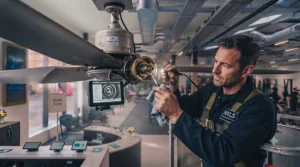
Installation-wise, always confirm mounting hardware is rated for the fan’s weight and that any electrical work is carried out by a qualified electrician, particularly for hardwired wall-control or reversible units where incorrect wiring can affect both safety and warranty validity.
Fitness Environment Control: Long-Term Cost & Maintenance
The upfront price tag on any of these seven fans is only part of the real cost story. Running costs for ceiling fans are genuinely low compared with most gym equipment — even a fan drawing 60-70 watts on its highest setting costs a fraction of what air conditioning or heating consumes over the same period, which is exactly why fans remain the first line of defence for most facilities before anyone considers mechanical cooling.
Maintenance costs scale roughly with mechanical complexity. Pull-chain models like the Westinghouse Comet 132cm have essentially nothing to replace beyond the occasional pull cord or capacitor over a decade-plus lifespan. Remote and app-controlled units, including the Fantasia Cirrus 102cm and Big Ass Fans i6 84″, carry a slightly higher long-term cost of ownership through occasional remote replacement or, in rare cases, connectivity troubleshooting — though these costs remain modest against the convenience gained.
Total cost of ownership over, say, a five-year commercial lifespan tends to favour the mid-range mechanical fans on this list for smaller studios, simply because there’s less that can go wrong and less that needs replacing. For larger facilities, the automation and coverage of a premium unit like the Big Ass Fans i6 84″ can offset its higher purchase price through reduced need for multiple smaller fans and lower staff time spent manually adjusting settings across a busy class schedule.
Workout Comfort Systems: Common Mistakes When Buying
The single most common mistake gym owners make is buying based on diameter alone, without checking the manufacturer’s stated maximum room coverage — a 91cm fan and a 213cm fan aren’t simply “small” and “big” versions of the same product; they’re designed for genuinely different room sizes.
A second frequent error is ignoring ceiling height entirely until after purchase, only to discover the downrod supplied doesn’t safely clear equipment below. Always measure clearance first, and check what downrod lengths (if any) are available separately.
Third, some buyers assume smart, app-controlled fans are automatically “better” without considering whether their facility actually needs that flexibility — for a single-room studio with one clear routine, a reliable pull-chain fan often serves better than an expensive smart unit whose features go largely unused.
Finally, overlooking warranty terms is a mistake that only becomes obvious years later. Unbranded budget imports sometimes carry minimal or no meaningful warranty, whereas established brands like Westinghouse and Fantasia typically back their commercial ranges with warranties running into double-digit years — a genuinely useful signal of how the manufacturer itself rates the product’s expected lifespan.
FAQ
❓ What size ceiling fan do I need for a gym?
❓ Do ceiling fans actually cool a gym down?
❓ How high should a gym ceiling fan be mounted?
❓ Are smart WiFi ceiling fans worth it for a fitness studio?
❓ Can gym ceiling fans run in reverse during winter?
Conclusion
There’s no single “best” gym ceiling fan, because the right choice depends entirely on your ceiling height, floor area, and how much you value simplicity versus smart convenience. For most single-studio UK gyms, something like the Westinghouse Industrial 142cm or AireRyder Zephyr will comfortably solve the stale-air problem without a big spend. Multi-purpose or premium facilities have good reasons to look further up this list, right through to the automated coverage of the Big Ass Fans i6 84″.
What matters most is matching the fan to the room rather than chasing the highest spec sheet — a fan that’s the wrong size for its space will disappoint regardless of brand. Measure first, check manufacturer coverage ratings, and factor in genuine long-term reliability rather than just the number on the price tag.
✨ Ready to Transform Your Training Space?
🔍 Browse the full range of gym ceiling fans covered in this guide and find the right fit for your facility. A properly ventilated gym keeps members training harder, longer, and coming back more often.
Recommended for You
- Restaurant Ceiling Fans 2026: 7 Best Picks for Every Dining Room
- Retail Space Ceiling Fans: 7 Best Picks for UK Shops in 2026
- Office Ceiling Fans Bulk Buy: 7 Best Picks for 2026
Disclaimer: This article contains affiliate links. As an Amazon Associate, I earn from qualifying purchases. If you purchase products through these links, we may earn a small commission at no additional cost to you.
✨ Found this helpful? Share it with your friends! 💬🤗
