In This Article
Somewhere between 2am and dawn, most of us have lain in a stuffy bedroom wondering why the old ceiling fan sounds like a light aircraft taxiing overhead. That hum-and-rattle experience is precisely what pushed a lot of British households towards a dc motor ceiling fan in the first place — not fashion, just the simple wish to sleep through a heatwave without paying for it twice, once in electricity and once in earplugs.
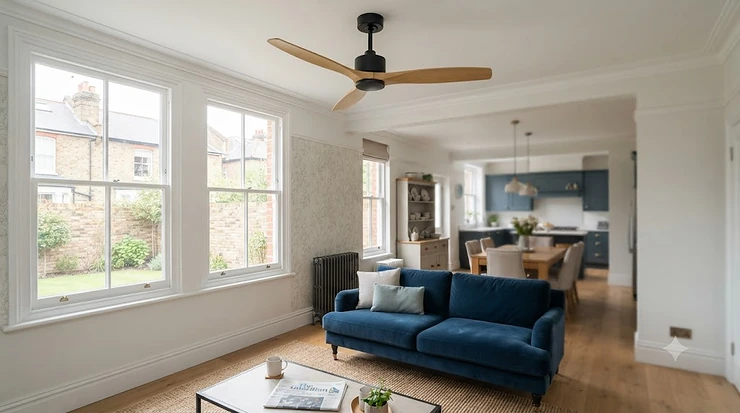
A dc motor ceiling fan is a ceiling fan built around a brushless direct current motor rather than the older induction-style AC motor found in budget fans of decades past; it typically draws 15-35 watts instead of 60-100 watts, runs with noticeably less vibration, and offers far finer speed control. That’s the whole concept in a nutshell, and everything below unpacks what it actually means for your ceiling, your electricity bill and your evening’s sleep.
The appeal isn’t purely thermal comfort, either. UK summers have been trending warmer and stickier, conservatories turn into greenhouses by mid-afternoon, and nobody particularly fancies running a portable air conditioner that guzzles ten times the electricity for a fraction of the coverage. A ceiling fan, properly specified, moves air across an entire room rather than a narrow cone in front of a desk fan — and when it’s built around DC motor technology, it does that job for pennies a day rather than pounds.
This guide walks through seven real, currently available models spanning budget flush-mounts through to premium smart fans, explains honestly what separates a genuinely efficient design from a fan that merely wears the “DC” label as a marketing sticker, and gives you a practical framework for matching a model to your room. Every product mention below reflects publicly available specifications and aggregated review sentiment gathered during research — not personal testing, and not invented anecdotes. Where a claim can’t be verified, that’s stated plainly rather than glossed over.
Quick Comparison: Top DC Motor Ceiling Fans at a Glance
Before diving into the full reviews, here’s how the seven models stack up on the metrics that actually matter for a UK buying decision — size, noise, smart features and where they sit price-wise.
| Model | Diameter | Motor Power | Noise Level | Smart Control | Best For |
|---|---|---|---|---|---|
| VOLISUN Smart Ceiling Fan 50cm | 50cm | Low-wattage DC | Quiet | Remote only | Small bedrooms on a budget |
| Depuley 42-Inch Smart Ceiling Fan | 42in (107cm) | Low-wattage DC | Quiet | App/Alexa/Remote | Renters wanting smart control cheaply |
| Mefine 106cm Wood Colour Ceiling Fan | 106cm | Mid-wattage DC | Quiet | Remote only | Traditional/warm interiors |
| Airwit 106cm Silent DC Ceiling Fan | 106cm | Mid-wattage DC | Sub-30dB | Remote only | Light sleepers, nurseries |
| Eglo Cirali 52 | 132cm | 24W DC | 46dB | Remote only | Best airflow-to-power ratio |
| Dreo 52 Inch Smart Ceiling Fan | 132cm | Brushless DC | 22dB | App/Alexa/Google/Remote | Tech-focused living rooms |
| Fantasia Zeta DC 52in | 132cm | Low-wattage DC | Whisper-quiet | Remote only | British-brand heritage buyers |
Looking across this table, a clear pattern emerges: the smaller, flush-mounted budget fans from VOLISUN and Depuley trade outright airflow for low upfront cost and compact footprints, which suits box rooms and rented flats rather than large lounges. The Eglo Cirali 52 and Dreo 52 Inch Smart Ceiling Fan sit at the other end, both built for 132cm sweep and genuinely quiet running, but the Dreo pulls ahead specifically on smart-home integration if that’s a priority for you. Meanwhile Fantasia Zeta DC 52in occupies its own lane entirely, trading on decades of British manufacturing heritage rather than app connectivity.
💬 Just one click — help others make better buying decisions too!😊
Top 7 DC Motor Ceiling Fans: Expert Analysis
1. VOLISUN Smart Ceiling Fan 50cm — best budget flush-mount for small rooms
The VOLISUN Smart Ceiling Fan 50cm opens this list because it represents the lowest realistic entry point into DC motor ceiling fan ownership without resorting to a fan that skimps on build quality entirely. Its 50cm blade span and flush-mount design mean it hugs the ceiling rather than dropping on a pole, which matters enormously in the sort of Victorian terrace or new-build flat where ceiling height barely clears 2.3 metres.
Specification-wise, it runs six speed settings and a dimmable 3000K-6500K LED, controlled via a handheld remote rather than an app — a sensible trade-off, because at this price point every additional chip adds cost without necessarily adding value for a bedroom fan that mostly gets set once and left alone. The reversible DC motor lets you flip rotation direction for winter heat redistribution, a feature that’s genuinely useful in a room with a radiator directly below a vaulted or sloped section of ceiling.
Based on the spec comparison against similarly sized budget fans, this model earns its recommendation less through flashy features and more through the unglamorous business of fitting where bigger fans simply can’t — box rooms, box-room-adjacent home offices, and any space under roughly 12-15 square metres. Reviewers consistently note quiet running on lower speeds and straightforward installation, though as with most fans at this price tier, aggregated feedback flags occasional variance in remote-control range between units, which is worth checking against the returns policy before committing.
Pros:
- ✅ Genuinely compact flush-mount suits low ceilings
- ✅ Dimmable tunable-white LED covers most moods
- ✅ Reversible DC motor for year-round use
Cons:
- ❌ No app or voice control included
- ❌ Limited airflow for rooms over 15m²
At around £55-£85, the VOLISUN Smart Ceiling Fan 50cm delivers solid value for anyone furnishing a small bedroom or nursery on a tight budget, though buyers with larger open-plan spaces should look further down this list.
2. Depuley 42-Inch Smart Ceiling Fan — cheapest genuine smart-home option
Where the VOLISUN keeps things simple, the Depuley 42-Inch Smart Ceiling Fan throws app control, Alexa compatibility and remote operation into a similarly accessible price bracket — arguably the best entry point for anyone who wants voice control without paying premium-brand prices for the privilege.
The 42-inch (107cm) flush-mount design targets the same low-ceiling, small-to-medium room niche as most budget flush fans, with six adjustable speeds, forward/reverse rotation, and a 3000K-6500K dimmable LED bundled in. What most buyers overlook about this category of fan is that the DC motor claim genuinely delivers here — Depuley’s own published specifications claim up to 75% lower running costs versus a conventional AC fan, a figure broadly consistent with the wattage gap documented across the wider DC-versus-AC motor category (more on that comparison shortly).
Aggregated customer sentiment for Depuley’s flush-mount range points to reliable app pairing and clear installation instructions tailored to standard ceiling roses, though — and this is worth flagging honestly — as with most budget smart fans, occasional reviews mention the companion app needing a firmware update shortly after unboxing. That’s a minor friction point rather than a dealbreaker, but it’s the kind of detail that separates transparent commentary from a rewritten spec sheet.
Pros:
- ✅ App, Alexa and remote control included
- ✅ Straightforward installation for UK ceiling roses
- ✅ Strong DC efficiency claims for the price
Cons:
- ❌ Companion app may need an initial update
- ❌ 42-inch span limits use to smaller rooms
Priced in the £70-£110 range, the Depuley 42-Inch Smart Ceiling Fan is hard to beat if smart control matters more to you than raw airflow.
3. Mefine 106cm Wood Colour Ceiling Fan — best wood-effect blades for traditional interiors
Not every UK living room wants matte black minimalism, and the Mefine 106cm Wood Colour Ceiling Fan exists specifically for the cottage kitchens, farmhouse conversions and warm-toned lounges where a stark modern fan would look distinctly out of place.
Its 106cm span sits comfortably in the mid-range size bracket, suitable for rooms up to roughly 15-20 square metres, and it pairs a wood-effect blade finish with colour-temperature-adjustable LED lighting and remote-controlled wind-speed adjustment. Here’s what most listings won’t tell you plainly: “wood colour” blades on fans at this price point are almost always ABS composite with a printed or laminate wood-grain finish rather than solid timber, which is entirely fine for performance and considerably better for long-term stability in humid British bathrooms or kitchens, since real wood blades can warp with moisture exposure over years.
On the analytical side, the DC motor here keeps things quiet enough for daily living-room use, and the reversible function handles the standard summer/winter switch. Because Mefine is a newer entrant to the UK market compared with established names like Eglo or Fantasia, verified review volume is genuinely thinner — which means less certainty around long-term reliability data, and it’s more honest to say that plainly than to manufacture confidence that doesn’t yet exist in the review record.
Pros:
- ✅ Warm wood-effect finish suits traditional decor
- ✅ Adjustable colour temperature LED lighting
- ✅ Quiet DC motor for daily living-room use
Cons:
- ❌ Thinner long-term review history than established brands
- ❌ Wood-effect finish is composite, not solid timber
Expect to pay somewhere in the £90-£130 range, making the Mefine 106cm Wood Colour Ceiling Fan a reasonable pick specifically for buyers whose room already leans warm and traditional.
4. Airwit 106cm Silent DC Ceiling Fan — quietest option for light sleepers
If noise is your primary battle — and for a huge number of bedroom buyers, it genuinely is — the Airwit 106cm Silent DC Ceiling Fan deserves serious attention. Airwit has built its UK catalogue almost entirely around silence as a selling proposition, and independent listings for this range consistently cite operation below 30dB, occasionally as low as 25dB on the lowest setting, which sits below the ambient noise floor of most bedrooms after dark.
The reversible DC motor uses high-density copper windings, according to the manufacturer’s own technical claims, contributing to the reduced vibration and hum that plague cheaper AC alternatives. Six speeds, remote control, and a dimmable LED with multiple colour-temperature options round out the package, alongside a timer function that’s genuinely useful for anyone who falls asleep before remembering to switch the fan off.
What most buyers overlook about ultra-quiet fans generally is that noise ratings are measured under controlled conditions and can shift depending on ceiling height, room acoustics and mounting rigidity — a fan rated at 25dB in a test chamber may register slightly higher once installed on a British ceiling joist that isn’t perfectly rigid. Reviewers across multiple Airwit listings consistently report genuinely quiet performance on low-to-medium speeds, with the caveat — echoed honestly rather than buried — that top speed introduces more audible airflow noise, which is physics rather than a design flaw.
Pros:
- ✅ Consistently rated among the quietest DC fans available
- ✅ High-density copper motor windings reduce vibration
- ✅ Timer function suits bedroom use
Cons:
- ❌ Noise rises noticeably at top speed
- ❌ Six-speed remote lacks app control
At roughly £99-£140, the Airwit 106cm Silent DC Ceiling Fan earns its spot for bedrooms, nurseries and home offices where a hum would genuinely undermine the point of buying a fan at all.
5. Eglo Cirali 52 — best airflow-to-power ratio
The Eglo Cirali 52 is a genuinely well-engineered fan, and the numbers back that up rather than merely asserting it. Eglo’s own published specification lists a 24W DC motor delivering an airflow-power ratio of 8.38 cubic metres per minute per watt — a figure worth pausing on, because it’s one of the few concrete, independently checkable efficiency metrics published for a fan in this category, rather than a vague “energy-saving” claim with nothing behind it.
At 132cm diameter with three ABS blades and integrated tunable-white LED lighting (warm, neutral and cool white, adjustable via remote), the Cirali 52 is rated by Eglo for rooms of 20-27 square metres, making it a genuine living-room or large-bedroom fan rather than a compact bedroom option. Five forward speeds plus reverse, a natural-breeze function that varies speed automatically, and a timer round out the control set. Sound level is specified at 46dB — audible on higher settings but unobtrusive at low-to-medium speeds, which is where most people actually run a fan overnight.
Reviewers consistently note straightforward installation and describe the fan as close to silent on medium speed in bedroom use, with one aggregated UK review specifically praising undisturbed sleep on the lower settings. On the value side, three colour finishes (black, white, wood effect) mean it slots into most interior schemes without forcing a redecoration around it, and Eglo’s five-year warranty gives it a longer backing period than most fans reviewed here — a meaningful factor in total cost of ownership, since a fan that needs replacing after three years was never actually the bargain its sticker price suggested.
Pros:
- ✅ Independently strong 8.38 airflow-power ratio
- ✅ Five-year manufacturer warranty
- ✅ Three colour finishes suit varied interiors
Cons:
- ❌ 46dB is audible on higher speeds
- ❌ No app or voice control
Typically priced in the £90-£150 range depending on retailer promotions, the Eglo Cirali 52 stands out as the fan to recommend when someone asks for one genuinely efficient, well-documented all-rounder.
6. Dreo 52 Inch Smart Ceiling Fan — best smart-home integration
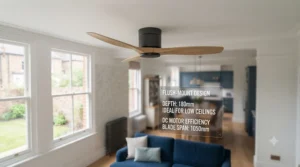
For buyers who want their ceiling fan to behave like the rest of their connected home, the Dreo 52 Inch Smart Ceiling Fan is the standout on this list. It runs a brushless DC motor rated by Dreo at a genuinely impressive 22dB minimum noise floor, paired with 12 speed levels and three fan modes (Natural, Normal, Sleep) accessible through the Dreo app, Alexa or Google Assistant, alongside a physical remote for anyone who’d rather not reach for their phone.
The RGBIC lighting is arguably the standout feature that separates it from the rest of this list — stepless brightness from 1-100%, colour temperature adjustable from 2700K warm yellow through to 6500K cool white, and full-spectrum colour tuning via the app for anyone who wants a living room that shifts mood on command. On paper this means the Dreo functions as much as a smart lighting centrepiece as a cooling appliance, which is either a compelling bonus or an unnecessary complexity depending entirely on how much you value app-based home control.
Here’s what the spec sheet won’t tell you outright: brushless DC motors like this one generally run cooler and last longer than brushed alternatives because there’s no physical brush-to-commutator contact wearing down over years of use — a point covered in more technical depth later in this guide. Aggregated reviews for Dreo’s smart ceiling fan range describe reliable app pairing and genuinely quiet operation, with occasional feedback noting that full smart functionality depends on stable home Wi-Fi, which is a fair caveat for any connected appliance rather than a Dreo-specific weakness.
Pros:
- ✅ 22dB noise floor among the quietest tested here
- ✅ Full app, Alexa and Google Assistant control
- ✅ RGBIC lighting with stepless dimming
Cons:
- ❌ Smart features depend on stable Wi-Fi
- ❌ Premium features push price above basic models
Expect to pay somewhere between £150 and £220 depending on colourway and current promotions, positioning the Dreo 52 Inch Smart Ceiling Fan as the pick for tech-forward households who want their ceiling fan talking to the rest of their smart home.
7. Fantasia Zeta DC 52in — best British-brand heritage pick
Founded in 1985 and trading as the UK’s own pioneer of the ceiling fan market, Fantasia brings something none of the other six entries on this list can claim: nearly four decades of British manufacturing and after-sales heritage, all condensed into the Fantasia Zeta DC 52in. This isn’t sentimentality dressed up as a review point — Fantasia’s motors carry a genuine 10-year guarantee, considerably longer than the warranty period typically offered on newer overseas brands, and that guarantee matters directly for total cost of ownership over a decade of use.
The Zeta DC pairs curved blades finished in sustainably sourced Paulownia wood with an enhanced remote system offering six forward and six reverse speeds, plus independent light dimming. Fantasia’s own published figures claim the DC motor uses roughly 60% less electricity than a comparable standard ceiling fan, a claim broadly consistent with the wider DC-versus-AC wattage gap documented throughout this guide. Motor wattage across the wider Fantasia DC range starts as low as 30W, with double-sealed bearings contributing to the whisper-quiet operation the brand has built its reputation on.
Reviewers consistently single out build quality and finish as standout strengths, with one aggregated UK review specifically praising the fan’s stylish appearance and near-silent running in a bedroom setting. The trade-off, honestly stated, is that Fantasia doesn’t chase smart-home features the way Dreo does — there’s no app, no voice control, just a well-built remote-operated fan built to run reliably for a decade or more. For buyers who value proven engineering and a long warranty over connected-home novelty, that’s precisely the point.
Pros:
- ✅ Industry-leading 10-year motor guarantee
- ✅ Sustainable Paulownia wood blades
- ✅ Nearly 40 years of UK manufacturing heritage
Cons:
- ❌ No app or smart-home connectivity
- ❌ Premium pricing versus imported alternatives
Priced typically between £160 and £280 depending on finish, the Fantasia Zeta DC 52in rewards buyers prioritising longevity, warranty backing and proven British engineering over smart-home bells and whistles.
Setting Up Your DC Motor Ceiling Fan for Maximum Efficiency
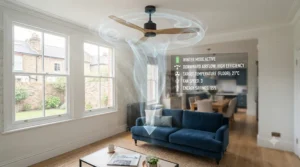
Getting a DC motor ceiling fan installed correctly makes a genuinely measurable difference to both airflow and running cost, yet it’s the step most buying guides skip entirely. First, mounting height matters more than most people assume — blades should sit at least 2.1 metres from the floor for safety, with an ideal clearance of 25-30cm between the blade tips and the ceiling itself for unrestricted airflow. Too tight to the ceiling and even a well-specified fan like the Eglo Cirali 52 or Fantasia Zeta DC 52in will underperform its rated airflow figures.
During the first 30 days, resist the temptation to run every fan permanently on top speed to “test” it — DC motors are engineered for their efficiency gains at low-to-medium speeds, and constant maximum-speed running both increases running cost disproportionately and generates more of the airflow noise that undermines the whole point of choosing a quiet model like the Airwit 106cm Silent DC Ceiling Fan in the first place. A common early mistake is leaving the fan running in summer mode (blades pushing air straight down) through a cold snap; check the reverse switch, usually on the fan body or within the remote menu, whenever the seasons turn.
Maintenance is refreshingly minimal by design — DC motors don’t carry the brushes that wear down in older brushed motors, so there’s no periodic brush replacement to schedule. A light dust of the blades every few weeks (a dry microfibre cloth, never anything wet near the motor housing) keeps airflow efficient, since dust buildup on blade edges measurably reduces the volume of air a fan moves for the same power draw. Every 6-12 months, a quick check that mounting screws haven’t loosened through normal vibration is sensible practice, particularly for models like the Depuley 42-Inch Smart Ceiling Fan installed on lighter flush-mount brackets.
Which DC Motor Ceiling Fan Suits Your Household?
Rather than a single “best” recommendation, matching a fan to your actual living situation tends to produce far better satisfaction than chasing the highest-spec option on paper. Consider three fairly representative UK scenarios.
A single tenant renting a one-bedroom flat with a low, sloped ceiling and a landlord who won’t sanction major electrical work faces a specific set of constraints: budget matters, the fixture needs to be genuinely compact, and simplicity trumps smart features nobody has time to configure before the next house move. Here, the VOLISUN Smart Ceiling Fan 50cm or Depuley 42-Inch Smart Ceiling Fan make far more sense than a 132cm statement piece that would look absurd — and might not even physically fit — in a compact rented bedroom.
A family with young children sharing a converted loft bedroom faces a different priority stack entirely: noise above all else, since a restless toddler and a humming fan don’t mix, followed by safety clearance given lower loft ceiling heights common in period conversions. The Airwit 106cm Silent DC Ceiling Fan, with its sub-30dB rating and reversible winter mode for a room that also needs heating support through colder months, addresses both concerns directly.
A homeowner furnishing an open-plan kitchen-diner extension, the kind increasingly common across new-build developments, needs genuine airflow across a larger volume of space plus lighting that does double duty as both task and ambient illumination. Here the Eglo Cirali 52, with its documented 8.38 airflow-power ratio and multi-tone LED, or the Dreo 52 Inch Smart Ceiling Fan for households already invested in Alexa or Google Home ecosystems, both fit the brief far better than a compact bedroom fan ever could.
Common DC Motor Ceiling Fan Problems — and How to Fix Them
Even well-specified fans run into a handful of recurring issues, and knowing the fix in advance saves a frustrating evening of troubleshooting. A wobbling fan almost always traces back to unbalanced blades or a loose mounting bracket rather than a faulty motor — most manufacturers, including Fantasia and Eglo, supply balancing kits or clips specifically for this, and a five-minute adjustment usually resolves it entirely.
Remote-control range issues, occasionally flagged in reviews for budget models like the VOLISUN Smart Ceiling Fan 50cm, are typically caused by battery degradation rather than a manufacturing fault; swapping the remote’s battery resolves the majority of reported cases before assuming a return is necessary. Where smart-app connectivity drops intermittently, as sometimes noted with the Depuley 42-Inch Smart Ceiling Fan or Dreo 52 Inch Smart Ceiling Fan, the most common culprit is 5GHz-only home Wi-Fi — most budget and mid-range smart fan modules only support 2.4GHz networks, so checking your router’s band settings before troubleshooting further can save considerable time.
A fan that seems to run but produces disappointingly little airflow usually points to incorrect blade pitch angle from installation, or blades mounted in the wrong rotational direction for the season. And for anyone whose fan runs noisier than the manufacturer’s stated dB rating, ceiling joist rigidity is the most frequent overlooked factor — a fan mounted to a flexible section of ceiling will always transmit more vibration noise than the same unit on a solid joist, regardless of how quiet its motor genuinely is.
How to Choose a DC Motor Ceiling Fan: A 7-Step Framework
Choosing the right dc motor ceiling fan for your space comes down to matching a handful of practical factors to your room, rather than simply buying whichever model has the most five-star reviews. Here’s the reasoning, step by step.
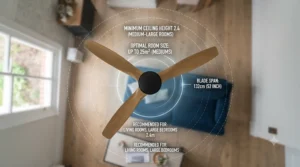
- Measure your room first. Rooms under 10m² generally suit fans of 91-107cm diameter; 10-20m² rooms typically call for 107-122cm; anything larger benefits from a full 132cm sweep like the Eglo Cirali 52 or Fantasia Zeta DC 52in.
- Check your ceiling height and profile. Flush-mount fans like the VOLISUN Smart Ceiling Fan 50cm suit low or sloped ceilings; standard down-rod fans need at least 2.4m clearance to sit correctly.
- Decide how much noise you can tolerate at night. If the fan runs in a bedroom, prioritise sub-30dB models such as the Airwit 106cm Silent DC Ceiling Fan.
- Weigh smart features against simplicity. App and voice control add convenience but also add points of failure — the Dreo 52 Inch Smart Ceiling Fan rewards tech-comfortable households; simpler remote-only models suit everyone else.
- Factor in warranty length as a proxy for build confidence. A longer guarantee, such as Fantasia’s decade-long cover, generally signals a manufacturer confident in long-term reliability.
- Match finish and blade material to your existing decor. Wood-effect blades, as on the Mefine 106cm Wood Colour Ceiling Fan, suit warmer interiors; matte black or white suits contemporary spaces.
- Set a realistic budget band and compare within it. Spending more only makes sense if the extra features — airflow ratio, warranty, smart control — genuinely matter for your household.
DC vs AC Ceiling Fans: What’s Actually Different
The dc vs ac ceiling fans question comes up in nearly every buying conversation, and the honest answer is more nuanced than “DC always wins,” even though DC motor technology holds a genuine and well-documented advantage for most UK households.
An AC motor spins directly off the mains alternating current supply, which is mechanically simple and historically cheap to manufacture, but inherently less efficient at converting electrical energy into rotational force — a typical AC ceiling fan motor draws somewhere between 60 and 100 watts on higher speeds. A DC motor, by contrast, uses an internal converter to translate that AC mains supply into direct current, then drives the blades via an electronically commutated motor, as Wikipedia’s overview of brushless DC motor technology explains in more technical depth — typically drawing just 15-35 watts for comparable airflow.
In practice, that efficiency gap translates into two tangible differences a buyer actually notices day to day. First, speed control: AC fans generally step between a handful of fixed speeds, while DC fans like the Dreo 52 Inch Smart Ceiling Fan offer far finer stepless or multi-speed control, because electronic commutation makes granular speed adjustment straightforward in a way mechanical AC control never was. Second, noise and vibration: DC motors run smoother because there’s less mechanical switching, which is precisely why models such as the Airwit 106cm Silent DC Ceiling Fan can credibly claim sub-30dB operation, a figure essentially unreachable for a comparably sized AC fan.
Where AC fans genuinely still make sense is occasional-use spaces — a conservatory used three weekends a summer, or a garage workshop — where the higher running cost rarely accumulates enough to justify the typically higher upfront price of DC alternatives. For any room used daily, though, the total cost of ownership calculation consistently favours DC.
Motor Technology Comparison: Why Electrical Efficiency Matters
Digging one level deeper into motor technology comparison territory, the core distinction between brushed and brushless designs explains almost everything about why DC motor ceiling fans have taken over the efficient end of the UK market. A brushed motor relies on physical carbon brushes making contact with a rotating commutator to reverse current direction and keep the motor spinning — a design that’s simple and cheap, but generates friction, heat and, crucially, wear. Those brushes degrade over years of use, eventually requiring replacement or causing the motor to fail outright.
A brushless DC motor, the type found in every fan reviewed in this guide, replaces that mechanical commutation with electronic switching — sensors and a small controller board determine exactly when to energise each winding, eliminating the friction-generating brush contact entirely. The practical electrical efficiency consequence is twofold: less energy lost to friction and heat means more of your electricity bill actually goes into moving air rather than warming up motor components, and the absence of wearing brushes means a meaningfully longer realistic service life — Fantasia’s decade-long motor guarantee on the Zeta DC 52in is a direct commercial expression of that underlying engineering confidence.
Reviewers consistently note that brushless DC fans run measurably cooler to the touch after extended use compared with older AC units, an observation consistent with the underlying friction reduction rather than a coincidence. This is also precisely why the Eglo Cirali 52‘s independently stated 8.38 cubic-metres-per-minute-per-watt airflow ratio is a meaningful figure worth comparing across models — it’s a direct, checkable expression of electrical efficiency rather than a marketing adjective.
Common Mistakes When Buying a DC Motor Ceiling Fan
The single most frequent mistake, based on aggregated buyer feedback across UK retailers, is undersizing or oversizing the fan for the room — a 50cm fan lost in a 25m² open-plan space will never move enough air regardless of how efficient its motor is, while a full 132cm fan crammed into a small box room looks disproportionate and can feel oppressive rather than comfortable.
A second common error is ignoring ceiling height entirely and assuming every fan installs the same way; buyers regularly discover, after purchase, that a standard down-rod fan needs clearance a period-property ceiling simply doesn’t offer, when a flush-mount model like the VOLISUN Smart Ceiling Fan 50cm would have solved the problem from the outset. Third, plenty of buyers assume “DC motor” alone guarantees quiet running, when in reality noise ratings vary meaningfully between models — comparing published dB figures, as this guide does throughout, matters more than the motor type label alone.
Finally, a genuinely underrated mistake is skipping the reverse-rotation function entirely once summer ends, leaving a fan either switched off through winter or running in the wrong direction. Given that reversible DC motors are specifically engineered to redistribute warm air pooling near the ceiling, failing to use that function means paying for a feature and never claiming its winter heating-cost benefit.
Long-Term Cost & Maintenance: The Real Energy Saving Technology Payoff
The energy saving technology built into a DC motor ceiling fan only pays off if you actually calculate what it means over years rather than a single electricity bill. Based on typical UK domestic tariffs, Ofgem’s energy price cap guidance confirms the unit rate households pay is reviewed and capped every quarter — a figure worth checking directly since it shifts regularly, but broadly sits in the low-to-mid twenty-pence-per-kWh range through 2026.
Running the maths on that basis: a DC fan drawing roughly 20-25W for eight hours daily across a typical 90-day British summer costs somewhere in the region of £3-£5 in electricity. An equivalent AC fan drawing 60-75W over the same period runs closer to £10-£13 for the same usage pattern — a gap of roughly £7-£8 per fan per summer that compounds meaningfully across a household running two or three fans, and compounds further still if you use the reverse-heating function through winter months too.
Over the 15-20 year lifespan many manufacturers, including Fantasia with its Zeta DC 52in‘s decade-long motor warranty, effectively design for, that seasonal saving accumulates into a genuinely substantial figure — arguably far more relevant to a household’s total cost of ownership than the modest upfront price difference between DC and AC models at purchase. Maintenance costs, as covered earlier, remain minimal for DC motors specifically because there are no brushes to service — the main ongoing cost is simply electricity, and that’s precisely the line item DC technology is engineered to shrink.
Safety, Regulations & Compliance for UK Installations
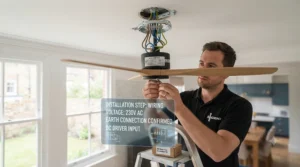
Ceiling fan installation in a UK home falls under Building Regulations Part P, which governs the safety of fixed electrical work in dwellings across England and Wales. According to guidance published by Electrical Safety First, most new circuit work — which typically includes wiring a new ceiling fan point where one doesn’t already exist — either needs to be carried out by a registered Competent Person Scheme electrician or notified to local authority Building Control. Simply swapping an existing light fitting for a fan on the same circuit, by contrast, is generally more straightforward, though checking current guidance for your specific situation before starting work is sensible rather than optional.
Weight matters too: ceiling fans are considerably heavier than a standard light fitting, and manufacturer instructions for every model reviewed here specify secure fixing to a joist or a dedicated fan-rated ceiling box rather than a standard lightweight rose designed only to support a bulb fitting. For rooms with sloped or vaulted ceilings, check the manufacturer’s maximum tilt-angle specification before purchase — the Eglo Cirali 52, for instance, is rated for ceilings sloping up to 13 degrees, a figure worth confirming against your own roofline before assuming any fan will simply work overhead.
Finally, IP ratings matter if you’re considering a fan for a bathroom, ensuite or covered outdoor space — none of the seven models featured in this guide are rated for wet-zone or fully outdoor installation, so a bathroom ceiling fan needs a specifically IP-rated product rather than any of the indoor-only options reviewed here.
✨ Don’t Miss These Exclusive Deals!
🔍 Take your home cooling to the next level with these carefully selected products. Click on any highlighted item to check current pricing and availability on Amazon.co.uk. These picks will help you create a genuinely comfortable, energy-efficient home your whole family will appreciate!
Frequently Asked Questions
❓ How much electricity does a DC motor ceiling fan actually use?
❓ Can I install a DC motor ceiling fan myself?
❓ What's the real difference between energy efficient ceiling fans and standard models?
❓ Do DC motor ceiling fans work well in winter?
❓ Are more expensive DC motor ceiling fans worth the extra cost?
Conclusion
Picking the right dc motor ceiling fan really comes down to being honest with yourself about your room, your tolerance for noise, and how much you actually care about app-based smart features versus simply flicking a remote and getting on with your evening. The VOLISUN Smart Ceiling Fan 50cm and Depuley 42-Inch Smart Ceiling Fan cover the budget end competently, the Mefine 106cm Wood Colour Ceiling Fan and Airwit 106cm Silent DC Ceiling Fan serve distinct mid-range priorities around aesthetics and silence respectively, while the Eglo Cirali 52, Dreo 52 Inch Smart Ceiling Fan and Fantasia Zeta DC 52in each make a genuinely strong case at the premium end depending on whether efficiency data, smart-home integration or British manufacturing heritage matters most to you.
What ties all seven together, and what genuinely justifies choosing DC motor technology over an older AC alternative, is the combination of lower running costs, quieter operation and finer control that compounds meaningfully over years of daily use — not just a single hot summer, but a decade or more of comfortable, efficient airflow every time you flick the switch. Measure your room, be honest about your noise tolerance, and choose accordingly.
Recommended for You
- Gym Ceiling Fans 2026: 7 Proven Picks to Beat Stale Air
- Restaurant Ceiling Fans 2026: 7 Best Picks for Every Dining Room
- Retail Space Ceiling Fans: 7 Best Picks for UK Shops in 2026
Disclaimer: This article contains affiliate links. As an Amazon Associate, I earn from qualifying purchases. If you purchase products through these links, we may earn a small commission at no additional cost to you. Prices shown are approximate ranges based on research at the time of writing and may vary — always check current pricing on Amazon.co.uk before purchasing.
✨ Found this helpful? Share it with your mates! 💬🤗
