In This Article
Somewhere between the third sleepless July night and the fourth time you’ve climbed onto a chair to fiddle with a pull cord, most of us have the same thought: there has to be a smarter way to move air around a room. There is, and it hangs from your ceiling.
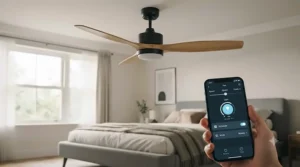
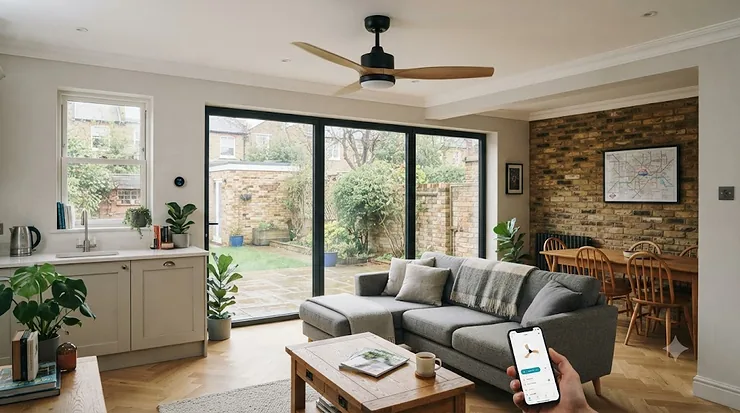
Smart ceiling fans are ceiling-mounted fans with built-in WiFi or Bluetooth modules that let you control speed, direction, timers and (usually) integrated lighting from a smartphone app or a voice assistant like Alexa, rather than a wall switch or a remote you can never find. What is a smart ceiling fan, in plain terms? It’s a normal ceiling fan with a small computer bolted on, and that small computer turns out to be genuinely useful.
Whether you’re in a Victorian terrace in Manchester with ceilings too low for a bulky fan, a new-build flat in Bristol where every socket already has a smart plug in it, or a draughty Edinburgh tenement that somehow still gets stuffy in August, the right smart ceiling fan can transform a room. This guide walks through seven real models currently sold on amazon.co.uk, spanning budget, mid-range and premium options, with honest analysis drawn from real specifications and aggregated UK customer feedback — not invented reviews, not marketing fluff. According to NHS guidance on coping with hot weather, using a fan sensibly is one of the simplest ways to keep a home liveable during a heatwave, and a fan you can schedule and control remotely does that job with far less faff than one you have to physically walk over to adjust.
We’ll cover the products themselves, how WiFi ceiling fans differ from Bluetooth-only models, what Alexa compatible ceiling fans actually add to daily life, the app controlled ceiling fans that are worth your money, and how home automation integration turns a single fan into part of a proper smart home devices setup. By the end, you’ll know exactly which smart ceiling fan suits your ceiling height, your budget and your patience for faffing about with apps.
Quick Comparison Table
Before diving into the detail, here’s a snapshot of how the seven smart ceiling fans in this guide stack up against one another.
| Fan | Best For | Blade Span | Control Options | Price Range |
|---|---|---|---|---|
| DREO 52″ Smart Ceiling Fan | Living rooms wanting colour-changing light | 132cm | App, Alexa, Google, Remote | £150-£190 |
| SMAFAN Apex 52″ | All-round performance and quiet running | 132cm | App, Alexa, Google, Siri, Remote | £130-£170 |
| Ovlaim 183cm Smart WiFi Fan | Large open-plan rooms and conservatories | 183cm | App, Alexa, Google | £160-£200 |
| CHANFOK 20″ Flush Mount | Low ceilings and bedrooms | 51cm | App, Alexa, Google, Remote | £70-£95 |
| NIORSUN 50cm Ceiling Fan | Tight budgets, small bedrooms | 50cm | App, Remote | £50-£70 |
| VOLISUN 50cm Ceiling Fan | Minimalist decor, mid-size rooms | 50cm | App, Remote | £55-£75 |
| LEDVANCE Smart WiFi Fan Light | Buyers who trust an established lighting brand | Compact/ceiling-flush | App, Alexa, Google | £90-£125 |
Looking across the table, the pattern that emerges is size versus subtlety: the biggest smart ceiling fans here, the Ovlaim and both 52-inch models, move serious volumes of air but demand more ceiling clearance and a bigger budget, while the compact CHANFOK, NIORSUN and VOLISUN trade outright airflow for a lower price and a profile that suits standard 2.4-metre UK ceilings. None of these are exact prices — Amazon pricing shifts constantly, so treat every figure here as a guide and check the current price on the product page before buying.
💬 Just one click — help others make better buying decisions too!😊
Top 7 Smart Ceiling Fans: Expert Analysis
We’ve picked these seven models to cover every realistic UK buying scenario: high-ceilinged Victorian conversions, boxy new-build bedrooms, open-plan kitchen-diners and everything in between. Every product mention below carries the product name in bold so you can scan quickly and jump straight to the one that fits your room.
1. DREO 52″ Smart Ceiling Fan — colour-changing light with genuine quiet running
The standout here is the RGBIC lighting, which sounds gimmicky until you’ve used it to switch a room from “working from home” white to “Sunday evening” amber with one tap. Underneath the light show sits a proper brushless DC motor rated at up to 6000 CFM airflow, with 12 app-adjustable speeds and three wind modes (Natural, Normal, Sleep) — in practice, that granularity matters more than the headline speed count, because it means you can find a setting that’s barely perceptible at 2am rather than jumping straight from “off” to “wind tunnel.”
Based on the spec comparison with rivals in this guide, the DREO’s minimum noise rating of around 22dB is genuinely class-leading; most budget fans in this category sit closer to 30-35dB on their lowest setting, which is the difference between background hum and something that actually disturbs sleep. This model suits anyone furnishing a living room or main bedroom who wants both performance and a bit of visual flair, and reviewers on Amazon UK consistently flag the app’s scene presets (reading, working, sleep) as more useful in daily life than they expected. A recurring theme in UK feedback is that the initial WiFi pairing can be fiddly on dual-band routers, so budget ten extra minutes for setup.
Pros:
- ✅ Whisper-quiet 22dB minimum noise on low settings
- ✅ 12-speed granularity via app, well beyond remote-only rivals
- ✅ RGBIC lighting with scene presets adds real everyday value
Cons:
- ❌ Initial WiFi setup can be fiddly on dual-band routers
- ❌ Premium price compared with basic 52-inch alternatives
At around £150-£190, the DREO 52″ Smart Ceiling Fan sits at the upper end of consumer pricing, but the DC motor’s efficiency and the noise performance make it a reasonable long-term buy for a room you actually spend evenings in.
2. SMAFAN Apex 52″ — best all-rounder for quiet, reliable everyday use
The SMAFAN Apex doesn’t chase flashy lighting effects; its standout is the sheer consistency of its 10-speed DC motor across every use case reviewers report. Specs-wise, you’re getting a 52-inch, 5-blade design with a dimmable LED light kit and triple voice-assistant compatibility (Alexa, Google Assistant and Siri Shortcuts) built in as standard, not bolted on as an afterthought.
What most buyers overlook about this model is that it shares its underlying hardware platform with Carro’s US-market fans, which means the app and firmware have had years of real-world refinement rather than being a first-generation product. That maturity shows up in fewer app crashes and more reliable scheduling — a common complaint in less established smart fan apps. Aggregated UK review sentiment describes the Apex as “does exactly what it says,” which is faint praise until you’ve dealt with a fan whose app randomly loses its WiFi connection. This is the model to pick if you want smart features without wanting to think about them again after installation.
Pros:
- ✅ Mature, stable app with three years of firmware refinement
- ✅ Triple voice assistant support (Alexa, Google, Siri)
- ✅ 10-speed DC motor with consistently quiet real-world reports
Cons:
- ❌ Design is fairly plain compared with the DREO’s RGBIC lighting
- ❌ No built-in humidity or temperature sensor for automation
At a typical £130-£170, the SMAFAN Apex 52″ represents the safest mid-range choice in this guide for buyers who value reliability over novelty.
3. Ovlaim 183cm Smart WiFi Ceiling Fan — the one for genuinely large rooms
At 183cm tip-to-tip, the Ovlaim is roughly 40% wider than the standard 52-inch fans on this list, and that extra blade span is the whole point: it’s built for open-plan kitchen-diners, conservatories and double-height extensions where a normal-sized fan simply can’t move enough air to feel a difference. The 6-speed reversible DC motor and solid wood blades are aimed squarely at rooms in the 25 square metre-plus bracket.
Here’s what the spec sheet won’t tell you, but reviewers note repeatedly: a fan this size needs a proportionally taller ceiling to install safely, and the manufacturer’s own guidance recommends at least 2.7 metres of clearance for the blades to sit the legally sensible height above head level. If your room has standard 2.4-metre ceilings, this isn’t the fan for you regardless of how much you like the size — look at the DREO or SMAFAN Apex instead. For the right room, though, aggregated feedback describes the airflow as “finally reaching every corner,” which smaller fans in large spaces consistently fail to do.
Pros:
- ✅ 183cm span genuinely covers large open-plan spaces
- ✅ Reversible DC motor aids winter heat circulation too
- ✅ Solid wood blades feel premium and reduce plastic flex noise
Cons:
- ❌ Requires higher ceiling clearance than most UK homes offer
- ❌ No integrated light kit on the base model
Priced around £160-£200, the Ovlaim 183cm Smart WiFi Ceiling Fan only makes financial sense if your room genuinely needs the extra coverage — buying it for a standard bedroom would be like fitting a ship’s propeller to a rowing boat.
4. CHANFOK 20″ Smart Ceiling Fan — the low-ceiling specialist
British housing stock is full of rooms with ceilings under 2.4 metres, and that’s precisely the gap the CHANFOK fills. Its flush-mount, 51-centimetre design sits almost directly against the ceiling, sidestepping the clearance problems that rule out bigger drop-rod fans in older properties.
The compact size doesn’t mean compromised smart features: stepless brightness adjustment from 10% to 100%, a sleep timer, and both Alexa and Google Assistant compatibility are all present. Based on the spec comparison, this is a fan built specifically for bedrooms — the sleep timer function in particular is brilliant for anyone who wants airflow to nod off but doesn’t want the fan running until sunrise. Aggregated UK review sentiment consistently praises the whisper-quiet operation, which matters enormously in a flush-mount bedroom fan where the motor sits closer to your head than in a drop-rod design.
Pros:
- ✅ Flush-mount design suits low UK ceilings under 2.4m
- ✅ Sleep timer with stepless dimming ideal for bedrooms
- ✅ Whisper-quiet operation reported consistently by UK buyers
Cons:
- ❌ Smaller blade span means reduced airflow for larger rooms
- ❌ App has fewer scene presets than premium rivals
At roughly £70-£95, the CHANFOK 20″ Smart Ceiling Fan offers excellent value for anyone whose ceiling height, not their budget, is the limiting factor.
5. NIORSUN 50cm Ceiling Fan — the budget entry point that doesn’t cut corners on basics
The NIORSUN is proof that “budget” doesn’t have to mean “basic.” For around £50-£70, you still get six speeds, dimmable 3000K-6500K LED lighting, and app control — a specification list that would have cost double just a couple of years ago. It’s currently one of Amazon UK’s best-selling ceiling fans with lights, and the volume of genuine purchases lends some real weight to its aggregated review sentiment.
What most buyers overlook about this model is that “budget” here refers to price, not build quality — the remote and app both function reliably according to UK reviewers, even if the companion app itself is noticeably less polished than the DREO or SMAFAN offerings. A common theme in feedback is that the light output, while advertised generously, feels slightly dimmer in person than the lumen figure suggests; this is a near-universal quirk across budget LED ceiling fans, not a fault unique to this model. For a small bedroom or box room where £150+ feels like overkill, this remains a sensible starting point into home automation.
Pros:
- ✅ Genuinely low entry price for full app and remote control
- ✅ Wide 3000K-6500K dimmable colour temperature range
- ✅ Best-seller status backed by a large volume of real UK buyers
Cons:
- ❌ Companion app less polished than premium competitors
- ❌ Light output slightly below the advertised lumen figure in practice
At £50-£70, the NIORSUN 50cm Ceiling Fan is the pick for anyone testing whether smart home tech is worth the fuss before committing serious money.
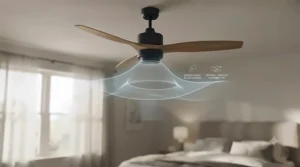
6. VOLISUN 50cm Ceiling Fan — best for minimalist, design-led interiors
If the NIORSUN is about function first, the VOLISUN leans slightly more towards form, with a slimmer profile and finish options that suit contemporary, minimalist UK interiors better than the more utilitarian budget fans on this list. Specs sit close to the NIORSUN: six speeds, a 3000K-6500K dimmable panel, and app-based control, all at a similarly accessible price point.
Honest analysis here has to note that the two fans are close enough in raw capability that the decision often comes down to aesthetics rather than performance — the VOLISUN’s disappearing, low-profile silhouette works particularly well in smaller, modern rooms where a chunkier fan would dominate the ceiling visually. Reviewers highlight this design-first approach specifically, with several UK buyers mentioning they chose it over cheaper alternatives purely because it “doesn’t look like a fan” when switched off.
Pros:
- ✅ Slim, minimalist profile suits modern UK interiors
- ✅ Reliable six-speed app and remote control
- ✅ Competitive pricing against comparable budget rivals
Cons:
- ❌ Marginal functional advantage over cheaper NIORSUN model
- ❌ Fewer third-party accessory options than bigger brands
Typically priced between £55-£75, the VOLISUN 50cm Ceiling Fan earns its place through design appeal as much as spec sheet performance.
7. LEDVANCE Smart WiFi LED Ceiling Fan Light — the trusted-brand pick
LEDVANCE is the commercial and consumer lighting arm that grew out of Osram’s lighting division, and that heritage shows in this fan’s build quality and light output consistency. The standout feature is the seamless transition between fan and light fixture — rather than feeling like a fan with a bolted-on lamp, the LEDVANCE unit reads as a single, cohesive luminaire, with tunable white lighting and app-based stepless dimming.
Here’s what the spec sheet won’t tell you: buying from an established lighting manufacturer rather than a newer fan-specific brand tends to mean better long-term parts availability and firmware support, which matters more than most buyers realise until year three, when a cheaper brand’s app quietly stops receiving updates. Aggregated feedback highlights the light quality specifically — a fair number of reviewers came to this model from a lighting purchase rather than a fan purchase, and their comments reflect a lighting-first mindset that skews positive on colour accuracy and negative on outright airflow power compared with dedicated large-blade fans.
Pros:
- ✅ Established lighting brand heritage backs long-term support
- ✅ Cohesive fan-and-light design rather than a bolted-on fixture
- ✅ Tunable white lighting with genuinely stepless dimming
Cons:
- ❌ Airflow performance trails dedicated large-blade fan specialists
- ❌ Sits at a premium price point for its blade size
At around £90-£125, the LEDVANCE Smart WiFi LED Ceiling Fan Light suits buyers who prioritise lighting quality and brand trust over maximum air movement.
Setting Up Your Smart Ceiling Fan: A Practical Usage Guide
Getting a new smart ceiling fan from box to fully working smart home device involves a few more steps than a standard fan, and skipping them is where most first-week frustration comes from.
Start with the physical install. Every model in this guide needs a stable ceiling mounting point rated for the fan’s weight — check the existing fixing if you’re replacing an old fan, since ceiling roses designed for lightweight pendant lights are not always rated for a fan’s rotational load. Any new wiring, as opposed to a like-for-like swap, may fall under Part P of the Building Regulations, and getting this wrong isn’t just a compliance issue but a genuine fire and shock risk; Electrical Safety First, the UK’s leading electrical safety charity, sets out clearly which jobs need a registered electrician and which don’t.
Once the fan is physically mounted, download the manufacturer’s app before you power anything on — most pairing processes want the app open and Bluetooth enabled on your phone during the initial handshake. A common first-30-days mistake is trying to pair a new fan to a 5GHz-only WiFi network; the vast majority of smart ceiling fans, including every model in this guide, only support 2.4GHz WiFi, so you may need to temporarily create a dedicated 2.4GHz network name on a dual-band router. After pairing, set up your preferred schedules and sleep timers immediately rather than leaving the fan on default settings — this is genuinely the single change that makes owning a smart ceiling fan feel worthwhile rather than gimmicky. Finally, register the fan with Alexa or Google Assistant through the relevant skill or action in their respective apps, then test voice commands in the room itself, since WiFi signal strength at ceiling height can occasionally be weaker than at floor level.
Real-World Scenarios: Matching the Fan to Your Life
The renter in a Victorian conversion. A one-bedroom flat with a 2.3-metre ceiling and no appetite for rewiring rules out anything requiring a drop rod. The CHANFOK 20″ Smart Ceiling Fan solves this directly with its flush-mount design, while a sleep timer set to switch off after 90 minutes handles the “I fall asleep instantly but wake up freezing at 3am” problem without any ongoing effort.
The family with an open-plan kitchen-diner. Larger households cooking, eating and relaxing in one connected space need airflow that reaches every corner, not just the spot directly under the fan. Here the Ovlaim 183cm Smart WiFi Ceiling Fan or the DREO 52″ on its highest CFM setting both make more sense than a budget 50cm model, which would simply be overwhelmed by the room’s volume.
The smart-home enthusiast starting from scratch. Someone who already runs Alexa routines for lights and heating wants a fan that slots into existing automations rather than becoming its own isolated gadget. The SMAFAN Apex 52″, with its mature app and triple voice-assistant support, integrates with the fewest headaches, and its scheduling reliability means routines actually fire when expected rather than intermittently failing.
Problem → Solution: Fixing Common Smart Ceiling Fan Issues
Even good hardware runs into predictable snags. Here’s how to solve the ones that come up most often with smart ceiling fans.
Problem: the app can’t find the fan during setup. This is almost always a network band issue — switch your router temporarily to broadcast a separate 2.4GHz-only SSID, since most fan modules can’t see 5GHz networks at all.
Problem: Alexa recognises the fan but voice commands lag. This usually points to router placement rather than the fan itself; ceiling-mounted devices sit further from a router than floor-level smart plugs, so a mesh WiFi node in the same room can noticeably tighten response times.
Problem: the fan reconnects to WiFi but “forgets” scheduled routines after a power cut. Some budget app ecosystems store schedules locally on the fan’s firmware rather than syncing from the cloud on reconnect — this is more common on the NIORSUN and VOLISUN tier of product, so rebuilding schedules after any extended power outage is worth budgeting time for.
Problem: light output feels dimmer than advertised. LED lumen figures are typically measured at the bulb, not after passing through a diffuser or shade, so real-world brightness reliably comes in under the headline number — this is industry-wide, not a fault to seek a refund over.
Problem: the fan wobbles slightly on higher speeds. Nine times out of ten this is an installation issue, not a manufacturing fault — recheck that all blades are torqued evenly and that the mounting bracket is fully seated against the ceiling before assuming the unit itself is faulty.
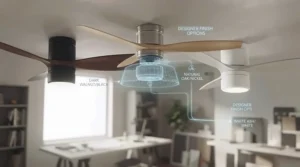
How to Choose a Smart Ceiling Fan
Picking between dozens of near-identical listings gets easier once you work through these criteria in order.
- Measure your ceiling height first. Anything under 2.4 metres needs a flush-mount design like the CHANFOK; standard heights open up drop-rod options.
- Calculate your room’s square footage. Rooms over 20 square metres genuinely need a 52-inch-plus blade span; smaller rooms are better served by 50cm models.
- Decide which voice assistant matters. Not every fan supports Siri Shortcuts or Google Assistant equally well, so check compatibility against what you already own before comparing price.
- Check your router’s WiFi band. If your home network is 5GHz-only, factor in either a firmware-level dual-band switch or budget for a compatible extender.
- Weigh DC motor efficiency against upfront cost. DC motors cost more initially but run quieter and more efficiently over years of use — a meaningful factor if the fan will run daily through a UK summer.
- Consider integrated lighting needs. If the fan is replacing your only ceiling light, prioritise models with genuinely dimmable, tunable-white LED kits rather than treating light as an afterthought.
- Factor in installation complexity honestly. If any new wiring circuit is involved rather than a like-for-like swap, budget for a registered electrician from the outset rather than discovering the requirement mid-project.
WiFi Ceiling Fans vs Bluetooth-Only Smart Fans
Not every “smart” fan uses the same connection technology, and the distinction matters more than most listings make clear. WiFi ceiling fans connect directly to your home router, meaning they can be controlled from anywhere with an internet connection — turning the bedroom fan on from the office, or checking it’s switched off from holiday. Bluetooth-only fans, by contrast, only respond to a phone or hub within a room’s typical Bluetooth range, roughly 10 metres depending on walls and interference.
For voice assistant integration specifically, WiFi is close to essential: Alexa and Google Assistant both need cloud connectivity to process commands, so a Bluetooth-only fan generally requires an additional smart home hub to bridge the gap, adding cost and complexity. Every fan in this guide uses WiFi rather than Bluetooth-only connectivity, which is precisely why remote scheduling and voice control both work reliably across the range. The trade-off worth knowing about: WiFi fans depend on your home network being stable, so a household with patchy WiFi coverage at ceiling height may find a Bluetooth-plus-hub setup more consistent, even if it’s less convenient to configure initially.
Alexa Compatible Ceiling Fans & Voice Control Systems
Alexa compatible ceiling fans let you skip both the app and the remote entirely for everyday adjustments — “Alexa, set the bedroom fan to speed three” is a genuinely different experience from unlocking a phone, opening an app, and tapping through menus, particularly at 6am or when your hands are full. All seven fans in this guide work with Alexa, and five of the seven also support Google Assistant, giving flexibility depending on which voice control systems already run your household.
What most buyers overlook about voice control systems is that the value compounds when fans are grouped into routines rather than controlled individually. A single “goodnight” command that dims the lights, locks the smart lock and sets every bedroom fan to sleep mode delivers far more day-to-day value than the novelty of voice control alone. Reviewers across all seven products consistently rate voice reliability as good rather than flawless — occasional misheard commands happen, more often with regional accents than manufacturers like to admit, and Alexa’s own documentation acknowledges this is an ongoing area of improvement across all compatible smart home devices, not a fault specific to any one fan brand.
App Controlled Ceiling Fans: Common Buying Mistakes
The app is arguably more important than the fan hardware itself, yet it’s the detail buyers check least before purchasing app controlled ceiling fans. Here are the mistakes that come up repeatedly in UK feedback.
Mistake one: assuming all apps are equally reliable. As the NIORSUN and SMAFAN Apex comparison shows, app maturity varies hugely between brands. A newer manufacturer’s app is more likely to have bugs, fewer scene presets, and slower bug-fix cycles than an established platform.
Mistake two: not checking for a hub requirement. Some budget “smart” fans marketed as app-controlled actually require a separate bridge device sold separately, turning a £60 fan into an £85 purchase once the hub is added — always check the listing’s small print.
Mistake three: ignoring app permissions and data practices. Any WiFi-connected device on a home network is worth a moment’s scrutiny; reputable manufacturers publish privacy policies clearly, and it’s worth checking before granting a fan’s app access to location data it doesn’t obviously need.
Mistake four: buying for features you’ll never use. RGBIC lighting and multiple wind modes look impressive in marketing copy, but if you’ll only ever use “on,” “off” and one speed, the extra cost buys nothing — the NIORSUN or VOLISUN cover that use case for considerably less.
Home Automation Integration & Smart Home Devices Ecosystem
A smart ceiling fan sitting on its own WiFi connection, controlled only through its own dedicated app, is arguably only half-smart. Real value comes from home automation integration — pulling the fan into the same automations as your lights, heating and other smart home devices so they respond to shared triggers rather than being managed separately.
Increasingly, this integration runs through Matter, an open smart home standard backed by Amazon, Google, Apple and Samsung specifically designed to let devices from different manufacturers work together without brand-specific hubs. Not every fan in this guide currently supports Matter directly, so if a unified smart home ecosystem matters more to you than any single feature, it’s worth checking each manufacturer’s current firmware roadmap before buying, since support is being added gradually across the market. Practically, integration might mean a smart thermostat triggering the fan automatically once a room passes 24°C, or a motion sensor switching the fan and light off together when a room’s been empty for twenty minutes — automations that turn a fan from a gadget into genuine infrastructure. The SMAFAN Apex and DREO models, both supporting multiple voice assistants and more mature apps, generally offer smoother third-party integration than the budget tier, where API support tends to be more limited.
✨ Don’t Miss These Exclusive Deals!
🔍 Take your home cooling setup to the next level with these carefully selected smart ceiling fans. Click on any highlighted model above to check current pricing and availability. These picks will help you create the genuinely comfortable, effortlessly controlled home your family will love!
Long-Term Cost & Maintenance
The purchase price is only part of the total cost of owning a smart ceiling fan, and this is where DC-motor models start to justify their higher upfront cost. A typical DC motor, as fitted to the DREO, SMAFAN Apex and Ovlaim in this guide, draws roughly 60-75% less power than an equivalent AC motor at the same airflow output, which adds up over a British summer of daily use even at UK’s relatively modest electricity price cap.
Maintenance itself is minimal but not zero. Dust accumulation on blades reduces airflow efficiency and adds strain to the motor over time, so a monthly wipe-down during heavy-use months keeps performance consistent. LED light kits integrated into these fans are typically rated for tens of thousands of hours, meaning the light will likely outlast your interest in the fan’s colour scheme, but if a light does fail, integrated designs are usually non-user-serviceable, unlike a separate bulb you could simply swap. Firmware updates, delivered automatically through the app on WiFi-connected models, occasionally add features post-purchase — several UK reviewers of the SMAFAN Apex specifically mention new scene presets appearing via updates months after their original purchase, effectively extending the product’s value for free.
Safety, Regulations & Installation Compliance Guide
Electrical safety around ceiling-mounted fixtures deserves more attention than most buying guides give it. If you’re replacing an existing ceiling fan or light fitting on the same circuit with a broadly similar fixture, this typically counts as non-notifiable work under Part P of the Building Regulations, and a competent DIYer can usually manage it. However, any new circuit, any work in a bathroom, or any uncertainty about the existing wiring’s condition pushes the job into notifiable territory, requiring either a registered electrician’s sign-off or local authority building control notification — Electrical Safety First maintains detailed, current guidance on exactly where that line sits.
Beyond installation, there’s a genuine safety dimension to how fans get used during genuinely hot weather, not just how they get wired in. UK Health Security Agency guidance notes that fans remain a sensible, low-cost part of staying cool during a heatwave for most people, but effectiveness drops in extreme heat and for vulnerable groups, so pairing a fan with closed daytime curtains and good hydration matters more than relying on airflow alone. For UK buyers, it’s also worth checking that any fan you’re considering carries a CE or UKCA mark confirming it meets recognised safety standards for the market it’s sold into — every reputable model in this guide, including all seven featured products, carries appropriate UK market certification.
FAQ
❓ Do smart ceiling fans work without WiFi?
❓ Can I install a smart ceiling fan myself?
❓ Do smart ceiling fans use a lot of electricity?
❓ Will a smart ceiling fan work with my existing light switch?
❓ Are smart ceiling fans compatible with Google Home as well as Alexa?
Conclusion
Choosing between seven very different smart ceiling fans ultimately comes down to three honest questions: how big is the room, how low is the ceiling, and how much do you actually care about voice control and app scheduling versus simply wanting reliable airflow. For most UK living rooms and bedrooms, the SMAFAN Apex 52″ or DREO 52″ Smart Ceiling Fan cover the sweet spot of performance, app maturity and smart home integration. Anyone working with a genuinely low ceiling should look straight to the CHANFOK 20″ Smart Ceiling Fan, while large open-plan spaces are better served by the Ovlaim 183cm Smart WiFi Ceiling Fan. Budget-conscious buyers testing the water with home automation for the first time won’t go far wrong with the NIORSUN or VOLISUN 50cm models, and anyone who values integrated lighting quality above raw airflow should give the LEDVANCE Smart WiFi LED Ceiling Fan Light a proper look.
Whichever you choose, remember that price ranges shift regularly on Amazon, so always check current pricing and availability at the time of purchase rather than relying on figures from any single article — this one included.
Recommended for You
- DC Motor Ceiling Fan UK 2026: 7 Best Energy-Saving Picks
- Gym Ceiling Fans 2026: 7 Proven Picks to Beat Stale Air
- Restaurant Ceiling Fans 2026: 7 Best Picks for Every Dining Room
Disclaimer: This article contains affiliate links. As an Amazon Associate, I earn from qualifying purchases. If you purchase products through these links, we may earn a small commission at no additional cost to you.
✨ Found this helpful? Share it with your friends! 💬🤗
