
In This Article
If you’ve ever opened the door to your summer house on a July afternoon and been hit by a wall of trapped, greenhouse-warm air, you already know the problem. Timber-framed garden buildings with big glazed windows are brilliant sun traps — wonderful in April, borderline unbearable by 3pm in August. That’s precisely where summer house ceiling fans earn their keep, pulling stagnant air off the ceiling and pushing a genuine breeze down to where you’re actually sitting, working, or trying to read a book without sticking to the chair.
This guide skips the marketing fluff and gets into the specifics: seven real products spanning budget, mid-range and premium price points, honest analysis of what the specs mean in practice, and the practical bits nobody tells you — how these fans cope with low timber ceilings, whether you need mains power or can get away with battery, and what actually causes a garden room to overheat in the first place. UK summers have been trending warmer for years — Met Office data confirms that several of the UK’s hottest days on record have all occurred within the last decade — which is exactly why a garden building that felt fine a few summers ago might feel unbearable now. We’ve dug into real UK retailer listings, manufacturer data and aggregated customer sentiment rather than reheating an Amazon product page, because that’s what UK Associates Programme “original content” rules require — and, frankly, it’s what you deserve before spending your money.
Whether you’ve got a fully wired garden office with power already run out from the house, or a simple timber summer house with no sockets in sight, there’s a sensible option below. Let’s get into it.
Quick Comparison Table
| Fan | Type | Best For | Price Range |
|---|---|---|---|
| Fantasia Blade 42in | Mains, low profile | Budget buyers, small summer houses | Under £150 |
| OUTON 42″ Low Profile | Mains, hugger with LED | Tightest budgets, low ceilings | Under £100 |
| Hunter Newsome | Mains, low profile | Reliable mid-budget all-rounder | £100-£180 range |
| Fantasia Viper 54in | Mains, remote + light | Larger garden rooms | £180-£280 range |
| Westinghouse Contempra 48in | Mains, damp-rated hugger | Part-exposed or unheated buildings | £150-£250 range |
| Fantasia Elite Low Energy Tau 50in | Mains, DC motor | Premium buyers wanting quiet & efficiency | £250-£350 range |
| VEVOR Rechargeable Solar Fan | Battery/solar, portable | Off-grid sheds with no wiring | Under £60 |
Looking at the spread above, the split really comes down to two questions: how big is the space, and do you actually have mains power out there? Budget-conscious buyers with a modest 2.5 x 3 metre summer house are well served by the OUTON 42″ Low Profile or the Fantasia Blade 42in, while anyone with a part-exposed or uninsulated structure should lean toward the damp-rated Westinghouse Contempra 48in. If your summer house has no electrics run to it at all, the VEVOR Rechargeable Solar Fan sidesteps the wiring question entirely — more on that trade-off later.
💬 Just one click — help others make better buying decisions too!😊
Top 7 Summer House Ceiling Fans: Expert Analysis
1. Fantasia Blade 42in Ceiling Fan — best budget pick for low timber ceilings
The Fantasia Blade 42in is Fantasia’s entry point into UK ceiling fans, and it’s built specifically around the low-profile “hugger” style that suits timber summer houses with a joist-to-floor height under 2.4 metres. Key specs worth noting: a 42-inch blade span, a three-speed pull-cord or wall-switch operation depending on the variant, and a compact motor housing that sits close to the ceiling rather than dropping on a downrod. In practice, that shallow mounting depth matters more than the spec sheet suggests — many summer houses have a ridge height barely clearing six foot six at the eaves, and a standard downrod fan would leave you ducking every time you stood up.
Based on the spec comparison with pricier DC alternatives, this AC motor fan trades a little efficiency and near-silence for a much lower upfront cost, which is a sensible swap for a space you might use three or four months of the year rather than daily. Reviewers consistently report that the motor is dependable over several summers, though a handful note a faint hum on the highest of the three speeds — noticeable in a quiet garden room, though masked outdoors or with music on.
Pros:
- ✅ Genuinely low-profile mount for sub-2.4m timber ceilings
- ✅ Simple three-speed operation, easy DIY installation
- ✅ Well below £150, ideal for a first-time summer house fan
Cons:
- ❌ AC motor is audibly louder on top speed than DC rivals
- ❌ No remote control on the standard model
At around £130-£150, the Fantasia Blade 42in delivers solid value if your priority is simply moving air in a modest summer house without overspending on a space you use seasonally.
2. OUTON 42″ Low Profile Ceiling Fan — best for the tightest budgets
The OUTON 42″ Low Profile (107cm blade span) is a flush-mount hugger fan with an integrated LED light kit, aimed squarely at rooms where headroom is at a premium — which describes most timber summer houses built to permitted development height limits. What most buyers overlook about this model is that the integrated light isn’t an afterthought bolt-on; it’s built into the housing, which means one ceiling rose does double duty as light fitting and fan, saving you a second wiring run if you’re fitting this during a first-time electrics job.
The medium 42-inch span is well matched to summer houses in the 2.5-3.5 square metre range typical of garden hideaways, home bars and small offices — go much larger than that and you’d be better served by the 54-inch Fantasia Viper further down this list. Aggregated customer feedback on this style of budget hugger fan consistently flags good value for money against pricier branded equivalents, with the usual caveat for budget imports: build quality on the remote control unit tends to be the first thing to show its age, even when the motor itself keeps running reliably.
Pros:
- ✅ Integrated LED means one fitting handles light and airflow
- ✅ Compact 42-inch span suits small-to-medium summer houses
- ✅ Among the most affordable low-profile options available
Cons:
- ❌ Remote control build quality lags behind the motor’s reliability
- ❌ Limited finish/colour choices compared to established UK brands
Priced under £100 in most listings, the OUTON 42″ Low Profile is the fan to buy if this is a genuinely tight-budget upgrade rather than a long-term statement piece.
3. Hunter Newsome Low Profile Ceiling Fan — best all-rounder from an established brand
Hunter has been making fans for well over a century, and that pedigree shows in the little details rather than flashy features — smooth motor balancing straight out of the box, and a hugger-style housing designed from the ground up rather than adapted from a downrod model. The Hunter Newsome typically comes as a 42 to 44-inch fan with reversible blades (often two-tone, so you can flip the look without buying twice) and a straightforward pull-chain or wall-control operation.
Here’s what the spec sheet won’t tell you, but user reports suggest: Hunter’s WhisperWind-style motor engineering, seen across the wider range, tends to produce noticeably less wobble over time than budget alternatives, which matters in a timber-framed building where any structural flex can translate into an audible tick-tick-tick from an unbalanced fan. For a family that uses their garden room as a genuine second living space — reading, gaming, working from home — this is the fan that’s least likely to become an annoyance six months in.
Pros:
- ✅ Established manufacturer with decades of motor engineering behind it
- ✅ Reversible blade finish adds design flexibility
- ✅ Smooth, low-wobble operation reported over extended use
Cons:
- ❌ Fewer smart-control options than newer DC competitors
- ❌ Mid-pack price means it’s not the outright cheapest option
In the £100-£180 range depending on finish, the Hunter Newsome sits comfortably as the safe, dependable middle choice for buyers who want brand reliability without paying premium DC-motor prices.
4. Fantasia Viper 54in Ceiling Fan with Light and Remote — best for larger garden rooms
Step up in blade span and you get the Fantasia Viper 54in, a considerably larger fan aimed at bigger summer houses, garden rooms and outbuildings used as home offices or entertaining spaces. The 54-inch span moves noticeably more air per rotation than the 42-inch budget options above, which in practice means you can run it on a lower, quieter speed setting and still achieve the same cooling effect — a genuinely useful trade-off for anyone sensitive to fan noise during video calls.
Based on the spec comparison with the smaller models in this list, the Viper’s integrated light kit and remote control unit add real day-to-day convenience: no groping for a pull cord in a dim summer house, and the ability to dim or switch off the light independently of the fan speed. What most buyers overlook is that a fan this size needs a genuinely larger room to make sense — in anything under 3 metres square, a 54-inch span can feel oversized and the blade tip clearance becomes tight, so measure carefully before buying.
Pros:
- ✅ Larger 54-inch span suits bigger summer houses and garden offices
- ✅ Remote control plus dimmable integrated light kit
- ✅ Effective airflow even on lower, quieter speed settings
Cons:
- ❌ Needs a genuinely spacious room — not for small buildings
- ❌ Higher price point than the 42-inch budget options
Typically priced in the £180-£280 range, the Fantasia Viper 54in is worth the extra outlay specifically for larger, multi-use garden buildings where a smaller fan would be working harder than it needs to.
5. Westinghouse Contempra 48in Indoor/Outdoor Hugger Fan — best for part-exposed or unheated buildings
Most fans on this list are designed for fully enclosed, weathertight rooms. The Westinghouse Contempra 48in is different: it’s rated for damp locations, meaning it’s built to cope with the humidity swings that unheated or part-ventilated summer houses experience — condensation on cold mornings, the occasional draught through a vent, or a building that isn’t fully insulated to house standards. The hugger-style mount keeps it low-profile despite the larger 48-inch span, and the weatherproof ABS blades won’t warp or delaminate the way a cheap timber-effect blade can in a humid space.
Reviewers consistently note that Westinghouse’s build quality punches above its price point, particularly the motor housing seals, though as with most damp-rated (rather than fully wet-rated) fans, it still isn’t designed for direct rain exposure — this is for covered, part-open or unheated structures, not an open-sided gazebo. On paper this means it’s the sensible pick for anyone whose summer house doubles as a workshop, potting shed extension, or simply isn’t insulated to the same standard as the main house.
Pros:
- ✅ Damp-rated for humid, part-ventilated or unheated buildings
- ✅ Weatherproof ABS blades resist warping over time
- ✅ Solid build quality reported relative to its price bracket
Cons:
- ❌ Not rated for direct rain or fully open-air installation
- ❌ Availability through UK sellers can be more limited than native UK brands
Around the £150-£250 mark depending on finish, the Westinghouse Contempra 48in is the one fan on this list built specifically for the damp-prone reality of British garden buildings.
6. Fantasia Elite Low Energy Tau 50in Ceiling Fan — best premium pick for quiet, efficient running
At the top of this list sits the Fantasia Elite Low Energy Tau 50in, part of Fantasia’s Elite range and backed by a ten-year motor warranty — a genuinely long guarantee that signals real confidence in the DC motor inside it. Where the budget AC fans on this list draw somewhere in the 50-75 watt range on full speed, a low-energy DC motor like this typically sips 15-35 watts even at higher settings, which over a full summer of regular use adds up to a noticeably smaller dent in your electricity bill.
What most buyers overlook about DC motors specifically is the noise profile: because the motor doesn’t rely on the same coil-switching as an AC motor, it runs with a smoother, lower hum, particularly at low-to-medium speeds — genuinely close to silent, based on the spec comparison with the AC alternatives earlier in this list. The reverse function also means you can use it to gently recirculate warm air in a heated garden office through spring and autumn, extending its usefulness well beyond peak summer.
Pros:
- ✅ Ten-year motor warranty signals serious build confidence
- ✅ Low-energy DC motor cuts running costs meaningfully
- ✅ Noticeably quieter operation than AC-motor equivalents
Cons:
- ❌ Highest upfront price of the mains-powered options here
- ❌ Overkill for a summer house used only a handful of weekends a year
Sitting in the £250-£350 range, the Fantasia Elite Low Energy Tau 50in earns its premium price if your summer house sees genuinely regular use and quiet running matters to you.
7. VEVOR Rechargeable Solar Fan with LED Lantern — best for summer houses with no mains power
Not every summer house has electrics run to it, and that’s exactly the gap the VEVOR Rechargeable Solar Fan fills. Rather than a true ceiling-mounted fan, it’s a portable, hook-hung unit built around a 10,000mAh rechargeable battery and a foldable solar panel, so it can trickle-charge during the day and run for hours once the sun goes down — no wiring, no electrician, no Part P paperwork.
Here’s the honest trade-off: airflow from a compact battery unit like this simply can’t match a mains-powered 42-inch or 54-inch blade span, and the built-in LED lantern, while a genuinely useful bonus for evening use, does draw down the same battery the fan relies on. Reviewers of this style of solar camping fan consistently describe it as “good enough” for a small potting shed, a compact summer house, or as a stopgap while you save for a proper wired install, rather than a full replacement for mains cooling in a larger garden room. What the spec sheet won’t tell you is how much this changes the buying decision for anyone weighing battery vs mains powered garden buildings — it’s less about which is “better” and entirely about whether running an electrician’s cable out to your building is realistic this year.
Pros:
- ✅ No electrician or wiring required — genuinely plug-and-play
- ✅ Solar recharging keeps running costs at effectively zero
- ✅ Doubles as an LED lantern for evening use
Cons:
- ❌ Airflow noticeably weaker than any mains ceiling fan on this list
- ❌ Lantern use shortens the battery’s fan-running time
At under £60, the VEVOR Rechargeable Solar Fan is less a rival to the mains fans above and more a sensible stopgap or permanent solution for genuinely off-grid buildings.
Top 7 Products at a Glance
| Fan | Motor Type | Blade Span | Best For | Price Range |
|---|---|---|---|---|
| Fantasia Blade 42in | AC | 42in | Budget, low ceilings | Under £150 |
| OUTON 42″ Low Profile | AC | 42in | Tightest budgets | Under £100 |
| Hunter Newsome | AC | 42-44in | Reliable all-rounder | £100-£180 range |
| Fantasia Viper 54in | AC | 54in | Larger garden rooms | £180-£280 range |
| Westinghouse Contempra 48in | AC | 48in | Damp/unheated buildings | £150-£250 range |
| Fantasia Elite Low Energy Tau 50in | DC | 50in | Quiet, efficient premium | £250-£350 range |
| VEVOR Rechargeable Solar Fan | DC/Battery | N/A | No mains power | Under £60 |
The clearest pattern in this table is the motor split: everything bar the Fantasia Elite Low Energy Tau 50in and the VEVOR Rechargeable Solar Fan uses a conventional AC motor, which is cheaper to buy but costs more to run and hums a little louder at speed. If you’re using your summer house daily through the summer months, the running-cost gap between AC and DC genuinely closes the price difference over a few seasons — something worth weighing rather than judging purely on the sticker price.
👉 Ready to Cool Down Your Summer House?
Compare current prices and availability for these picks before the next heatwave catches you out.
Practical Usage Guide: Installation and Timber Ceiling Fixing Points
Fitting a ceiling fan into a timber-framed summer house is a genuinely different job from fitting one into a plasterboard ceiling in the main house, and getting the timber ceiling fixing points wrong is the single most common mistake DIY installers make. Most summer house roofs are built from timber joists or rafters with a thinner tongue-and-groove or ply lining underneath — that lining alone will not support a fan’s weight and constant rotational torque, so the fixing bracket must be screwed directly into a structural joist or a noggin fitted specifically for the purpose, not just into the decorative ceiling boards.
Before you start, locate at least one joist using a stud/joist detector or by tapping and looking for the fixing nails in the lining boards, then plan the fan’s position around that joist rather than forcing the joist to match your ideal spot in the room. If no joist falls where you want the fan, it’s far safer to fit a short timber noggin between two joists and fix the bracket to that, rather than relying on screws into thin lining alone — cheap toggle-style plasterboard fixings are not rated for a rotating ceiling fan’s dynamic load. Once the bracket is solidly fixed, standard building-industry guidance recommends a minimum blade-to-floor clearance of around 2.1 metres for safety, so measure your actual ceiling height and blade span together before committing to a model.
On the electrical side, remember that permitted development structures like sheds, garages and summer houses are explicitly covered by Part P of the Building Regulations, even though they sit outside the main house — new circuit work should either be carried out or signed off by a registered electrician. For more detail on what counts as notifiable work, the government’s own guidance is a useful starting point: building regulations for electrical safety in dwellings and outbuildings. Common first-30-day mistakes include running the fan on the wrong rotation direction (clockwise pushes air up in cooler months, anticlockwise pulls a cooling downdraught in summer) and over-tightening blade screws, which can warp lightweight ABS blades and introduce a wobble that gets worse, not better, with use.
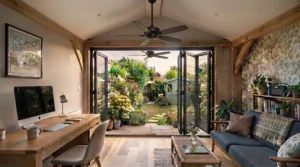
Real-World Scenarios: Which Fan Suits Your Summer House
Different summer houses, different priorities. If you’re a remote worker who’s converted a 3×2.5 metre summer house into a permanent home office, quiet running matters more than raw airflow — the Fantasia Elite Low Energy Tau 50in or the Hunter Newsome make the most sense, since a loud fan hum during video calls undoes the whole point of a peaceful garden office. Budget and low ceiling height both point toward the compact huggers instead.
If you’re a family with a larger garden room used for weekend gatherings, games nights and the occasional home cinema evening, the extra airflow of the Fantasia Viper 54in earns its keep — a bigger blade span cools a crowded room faster and copes better with a door that’s constantly opening and closing as people wander in and out. Pair it with the integrated light and remote for genuine everyday convenience rather than a pull-cord you can never find in the dark.
And if you’ve got a simple, unwired potting shed or a compact summer house you use occasionally through the warmer months rather than daily, running an electrician’s cable out to the garden for a single seasonal fan may not be worth the cost or disruption. That’s precisely the scenario the VEVOR Rechargeable Solar Fan was built for — a genuinely no-installation option that still takes the worst of the heat off a stuffy afternoon.
Battery vs Mains Powered Garden Buildings: The Decision Framework
The battery vs mains powered garden buildings question comes down to three practical factors: how often you use the space, how far the building is from your consumer unit, and how much airflow you actually need. If your summer house sits right against the house wall and you’re already planning an electrician’s visit for lighting or sockets, adding a mains ceiling fan circuit at the same time is genuinely the more cost-effective long-term route — one call-out covers both jobs, and a wired fan will always outperform a battery unit for raw airflow.
If, on the other hand, your garden building sits at the far end of a long garden, involves trenching a cable run, or you simply use the space for a handful of weekends each summer, the calculus flips. A solar/battery unit like the VEVOR Rechargeable Solar Fan avoids the labour cost of running SWA armoured cable underground entirely, and while it won’t match a 50-inch DC fan for cooling power, it removes the electrician, the paperwork, and the disruption of digging up a lawn. As a simple priority checklist: choose mains if you use the building three or more days a week, need to cool a room over roughly four square metres, or already need power out there for other reasons; choose battery/solar if usage is occasional, the building is hard to reach with cable, or you want a trial run before committing to a permanent wiring job.
Why Summer Houses Overheat: Causes and Fixes
Understanding summer house overheating causes explains why a ceiling fan helps as much as it does. Timber summer houses typically have large single-glazed or thin double-glazed windows to maximise natural light, which act almost like a greenhouse — solar radiation passes through the glass, warms the interior surfaces, and that heat then struggles to escape through the same glazing, a straightforward case of the well-documented greenhouse effect at a domestic scale. Add a dark-stained timber roof absorbing direct sun, minimal roof insulation compared to a house loft, and often no cross-ventilation beyond a single door, and you have a recipe for trapped heat that can sit 8-10°C above the outside air temperature by late afternoon.
A ceiling fan doesn’t lower that trapped air temperature — Wikipedia’s overview of how ceiling fans work is clear that fans don’t reduce air temperature or humidity, they only move air — but the moving air increases evaporative cooling from your skin, which is why a fan-cooled room genuinely feels several degrees more comfortable even though the thermometer reading hasn’t changed. The most effective fix pairs a ceiling fan with basic passive measures: closing curtains or fitting reflective blinds before the sun hits the windows directly, opening opposite-facing windows or a roof vent to create a genuine cross-breeze rather than just recirculating hot air, and, where budget allows, adding roof insulation, which does more for long-term comfort than any single fan ever will. On the hottest days, it’s also worth knowing the difference between simple discomfort and a genuine health risk — the government’s official hot weather guidance is a useful reference if you or anyone using the space is vulnerable to heat.
How to Choose Fans for Summer House Cooling
Choosing the right fans for summer house cooling comes down to matching the fan to your specific building, not just picking the biggest or cheapest option available. Here’s a practical, step-by-step approach:
- Measure your ceiling height first. Anything under 2.4 metres needs a genuine low-profile hugger fan, not a standard downrod model, or you’ll be ducking every time you stand.
- Match blade span to room size. A 42-inch fan suits rooms up to roughly 3 metres square; step up to 48-54 inches for larger garden rooms and offices.
- Check the power source realistically. If mains electrics aren’t already run to the building, factor in electrician costs before comparing fan prices alone.
- Prioritise noise if it’s a workspace. DC motor fans run noticeably quieter than AC equivalents, which matters far more in a home office than a games room.
- Consider the damp rating for unheated buildings. A standard indoor-rated fan can suffer in a summer house that gets genuinely humid overnight; a damp-rated model like the Westinghouse Contempra 48in copes better.
- Decide if you need a light kit. An integrated LED saves a second wiring job if you’re doing the electrics from scratch anyway.
- Budget for the whole job, not just the fan. Installation, any necessary noggins or joist work, and electrician sign-off all add to the real cost of getting this right.
Quiet Ceiling Fans for Garden Rooms: What Actually Matters
If you’re specifically after a quiet ceiling fan for garden room use — most commonly a home office — the motor type matters more than almost any other spec on the page. DC motor fans, like the Fantasia Elite Low Energy Tau 50in, use electronically commutated motors that run without the coil-switching buzz inherent to older AC induction motors, and manufacturers routinely quote noise figures well under 35 decibels at low-to-medium speed, which is genuinely close to a quiet library.
What most buyers overlook is that noise complaints about ceiling fans are rarely about the motor alone — a wobbling blade caused by a loose fixing or an unbalanced blade set will produce a rhythmic tick or hum that’s far more distracting than a smoothly running motor at full speed. Reviewers consistently note that taking the time to balance blades correctly during installation (most fans ship with a simple balancing kit) resolves the majority of noise complaints reported in the first month of ownership. If quiet running is your absolute priority, pair a genuine DC motor fan with careful balancing at install, and avoid mounting directly onto thin lining boards that can transmit vibration through the whole roof structure.
Common Mistakes When Buying a Summer House Ceiling Fan
The most frequent mistake is buying based on blade span alone without checking the ceiling height clearance — a beautiful 54-inch statement fan is wasted, and potentially unsafe, in a summer house where the eaves barely clear head height. A close second is assuming any indoor-rated fan will cope with a summer house’s humidity swings; unheated timber buildings often see far more condensation than a house room, and a standard fan not rated for damp conditions can corrode or seize at the motor bearings within a couple of seasons.
Buyers also regularly underestimate installation costs, assuming the fan price is the whole budget, when in reality a first-time electrics job in a detached garden building typically needs a registered electrician for the circuit work regardless of how simple the fan mounting itself is. Finally, many people choose the loudest-specced AC motor fan purely because it’s cheaper upfront, without factoring in that a summer house used as a daily home office will rack up running hours fast enough for the DC motor’s lower running cost and quieter operation to justify the higher price within two or three seasons.
Summer House Ceiling Fans vs Portable and Pedestal Fans
A ceiling fan and a pedestal or tower fan solve the same basic problem in different ways, and the comparison matters before you commit to a permanent installation. A ceiling-mounted fan circulates air across the entire room evenly, doesn’t take up any floor space in what’s often a small building, and — provided you’ve fitted a DC motor model — runs quieter per unit of airflow than most portable alternatives. A pedestal fan, on the other hand, needs zero installation, can be moved between the house and the summer house as needed, and avoids any electrician cost entirely.
| Factor | Ceiling Fan | Pedestal/Tower Fan |
|---|---|---|
| Floor space used | None | Takes up usable floor area |
| Airflow coverage | Whole-room, even | Directional, localised |
| Installation | Requires mounting/wiring | None |
| Best For | Permanent, daily-use rooms | Occasional or rented spaces |
The analysis here is fairly clear-cut: if your summer house is a permanent extension of daily life — a home office, a snug, a regular hangout space — a proper ceiling fan like the Fantasia Elite Low Energy Tau 50in pays for itself in comfort and quiet running. If you’re renting, unsure how long you’ll keep the building, or simply want a flexible stopgap, a pedestal fan or the portable VEVOR Rechargeable Solar Fan avoids any commitment at all.
Long-Term Cost and Maintenance
Running costs vary more than most buyers expect. A budget AC motor fan drawing around 55-75 watts on full speed, run for 8 hours a day through a warm UK summer, costs roughly £0.13-£0.18 per day at current typical UK electricity rates — modest, but it adds up over a season of daily use. A DC motor equivalent like the Fantasia Elite Low Energy Tau 50in, drawing closer to 15-30 watts for comparable airflow, cuts that daily cost by more than half, which starts to meaningfully offset its higher purchase price after a couple of full summers of regular use.
Maintenance is straightforward but easy to neglect: dust build-up on blades is the single biggest cause of reduced airflow and increased motor strain over time, and a simple wipe-down every few weeks during the season keeps performance consistent. Check blade screws for tightness at the start of each summer, since seasonal temperature swings can loosen fixings in a timber building more than in a solid-walled house, and for damp-rated models like the Westinghouse Contempra 48in, an annual check of the motor housing seal is worth the five minutes it takes, particularly after a wet winter.
Safety, Regulations and Compliance Guide
Electrical work in a summer house, shed or any other outbuilding falls under the same Part P Building Regulations that apply inside the main house, because — as outlined in official guidance — the regulations explicitly cover gardens and outbuildings, not just the dwelling itself. New circuits, in particular, should be installed or certified by a registered electrician working to BS 7671 wiring standards; simply extending an existing socket circuit yourself is treated differently to adding a brand-new circuit, so it’s worth checking which category your job falls into before picking up a screwdriver.
Beyond the wiring itself, structural safety matters just as much: any ceiling fan fixing must be secured to a structural joist or a properly fitted noggin, never to thin lining boards alone, and blade-to-floor clearance should meet standard safety minimums to avoid contact injury in a room where people are moving around, including children. For damp or part-exposed buildings, always check a fan’s IP rating and damp/wet classification before installation — a fan rated only for fully dry indoor use can develop electrical faults if fitted somewhere genuinely humid, which is a fire and shock risk rather than just a warranty issue.
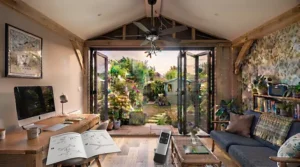
Frequently Asked Questions
❓ Can I fit a ceiling fan in a summer house myself?
❓ What size ceiling fan do I need for a summer house?
❓ Do ceiling fans work without mains electricity?
❓ Why is my summer house so much hotter than outside?
❓ Are DC ceiling fans worth the extra cost for a garden room?
Conclusion
Cooling a summer house properly isn’t complicated, but it does reward a bit of planning. Get the ceiling height and timber fixing points sorted before you fall for a statement 54-inch fan that won’t clear the eaves. Be honest about whether mains power is realistic for your building or whether a battery solution genuinely suits your usage pattern better. And remember that a fan is only half the answer — pairing any of the seven picks above with basic shading and ventilation will do more for comfort than any single product on its own.
From the budget-friendly OUTON 42″ Low Profile right through to the premium, whisper-quiet Fantasia Elite Low Energy Tau 50in, there’s a genuinely sensible option here whatever your summer house looks like and however you use it. Measure twice, check your joists, and choose the fan that matches how you actually spend time out there — not just the one with the flashiest spec sheet.
✨ Don’t Miss These Exclusive Deals!
🔍 Take your summer house comfort to the next level with these carefully selected fans. Click on any highlighted product to check current pricing and availability. A well-chosen fan turns a stuffy timber box into the garden room you actually want to spend your summer in!
Recommended for You
- Garden Room Ceiling Fans: 7 Best Picks for UK Owners 2026
- Pergola Ceiling Fans UK: 7 Top Picks to Beat the Heat in 2026
- Ceiling Fans for Covered Patios: 7 Best Picks for 2026
Disclaimer: This article contains affiliate links. As an Amazon Associate, I earn from qualifying purchases. If you purchase products through these links, we may earn a small commission at no additional cost to you.
✨ Found this helpful? Share it with your friends! 💬🤗
