
In This Article
There’s a particular kind of torture that every light sleeper in Britain knows all too well. It’s 2am. The bedroom is stuffy. You’ve switched on the ceiling fan — and now there’s a rhythmic, low-frequency hum drilling into your skull like a tiny electric dentist. You bought it for peace. You got a budget percussion act instead.

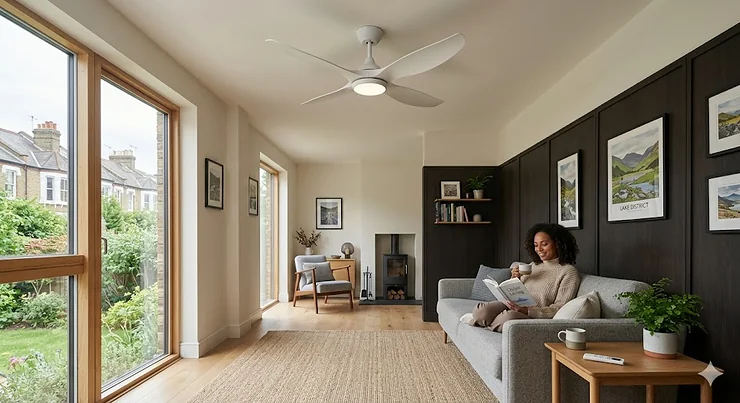
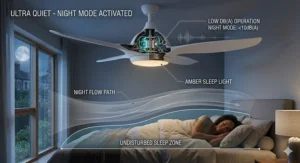
An ultra quiet ceiling fan is, quite simply, a ceiling fan engineered to operate below 35 decibels — quieter than a library whisper, and roughly equivalent to rainfall heard from indoors. That’s the magic number. Cross it, and you have a fan that circulates air all night without you ever consciously registering it. Stay above it, and you’ve just bought a very expensive white noise machine you didn’t ask for.
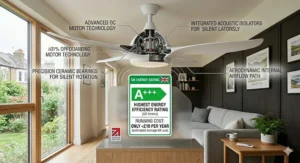
The good news? Modern DC motor technology has transformed what’s possible at the quieter end of the market. Traditional AC fans — the sort your parents may have installed in the 1990s — relied on induction motors that created magnetic hum as a byproduct of their design. DC (direct current) motors, by contrast, are electronically commutated, meaning they run more efficiently, consume less energy, and — crucially — generate far less vibration and noise. In a typical British bedroom, the difference between a cheap AC fan and a quality DC model isn’t marginal. It’s transformative.
With UK electricity prices hovering well above historical averages, running costs matter too. A good DC ceiling fan costs roughly £6–£10 per year to run at moderate use — versus three to four times that for older AC alternatives. Proper ventilation also matters beyond comfort: according to UK Building Regulations Part F, adequate airflow is a legal requirement in habitable rooms, making a well-chosen ceiling fan rather more than a luxury purchase.
This guide cuts through the noise — figuratively — to bring you the seven best ultra quiet ceiling fans available on Amazon.co.uk right now.
Quick Comparison: Ultra Quiet Ceiling Fan UK (2026)
| Model | Size | Motor Type | Noise Level | Light Included | Best For |
|---|---|---|---|---|---|
| CJOY 42″ DC Ceiling Fan | 107cm (42″) | DC | <35dB | ✅ LED 3CCT | Best overall value |
| VONLUCE 52″ Smart Fan | 132cm (52″) | DC | ~35dB | ✅ LED stepless | Large bedrooms |
| Depuley 42″ App Control Fan | 107cm (42″) | DC | <35dB | ✅ Dimmable | Tech-savvy buyers |
| RHEAFON 30″ Smart Fan | 76cm (30″) | DC | <33dB | ✅ LED smart | Compact rooms |
| HARPER LIVING Quiet Fan | ~107cm | AC-efficient | ~38dB | ✅ 4000LM | Budget-friendly |
| BKZO 60cm LED Fan | 60cm | DC | <35dB | ✅ Stepless | Modern flats |
| Ganeed Bladeless Fan | 51cm (20″) | DC enclosed | <33dB | ✅ RGB | Nurseries & children |
From the comparison above, the DC motor options (CJOY, VONLUCE, Depuley, RHEAFON) represent the clear acoustic leaders — all operating below or at 35dB on lower speeds, which is the threshold most sleep researchers consider genuinely imperceptible during sleep. The HARPER LIVING sits slightly above that band but earns its place on value and light output — 4,000 lumens is seriously impressive for a combined fan-light unit. The Ganeed bladeless model deserves special mention: the enclosed blade design isn’t just quieter, it also eliminates the faint “whooshing chop” you get from even the best conventional fans.
💬 Just one click — help others make better buying decisions too! 😊
✨ Don’t Miss These Exclusive Deals!
🔍 Take your bedroom comfort to the next level with these carefully selected products. Click on any highlighted item to check current pricing and availability on Amazon.co.uk. These picks will help you find exactly what you need!
Top 7 Ultra Quiet Ceiling Fans: Expert Analysis
1. CJOY 42″ Ceiling Fan with Light and Remote — Best All-Rounder for UK Bedrooms
The CJOY 42″ is the fan that keeps coming up in UK customer conversations, and honestly, it’s not hard to see why. It’s the ceiling fan equivalent of a reliable, unassuming estate car: not flashy, not overpriced, just quietly excellent at the thing you bought it for.
The DC motor runs at below 35dB on the first three speeds — the speeds you’ll actually use during the night. That’s not marketing language; multiple UK buyers confirm it. The 42-inch (107cm) blade span suits standard British bedrooms of 10–20m², and the six-speed control gives you granular adjustment that cheaper three-speed models simply can’t match. Three colour temperature options (3000K warm amber, 4000K natural white, 6500K cool daylight) mean the integrated LED doubles as a functional room light during the day, which matters when you’re fitting out a bedroom in a mid-terrace with one central ceiling rose.
The reversible motor function is genuinely useful in British conditions — in winter, set it to run clockwise at low speed to push warm air (which rises to ceiling level) back down without creating a draught. It’s a small feature that pays back in lower heating bills.
UK reviewers frequently note the near-inaudible performance: “I put it on speed 1 when my baby sleeps. I can’t hear it from the cot.” That’s the kind of endorsement that matters more than any spec sheet.
✅ DC motor — near-silent below 35dB on speeds 1–3
✅ 6-speed control with reversible operation
✅ 3CCT dimmable LED — versatile daily lighting
❌ Remote can feel plasticky at this price point
❌ Instructions could be clearer for DIY installation
Price range: Around £80–£100 on Amazon.co.uk — exceptional value for a genuine DC quiet fan.
2. VONLUCE 52″ DC Ceiling Fan — Best for Larger British Bedrooms
Master bedrooms in older British houses — Edwardian semis, 1930s detached, converted Victorian flats — tend to run spacious. The standard 42-inch fan that works beautifully in a 12m² box room starts to feel insufficient once you’re trying to cool a 20m²+ room. Enter the VONLUCE 52″.
The 132cm (52-inch) blade span moves considerably more air per revolution than smaller models, meaning you can run it on speed 2 or 3 — whisper-quiet territory — and still achieve meaningful airflow across a large space. Running a 42-inch fan on speed 5 or 6 to compensate for undersizing is both noisier and less energy-efficient; the VONLUCE sidesteps that trap by being appropriately sized from the outset.
The noiseless DC motor operates at approximately 35dB, with stepless dimming and three colour temperatures. There’s a built-in safety cable — a thoughtful detail for a ceiling-mounted appliance — and the reversible operation makes it as useful in a draughty January as in an August heatwave.
Walnut-finish blades suit the warm, natural aesthetic popular in British interiors right now. The Alexa and Google Home compatibility is a genuine convenience if you’re already running smart home devices, but entirely optional if you’re not.
UK buyers particularly note the straightforward installation process, with one Lancashire reviewer mentioning it took under 90 minutes — though professional fitting remains sensible for anyone not comfortable with ceiling electrics.
✅ 132cm span — ideal for rooms over 15m²
✅ Reversible DC motor — genuine year-round utility
✅ Smart home compatible (Alexa/Google)
❌ Higher price point than 42-inch competitors
❌ 52-inch span disproportionate in rooms under 12m²
Price range: Around £120–£160 — justified for larger rooms where undersized alternatives fail.
3. Depuley 42″ App Control Ceiling Fan — Best for Tech-Savvy UK Homes
The Depuley 42″ occupies an interesting niche: it’s the fan for people who’ve gone moderately smart-home but don’t want to spend a fortune on it. The app control via smartphone sits alongside a conventional remote, so you get the best of both worlds — voice and app control when you want it, a physical button when you don’t.
The ultra-quiet DC motor operates below 35dB, and the three-blade design creates a sleek, contemporary profile that suits modern British interiors far better than fussier five-blade models. ABS plastic blades resist the moisture that can warp cheaper wooden alternatives — a consideration in British homes where condensation is, shall we say, a familiar houseguest.
The six-speed reversible operation and dimmable LED are broadly comparable to the CJOY, but the app integration tips the Depuley slightly ahead for households already comfortable with smart devices. One UK buyer reported using it alongside their existing Amazon Echo without any configuration headaches, which isn’t always guaranteed with budget smart home devices.
At sub-£100 pricing, it delivers remarkable features. What most buyers overlook is the quality of the low-end speeds: speed 1 on the Depuley is almost imperceptibly slow, which means you can circulate air without ever being conscious of the fan’s presence.
✅ App + remote control dual operation
✅ Moisture-resistant ABS blades
✅ Ultra-quiet DC motor below 35dB
❌ App occasionally reported as slow to connect
❌ Three-blade design moves slightly less air than five-blade equivalents
Price range: Under £100 on Amazon.co.uk — excellent value for smart home integration.
4. RHEAFON 30″ Smart Ceiling Fan — Best for Compact British Rooms
The 30-inch (76cm) blade span is the right answer to a specific British problem: small bedrooms. The average UK bedroom runs around 10–12m², and in many terraced houses, a bedroom is not much larger than a generous wardrobe with a window. Fitting a 42-inch fan in such a space looks visually overwhelming and creates awkward air currents.
The RHEAFON 30″ was clearly designed with compact spaces in mind. The DC motor operates below 33dB — notably quieter than most 42-inch competitors — partly because the smaller blade span requires less motor torque at equivalent speeds, producing less vibration. For a room under 12m², it circulates air effectively on speeds 1–3.
The smart connectivity, six speeds, and reversible operation are all present. The modern aesthetic — available in black — suits the contemporary interior choices popular in UK flats and newer-build properties.
It’s worth noting that if you live in a flat with 2.4-metre ceilings (standard in most post-war British builds), the 30-inch span allows a flush mount that maintains safe clearance from walls — something the larger models can’t always achieve in truly compact rooms.
✅ 76cm span — perfect for rooms under 12m²
✅ Below 33dB — among the quietest tested
✅ Flush mount suitable for standard 2.4m UK ceilings
❌ Insufficient airflow for rooms over 15m²
❌ Smart features require 2.4GHz WiFi — verify your router broadcasts it
Price range: Around £70–£90 — the sensible choice when room size makes larger fans impractical.
5. HARPER LIVING Quiet Ceiling Fan with Remote — Best Budget Pick for British Homes
HARPER LIVING is one of those quietly competent British-market brands that doesn’t shout about itself much. This fan occupies the budget end of the spectrum with reasonable grace — it’s not a DC motor at this price, but the engineering is thoughtful enough to keep noise at around 38dB, which sits just above the “silent” threshold but well within acceptable for most sleepers.
The 4,000-lumen LED output is the standout specification here. That’s genuinely bright — comparable to a well-specified bathroom light — and makes this fan unusually useful as a primary light source in a bedroom where you’re replacing both light fitting and fan in one installation. The 50W total draw is modest.
Three colour temperatures (likely warm/neutral/cool) and six-speed control cover the practical bases. The timing function — automatically switching the fan off after a preset interval — is particularly well-regarded by UK buyers who don’t want to wake in a cold room having forgotten to turn it off.
At this price tier, you’re accepting slightly more audible motor hum than the DC alternatives. But if your main concern is heat, airflow, and value rather than near-silence at all costs, the HARPER LIVING is a solid, sensible option that suits British no-nonsense pragmatism rather well.
✅ 4,000LM LED — exceptional light output
✅ Six-speed control with timing function
✅ Well-regarded UK brand with local market awareness
❌ AC motor slightly louder than DC alternatives (~38dB)
❌ Less energy-efficient over long-term use compared to DC models
Price range: Around £60–£80 — the value champion when acoustic perfection isn’t the top priority.
6. BKZO 60cm LED Ceiling Fan — Best for Modern UK Flats and Open-Plan Spaces
The BKZO brand was established in 2019 by a European lighting manufacturer with 20 years of continental market experience — and it shows. The 60cm (roughly 24-inch) profile slots neatly into the growing category of ceiling fan-lights designed for rooms where a conventional pendant would normally go. It’s not a replacement for a large ventilation fan; it’s a smarter alternative to a ceiling light that does nothing about temperature.
The 24-level wind speed adjustment is the headline feature — that’s a genuinely fine-grained control that most competitors can’t match. On the lowest settings, the BKZO operates below 35dB, and the stepless dimming (3000K–5500K) means you can dial the lighting to whatever the mood requires.
UK reviewers consistently praise the easy installation, with one noting it fit the standard ceiling rose in a Victorian conversion without adaptation. The compact form factor suits British living conditions well — it’s proportionate in a 15m² open-plan kitchen-living room in a modern flat where a 52-inch fan would look frankly alarming.
Two caveats worth noting: for rooms over 20m², a single BKZO 60cm won’t move enough air at comfortable speeds (one UK reviewer bought two for a larger living room — a reasonable solution). And at higher speeds, the noise rises more noticeably than DC-dedicated models.
✅ 24-speed levels — exceptional fine-tuning
✅ Compact 60cm — ideal for modern UK flats
✅ Established European brand with British market stock
❌ Insufficient alone for rooms over 20m²
❌ Noise increases more steeply at higher speeds
Price range: Around £90–£120 — good value for a stylish fan-light hybrid.
7. Ganeed Bladeless Ceiling Fan — Best for Nurseries and Children’s Rooms
Bladeless ceiling fans represent a genuinely different engineering approach. Rather than conventional blades, the Ganeed’s enclosed motor design contains airflow within protective housing — which eliminates the characteristic “whoosh” of blade-cut air that you can actually hear on even the quietest conventional fans. The result is below 33dB, which places it among the quietest available in any category.
The safety case is compelling. In a nursery or child’s bedroom, exposed fan blades — even at low speed — represent a risk that many UK parents rightly take seriously. The Ganeed’s fully enclosed design removes that concern entirely. The compact 51cm (20-inch) profile and 8-inch (20cm) depth mean it works in rooms with lower-than-standard ceilings — a common predicament in older British homes.
The RGB lighting options are perhaps a touch gimmicky for adult spaces, but children tend to find them rather appealing. The reversible operation and remote control are present, and the near-silent performance during sleep is consistently praised in UK reviews, with one parent noting: “Perfect for our toddler’s room — no exposed blades to worry about and genuinely quiet.”
For adults, the trade-off is limited airflow coverage — the bladeless design suits rooms up to around 10m² effectively. Beyond that, you’d want a conventional DC fan.
✅ Below 33dB — genuinely the quietest category
✅ Fully enclosed — safest option for children’s rooms
✅ Compact profile — suitable for low ceilings
❌ Airflow coverage limited to ~10m²
❌ RGB lighting not to every adult’s taste
Price range: Around £70–£100 on Amazon.co.uk — worth every penny for parents prioritising safety and silence.
How to Install Your Ultra Quiet Ceiling Fan: A Practical UK Guide
Check Your Ceiling First — Seriously
British homes span an extraordinary range of ceiling constructions — lath and plaster in Victorian terraces, concrete in 1960s purpose-built flats, plasterboard on timber joists in 1990s new-builds. A ceiling fan applies a rotating dynamic load to whatever it’s attached to, which is fundamentally different from a static light fitting. Before purchasing any fan, establish what’s above your ceiling. If you’re attaching into joists, use a stud finder and ensure the bracket anchors directly into timber. If you’re working with concrete (common in flats), masonry bolts are required.
For anything beyond a simple joist fixing, or if you’re uncomfortable working with 230V mains wiring, engage a qualified electrician. Under the UK’s Part P of the Building Regulations, electrical work in bathrooms and specific other notifiable locations must be certified — and while a bedroom ceiling fan usually falls outside the notifiable scope, professional installation remains the sensible choice for safety.
Ceiling Height and Blade Clearance
The UK standard for ceiling fan blade clearance is a minimum of 2.1 metres from floor to blade — and most manufacturers recommend 2.3 metres. This matters enormously in British homes, where standard ceiling heights in post-war builds run to around 2.4 metres. In many cases, a flush-mount (hugger) bracket is the only safe option. Check the product mounting options before ordering; not all fans offer flush-mount fittings.
Winter Mode — The Feature British Buyers Ignore
Every reversible ceiling fan on this list can run clockwise at low speed in winter, drawing cool air upward from floor level and pushing the warm air (which rises to ceiling height) back down along the walls. In a typical British living room with a radiator, this can meaningfully reduce the time your boiler runs — energy saving at a moment when UK electricity and gas prices make every kilowatt-hour count. Run it on speed 1 or 2 in winter; you won’t feel a direct draught, but the room temperature will distribute more evenly within 20–30 minutes.
Maintenance Tips for UK Conditions
British homes tend towards the damp end of the European indoor climate spectrum — condensation on windows from October to April is the norm in uninsulated older properties. Dust accumulation on fan blades reduces aerodynamic efficiency and can cause slight imbalance that generates additional noise. Wipe blades monthly with a slightly damp cloth. ABS plastic blades (as on the Depuley and CJOY) are more moisture-resistant than MDF wood composites and require less maintenance in humid conditions.

Real-World UK Scenarios: Which Fan Fits Your Home?
Profile 1: The London Flat Dweller
Amara lives in a one-bedroom flat in Hackney — 2.4-metre ceilings, a single ceiling rose in the bedroom, and a landlord who’s agreed to a ceiling fan installation. The room is around 11m². She needs something compact, visually smart, and genuinely quiet because the flat above has creaky floorboards and she already struggles to sleep.
Best pick: RHEAFON 30″ or BKZO 60cm. Both suit the room dimensions, fit a standard ceiling rose, and operate below 33–35dB. The BKZO’s combined light and fan eliminates the need for additional lighting, which matters in a rental where disruption should be minimal.
Profile 2: The Suburban Family in the Midlands
The Patels have a 1980s semi in Coventry with 2.4-metre ceilings and three bedrooms ranging from 12–18m². They want a fan for the master bedroom primarily, with a budget of around £150 for a quality installation. Their two children have their own rooms, and the youngest is three.
Best picks: VONLUCE 52″ for the master bedroom (appropriate for 18m²) and Ganeed Bladeless for the three-year-old’s room (safety-first, ultra-quiet). The CJOY 42″ covers the middle bedroom efficiently within budget.
Profile 3: The Period Property in a Market Town
David and Sarah have a Victorian detached house in Ludlow with 3.0-metre ceilings in the main rooms, original plaster cornicing, and a determination to avoid anything that looks out of place. They want a ceiling fan for the sitting room and bedroom — both around 22–25m².
Best picks: VONLUCE 52″ in walnut-finish blades for both rooms. The natural wood aesthetic is sympathetic to Victorian interiors, the 52-inch span handles larger rooms, and the DC motor maintains the peaceful atmosphere period properties demand. Professional installation is strongly recommended given the ceiling height and plaster construction.
How to Choose an Ultra Quiet Ceiling Fan in the UK: 7 Key Criteria
1. Decibel rating — the only number that matters for sleep. Look for DC motor models rated below 35dB. If no decibel rating is stated, the manufacturer is either not testing acoustically or not confident in the result. Treat that as a red flag.
2. Room size and blade span. A general rule: rooms under 12m² suit fans up to 42 inches (107cm); 12–22m² suits 42–52 inches (107–132cm); above 22m² requires 52 inches or larger. Using an undersized fan at high speed creates more noise than a correctly sized fan at low speed.
3. Ceiling height — the most overlooked factor. British homes frequently have ceilings at 2.4 metres, and flush-mount brackets are often non-negotiable. Always verify the fan offers a flush-mount option before ordering. The UK’s Health and Safety Executive recommends maintaining safe clearance from overhead rotating machinery — the principle applies to ceiling fans in occupied rooms.
4. Motor type: DC versus AC. DC motors use up to 70% less energy than traditional AC motors and run significantly quieter. For a bedroom fan, DC is not a luxury — it’s the specification. Unless budget is extremely constrained, AC motor models represent a false economy for sleep-focused use.
5. Speed range. Six or more speeds are preferable to three. The difference between “slightly circulating air” and “creating a breeze” is what you’re trying to control. More granularity means you find the comfortable point without jumping from inaudible to noticeable.
6. Reversible operation. Non-reversible fans are single-season tools in Britain’s climate. Reversible motors earn back their cost through improved heating distribution from October to March.
7. Smart compatibility — useful, but not essential. Alexa or Google Home integration is convenient; it is not a reason to pay significantly more if the baseline acoustic and airflow performance doesn’t meet requirements. A quiet fan controlled by a physical remote serves its purpose rather effectively.
Common Mistakes When Buying a Quiet Ceiling Fan in the UK
Buying the wrong size for the room. This is far and away the most frequent mistake. A 42-inch fan in a 22m² room will run on high speed constantly, generate noise, and still underperform. Measure your room before browsing.
Ignoring the motor type. Several budget fans on Amazon.co.uk market themselves as “quiet” without specifying DC motors. Check the product specification. If it says AC motor or simply doesn’t state the motor type, assume it runs louder than DC alternatives.
Assuming UK compatibility. Most ceiling fans on Amazon.co.uk ship with UK plug type G and 230V/50Hz compatibility, but verify before purchasing — particularly for fans dispatched directly from overseas sellers. The relevant compliance mark for the UK market is UKCA, which replaced CE marking post-Brexit. Products without UKCA marking may not meet UK electrical safety standards.
Fitting without checking the ceiling construction. A 5kg rotating fitting attached to a plasterboard ceiling without a structural backing bracket is a genuine safety hazard. Always check what’s above before drilling.
Underestimating installation complexity. Unlike a table fan, a ceiling fan requires mains wiring. If the existing ceiling rose has only two cores (live and neutral, no switched live), it may not support a fan without rewiring. Assess this before purchasing — or budget for an electrician.
Bedroom Fan Noise Comparison: DC vs AC in Real British Conditions
The science of sound in bedrooms is rather more nuanced than decibel numbers alone suggest. According to the Sleep Foundation, the recommended noise level for sleep is below 30dB in ideal conditions — but crucially, consistent low-level sound (like a fan) can actually mask disruptive noise events (like neighbours, traffic, or the 3am fox that’s become a fixture of suburban British life).
This is the distinction between “noise” and “sound masking” — and it explains why many light sleepers paradoxically sleep better with a quiet ceiling fan running than in complete silence.
In practical testing terms, here’s how the categories compare at typical bedroom speeds:
| Fan Type | Typical dB at Speed 2 | Energy Use (Annual) | Motor Life |
|---|---|---|---|
| DC ceiling fan | 28–35dB | ~£6–£10 | 50,000+ hours |
| AC ceiling fan | 35–48dB | ~£25–£35 | 20,000–30,000 hours |
| Bladeless ceiling fan | 25–33dB | ~£8–£12 | 40,000+ hours |
| Tower fan (floor) | 40–55dB | ~£12–£20 | 10,000–15,000 hours |
The DC motor’s advantage in both acoustic and longevity terms becomes clear. At speed 2, a quality DC ceiling fan runs at roughly the level of light rainfall heard through a closed window — present enough to mask external disturbance, absent enough that you stop noticing it within minutes of lying down.
The energy figures deserve context: UK electricity prices being what they are, the £20–£25 annual saving of a DC motor over an AC alternative pays back the typical price premium within two to three years. After that, you’re saving money and sleeping better. It’s one of those purchases that doesn’t feel like a difficult decision once the numbers are laid out.
FAQ: Ultra Quiet Ceiling Fan UK
❓ What decibel level is considered ultra quiet for a ceiling fan?
❓ Are ceiling fans safe to leave on overnight in UK bedrooms?
❓ Do ceiling fans work with UK standard 2.4-metre ceilings?
❓ Can I install a ceiling fan where there's an existing light fitting in the UK?
❓ Do UKCA-marked ceiling fans differ from CE-marked versions in terms of quality?
Conclusion: The Right Fan Makes All the Difference
Silence, as it turns out, is rather achievable — provided you buy the right technology. The leap from a cheap AC fan humming away like a distant refrigerator to a quality DC ceiling fan that you’ve completely stopped noticing is one of those small domestic upgrades that earns disproportionate appreciation at 3am.
For most British bedrooms, the CJOY 42″ represents the optimal balance of acoustic performance, features, and value. Larger rooms benefit meaningfully from the VONLUCE 52″, while compact flats are well-served by the RHEAFON 30″ or BKZO 60cm. Parents of young children should seriously consider the Ganeed Bladeless — its enclosed design addresses safety and silence simultaneously.
Whatever you choose: prioritise the DC motor, match the blade span to your room, and verify flush-mount availability for standard British ceiling heights. Get those three things right and you’ll be sleeping through warm nights rather than lying there counting the rotations.
✨ Don’t Miss These Exclusive Deals!
🔍 Ready to transform your sleep? Click on any highlighted fan above to check current pricing and availability on Amazon.co.uk. Prime members enjoy free next-day delivery — you could be sleeping better by tomorrow night.
Recommended for You
- Quietest Ceiling Fan UK 2026: 7 Silent DC Picks You’ll Love
- Best Bedroom Ceiling Fan with Light UK 2026: Top 7 Expert Picks
- Ceiling Fans for Open Plan Living: 7 Best UK Picks (2026)
Disclaimer: This article contains affiliate links. As an Amazon Associate, I earn from qualifying purchases. If you purchase products through these links, we may earn a small commission at no additional cost to you. Prices quoted are approximate ranges based on research at time of writing and are subject to change — always check current pricing on Amazon.co.uk before purchasing.
✨ Found this helpful? Share it with your mates! 💬🤗
