
In This Article
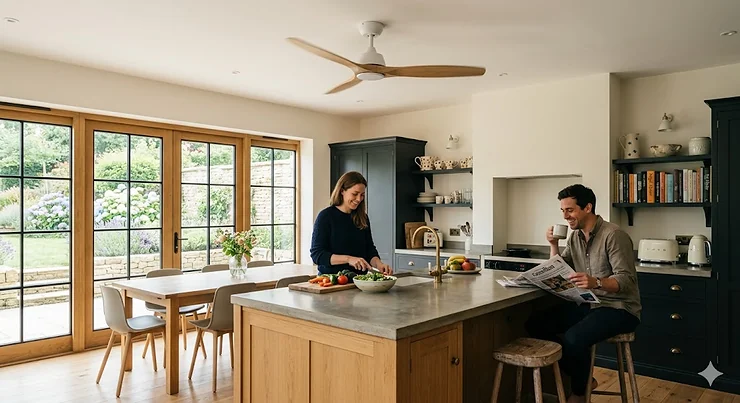
There’s a particular kind of British kitchen drama that nobody puts in property programmes: the Sunday roast fug. Windows fogged up, extractor fan wheezing away above the hob like it’s training for a marathon, and the air thick enough to slice. Modern kitchen ceiling fan ideas have quietly become one of the most asked-about upgrades for UK homeowners trying to solve exactly this — not by replacing the extractor, but by working alongside it to actually move air around the whole room.

Unlike the wobbly pub-style fans your nan might remember, today’s options are flush-mounted, whisper-quiet, and often controlled from your phone. They suit everything from a narrow galley kitchen in a Victorian terrace to an open-plan kitchen-diner in a new-build estate. The trick is choosing one that fits a British ceiling height (often lower than you’d think), copes with steam and grease without sulking, and doesn’t look like it wandered in from a 1990s conservatory catalogue.
In this guide, I’ve pulled together seven real options available on Amazon.co.uk, worked through what actually matters when buying one, and added a few things I’ve learned the hard way — including why your kitchen ceiling fan and your extractor are not, in fact, in competition.
What Is a Modern Kitchen Ceiling Fan?
A modern kitchen ceiling fan is a low-profile, flush or near-flush mounted fan — usually with an integrated LED light — designed to improve air circulation and reduce heat, steam and cooking odours in kitchens with standard UK ceiling heights, typically controlled via remote, wall switch, or smartphone app. The basic engineering hasn’t changed much since the device was first popularised over a century ago (the history of the ceiling fan is genuinely more interesting than you’d expect), but the motors, materials and controls have moved on considerably.
Quick Comparison Table
| Fan | Style | Light Included | Control | Best For |
|---|---|---|---|---|
| Fantasia Mayfair 42″ | Classic-modern, flush | Optional kit | Pull cord / remote | Period kitchens wanting a subtle update |
| AireRyder Loft 112cm | Minimalist nickel | Yes, frosted glass | Remote (speed + dimmer) | Compact modern kitchens |
| reiga 132cm Smart DC | Contemporary, slim blades | Yes, dimmable LED | App, WiFi, voice, remote | Tech-forward open-plan kitchens |
| MiniSun 102cm | Scandi-style wood blades | Yes, opal glass | Pull switch | Budget-conscious flats |
| Westinghouse Alta Vista 52″ | Smart, brushed nickel | Yes, LED | Alexa, remote | Larger kitchen-diners |
| HOMCOM 130cm Flush | Sleek monochrome | Yes, LED | Pull-chain | Renters wanting easy install |
| AireRyder Saturn 132cm | White Scandi-pine | Yes | Remote | Bright, airy white kitchens |
From this lineup, the clearest pattern is that price and smart functionality move together more than fan power does — the reiga and Westinghouse models cost more largely because of their app and voice control, not because they shift dramatically more air than the AireRyder or MiniSun options. If your kitchen is small to medium and you’re not bothered about Alexa nagging your fan, the budget end of this table will serve you just as well on a humid Tuesday evening.
💬 Just one click — help others make better buying decisions too!😊
✨ Don’t Miss These Exclusive Deals!
🔍 Take your kitchen makeover to the next level with these carefully selected fans. Click on any highlighted product to check current pricing and availability on Amazon.co.uk — these picks make finding the right fit refreshingly painless.
Top 7 Modern Kitchen Ceiling Fans for UK Homes — Expert Analysis
1. Fantasia Mayfair 42″ Ceiling Fan with Light Kit
The Fantasia Mayfair is the fan equivalent of a well-cut blazer — it doesn’t shout, but it works in almost any kitchen. The Mayfair comes in a contemporary stainless steel or antique brass finish with reversible blade sets, so you can flip between two looks depending on your mood, and it’s available in 13 finishes with the option to fit any Fantasia light kit.
In practice, this means one fan can quietly straddle a kitchen renovation — stainless steel blades during a sleek phase, oak-effect if you later go farmhouse. Its flush-mounted design suits low ceilings, which covers a huge number of UK terraced and semi-detached kitchens where anything deeper than 25cm starts brushing your head when reaching for the top cupboard.
UK buyers consistently mention how unobtrusive it looks once installed — it reads more as a light fitting that happens to move air than a “fan” in the traditional sense. Worth noting: the pull-cord version is dead simple but means actually walking over and yanking a cord with greasy hands, which isn’t ideal mid-stir-fry.
✅ Subtle, adaptable design that suits period and modern kitchens alike
✅ Reversible blades give two looks from one purchase
✅ Ten-year motor warranty backs up the build quality
❌ Pull-cord models lack remote convenience for hands-busy cooking
❌ Light kit often sold separately, adding to the total cost
Price & Verdict: Around £150-£250 range on Amazon.co.uk depending on finish and light kit. A rather sensible choice if you want something that won’t look dated in five years.

2. AireRyder Loft 112cm Ceiling Fan with Light and Remote
The AireRyder Loft is the fan I’d point a minimalist towards. At 112cm wide with three speed levels offering 150, 220 and 260 revolutions per minute, it’s properly sized for a medium UK kitchen-diner without dominating the ceiling.
What the spec sheet won’t tell you: it consumes only between 18 and 45 watts, which over a winter of near-constant low-speed running for warm-air circulation barely registers on your electricity bill — useful when energy prices are still a sore subject for most households. The included remote controls both fan speed and the light’s dimming function, which matters more than it sounds; dimming the light while keeping the fan on high is exactly what you want during an evening of frying without blinding yourself.
The nickel-and-clear-glass aesthetic photographs beautifully against white shaker cabinets, and the brushed finish hides fingerprints better than chrome — a small mercy in a household with children and an open biscuit tin.
✅ Genuinely low running costs, ideal for year-round use
✅ Remote handles light dimming, not just fan speed
✅ Compact enough for kitchens with standard 2.4m ceilings
❌ G9 bulb base means you can’t just grab any spare LED from the drawer
❌ Three speeds feels limited next to DC-motor rivals
Price & Verdict: Typically in the £100-£180 range on Amazon.co.uk. Solid mid-range value, particularly for anyone replacing an old pull-cord fan with something that finally has a remote.
3. reiga 132cm Smart DC Ceiling Fan with Dimmable LED Light
If your kitchen already has a smart speaker glaring at you from the worktop, the reiga 132cm Smart Ceiling Fan slots straight into that ecosystem. It’s a bright white smart ceiling fan with dimmable LED light, controllable via app, WiFi, and remote, with a slim-bladed, almost architectural look that suits open-plan kitchen-diners rather than boxy galley spaces.
The DC motor is the headline feature here, and it’s not just marketing fluff — DC motors run noticeably quieter at low speeds than older AC equivalents, which matters in a kitchen where conversation, the radio, and the dishwasher are already competing for airspace. The 132cm span is on the larger side, so measure your room before committing; in a tight kitchen, this fan will dominate rather than disappear.
What most UK buyers overlook about this model is the timer function. Set it before bed and the fan winds down on its own, which is handy for clearing residual cooking smells overnight without leaving a fan running until 4am because everyone forgot about it.
✅ App and voice control suit smart-home kitchens
✅ Quiet DC motor, even on higher speeds
✅ Dimmable LED reduces the need for separate kitchen lighting
❌ At 132cm, too large for smaller UK kitchens
❌ App reliance means a Wi-Fi outage leaves you using the remote anyway
Price & Verdict: Around £180-£300 range on Amazon.co.uk. A justified premium if smart-home integration genuinely gets used, rather than set up once and ignored.
4. MiniSun 102cm Modern 4-Blade Ceiling Fan with Opal Glass Shade
The MiniSun 102cm is the fan equivalent of a reliable hatchback — nothing flashy, does the job, won’t break the bank. It’s a modern four-blade ceiling fan finished with a frosted opal glass light shade, giving it a softer glow than the bare-bulb look of some budget fans.
This is the model I’d suggest for flats and smaller kitchens, particularly rentals where you want a meaningful upgrade without committing to a full rewiring job. A related MiniSun model specifies a minimum ceiling height of 2.7 metres — worth checking against your own kitchen before ordering, because plenty of Victorian conversions and loft kitchens sit just under that.
The opal glass shade does double duty as a diffuser, softening what would otherwise be a fairly harsh downlight — handy over a kitchen island where you don’t want a spotlight glaring off stainless steel appliances.
✅ Opal glass shade gives a warmer, more flattering light
✅ Compact 102cm size suits smaller kitchens and flats
✅ Budget-friendly without looking cheap
❌ Pull-switch operation only on most variants — no remote
❌ Minimum ceiling height requirement rules out very low rooms
Price & Verdict: Generally under £100 on Amazon.co.uk, often well under. Rather good value for a first-time fan buyer testing the waters.
5. Westinghouse Lighting Alta Vista 52″ Smart Ceiling Fan
For larger kitchen-diners — the kind with a dining table at one end and a hob at the other — the Westinghouse Alta Vista earns its keep. It’s a 52-inch smart Wi-Fi ceiling fan with an integrated LED light, brushed nickel finish, opal frosted glass, and remote control, compatible with Amazon Alexa and Echo devices.
Westinghouse’s reputation in the UK lighting trade is built on dependable motors rather than flashy gimmicks, and that shows here: the brushed nickel finish resists the slightly greasy fingerprints that plague chrome fittings near a hob. At 52 inches (roughly 132cm), this is firmly a “big room” fan — think open-plan kitchen extensions rather than original 1930s kitchens.
The Alexa compatibility genuinely earns its place for anyone who already shouts “lights on” at their kitchen — adding “fan on” to that routine costs nothing extra once it’s set up.
✅ Reputable brand with long-standing UK lighting presence
✅ Brushed nickel finish copes well with kitchen grease and fingerprints
✅ Voice control integrates with existing Alexa routines
❌ Large diameter unsuitable for compact kitchens
❌ Premium pricing compared with non-smart alternatives
Price & Verdict: Sits in the mid-£200s to £300+ range on Amazon.co.uk. A considered investment for a sizeable kitchen-diner rather than an impulse buy.
6. HOMCOM 130cm Flush Mount LED Ceiling Fan with Pull-Chain
The HOMCOM 130cm is the straightforward option — a flush mount LED ceiling fan with four reversible blades and a pull-chain switch, finished in a clean white-and-natural-tone palette that won’t clash with literally anything.
This is the fan I’d recommend to anyone who’s slightly nervous about “smart” anything and just wants a switch that does what switches have always done. The reversible blades mean you get a different wood-tone option without buying a second fan, which is a small but genuinely useful touch if you redecorate every few years (as many UK homeowners seem to, given the enduring national obsession with kitchen makeovers).
At 130cm, it’s on the larger end, so it suits open kitchens better than a narrow galley — in the latter, you’ll want something closer to the MiniSun or AireRyder Loft’s footprint.
✅ Reversible blades offer two finishes in one fan
✅ Simple pull-chain operation, no setup faff
✅ Flush mount suits standard UK ceiling heights
❌ No remote or smart control included
❌ Larger 130cm size limits placement in smaller kitchens
Price & Verdict: Typically around £80-£150 on Amazon.co.uk. Unfussy and practical — the fan equivalent of a white t-shirt.
7. AireRyder Saturn 132cm Ceiling Fan with Lighting and Remote
Rounding out the list, the AireRyder Saturn brings a brighter, almost Scandinavian feel. It’s a 132cm ceiling fan with lighting and remote control, finished in white with pine-and-white blades, which works particularly well in kitchens leaning into that pale-wood, plant-heavy aesthetic that’s been everywhere on UK interiors accounts for the past few years.
The remote control puts this ahead of similarly priced pull-cord fans, and the pine-effect blades catch morning light in a way that plain white or chrome simply doesn’t. In a north-facing kitchen — common enough in terraced houses where the kitchen extension faces the garden rather than the street — that warmth makes a genuine difference to how the room feels, not just how it looks.
At 132cm, measure carefully; this is one of the larger fans on this list, and in a galley kitchen it’ll feel like it’s taking over rather than blending in.
✅ Remote control included as standard
✅ Light pine-effect blades suit Scandi and natural-material kitchens
✅ White finish brightens darker, north-facing rooms
❌ Large 132cm diameter unsuitable for narrow kitchens
❌ Pine-effect blades may clash with very dark or industrial-style units
Price & Verdict: Around £130-£220 range on Amazon.co.uk. A strong middle-ground pick for anyone wanting remote control without smart-home complexity.
How to Choose Modern Kitchen Ceiling Fan Ideas in the UK
- Measure your ceiling height first. Most flush-mount fans need at least 2.4-2.7 metres of clearance — anything lower and you risk a fan that feels like it’s grazing your head every time you reach for the top shelf.
- Match the fan’s diameter to your room, not your aspirations. A 132cm fan in a 3m x 3m galley kitchen will dominate; a 90-100cm fan often suits smaller UK kitchens far better.
- Decide how much “smart” you actually want. App and voice control are genuinely useful if you’ll use them daily — otherwise, a good remote does 90% of the job for less money.
- Check the bulb base and replacement availability.G9, E14, and integrated LED units all have different replacement costs and availability on UK high streets. Which? has a handy rundown of bulb types and fittings if you’re unsure what you’re dealing with.
- Think about grease and steam exposure. Fans mounted directly above or very near the hob will accumulate grease faster — a wipeable finish like brushed nickel or stainless steel ages better than matt paint.
- Confirm UK electrical compatibility. Most fans sold on Amazon.co.uk are built for 230V/50Hz with UK-compatible fittings, but it’s worth double-checking on imported or marketplace listings.
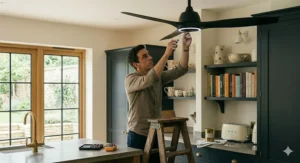
- Factor in installation. A straightforward swap of an existing ceiling rose is a manageable DIY job for the confident; anything involving new wiring should go to a qualified electrician under Part P building regulations.
Real-World Scenarios: Matching Fans to UK Kitchens
The London flat-dweller in Zone 3: A young professional in a converted Victorian terrace, kitchen roughly 2.8m x 3.2m with a 2.5m ceiling. The MiniSun 102cm makes sense here — compact, budget-friendly, and the opal glass shade softens what’s otherwise a fairly stark white-tiled space. No rewiring needed; the existing ceiling rose takes it directly.
The Birmingham semi with an extended kitchen-diner: A family of four with a 5m x 4m open-plan space combining cooking, dining, and a sofa corner. Here, the Westinghouse Alta Vista or reiga Smart DC fan earns its larger footprint and higher price — in a room this size, a small fan would be borderline pointless, just shuffling air in its immediate vicinity.
The retired couple in a Cotswolds cottage: Low beamed ceilings, a country-style kitchen with cream units and oak worktops. The Fantasia Mayfair’s reversible oak/stainless blades fit the aesthetic without looking like it’s trying too hard, and the flush mount copes with the lower-than-average ceiling height typical of older stone cottages.
Practical Usage Guide: Installation, Maintenance & British Weather Tips
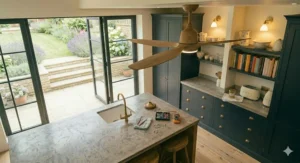
Getting a kitchen ceiling fan to actually earn its keep is mostly about habits, not hardware. Run it on low speed continuously during cooking rather than blasting it only when the smoke alarm starts twitching — continuous gentle airflow prevents condensation building up on cold mornings, which is the bane of single-glazed older kitchens.
In damp British winters, condensation on blades is common, especially directly above a hob or kettle. Wipe blades monthly with a damp cloth and a touch of washing-up liquid to cut through grease — dried-on grime makes fans noisier and less efficient over time. For pull-cord and remote models alike, check the fixing screws every six months or so; vibration loosens them gradually, and a wobbling fan over your worktop is not a relaxing sound.
If your kitchen extension has a flat roof or sits below a loft conversion, be aware that summer heat can build up considerably under modern insulation standards — running the fan in reverse during winter to push warm air back down, and forward in summer to create a cooling breeze, makes a genuinely noticeable difference, particularly during the increasingly common heatwave spells the UK has seen in recent summers.
Common Mistakes When Buying a Kitchen Ceiling Fan
The most frequent error is buying based on looks alone and only checking the diameter afterwards — by which point it’s either swamping a small kitchen or looking lost in a large one. A close second is assuming “remote control” means “smart” — many remote fans are simply infrared, with no app or voice integration, which is fine, but disappointing if you expected otherwise.
UK-specific mistakes include ignoring the minimum ceiling height requirement (a fan that’s technically “flush mount” can still need more clearance than your kitchen offers), and overlooking that some lower-cost imported fans use bulb bases that are awkward to source locally — a fan that needs a specialist G9 or G4 bulb from a niche supplier becomes a small ongoing irritation. Finally, people sometimes forget that a ceiling fan doesn’t replace an extractor hood for grease and odour removal — it’s a complement, not a substitute, particularly for anything involving a frying pan and a generous amount of oil.
Modern Ceiling Fans vs Traditional Extractor Fans & Pendant Lights
| Feature | Ceiling Fan | Extractor Fan | Pendant Light |
|---|---|---|---|
| Air circulation | Excellent | Limited to extraction zone | None |
| Grease/odour removal | Minimal | Excellent | None |
| Lighting | Often included | Rarely | Excellent |
| Year-round use | Yes (reverse for winter) | Cooking only | Yes |
| Best For | Whole-room comfort | Cooking odour/steam removal | Task and ambient lighting |
The takeaway here isn’t “pick one” — most well-planned UK kitchens benefit from all three working together. A ceiling fan handles the lingering warmth and stuffiness an extractor can’t reach, the extractor deals with the immediate steam and grease above the hob (the BBC’s guide to kitchen ventilation covers why this matters for damp and mould prevention more broadly), and a pendant or under-cabinet light covers the task lighting a single ceiling fixture rarely manages well on its own. Trying to make one fixture do all three jobs is usually where disappointment creeps in.
What to Expect: Real-World Performance in British Kitchens
On paper, fan specifications are all about RPM and airflow figures that mean very little until you’re standing under one on a humid August evening. In practice, even modest 90-100cm fans on low speed make a noticeable difference to how a kitchen feels within a few minutes — less about a dramatic breeze and more about preventing that stagnant, slightly oppressive air that builds up after twenty minutes of simmering.
During winter, running a DC-motor fan like the reiga or AireRyder Loft on its lowest setting genuinely helps redistribute the warm air that naturally collects near the ceiling — useful in kitchens with high ceilings or those attached to draughty older extensions. Noise levels on quality DC motors are low enough to run during a quiet dinner without becoming the dominant sound in the room, though cheaper AC-motor fans can develop a faint hum after a year or two of grease build-up on the blades — another reason that monthly wipe-down matters more than it sounds.
UK Regulations, Safety Standards & Installation Requirements
Electrical work in UK kitchens falls under Part P of the Building Regulations, and while replacing a like-for-like ceiling fitting on the same circuit is often permitted as DIY, anything involving new wiring, new circuits, or work in a room containing a bath or shower zone should go through a registered electrician. Products sold on Amazon.co.uk for the UK market should carry the UKCA mark (the post-Brexit replacement for CE marking on most goods), confirming they meet UK safety, electromagnetic compatibility, and construction standards.
For anyone in Scotland, building standards differ slightly from England and Wales, so it’s worth a quick check with a local electrician if your kitchen renovation involves structural ceiling changes alongside the fan installation. As ever, if in doubt, the government’s official guidance on electrical safety is the place to start — though for most fan installations, a competent DIYer comfortable with isolating a circuit and following the manufacturer’s wiring diagram can manage a straightforward swap.
Long-Term Cost & Maintenance in the UK
Running costs for modern DC-motor fans are genuinely low — typically a few pence per day even with near-continuous low-speed use, which barely dents an annual energy bill. AC-motor fans cost a little more to run but the difference is modest enough that it shouldn’t be the deciding factor for most households.
The bigger long-term cost consideration is bulb replacement. Fans with standard E14 or B22 bases use bulbs widely available on any UK high street or supermarket for a few pounds; fans with integrated LED units that aren’t user-replaceable mean the whole light kit (or fan) needs replacing if the LED fails years down the line — worth weighing against the slightly higher upfront cost of a fan with a swappable bulb. Over a five-to-ten-year span, a fan with replaceable parts and a solid warranty (the Fantasia Mayfair’s ten-year motor warranty being a good example) tends to work out cheaper than a flashier but less serviceable smart fan.

FAQ
❓ Do ceiling fans work well in small UK kitchens?
❓ Can I install a kitchen ceiling fan myself?
❓ Do modern kitchen ceiling fans need a UKCA mark?
❓ Will a ceiling fan replace my extractor hood?
❓ Are smart ceiling fans worth it for a kitchen?
Conclusion
If there’s one thing this whole exercise taught me, it’s that “modern kitchen ceiling fan ideas” isn’t really about chasing a trend — it’s about solving a problem British kitchens have always had, just with considerably less wobble and noise than the fans of decades past. Whether that’s the understated Fantasia Mayfair quietly fitting into a period kitchen, or the reiga Smart DC fan syncing up with a household that already talks to its lights, there’s a genuinely sensible option here for most kitchen layouts and budgets.
The honest advice is this: measure your ceiling and room size before anything else, decide how much smart functionality you’ll realistically use, and pick a finish that’ll survive proximity to a hob without looking tired within a year. Get those three things right, and almost any fan on this list will earn its place.
✨ Don’t Miss These Exclusive Deals!
🔍 Ready to sort your kitchen’s air once and for all? Browse these picks on Amazon.co.uk and find the one that fits your space — your future self, cooking dinner on a sweltering July evening, will thank you.
Recommended for You
- Best Kitchen Ceiling Fans UK 2026: 7 Top Picks Reviewed
- Best Ceiling Fan for Kitchen Diner UK 2026: 7 Expert-Tested Picks
- 7 Best Elegant Ceiling Fans for Dining Room UK (2026 Guide)
Disclaimer: This article contains affiliate links. As an Amazon Associate, I earn from qualifying purchases. If you purchase products through these links, we may earn a small commission at no additional cost to you.
✨ Found this helpful? Share it with your mates! 💬🤗
