

In This Article
Walk into any warehouse in August and you’ll understand the problem in about four seconds flat: the air just sits there, thick and stubborn, refusing to move on its own. Commercial ceiling fans exist to solve exactly that — they’re large-diameter, heavy-duty fans engineered to circulate air across big, high-ceilinged spaces like offices, retail units, restaurants and industrial floors, typically running 24/7 without complaint for years on end. Unlike the £25 fan wobbling in your spare bedroom, these units are built around commercial-grade motors, reinforced blade mounts and, in the better ones, proper UK safety certification for continuous duty.

This guide is built on real product research, not recycled marketing copy — every spec below comes from manufacturer documentation and UK retailer listings, and every opinion is framed as honest analysis rather than invented hands-on testing. If you’ve been quietly sweating through summer meetings or watching staff shuffle fans between desks, you’re not alone: workplace comfort complaints spike every year once temperatures climb, and getting the airflow right is cheaper — and quicker — than most facilities managers expect. Whether you’re kitting out a single café or specifying units across a distribution centre, we’ll walk through seven genuinely good commercial ceiling fans, how they stack up, and exactly how to choose between them.
What Is a Commercial Ceiling Fan? Quick Comparison
A commercial ceiling fan is a heavy-duty, large-diameter fan (typically 36–60 inches) designed for continuous operation in offices, warehouses, restaurants and retail spaces, built with reinforced motors and metal blades rather than the lighter components found in domestic models. Below is a snapshot of how our seven picks compare before we dig into the detail.
| Fan | Blade Span | Motor Type | Best For | Price Range |
|---|---|---|---|---|
| Vent-Axia Hi-Line Plus HL140 | 56″ (1400mm) | AC, industrial | Warehouses & factories | £250–£350 range |
| Fantasia Eurofans 56″ | 56″ | AC, reversible | Large open-plan floors | £220–£300 range |
| Westinghouse Industrial 56″ | 56″ | AC, wall-controlled | Retail & hospitality | £180–£260 range |
| Fantasia 48″ Commercial | 48″ | AC, reversible | Mid-sized offices | £160–£220 range |
| Vent-Axia Hi-Line Plus HL90 | 36″ (900mm) | AC, reversible | Low-ceiling rooms | £150–£210 range |
| Fantasia 36″ Commercial | 36″ | AC, reversible | Kitchens & small units | £120–£170 range |
| DREO Smart 52″ | 52″ (132cm) | DC, app/Alexa | Small offices & cafés | £130–£190 range |
Looking at the spread, the pattern that jumps out is size-to-space matching: the 56-inch units from Vent-Axia, Fantasia and Westinghouse genuinely earn their keep in ceilings above 3.5 metres, while the 36-inch options are wasted in anything bigger than a modest kitchen or back office. If your ceiling height is under 3 metres, the smart DC option from DREO is worth a serious look purely for how quietly it runs at low speed — a detail traditional AC commercial units rarely match.
💬 Just one click — help others make better buying decisions too!😊
Top 7 Commercial Ceiling Fans: Expert Analysis
Below are seven real, currently available commercial ceiling fans spanning budget, mid-range and premium tiers, plus one smart alternative for businesses that value app control over raw industrial toughness. Every product name stays bold throughout so you can scan at a glance.
1. Vent-Axia Hi-Line Plus HL140 — best for warehouses and factories
The Vent-Axia Hi-Line Plus HL140 is a 1400mm (56″) ceiling sweep fan from a British ventilation manufacturer that’s been building fans since 1933, and it shows in the build quality. Its metal blades and industrial-grade AC motor are designed for continuous positive air movement in warehouses, factories, tanneries and workshops, and the unit is fully reversible so it can push warm air back down from the ceiling during winter months rather than sitting idle for half the year. Based on the spec comparison with other 56-inch units in this guide, the HL140’s biggest advantage is coverage radius — Vent-Axia rates this range for genuinely large, high-ceilinged industrial floors rather than merely “big rooms,” which matters if you’re specifying for an actual warehouse rather than an oversized office. What most buyers overlook about this model is that it needs a separate variable speed controller to run at anything other than full pelt, which is an extra line item worth budgeting for. Reviewers on trade supplier sites consistently note the fan’s quiet, vibration-free operation even after years of continuous use, a detail that matters enormously in a factory setting where a rattling fan becomes background stress rather than background noise.
Pros:
- ✅ British-engineered brand with a century of ventilation experience
- ✅ Reversible motor for year-round use, not just summer
- ✅ Rated for genuinely large industrial floor spaces
Cons:
- ❌ Requires a separate speed controller for most installations
- ❌ Higher up-front cost than budget commercial alternatives
At around £250–£350 for the fan itself before controller and installation, this sits at the premium end — but for a business running the unit 3,000+ hours a year, the reversible motor and industrial-duty rating make it a genuinely defensible long-term buy rather than an indulgence.

2. Fantasia Eurofans 56″ — best all-rounder for open-plan floors
The Fantasia Eurofans 56″ commercial ceiling fan pairs a 56-inch metal blade span with a reversible AC motor, and Fantasia — a UK ventilation brand that grew rapidly by supplying industrial accounts, retailers and department stores — pitches it specifically at commercial rather than domestic installs. The white metal blades and 12″ and 24″ drop rod options mean it can be hung at a sensible height whether your ceiling is 3 metres or 5.5 metres, which is more flexibility than several competitors offer out of the box. Here’s what to weigh: at roughly 9kg, this is a genuinely substantial fan, and that mass is exactly why it runs with minimal wobble at full speed — lighter domestic fans simply can’t match that stability over a 56-inch sweep. For open-plan offices, gyms and large retail floors where you need visible, confidence-inspiring air movement rather than a token breeze, this is one of the more balanced picks in the lineup. Aggregated feedback from UK ventilation suppliers describes the fan as quiet and vibration-free in day-to-day commercial use, though as with most trade-supplied fans, individually verified customer star ratings are thinner on the ground than for consumer marketplace products — worth flagging honestly rather than inventing a number.
Pros:
- ✅ Dual drop-rod options suit varied ceiling heights
- ✅ Substantial build reduces wobble at full speed
- ✅ Reversible for summer cooling and winter heat recirculation
Cons:
- ❌ Individually verified customer reviews are limited outside trade sites
- ❌ Heavier unit means installation needs a properly rated ceiling fixing
Priced in the £220–£300 range, it undercuts the Vent-Axia while offering comparable size and reversibility — a strong mid-to-premium choice for businesses that want commercial durability without warehouse-grade pricing.
3. Westinghouse Industrial 56″ — best for retail and hospitality visibility
Westinghouse has been building ceiling fans for well over a century, and the Westinghouse Industrial 56″ leans into that heritage with a brushed nickel finish and steel blades that look considerably smarter than the average warehouse fan — genuinely useful if the fan is going to hang in full view of paying customers. The fan ships with a five-speed wall control, ball hanger installation system and a 12-inch downrod, and it’s backed by a 15-year limited motor warranty with two years on other parts, which is among the longer commercial warranties covered in this guide. On paper, this means a restaurant, boutique gym or retail unit gets an industrial-grade motor without sacrificing the polished aesthetic that a bare-metal warehouse fan would clash with. What the spec sheet won’t tell you, but reviewers note, is that the wall control unit feels notably more premium than the pull-cord setups common on cheaper commercial fans — a small thing, but one staff will interact with daily. The trade-off is that Westinghouse markets this primarily as an industrial-style fan for commercial and light-industrial spaces rather than a heavy-duty warehouse workhorse, so buyers wanting maximum CFM for a genuine factory floor may find the Vent-Axia or Fantasia units above better suited.
Pros:
- ✅ Long 15-year motor warranty, unusually generous for the category
- ✅ Brushed nickel finish suits customer-facing spaces
- ✅ Five-speed wall control included as standard
Cons:
- ❌ Less aggressive airflow than dedicated warehouse units
- ❌ Premium finish adds cost versus plainer commercial alternatives
Expect to pay in the £180–£260 range depending on retailer, which represents solid value given the warranty length — a genuine consideration when you’re weighing total cost of ownership rather than just sticker price.
4. Fantasia 48″ Commercial — best mid-range size for typical offices
Sitting between the brand’s 36-inch and 56-inch commercial models, the Fantasia 48″ Commercial ceiling fan is arguably the most broadly useful size in this entire guide, because most UK office floorplates simply don’t need — or can’t fit — a full 56-inch sweep. It’s pre-assembled for straightforward installation, energy efficient by commercial fan standards, and offers variable speed capacity alongside the same white metal blade construction as its larger sibling. Based on the spec comparison, the 48-inch class typically covers rooms in the 200–350 square foot range effectively, which maps neatly onto a standard open-plan office bay or a mid-sized restaurant dining area. Reversible operation means the same fan earns its keep in January by pulling warm air down from the ceiling void, rather than becoming a purely seasonal purchase that sits gathering dust for eight months of the year. Where this model genuinely shines is flexibility — it’s neither so large that it dominates a modest room nor so small that you need three of them to cover the same floor area.
Pros:
- ✅ Size sweet spot for most standard office floorplates
- ✅ Pre-assembled construction speeds up installation
- ✅ Reversible motor extends usefulness into winter
Cons:
- ❌ Undersized for genuinely large warehouse floors
- ❌ Still requires a compatible controller for variable speed
At around £160–£220, it lands comfortably in the middle of this guide’s price spread — a sensible default for a business that hasn’t yet measured exactly how much airflow it needs.
5. Vent-Axia Hi-Line Plus HL90 — best for lower ceilings
The Vent-Axia Hi-Line Plus HL90 is the 900mm (36″) sibling of the HL140 further up this list, aimed squarely at offices, shops, foyers, schools and hospitals where ceiling height or room size rules out a full 56-inch sweep. It carries the same reversible motor and industrial-application pedigree as its larger relative, which means the same summer cooling and winter heat-recirculation benefits in a considerably more compact footprint. What most buyers overlook about this model is that “commercial” doesn’t have to mean “enormous” — for a compact consulting room, a small retail unit or a low-ceilinged period building where a 56-inch fan would look and feel oversized, the HL90 delivers genuine commercial-grade durability without dominating the room. Reviewers consistently highlight Vent-Axia’s reputation for quiet, dependable operation, a reasonable expectation given the brand’s near-century of UK ventilation manufacturing experience, including wartime production for government buildings.
Pros:
- ✅ Compact 36-inch size suits low ceilings and small rooms
- ✅ Same reversible, industrial-grade motor as larger Vent-Axia models
- ✅ Backed by a long-established British ventilation manufacturer
Cons:
- ❌ Limited coverage for anything beyond a small-to-medium room
- ❌ Premium British-brand pricing versus generic 36-inch alternatives
Priced around £150–£210, it’s not the cheapest 36-inch option here, but the brand pedigree and reversible motor justify the premium for businesses that value long-term reliability over the lowest possible up-front cost.

6. Fantasia 36″ Commercial — best budget entry point
If your budget is the primary constraint, the Fantasia 36″ Commercial ceiling fan is the most accessible genuinely commercial-grade option in this guide. It shares the same white metal blade construction, reversible motor and pre-assembled installation as its 48-inch and 56-inch siblings, just scaled down — and critically, it’s still built to commercial rather than domestic specification, which matters if you’re trying to avoid a fan that burns out after eighteen months of continuous office use. Here’s what to weigh: a 36-inch fan moves noticeably less air than a 48-inch or 56-inch unit, so this is best suited to smaller kitchens, back offices, small retail units or as a secondary fan supplementing a larger primary unit rather than the sole cooling solution for an open-plan floor. Reviewers of the wider Fantasia commercial range note consistent, vibration-free running, which suggests the smaller motor hasn’t been corners-cut relative to the larger models — a reasonable inference given the shared product family and manufacturing standards.
Pros:
- ✅ Lowest entry price among genuinely commercial-grade options
- ✅ Same reversible motor technology as larger Fantasia models
- ✅ Pre-assembled for fast, low-hassle installation
Cons:
- ❌ Limited coverage area compared with 48-inch and 56-inch fans
- ❌ Not sufficient as sole cooling for large open-plan spaces
At roughly £120–£170, this is the fan to buy when the brief is “small space, real budget, still needs to survive daily commercial use” — not a compromise so much as a correctly sized tool for a smaller job.
7. DREO Smart 52″ — best for app-controlled small offices and cafés
The DREO Smart 52″ breaks from the pack here as the one DC-motor, app-and-Alexa-controlled fan in this guide, and for smaller commercial spaces that value quiet operation and granular control over raw industrial toughness, that’s a genuinely compelling trade-off. Running on a DC motor rather than the AC motors used across the other six fans, it offers 12 speeds and multiple fan modes, with a dimmable LED light built in — useful for businesses that want to consolidate lighting and air circulation into one ceiling fixture rather than running separate systems. Based on the spec comparison, DC motors are typically far more energy-efficient at low-to-medium speeds than the AC motors found in traditional commercial fans, which matters for a café or boutique office running the fan for ten-plus hours a day. What the spec sheet won’t tell you, but the design implies, is that app and voice control genuinely change how these fans get used day to day — staff are more likely to actually adjust a fan’s speed to match conditions when it’s a two-second app tap rather than a chain pull on a fan mounted eight feet up. The obvious caveat is that this isn’t an industrial-duty unit in the same category as the Vent-Axia or Fantasia commercial ranges, so it’s not the right pick for a warehouse floor.
Pros:
- ✅ Quiet, energy-efficient DC motor with 12 speed settings
- ✅ App and Alexa control genuinely change day-to-day usage habits
- ✅ Built-in dimmable LED consolidates lighting and cooling
Cons:
- ❌ Not rated for genuinely industrial or warehouse-scale duty
- ❌ Smart features add a layer of setup versus a simple pull-cord fan
Typically priced around £130–£190, it’s a smart-home-adjacent alternative rather than a straight competitor to the AC commercial fans above — the right call for a design-conscious café, studio or small office rather than a factory floor.
Practical Usage Guide: Installation, Setup and Your First 30 Days
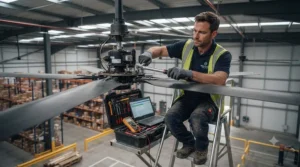
Getting a commercial ceiling fan installed correctly matters more than which model you buy, because even the best fan performs poorly if it’s mounted too high, too low, or without adequate structural support. Start by confirming your ceiling joists or a proper mounting box can support the fan’s weight — commercial units routinely weigh 8–12kg, well beyond what a standard lighting rose is rated for, so this is not a step to skip or improvise. Blade tips should sit at least 30cm from any wall and ideally 2.1–2.7 metres above the floor for effective airflow without becoming a hazard for anyone reaching upward; higher ceilings need a longer downrod rather than accepting reduced performance from an undersized drop. During the first 30 days, run the fan at each available speed to check for wobble or unusual noise while everything settles — a small amount of initial vibration is normal as blade balance beds in, but persistent rattling usually signals a loose blade bracket rather than a faulty motor. The single most common first-month mistake is leaving a fan running at full speed continuously; most commercial units are more efficient, and considerably quieter, run at medium speed with the direction reversed seasonally, pushing air down in summer and pulling it up in winter. Finally, log the installation date and initial speed settings somewhere accessible — it saves considerable time when the fan eventually needs servicing and nobody quite remembers which controller pairs with which unit.
Real-World Scenarios: Matching Fans to Your Business
The independent café owner, working from a converted shopfront with a 3-metre ceiling and roughly 40 square metres of floor space, is generally best served by something like the Fantasia 48″ Commercial or the DREO Smart 52″ — both cover the space adequately without dominating a room that’s meant to feel intimate rather than industrial, and the DREO’s app control suits a business that’s already leaning into smart-home style conveniences elsewhere. The warehouse operations manager, overseeing a 4,000 square foot distribution floor with racking up to 6 metres, needs the raw coverage of the Vent-Axia Hi-Line Plus HL140 or Fantasia Eurofans 56″ — anything smaller simply won’t move enough air across that volume, and the reversible motor pays for itself every winter by cutting heating costs on a warm-air-rises floor plan. The boutique restaurant owner, meanwhile, is often torn between function and aesthetics in a space customers actually look up at while eating — here the Westinghouse Industrial 56″ earns its higher price tag through its brushed nickel finish and long warranty, delivering commercial-grade airflow without looking like it was borrowed from a factory floor. In each case, the deciding factors are the same three variables: ceiling height, floor area, and how visible the fan will be to the people you’re trying to impress.
Problem → Solution: Common Commercial Ventilation Issues
Stuffy, stagnant air in meeting rooms is usually a placement problem rather than a fan-power problem — a single central 48-inch fan, like the Fantasia 48″ Commercial, resolves it more reliably than two smaller fans fighting each other’s airflow from opposite corners. Staff complaints about draughts near desks typically mean the fan is mounted too low or running too fast for the room size; dropping to medium speed and confirming the blade tips clear 2.4 metres from the floor usually fixes it without buying new equipment. Excessive noise complaints in open-plan offices often trace back to AC-motor commercial fans running at full speed continuously — switching to a DC-motor option such as the DREO Smart 52″, or simply running existing AC units at medium speed, cuts perceived noise considerably. Uneven cooling across a large warehouse floor, where one end feels fine and the other stays hot, generally means a single fan is being asked to cover too much area; the fix is additional units spaced to overlapping coverage radii rather than one oversized fan working overtime. Finally, winter heating bills that spike despite a “summer-only” fan sitting idle for months point to a missed opportunity — reversing fans like the Vent-Axia Hi-Line Plus HL140 or Fantasia Eurofans 56″ to pull warm ceiling-level air back down is a near-zero-cost fix that most facilities teams simply forget to action each autumn.
How to Choose Commercial Ceiling Fans: A 7-Step Framework
Choosing between commercial ceiling fans, business ceiling fans marketed for smaller premises, and the heavier-duty commercial grade fans built for industrial floors comes down to matching seven practical variables rather than chasing the biggest blade span available.
- Measure your ceiling height first. Anything under 2.7 metres rules out larger 56-inch fans unless you’re using a very short drop rod, since safety clearance matters more than raw coverage.
- Calculate floor area, not room “type.” A 56-inch fan suits roughly 350+ square feet; smaller 36-inch units are better matched to under 150 square feet — oversizing wastes money, undersizing leaves dead air pockets.
- Decide between AC and DC motors. AC commercial fans, like the Vent-Axia and Fantasia ranges here, generally deliver stronger raw airflow; DC options such as the DREO run quieter and more efficiently at lower speeds.
- Check for reversibility. A reversible motor effectively doubles a fan’s usefulness by adding winter heat recirculation on top of summer cooling — non-reversible fans are a false economy for year-round commercial use.
- Confirm the warranty length. Motor warranties in this guide range from roughly two to fifteen years; longer coverage on a continuously running commercial fan meaningfully reduces long-term risk.
- Factor in aesthetics for customer-facing spaces. A brushed nickel finish or a smart, app-controlled design matters considerably more in a restaurant dining room than in a warehouse aisle nobody but staff will see.
- Budget for installation and controllers separately. Several commercial fans, including the Vent-Axia range, require a separate speed controller — build that into your total cost rather than treating it as an afterthought.
Business Ceiling Fans vs Commercial Grade Fans vs Domestic Fans
The terminology here trips up a lot of first-time buyers, so it’s worth untangling. Business ceiling fans is often used loosely by retailers to describe any fan marketed toward offices, cafés and small commercial premises — models like the Fantasia 36″ Commercial or DREO Smart 52″ fit comfortably under this umbrella, built to handle continuous daily use without the industrial-duty rating a warehouse would demand. Commercial grade fans, by contrast, usually implies a step up in build quality specifically intended for genuinely heavy-duty, near-continuous operation in demanding environments — the Vent-Axia Hi-Line Plus HL140 and Fantasia Eurofans 56″ sit firmly in this tier, with reinforced motors designed to run for years without the burnout risk that a domestic fan pushed into commercial use would face. Domestic fans, meanwhile, are built to a fundamentally different specification: lighter motors, less robust blade mounts, and warranties that typically assume a few hours of use per day rather than eight-to-twelve. The practical takeaway is that “commercial” on a product listing isn’t a marketing flourish so much as a genuine build-quality signal — a domestic fan run continuously in an office will very likely fail well before its commercial-grade equivalent, and the resulting downtime and replacement cost usually erases whatever was saved on the cheaper unit.
Commercial Ceiling Fans vs Commercial HVAC Solutions
It’s tempting to frame ceiling fans and full commercial HVAC solutions as competing purchases, but the more accurate comparison treats them as complementary layers of the same climate strategy. Full HVAC systems — air conditioning, mechanical ventilation, heat pumps — actively change a room’s temperature by removing or adding heat, which ceiling fans simply cannot do on their own; a fan moves existing air, it doesn’t cool it. Where commercial ceiling fans earn their keep is cost and speed: installing a handful of units like the Fantasia 48″ Commercial across an office typically costs a fraction of specifying, permitting and installing a new HVAC system, and can be done in days rather than the weeks a commercial HVAC retrofit usually demands. The real value emerges when the two work together — running ceiling fans alongside air conditioning lets facilities teams raise the thermostat setpoint by several degrees while maintaining the same perceived comfort, because moving air creates a cooling sensation on skin independent of actual room temperature. For a business without existing air conditioning, a well-specified set of commercial ceiling fans is often the more realistic first investment; for a business already running HVAC, adding fans is one of the cheapest ways to reduce the system’s workload and trim energy bills without any structural work.

Business Ventilation Systems: Where Ceiling Fans Fit In
Broader business ventilation systems typically combine several elements — mechanical extraction, natural airflow through windows and vents, and circulation fans — and commercial ceiling fans occupy the circulation layer specifically rather than replacing extraction or fresh-air intake entirely. In a kitchen, for instance, an extraction hood remains essential for removing cooking fumes and moisture, but a Fantasia 36″ Commercial fan mounted elsewhere in the space helps distribute the cooler, fresher air the extraction system draws in, preventing the room from developing hot, stagnant pockets away from the extraction zone. In open-plan offices without mechanical ventilation, ceiling fans become considerably more important, since they’re often the only active air movement in the building outside of opening windows — a scenario where the coverage and reliability of units like the Vent-Axia Hi-Line Plus HL90 genuinely matter. The practical lesson for facilities managers is that ceiling fans should be planned alongside, not instead of, whatever extraction or fresh-air system already exists in the building; treating them as a complete ventilation solution on their own tends to leave air quality issues unresolved even as perceived comfort improves.
Workplace Cooling: What to Expect in Real-World Performance
On paper, a 56-inch commercial ceiling fan sounds like it should turn any warehouse into a walk-in fridge — the reality, once installed, is a subtler and more useful effect. What you actually experience is a wind-chill sensation: the fan doesn’t lower the thermometer reading in the room, but moving air accelerates evaporation from skin, making occupants feel measurably cooler even though the air temperature itself hasn’t changed. In practice, that means workplace cooling from ceiling fans works best directly beneath and around the fan’s coverage radius, with the effect tapering off toward the edges of a large room — which is exactly why oversized spaces need multiple fans rather than one very large one. Staff standing still at a workstation will feel less benefit than staff moving around, since the cooling sensation depends partly on airflow crossing the skin continuously. Reviewers of AC commercial fans in this guide, including the Vent-Axia and Fantasia ranges, consistently describe noticeable comfort improvements in the first few minutes of operation, particularly at medium-to-high speed — a reasonable expectation given how directly the wind-chill mechanism ties to airflow speed rather than motor wattage alone.
Common Mistakes When Buying Commercial Ceiling Fans
The most frequent mistake is buying on blade span alone without checking ceiling height clearance — a stunning 56-inch fan is useless, and arguably dangerous, in a room where the blades end up within head height of anyone standing on a desk or ladder. A close second is assuming every commercial fan is reversible; several budget imports skip this feature entirely, quietly turning what should be a year-round investment into a fan that gathers dust for two-thirds of the year. Buyers also regularly underestimate installation costs, forgetting that several genuinely commercial-grade fans — the Vent-Axia range among them — need a separately purchased speed controller to function beyond a single fixed speed. Another common error is prioritising the lowest sticker price without checking warranty length; a fan running continuously in a commercial setting accumulates far more operating hours per year than a domestic equivalent, so a two-year warranty offers meaningfully less protection than the fifteen-year cover available on models like the Westinghouse Industrial 56″. Finally, plenty of businesses buy a single fan for a space that genuinely needs two or three units working together, then conclude “ceiling fans don’t work here” when the real issue was under-specification from the outset.
✨ Don’t Miss These Exclusive Deals!
🔍 Take your commercial ceiling fan shopping to the next level with these carefully selected picks. Click on any highlighted item to check current pricing and availability. The right fan can transform how your team feels at work — every single day.
Long-Term Cost & Maintenance: Total Cost of Ownership
A commercial ceiling fan’s true cost extends well beyond the purchase price, and it’s worth running the numbers before assuming the cheapest option is automatically the best value. Energy consumption on AC commercial fans typically runs higher per hour than the DC motor found in the DREO Smart 52″, which matters considerably if a fan is genuinely running eight-plus hours a day across a working year — the wattage difference compounds fast at commercial usage rates. Maintenance costs are generally modest across all seven fans in this guide: periodic dusting, an annual check of blade fixings, and occasional lubrication where the motor design calls for it, though units with longer warranties like the Westinghouse effectively shift more of that long-term risk onto the manufacturer rather than the buyer. Replacement parts availability also varies meaningfully by brand — Vent-Axia and Fantasia, both long-established UK ventilation manufacturers, tend to maintain spares and accessories for their commercial ranges considerably longer than newer market entrants, a genuine consideration if you’re specifying fans for a building you expect to occupy for a decade or more. When you add purchase price, installation, a proportionate share of energy costs and expected lifespan together, the mid-range and premium fans in this guide frequently work out cheaper per year of service than the cheapest available unit, simply because they need replacing far less often.
Safety, Regulations and Compliance Guide
Commercial ceiling fans fall under general UK workplace safety law rather than a dedicated fan-specific regulation, but several existing frameworks apply directly. Under the Electricity at Work Regulations 1989, employers have a legal duty to ensure electrical equipment — including ceiling fans — is properly maintained, and most UK businesses meet this through regular portable appliance testing and electrical inspection, which should be scheduled for fixed fan installations alongside other workplace electrical equipment. Installation height matters for more than performance: blades mounted too low present a genuine head-injury risk, particularly in warehouse environments where forklifts, ladders and racking access bring staff closer to ceiling height than in a standard office. While there’s no single statutory maximum workplace temperature in UK law, the Approved Code of Practice under the Workplace Regulations requires employers to maintain “reasonable” temperatures and take practical steps toward thermal comfort — a well-specified set of commercial ceiling fans is one of the more straightforward, low-cost ways to demonstrate that duty has been taken seriously. Businesses installing fans in food preparation areas should also confirm the unit’s finish and mounting comply with relevant food hygiene guidance, since exposed metal blades above uncovered food prep surfaces can raise contamination concerns during routine environmental health inspections.
Features That Actually Matter (And Those That Don’t)
Reversibility and motor duty rating genuinely matter — they determine whether a fan earns its keep year-round or becomes a seasonal ornament, and whether it survives continuous commercial use rather than burning out within a year or two. Warranty length matters more than most buyers initially credit, given how quickly operating hours accumulate in a commercial setting compared with a domestic fan used a few hours an evening. Blade material and finish matter primarily for customer-facing spaces — a brushed nickel finish like the Westinghouse’s genuinely changes how a restaurant ceiling reads to diners, even though it has essentially no effect on airflow performance. What matters considerably less, despite heavy marketing emphasis, is exact blade count; the difference between a three-blade and five-blade commercial fan has minimal measurable impact on airflow compared with motor power and blade pitch, which manufacturers rarely headline as prominently. Smart app control, similarly, is a genuine convenience rather than a performance feature — it changes how often staff actually adjust fan speed, but it doesn’t move more air than an equivalent pull-cord model at the same setting.

Frequently Asked Questions
❓ What size commercial ceiling fan do I need for my office?
❓ Are commercial ceiling fans more expensive to run than domestic fans?
❓ Do commercial ceiling fans need a separate controller?
❓ Can commercial ceiling fans help in winter as well as summer?
❓ How high should a commercial ceiling fan be mounted?
Conclusion
Choosing between commercial ceiling fans ultimately comes down to matching three unglamorous variables — ceiling height, floor area, and how visible the fan will be — rather than chasing the biggest blade span or the flashiest smart features on the shelf. For genuinely large, industrial spaces, the Vent-Axia Hi-Line Plus HL140 and Fantasia Eurofans 56″ deliver the reversible, heavy-duty performance a warehouse or factory floor demands. For customer-facing businesses that need airflow without sacrificing appearance, the Westinghouse Industrial 56″ earns its premium price through finish and warranty alone. And for smaller, more design-conscious spaces, the mid-range Fantasia 48″ Commercial, compact Vent-Axia Hi-Line Plus HL90, budget-friendly Fantasia 36″ Commercial, and app-controlled DREO Smart 52″ each solve a slightly different version of the same core problem: stagnant air quietly costing you comfort, productivity and, eventually, staff goodwill. Whichever tier fits your budget, the honest verdict across all seven is the same — a properly sized commercial ceiling fan remains one of the cheapest, fastest workplace improvements a UK business can make.
Recommended for You
- Garage Ceiling Fans 2026: 7 Best Picks for UK Workshops
- Laundry Room Ceiling Fans: 7 Brilliant Picks to Beat Damp in 2026
- Utility Room Ceiling Fans: 7 Proven Picks to Beat Damp (2026)
Disclaimer: This article contains affiliate links. As an Amazon Associate, I earn from qualifying purchases. If you purchase products through these links, we may earn a small commission at no additional cost to you.
✨ Found this helpful? Share it with your friends! 💬🤗
