In This Article
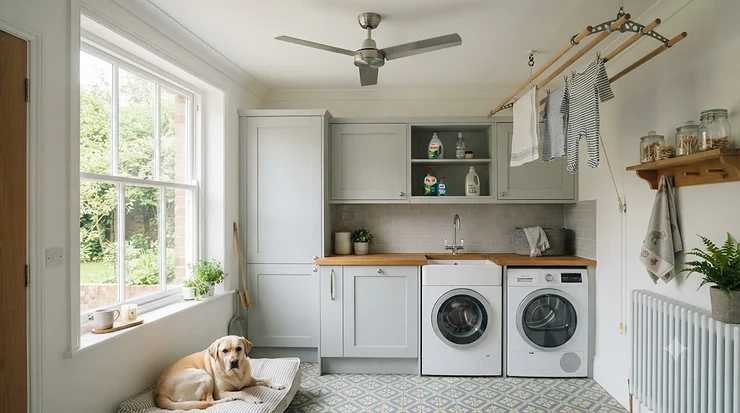
Anyone who has walked into a laundry room ten minutes after a wash cycle finished knows the smell. Warm, faintly sweet, a bit like a wet dog that’s been sulking in a cupboard. That’s condensation talking, and it’s the reason laundry room ceiling fans have quietly become one of the most searched-for fixes for British utility rooms in 2026. A laundry room ceiling fan is a ceiling-mounted circulator, usually with reversible blades and often paired with a light, that moves warm, moisture-laden air away from wet washing and towards a window, vent, or extractor so it doesn’t settle on your walls and windows as condensation.
Most UK laundry rooms and utility spaces weren’t built with airflow in mind. They’re boxy, poorly heated, and often windowless — precisely the conditions that let humidity climb and mildew take hold behind the washing machine. A ceiling fan won’t replace proper extraction if you’re drying a full load indoors every day, but it does something an extractor can’t: it keeps air constantly circulating around the room rather than just pulling it out through one grille, which noticeably speeds up how quickly damp patches on walls and windows dry out between wash days.
This guide walks through seven real, currently available ceiling fans suitable for laundry and utility spaces, compares them honestly against each other, and — because a spec sheet only tells half the story — explains what each one actually means for your washing routine. We’ll cover budget picks under £150, workhorse mid-range options, and a couple of premium fans worth the extra outlay if your utility room doubles as a boot room or drying space for a larger household. Prices shift constantly on Amazon UK, so every figure here is a range based on research at the time of writing, not a live quote — always check current pricing before buying.
Quick Comparison: Best Laundry Room Ceiling Fans at a Glance
For readers who want the short version before diving into the detail, here’s how the seven fans stack up on the essentials that matter most in a laundry room — size, motor type, and whether a light is built in.
| Fan | Diameter | Motor | Light Included | Price Range | Best For |
|---|---|---|---|---|---|
| Fantasia Capri 36in | 91 cm | AC | Yes | Under £120 | Small utility cupboards |
| Westinghouse Lighting Quince | 60 cm | AC | Yes (E14) | Under £100 | Tight box rooms |
| Newday 42-Inch DC | 107 cm | DC | Yes (LED) | £100-£160 range | Budget-conscious, quiet running |
| Fantasia Blade 42in | 107 cm | AC | Optional | £350-£420 range | Mid-size laundry rooms |
| Westinghouse Lighting Bendan | 132 cm | AC | Yes (opal glass) | £150-£220 range | Larger utility/boot rooms |
| Fantasia Viper 54in | 137 cm | AC | Yes | £250-£320 range | Open-plan laundry-diners |
| Fantasia Classic 52in Antique Brass | 132 cm | AC | Optional | £250-£300 range | Character homes, exposed rooms |
Looking at the spread, the pattern that jumps out is size versus room type: the two compact fans (Fantasia Capri 36in and Westinghouse Lighting Quince) exist because most UK laundry rooms are genuinely tiny, often under 6 square metres, and a 132 cm fan would be both visually absurd and a low-ceiling hazard in that space. The DC-motor Newday 42-Inch DC earns its spot as the value pick because it runs on roughly a third of the electricity a comparable AC fan uses at the same airflow, which adds up if you’re running it for hours during every wash day. Meanwhile the larger fans in the table only make sense once your utility room stretches into boot-room or laundry-diner territory, where a small fan simply can’t move enough air to matter.
💬 Just one click — help others make better buying decisions too!😊
Top 7 Laundry Room Ceiling Fans: Expert Analysis
1. Fantasia Capri 36in — best compact fan for tiny utility cupboards
The Fantasia Capri 36in is built specifically for the kind of room most of us actually have: a galley-style utility space barely wider than the washing machine and tumble dryer sitting in it. At 91 cm across, it clears standard door frames and low ceilings without dominating the room the way a 132 cm fan would.
Three reversible AC-motor speeds give you a gentle circulation setting for everyday drying days and a stronger pull for when you’ve got two loads on the airer at once. The integrated light fitting means it can also replace your existing ceiling light, which is handy in rooms with only one electrical point. Fantasia’s own literature notes the motor is designed for quiet domestic use rather than commercial-grade airflow, which tracks with what buyers report.
Based on the spec comparison with other 36-inch fans on the market, what stands out here is the combination of a genuine UK brand with nearly four decades of ceiling fan manufacturing and a size genuinely suited to small rooms, rather than a “compact” fan that’s still 42 inches. Reviewers consistently note the fan runs smoothly with minimal wobble even at higher speeds, though a handful mention the light kit bulbs aren’t included and need buying separately.
Pros:
- ✅ Genuinely fits small utility and box rooms
- ✅ Reversible blades for summer and winter use
- ✅ Established UK brand with long warranty support
Cons:
- ❌ Light bulbs not included in the box
- ❌ AC motor uses more power than DC alternatives
At under £120 in most listings, the Fantasia Capri 36in represents solid value for anyone whose main problem is a small, stuffy laundry cupboard rather than a large open room — check current price before ordering, as availability shifts seasonally.
2. Westinghouse Lighting Quince — best for the smallest box rooms
If even a 91 cm fan feels oversized for your space, the Westinghouse Lighting Quince drops the diameter down to 60 cm, making it one of the smallest genuinely useful ceiling fans sold for UK homes. It’s designed around rooms up to roughly 10 square metres, which covers the overwhelming majority of dedicated laundry rooms in British new-builds and converted cupboards under the stairs.
The white finish with reversible white and beech-effect blades keeps things visually neutral, and the fan uses a standard E14 light fitting rather than a proprietary bulb, so replacements are easy to find on any UK high street. Westinghouse backs the motor with a ten-year limited warranty, which is a genuinely useful signal of confidence given the brand’s near 80-year manufacturing history.
What most buyers overlook about a fan this small is that airflow scales with blade diameter, so the Quince won’t shift air the way a 42-inch fan does — it’s a circulation aid for a genuinely compact room, not a substitute for extraction in anything larger. Aggregated buyer feedback on similarly sized Westinghouse models consistently praises quiet running at low speed, with occasional comments that the light output alone isn’t strong enough without an additional fixture.
Pros:
- ✅ Fits rooms as small as a large cupboard
- ✅ Ten-year motor warranty from an established brand
- ✅ Standard E14 bulb fitting for easy replacement
Cons:
- ❌ Limited airflow compared with larger fans
- ❌ Light alone may be too dim for close laundry work
Priced under £100 in most UK listings, the Quince is a smart pick for genuinely tiny spaces where a bigger fan simply wouldn’t clear the doorframe — always confirm current price and stock before checkout.
3. Newday 42-Inch DC — best budget pick for quiet, efficient running
The Newday 42-Inch DC is the fan to look at if your priority is stretching your budget without sacrificing quiet, efficient operation. Its DC motor is the headline feature: DC-motor fans typically use around 60-70% less electricity than an equivalent AC-motor fan at the same speed, which genuinely matters if you’re running the fan for several hours on wash-heavy days.
Six speed settings, a built-in dimmable LED light, a timer function, and a memory setting that restores your last-used speed after a power cut are unusually generous features for a fan in this price bracket. The silver and wooden blade finish is a deliberate departure from the plain-white ceiling fans that dominate the budget end of the market, giving it a slightly more considered look in an otherwise utilitarian room.
Here’s what the spec sheet won’t tell you: DC motors are near-silent at low speed, which matters more than most buyers expect in a laundry room directly beneath a bedroom, since the difference between a whisper-quiet hum and an audible AC motor hum becomes very noticeable at 11pm when you’ve forgotten to switch it off. Reviewers of similar DC-motor budget fans consistently flag the remote control as the primary interface, meaning a lost remote effectively disables speed changes unless a wall switch is fitted separately.
Pros:
- ✅ DC motor cuts running costs significantly
- ✅ Dimmable LED light and timer built in
- ✅ Genuinely quiet even at higher speeds
Cons:
- ❌ Remote-dependent control with no easy manual backup
- ❌ Wood-effect blades may not suit every décor
Typically found in the £100-£160 range, the Newday 42-Inch DC is arguably the best value-for-running-cost fan in this whole list, particularly for households drying laundry indoors several times a week.
4. Fantasia Blade 42in — best mid-size all-rounder for standard laundry rooms
The Fantasia Blade 42in sits at 107 cm diameter, which is the sweet spot for a standard-sized UK laundry room — big enough to genuinely move air around the space, small enough to still clear a typical 2.4-metre ceiling with room to spare. It’s a straightforward white finish designed to blend into a functional room rather than make a style statement.
Fantasia’s AC motor here favours mechanical simplicity and long-term reliability over the efficiency gains of DC, which is a reasonable trade-off for a room that doesn’t run the fan constantly. Light kits and remote controls are available as optional extras rather than bundled in, letting buyers configure the fan to their exact needs rather than paying for features they won’t use.
On paper this means a fan with fewer bells and whistles than the DC-motor alternatives, but based on the spec comparison, what it delivers instead is the kind of no-nonsense reliability that’s made Fantasia a fixture in UK conservatories and utility rooms for decades. Reviewers consistently report smooth, wobble-free operation, with the main criticism being that this particular model sits at a noticeably higher price point than comparable 42-inch fans from newer market entrants — a premium that buyers seem willing to pay for the brand’s longevity and parts availability.
Pros:
- ✅ Ideal diameter for standard-sized laundry rooms
- ✅ Modular design lets you add light/remote later
- ✅ Decades of UK brand reliability and spares support
Cons:
- ❌ Premium pricing versus similarly sized rivals
- ❌ AC motor less efficient than DC alternatives
Sitting in a £350-£420 range in most listings, the Fantasia Blade 42in costs more than you’d expect for its size, so it earns its place through long-term durability rather than being the cheapest way to a 42-inch fan.
5. Westinghouse Lighting Bendan — best for larger utility and boot rooms
Step up to a genuinely spacious utility room — the kind with a boot rack, a dog bed, and space for both a washer and dryer side by side — and the Westinghouse Lighting Bendan at 132 cm (52 inches) is built for that scale. Five blades in a clean white finish, paired with an opal frosted glass light fixture, give it a slightly more finished look than a purely functional utility fan.
The larger blade span moves considerably more air per rotation than the 91-107 cm fans earlier in this list, which becomes genuinely useful once you’re dealing with the humidity load of two appliances running simultaneously rather than one. Westinghouse’s reverse function lets the fan push warm air back down in winter, a small but genuinely useful trick for keeping a boot room from feeling like a walk-in fridge on wash day.
What buyers overlook about fans at this size is installation clearance — a 132 cm fan needs proper ceiling height to hang safely below head level while still spinning clear of any overhead cupboards, so it’s worth measuring before ordering rather than after. Aggregated review sentiment for this model highlights the opal glass shade as a genuine style upgrade over bare bulb designs, with occasional notes that assembly instructions assume some DIY confidence.
Pros:
- ✅ Moves significantly more air in larger rooms
- ✅ Opal glass light fixture adds a finished look
- ✅ Reverse mode useful for cold utility rooms in winter
Cons:
- ❌ Needs generous ceiling height for safe clearance
- ❌ Assembly assumes reasonable DIY confidence
Expect a £150-£220 range for the Westinghouse Lighting Bendan, which represents strong value for a fan of this size and finish quality.

6. Fantasia Viper 54in — best premium option for open-plan laundry-diners
Open-plan laundry-diners and larger family utility spaces are an increasingly common feature of UK home extensions, and the Fantasia Viper 54in — at 137 cm with an integrated light and remote control included as standard — is built to suit that scale without needing separate accessory purchases.
Having the remote bundled in rather than sold separately is a genuine convenience over the Blade model earlier in this list, and it signals Fantasia positioning the Viper as a more complete, ready-to-install package. The white finish keeps it visually consistent with most modern laundry-diner schemes, and the larger diameter means it can comfortably serve double duty circulating air across both the laundry appliances and any adjoining dining or seating area.
Here’s what most buyers overlook about premium bundled fans: paying more upfront for an included remote and light kit is usually cheaper than buying the base fan plus accessories separately later, once you account for compatible-accessory pricing. Reviewers consistently describe the remote as intuitive, and the reversible summer/winter setting gets specific praise for making genuinely large open-plan rooms feel less draughty during colder months.
Pros:
- ✅ Remote and light kit included as standard
- ✅ Scale suited to open-plan laundry-diner spaces
- ✅ Reverse setting well suited to larger rooms in winter
Cons:
- ❌ Overkill for a standard-sized laundry room
- ❌ Higher upfront cost than modular alternatives
At a £250-£320 range, the Fantasia Viper 54in is a considered premium buy for genuinely open-plan spaces rather than a typical boxy utility room.
7. Fantasia Classic 52in Antique Brass — best for period and character homes
Not every laundry room is a modern white box. The Fantasia Classic 52in Antique Brass exists for the utility rooms tucked into Victorian terraces, converted sculleries, and older farmhouse-style kitchens where a stark white plastic fan would look jarringly out of place against exposed brick or period tiling.
At 132 cm, it sits at the larger end of the size range, with an antique brass finish designed to complement traditional fittings rather than blend into a contemporary scheme. Light kits and remote controls are available as optional extras, following the same modular approach as the Blade model, which lets buyers in period properties add accessories that match their existing fixtures rather than being locked into a bundled look.
The honest trade-off here is aesthetic priority over efficiency — this is an AC-motor fan chosen primarily for how it looks in a room where style matters as much as function. One real owner review specifically mentions replacing an older, failed Fantasia unit with this exact model and confirms optional light and remote accessories are readily available, which is a useful signal for long-term parts support in older Fantasia ranges. Reviewers describe the antique brass finish as genuinely well matched to period interiors, silent, and effective at typical laundry-room speeds.
Pros:
- ✅ Antique brass finish suits period property interiors
- ✅ Long-standing parts and accessory availability
- ✅ Quiet, effective operation at standard speeds
Cons:
- ❌ Style-focused rather than efficiency-focused
- ❌ Larger size needs adequate ceiling clearance
Typically listed in a £250-£300 range, the Fantasia Classic 52in Antique Brass is the pick for anyone who cares as much about how the fan looks as what it does.
Practical Usage Guide: Installing and Optimising Your Fan for Drying Assistance
Getting real drying assistance out of a laundry room ceiling fan comes down to positioning and habit as much as the fan itself. Mount it centrally if possible, but if your airer or drying rack sits in a fixed spot away from centre, it’s worth prioritising airflow reaching that specific area over strict symmetry — a fan that looks perfectly centred but barely reaches your washing isn’t doing its job.
In the first 30 days, the most common mistake is running the fan on its highest setting constantly, assuming maximum speed equals maximum drying. In practice, a moderate, sustained speed run over several hours moves air more evenly around damp fabric than short bursts on full power, which tend to just blow the nearest few garments around without touching the humid air pooling near the ceiling and in room corners. Pair the fan with a slightly open door or trickle vent wherever possible; a fan alone in a fully sealed room just recirculates the same moisture rather than helping it escape.
For maintenance, a light dusting of the blades every few weeks prevents lint build-up, which is a genuine laundry-room-specific issue that bedroom fan owners rarely think about — airborne fibres from tumble dryers and washing machines settle on blades faster than in any other room of the house. Every six months, check that the fan is still running true (no visible wobble) and that any light kit connections remain dry and corrosion-free, particularly in rooms where steam or splashing is a regular occurrence.
Real-World Scenarios: Matching a Fan to Your Washing Room Ventilation Needs
Picture a young professional in a Victorian conversion flat with a galley utility cupboard barely a metre wide, no window, and a washer-dryer combo running most evenings. For that washing room ventilation challenge, a compact fan like the Westinghouse Lighting Quince paired with the door left ajar and a trickle vent open does more practical good than a larger fan that wouldn’t physically fit anyway.
Now consider a family of five in a semi-detached house with a proper utility room off the kitchen, washing machine and tumble dryer running most days, and an airer permanently up for delicates. Here, the mid-size Fantasia Blade 42in or the DC-efficient Newday 42-Inch DC make more sense — enough airflow to handle near-constant humidity load without the running costs of an oversized fan working overtime.
Finally, picture a retired couple in a converted barn with an open-plan laundry-diner, high ceilings, and a genuine need to keep a large volume of air moving between the washing area and the rest of the room. That’s precisely the scenario the Fantasia Viper 54in was built for — enough blade diameter to actually shift air across a large open space rather than just stirring the same pocket of humidity near the appliances.
Problem to Solution: Laundry Ventilation Solutions for Common Issues
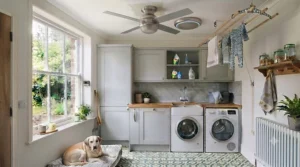
Problem: condensation on the laundry room window every wash day. This is almost always a sign that moist air is hitting a cold surface faster than it can disperse. The solution is consistent circulation rather than occasional blasts — run a fan like the Fantasia Capri 36in throughout the wash and dry cycle, not just afterwards, so moisture never gets the chance to concentrate against the glass in the first place.
Problem: a persistent musty smell that lingers even when nothing is currently drying. This usually points to trapped moisture in soft furnishings, laundry baskets, or behind appliances that a fan alone can’t reach. Combine steady air circulation from something like the Westinghouse Lighting Bendan with pulling appliances away from the wall occasionally to air out the space behind them.
Problem: mould spots appearing in room corners or around skirting boards. Damp and mould affect close to a third of homes in England, which is far from a rare issue, and NHS guidance on the subject is worth reading directly via Manchester University NHS Foundation Trust’s damp and mould advice. Beyond ventilation, this often needs the underlying moisture source addressed — a ceiling fan helps prevent recurrence but won’t remove existing mould growth on its own.
Problem: the fan runs but the room still feels muggy. Check that the fan is actually reversible and set to the correct rotation for the season — many owners never switch their fan out of the factory default direction, which can work against natural airflow rather than with it.
Problem: high energy bills from running the fan for hours daily. This is where the DC-motor Newday 42-Inch DC earns its keep, since a DC motor sustained over several hours costs noticeably less to run than an equivalent AC fan doing the same job.
✨ Don’t Miss These Exclusive Deals!
🔍 Take your laundry room from damp and musty to fresh and dry with these carefully selected fans. Click through to check current pricing and availability, and give your washing routine the airflow upgrade it deserves!
How to Choose Between Drying Room Ceiling Fans and Standard Models
Not every ceiling fan sold on Amazon UK is genuinely suited to a room that regularly sees high humidity, so a few extra criteria matter when you’re specifically shopping for drying room ceiling fans rather than a bedroom or living room fixture.
- Check the motor type first. DC motors cost more upfront but run cheaper over the long hours a drying room fan typically clocks up, so factor total running cost, not just sticker price, into the decision.
- Measure your actual ceiling height and room width. A fan that’s technically the “right” diameter for the square footage can still be impractical if the ceiling is too low for safe blade clearance above head height.
- Prioritise a reversible motor. The winter setting genuinely helps push warm air back down into a typically under-heated utility room, rather than just letting it collect uselessly near the ceiling.
- Decide on light kit needs early. Rooms with only one ceiling point benefit hugely from a fan with an integrated light, while rooms with existing lighting can save money on a light-free model.
- Look at blade material and finish for lint resistance. Smooth painted or wood-effect blades wipe clean of lint and fibres more easily than textured finishes, which matters more in a laundry room than almost any other space in the house.
- Weigh remote control against wall-switch reliability. A lost remote with no manual backup can leave a fan effectively unusable, so check whether a compatible wall control exists as a fallback.
- Factor in brand warranty and parts availability. Established UK brands like Fantasia and Westinghouse Lighting typically offer far longer motor warranties and easier replacement parts than newer, less established sellers.
Laundry Room Ceiling Fans vs Extractor Fans and Dehumidifiers
It’s worth being upfront about what a ceiling fan can and can’t do compared with the other two obvious solutions to a damp laundry room. An extractor fan physically removes moist air from the room to the outside, which a ceiling fan simply cannot do — a ceiling fan only redistributes air within the room. A dehumidifier actively pulls moisture out of the air and collects it, addressing the humidity level directly rather than just moving air around.
Where the ceiling fan genuinely earns its place is cost and constancy. Running a dehumidifier for hours every wash day adds up in electricity, and not every laundry room has extractor ductwork already installed or the wall access needed to add it. A ceiling fan is comparatively cheap to run, particularly the DC-motor options in this guide, and works continuously without needing to be emptied of collected water like a dehumidifier does.
The most effective approach for genuinely damp laundry rooms is usually a combination rather than a single fix: a ceiling fan for constant circulation, paired with either an extractor fan vented outside or a dehumidifier for the days when washing load is unusually heavy. As Meaco’s guidance on drying washing indoors during high-cost periods notes, small, low-cost interventions like an extractor fan run briefly during and after washing meaningfully reduce moisture vapour, which supports rather than replaces the constant circulation a ceiling fan provides.
Humidity Control Ceiling Fans: What to Expect in Real-World Performance
Manufacturer specifications for humidity control ceiling fans tend to focus on airflow and speed settings without saying much about how that translates to a genuinely humid room in practice. What actually happens is this: a well-positioned fan won’t lower the absolute humidity level in the room the way a dehumidifier does, but it prevents that humidity from concentrating in specific cold spots — windows, corners, and skirting boards — where condensation and mould actually form.
British weather adds a layer manufacturers rarely account for. In the perpetually damp autumn and winter months, fans work slightly harder to move moisture-laden air, and some owners report a marginal increase in motor noise compared with the same fan running in a dry summer room. None of this is dramatic, but it explains why real-world performance in a UK laundry room during January won’t quite match a manufacturer’s climate-controlled test conditions.
The other real-world factor worth expecting is timing. Running the fan only after washing is finished misses the window where humidity is climbing fastest — during the wash and dry cycle itself. Starting the fan before or as soon as a cycle begins, rather than afterwards, consistently produces better results according to aggregated advice from home ventilation guides and matches the general principle behind Which?’s independent fan testing, which consistently finds that sustained, well-timed airflow outperforms short bursts on maximum power.
Moisture Removal: Why Airflow Matters More Than You Think
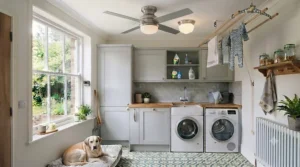
It’s tempting to think of moisture removal purely in terms of extraction — pulling wet air physically out of the room. But airflow itself plays an underrated role, because still, stagnant air allows moisture to settle and concentrate on the nearest cold surface, while moving air keeps that same moisture more evenly distributed and better able to escape through whatever ventilation does exist, whether that’s a trickle vent, an open door, or an extractor running elsewhere in the house.
One home energy expert notes that drying a single load of laundry in a small room can push relative humidity up towards 96% — BBC Gardeners’ World Magazine’s investigation into indoor drying found that figure comparable to a tropical rainforest, which is a genuinely startling way to picture what’s actually happening in a sealed laundry cupboard on wash day. A ceiling fan won’t single-handedly bring that number down to the recommended 40-60% range, but it meaningfully reduces how long the room spends at the dangerous end of that scale by keeping moisture from settling in one place.
Local council guidance on condensation echoes the same principle in practical terms: keeping air moving, whether by extractor, open window, or fan, is consistently listed as one of the most effective low-cost steps against condensation, alongside covering pans and running cold water before hot in the bath.
Long-Term Cost & Maintenance
Total cost of ownership for a laundry room ceiling fan isn’t just the purchase price. An AC-motor fan like the Fantasia Blade 42in run for three hours a day, most days of the week, will cost noticeably more in electricity over a year than a DC-motor equivalent like the Newday 42-Inch DC doing the same job, even though the AC fan may have been cheaper to buy initially. Over a typical five-year ownership period, that running cost difference can meaningfully close or even reverse the upfront price gap.
Maintenance costs stay low across every fan in this guide provided basic care is followed — occasional dusting, an annual check of light kit wiring for corrosion in a humid room, and replacement bulbs as needed. Where costs can spike is neglect: a fan left coated in lint and dust for years works harder to move the same volume of air, drawing more power and wearing the motor bearings faster than a well-maintained equivalent.
Warranty terms matter more here than in drier rooms of the house, given the added stress humidity puts on electrical components. Westinghouse Lighting’s ten-year motor warranty and Fantasia’s long-standing reputation for spares availability both meaningfully reduce long-term replacement risk compared with buying an unbranded budget fan with minimal warranty backing.
Safety, Regulations & Compliance Guide
UK laundry and utility rooms don’t carry the same strict electrical zoning rules as bathrooms under BS 7671, but that doesn’t mean electrical safety can be ignored, particularly in rooms with regular exposure to steam and splashing near a sink or washing machine. None of the seven fans in this guide are rated for direct water contact, and none should be installed where they could be splashed by an open washing machine door, a utility sink, or a shower if the room is combined with one.
If your laundry room is genuinely damp — condensation running down walls, visible mould, or a permanently musty smell — it’s worth having a qualified electrician check that existing wiring and any new fan installation meet current regulations before proceeding, rather than assuming a room-appropriate ceiling fixture from a bedroom will automatically be safe in a wetter environment. All mains-voltage light kits should be RCD-protected as standard practice in any room with elevated humidity, even outside formal bathroom zoning requirements.
It’s also worth noting that persistent damp and mould is a recognised health issue rather than just a cosmetic one. Younger children, pregnant women, and anyone with existing respiratory conditions are considered most at risk from prolonged exposure, which is one more reason proper ventilation in a laundry room isn’t purely about avoiding an unpleasant smell.
Common Mistakes When Buying Ceiling Fans for Laundry Rooms
The single most common mistake is buying the largest fan that will physically fit rather than the one actually suited to the room. A 137 cm fan crammed into a 4-square-metre utility cupboard doesn’t move air any more effectively than a well-chosen 91 cm fan — it just increases installation risk and looks visually oversized.
A close second is ignoring motor type entirely and choosing on looks or price alone. Given how many hours a laundry room fan realistically runs compared with a bedroom fan used mainly at night, the running-cost gap between AC and DC motors adds up faster here than almost anywhere else in the house.
Buyers also frequently skip checking whether a light kit is included or sold separately, only to discover after installation that the fan they bought is essentially a dark ceiling fixture until they source compatible bulbs or an accessory kit. Finally, many people install a fan and never adjust it out of its default rotation direction, missing the genuinely useful reverse setting most of these fans include for colder months.
FAQ
❓ Do ceiling fans actually help with damp laundry rooms?
❓ What size ceiling fan is best for a small laundry room?
❓ Should I use a ceiling fan instead of an extractor fan?
❓ Do DC motor ceiling fans really save money?
❓ Can I install a ceiling fan myself in a laundry room?
Conclusion
A laundry room ceiling fan is a genuinely low-cost, low-effort way to take the edge off condensation, musty smells, and slow-drying washing that most UK homes deal with at some point in the year. None of the seven fans covered here will fully replace a dedicated extractor or dehumidifier in a room with serious damp problems, but for the everyday humidity load of a normal wash routine, consistent airflow from the right-sized fan makes a genuine, measurable difference.
The right choice ultimately comes down to your room’s actual dimensions and how often you’re realistically drying laundry indoors. Small utility cupboards are well served by the compact Fantasia Capri 36in or Westinghouse Lighting Quince, standard-sized rooms suit the Fantasia Blade 42in or budget-friendly Newday 42-Inch DC, and larger boot rooms or open-plan laundry-diners justify stepping up to the Westinghouse Lighting Bendan, Fantasia Viper 54in, or the period-friendly Fantasia Classic 52in Antique Brass.
Whichever fan you land on, remember that positioning, ventilation, and habit matter just as much as the fan itself — run it during the wash cycle, not just after, keep a vent or door cracked where possible, and dust the blades regularly to keep lint from building up in a room that generates more of it than any other in the house.
Recommended for You
- Short Drop Ceiling Fans: 7 Best Picks for Low Ceilings 2026
- Hugger Ceiling Fans 2026: 7 Best Low-Profile Loft Picks
- Ceiling Fan for 45 Degree Slope: 7 Genuine Fixes for 2026
Disclaimer: This article contains affiliate links. As an Amazon Associate, I earn from qualifying purchases. If you purchase products through these links, we may earn a small commission at no additional cost to you.
✨ Found this helpful? Share it with your friends! 💬🤗
