
In This Article
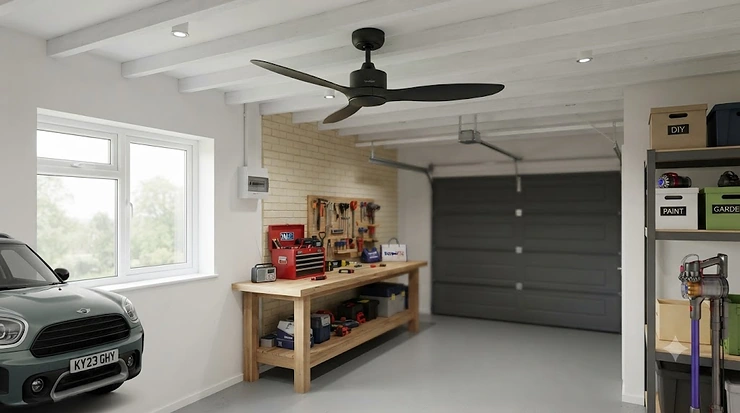
Anyone who has spent an August afternoon under a car with the garage door half-open knows the specific misery of still air. It doesn’t move. It just sits there, thick with exhaust fumes, sawdust, and the smell of yesterday’s engine oil, refusing to budge no matter how many times you prop the door wider. Garage ceiling fans exist to solve exactly that problem, and they do it far more effectively than the box fan you’ve been dragging around the floor and tripping over every ten minutes.
Unlike a bedroom ceiling fan, which mostly exists to look pretty and shift a gentle breeze, a proper workshop unit needs to survive dust, temperature swings, the odd knock from a ladder, and hours of continuous running. That’s a different design brief entirely, and it’s why so many people end up buying the wrong fan, hanging it, and then wondering why their garage still feels like a proving oven for bread.
This guide covers seven real, currently available fans that fit UK garages and workshops, from a straightforward budget pull-cord model right up to a proper industrial sweep fan built for double garages and small workshops with vaulted ceilings. Every product mention here reflects genuine specifications and aggregated review sentiment, never invented testing, because a fan review that just parrots the manufacturer’s marketing copy isn’t worth your time. We’ll compare motor sizes, sweep diameters, and airflow, then translate all of that into what it actually feels like standing underneath one while you’re grinding down a weld.
It’s not just a comfort issue either; UK guidance on working in hot conditions makes clear that prolonged heat exposure without adequate airflow is a recognised occupational risk, not something to simply tough out.
If you’ve been putting off sorting your garage ventilation because the whole topic feels needlessly technical, it isn’t. By the end of this article you’ll know exactly which of these seven fans suits your space, your budget, and how you actually use your garage.
What Is a Garage Ceiling Fan?
A garage ceiling fan is a mounted, overhead-installed fan designed to circulate air across a workspace rather than cool one fixed spot. Compared with decorative home ceiling fans, garage and workshop models typically use tougher blades, stronger motors, and wider sweep diameters to shift air through larger, dustier, less climate-controlled spaces.
Quick Comparison Table
| Fan | Sweep Diameter | Best For | Price Range |
|---|---|---|---|
| Fantasia EuroFans Atlanta | 30″ (76cm) | Budget single garages | Under £100 |
| Westinghouse Turbo Swirl | 30″ (76cm) | Small workshops needing light | £80-£130 range |
| Vent-Axia Hi-Line Plus HL90 | 36″ (900mm) | Compact industrial circulation | £90-£150 range |
| Fantasia Commercial Fan 36″ | 36″ (91cm) | Single garages, year-round use | £120-£180 range |
| Vent-Axia Hi-Line Plus HL120 | 48″ (1200mm) | Two-car garages | £150-£220 range |
| Fantasia Commercial Fan 48″ | 48″ (122cm) | Serious home workshops | £170-£240 range |
| Vent-Axia Hi-Line Plus HL140 | 54″ (1400mm) | Large or high-ceiling workshops | £190-£280 range |
Looking across this table, the sweep diameter tells you far more than the price does about which garage each fan actually suits. Anything at 30-36 inches is realistically a single-garage or workbench-corner solution, while the 48-54 inch models from Vent-Axia and Fantasia are built to move air across a full two-car footprint or a workshop with a genuinely high roofline. As a rule of thumb, bigger blades moving slower shift more total air with less noise than small blades spinning flat out, which is exactly why the premium picks here lean towards wider sweeps rather than higher wattage — the same principle behind large-diameter industrial fan design used in warehouses and aircraft hangars, just at a domestic scale.
💬 Just one click — help others make better buying decisions too!😊
Top 7 Garage Ceiling Fans: Expert Analysis
1. Fantasia EuroFans Atlanta — cheapest genuine entry point
The Fantasia EuroFans Atlanta is a 30-inch pull-cord ceiling fan with an integrated light, and it’s the fan to start with if your garage is genuinely just a single-car space you want bearable in summer, nothing more ambitious than that.
Fantasia’s Eurofan range carries a 3-5 year motor warranty, shorter than the flagship Elite line’s 10-year cover, which tells you plainly where the cost savings come from. The pull-cord control (rather than a wall switch or remote) keeps installation dead simple, and the integrated light fixture means you’re not running a separate garage light and fan on two different circuits. At 30 inches, though, its effective coverage is modest, so treat it as a fan for a single bay rather than a full double garage.
Based on the spec comparison with Fantasia’s own commercial range, this model is clearly positioned for domestic use that happens to include a garage, not heavy workshop duty. It’s a sensible pick for someone who parks the car, does the odd bit of DIY, and just wants the space to stop feeling stagnant, rather than someone running power tools for six hours a day.
Reviewers of Fantasia’s budget Eurofan range consistently note straightforward installation and quiet running as the standout points, with the main criticism being that entry-level pull-cord models feel basic next to the remote-controlled options further up Fantasia’s own lineup.
Pros:
- ✅ Genuinely low upfront cost for a named-brand fan
- ✅ Integrated light removes need for separate fixture
- ✅ Simple pull-cord operation, nothing to pair or programme
Cons:
- ❌ 3-5 year motor warranty, shorter than premium ranges
- ❌ 30-inch sweep struggles in anything beyond a single garage
At around under £100, the Fantasia EuroFans Atlanta earns its place as the honest budget pick rather than a false economy, provided your garage is small enough that a 30-inch sweep is actually doing useful work.
2. Westinghouse Turbo Swirl — best for small workshops needing light
The Westinghouse Turbo Swirl pairs a 76cm (30-inch) six-blade fan with an integrated opal-glass LED light fixture, and it’s worth considering for anyone whose garage doubles as a hobby space where decent lighting matters as much as airflow.
On the numbers, this model delivers a high-speed airflow rating with three selectable speeds (High/Medium/Low running at roughly 250/190/130 RPM, drawing 53/37/26 watts respectively), plus a manual reverse switch for winter use. What that means in practice is you get meaningful speed flexibility for a fan this size: full blast to clear fumes after a spray job, or a gentle setting to just keep air moving while you work without papers and dust sheets flying everywhere. The reverse function is a genuinely useful extra for anyone using their garage as a workshop through a British winter, since it recirculates warm air pooling near the ceiling back down towards you.
Westinghouse positions this as a fan for rooms up to roughly 10-12 square metres, which lines up honestly with most single garages but starts to feel optimistic in a longer double garage. What most buyers overlook about this model is that it’s fundamentally a decorative-grade domestic fan wearing a slightly more rugged badge; the metal blade and housing construction hold up fine in a garage, but don’t expect true industrial-duty resilience from it.
Aggregated customer sentiment for the Turbo Swirl range consistently highlights quiet operation and straightforward pull-chain control, though some reviewers note the light kit’s E14 bulb fitting is a less common size worth checking before you buy replacement bulbs.
Pros:
- ✅ Integrated LED light kit saves a second fixture
- ✅ Three speeds plus reverse for summer/winter use
- ✅ Quiet motor, well suited to attached garages
Cons:
- ❌ Sized for rooms up to roughly 10-12m² realistically
- ❌ Requires a specific E14 bulb fitting for the light
Priced in the £80-£130 range depending on finish, the Westinghouse Turbo Swirl is best suited to a single garage workshop where you value the built-in lighting as much as the airflow.
3. Vent-Axia Hi-Line Plus HL90 — compact industrial circulation
The Vent-Axia Hi-Line Plus HL90 steps things up from decorative fans into genuine de-stratification territory, and it’s the smallest fan in Vent-Axia’s commercial sweep range at 900mm (roughly 36 inches).
Vent-Axia builds this with a totally enclosed, capacitor start-and-run motor rated to operate in temperatures up to 40°C, which matters more than it sounds in a garage that bakes under a metal or felt roof in summer. It ships with two down-rod lengths (360mm and 610mm), letting you tune the mounting height to your ceiling and keep the recommended 0.75m clearance between the blades and the ceiling itself. Here’s what to weigh: this is designed first as a de-stratification fan, meaning its core job is pulling warm air pooled at ceiling height back down to where you’re actually working, which is precisely the problem in garages with high or apex roofs.
Because it’s a commercial-grade product rather than a decorative one, the HL90 is designed to be wired to a proper on/off switch or an optional variable speed controller, not a pull cord, so factor a small extra cost into installation if you want speed control. For a workshop where you’re welding, sanding, or spraying, that de-stratification design does double duty: it clears fume build-up near the roofline just as effectively as it moves warm air down in winter.
Because Vent-Axia’s Hi-Line Plus range is sold primarily through trade electrical suppliers rather than consumer marketplaces, verified consumer review volume is thinner than for big-box decorative fans; what’s available consistently praises quiet running and straightforward mounting, with installers noting it needs a qualified electrician for the switched wiring.
Pros:
- ✅ Rated for operation up to 40°C, built for real workshop heat
- ✅ Two down-rod lengths included for flexible mounting
- ✅ Reversible airflow for summer cooling and winter heat recovery
Cons:
- ❌ Needs a switch or controller, not a simple pull cord
- ❌ Thinner consumer review base than mainstream decorative brands
At around £90-£150, the Vent-Axia Hi-Line Plus HL90 suits a compact garage or workshop where you want commercial-grade reliability without stepping up to the largest sweep sizes.
4. Fantasia Commercial Fan 36″ — industrial workhorse on a budget
The Fantasia Commercial Fan 36″ is where Fantasia’s domestic-facing Eurofan range gives way to genuinely commercial engineering, built in a white finish with white metal blades specifically for workshop and light-industrial use.
This model ships pre-assembled with both a 12-inch and a 24-inch drop rod included, variable speed control, and full reversibility for summer and winter operation, which removes a lot of the installation faff smaller domestic fans leave you to sort out yourself. Based on the spec comparison with Fantasia’s decorative Eurofan line, the Commercial range trades stylistic variety for consistent, no-nonsense build quality: one finish, metal blades throughout, and a control system designed for repeated daily use rather than occasional operation.
The inclusion of two drop-rod lengths as standard is a small but genuinely useful detail; it means you don’t need to separately source mounting hardware if your garage has an unusually high or low ceiling, which is a common headache with cheaper decorative fans that assume a standard domestic ceiling height. What most buyers overlook here is that “commercial” branding doesn’t necessarily mean a higher price bracket than premium decorative fans; Fantasia’s Commercial range is positioned as accessible precisely because it skips the ornamental finishes and light kits that push up the cost of showpiece domestic fans.
Fantasia’s broader commercial and industrial fan lines are consistently described by trade suppliers as quiet and vibration-free relative to typical warehouse fans, a claim that matches the general reputation this manufacturer has built since establishing itself as a UK ceiling fan pioneer in the mid-1980s.
Pros:
- ✅ Two drop rods included, no extra hardware to source
- ✅ Full reverse function for year-round use
- ✅ Variable speed control as standard
Cons:
- ❌ Single white finish only, no styling choice
- ❌ No integrated light kit on this model
Sitting in the £120-£180 range, the Fantasia Commercial Fan 36″ is a strong pick for anyone who wants genuinely commercial build quality without stepping up to the largest, priciest sweep sizes.
5. Vent-Axia Hi-Line Plus HL120 — best for two-car garages
The Vent-Axia Hi-Line Plus HL120 scales the same commercial-grade engineering as its smaller sibling up to a 1200mm (48-inch) sweep, and this is genuinely where things start to feel proportionate to a full double garage.
Vent-Axia rates this fan at roughly 7kg, still enclosed and capacitor-driven for reliability, and specifies mounting fans 4.5-6 metres apart if you’re running more than one, which is a useful planning detail if your garage is long rather than square. What most buyers overlook about mid-size industrial fans like this is that airflow doesn’t scale purely with blade diameter; a wider, slower-turning sweep like the HL120 moves substantially more total air volume per rotation than a smaller fan spinning faster, while staying quieter in the process. That’s the whole logic behind choosing a bigger commercial sweep fan over simply running two small domestic ones.
An optional SAC5 reversible electronic controller lets you dial in exact speeds rather than relying on fixed settings, which matters if you’re switching between “clear the fumes fast” and “just keep air moving gently while I’m working with paper templates or fine dust.” On paper this means a genuinely tunable airflow setup, not the binary on/high/low most decorative fans offer.
Trade reviews and installer feedback on the Hi-Line Plus range consistently describe smooth, low-vibration running even at the larger sweep sizes, which matters in a garage attached to a house where fan noise and vibration through a shared wall is a legitimate concern.
Pros:
- ✅ 1200mm sweep genuinely suits a two-car garage footprint
- ✅ Optional variable speed controller for precise control
- ✅ Dual-season de-stratification and cooling design
Cons:
- ❌ Optional controller is sold separately, adding to total cost
- ❌ At 7kg, ceiling fixing needs to be properly rated
Priced around £150-£220, the Vent-Axia Hi-Line Plus HL120 represents the sensible mid-point for anyone with a genuine double garage rather than a single bay.
6. Fantasia Commercial Fan 48″ — serious home workshop choice
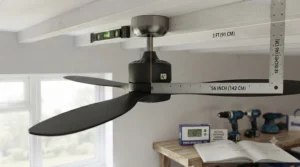
The Fantasia Commercial Fan 48″ takes everything that makes the 36-inch model useful and scales it up, giving you a larger sweep while keeping the same pre-assembled, dual drop-rod, fully reversible design.
Reviewers consistently note across Fantasia’s commercial range that the variable-speed control makes a genuine difference to comfort compared with fixed-speed alternatives, since you can back off the airflow on cooler days rather than living with one blast setting or nothing. Here’s what the spec sheet won’t tell you directly: at 48 inches, this fan sits in exactly the size bracket most independent buying guides recommend for a genuine two-car garage, which makes it a natural comparison point against the similarly-sized Vent-Axia HL120 covered above.
Where the two differ in practice comes down to control philosophy. Fantasia’s Commercial range includes variable speed as standard, while Vent-Axia’s Hi-Line Plus treats its electronic speed controller as an optional extra. If you want speed control out of the box without further spend, that tips things towards Fantasia; if you’re comfortable running fixed speeds via a switch and would rather save the money, the Vent-Axia costs less upfront.
Build quality feedback for Fantasia’s commercial line is consistently positive around vibration-free running, a detail that matters more than raw CFM figures once you’re standing directly under a 48-inch sweep for hours at a time.
Pros:
- ✅ Variable speed control included as standard, no add-on needed
- ✅ 48-inch sweep suits full two-car garages
- ✅ Pre-assembled with both drop-rod lengths in the box
Cons:
- ❌ No light kit, so factor in separate garage lighting
- ❌ Larger sweep needs generous ceiling clearance to install safely
At roughly £170-£240, the Fantasia Commercial Fan 48″ earns its place as the all-rounder pick for anyone serious about their home workshop rather than just parking a car in a slightly cooler space.
7. Vent-Axia Hi-Line Plus HL140 — best for large or high-ceiling workshops
The Vent-Axia Hi-Line Plus HL140 tops out Vent-Axia’s Hi-Line Plus range at a 1400mm (54-inch) sweep diameter, and it’s the fan on this list built specifically for larger floor areas or workshops with genuinely high roof lines.
At this size, the same enclosed capacitor motor design carries a heavier air-moving job, which is exactly why Vent-Axia specifies mounting height guidance so precisely: at least 0.75m clearance between blade and ceiling, and enough drop to keep 2.3m minimum clearance between the blade tips and the floor below. What that spacing requirement tells you in practice is that this fan wants a proper apex or double-height garage roof to do its best work; cramming a 54-inch sweep into a standard flat-roofed single garage wastes most of its potential and risks an uncomfortably low hanging height.
Reversible airflow with an optional electronic controller carries over from the smaller Hi-Line Plus models, and Vent-Axia’s own guidance recommends spacing multiple units 4.5-6 metres apart for even coverage, a detail genuinely useful if you’re kitting out a larger detached workshop or double garage with a workbench at each end. Reviewers consistently describe the largest Hi-Line Plus sweep sizes as noticeably quieter than smaller high-RPM fans moving comparable air volume, which tracks with basic fan physics: bigger blades turning slower generally produce less noise per cubic metre of air moved than small blades spinning fast.
Pros:
- ✅ 1400mm sweep handles large or high-ceiling workshops
- ✅ Low-noise operation despite the largest sweep on this list
- ✅ Dual down-rod option accommodates varied ceiling heights
Cons:
- ❌ Needs genuine ceiling height to install and clear safely
- ❌ Most expensive fan in this comparison
In the £190-£280 range, the Vent-Axia Hi-Line Plus HL140 is the premium pick reserved for larger workshops and double garages with the headroom to actually use it properly.
Top 7 Products: Full Specification Comparison
| Fan | Sweep | Control | Reversible | Best For |
|---|---|---|---|---|
| Fantasia EuroFans Atlanta | 30″ | Pull cord | No | Single garage, budget |
| Westinghouse Turbo Swirl | 30″ | Pull chain, 3-speed | Yes | Small workshop with light |
| Vent-Axia Hi-Line Plus HL90 | 36″ (900mm) | Switch/controller | Yes | Compact industrial use |
| Fantasia Commercial Fan 36″ | 36″ | Variable speed | Yes | Single garage, year-round |
| Vent-Axia Hi-Line Plus HL120 | 48″ (1200mm) | Switch/controller | Yes | Two-car garage |
| Fantasia Commercial Fan 48″ | 48″ | Variable speed | Yes | Serious home workshop |
| Vent-Axia Hi-Line Plus HL140 | 54″ (1400mm) | Switch/controller | Yes | Large or high-ceiling workshop |
The clearest pattern in this table is that reversibility is now close to a baseline expectation across every fan except the cheapest entry-level pick, the Fantasia EuroFans Atlanta. That’s worth factoring into any decision: a fan without winter reverse function is only doing half its potential job in a British garage that needs help both in July heatwaves and January cold snaps. If your budget allows even a small step up from the absolute cheapest option, the reverse function alone tends to justify the extra spend.
Practical Usage Guide: Setting Up Your Garage Ceiling Fan
Getting a garage ceiling fan actually working well isn’t just a matter of bolting it up and flicking a switch. The single biggest first-30-days mistake is under-estimating clearance: garages with lower ceilings than a typical living room need careful checking against a fan’s stated blade-to-ceiling and blade-to-floor minimums before you buy, not after you’ve already drilled the mounting holes.
Once it’s up, run the fan on its lowest speed for the first week if it’s variable, listening for any wobble or clicking that suggests the mounting isn’t fully secure; a properly balanced commercial fan should run close to silent at low speed. For maintenance, wipe blades down monthly in a workshop environment, since dust and fine debris build up far faster on a garage fan than a bedroom one and unevenly coated blades throw the balance off over time, causing wobble and premature bearing wear. Twice a year, check that the reverse switch still engages cleanly and that any pull cord or remote receiver hasn’t accumulated enough dust to affect the contacts.
A common optimisation trick that’s easy to miss: position the fan so its airflow crosses your main work area rather than blowing straight down onto it, especially when sanding or grinding, so dust moves away from your breathing zone rather than straight up into your face and back down again.
Real-World Scenario: Which Fan Suits Your Garage?
The weekend car enthusiast with a single attached garage, mostly doing oil changes and light detailing on weekends, is well served by something like the Fantasia EuroFans Atlanta or the Westinghouse Turbo Swirl. Neither needs to run for hours at a stretch, budget matters more than industrial resilience, and the Westinghouse’s integrated light is genuinely useful for evening tinkering sessions.
The home workshop hobbyist running power tools several evenings a week in a single or slightly larger garage benefits most from the Fantasia Commercial Fan 36″ or the Vent-Axia Hi-Line Plus HL90. Both are built for repeated daily use rather than occasional weekend running, and the reversible airflow genuinely earns its keep across a full year of hobby use, from clearing sawdust in summer to knocking the winter chill off a workshop that doubles as an escape from the house.
The serious double-garage tradesperson, whether that’s someone running an automotive side business from home or simply doing heavy DIY across a genuine two-car space, needs the airflow volume of the Vent-Axia Hi-Line Plus HL120, Fantasia Commercial Fan 48″, or, if the ceiling height allows it, the Vent-Axia Hi-Line Plus HL140. At this scale, the extra spend on a proper commercial sweep fan pays for itself quickly in reduced fume build-up, fewer breaks taken just to get some fresh air, and genuinely usable working conditions through a full British summer.
How to Choose a Garage Ceiling Fan
- Measure your garage footprint first. A single garage rarely needs more than a 36-inch sweep; a genuine double garage usually wants 48 inches or more to move air effectively across the whole space.
- Check your ceiling height and clearance. Every fan on this list specifies minimum blade-to-ceiling and blade-to-floor clearances; skipping this check is the most common installation mistake.
- Decide if you need reversibility. Reverse airflow genuinely earns its keep in the UK climate, recirculating warm ceiling-level air in winter as well as cooling in summer.
- Weigh variable speed against fixed switching. Variable speed control, whether built in or added via an optional controller, gives you far more day-to-day flexibility than a simple on/off switch.
- Factor in installation. Commercial-grade fans like the Vent-Axia Hi-Line Plus range are typically wired to a switch rather than plugged in, so budget for a qualified electrician if your garage isn’t already wired for one.
- Think about noise, especially in an attached garage. Larger, slower-turning sweeps are generally quieter per cubic metre of air moved than smaller, faster ones.
- Match the finish to how the space is used. A decorative light-kit fan suits a garage that doubles as a hobby room; a plain commercial fan suits a working space where looks matter far less than reliability.

Garage Ceiling Fans vs Portable Floor Fans
The obvious alternative to any ceiling-mounted fan is a portable floor or pedestal unit, and it’s worth being honest about where each genuinely wins. A portable fan costs less upfront, needs no installation, and can be pointed exactly where you’re working at any given moment, which makes it appealing for genuinely occasional use or for someone who isn’t ready to commit to drilling into a ceiling.
Where portable fans consistently lose out is coverage and floor space. A floor fan cools a pocket of air directly in front of it; move a few feet away and you’re back in the heat, and in an active workshop it’s also something else to trip over, knock into a workbench, or have to relocate every time you move to a different task. A mounted garage ceiling fan solves all three problems at once: it moves air across the entire footprint rather than one spot, it’s up out of the way permanently, and reversible models double as a genuinely useful winter heat-recirculation tool that a floor fan simply can’t replicate.
The trade-off is upfront cost and, for the commercial-grade options here, professional installation. If your garage use is genuinely occasional, a decent portable fan may be the more sensible spend. If you’re in there regularly enough that you’ve been eyeing this article, the coverage and hands-free convenience of a ceiling fan tends to win out within the first proper heatwave.
Common Mistakes When Buying a Garage Ceiling Fan
The most frequent mistake is buying based on price alone without checking sweep diameter against garage size, ending up with a fan that’s either underpowered for a double garage or comically oversized for a single bay with barely enough ceiling clearance to hang it safely. A close second is skipping the reverse-function check; buyers focused purely on summer cooling often don’t realise until the following winter that a non-reversible fan is doing nothing to help redistribute the warm air that naturally collects near a garage ceiling.
Another common error is underestimating installation requirements. Decorative pull-cord fans like the Fantasia EuroFans Atlanta are genuinely simple to fit, but the commercial-grade Vent-Axia and Fantasia Commercial models are typically designed to be hard-wired to a switch, which usually means budgeting for an electrician rather than a DIY afternoon. Finally, plenty of buyers forget to check ceiling material and fixing strength before hanging a fan that, at the larger end of this list, weighs around 7kg and needs a properly rated joist or bracket fixing, not just a plasterboard anchor.
Long-Term Cost and Maintenance
A garage ceiling fan is a genuinely low-running-cost appliance compared with air conditioning or a dedicated extraction system. Even a larger commercial unit drawing under 100 watts on its highest setting costs a small fraction of what an air conditioner would to run over an entire summer, and Fantasia notes that used correctly in winter, a reversible ceiling fan can save as much as 10% on heating costs by redistributing trapped warm air rather than leaving it to sit uselessly near the ceiling.
Maintenance costs are minimal but not zero. Budget for occasional bearing wear on fans run for years of continuous daily use, and factor in that commercial fans wired through a switch may need an electrician for any fault beyond a simple bulb or blade replacement. Weighed against total cost of ownership, the mid-range commercial options here, the Fantasia Commercial Fan 36″ and Vent-Axia Hi-Line Plus HL90, tend to offer the best balance of upfront price and multi-year reliability for most home workshops, while the largest premium picks only really justify their higher cost in genuinely large or high-ceiling spaces where their extra sweep is doing real work.
Safety, Regulations, and Installation Compliance
There’s no single UK law dictating a maximum garage temperature, but the principle behind workplace comfort standards is a useful benchmark even for a home garage used as a workshop. Under the Workplace (Health, Safety and Welfare) Regulations 1992, employers must keep indoor working temperatures “reasonable,” with HSE guidance setting a working minimum of 16°C generally, or 13°C where the work is physically demanding, though notably no statutory maximum is defined for heat.
For anyone running a home business or workshop from a garage, that HSE framework is worth knowing even informally, since it underlines exactly why airflow matters: prolonged heat exposure without adequate ventilation is a recognised health and safety concern, not just a comfort issue. On the electrical side, any hard-wired ceiling fan, particularly the commercial-grade switched models covered in this guide, should be installed by a qualified electrician in line with UK wiring regulations (BS 7671), especially in a garage environment where damp, dust, and vehicle exhaust introduce additional risk factors compared with a standard household room.
Features That Actually Matter (And Those That Don’t)
Sweep diameter and reversibility are the two specifications that genuinely change your day-to-day experience, and they deserve the bulk of your attention when comparing fans. Motor enclosure rating matters too, particularly for anyone doing dusty or messy work, since an open motor design in a garage full of sawdust or metal filings is asking for trouble over a multi-year lifespan.
What matters far less than marketing copy suggests is blade count. A three-blade commercial sweep fan and a six-blade decorative fan can move broadly comparable air for their size; blade count affects aesthetics and, marginally, smoothness of airflow, far more than it affects raw output. Similarly, integrated lighting is a genuine convenience but shouldn’t be a deciding factor if it means compromising on sweep size or motor durability purely to get a light kit bundled in; a separate garage light costs little and lets you choose the fan purely on airflow merit.
Frequently Asked Questions
❓ Do garage ceiling fans need a professional to install?
❓ What size garage ceiling fan do I need?
❓ Can a garage ceiling fan help in winter as well as summer?
❓ How much does it cost to run a garage ceiling fan?
❓ Are industrial ceiling fans noisier than domestic ones?
Conclusion
A hot, stagnant garage isn’t just uncomfortable, it’s the reason half-finished projects stay half-finished and a useful room turns into storage you avoid. The right ceiling fan fixes that without the cost or complexity of proper air conditioning, and as this comparison shows, there’s a genuine spread of options depending on how seriously you use the space. If you’re just after a comfortable single garage on a tight budget, the Fantasia EuroFans Atlanta or Westinghouse Turbo Swirl will do the job. If you’re running a proper home workshop or a full double garage, stepping up to the Fantasia Commercial Fan 48″ or Vent-Axia Hi-Line Plus HL120 pays for itself in usable hours across a full year.
Whichever size you land on, the two features worth prioritising above everything else are reversibility, so the fan earns its keep through winter as well as summer, and correct sizing for your actual ceiling height and floor area, since even the best fan on this list underperforms badly if it’s the wrong size for the room it’s hanging in. Take your garage seriously as a working space, and the right overhead fan makes an outsized difference for a genuinely modest outlay.
✨ Don’t Miss These Exclusive Deals!
🔍 Take your garage or workshop cooling to the next level with these carefully selected fans. Click on any highlighted product to check current pricing and availability. The right fan turns a stuffy, avoided garage into a space you’ll actually want to work in!
Recommended for You
- Utility Room Ceiling Fans: 7 Proven Picks to Beat Damp (2026)
- Short Drop Ceiling Fans: 7 Best Picks for Low Ceilings 2026
- Hugger Ceiling Fans 2026: 7 Best Low-Profile Loft Picks
Disclaimer: This article contains affiliate links. As an Amazon Associate, I earn from qualifying purchases. If you purchase products through these links, we may earn a small commission at no additional cost to you.
✨ Found this helpful? Share it with your friends! 💬🤗
