
In This Article
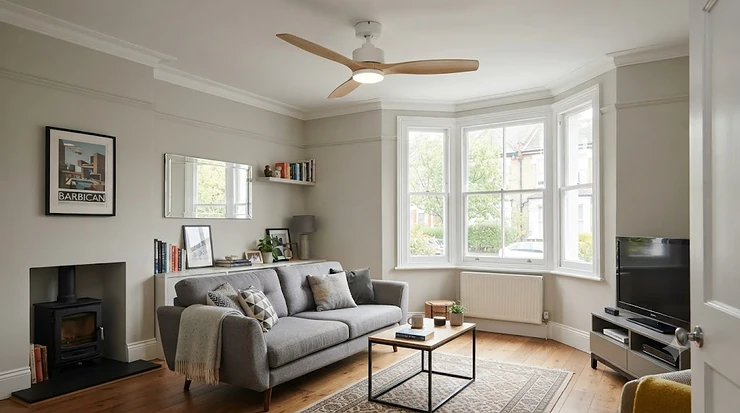
Standard downrod ceiling fans hang somewhere between 200mm and 450mm below the ceiling, which sounds trivial until you’re stood in a loft conversion with a 2.4m ceiling wondering whether a spinning blade is about to clip the top of your head. Hugger ceiling fans solve exactly that problem. A hugger ceiling fan, also called a flush mount or low profile ceiling fan, is a fan mounted directly to the ceiling bracket without a downrod, so the blades sit as close to the ceiling as the motor housing allows.

This matters more in the UK than the marketing usually admits. Government space standards set a minimum floor-to-ceiling height of 2.3 metres for new-build habitable rooms, as set out in the Nationally Described Space Standard, and a great many period conversions, loft rooms and boxrooms sit right at or below that figure. A fan hanging on even a short downrod can eat into headroom that was already tight.
This guide compares seven real, currently available hugger and flush mount fans across budget, mid-range and premium price points, with honest analysis grounded in real specifications rather than product-page superlatives. We’ll cover clearance measurements in real millimetres, materials, installation rules that actually apply in UK homes, and a full range comparison so you’re choosing on substance rather than guesswork. Every price below is a range rather than a fixed figure, since retailer prices move constantly – always check the current price before buying.
Quick Comparison Table
| Fan | Size | Light | Control | Price Range | Best For |
|---|---|---|---|---|---|
| Fantasia Kompact Combi 28″ | 28″ (710mm) | Yes | Pull chain | £180-£240 | Smallest rooms and tightest lofts |
| Fantasia Capri Combi 36″ | 36″ (910mm) | Yes | Pull chain | £200-£260 | Traditional-style compact rooms |
| RLMIEL 42 Inch Flush Mount Fan | 42″ (1070mm) | Yes | Remote | £60-£90 | Budget bedrooms and box rooms |
| Mpayel 56 Inch Flush Mount Fan | 56″ (1420mm) | Yes | Remote/app | £90-£130 | Larger low-ceiling living rooms |
| reiga 132cm White Gold Fan | 52″ (1320mm) | Yes | WiFi/app/voice | £140-£190 | Smart-home households |
| Fantasia Elite Viper Plus 44″ | 44″ (1120mm) | Yes (LED) | Remote | £260-£330 | Mid-size rooms wanting premium build |
| Fantasia Elite Viper Plus 54″ | 54″ (1370mm) | Yes (LED) | Remote | £420-£570 | Larger low-ceiling rooms, premium finish |
Reading across the table, price tracks build quality and brand heritage more closely than it tracks raw size – the budget RLMIEL 42 Inch Flush Mount Fan is actually larger in diameter than the pricier Fantasia Kompact Combi 28″, yet costs a fraction as much, because you’re paying for Fantasia’s 10-year motor warranty and heritage engineering rather than blade span. Smart-home households leaning towards voice or app control should look at the reiga 132cm White Gold Fan first; anyone prioritising a fan that will realistically outlast a decade of daily use should weight the two Fantasia Elite Viper Plus models more heavily despite the higher price.
💬 Just one click — help others make better buying decisions too!😊
Top 7 Hugger Ceiling Fans: Expert Analysis
1. Fantasia Kompact Combi 28″ — smallest true flush option for tight lofts
When a room genuinely can’t spare the depth of a standard fan, the Fantasia Kompact Combi 28″ is where most UK lighting retailers point customers first. At 28 inches (710mm) blade span with a built-in light kit, it’s designed specifically for smaller rooms where even a 36-inch fan would feel oversized relative to the space.
What the compact size means in practice: smaller blades move less air per rotation than a 42-inch or 52-inch fan, so this model suits a boxroom, small bedroom or landing rather than an open-plan living space – trying to cool a large room with it will mean running the motor at maximum speed constantly, which shortens component life over time. The twin pull-chain design operates the three fan speeds and the light independently, a deliberately simple mechanism that avoids the failure points sometimes seen in cheaper remote receivers.
Based on the spec comparison with pricier fans in this guide, the Kompact Combi’s main selling point isn’t raw performance – it’s the 10-year manufacturer motor warranty and Fantasia’s four-decade reputation as, by the company’s own account, pioneers of the UK ceiling fan market. For a small room where you want a fan you won’t think about again for a decade, that heritage is worth more than an extra few CFM of airflow.
Pros:
- ✅ Genuinely compact – suits rooms where bigger fans feel oversized
- ✅ Simple, reliable pull-chain operation with fewer failure points
- ✅ Backed by a 10-year manufacturer motor warranty
Cons:
- ❌ Limited airflow for anything beyond a small room
- ❌ No remote control included as standard
Sitting in the £180-£240 range, the Fantasia Kompact Combi 28″ is a strong pick for small rooms where longevity matters more than smart features.

2. Fantasia Capri Combi 36″ — best traditional pull-chain hugger
Stepping up in size, the Fantasia Capri Combi 36″ keeps the same twin pull-chain philosophy as the Kompact but in a stainless steel finish with reversible maple or silver blades, aimed at rooms that need a bit more airflow without moving into remote-control territory.
The stainless steel motor housing and reversible blade finish mean it’s genuinely adaptable to a room’s existing décor without needing a full colour-matched replacement if you redecorate – flip the blades and you get a different look for free. At 58W power draw on its highest setting, it delivers a manufacturer-quoted airflow of around 4,720 cubic feet per minute, which is respectable for a fan this compact, though reviewers consistently note that, like the smaller Kompact, the twin pull-chain system means no remote unless you add Fantasia’s optional upgrade kit separately.
Here’s what most buyers overlook: this fan ships as a flush mount design but can be converted to a drop-rod fan up to 72 inches if a future room or landlord situation calls for it, which gives it more long-term flexibility than fans that are permanently fixed to one mounting style. That’s a genuinely useful bit of future-proofing for anyone who might move house within the fan’s lifespan.
Pros:
- ✅ Reversible blade finish adapts to redecorating without a new fan
- ✅ Can be converted to drop-rod mounting later if needed
- ✅ Virtually silent operation on lower speed settings
Cons:
- ❌ Still no remote control as standard – chain-operated only
- ❌ Traditional styling won’t suit every modern interior
At £200-£260, the Fantasia Capri Combi 36″ rewards buyers who value flexibility and quiet reliability over the latest smart features.
3. RLMIEL 42 Inch Flush Mount Ceiling Fan — best budget smart hugger fan
This is where the market shifts noticeably in character. The RLMIEL 42 Inch Flush Mount Ceiling Fan trades Fantasia’s brand heritage for a genuinely modern feature set at a fraction of the price – remote control, six fan speeds, a 20W dimmable LED light with three colour temperatures, and a reversible DC motor, all in a flush profile designed for exactly the low-clearance rooms this guide is about.
The DC motor is the detail worth dwelling on: compared with the AC motors in older-style hugger fans, DC motors typically run quieter and more efficiently, and the six-speed granularity here lets you fine-tune airflow far more precisely than a traditional three-speed pull-chain fan. What the spec sheet won’t tell you, but the adjustable colour temperature range (3000K-6500K) suggests, is that this is designed as a genuine light replacement as well as a fan – useful if you’re fitting it into a room with no separate ceiling light already.
Reviewers consistently report that the fan is genuinely quiet on its lowest setting with only mild wind noise stepping up through the speeds, and that the remote’s memory function – recalling your last brightness and colour setting – is a small but appreciated convenience. Being a newer, less-established brand than Fantasia, it doesn’t carry the same decades-long track record, so buyers prioritising maximum long-term reliability should weigh that against the significant price saving.
Pros:
- ✅ Genuinely quiet reversible DC motor with six speed settings
- ✅ Dimmable, colour-adjustable LED light with memory function
- ✅ Remote control included as standard at a low price point
Cons:
- ❌ Newer brand without Fantasia’s decades-long UK track record
- ❌ Assembly and ceiling-fixing require careful attention to instructions
In the £60-£90 range, the RLMIEL 42 Inch Flush Mount Ceiling Fan is the best value entry point into remote-controlled, dimmable hugger fans currently available on Amazon.co.uk.
4. Mpayel 56 Inch Flush Mount Ceiling Fan — best budget large-room hugger
Bigger rooms need bigger blade spans to move air effectively without running the motor flat out constantly, and the Mpayel 56 Inch Flush Mount Ceiling Fan answers that at a still-accessible price point. Its 56-inch span and five-blade design are aimed at larger low-ceiling living rooms and open-plan spaces where a 36-inch or 42-inch fan would be visibly under-specced.
The remote and app control combination is the standout practical feature here – being able to adjust fan speed and light dimming from a phone is a genuine convenience over hunting for a small remote, particularly in a family living room where remotes have a habit of disappearing under sofa cushions. The dimmable lighting system paired with the reversible motor also means this fan pulls double duty as a room’s main light fitting and its year-round temperature management tool, running one way to cool in summer and reversed to push warm air back down in winter.
On paper this means strong value for a large-room fan, and reviewer feedback on similarly specced flush mount fans in this price bracket tends to confirm decent day-to-day performance, though buyers should expect the finish and long-term component quality to sit a notch below the premium Fantasia models rather than matching them directly.
Pros:
- ✅ Large 56-inch span suits sizeable living rooms and open-plan areas
- ✅ Combined remote and app control adds genuine convenience
- ✅ Reversible motor supports both summer cooling and winter warmth
Cons:
- ❌ Finish and component quality trail premium branded alternatives
- ❌ Five-blade design adds slightly more visual bulk than slimmer 3-blade fans
Priced around £90-£130, the Mpayel 56 Inch Flush Mount Ceiling Fan is the pragmatic choice for anyone furnishing a large low-ceiling room on a tight budget.
5. reiga 132cm White Gold Ceiling Fan — best smart WiFi hugger fan
For households already invested in smart home ecosystems, the reiga 132cm White Gold Ceiling Fan goes a step further than remote or app control alone, adding WiFi connectivity with Alexa voice compatibility on top of its DC motor and dimmable LED light kit. At 132cm (roughly 52 inches), it sits in the same size bracket as many mid-range downrod fans, just without the downrod.
The white and gold finish is a genuine style differentiator in a market dominated by white, black and stainless steel options, which matters if the fan is a visible feature in an open-plan kitchen-diner rather than a purely functional fitting tucked into a bedroom. Reviewers highlight the DC motor’s quiet operation and the reversible direction function as consistent strengths, alongside the convenience of setting schedules or voice commands rather than reaching for a remote every time.
What most buyers overlook about WiFi-enabled fans generally is the setup step – pairing a fan with a home WiFi network and a voice assistant app takes longer on first install than a standard remote-control fan, and a patchy WiFi signal in the room can cause intermittent app connectivity issues, a genuine practical consideration rather than a flaw specific to this model alone.
Pros:
- ✅ WiFi and Alexa voice control adds genuine smart-home convenience
- ✅ Distinctive white and gold finish stands out from generic options
- ✅ Quiet reversible DC motor with dimmable LED lighting
Cons:
- ❌ Initial WiFi and app pairing takes longer than remote-only fans
- ❌ App reliability depends on the strength of your home WiFi in that room
Expect to pay in the £140-£190 range for the reiga 132cm White Gold Ceiling Fan – a sensible upgrade if smart-home integration is a genuine priority rather than a nice-to-have.

6. Fantasia Elite Viper Plus 44″ — best mid-size premium hugger
Moving into Fantasia’s Elite range, the Fantasia Elite Viper Plus 44″ is built around what the brand calls low-energy motor technology paired with G9 LED bulbs rated at 3.8W each – a roughly 94% energy saving over the standard 60W G9 bulb they replace, according to Fantasia’s own specifications, while still producing around 330 lumens per bulb with a 30,000-hour rated life.
Here’s what that means day to day: the LED upgrade isn’t just about running costs, it also means considerably less heat generated at the light fitting, which matters more than you’d think on a fan mounted close to the ceiling in a room that already runs warm in summer. The remote control operates both the three fan speeds and independent light dimming, plus a reverse function for winter use, bringing this model’s functionality broadly in line with the budget smart fans above it in this guide – the real differentiator is build quality and the reputation behind it.
Reviewers and UK lighting retailers consistently position the Viper Plus range as one of Fantasia’s best-selling lines, and the finish options (stainless steel or white, with a choice of blade finishes) give more flexibility to match existing décor than the simpler Capri and Kompact models below it. What the spec sheet won’t tell you is that this sits in an odd but sensible middle ground: genuinely premium build without the price of the largest 54-inch version.
Pros:
- ✅ Low-energy LED lighting cuts running costs substantially
- ✅ Remote-operated speed, dimming and reverse function in one unit
- ✅ Strong reputation as one of Fantasia’s best-selling ranges
Cons:
- ❌ Noticeably pricier than budget remote-control alternatives with similar functionality
- ❌ Flush mounting typically requires a separate mounting kit for full clearance
At £260-£330, the Fantasia Elite Viper Plus 44″ suits buyers who want premium build quality and brand confidence without stretching to the largest model in the range.
7. Fantasia Elite Viper Plus 54″ — best premium hugger for larger low-ceiling rooms
The largest fan in this guide, the Fantasia Elite Viper Plus 54″, shares the same low-energy LED lighting and remote-controlled feature set as its 44-inch sibling but scales the blade span up to suit bigger low-ceiling rooms – open-plan kitchen-diners, larger living rooms, or loft conversions with generous floor area but restricted headroom.
The larger blade span moves noticeably more air per rotation than the 44-inch model, which matters in bigger rooms where a smaller fan would need to run at maximum speed constantly to have any real cooling effect – a false economy that shortens motor life over time. Available in stainless steel or white finishes, with maple or dark oak blade options depending on the exact variant, it offers more finish flexibility than most fans at this size point, letting it sit convincingly in both contemporary and more traditional rooms.
Based on the spec comparison with the rest of this guide, the jump in price from the 44-inch to 54-inch Viper Plus is largely down to the larger motor needed to drive the bigger blade span safely and quietly, rather than a fundamentally different feature set – so it’s worth being confident your room genuinely needs the extra diameter before paying the premium.
Pros:
- ✅ Larger blade span suits genuinely big low-ceiling rooms
- ✅ Multiple finish and blade combinations for different interiors
- ✅ Same low-energy LED and remote functionality as the 44-inch model
Cons:
- ❌ Significant price premium over the 44-inch version
- ❌ Overkill for anything smaller than a large living or dining room
Typically priced in the £420-£570 range, the Fantasia Elite Viper Plus 54″ is the top-tier choice for larger low-ceiling rooms where both performance and finish quality genuinely matter.
Installing and Setting Up Your Hugger Ceiling Fan
Getting the install right in the first few weeks avoids most of the common complaints seen in reviews. Before fitting anything, confirm your existing ceiling rose or fan bracket can bear the fan’s weight – most hugger fans are lighter than downrod equivalents, but a fan with an integrated light kit still needs a properly rated fixing point rather than a standard lightweight ceiling rose. If you’re replacing a light fitting with a fan-and-light combo like the Mpayel 56 Inch Flush Mount Ceiling Fan or RLMIEL 42 Inch Flush Mount Ceiling Fan, check the existing circuit can handle the combined load of motor and light before switching on.
A common first-month mistake is under-tightening the blade brackets, which causes the faint wobble and rattle that dominates negative reviews of budget fans – torque each blade screw evenly rather than fully tightening one before moving to the next, which keeps the blade assembly balanced. For remote and WiFi models like the reiga 132cm White Gold Ceiling Fan, pair the remote or app on a strong WiFi signal at the point of installation rather than assuming it’ll connect fine later; a weak signal at ceiling height is a frequent, easily avoided source of frustration.
Once running, rebalance the blades if you notice a wobble developing over the first few weeks – small clip-on balancing weights, sold separately, resolve the vast majority of cases without needing to replace anything. For pull-chain models such as the Fantasia Kompact Combi 28″ and Fantasia Capri Combi 36″, avoid yanking the chain at an angle, which is the most common cause of premature chain switch failure reported in long-term reviews.

Real-World Scenarios: Which Hugger Fan Suits Your Room
Picture a young professional converting a boxroom into a home office, with a 2.3m ceiling and limited budget. The Fantasia Kompact Combi 28″ or the significantly cheaper RLMIEL 42 Inch Flush Mount Ceiling Fan both fit this brief, with the choice largely coming down to whether chain-operated simplicity or remote-controlled dimming and colour temperature matters more for a working space.
Next, a family with a large open-plan kitchen-diner in a 1930s semi with a lowered, insulated loft ceiling at 2.4m. Here the size requirement rules out the smaller fans entirely – the Mpayel 56 Inch Flush Mount Ceiling Fan offers the necessary blade span at a reasonable price, while the Fantasia Elite Viper Plus 54″ is the upgrade pick if budget allows and the room is a genuine focal point for guests.
Finally, a smart-home enthusiast fitting out a newly converted loft bedroom who already controls their lighting and heating by voice and app. The reiga 132cm White Gold Ceiling Fan is the obvious fit here, integrating into an existing smart-home routine rather than adding another standalone remote to the pile in a drawer.
How to Choose a Hugger Ceiling Fan
Working through these steps in order gets most buyers to a confident decision faster than comparing spec sheets side by side.
- Measure your actual ceiling height and current fixture depth first. Know the exact clearance available before comparing fans, since blade-to-ceiling distance varies by a few centimetres between models even within the “hugger” category.
- Match blade span to room size honestly. A 28-inch fan in a large living room will underperform regardless of motor quality; a 56-inch fan in a boxroom will look and feel oversized.
- Decide whether you need a light kit built in. If the room has no separate ceiling light, prioritise fans like the RLMIEL 42 Inch Flush Mount Ceiling Fan or Mpayel 56 Inch Flush Mount Ceiling Fan that double as the main light fitting.
- Consider your control preference realistically. Pull-chain fans are simpler and have fewer parts to fail, but remote, app or voice control add genuine day-to-day convenience if you’ll actually use it.
- Factor in existing circuit capacity. A combined fan-and-light fitting draws more than a light alone; check your circuit can handle it, particularly on older wiring.
- Weigh brand heritage against price. Established UK brands like Fantasia carry decades of reliability data and long warranties; newer budget brands can offer strong value but with less of a track record.
- Check the exact mounting and fixing requirements before buying. Some flush mount fans need a separate mounting kit purchased alongside the fan itself to achieve true minimal clearance – confirm this isn’t an unexpected extra cost.
Ceiling Fan for a 2.4m Ceiling: What Clearance You Actually Need
A 2.4-metre ceiling is close to the average for contemporary UK homes, but it’s tighter than it sounds once a fan, its fixing plate and its blade sweep are all accounted for. The Nationally Described Space Standard sets a working minimum of 2.3 metres over most of a habitable room’s floor area for new housing, as confirmed on the gov.uk technical housing standards page, which means a genuinely low-clearance fan isn’t a luxury choice in a huge number of UK homes – it’s often the only fan that fits safely.
On a 2.4m ceiling, a hugger fan with roughly 195mm of clearance from ceiling to blade, typical of the flush-mounted Fantasia range in this guide, leaves the blades sweeping at around 2.2m from the floor – comfortably above head height for most adults, though worth double-checking in a room used by particularly tall household members or where furniture like a bed sits close underneath. A downrod fan, even a short one, can easily eat another 100-150mm of that margin, which is exactly why hugger and flush mount designs exist as a distinct category rather than a cosmetic variant.
The practical takeaway: on anything at or below 2.4m, treat true flush mount as the default starting point rather than an optional upgrade, and only consider a downrod fan if your ceiling comfortably clears 2.6m or more.
Understanding Minimal Clearance: How Hugger Fans Are Measured
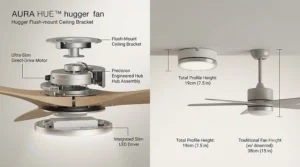
Manufacturers describe clearance in two figures that are easy to conflate but mean different things. The first is ceiling-to-blade distance – how far the spinning blades themselves sit below the ceiling surface – and the second is total drop, or ceiling-to-lowest-point, which includes the light kit, pull chains or any decorative finial hanging below the blade line. Across the Fantasia flush range featured in this guide, ceiling-to-blade clearance typically runs around 190-195mm, with total drop to the lowest point closer to 300mm once a light kit is factored in.
What most buyers overlook when comparing minimal clearance fans is that a fan advertised as “flush mount” can still vary by several centimetres in actual measured clearance between brands, because the motor housing depth differs. A slimmer DC motor, common on newer budget models like the RLMIEL 42 Inch Flush Mount Ceiling Fan, can sometimes achieve a tighter overall profile than a bulkier traditional AC motor housing, even though both are marketed under the same “hugger” label. Always check the manufacturer’s stated millimetre measurements rather than relying on the word “flush” alone, particularly if your available clearance is genuinely marginal.
Flush Mount vs Downrod: Close-to-Ceiling Mounting Explained
This comparison genuinely comes down to one question: does your ceiling comfortably clear 2.6 metres, or are you working with something closer to 2.3-2.4m? Flush mount, or hugger, fans bolt directly to the ceiling bracket with no downrod at all, maximising headroom at the cost of slightly reduced airflow efficiency, since blades spinning closer to the ceiling surface interact more with that surface than blades hanging further into open room air.
| Factor | Flush Mount (Hugger) | Downrod Mount |
|---|---|---|
| Typical clearance from ceiling | 150-200mm to blade | 250mm+ to blade, adjustable |
| Best ceiling height | Up to around 2.5m | 2.6m and above |
| Airflow efficiency | Slightly reduced near ceiling | Generally more efficient |
| Installation flexibility | Fixed, minimal adjustment | Adjustable drop length |
| Best For | Lofts, low ceilings, boxrooms | Standard and high ceilings |
The efficiency gap in the table is real but modest for typical room sizes – Fantasia and other manufacturers design hugger fan blade pitch specifically to compensate for the closer ceiling proximity, so the practical difference in everyday cooling is smaller than the raw specification difference suggests. For anyone genuinely uncertain, the safer default on a UK ceiling at or below 2.4m is flush mount every time; downrod fans only become the better choice once you have real headroom to spare.
Compact Height Fixtures: Hugger Fan Materials and Build Quality
Hugger fan motor housings are typically built from either painted or powder-coated steel, as seen across the Fantasia range, or a lighter composite and steel combination increasingly common on budget DC-motor fans like the reiga 132cm White Gold Ceiling Fan. The choice of material affects both the fan’s weight – relevant to what your ceiling fixing point can safely support – and its overall depth, since steel motor housings on premium models are often engineered slightly more compactly to preserve that all-important minimal clearance.
Blade materials vary more widely than most buyers expect. Fantasia’s traditional range uses real wood veneer blades (maple, dark oak) over a composite core, which adds a small amount of weight but gives a genuinely premium look and feel compared with the moulded plastic or ABS blades common on budget fans. LED light kits, now standard across almost the entire hugger fan market, use significantly less energy and generate less heat than the halogen or incandescent fittings older fans shipped with, which matters specifically for compact height fixtures where the light source sits only centimetres from a ceiling that may already be warm in summer.
What the spec sheet won’t tell you is that build quality differences show up less in day-one performance and more in how the fan ages – premium motor housings and metal blade brackets resist the wobble and rattle that develops in cheaper fans after a year or two of regular use, which is where the price gap between budget and Fantasia-tier fans genuinely earns its keep over the long term.
Common Mistakes When Buying a Hugger or Flush Mount Fan
The most frequent mistake is buying based on the word “low profile” in a product title without checking the actual millimetre clearance figures, which, as covered above, can vary meaningfully between brands using the same marketing language. A closely related error is measuring ceiling height but forgetting to account for the light kit and any pull chain or finial hanging below the blade line – the true lowest point of the fan, not just the blade height, is what determines whether it clears a doorway sightline or a tall household member’s head.
Buyers also regularly underestimate blade span requirements, choosing a compact fan like the Fantasia Kompact Combi 28″ for a room that genuinely needs the airflow of a 42-inch or larger model, then running the smaller fan constantly at maximum speed and wondering why it wears out faster than expected. On the flip side, oversizing a fan for a small room wastes money and can make the space feel visually cramped despite the extra clearance gained by choosing a flush mount design in the first place.
Finally, a significant number of DIY installers skip checking whether their intended install counts as notifiable electrical work before starting, which can create genuine compliance problems – covered in full in the safety section below.
Long-Term Cost & Maintenance
A hugger fan is typically a multi-year fixture rather than a seasonal purchase, so cost is best thought of per year of use rather than purely as an upfront figure. A £220 Fantasia Capri Combi 36″ that lasts a genuine decade under its motor warranty works out to roughly £22 a year, which compares favourably with cheaper unbranded fans that may need replacing every two to three years as bearings and switches wear.
Running costs differ meaningfully too. Fans with older-style halogen or incandescent light kits cost noticeably more to run than the LED-equipped models featured throughout this guide – the Fantasia Elite Viper Plus 44″ and 54″ models’ G9 LED bulbs are quoted by Fantasia as using roughly 94% less energy than the standard bulbs they replace, which adds up meaningfully over years of daily use in a main living space. Maintenance costs across the range are modest regardless of price point: replacement remote batteries, occasional blade rebalancing weights, and, rarely, a replacement pull-chain switch are the main ongoing expenses, none of which run to more than a few pounds.
The main hidden cost to budget for is a separate flush mounting kit on models that ship as dual-mount rather than fixed-flush – checking this before ordering avoids an unexpected top-up purchase once the fan arrives.
Safety & Electrical Regulations Guide
Fitting a ceiling fan in England involves Part P of the Building Regulations, which governs electrical safety in dwellings. The good news for most straightforward fan installations is that replacing an existing light fitting with a fan-and-light combination on the same circuit is generally non-notifiable work, provided it isn’t in a bathroom’s special location zones and doesn’t involve installing a new circuit – full detail on what counts as notifiable is available from the IET’s official Part P guidance. That said, all electrical work, notifiable or not, still needs to be carried out safely and in line with BS 7671 wiring regulations, so using a competent, ideally Part P-registered electrician is strongly advisable if you’re not confident doing the isolation and connection work yourself.
Weight and fixing safety matter just as much as the electrical side. A hugger fan with an integrated light kit, such as the Mpayel 56 Inch Flush Mount Ceiling Fan, is heavier than a standard light fitting and needs a properly rated ceiling rose or bracket rather than the lightweight fixing many older ceiling roses provide – if in doubt, a fan-rated box or brace should be fitted first. For rooms with genuinely marginal headroom, it’s also worth checking the fan’s total drop measurement against the tallest regular occupant of the room, not just an average adult height, particularly in a home gym, bedroom with a raised bed, or a room used by teenagers likely to still be growing.
Problem → Solution: Fixing Common Hugger Fan Issues
Problem: Fan wobbles noticeably even at low speed. This is almost always a balance issue rather than a fault – use a balancing kit (small clip-on weights) on the blade nearest the direction of wobble, adjusting incrementally, a fix that resolves the vast majority of cases reported by owners of budget models like the RLMIEL 42 Inch Flush Mount Ceiling Fan.
Problem: Remote or app control loses connection intermittently. For WiFi-enabled fans such as the reiga 132cm White Gold Ceiling Fan, check signal strength at ceiling height specifically, since it’s often weaker there than at furniture level where you tested the network originally; a WiFi extender in the room can resolve persistent drop-outs.
Problem: Fan clips a tall doorframe or head height sightline. Double-check the total drop measurement, including light kit and any chain, against your actual clearance – if it’s genuinely too tight even for a hugger fan, a smaller blade span like the Fantasia Kompact Combi 28″ is the fix, not forcing a larger fan into an unsuitable space.
Problem: Pull chain switch feels stiff or has stopped working. Avoid pulling the chain at an angle, which is the leading cause of internal switch wear on models like the Fantasia Capri Combi 36″; a replacement chain switch is an inexpensive part rather than requiring a full fan replacement.
Problem: LED light has dimmed or developed flickering. Confirm the fan isn’t connected to a standard wall dimmer not designed for LED fan lighting – most manufacturers specify a dedicated fan-compatible control, and using the wrong type of dimmer is a common, easily fixed cause of flickering.
FAQ
❓ What is a hugger ceiling fan?
❓ What ceiling height do you need for a hugger fan?
❓ Are hugger ceiling fans less effective than downrod fans?
❓ Do you need an electrician to fit a hugger ceiling fan?
❓ What size hugger fan do I need for my room?
Conclusion
There’s no single best hugger ceiling fan – only the right one for your ceiling height, room size and budget. For genuinely tight lofts and small rooms, the Fantasia Kompact Combi 28″ or Fantasia Capri Combi 36″ offer proven, low-maintenance simplicity backed by decades of UK brand heritage. Budget-conscious buyers furnishing a bedroom or study should look first at the RLMIEL 42 Inch Flush Mount Ceiling Fan, while larger open-plan rooms are better served by the Mpayel 56 Inch Flush Mount Ceiling Fan or, for a genuine premium finish, the Fantasia Elite Viper Plus 54″. Smart-home households shouldn’t overlook the reiga 132cm White Gold Ceiling Fan, and anyone wanting mid-size premium build without the largest model’s price tag should consider the Fantasia Elite Viper Plus 44″.
Whichever model fits your room, the clearance measurements and comparisons above should make the decision far more concrete than scrolling product listings alone – checking the real millimetre figures against your actual ceiling height is the single step that prevents most buying regret in this category. Always check current pricing and availability before ordering, since every figure in this guide is a range rather than a price that holds indefinitely.
✨ Don’t Miss These Exclusive Deals!
🔍 Ready to find your perfect hugger fan? Click through on any highlighted model above to check current pricing and availability on Amazon, and get your low-ceiling room sorted before the next warm spell!
Recommended for You
- Ceiling Fan For Sloped Ceiling: 7 Angled Picks for 2026
- 7 Best Ceiling Fans for Loft Conversion UK (2026 Guide)
- Reversible Motor Ceiling Fan: 7 Best UK Picks for 2026
Disclaimer: This article contains affiliate links. As an Amazon Associate, I earn from qualifying purchases. If you purchase products through these links, we may earn a small commission at no additional cost to you.
✨ Found this helpful? Share it with your friends! 💬🤗
