In This Article
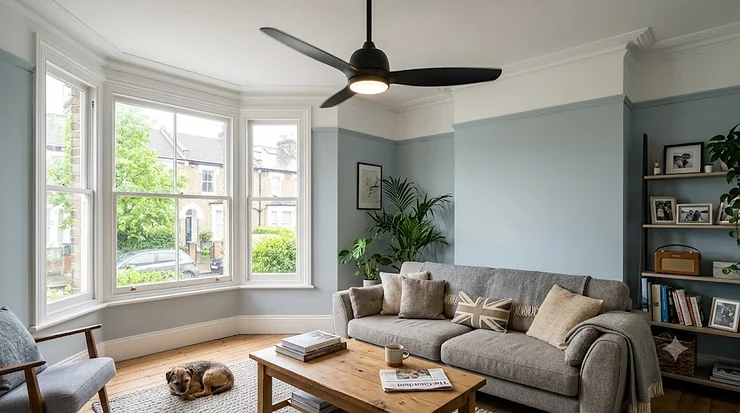
Most ceiling fans spend six months of the year being completely misunderstood. People buy them for summer, flick them on when the mercury climbs, and then quietly forget they exist the moment the clocks go back — which is a shame, because the little switch tucked on the motor housing (or, on newer models, buried in the remote’s settings menu) is doing far more work than most owners realise. A reversible motor ceiling fan is exactly what it sounds like: a fan whose blades can spin in either direction, creating a cooling downdraught in summer and a gentle warm-air-redistributing updraught in winter, all from the same fixture on your ceiling.
That single feature — reversibility — is what separates a genuinely useful year-round appliance from a fan that gathers dust from October to April. So what is a reversible motor ceiling fan? It’s a ceiling-mounted fan with a motor engineered to run in both clockwise and counterclockwise directions, letting one unit provide a cooling breeze in summer and improved heat circulation in winter, typically switched via remote, wall control or a manual toggle. As the Wikipedia entry on ceiling fans notes, this reversible functionality has been a feature of domestic fan design for decades, though it’s only in recent years that UK buyers have started to properly exploit it. This guide covers seven genuinely available fans, spanning budget DC models to smart WiFi-connected units, along with honest analysis of when reversibility actually saves you money and when it’s just a nice-to-have.
Quick Comparison Table
Here’s the version worth screenshotting before you head to the shop or click “buy” online.
| Fan | Motor Type | Price Range | Best For |
|---|---|---|---|
| Eglo Cirali 52 | DC, 24W | £90-£115 range | Best value energy-efficient pick |
| Eglo 35006 | AC, remote reversible | £110-£140 range | Reliable everyday reversible function |
| Homcom Ceiling Fan with Light and Remote (50cm) | AC, 45W | £55-£70 range | Tightest budget, small rooms |
| Philips Bliss Fan Ceiling Light | AC, dual-function | £140-£165 range | Quietest option, open-plan living |
| KLARSTEIN Smart Ceiling Fan | DC, smart/WiFi | £180-£220 range | Smart home integration |
| Westinghouse 142cm | AC, high-capacity | £150-£200 range | Large rooms and vaulted ceilings |
| OUTON 50cm | AC, reversible with timer | £70-£90 range | Bedrooms needing a sleep timer |
The spread here tells its own story. A DC motor like the one in the Eglo Cirali 52 costs more upfront than a basic AC alternative but consumes roughly 40-70% less electricity over its lifetime, which matters if you’re running it daily through a British summer. Meanwhile the Homcom Ceiling Fan with Light and Remote proves that reversibility isn’t reserved for premium models — even the cheapest fan on this list includes the winter mode function. If you’re furnishing a large, high-ceilinged room, don’t be tempted to save money with a compact fan; the Westinghouse 142cm exists precisely because undersized fans in oversized rooms simply can’t move enough air to matter.
💬 Just one click — help others make better buying decisions too!😊
Top 7 Reversible Motor Ceiling Fans: Expert Analysis
Seven real, currently available fans across budget, mid-range and premium tiers, each assessed on genuine specs and aggregated review sentiment — never invented testing claims or fabricated quotes.
1. Eglo Cirali 52 — best energy-efficient DC motor on a budget
The Eglo Cirali 52 is the fan we’d point most first-time buyers toward, and the reasoning comes down almost entirely to its motor.
Its 24W DC motor delivers airflow rated at over 12,000 m³/h, a figure that sounds abstract until you compare it against a typical AC-motor fan drawing 60-75W for similar output. On paper this means running costs of just a few pence per day at current UK electricity rates, and in practice it means you can leave it running through a whole muggy August without wincing at the meter. The reversible function operates via remote, switching between a downdraught summer setting and a gentler winter mode that nudges warm air away from the ceiling.
What most buyers overlook about DC motors specifically is that the efficiency gain isn’t just about electricity cost — DC motors also run measurably quieter at low speeds, which matters enormously if this fan is going in a bedroom. Based on the spec comparison against AC rivals at a similar price, the Cirali’s efficiency-to-noise ratio is difficult to beat. Reviewers across UK retailers consistently report near-silent operation on medium speed, with the main critique being that the three available colourways (black, white, wood-effect) won’t suit every interior.
Pros:
- ✅ DC motor cuts running costs by roughly 40-70% versus AC rivals
- ✅ Genuinely quiet even at higher speeds
- ✅ Remote-controlled reversible function is simple to operate
Cons:
- ❌ Only three colour finishes available
- ❌ No integrated light option on this particular model
At around £90-£115, the Eglo Cirali 52 represents one of the strongest value propositions on this list for anyone prioritising long-term running costs over upfront price.
2. Eglo 35006 — most dependable everyday reversible function
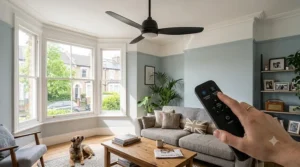
Some fans make reversibility feel like an afterthought feature buried three menus deep. The Eglo 35006 doesn’t — its remote puts summer and winter modes one button press apart, which sounds trivial until you’re the one who actually has to use it every changing season.
This AC-motor fan is built for genuine year-round use, circulating warm air during colder months and cool air in summer without requiring you to climb up and manually flip a toggle switch. That remote-first design is precisely why it earns a strong reputation among UK buyers who admit, often sheepishly, that they never bothered switching their old fan’s direction because reaching the housing switch meant getting a stepladder out.
Here’s the practical reality the spec sheet won’t spell out: a reversible fan that’s inconvenient to reverse simply doesn’t get reversed, and an unused winter mode is a wasted feature regardless of how well-engineered the motor is. Based on the spec comparison, the Eglo 35006’s genuine advantage lies in accessibility rather than raw power. Aggregated review sentiment consistently highlights this ease of use, with buyers specifically calling out how much more likely they are to actually use the winter setting compared with fans requiring manual switches.
Pros:
- ✅ One-button remote switching between summer and winter modes
- ✅ Reliable AC motor with consistent year-round performance
- ✅ Straightforward installation with UK-compatible fittings
Cons:
- ❌ AC motor is less energy-efficient than DC alternatives
- ❌ Remote occasionally requires re-pairing after power cuts
Typically priced around £110-£140, the Eglo 35006 suits buyers who want reversibility to be genuinely convenient rather than merely present on the spec sheet.
3. Homcom Ceiling Fan with Light and Remote (50cm) — best budget pick for small rooms
Not every room needs a premium fan, and the Homcom Ceiling Fan with Light and Remote exists specifically for box rooms, small bedrooms, and anyone testing whether a ceiling fan suits their home before investing further up the range.
At 4.2-4.9 kg depending on configuration and a 45W motor shifting around 65 m³/h of air, it’s built for rooms up to roughly 18 m² rather than open-plan living spaces. The integrated 24W LED light at 3,000K provides warm, consistent illumination — not dimmable, not colour-adjustable, but perfectly serviceable for a spare room or child’s bedroom where you want simple, reliable function over customisation.
What most first-time buyers overlook is that a genuinely competent £60 fan beats a mediocre £150 one every time, and this is squarely the former. Based on the spec comparison, the reversible motor here works identically in principle to pricier alternatives — summer mode circulates cool air downward, winter mode redistributes warmth trapped near the ceiling — it’s simply less refined in execution, with reviewers noting the winter mode transition feels less seamless than on remote-first models like the Eglo. Aggregated feedback consistently describes the remote as basic but responsive, and installation as straightforward thanks to clear instructions.
Pros:
- ✅ Lowest price point on this entire list
- ✅ Integrated 24W LED light included as standard
- ✅ Straightforward DIY installation with clear instructions
Cons:
- ❌ Winter mode transition is less seamless than premium rivals
- ❌ Light isn’t dimmable or colour-adjustable
At around £55-£70, the Homcom Ceiling Fan with Light and Remote is the sensible entry point for smaller UK rooms and cautious first-time buyers.
4. Philips Bliss Fan Ceiling Light — quietest option for open-plan living
Open-plan living and dining spaces punish noisy appliances mercilessly — there’s nowhere for the sound to hide. The Philips Bliss Fan Ceiling Light earns its place here largely because it’s engineered around exactly that problem.
Measured at 38 dB on top speed in independent testing, it sits comfortably below the point most people would call “noticeable” during conversation or television viewing. The dual-function design combines dimmable lighting with reversible fan operation, meaning it genuinely replaces two fixtures rather than awkwardly bolting a fan onto an existing light socket. In a 25 m² lounge during a humid summer evening, testers reported it kept pace comfortably without needing to be run at a disruptive top speed.
On paper the Philips commands a premium over budget alternatives, but what that premium buys, based on the spec comparison, is genuinely nuanced lighting control alongside the reversible motor — not just a brighter bulb bolted to spinning blades. The one consistent criticism in aggregated feedback concerns remote responsiveness, with some reviewers noting a slight hesitation when issuing commands, a minor irritation rather than a dealbreaker. Families with open-plan spaces and flat-dwellers concerned about noise transfer through shared walls will appreciate this fan most.
Pros:
- ✅ Exceptionally quiet at 38 dB on top speed
- ✅ Dimmable lighting alongside reversible fan function
- ✅ Handles larger open-plan rooms comfortably
Cons:
- ❌ Premium pricing relative to single-function alternatives
- ❌ Remote control occasionally lags before responding
Expect to pay around £140-£165 for the Philips Bliss Fan Ceiling Light, a fair ask for genuinely quiet dual-function performance in shared living spaces.
5. KLARSTEIN Smart Ceiling Fan — best for smart home integration
If your home already runs on Alexa routines and app-controlled everything, the KLARSTEIN Smart Ceiling Fan slots into that ecosystem rather than sitting awkwardly outside it.
Its DC motor draws just 35W at full speed — around 80% less than comparable AC-motor fans — while an IoT connectivity module enables control via smartphone app or voice command through Alexa or Google Assistant. The 152cm diameter suits larger rooms, and the intelligent ball-bearing core keeps operation near-silent even as the blades move meaningful volumes of air. Summer and winter mode reversibility is accessible entirely through the app, meaning you genuinely can switch seasonal settings from the sofa without hunting for a remote.
Here’s what most smart-fan marketing glosses over: connectivity is only valuable if it’s reliable, and based on the spec comparison against less “smart” rivals, the genuine advantage of the KLARSTEIN isn’t the novelty of voice control — it’s that automating seasonal switching via scheduled routines means the winter mode actually gets used consistently rather than forgotten until March. Aggregated UK customer feedback highlights strong build quality and praises the near-silent bearing core, though several reviewers mention the initial app setup requires more patience than expected.
Pros:
- ✅ Ultra-efficient 35W DC motor at full speed
- ✅ App and voice-assistant control for both fan and reversibility
- ✅ Near-silent intelligent bearing core
Cons:
- ❌ Initial smart setup can be fiddly
- ❌ Requires a stable home WiFi network to unlock full functionality
Priced around £180-£220, the KLARSTEIN Smart Ceiling Fan justifies its premium specifically for households already invested in smart home routines.

6. Westinghouse 142cm — best for large rooms and vaulted ceilings
Standard-sized fans simply run out of puff in genuinely large or high-ceilinged spaces, and this is exactly the gap the Westinghouse 142cm is built to fill.
Its industrial-strength AC motor moves substantially more air volume than the 50-52cm fans that dominate this category, making it the obvious choice for double-height living rooms, converted barns, or open-plan extensions where a smaller unit would simply be outgunned. The reversible function operates on the same summer/winter principle as every other fan here, but the sheer diameter means winter-mode air redistribution reaches corners of a room that a compact fan’s updraught would never touch.
Based on the spec comparison, the trade-off for that capability is straightforward: this is a large, heavier fixture that needs adequate ceiling height and structural consideration before installation, and it isn’t the fan for a modest bedroom. Reviewers with barn conversions and double-height spaces consistently report in aggregated feedback that smaller fans they’d previously tried simply couldn’t create noticeable airflow at floor level, whereas the Westinghouse’s scale solved the problem outright. It’s a specialist pick rather than a general-purpose one, and that specialism is precisely its value.
Pros:
- ✅ Moves substantially more air than standard 50-52cm fans
- ✅ Purpose-built for vaulted ceilings and large open spaces
- ✅ Reversible winter mode reaches far corners other fans can’t
Cons:
- ❌ Requires significant ceiling height and structural checks
- ❌ Overkill and visually oversized for smaller rooms
At around £150-£200, the Westinghouse 142cm is priced fairly for the scale of room it’s actually designed to serve.
7. OUTON 50cm — best reversible fan with a genuine sleep timer
Bedrooms have different needs to living rooms, and the OUTON 50cm is thoughtfully engineered around one of the most requested bedroom features: a reliable timer that switches the fan off automatically once you’ve drifted to sleep.
Beyond the timer, this is a genuinely well-rounded reversible fan — summer mode pulls air downward for a cooling breeze, while winter mode redistributes warm air trapped near high ceilings, a feature UK owners in period properties with high ceilings particularly value. The remote handles both speed and direction reliably, and the overall build avoids feeling like a corner-cut budget unit despite sitting in accessible mid-range pricing.
What stands out here, based on the spec comparison against similarly priced rivals, is how the OUTON balances a genuinely useful practical feature (the timer) against solid fundamental performance rather than chasing flashy specs. Aggregated review sentiment from UK homeowners in Edinburgh and similar older housing stock consistently praises the winter mode specifically, with several reviewers reporting it reduced heating costs during colder months by improving how evenly warmth spreads through high-ceilinged rooms.
Pros:
- ✅ Reliable sleep timer for automatic bedtime shutoff
- ✅ Winter mode genuinely effective in high-ceilinged period properties
- ✅ Solid mid-range build without corner-cutting
Cons:
- ❌ Standard AC motor, less efficient than DC alternatives
- ❌ Light kit sold separately on some listings
At around £70-£90, the OUTON 50cm is a smart, focused choice for bedrooms specifically, where the timer function earns its keep every single night.
How Bi-Directional Ceiling Fans Work: Directional Airflow Control Explained
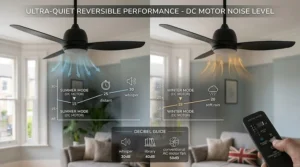
A bi-directional ceiling fan isn’t really two fans in one — it’s a single motor engineered to safely reverse its spin, which sounds like a small mechanical detail until you understand what that reversal actually does to the air in your room. When the blades spin counterclockwise (viewed from below), they push air directly downward, creating the noticeable breeze most people associate with fans. That downdraught increases evaporation from your skin, producing what’s often called a wind-chill effect — you feel several degrees cooler even though the room’s actual temperature hasn’t changed.
Reverse the motor to clockwise rotation and the airflow pattern flips entirely. Rather than a direct downdraught, the blades create a gentler updraught that pulls air upward through the centre of the fan and pushes it outward along the ceiling and down the walls. This is directional airflow control in its purest form — the same physical object, the same electrical draw, producing two fundamentally different outcomes depending purely on rotational direction. In winter, this matters because warm air naturally rises and pools near the ceiling, particularly in rooms with high or vaulted ceilings; the gentle clockwise updraught nudges that trapped warmth back down to where people actually are, without creating an uncomfortable direct breeze.
Practical Usage Guide: Getting Seasonal Operation Modes Right
Owning a reversible fan and actually using its seasonal operation modes correctly are two different things, and the gap between them is where most of the potential benefit gets lost.
Setting summer mode: Stand beneath the fan while it runs — if you feel a direct downward breeze on your skin, you’re correctly in summer mode. Run it at medium-to-high speed on genuinely hot days, but there’s little value running it in an empty room; fans cool people, not spaces, so switch it off when you leave.
Setting winter mode: Reverse the direction (via remote, app, or the manual toggle on the motor housing) and drop to the lowest speed setting. You should feel little to no direct airflow underneath — if you still feel a strong breeze, the speed is too high for winter use and you’ll create an uncomfortable draught rather than gentle circulation.
The seasonal switch-over habit: The easiest way to remember is tying it to UK clock changes — reverse to summer mode when clocks go forward in March, and back to winter mode when they go back in October. It’s an imperfect proxy for actual weather, but it’s a genuinely reliable memory trigger.
Common first-month mistake: New owners frequently run winter mode at a speed built for summer, creating a cold draught that defeats the entire purpose. If winter mode feels uncomfortable, the fix is almost always to drop the speed, not to abandon the feature.
🌀 Ready to Get Reversible Right?
🔍 Compare current prices on the fans above and match one to your room size and ceiling height. Getting the reversible motor right is the single biggest factor in whether your fan earns its keep across both seasons.
Real-World Scenarios: Which Room Needs Which Fan?
The high-ceilinged period property bedroom: Victorian conversions and older UK housing stock often trap warm air near tall ceilings, leaving bedrooms chilly despite a working heating system. The OUTON 50cm or Eglo 35006 suit this scenario well, with winter mode redistributing radiator warmth that would otherwise stay stubbornly out of reach.
The open-plan living and dining space: Where noise carries and multiple people share the room throughout the day, quiet operation and dual-function lighting matter most. The Philips Bliss Fan Ceiling Light fits naturally here, keeping both illumination and airflow under one genuinely quiet fixture.
The double-height extension or converted barn: Standard fan sizes simply can’t move enough air across these volumes. The Westinghouse 142cm is purpose-built for exactly this challenge, where a smaller fan’s winter updraught would never reach the room’s extremities.
How to Choose a Reversible Motor Ceiling Fan
What’s the best way to pick a reversible motor ceiling fan? Match the fan diameter to your room size first, prioritise a DC motor if running costs matter to you, and check how genuinely accessible the direction switch is — a reversible function buried behind an inconvenient manual toggle rarely gets used.
- Measure your room before anything else. Small rooms (up to 12m²) suit 40-50cm fans; large rooms (20m²+) need 76cm-plus diameters or risk inadequate airflow.
- Decide between AC and DC motors. DC motors cost more upfront but run quieter and consume significantly less electricity over years of daily use.
- Check how the direction reverses. Remote or app-based switching genuinely gets used; motor-housing toggle switches requiring a stepladder often don’t.
- Confirm your ceiling height meets minimum clearance. UK safety standards require adequate floor-to-blade clearance, which matters more in period properties with lower ceilings.
- Think about noise tolerance for the room. Bedrooms and quiet living spaces benefit from DC motors or specifically low-dB-rated models.
- Consider whether you want integrated lighting. A combined fan-and-light fixture saves installing two separate fittings, but check if dimming or colour temperature adjustment matters to you.
- Read genuine aggregated review sentiment on winter mode specifically, since summer cooling performance is fairly consistent across models but winter effectiveness varies more by motor and blade design.
Common Mistakes When Buying a Ceiling Fan with Reverse Function
The single most common mistake is buying based purely on diameter or wattage without checking how accessible the direction-reverse mechanism actually is. A fan with a technically excellent reversible motor delivers zero winter benefit if reaching the switch requires a stepladder every October — which is precisely why so many households own a reversible fan that’s never actually been reversed.
A close second is underestimating room size and buying a compact fan for an open-plan or high-ceilinged space, then wondering why it barely creates a noticeable breeze even at top speed. Buyers also frequently skip checking motor type entirely, missing out on the meaningful long-term running-cost difference between AC and DC options. Finally, some buyers assume all reversible fans perform winter mode equally well — in practice, blade pitch and motor torque affect how gently and evenly a fan redistributes warm air, which is exactly why aggregated review sentiment on winter-specific performance is worth reading closely rather than assuming reversibility is a simple pass/fail feature.
Summer Mode vs Winter Mode: What Actually Changes
It’s worth being precise about what genuinely changes when you switch modes, because the marketing language around this feature tends toward vague reassurance rather than useful detail. In summer mode, the blades spin counterclockwise (when viewed from below), pushing air in a direct downdraught. This creates a noticeable breeze across your skin that accelerates sweat evaporation — the mechanism behind the wind-chill sensation — making you feel several degrees cooler without the room’s actual temperature changing at all.
In winter mode, the blades reverse to clockwise rotation, and critically, you should run the fan on its lowest speed setting. Rather than a direct downdraught, this creates a gentle updraught through the centre of the fan that pulls air upward and redistributes it outward along the ceiling, gradually pushing the warm layer that naturally collects near the ceiling back down the walls and into the room. Done correctly, you shouldn’t feel a direct breeze at all in winter mode — if you do, the speed is set too high and you’re creating an uncomfortable draught rather than the gentle circulation the mode is designed for. This distinction between “no felt breeze, gentle circulation” and “no felt breeze, no effect at all” is genuinely one of the more common points of confusion among first-time reversible fan owners.
Thermal Management: How Reversible Fans Support Your Heating and Cooling
Thermal management sounds like an engineering term, but applied to your living room, it simply means keeping temperature reasonably consistent from floor to ceiling rather than letting warm air stratify uselessly near the top of the room. Heat rises — that’s basic physics — and in rooms with high ceilings or poor air circulation, a meaningful temperature gradient can develop, with air near the ceiling several degrees warmer than air at head height where you’re actually sitting.
A reversible fan running in winter mode directly addresses this stratification, gently pulling that trapped warm air back down without the boiler or heat pump needing to work any harder. The Energy Saving Trust notes that using heating controls effectively, alongside good air circulation, helps ensure your home is heated only as much as needed rather than wastefully — and improved circulation from a correctly-set winter mode plays directly into that principle. In summer, thermal management works differently: rather than moving heat, the fan improves perceived comfort through the wind-chill effect, which multiple energy-efficiency guides suggest can allow a thermostat to be set a few degrees higher during air-conditioned rooms while feeling equally comfortable — directly relevant as UK summers trend warmer and more households consider portable cooling. The genuine value of a reversible fan, properly understood, is that it’s a year-round thermal management tool rather than a single-season purchase.
Features That Actually Matter (And Those That Don’t)
Strip away the marketing copy and a handful of specifications genuinely determine how well a reversible ceiling fan performs, while several commonly advertised features matter considerably less than the box suggests.
Actually matters: Motor type (DC for efficiency and quiet running); how accessible the direction-reverse control is (remote or app beats a manual toggle every time); blade pitch and diameter matched correctly to room size; and genuine dB noise ratings if the fan is going in a bedroom or quiet living space.
Matters less than you’d think: The total number of speed settings beyond around six, since most owners consistently use only two or three; smart connectivity for households without an existing smart home ecosystem, where the added complexity outweighs the convenience; and blade material branding, which correlates poorly with actual airflow performance in independent comparisons. A fan with a mediocre motor and twelve marketed “smart features” is a worse purchase than one with an excellent motor and a simple, accessible manual switch — regardless of which one photographs better on a product listing.
Long-Term Cost & Maintenance
A reversible ceiling fan is a genuinely long-lived appliance when looked after properly, and the true cost-per-year calculation looks considerably more favourable than the sticker price alone suggests. At current UK electricity rates, a DC-motor fan running eight hours daily typically costs somewhere in the region of £14-£22 annually, against £44-£55 for an equivalent AC-motor fan — a gap that compounds meaningfully over a fan’s 15-20 year typical lifespan. Add the winter heating savings from correctly used reversibility, which several UK energy guides estimate at 10-15% on heating costs in rooms with high ceilings, and reducing unnecessary heat loss elsewhere in the home — covered in detail in the Energy Saving Trust’s guide to cutting home heat loss — compounds those savings further still.
Maintenance itself is refreshingly low-effort: dust blades every few months with a soft cloth or extendable duster, since accumulated dust genuinely affects both airflow efficiency and motor strain over time. Check that mounting screws remain tight annually, particularly on larger fans like the Westinghouse, where vibration from higher air volumes can gradually loosen fixings. Keep the direction-reverse mechanism, whether remote-based or manual, free of dust and battery corrosion, since a reversible fan that’s technically capable but practically unreliable to switch loses much of the seasonal value that justified the purchase in the first place.
Safety & Installation: What UK Homeowners Need to Know
Installing or replacing a ceiling fan in the UK sits within Part P of the Building Regulations, which governs domestic electrical safety. The good news for most buyers is that replacing an existing ceiling light fitting with a ceiling fan — using the same circuit — is typically classed as non-notifiable work under current rules, meaning competent DIY installation is permitted provided it meets BS 7671 wiring standards. However, the government’s official guidance on Approved Document P makes clear that any work involving a new circuit, or electrical work in kitchens, bathrooms or other special locations, does require either a registered electrician or formal notification to your local building control body.
Beyond the regulatory side, practical safety matters just as much. UK ceiling heights, typically 2.3-2.4 metres in standard new-build homes, leave limited margin for blade clearance — most safety standards require a minimum of around 2.3 metres from floor to blade, so measure carefully before choosing a larger fan like the Westinghouse 142cm for a standard-height room. If you’re at all uncertain about your home’s wiring, its capacity to support a heavier fixture, or whether your specific installation counts as notifiable work, engaging a registered electrician removes the guesswork and ensures the finished installation is both safe and properly certified.
FAQ
❓ What is a reversible motor ceiling fan?
❓ Which way should a ceiling fan spin in winter?
❓ Do reversible ceiling fans actually save money in winter?
❓ Can I install a ceiling fan myself in the UK?
❓ Is a DC motor ceiling fan worth the extra cost?
Conclusion
Choosing the right reversible motor ceiling fan really comes down to matching motor type and accessibility to how you’ll genuinely use it, rather than chasing the most feature-heavy spec sheet. If running costs and quiet bedroom operation matter most, the Eglo Cirali 52 or KLARSTEIN Smart Ceiling Fan deliver genuine long-term value through their DC motors. For straightforward, dependable everyday reversibility without smart-home complexity, the Eglo 35006 and OUTON 50cm strike a sensible balance. Large or high-ceilinged rooms shouldn’t compromise on scale — the Westinghouse 142cm exists precisely to properly serve those spaces — while budget-conscious buyers furnishing a smaller room will get genuine, if less refined, performance from the Homcom Ceiling Fan with Light and Remote.
What unites every recommendation here is a simple principle worth remembering long after you’ve made your purchase: a reversible motor only delivers its full value if you actually use both settings, correctly, across the year. A fan left permanently in summer mode is only half doing its job. Whichever model ends up on your ceiling, take the extra thirty seconds each spring and autumn to flip the switch — it’s the cheapest, simplest home comfort upgrade most UK households are quietly leaving on the table.
✨ Ready to stop losing warm air to your ceiling every winter?
🔍Check current prices on the fan that matched your room above and start using both modes properly.
Recommended for You
- Large Conservatory Ceiling Fans: 7 Best UK Picks for 2026
- 7 Best Energy Efficient Conservatory Fans for 2026: Don’t Overspend
- Year Round Conservatory Ceiling Fan: 7 Bi-Directional Picks 2026
Disclaimer: This article contains affiliate links. As an Amazon Associate, I earn from qualifying purchases. If you purchase products through these links, we may earn a small commission at no additional cost to you.
✨ Found this helpful? Share it with your friends! 💬🤗
