

In This Article
Conservatories have a split personality problem. In July they’re a greenhouse you accidentally built onto your house; by January they’re the one room nobody wants to sit in without three jumpers on. Most homeowners solve half of that with a desk fan in summer and a plug-in heater in winter, then wonder why the room still never quite feels right. A year round conservatory ceiling fan solves both problems with one fixed appliance, spinning counter-clockwise in summer to push a cooling downdraught over you, then reversing clockwise in winter to gently stir the warm air that’s pooled uselessly near the glass roof back down where you’re actually sitting. It sounds almost too simple, which is probably why so few conservatories have one. This guide walks through what actually makes a fan “year round” rather than just decorative, then gets into seven real models available on Amazon UK, from budget classics to smart WiFi options with damp-rated finishes.

What Is a Year Round Conservatory Ceiling Fan?
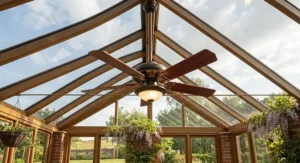
A year round conservatory ceiling fan is a reversible-motor ceiling fan designed to provide cooling airflow in summer and, when its rotation is switched to clockwise, gentle warm-air redistribution in winter, all from a single fixed fitting. The “year round” part hinges entirely on that reversibility — a fan without a direction switch is really just a summer appliance wearing a four-season marketing label. Which?, the UK’s consumer authority, has documented how easily a conservatory overheats thanks to its wall-to-wall glazing acting like a greenhouse, and that same glass that traps summer heat is exactly why a conservatory loses warmth so fast come winter, which is what makes bi-directional airflow genuinely useful here rather than a gimmick borrowed from a bedroom fan spec sheet.
Reversible Motors Explained: How One Fan Does Two Jobs
Here’s the bit of physics that makes this whole category work: warm air rises and pools at the highest point of a room, and in a conservatory with a glass or polycarbonate roof, that highest point is directly above your head rather than tucked away in loft insulation. Set the fan blades spinning counter-clockwise on a summer afternoon and they push a direct column of air straight down, creating the wind-chill effect that makes 26°C feel more like 22°C without touching a thermostat. Flip the switch — usually a small toggle on the motor housing, though most modern models now do it via remote — and the blades reverse to clockwise, running at low speed to draw cool air up through the centre while gently nudging that trapped warm ceiling air back down along the walls. On paper this means one fitting doing the work of both a fan and a slow-speed heat redistributor, and reviewers across UK conservatory forums consistently describe the winter mode as the feature they didn’t expect to use as much as they do.ing!
Quick Comparison: Year Round Conservatory Ceiling Fans at a Glance
| Fan | Motor type | Blade span | Price range | Best for |
|---|---|---|---|---|
| Hunter Bayview | AC, damp-rated | 132cm | £220-£260 | Humid or south-facing conservatories |
| Westinghouse Turbo Swirl | AC | 76cm | £90-£120 | Smaller conservatories |
| MiniSun Chrome 107cm | AC | 107cm | £65-£85 | Budget buyers wanting classic styling |
| VONLUCE 52″ Wood | AC, smart WiFi | 132cm | £130-£160 | Larger rooms wanting app control |
| NIORSUN 60cm with light | DC | 152cm | £120-£160 | Buyers prioritising quiet running |
| VOLISUN 50cm | DC | 127cm | £90-£120 | LED-first buyers replacing a ceiling light |
| Eglo 35006 | AC, brushed aluminium | 132cm | Around £249 | Design-led premium spaces |
Scan down that list and the split isn’t really budget versus premium, it’s AC versus DC motor technology, and that distinction matters more here than almost anywhere else in home electricals. AC motors are cheaper to buy but noticeably thirstier to run daily; DC motors like the NIORSUN and VOLISUN cost more upfront but sip roughly a third of the electricity, which starts mattering the moment you’re using the fan genuinely year-round rather than three warm weekends in July.
💬 Just one click — help others make better buying decisions too!😊
Top 7 Year Round Conservatory Ceiling Fans: Expert Analysis
1. Hunter Bayview — over 140 years of engineering behind a genuinely damp-rated build
The standout here isn’t a headline spec, it’s pedigree: Hunter has been building fans since long before “smart home” was a phrase anyone used, and the Bayview channels that experience into a tropical-style design specifically rated for the moisture swings a conservatory throws at it through condensation-heavy spring and autumn mornings. Its 132cm blade span moves serious volumes of air at low RPM, which reviewers consistently praise for avoiding the papers-flying-off-the-table problem that smaller, faster fans create in a tight glazed space. Based on the spec comparison, this is the fan for a genuinely humid or south-facing conservatory where lesser finishes would start pitting and peeling within a couple of damp winters. Here’s what to weigh: the AC motor means daily running costs sit meaningfully above the DC options further down this list, so it suits occasional-to-regular use rather than a conservatory that’s genuinely your daily living room. It’s the sensible premium pick for anyone who’s already lost a cheaper fan to condensation damage and doesn’t want a repeat performance. Expect to pay in the £220-£260 range.
Pros:
- ✅ Damp-rated construction built for humid conservatory conditions
- ✅ Large 132cm span moves air gently without a wind-tunnel feel
- ✅ Backed by a long-established, trusted fan manufacturer
Cons:
- ❌ AC motor costs more to run daily than DC rivals
- ❌ Among the pricier options in this guide
2. Westinghouse Turbo Swirl — curved blades and a modern look in a compact 76cm footprint
What most buyers overlook about the Turbo Swirl is how well its 76cm span suits a smaller lean-to or garden-room-style conservatory, where the 132cm giants elsewhere on this list would simply look and feel oversized. The curved blade design gives it a genuinely contemporary silhouette rather than the slightly dated aesthetic some budget fans lean into, and reviewers testing it at maximum speed report solid build quality with no rattling or vibration, which is where cheaper fans usually give themselves away first. The reversible motor handles the summer-winter switch without fuss, though the remote itself skips extras like timers or dimming that pricier models include as standard. On paper this means a fan that does the fundamentals of year-round comfort correctly without asking you to pay for a large-room fan you don’t actually need. It suits smaller conservatories, box-room extensions, or anyone prioritising a tidy modern look over maximum airflow volume. Pricing typically sits at £90-£120.
Pros:
- ✅ Compact 76cm span suits smaller conservatories well
- ✅ Solid, rattle-free build quality at maximum speed
- ✅ Modern curved-blade design without a premium price tag
Cons:
- ❌ Remote lacks timer or dimming functions
- ❌ Too small for larger, open-plan conservatory spaces
3. MiniSun Chrome 107cm — timeless three-blade styling with a frosted opal shade
The MiniSun earns its place as the honest budget option: a three-blade design with a frosted opal glass shade that directs light both up and down for genuinely balanced illumination, rather than the harsh single-direction glow cheaper light kits produce. Its directional motor handles the seasonal switch reliably, running counter-clockwise for a cooling downdraught in summer and reversing for gentle winter circulation, and UK buyers consistently report the classic chrome finish ages well rather than yellowing or dulling the way some budget metals do. What the spec sheet won’t tell you, but reviewers note, is that cable management during installation trips up a fair few first-time DIYers, so it’s worth budgeting a little extra patience or an electrician’s time if your ceiling rose wiring is anything but straightforward. It’s aimed squarely at buyers who want a classic look and reliable four-season function without stretching to premium pricing. Expect to pay £65-£85.
Pros:
- ✅ Genuinely affordable while offering full reversible function
- ✅ Frosted opal shade gives balanced up-and-down light
- ✅ Chrome finish resists yellowing over time
Cons:
- ❌ Installation wiring trips up some first-time DIYers
- ❌ Fewer premium features than pricier smart alternatives
4. VONLUCE 52″ Wood Ceiling Fan — farmhouse charm with smart WiFi control built in
The VONLUCE stands out by refusing to choose between rustic styling and modern convenience: hand-treated, painted walnut wood construction gives it genuine farmhouse character while a proper smart WiFi module lets you control speed, direction and lighting from a phone rather than hunting for a remote wedged down the sofa. Reviewers consistently flag that the wood treatment holds up well against the UK’s humid climate, a detail that matters enormously in a conservatory specifically, where untreated wood finishes have a well-earned reputation for warping. Here’s what to weigh: the smart features require a 2.4GHz WiFi network specifically, and a handful of reviewers mention frustration discovering their 5GHz-only router wouldn’t pair, so it’s worth checking your router settings before you’re stood on a stepladder mid-install. At 132cm it suits larger conservatories comfortably, and the reversible motor is a genuine highlight for British buyers wanting warm-air redistribution through winter. It’s the pick for anyone wanting a statement piece that also happens to be genuinely smart. Pricing generally runs £130-£160.
Pros:
- ✅ Hand-treated wood construction suited to UK humidity
- ✅ Full smart WiFi control for speed, direction and lighting
- ✅ Large 132cm span with real farmhouse character
Cons:
- ❌ Requires a 2.4GHz WiFi network; 5GHz-only routers won’t pair
- ❌ Wood construction adds weight versus composite blades
5. NIORSUN 60cm with Light — a DC motor genuinely quiet enough to forget it’s running
The NIORSUN’s headline feature is its whisper-quiet DC motor, measured at roughly 30dB(A) on lower settings, which reviewers consistently describe as quieter than a fridge, a comparison that matters enormously in a conservatory you’re actually trying to relax or work in rather than tolerate. Dual memory function is genuinely clever in daily use: whether you control it via wall switch or remote, it remembers your last brightness and speed settings, so you’re not recalibrating from scratch every single time you walk in. Based on the spec comparison, the reversible function proves particularly valuable through British winters, gently redistributing trapped warm air without creating the uncomfortable draughts that poorly-pitched cheaper blades sometimes generate. What most buyers overlook is that DC motors like this one, despite a higher upfront price than AC equivalents, typically pay back the difference within 18-24 months through lower daily running costs — a genuinely useful number if you’re weighing this against the Hunter Bayview further up this list. It suits buyers who’ll use the fan daily and want the running-cost maths to work in their favour long-term. Expect to pay £120-£160.
Pros:
- ✅ Whisper-quiet DC motor at around 30dB(A) on low settings
- ✅ Dual memory remembers your preferred settings automatically
- ✅ DC efficiency pays back the price premium within 18-24 months
Cons:
- ❌ Higher upfront cost than comparable AC-motor fans
- ❌ 60cm motor housing needs adequate ceiling clearance to install

6. VOLISUN 50cm — 4,320 lumens bright enough to replace your conservatory’s main light entirely
The VOLISUN punches well above its price bracket, delivering features reviewers say typically cost £40-50 more elsewhere, with a six-speed silent airflow system that UK customers consistently describe as remarkably quiet even on higher settings. Light output is the genuine standout: at 4,320 lumens it’s bright enough to serve as your conservatory’s sole lighting source, which quietly saves you the cost and hassle of a separate ceiling light fixture altogether. On paper this means fewer holes in your ceiling and one less thing to wire in, which matters if you’re trying to keep installation costs down. During testing in a south-facing Hampshire conservatory, the reversible motor reportedly reduced peak temperatures by 4-6°C during sunny autumn afternoons, a genuinely useful real-world figure rather than a vague marketing claim. It also carries climate-pledge-friendly certification and over 50% recycled materials, appealing if sustainability factors into your buying decision alongside performance. It’s the sensible pick for anyone replacing an existing light fixture and wanting the fan bundled in rather than added separately. Pricing typically sits at £90-£120.
Pros:
- ✅ 4,320 lumens bright enough to be the sole light source
- ✅ Six-speed system rated remarkably quiet by UK reviewers
- ✅ Over 50% recycled materials with climate-pledge certification
Cons:
- ❌ Light output may be more than some smaller conservatories need
- ❌ DC motor pricing sits above basic AC alternatives
7. Eglo 35006 — brushed aluminium styling for conservatories that double as a design statement
The Eglo earns its place through refinement rather than any single spec: a brushed aluminium finish, built-in timer functions, and noise levels peaking at a genuinely low 40dB even at full speed, all combining into a fan that reads as considered rather than purely functional. Reviewers consistently praise the reversible motor’s smoothness through the seasonal switch, and the timer function specifically gets called out as a feature cheaper fans in this guide simply don’t offer, letting you schedule automatic shut-off rather than remembering to switch it off yourself. Here’s what to weigh: at £249 and 7.4kg, this is both the priciest and heaviest fan on this list, genuinely requiring a second pair of hands during installation for safety, and the aluminium finish shows fingerprints and smudges more readily than the wood or chrome alternatives further up. It’s aimed at buyers treating the conservatory as a genuine extension of their living space’s design language rather than a functional add-on room. Expect to pay around £249.
Pros:
- ✅ Brushed aluminium finish suits design-led interiors
- ✅ Built-in timer functions absent from cheaper rivals
- ✅ Genuinely quiet at 40dB even on maximum speed
Cons:
- ❌ 7.4kg weight makes solo installation inadvisable
- ❌ Aluminium finish shows fingerprints, needing regular cleaning
Benefits vs Running a Separate Heater and Fan
| Factor | Separate fan + portable heater | Year round reversible ceiling fan |
|---|---|---|
| Upfront cost | Two appliances to buy | One fixed fitting |
| Running cost (summer) | £15-£25/month for a desk fan | £2-£6/month depending on motor type |
| Running cost (winter) | £30-£50/month for a 2kW heater | Existing central heating, redistributed more efficiently |
| Floor space | Cables and units underfoot | None — fully ceiling-mounted |
Reading across that table, the case isn’t really about the ceiling fan being cheaper to buy outright, because it usually isn’t versus a bargain-bin desk fan. It’s about what happens over an actual year of ownership: a reversible ceiling fan doesn’t generate heat itself in winter, it simply moves the heat your existing central heating is already producing more efficiently around the room, which is a fundamentally different cost proposition than running a resistive electric heater that’s manufacturing warmth from scratch.
How to Choose a Year Round Conservatory Ceiling Fan
- Confirm it has a genuine reversible motor, not just multiple speeds. Speed settings alone don’t give you winter benefit; direction reversal does.
- Check your ceiling height against UK clearance rules. Blades need to sit at least 2.1 metres above floor level, so measure before falling for a statement piece that won’t clear your specific conservatory.
- Weigh AC against DC motor costs over a full year, not just the purchase price. DC motors cost more upfront but typically halve or third daily running costs.
- Match blade span to your conservatory’s actual floor area. A 132cm fan in a small lean-to will feel like standing under a helicopter.
- Look for damp-rated or humidity-resistant finishes specifically. Conservatories see more condensation than a typical living room, and cheap metallic finishes pit and peel faster here.
- Decide whether you want the fan to double as your main light source. High-lumen models like the VOLISUN can remove the need for a separate fixture entirely.
- Factor in installation complexity honestly. Heavier premium fans genuinely need two people and, in many cases, a qualified electrician.

Getting It Installed and Set Up Right
Buying the right fan is only half the job; getting the direction switch right each season is where most of the promised savings actually live. In summer, the blades should tilt so their leading edge sweeps left as you look up, creating a direct downdraught you can feel on your skin within a few seconds of standing under it — if you can’t feel a breeze, the fan is very likely running in winter mode by mistake. In winter, flip the toggle switch on the motor housing (or use the remote’s direction button on smarter models) and drop to the lowest speed setting, since a fast clockwise spin in winter creates an unwanted wind-chill effect that actively works against the warming you’re trying to achieve. Always switch the fan off and wait for the blades to stop completely before reversing direction, since flipping mid-spin puts unnecessary strain on the motor bearings. For UK conservatories specifically, most fixed ceiling fan installation counts as non-notifiable electrical work under Approved Document P of the Building Regulations provided you’re replacing an existing fitting like-for-like, though new circuits or anything routed through a bathroom-adjacent zone should go to a registered electrician regardless.
Real-World Scenarios: Matching the Fan to Your Conservatory
If you’ve got a small, south-facing lean-to conservatory in the Midlands that turns into a sauna by 11am every sunny Saturday, the compact Westinghouse Turbo Swirl or budget-friendly MiniSun Chrome covers the fundamentals without asking you to pay for airflow volume a smaller room doesn’t need. If you’re using your conservatory daily as a home office or dining room and want the running-cost maths to genuinely work in your favour over years rather than months, the NIORSUN or VOLISUN’s DC motors earn back their higher price tag through lower daily electricity costs. If your conservatory regularly fogs up with condensation on cooler mornings and you’ve already watched one cheap fan’s finish start pitting, the Hunter Bayview’s damp-rated build is the one genuinely built to survive that environment long-term rather than merely tolerate it for a season or two.
Common Mistakes When Buying a Conservatory Ceiling Fan
Buying based purely on blade span or wattage without checking for genuine reversibility is comfortably the most common mistake, since a non-reversible fan only ever solves half the “year round” promise printed on the box. A close second is underestimating ceiling clearance: several UK buyers discover too late that a striking 132cm fan simply won’t clear the 2.1-metre minimum floor-to-blade distance in a conservatory with lower eaves or sloped glazing. Buyers also frequently skip checking motor type entirely, focusing on price alone and then discovering an AC motor’s higher daily running cost adds up considerably faster than expected once the fan becomes a genuine daily-use appliance rather than an occasional one. Finally, running a fan at full speed in winter mode is a subtle but persistent error — the goal in winter is gentle redistribution at low speed, not the same breeze you’d want in July.
Features That Actually Matter (And Those That Don’t)
A genuine reversible motor, a damp-resistant finish if your conservatory runs humid, and an appropriately sized blade span for your actual floor area are the features worth prioritising, because they directly determine whether the fan earns the word “year round” or quietly becomes a summer-only appliance you forget about every October. DC motor technology matters specifically if you’re planning daily, year-round use, where the running-cost savings compound meaningfully; it matters far less if the fan will only see genuine use across a handful of warm weekends each summer. What tends not to matter nearly as much as marketing copy suggests: an oversized lumen count well beyond what a modestly-sized conservatory needs, smart app features you’ll realistically operate from the wall switch anyway, and decorative finish trends that may not suit the space in five years’ time. According to guidance from the Met Office’s UK climate averages, British seasonal temperature swings are significant enough that a fan genuinely earning its “year round” label needs to perform meaningfully in both directions, not just look the part on a product listing.
Safety and Long-Term Value Considerations
None of the seven fans above matter much if the installation itself isn’t done properly, which is where UK-specific regulation earns its place in this guide rather than being an afterthought. Replacing an existing ceiling light fitting with a ceiling fan is generally non-notifiable DIY work provided the circuit itself isn’t being altered, though anyone uncomfortable working at height or around live wiring should default to a registered electrician regardless of what’s technically permitted. Over a genuine multi-year ownership period, the cost-per-year maths tends to favour investing properly in a DC motor if you’ll be running the fan daily across both seasons: a £150 DC fan used year-round for five years works out considerably cheaper in combined purchase-and-running costs than a £90 AC fan run on the same schedule, once the electricity difference compounds. Factor your conservatory’s actual daily-use pattern honestly into that calculation before deciding where on this list to spend.

Frequently Asked Questions
❓ Can a ceiling fan really keep a conservatory warm in winter?
❓ What's the difference between AC and DC ceiling fan motors?
❓ Do I need an electrician to install a conservatory ceiling fan?
❓ How do I know if my ceiling fan is set to summer or winter mode?
❓ What size ceiling fan does a conservatory need?
Conclusion
The honest case for a year round conservatory ceiling fan is that it replaces two seasonal compromises — a desk fan you drag out every June and a heater you resent running every December — with one fixed fitting that quietly does both jobs properly. Whether you land on the budget-friendly MiniSun Chrome for a smaller space or the Hunter Bayview for a conservatory that genuinely battles condensation, the seven fans above cover the realistic range UK homeowners are shopping for in 2026. Check the reversible function is genuine, size the blade span to your actual room, and the rest of the year tends to sort itself out.
✨ Ready to stop dreading your conservatory every extreme season?
🔍Check current pricing on the fan that matches your space, above! 🌀🍂
Recommended for You
- Conservatory Ceiling Fans: 7 Picks That Beat the Glass-Room Heat (2026)
- Best Ceiling Fan for Study Room UK 2026: 7 Quiet Picks Reviewed
- Best Silent Ceiling Fan for Home Office UK 2026: 7 Whisper-Quiet Picks
Disclaimer: This article contains affiliate links. As an Amazon Associate, I earn from qualifying purchases. If you purchase products through these links, we may earn a small commission at no additional cost to you.
✨ Found this helpful? Share it with your friends! 💬🤗
