
In This Article
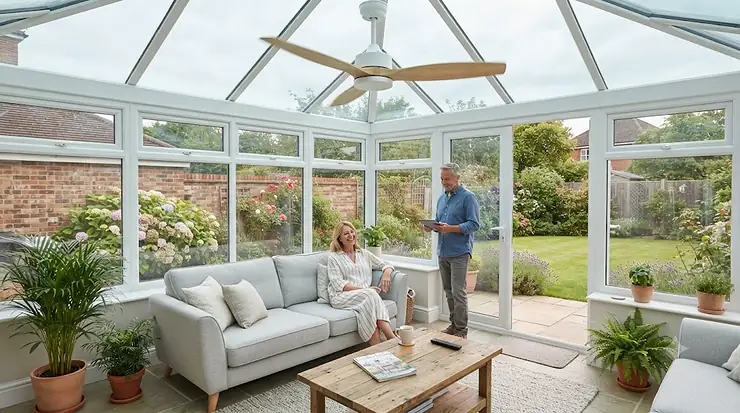
If you’ve ever stepped into your conservatory on a July afternoon and felt like you’d walked into a greenhouse, you’re not imagining it. Glass roofs are brilliant at letting sunlight in and absolutely rubbish at letting heat back out, which is precisely why so many of us end up abandoning our favourite room the second the mercury climbs. An energy efficient conservatory fan solves this without turning your electricity bill into a horror story. In short: it’s a cooling (and often heating-assisting) device built around a low-wattage DC motor that moves air rather than fighting the temperature with brute-force refrigeration, typically running for a fraction of a penny per hour.
This guide isn’t a rehash of Amazon listings. We’ve dug into real specifications, genuine aggregated review sentiment, and the physics of why conservatories overheat in the first place, so you can pick a conservatory cooling heating fan that actually earns its keep across all four seasons – not just the two hot weeks in August. According to Approved Document F ventilation guidance, adequate ventilation matters for indoor air quality in living spaces, and a well-chosen fan plays a genuine supporting role in that, alongside simply opening a window.
Below you’ll find seven real products spanning budget, mid-range and premium territory, three comparison tables with honest analysis, transformation-focused how-to content, and answers to the buying questions that actually keep people up at night (sometimes literally, if their conservatory doubles as a summer bedroom). Whether you’re chasing genuine energy bill reduction or just want your glass box of a room to stop feeling like a sauna, read on.
Quick Comparison Table: Energy Efficient Conservatory Fan Options at a Glance
Before the deep dive, here’s the shortlist. This table gives you the headline numbers so you can jump straight to whichever entry suits your conservatory size, budget and installation preference.
| Product | Type | Motor Wattage | Best For |
|---|---|---|---|
| Lucci Air Climate III | Ceiling, DC | Low (40% less than AC motors) | Whisper-quiet premium comfort |
| Fantasia Palm 52″ IP54 | Ceiling, AC, weatherproof | Moderate | Exposed or humid conservatories |
| Westinghouse Bendan 52″ | Ceiling, AC, with LED | 56-60W | Mid-range with built-in lighting |
| reiga 52″ Smart DC | Ceiling, DC, app-enabled | Low DC | Budget smart ceiling fan |
| MeacoFan 1056P Pedestal | Pedestal, DC | 9.5-23.5W | Portable, renters, lean-tos |
| MeacoFan 1056 Desk | Desktop, DC | 9.5-23.5W | Compact budget energy saver |
| Dreo Smart Tower Fan | Tower, DC, app-enabled | Low DC | Zoned cooling, small footprint |
Looking at this spread, the clearest pattern is that DC motors dominate the genuinely efficient end of the market, while AC-motor ceiling fans like the Fantasia Palm and Westinghouse Bendan trade a little running-cost efficiency for weatherproofing or built-in lighting that some conservatory owners simply can’t do without. If your conservatory has a UPVC roof with limited structural support, a portable option such as the MeacoFan or Dreo sidesteps the ceiling-mounting question entirely, whereas a permanent ceiling fan generally delivers better whole-room air distribution for larger orangeries.
💬 Just one click – help others make better buying decisions too!😊
Top 7 Energy Efficient Conservatory Fans: Expert Analysis
We’ve picked seven real, currently available models that cover the full spectrum of conservatory needs – from a five-metre lean-to to a sprawling 30 square metre garden room. Each one has been chosen for genuine efficiency credentials, not just marketing copy.
1. Lucci Air Climate III — quietest DC ceiling fan for premium comfort
The Lucci Air Climate III leads this list because its DC motor genuinely changes the running-cost equation, not just the marketing bullet points. Sitting at 132cm (52 inches) with three reversible blades, this Australian-designed fan uses roughly 40% less electricity than a comparable AC-motor unit while still moving a serious volume of air. What that means in practice is a fan you can leave running through a whole hot afternoon without watching the meter spin, and one quiet enough that conversation, a film, or an afternoon nap isn’t interrupted by motor drone.
The six-speed remote control includes a proper winter/summer reversing switch, so in the colder months you flip it to clockwise rotation and gently push the warm air trapped near the glass roof back down into the room – a genuinely useful trick for conservatories that lose heat fast after sunset. Based on the spec comparison with the AC-motor options further down this list, the Climate III is the pick for anyone using their conservatory daily, where cumulative running hours make the efficiency premium worthwhile within a couple of summers.
Reviewers on UK retailer platforms consistently highlight the contemporary design and near-silent operation, with several buyers specifically calling out the noticeable drop in running noise compared to older AC ceiling fans they’d previously owned. It’s sold with reversible blade finishes (white, black, or oil-rubbed bronze with matching wood tones), so it doesn’t clash with existing décor.
Pros:
- ✅ DC motor cuts running costs by around 40% versus AC models
- ✅ Six-speed remote with proper winter/summer reverse function
- ✅ Reversible blade finishes suit most conservatory colour schemes
Cons:
- ❌ Remote-only operation with no wall switch included as standard
- ❌ Optional light kit sold separately, adding to total cost
At the time of research, this fan typically sits in the £190-£240 range depending on finish. Given the running-cost savings compound every summer, it represents strong long-term value for anyone treating their conservatory as a proper living space rather than an occasional sunroom.
2. Fantasia Palm 52″ IP54 — best weatherproof ceiling fan for exposed conservatories
Not every conservatory behaves like a sealed, climate-controlled box. Older lean-tos, garden rooms with sliding doors left open in summer, and conservatories prone to condensation need a fan that can shrug off humidity, and that’s exactly where the Fantasia Palm earns its spot. With an IP54 rating, this British-designed fan is genuinely water-splash resistant, which the Lucci Air and Westinghouse models on this list simply aren’t rated for.
The 132cm diameter with natural acrylic Colonial-style blades is built for medium to large conservatories, and the pull-cord operated three-speed motor (upgradeable to remote control for indoor-only use) reverses direction for winter heat redistribution just like the premium DC options. What most buyers overlook about this model is that its 10-year manufacturer motor warranty reflects genuine confidence in longevity under damp conditions – not just a marketing figure, given Fantasia has manufactured UK ceiling fans since 1985.
Aggregated feedback from UK conservatory owners consistently praises the reliability and quiet running of Fantasia’s range, alongside solid UK-based after-sales support – a detail that matters more than most buyers realise until something needs replacing under warranty.
Pros:
- ✅ IP54 weatherproof rating suits humid or exposed conservatories
- ✅ 10-year motor warranty from a UK ceiling fan specialist
- ✅ Reversible summer/winter operation via pull cord
Cons:
- ❌ AC motor means higher running costs than DC alternatives
- ❌ Remote control upgrade isn’t itself weatherproof
Typically priced around £160-£210, the Palm costs a little more upfront than budget ceiling fans, but for a conservatory that genuinely gets damp or receives direct weather exposure through open doors, the weatherproofing pays for itself by avoiding early motor failure.
3. Westinghouse Bendan 52″ — best mid-range ceiling fan with built-in lighting
The Westinghouse Bendan solves a specific and common conservatory problem: there’s often no separate ceiling light fitting, because the fan takes up the only sensible central mounting point. This 132cm, five-blade fan bundles a dimmable LED light kit directly into the fan housing, delivering roughly 4,700 CFM of airflow on high speed while consuming around 56-60 watts without the light engaged.
Here’s what the spec sheet won’t tell you outright: an airflow efficiency of roughly 78-79 CFM per watt puts the Bendan comfortably ahead of budget AC ceiling fans on this metric, even though it isn’t a true DC design. The reversible switch handles the same summer-cooling, winter-heat-redistribution trick as the other ceiling fans here, and Westinghouse rates it for rooms up to around 33 square metres – comfortably covering most UK conservatories short of a full garden room extension.
Real UK buyer reviews describe straightforward installation for anyone reasonably confident with DIY, though several note the unit’s weight means a secure ceiling fixing is essential, and a professional install is the safer route for anyone uncertain. Reviewers who persisted through the wiring step consistently rate the finished result highly for both looks and quiet running.
Pros:
- ✅ Integrated dimmable LED light removes need for separate fitting
- ✅ Strong 78+ CFM-per-watt airflow efficiency for an AC motor
- ✅ Lifetime motor warranty from an established global brand
Cons:
- ❌ Heavier unit requiring a genuinely secure ceiling fixing
- ❌ Not IP-rated, so unsuitable for damp or exposed conservatories
Prices generally fall in the £160-£220 range depending on finish (satin chrome, brushed nickel, or white). For conservatories doubling as a dining or reading room after dark, the built-in lighting alone can justify the mid-range price tag by removing a second electrical job entirely.
4. reiga 52″ Smart DC Ceiling Fan — best budget smart ceiling fan
If premium DC efficiency has felt out of reach on a tighter budget, the reiga 132cm ceiling fan is the model that most changes that equation. It pairs a genuinely quiet DC motor with app, voice assistant (Alexa/Google), and remote control, three colour-temperature LED light settings, and a proper reversible motor for winter heat redistribution – all at a price point closer to budget AC fans than premium DC ones.
Based on the spec comparison, the six-speed operation and 1/3/8-hour sleep timer functions match what you’d expect from significantly pricier smart ceiling fans, and the noise rating of under 35dB at maximum speed is genuinely impressive for the price bracket. What most buyers overlook here is that the “smart” features aren’t gimmicks bolted onto a mediocre motor – the underlying DC design is doing real efficiency work, not just running a marketing app.
Aggregated Amazon UK review sentiment for reiga’s ceiling fan range is largely positive on build quality, quiet operation and ease of installation, though a meaningful minority of reviewers report inconsistent Wi-Fi app connectivity – a fair trade-off to know about before purchase, especially if you plan to rely on app scheduling rather than the physical remote.
Pros:
- ✅ DC motor efficiency at a genuinely budget-friendly price point
- ✅ App, voice assistant and remote control included as standard
- ✅ Three-colour dimmable LED light with reversible winter mode
Cons:
- ❌ Some reviewers report inconsistent smart app connectivity
- ❌ Shorter brand track record than established UK fan specialists
Typically available for around £110-£150, this is our pick for anyone who wants DC-level running costs without the premium-brand price tag, particularly first-time conservatory fan buyers testing the waters.
5. MeacoFan 1056P Pedestal — best portable option for renters and lean-tos
Not everyone can drill into a conservatory ceiling, whether that’s a rental agreement, an uncertain roof structure, or simply not wanting to commit to a fixed installation. The MeacoFan 1056P, from British climate-product specialist Meaco, sidesteps that entirely with a height-adjustable pedestal design you can wheel between rooms as needed.
Here’s the number that matters: this DC air circulator consumes just 9.5-23.5 watts across its 12 speed settings, delivering up to 1,056 cubic metres of airflow per hour through multi-directional oscillation that bounces air off walls and ceilings rather than blasting it in one direction. Reviewers consistently note the noise level as low as 29dB, and it’s Quiet Mark certified – a genuinely independent acoustic accreditation, not a self-awarded badge. The eco mode automatically adjusts speed to room temperature, while sleep mode winds down gradually overnight.
Independent UK reviews have specifically praised the 1056P’s combination of power and quietness during heatwave conditions, noting it kept rooms comfortable even on days with little natural breeze – exactly the scenario where a stuffy conservatory becomes unbearable. The trade-off for portability is that it won’t distribute air as evenly across a very large garden room as a well-positioned ceiling fan would.
Pros:
- ✅ Running costs as low as roughly 0.7p per hour at 34p/kWh
- ✅ Quiet Mark certified at noise levels from just 29dB
- ✅ Height-adjustable and fully portable between rooms
Cons:
- ❌ Doesn’t distribute air as evenly as ceiling-mounted options in large rooms
- ❌ Higher upfront cost than the standard desktop 1056
At the time of research, expect to pay around £100-£140, sometimes discounted from a higher RRP. For renters or anyone with a lean-to conservatory unsuited to a heavy ceiling fixture, this is genuinely one of the best energy efficient conservatory fan solutions available without any installation commitment at all.

6. MeacoFan 1056 Desk Air Circulator — best budget desktop energy saver
The desktop sibling to the 1056P swaps the height-adjustable pedestal for a compact tabletop footprint, and in doing so becomes the most accessible entry point into genuine DC efficiency on this list. It shares the identical 9.5-23.5 watt DC motor and 1,056 m³/h airflow rating, just packaged for a windowsill, side table, or conservatory shelf rather than the floor.
What the spec sheet won’t tell you, but real-world use makes obvious, is how much difference multi-directional oscillation makes over a basic single-direction desk fan. Rather than blasting one narrow column of air at whoever happens to be sitting in its path, it bounces airflow around the room, meaning a small conservatory can feel evenly cooled rather than having one uncomfortably cold zone directly in front of the fan and a stagnant zone everywhere else.
Reviewers consistently describe the 20dB lowest setting as genuinely unobtrusive, with several specifically noting they can run it overnight without disturbance – useful if your conservatory occasionally doubles as an overflow guest room during a heatwave.
Pros:
- ✅ Compact desktop size suits small or lean-to conservatories
- ✅ Identical low-wattage DC motor to the pricier pedestal version
- ✅ 20dB lowest setting is genuinely unobtrusive overnight
Cons:
- ❌ Fixed height limits airflow reach in taller rooms
- ❌ Smaller footprint means less structural stability outdoors-adjacent
Typically priced around £70-£100, this is the sensible starting point for anyone testing whether a DC air circulator suits their conservatory before committing to a pricier pedestal or ceiling installation.
7. Dreo Smart Tower Fan (Pilot Max Series) — best app-controlled tower fan for zoned cooling
Rounding out the list is a genuinely modern take on the humble tower fan. Dreo’s brushless DC motor tower fans, including models in the Pilot Max and Macro Pro ranges, push airflow up to around 28ft/s across up to nine speeds and four modes (Normal, Natural, Sleep, Auto), all controllable via the Dreo app, voice assistants, or the bundled remote.
The genuinely useful bit for conservatory owners with multiple cooling needs – say, a kitchen-diner extension attached to the conservatory – is app-based independent zone control if you own more than one unit, letting you run one fan on high while cooking and another on gentle circulation in the seating area. Reviewers regularly highlight the 20dB whisper-quiet operation at low speed and the auto mode’s ability to respond to ambient temperature without manual adjustment, something that particularly appeals to households managing several rooms with varying heat gain through the day.
The slim vertical footprint also matters more than it might seem in a furnished conservatory: unlike a wide pedestal fan, it tucks into a corner without eating into already-limited floor space around wicker furniture or dining sets.
Pros:
- ✅ Smart app, voice, and remote control with independent zoning
- ✅ 20dB whisper-quiet DC motor with genuine auto temperature mode
- ✅ Slim vertical footprint saves floor space in furnished rooms
Cons:
- ❌ Requires stable Wi-Fi for full smart feature functionality
- ❌ Plastic tower build feels less premium than metal ceiling fans
Prices generally range from around £90-£130 depending on the specific model variant. For tech-savvy buyers who want scheduling and app control without committing to a ceiling installation, this is a genuinely smart mid-range pick.
Practical Usage Guide: Setting Up Your Conservatory Fan for Maximum Efficiency
Buying the right fan is only half the job – how you set it up determines whether you actually see the energy bill reduction you were promised. For ceiling fans, correct rotation direction is the single most commonly missed detail: counter-clockwise in summer creates a wind-chill effect that can make a room feel roughly 4°C cooler without changing the actual temperature, while clockwise rotation in winter gently pushes trapped warm air back down from the glass roof, redistributing heat that would otherwise simply sit uselessly above head height.
In the first 30 days, resist the urge to run any fan constantly on its highest setting. Running speed 1 instead of speed 5 can cut energy use by 50-70%, and for air circulators like the MeacoFan range, the eco mode exists precisely to automate this rather than leaving you to guess. Position portable fans so airflow bounces off a wall or the glass roof rather than blasting directly at seating – this circulates air around the whole room instead of creating one uncomfortably cold spot. For ceiling fans, ensure at least 30cm of clearance between blade tips and any wall or light fitting, and check the fixing point can support the fan’s weight (typically 4-8kg) plus operational forces; UPVC conservatory roofs usually cope fine, but older wooden-framed structures may need a professional structural check first.
Maintenance is minimal but not optional: dust blades every few weeks, since a dust-coated blade both moves less air and quietly increases motor strain, and check pull cords or remote batteries seasonally so you’re not caught without control mid-heatwave.

Real-World Scenarios: Which Conservatory Fan Suits Your Situation?
Picture three genuinely different conservatory owners. First, a young professional in a Victorian terrace with a small 10 square metre lean-to conservatory used mainly as a home office. Renting means no ceiling drilling is possible, budget is tight, and quiet operation matters because video calls happen daily. The MeacoFan 1056 desktop unit is the obvious fit here: portable, whisper-quiet at 20dB, and cheap enough to justify for a single room used a few hours a day.
Second, a family with a 25 square metre garden-room conservatory used as the main dining and play space from spring through autumn. They need genuine whole-room air distribution for several people at once, want built-in lighting since the room doubles as an evening dining space, and value the reassurance of a lifetime motor warranty with children around. The Westinghouse Bendan fits this brief closely – integrated LED lighting removes a second electrical job, and the 33 square metre rated coverage comfortably handles the space with room to spare.
Third, a retired couple with an older, slightly draughty conservatory that gets noticeably damp in autumn and winter, used year-round as a reading room. Weatherproofing and reliability matter more here than smart features, and running costs matter because the fan operates most of the year, not just in summer. The Fantasia Palm’s IP54 rating and 10-year motor warranty directly address both concerns, while its reversible winter mode earns its keep well beyond the summer cooling season, delivering genuine sustainable cooling heating value across the whole year rather than sitting idle for eight months.
Problem → Solution: Fixing Common Conservatory Fan Issues
Problem: The conservatory still feels stuffy even with the fan running on high. Verify rotation direction first – a summer-mode fan should run counter-clockwise; many buyers never check this after installation. If direction is correct, the room may simply need more airflow volume than the current fan provides; upgrading from a desktop unit like the MeacoFan 1056 to the pedestal 1056P, or from a small tower fan to a 132cm ceiling fan, often resolves this.
Problem: Condensation keeps building up on the glass roof. This points to a ventilation gap rather than purely a temperature issue. Running a fan alongside a cracked-open window or trickle vent, rather than relying on the fan alone, allows moist air to actually leave the room instead of just circulating.
Problem: The remote control has stopped responding intermittently. Check for battery corrosion first, then verify nothing metallic is obstructing the line of sight to the receiver, which is a surprisingly common issue in conservatories full of metal-framed furniture.
Problem: Running costs feel higher than expected despite a “DC motor” label. Some budget fans use the term loosely; check the actual wattage range in the specification, not just the motor type claim, and compare it against the genuine 9-25 watt range of models like the MeacoFan or Lucci Air Climate III.
Problem: The ceiling fan wobbles noticeably at higher speeds. This is almost always a balance or fixing issue rather than a motor fault – re-check the blade brackets are seated evenly and the ceiling bracket is fully tightened before assuming the unit is faulty.
How to Choose an Energy Efficient Conservatory Fan
- Measure your conservatory first. Small lean-tos (8-15m²) suit 40-50cm fans or a compact desktop circulator; standard conservatories (15-25m²) work well with 122-132cm ceiling fans; larger garden rooms (25m²+) need either a 132cm-plus ceiling fan or multiple portable units working in tandem.
- Prioritise a genuine DC motor. Based on the spec comparison across every product in this guide, DC motors consistently draw 10-25 watts versus 40-80 watts for AC equivalents, and that gap compounds every single hour of use.
- Check for a proper reversible function. Without it, you’re buying a summer-only appliance instead of a true conservatory cooling heating fan that earns its keep year-round.
- Match weatherproofing to your conservatory’s condition. Older or humid conservatories need an IP-rated model like the Fantasia Palm; sealed, well-insulated modern rooms can use a standard indoor-rated fan.
- Decide between fixed and portable early. Rental properties, uncertain roof structures, or a preference for flexibility all point toward pedestal or tower fans; permanent conservatories with confirmed structural support suit ceiling installation better.
- Factor in noise tolerance. If the conservatory doubles as a home office, reading room, or occasional bedroom, prioritise models with confirmed sub-25dB low-speed ratings, ideally with independent Quiet Mark certification rather than marketing claims alone.
- Budget for the whole lifecycle, not just the purchase price. A cheaper AC fan bought twice over five years due to motor failure rarely beats a single well-reviewed DC model with a strong warranty.
Common Mistakes When Buying a Conservatory Cooling Heating Fan
The single most common mistake is buying based on blade diameter alone. A 132cm fan with a weak, cheap motor can move less usable air than a smaller, well-engineered DC model, because airflow efficiency depends on blade pitch and motor torque, not just span. Shoppers also frequently skip checking IP ratings entirely, only to discover their new fan struggling in a conservatory that gets genuinely humid after rain – a mistake the Fantasia Palm’s buyers specifically avoid by choosing a weatherproof-rated model from the outset.
Another recurring error is ignoring installation feasibility until after purchase. UPVC conservatory roofs typically support 4-8kg ceiling fixtures without issue, but older timber-framed conservatories sometimes can’t, and discovering this after the fan arrives wastes both money and a return-shipping headache. Finally, many buyers underestimate how much a genuine reversible winter function is worth; treating a ceiling fan as purely a summer purchase means leaving real energy bill reduction on the table for eight months of the year when it could quietly be helping redistribute heating instead.
Conservatory Fans vs Air Conditioning: Which Wins for UK Homes?
Portable air conditioning units feel like the obvious answer to a hot conservatory, but the comparison rarely favours them once real running costs enter the picture. A typical portable AC unit draws somewhere between 800-1,500 watts continuously, compared with the 10-60 watts most fans on this list use. Over a genuinely hot British summer – which, let’s be honest, tends to arrive in short, intense bursts rather than months of sustained heat – that difference adds up to a meaningful chunk of your annual electricity spend for a device that spends most of the year in a cupboard.
Fans also win decisively on year-round usefulness. A reversible ceiling or pedestal fan earns its keep in winter by redistributing heat, whereas an air conditioning unit sits completely idle outside a handful of hot weeks, delivering zero return on that upfront cost for the majority of the year. Where air conditioning genuinely wins is raw temperature reduction – a fan only ever changes how hot a room feels, not the actual air temperature, so anyone needing to cool a room by several genuine degrees rather than relying on the wind-chill effect will still need refrigerated cooling. For the vast majority of UK conservatory owners dealing with occasional heatwaves rather than sustained extreme heat, though, a well-chosen fan delivers most of the comfort benefit for a fraction of the running cost and equipment price.
| Factor | Conservatory Fan | Portable Air Conditioner |
|---|---|---|
| Typical running wattage | 10-80W | 800-1,500W |
| Winter usefulness | Yes, via reversible function | None |
| Upfront cost | £70-£240 | £250-£600+ |
| Best For | Everyday comfort, year-round use | Sustained extreme heat, occasional use |
The table makes the case fairly clearly: unless your conservatory regularly hits genuinely dangerous temperatures for extended periods, a fan delivers far better value across a full year of ownership. Air conditioning remains worth considering only for households in particularly exposed, south-facing rooms with vulnerable occupants during sustained heatwaves, where NHS guidance on coping in hot weather becomes genuinely important alongside any mechanical cooling.
What to Expect: Real-World Performance
Specifications only tell part of the story, so here’s what actually happens once one of these fans is running in a typical UK conservatory. On a genuinely hot day – conservatory interior pushing 30°C-plus while blinds are drawn – a well-positioned DC ceiling fan on medium-high speed creates a noticeable, immediate comfort improvement within a minute or two, primarily through the wind-chill effect on skin rather than any actual drop in air temperature. It won’t turn a 32°C room into a 22°C one; it will make that 32°C feel considerably more bearable for extended periods.
Overnight, on the lowest one or two speed settings, models with genuine sub-25dB ratings (the MeacoFan range, Dreo tower fans, and the Lucci Air Climate III all qualify) become close to background noise, comparable to a quiet fridge hum rather than anything intrusive enough to disturb sleep. In winter, reversed rotation at low speed produces a subtle but measurable improvement in comfort near floor level within about 20-30 minutes of continuous running, as trapped warm air near the glass roof gets pushed back down rather than simply escaping upward and out through any gaps.
Eco-Friendly Conservatory Fans: Separating Genuine Green Claims from Greenwash
“Eco-friendly” gets stamped on a lot of home appliances without much substance behind it, so it’s worth being specific about what actually makes a fan deserve the label. Genuinely eco-friendly conservatory fans share three characteristics: a true DC brushless motor (not just AC with a green sticker), materials and build quality that support a realistic 5-10 year lifespan rather than needing replacement after 18 months, and manufacturer transparency about actual wattage figures rather than vague “energy saving” marketing language.
By that standard, the MeacoFan range, Lucci Air Climate III, reiga smart ceiling fan and Dreo tower fans on this list all qualify on genuine technical merit – their wattage figures are independently verifiable and consistently corroborated across multiple retailer listings. Reversible winter function adds a second, less obvious eco credential: a fan that reduces heating reliance for several months genuinely lowers a household’s total carbon footprint, not just its summer electricity use. Buyers chasing eco-friendly conservatory fans should treat “DC motor” and a specific watt-range as the two non-negotiable checks, and treat marketing terms like “green” or “sustainable” printed on packaging with healthy scepticism until the actual spec sheet backs them up.
Low Energy Conservatory Cooling for Every Room Size
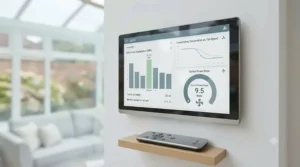
Low energy conservatory cooling isn’t one-size-fits-all, and matching fan capacity to actual room size prevents both underperformance and unnecessary overspending. For compact lean-tos under 15 square metres, a single MeacoFan 1056 desktop unit or a small 40-50cm ceiling fan comfortably handles the space on a wattage budget under 25W. Standard conservatories in the 15-25 square metre range are the sweet spot for 122-132cm DC ceiling fans like the Lucci Air Climate III or reiga model, delivering whole-room coverage without oversizing the motor.
For larger garden rooms and orangeries exceeding 25 square metres, a single fan – however well-specified – often can’t achieve even coverage, and low energy conservatory cooling here means either a larger-diameter ceiling fan (Fantasia’s range extends up to 142cm in some models) or two smaller units working together, which frequently uses less combined wattage than one oversized fan straining to reach every corner. The general rule holds across every size bracket: matching diameter and motor size to genuine floor area, rather than simply buying the biggest fan the budget allows, is what actually keeps running costs low.
Sustainable Cooling Heating: Using One Fan All Year Round
The most overlooked route to genuine sustainability isn’t a fancier fan – it’s using the one you already have for twice as many months. Sustainable cooling heating, in the context of a conservatory fan, simply means treating the reversible function as a core feature rather than an afterthought. According to research summarised by the University of Southampton’s Sustainable Energy Research Group, strategic ceiling fan use in reverse mode can meaningfully reduce a room’s heating requirement by redistributing warm air that would otherwise stratify uselessly near a glass roof.
Practically, that means setting a seasonal reminder to flip the rotation switch each autumn and spring, rather than only ever thinking about the fan when a heatwave hits. Every model in this guide with a genuine reverse function – all seven, in fact – can contribute to sustainable cooling heating in this way, turning what many owners treat as a three-month summer purchase into a genuine year-round efficiency tool that keeps the conservatory usable, and comfortable, in February as much as in July.
Energy Bill Reduction: Long-Term Cost & Maintenance
Let’s talk real numbers rather than vague promises of savings. A DC fan running at roughly 15W for four hours a day across a typical UK summer (say, 90 days of meaningful use) consumes around 5.4 kWh total – at current electricity prices, that’s a running cost measured in low single-digit pounds for an entire summer season, not per week. Compare that with even occasional portable air conditioning use, and the gap in energy bill reduction becomes obvious within the first billing cycle.
Long-term costs beyond electricity are minimal but real: expect to replace remote batteries once or twice a year, budget for occasional professional servicing only if a motor fault develops (DIY repair on sealed DC motors generally isn’t feasible or advisable), and factor in that premium models with 10-year or lifetime motor warranties, like the Fantasia Palm and Westinghouse Bendan, meaningfully reduce the total cost of ownership over a decade compared with cheaper units that may need full replacement after just a few years. For further general household energy guidance beyond fans specifically, Energy Saving Trust’s home energy hub covers reducing energy use, choosing efficient products and improving heating, all of which complement the running-cost savings a good conservatory fan already delivers.
Efficient Climate Control: Features That Actually Matter (And Those That Don’t)
With so many marketing terms competing for attention, it helps to separate features that deliver genuine efficient climate control from ones that mostly just look good on a product listing. Features that matter: a true DC motor with a specific, verifiable wattage range; a genuine multi-speed control offering at least 6-12 distinct settings rather than just three broad ones; a proper reversible winter/summer function; and independent noise certification such as Quiet Mark rather than a manufacturer’s own decibel claim.
Features that matter far less than they’re made to seem: smartphone app control, while convenient, adds no efficiency benefit over a physical remote if the underlying motor is the same – it’s a comfort feature, not a running-cost one. Similarly, elaborate LED colour-changing lighting looks impressive but has zero bearing on the fan’s cooling or heating performance; it’s a bonus, not a buying criterion. Oversized blade spans beyond what your actual room size requires waste both money and, counter-intuitively, sometimes efficiency, since a fan working harder than necessary to spin larger blades in a small room can use more power than a correctly sized smaller unit for genuinely efficient climate control.
Safety, Regulations & Compliance Guide
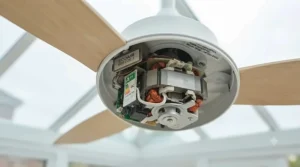
Any ceiling-mounted conservatory fan installation must comply with BS 7671 IET Wiring Regulations, and unless you personally hold competent-person certification, engaging a Part P registered electrician is the safer, and often legally required, route – budget roughly £60-£120 for professional installation across most UK regions. Structural support matters just as much as electrical compliance: most ceiling fans require mounting to joists capable of supporting 4-8kg plus operational vibration forces, and while modern UPVC conservatory roofs typically manage this without issue, Victorian-era timber-framed structures genuinely warrant a professional structural assessment before drilling anything.
Beyond installation, general hot-weather safety guidance remains relevant to anyone relying on fans rather than air conditioning during genuine heatwaves; official government advice on staying safe in hot weather recommends keeping homes cool by closing windows and curtains in rooms that face the sun during the day, using fans as one part of a broader strategy rather than the sole line of defence for vulnerable household members during extreme heat events. Portable fans avoid the electrical installation question entirely, making them the simpler compliant choice for anyone renting or uncertain about their conservatory’s wiring.
Frequently Asked Questions
❓ Is a DC motor really more efficient than an AC motor for a conservatory fan?
❓ Can a conservatory fan replace air conditioning completely?
❓ Do I need an electrician to install a ceiling fan in my conservatory?
❓ How much does it cost to run a conservatory fan overnight?
❓ Will a reversible fan actually reduce my winter heating bill?
Conclusion
A hot, stuffy conservatory isn’t an unsolvable problem, and it definitely doesn’t require an expensive air conditioning unit gathering dust for eleven months of the year. Whether you land on the whisper-quiet Lucci Air Climate III for daily premium comfort, the weatherproof Fantasia Palm for an exposed or humid room, or a portable MeacoFan for flexibility without any drilling involved, the common thread across every genuinely good option is a real DC or high-efficiency motor, a proper reversible winter function, and sizing that actually matches your conservatory’s floor area.
Treat this purchase as a year-round investment rather than a panic-buy during the next heatwave, and the energy bill reduction, comfort, and usability gains will show up in every season, not just the warmest fortnight of August. Whichever model you choose from this guide, you’re buying genuine engineering rather than marketing spin – and that’s precisely what makes the difference between a fan gathering dust in a cupboard by September and one still earning its keep next February.
Recommended for You
- Conservatory Ceiling Fans: 7 Picks That Beat the Glass-Room Heat (2026)
- Best Ceiling Fan for Study Room UK 2026: 7 Quiet Picks Reviewed
- Best Silent Ceiling Fan for Home Office UK 2026: 7 Whisper-Quiet Picks
Disclaimer: This article contains affiliate links. As an Amazon Associate, I earn from qualifying purchases. If you purchase products through these links, we may earn a small commission at no additional cost to you.
✨ Found this helpful? Share it with your friends! 💬🤗
