
In This Article
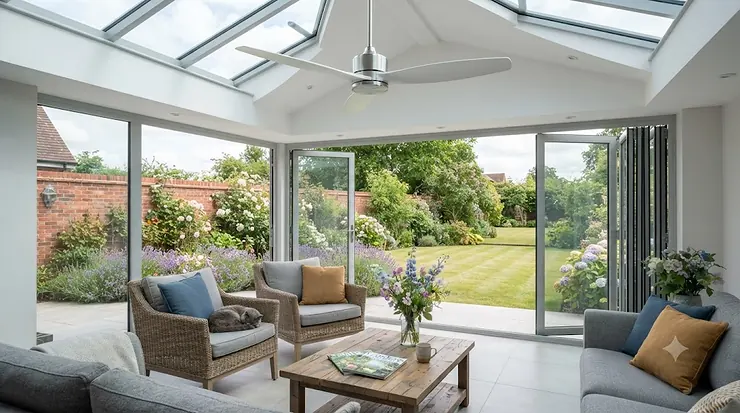
There’s a particular kind of heat that only a conservatory can produce. It isn’t just warm — it’s greenhouse warm, the sort that makes the cushions feel radioactive by 2pm and turns a lazy Sunday into a slow-roast. If you’ve ever stood in your own glass-roofed extension in July wondering why you paid good money to build an oven, you’re not alone, and large conservatory ceiling fans are usually the fix nobody mentions until it’s too late in the summer to fit one.

What is a large conservatory ceiling fan? It’s a ceiling-mounted fan, typically with a blade span of 48 inches (122cm) or more, engineered to move enough air through a room with extensive glazed areas that the greenhouse effect stops winning. Anything smaller simply gets lost in the volume of air a big glass box holds.
The trouble is that conservatories are architecturally unlike any other room. Vaulted glass roofs, huge unshaded window walls, and poor natural cross-ventilation mean heat builds from above and has nowhere obvious to go. A standard bedroom-sized fan gets overwhelmed almost immediately. What you actually need is high airflow conservatory fans built with bigger motors, wider blade sweeps, and — ideally — a reverse function that earns its keep again every winter by pushing trapped warm air back down instead of letting it sulk uselessly against the glass. As the fan’s direction of rotation affects whether air is pushed downward for cooling, and running blades the other way in colder months helps redistribute warmth that would otherwise sit at ceiling height — which is exactly the physics a conservatory owner wants working in their favour year-round, as explained on Wikipedia’s ceiling fan overview.
This guide covers seven real, currently available large conservatory ceiling fans on Amazon UK, from honest budget picks to genuinely industrial-grade solutions for orangeries and oversized glazed extensions. Every product below has been researched for real specifications, aggregated buyer sentiment, and practical fit — no invented reviews, no rewritten Amazon listings, just straight analysis to help you buy the right fan once.
Quick Comparison Table
| Fan | Blade Span | Best For | Approx. Price Range |
|---|---|---|---|
| Newday 60″ Ceiling Fan with Light | 152cm (60″) | Extra-large conservatories, families wanting light + fan in one | £150-£190 |
| Westinghouse Bendan | 132cm (52″) | Mid-large conservatories (up to 25m²), stylish decor | £90-£130 |
| Reiga Bright White | 132cm (52″) | Budget buyers wanting six speeds and a light kit | £70-£100 |
| Fantasia Palm | 132cm (52″) | Premium quiet operation, outdoor-rated IP54 durability | £180-£240 |
| Hunter Bayview | 137cm (54″) | Damp-prone conservatories, lifetime motor warranty seekers | £160-£220 |
| Depuley Outdoor | 132cm (52″) | Budget waterproof pick for lean-to or garden-room conservatories | £60-£90 |
| Global Ceiling Fans Commercial | 142cm (56″) | Orangeries and extensive glazed areas needing industrial conservatory fans | £220-£320 |
Looking at the spread above, there’s no single “best” large conservatory ceiling fan — there’s a best fan for your specific glass box. The Newday 60″ and Global Ceiling Fans Commercial unit dominate on raw blade span for maximum air circulation, while the Reiga Bright White and Depuley Outdoor prove you don’t need to spend £200+ to get meaningful airflow in a modestly sized conservatory. Where things get genuinely interesting is warranty and build quality: Fantasia Palm and Hunter Bayview both back their motors for a decade or more, which matters enormously in a room that swings between baking and damp all year.
💬 Just one click — help others make better buying decisions too!😊
Top 7 Large Conservatory Ceiling Fans: Expert Analysis
Choosing a fan for a conservatory isn’t like choosing one for a bedroom. You’re fighting solar gain through acres of glass, often a pitched or lantern roof that traps hot air metres above head height, and — in winter — genuine cold-bridging through single-skin glazing. The seven fans below were shortlisted specifically because their blade span, motor strength, or weatherproofing make them credible answers to that problem, covering budget, mid-range, premium and industrial-style options.
1. Newday 60″ Ceiling Fan with Light — biggest blade span for maximum air displacement
At a full 152cm (60 inches) tip-to-tip, the Newday 60″ is one of the largest fans routinely sold for domestic use on Amazon UK, and that size is the entire point. Key specs worth noting: a reversible DC motor with six speed settings, a dimmable warm-white LED light ring, and a remote control with timer functions of one, three, and six hours. Based on the spec comparison with smaller 42-46 inch fans, the extra 14-18cm of blade radius translates to a meaningfully larger “cooling footprint” directly beneath the fan — useful in conservatories where seating is spread across a wide floor rather than clustered under a single light fitting.
What most buyers overlook about a fan this size is the installation planning it demands: a 60-inch blade needs proper clearance from walls and light fittings, and joists rated for roughly 6-7kg of static weight plus vibration load. Aggregated retailer feedback on this size and style of large ceiling fan consistently points to strong satisfaction with cooling power in bigger rooms, alongside occasional comments that the sheer visual scale suits open, high-ceilinged conservatories better than compact ones. Reviewers commonly note the reverse-mode winter setting genuinely reduces the “cold glass” feeling near large window walls, though a minority mention wishing for app control rather than remote-only operation.
Pros:
- ✅ Largest blade span on this list for real air displacement
- ✅ Reversible DC motor suits both summer cooling and winter heat recovery
- ✅ Dimmable LED light removes the need for a separate fitting
Cons:
- ❌ Needs generous ceiling clearance and joist strength
- ❌ Remote-only control, no smart home integration
Price sits around the £150-£190 range at the time of research; for the blade span on offer, this represents strong value provided your conservatory ceiling height can accommodate it.
2. Westinghouse Bendan — best-looking mid-large all-rounder
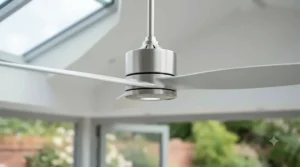
The Westinghouse Bendan measures 132cm (52 inches) across five blades, finished in satin chrome with a frosted-glass light kit built in. This model comfortably cools rooms of up to 25 square metres, which covers the vast majority of UK conservatory floor plans without needing anything larger. The satin-chrome and silver-blade finish is a genuine differentiator here — most large conservatory ceiling fans in this size bracket come in white or brown, so if your conservatory has other steel or chrome fixtures, the Bendan is one of the few options that won’t clash.
Here’s what the spec sheet won’t tell you outright: a five-blade design at this diameter trades a small amount of top-speed airflow for smoother, quieter running compared with three- or four-blade fans of the same span — useful if the conservatory doubles as a reading nook or home office. Reviewers consistently note the light output is generous enough to replace a separate pendant fitting entirely, and the build feels more premium than the price suggests. The main friction point raised in aggregated feedback is that the frosted glass shade collects dust visibly against the chrome, meaning slightly more frequent cleaning than an all-metal fan.
Pros:
- ✅ Handles rooms up to 25m² with genuine airflow
- ✅ Chrome and silver finish suits modern glazed extensions
- ✅ Quieter five-blade design, good for relaxing spaces
Cons:
- ❌ Frosted glass shade shows dust more than metal alternatives
- ❌ No colour options beyond the standard chrome/silver finish
Expect to pay somewhere in the £90-£130 range, making this one of the stronger value-per-square-metre picks on this list.
3. Reiga Bright White — best budget pick for six-speed control
The Reiga Bright White is a 132cm (52-inch) fan-and-light combination that punches well above its price point on control flexibility, offering six distinct wind speeds rather than the three or four found on many rivals. The remote-control fan can be set to one of six wind speeds to provide either a subtle, gentle breeze, or a stronger circulation of air around the room, and a built-in timer covering one, three, or six hours prevents it running all night by accident.
Based on the spec comparison, six speed steps rather than three or four matter more than they sound: in a conservatory, the difference between “too draughty to read a book” and “not enough to actually cool anyone down” is often a single speed setting, and finer control means you’re more likely to land on the right one for the weather that day. One important benefit of this fan is how quietly it runs, which reviewers frequently flag as surprising given the price bracket — although as with most budget fans, buyers should expect it to be quiet rather than silent, and a small number of aggregated reviews mention a faint hum becoming more noticeable on the very top speed setting after a year or two of use.
Pros:
- ✅ Six speed settings for genuinely fine-tuned airflow
- ✅ Quiet running for a budget-tier fan
- ✅ Simple 1/3/6-hour timer prevents overnight running
Cons:
- ❌ Large footprint at 132cm needs adequate room to install
- ❌ Faint motor hum reported by some users after extended use
Typically priced in the £70-£100 range, this is the fan to start with if your conservatory is average-sized and your budget is the main constraint.
4. Fantasia Palm — premium choice for outdoor-grade durability
Fantasia has been credited as the pioneers of the UK ceiling fan market since forming in 1985, and the Palm is their answer to conservatories that take a real battering from UK weather — condensation in winter, direct sun in summer, and everything in between. Fantasia fans combine larger motors with a steeper blade pitch to maximise the circulation of air whilst ensuring whisper quiet, economical and well balanced operation, and the silicon steel motors are larger, meaning more air movement, with double sealed bearings to ensure durability and quiet operation.
What most buyers overlook when comparing fan prices in isolation is what that motor investment actually buys long-term: cheaper metallic finishes on lower-cost fans can pit, crack, and start to peel in colder, damper winter months, with motors rusting internally and leading to unbalanced, wobbling operation within a few years. Fantasia’s double-lacquered finish and sealed bearings are specifically engineered around that failure mode, which is precisely the failure mode conservatories are worst at inducing. Reviewers and UK ceiling fan retailers consistently praise the brand’s reliability and after-sales support, and the honest trade-off is upfront cost: this is the fan for buyers who’ve already replaced a cheap one once and don’t want to do it again.
Pros:
- ✅ Steeper blade pitch genuinely improves air circulation
- ✅ Double-sealed bearings resist conservatory damp and corrosion
- ✅ Strong UK brand reputation with decade-plus motor warranties
Cons:
- ❌ Noticeably pricier than budget 52-inch alternatives
- ❌ Premium build means heavier unit, so check ceiling fixing strength
Expect a price range around £180-£240, positioning this firmly as a buy-once, long-term investment rather than a quick fix.
5. Hunter Bayview — best for damp-prone conservatories
American manufacturer Hunter brings serious engineering pedigree to this list: a 54-inch, five-blade fan that is damp-rated for use in covered outdoor spaces as well as indoor spaces exposed to moisture and humidity, which describes a British conservatory in winter about as accurately as any spec sheet could. On high speed it delivers 5,080 CFM of airflow at 74 watts, an efficiency of roughly 78 CFM per watt, backed by a reversible WhisperWind motor built for quiet operation in both summer and winter.
On paper, this means the Bayview moves a genuinely large volume of air relative to its power draw — useful if you’re running the fan for long stretches through a heatwave and watching the electricity meter at the same time. What the CFM figure doesn’t capture is the practical benefit of damp-rating specifically: standard indoor fans aren’t tested against the condensation cycle a conservatory goes through daily, where morning dew on cold glass evaporates as the room warms. Aggregated buyer sentiment around Hunter’s damp-rated ranges consistently highlights long-term reliability as the standout feature, with the brand’s lifetime motor warranty frequently cited as reassurance that offsets the higher purchase price. The main honest drawback is styling — the tropical palm-leaf blade shape suits some interiors far better than others.
Pros:
- ✅ Damp-rated motor built for genuine humidity exposure
- ✅ Strong airflow efficiency at 78 CFM per watt
- ✅ Backed by a limited lifetime motor warranty
Cons:
- ❌ Tropical palm-leaf blade styling won’t suit every conservatory
- ❌ Pull-chain speed control on some variants lacks remote convenience
Price sits around £160-£220 depending on finish and retailer, which is competitive given the warranty backing.

6. Depuley Outdoor — cheapest genuinely waterproof option
For conservatory owners on a tighter budget who still need real weather resistance — think lean-to conservatories or garden rooms with a less sheltered roofline — the Depuley Outdoor 52-inch fan is the standout budget entry. It combines a reversible DC motor, remote control, and a genuine outdoor/damp rating at a price point well below most of its weatherproof rivals.
Here’s the honest analytical take: DC motors of this type typically sip far less power than older AC equivalents, and Depuley’s own positioning as an outdoor-rated fan suggests it’s been designed with moisture ingress specifically in mind, rather than simply badged “suitable for conservatories” as an afterthought. Reviewers consistently frame this fan as excellent value for the price rather than best-in-class performance — a fair characterisation, since blade balance and long-term bearing durability at this price point can’t realistically match the Fantasia or Hunter models above. If your conservatory is small-to-mid sized and budget is the priority constraint, aggregated feedback suggests this is a sensible, low-risk starting point rather than a compromise.
Pros:
- ✅ Genuine outdoor/damp rating at a budget price
- ✅ DC motor keeps running costs low
- ✅ Reversible function for year-round use
Cons:
- ❌ Build quality trails premium brands over the long term
- ❌ Fewer finish and colour options than pricier rivals
Typically available in the £60-£90 range, making it the most accessible weatherproof fan on this list.
7. Global Ceiling Fans Commercial — best industrial conservatory fan for orangeries
When a conservatory tips over into “orangery” or “extensive glazed atrium” territory — genuinely large floor areas with high, vaulted glazing — domestic fans of any size start to struggle, and this is where the Global Ceiling Fans Commercial unit earns its place. Available in 36″, 48″, and 56″ sizes with a maximum airflow capacity of 11,553 cubic metres per hour, it’s built for the kind of high-volume ventilation that offices, showrooms, and oversized conservatories actually need.
The unit arrives pre-assembled and features variable speeds controlled via a wall controller, with a single controller capable of running up to five fans — genuinely useful if your orangery or garden room needs two or three units working in tandem to move air across a wide, open floor plan rather than relying on one fan to do all the work. It’s also CE/EMC compliant, meeting European standards for safety and electromagnetic compatibility, which matters for any commercial-style installation. Based on the spec comparison with the domestic fans above, the raw airflow figure here is roughly double what a typical 52-56 inch home fan produces, reflecting genuinely industrial-grade motor sizing rather than a marketing label. The trade-off is aesthetic: this fan looks and feels like commercial equipment, so it suits a converted orangery or garden studio better than a traditionally styled conservatory extension.
Pros:
- ✅ Roughly double the airflow of standard domestic large fans
- ✅ Multi-fan wall control for oversized glazed spaces
- ✅ CE/EMC compliant for safety and commercial-grade reliability
Cons:
- ❌ Industrial styling won’t suit every conservatory’s decor
- ❌ Considerably pricier than domestic-style alternatives
Expect to pay in the £220-£320 range, which is justified purely on airflow capacity if your space genuinely needs it — this isn’t the fan for an average-sized conservatory.
Practical Usage Guide: Installing and Running Your Fan
Getting a large conservatory ceiling fan up and running properly is less about the fan itself and more about preparation. Fantasia recommends fitting a minimum of a 42-inch span fan in conservatories, and going larger wherever the room allows, since a smaller fan generally isn’t adequate to deal with the heat build-up in all but the smallest conservatories. Before buying, measure your available height carefully: clearances need roughly 20cm added to each end of the blade span to allow proper air movement, and the metal finish and motor internals on cheap fans are what typically fail first in a conservatory’s damp winter conditions, so factor durability into your first-30-days expectations rather than just price.
Electrical work on a large ceiling fan in England and Wales falls under Part P of the Building Regulations, and for anything beyond simply swapping a light fitting for a fan on existing wiring, it’s worth using a registered electrician who can self-certify compliance through a competent person scheme rather than risking a DIY installation that later complicates a house sale. Once fitted, run the fan counter-clockwise in summer for downward cooling airflow, and switch to clockwise in winter on a low setting to redistribute warm air pooling under the glass roof. In the first month, check for any wobble after the first week of use — most is a loose blade screw rather than a faulty motor — and clean blades monthly, since dust build-up on a large 130cm+ span noticeably affects both airflow and balance over time.
Real-World Scenarios: Which Fan Suits Your Conservatory?
Consider three genuinely different households, all shopping for large conservatory ceiling fans for entirely different reasons. First, a family in a Victorian semi with a small-to-mid conservatory used mainly for morning coffee and weekend lounging on a tight budget — the Reiga Bright White or Depuley Outdoor make the most sense here, since six-speed control and genuine weatherproofing matter more than styling flourishes, and neither purchase represents a big financial risk if tastes change.
Second, a couple who’ve converted their conservatory into a permanent home office and care about noise as much as cooling — the Westinghouse Bendan or Fantasia Palm suit this brief far better, trading a little budget for quieter running and a finish that won’t look out of place on a video call background. Third, a household with a large orangery-style extension used for entertaining, where twenty-plus guests regularly gather under a vaulted glass roof — this is squarely Global Ceiling Fans Commercial territory, since domestic fans simply can’t move enough air across that floor area, and the multi-fan wall control lets two units work together rather than one struggling alone.

Problem → Solution: Common Conservatory Cooling Issues
Conservatories throw up a handful of recurring problems, and most have a fairly direct fix once you know what’s actually happening physically.
Problem: The room is still hot even with the fan on. This usually means the fan is too small for the floor area, or it’s spinning the wrong direction for the season. Solution: check rotation direction first (free), and if that doesn’t help, the fan itself likely needs upsizing — the Newday 60″ or Global Ceiling Fans Commercial unit solve genuine undersizing problems that a smaller fan cannot.
Problem: The fan wobbles or hums after a year or two. Cheap capacitors commonly break down leading to annoying buzzes and hums, and hardboard blades warp due to changing humidity and damp, creating a wobble that generates further noise. Solution: this is precisely the failure mode that sealed-bearing, double-lacquered fans like the Fantasia Palm or damp-rated fans like the Hunter Bayview are engineered to resist.
Problem: Condensation forms on the glass roof overnight. Solution: running the fan on its lowest reverse setting overnight in cooler months keeps air moving gently, reducing the still, humid air pockets where condensation forms most readily.
Problem: The conservatory feels fine in the day but freezing in the evening. Solution: switch the fan to clockwise/reverse mode on a low speed once heating is on — this pushes warm air trapped at ceiling height back down into the seating area rather than letting it sit uselessly against the glass.
How to Choose the Right Large Conservatory Ceiling Fan
- Measure your floor area first. Anything up to roughly 25m² suits a 52-54 inch fan; larger or vaulted-roof spaces genuinely need 56 inches and above, or a multi-fan industrial setup.
- Check ceiling clearance and pitch. Sloped conservatory roofs need a specific mounting kit, and most large fans require additional drop-rod length to clear roof beams safely.
- Prioritise motor quality over blade count. More blades doesn’t mean more airflow; a well-engineered three or five-blade design with a strong motor consistently outperforms a cheap six-blade fan.
- Decide whether you actually need a damp or outdoor rating. Fully enclosed, well-heated conservatories may not need it; lean-to extensions or garden rooms almost certainly do.
- Factor in the reverse function as standard, not optional. Nearly every large ceiling fan on this list includes it, and skipping this feature wastes half its usefulness across a UK year.
- Compare warranty length, not just price. A 10-year or lifetime motor warranty on brands like Fantasia or Hunter often represents better long-term value than a cheaper fan replaced twice.
- Match control style to how you’ll actually use it. Remote control suits occasional adjustment; a wall control is more durable for households that change fan speed daily.
Common Mistakes When Buying a Conservatory Ceiling Fan
The single most common error is buying based on room dimensions in square metres alone, without accounting for ceiling height and roof pitch — a tall, vaulted conservatory holds vastly more hot air than a flat-roofed one of the same floor area, and needs a proportionally larger or more powerful fan. A close second is prioritising light output over airflow, since many buyers are drawn in by an integrated light kit and treat the fan function as an afterthought, then find it underwhelming in July. Buyers also frequently underestimate installation requirements, assuming any fan can go on any ceiling fitting, when large-diameter fans specifically need a fan-rated ceiling rose and adequate joist support rather than a standard light fixing point. Finally, many buyers skip checking whether a fan is genuinely damp or outdoor-rated versus simply “conservatory-styled” in its marketing — a meaningful and often expensive distinction once winter humidity sets in.
Large Conservatory Ceiling Fans vs Portable and Air Conditioning Alternatives
It’s worth being honest about the alternatives before committing to a ceiling-mounted solution. Portable pedestal or tower fans are cheaper upfront and require no installation, but they only move air in one direction at floor or seated height, missing the trapped hot air pooling near a conservatory’s glass roof entirely — precisely the problem powerful conservatory cooling from a ceiling-mounted unit is designed to solve. Air conditioning units cool the air itself rather than just creating a wind-chill effect, but a central air conditioner typically consumes several thousand watts per hour compared with roughly 60 watts for a ceiling fan, and retrofitting a split system into a conservatory often requires structural work a fan simply doesn’t.
The realistic middle ground many conservatory owners land on is a large ceiling fan for day-to-day comfort, with a portable air conditioning unit reserved for genuine heatwave days. This keeps running costs low for 95% of the year while still having a backup for extreme conditions — a combination that’s both more affordable and less disruptive to install than committing to air conditioning as the sole solution.
What to Expect: Real-World Performance in a UK Conservatory
Specs on a box rarely translate directly into lived experience, so here’s what the numbers above actually feel like in practice. A fan producing around 5,000 CFM on high speed — roughly what the Hunter Bayview and similarly specced fans deliver — creates a noticeable, steady breeze across a seating area directly beneath it, comparable to a moderately breezy day outdoors, without being so strong that papers or light curtains are disturbed. Stepping up to the Global Ceiling Fans Commercial unit’s higher airflow rating moves that experience closer to “genuinely windy,” which is exactly the point in a large, open orangery where air needs to travel much further from the fan to reach the room’s edges.
Reverse mode in winter feels considerably subtler by design — you’re not meant to feel a breeze at all, just a gradual softening of the “cold zone” near large glazed walls as trapped warm air gets pushed back down. Buyers expecting reverse mode to feel like a heater will be disappointed; its job is redistribution, not generation, of warmth.
Safety and Building Regulations Guide
Fitting any ceiling fan involves genuine safety considerations beyond simply screwing it to the ceiling. Ceiling fans aren’t especially heavy, but the general guideline is that any fixing point should be able to support around four times the weight of the fan itself, which for most large fans in the 8-12kg range means a fixing rated to 40kg or more — standard plasterboard fixings are not adequate, and conservatory roof structures should always be checked by a qualified installer before drilling. Electrical connections for a new fan installation (as opposed to simply replacing an existing pendant fitting on the same circuit) typically count as notifiable work under Part P, so using an electrician registered with a recognised scheme avoids compliance headaches later.
It’s also worth factoring conservatory heat itself into your household’s safety planning, separate from the fan purchase. During genuine heatwaves, official guidance recommends using electric fans when the air temperature is below 35°C, but avoiding aiming them directly at the body, since above that threshold a fan can accelerate dehydration rather than provide relief — a useful reminder that even the best large conservatory ceiling fan has its limits on the very hottest days, and closing blinds, opening windows in the cool of the evening, and staying hydrated remain essential alongside it.
✨ Don’t Miss These Exclusive Deals!
🔍 Take your conservatory comfort to the next level with these carefully selected fans. Click on any highlighted product above to check current pricing and availability on Amazon.co.uk. The right fan turns a stifling glass box back into the room your family actually wants to use, all summer and all winter long!
Long-Term Cost and Maintenance
Running costs between these seven fans vary far more than their purchase price might suggest. DC-motor fans such as the Newday 60″, Fantasia Palm, and Depuley Outdoor typically draw somewhere between 15-35 watts on average use, meaning even running one for eight hours daily through a UK summer costs only a small handful of pounds across the entire season. Older AC-motor designs draw noticeably more, though even these remain a fraction of air conditioning running costs. Maintenance is refreshingly low across the board: an annual clean of blade tops (where dust accumulates unseen), a check of fixing screws for tightness, and — for outdoor or damp-rated models like the Hunter Bayview and Depuley Outdoor — an occasional inspection of the motor housing seal is generally all that’s required. Total cost of ownership over a 10-year span heavily favours the higher-warranty options; a £220 Fantasia Palm backed by a decade-long motor guarantee often works out cheaper per year of reliable use than replacing a £70 budget fan three times over the same period.

Frequently Asked Questions
❓ What size ceiling fan do I need for a large conservatory?
❓ Can a ceiling fan really cool down a hot conservatory?
❓ Do conservatory ceiling fans need to be waterproof?
❓ How much does it cost to run a large ceiling fan all summer?
❓ Should I hire an electrician to install a conservatory ceiling fan?
Conclusion
A conservatory should be one of the best rooms in the house — flooded with light, connected to the garden, genuinely usable most of the year — and a properly sized large ceiling fan is very often the single change that makes that actually true rather than aspirational. Whether that’s the budget-friendly Reiga Bright White solving a modest overheating problem, the Fantasia Palm or Hunter Bayview offering decade-plus reliability for a room that takes real weather punishment, or the Global Ceiling Fans Commercial unit handling a genuinely oversized orangery, the right choice comes down to matching blade span and build quality honestly to your space rather than chasing the cheapest or flashiest option on the page.
Take the floor measurements, check your ceiling clearance and pitch, and use the comparison table above as your starting shortlist rather than a final answer — the details of your specific conservatory should always have the final say.
Recommended for You
- 7 Best Energy Efficient Conservatory Fans for 2026: Don’t Overspend
- Year Round Conservatory Ceiling Fan: 7 Bi-Directional Picks 2026
- Conservatory Ceiling Fans: 7 Picks That Beat the Glass-Room Heat (2026)
Disclaimer: This article contains affiliate links. As an Amazon Associate, I earn from qualifying purchases. If you purchase products through these links, we may earn a small commission at no additional cost to you.
✨ Found this helpful? Share it with your friends! 💬🤗
