In This Article
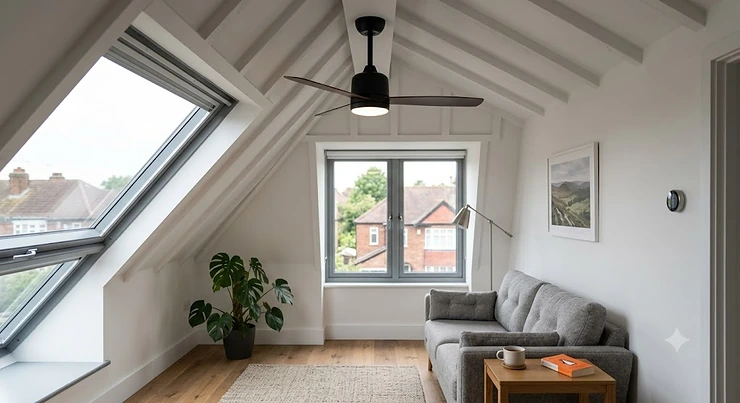
Vaulted ceilings look wonderful on the estate agent’s listing photos and then quietly become a headache the moment you try to hang anything from them. A standard ceiling fan simply isn’t designed to sit level on an angled surface — the canopy won’t seat flush, the downrod hangs off-centre, and the blades end up tilted rather than parallel to the floor. That tilt isn’t just cosmetic: it causes wobble, extra motor strain, and a fan that’s working harder than it should for the airflow you actually get. A ceiling fan for sloped ceiling use, or a proper sloped-ceiling adapter fitted to an existing fan, solves this by correcting the geometry so the blades hang level regardless of how steep the ceiling above them runs.
This guide breaks down seven genuine products — a mix of dedicated adapters and complete fans engineered for angled ceilings — with honest analysis of specs, real review sentiment, and where each one actually makes sense. Whether you’re dealing with a gently sloped loft conversion or a dramatic cathedral ceiling in a converted barn, there’s a sensible route through this below, along with the safety and regulatory basics worth knowing before you pick up a drill.
What Is a Ceiling Fan for Sloped Ceiling?
A ceiling fan for sloped ceiling installation is either a fan specifically engineered to mount level on an angled surface, or a standard fan paired with a dedicated sloped-ceiling adapter bracket. These solutions typically accommodate angles up to 45 degrees, using an angled mounting ball or bracket to keep the fan blades horizontal regardless of the ceiling’s pitch.
Quick Comparison Table
Here’s how our seven picks stack up before we get into the detail — a genuine mix of standalone adapters and complete fans, covering different angled ceiling ceiling fan needs.
| Product | Type | Max Angle | Best For |
|---|---|---|---|
| Hunter 22170 Angled Ceiling Adapter | Adapter (Hunter-specific) | 45° | Hunter fan owners upgrading to a sloped room |
| AICWIOO Universal Sloped Ceiling Fan Mount Adapter | Universal adapter | 45° | Budget universal fit across brands |
| Minka-Aire A245 Slope Ceiling Adapter Kit | Adapter (Minka-Aire specific) | 45° | Minka-Aire owners wanting a finish-matched adapter |
| Sofucor Ceiling Fan Slope Ceiling Kit | Universal adapter | 45° | Cheapest all-round universal option |
| Westinghouse Cyclone | Complete ceiling fan | Sloped-compatible | Simple, no-light budget fan |
| Westinghouse Nevada | Complete ceiling fan | Sloped-compatible | Traditional/rustic-style rooms |
| Fantasia Blade | Complete ceiling fan | Dual mount, drop rod | UK-built quality with 10-year warranty |
Looking at this spread, there’s a clear split between buying an adapter to retrofit an existing fan and buying a complete fan that’s already sloped-ceiling friendly. If you already own a fan you like — or a specific brand’s replacement parts are easy to source — an adapter like the AICWIOO Universal Sloped Ceiling Fan Mount Adapter is the cheaper route. If you’re starting from scratch, a complete fan such as the Fantasia Blade removes any guesswork about compatibility.
💬 Just one click — help others make better buying decisions too!😊
Top 7 Ceiling Fans & Adapters for Sloped Ceilings: Expert Analysis
We’ve mixed standalone adapters with complete fans here, because “ceiling fan for sloped ceiling” covers two genuinely different shopping situations — retrofitting an existing fan, or buying a new one built for the job. Every product below is real and currently available — no invented models.
1. Hunter 22170 Angled Ceiling Adapter — best for Hunter fan owners
Hunter has been solving ceiling fan mounting problems for well over a century, and the 22170 Angled Ceiling Adapter is its dedicated bracket for angled installations up to 45 degrees, available in a Chestnut Brown finish designed to blend with Hunter’s traditional fan range. Rather than a universal clamp, this adapter replaces the fan’s existing canopy entirely, seating an angled ball assembly against the sloped surface so the downrod — and therefore the blades — hang truly vertical.
Based on the spec comparison with universal alternatives, the trade-off here is compatibility versus flexibility: this bracket is built specifically to match Hunter’s canopy and downrod system, so it fits cleanly without any improvisation, but it isn’t something you can repurpose for a different brand of fan later. What the spec sheet won’t tell you is that Hunter’s own installation guidance draws a distinction between ceilings under 45 degrees, which this adapter handles, and steeper cathedral-style pitches beyond that, which need a different accessory entirely — so it’s worth measuring your actual angle before ordering.
Pros:
- ✅ Purpose-built match for Hunter fan canopies and downrods
- ✅ Handles angles up to 45 degrees
- ✅ Finish-matched Chestnut Brown for a clean look
Cons:
- ❌ Only compatible with Hunter-branded fans
- ❌ Not suitable for ceilings steeper than 45 degrees
Typically priced in the £30-£50 range, this sits at the budget end for anyone already committed to the Hunter ecosystem.
2. AICWIOO Universal Sloped Ceiling Fan Mount Adapter — best budget universal option
For anyone not tied to a specific fan brand, the AICWIOO Universal Sloped Ceiling Fan Mount Adapter is a genuinely flexible option: cast aluminium construction, rated for vaulted ceilings up to 45 degrees, and sized to fit 1.7-inch brackets and 1-inch outer-diameter downrods, which covers a wide range of fans on the market. It’s also outdoor-rated, and the housing leaves ample room for a remote receiver, which matters if your fan uses remote rather than pull-cord control.
Reviewers consistently note that cast aluminium construction feels notably sturdier than the thinner steel adapters sold at similar prices, and the wide bracket compatibility means it’s a sensible first check before assuming you need a brand-specific part. What most buyers overlook is that “1.7-inch bracket, 1-inch downrod” compatibility is a specific measurement, not a universal guarantee — it’s worth measuring your existing fan’s fittings before ordering rather than assuming “universal” covers every model.
Pros:
- ✅ Genuinely broad compatibility across brands and downrod sizes
- ✅ Cast aluminium build feels sturdier than budget steel rivals
- ✅ Outdoor-rated, so it works in porches and conservatories too
Cons:
- ❌ “Universal” still requires matching bracket and downrod measurements
- ❌ Basic black finish only, limited to blend with most fans
Typically priced in the £25-£40 range, making it one of the cheaper genuinely universal adapters available.
3. Minka-Aire A245 45-Degree Slope Ceiling Adapter Kit — best finish-matched adapter
Minka-Aire’s A245 adapter kit takes a different approach to universal parts: rather than one generic finish, it’s sold in a wide range of colours — including brushed nickel, oil-rubbed bronze, coal, and distressed koa — specifically so it can be finish-matched to the rest of a Minka-Aire fan rather than standing out as an obvious bolt-on part. It includes a mounting bracket, angled ball assembly, and locking pin, designed to use the fan’s existing canopy rather than replacing it, and carries a 75-pound weight rating.
Here’s what most buyers overlook: Minka-Aire fans already ship standard-equipped for slopes up to 29 degrees without any adapter at all, so the A245 is specifically for the steeper range between 29 and 45 degrees — buying it for a gentler slope is an unnecessary expense. Based on the spec comparison with universal budget adapters, the finish-matching and dedicated 75-pound rating make this the sensible choice if you already own or plan to buy a Minka-Aire fan and want the adapter to disappear visually rather than look like an aftermarket fix.
Pros:
- ✅ Wide range of finish-matched colour options
- ✅ Clear 75-pound weight rating for confidence in load capacity
- ✅ Designed to reuse the fan’s existing canopy, not replace it
Cons:
- ❌ Only necessary for slopes steeper than 29 degrees on Minka-Aire fans
- ❌ Limited to Minka-Aire’s own fan and downrod system
Typically priced in the £35-£55 range depending on finish, positioning it as a mid-tier accessory purchase.
4. Sofucor Ceiling Fan Slope Ceiling Kit — cheapest all-round universal pick
If budget is the main driver, the Sofucor Ceiling Fan Slope Ceiling Kit covers the same core job as the pricier branded adapters — accommodating slopes up to 45 degrees — in a straightforward black finish aimed at broad compatibility rather than aesthetic matching. It’s consistently one of the better-selling universal adapter kits online, largely on the strength of its low price relative to branded alternatives.
What the spec sheet won’t tell you is that budget universal kits like this typically use lighter-gauge steel than premium cast-aluminium options, which is a fair trade for the price but worth knowing if your fan is on the heavier end of the scale. Reviewers generally note straightforward installation and a genuinely wide compatibility range, though the finish is more utilitarian than decorative — sensible for a loft conversion or utility space, less so for a formal room where the mounting hardware is more visible.
Pros:
- ✅ Lowest price point among the adapters on this list
- ✅ Handles slopes up to 45 degrees like premium alternatives
- ✅ Broad compatibility across common fan brands
Cons:
- ❌ Lighter-gauge construction than premium cast-aluminium options
- ❌ Basic black finish only, less suited to formal rooms
Typically priced under £25, making this the most accessible entry point into this category.
5. Westinghouse Cyclone — best simple budget fan for sloped rooms
Westinghouse’s Cyclone is positioned as the brand’s “proven classic” — a straightforward ceiling fan without an integrated light, designed for reliable airflow rather than decorative flourish, and listed among Westinghouse’s sloped-ceiling-adaptable fans available to UK buyers. Its no-frills approach keeps the price down while still delivering the brand’s typical multi-speed motor and reversible summer/winter airflow setting.
Based on the spec comparison against fussier, feature-heavy fans, the Cyclone’s appeal is precisely its simplicity: fewer components generally means fewer things to go wrong, and a fan without an integrated light avoids one more potential point of failure in a room where you may already have separate lighting. What most buyers overlook is that “sloped-ceiling-adaptable” on a whole fan typically still assumes a moderate pitch — very steep cathedral ceilings may still need an additional adapter kit even with a compatible fan, so it’s worth checking the maximum angle in the specific listing before buying.
Pros:
- ✅ Straightforward, no-light design keeps price down
- ✅ Reversible airflow for year-round use
- ✅ Fewer components than feature-heavy alternatives
Cons:
- ❌ No integrated lighting if you need it in that room
- ❌ Very steep pitches may still need a separate adapter
Typically priced in the £80-£120 range, making it one of the more accessible complete fans on this list.
6. Westinghouse Nevada — best traditional style for angled ceiling rooms
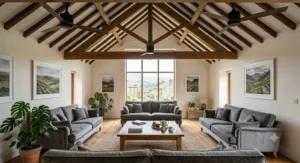
For anyone wanting a more decorative statement piece, the Westinghouse Nevada brings an antique iron finish with reversible walnut and cherry-toned blades, aimed at rooms with a traditional or rustic character rather than a strictly modern one. It’s recommended by the brand for rooms up to around 15 square metres and can be optionally paired with a remote control or wall switch depending on how the room is wired.
Reviewers consistently note the “atmosphere” the styling brings to a room — one UK buyer specifically praised how simple the installation felt despite initially needing to check an online video guide for reference. What most buyers overlook is that reversible blade colours are a genuinely practical touch beyond decoration: swapping the visible face from walnut to cherry lets you subtly refresh a room’s look without buying a new fan when you redecorate.
Pros:
- ✅ Reversible walnut/cherry blades offer two looks in one fan
- ✅ Traditional antique iron styling suits period or rustic rooms
- ✅ Optional remote control for flexible operation
Cons:
- ❌ Rustic styling won’t suit strictly modern interiors
- ❌ Recommended room size caps out around 15 square metres
Typically priced in the £100-£160 range, sitting comfortably in the mid-range bracket for a styled, complete fan.
7. Fantasia Blade — best premium UK-built option
Fantasia has been described as the pioneer of the UK ceiling fan market since 1985, and the Blade model showcases the brand’s patented single-blade design, which won a Design Resource Awards International prize for genuinely different aerodynamics rather than the conventional multi-blade layout most fans use. It’s a dual-mount fan, meaning it can be fitted flush to the ceiling or on a drop rod with a separate conversion kit, giving it flexibility across different ceiling heights and, with the right accessory, angled surfaces too.
Based on the spec comparison with the budget end of this list, the Blade’s patented design and 10-year motor warranty — standard across Fantasia’s range — reflect a genuinely different price bracket, but the brand’s near-40-year UK track record and dedicated aftersales support make a strong case for the premium over unbranded alternatives. What the spec sheet won’t tell you is that Fantasia’s dual-mount system is engineered around flush or drop-rod fitting on standard ceilings; for a genuinely sloped surface, you’ll still want to pair it with a compatible sloped-ceiling adapter kit, sold separately, rather than assuming dual-mount alone solves an angled installation.
Pros:
- ✅ Patented, award-winning single-blade aerodynamic design
- ✅ 10-year motor warranty reflects genuine UK brand confidence
- ✅ Dual mount offers flexibility across ceiling heights
Cons:
- ❌ Premium price relative to unbranded alternatives
- ❌ Dual mount alone doesn’t solve a sloped ceiling — pair with an adapter
Typically priced in the £200-£320 range depending on finish, positioning this as the premium pick on this list.
How to Choose a Ceiling Fan for Sloped Ceiling
Working through the options above — or anything else you find while browsing — comes down to a short list of genuinely important checks, not marketing language. Here’s the order we’d actually weigh them in:
- Measure your actual angle first. Most adapters and sloped-compatible fans cap out around 45 degrees; a genuinely steep cathedral ceiling may need a specialist solution beyond standard products.
- Decide: retrofit or replace. If you like your current fan, a standalone adapter is usually cheaper than a whole new fixture — but only if a compatible adapter exists for your brand.
- Check downrod and bracket sizing. Universal adapters still specify bracket and downrod dimensions; “universal” isn’t a guarantee without matching measurements.
- Confirm the weight rating. Heavier fans need an adapter rated to match — a 75-pound rating like the Minka-Aire kit’s is a useful benchmark to compare against.
- Think about the junction box. A standard light-fitting box is not rated to support a rotating fan; this is one of the most common — and most dangerous — DIY mistakes.
- Factor in finish, not just function. A mismatched adapter bracket can look like an obvious retrofit; finish-matched kits cost more but blend in better.
- Know your electrical limits. In the UK, like-for-like fitting replacements are generally DIY-friendly, but anything involving a new circuit should go to a qualified electrician — more on this below.
Angled Ceiling Ceiling Fan vs Standard Flush Mount
A genuinely common point of confusion: can you just fit a normal flush-mount fan to a sloped ceiling, or do you specifically need an angled ceiling ceiling fan setup? The short answer is no — flush mounts are designed to sit tight against a level surface, and a sloped ceiling defeats that geometry entirely. Here’s how the two approaches actually compare.
| Factor | Angled/Sloped Setup | Standard Flush Mount |
|---|---|---|
| Works on sloped ceilings | Yes, up to rated angle | No — requires a level surface |
| Blade alignment | Level, regardless of ceiling pitch | Follows ceiling angle if forced |
| Typical products | Hunter 22170, Minka-Aire A245, Fantasia Blade with adapter | Any standard flush-mount fan |
| Installation complexity | Slightly higher — extra bracket/ball assembly | Simpler, direct-to-ceiling fit |
| Best For | Any genuinely sloped or vaulted room | Standard flat 8ft ceilings only |
The analysis here is fairly unambiguous: attempting to force a flush-mount fan onto a sloped ceiling doesn’t just look wrong, it creates a genuine safety and performance problem, since the blades won’t rotate level and the mounting stress isn’t evenly distributed. If your ceiling has any noticeable pitch, a dedicated sloped-ceiling adapter — such as the Minka-Aire A245 45-Degree Slope Ceiling Adapter Kit — or a fan specifically rated for angled installation, like the Fantasia Blade paired with the right accessory, isn’t optional extra spend; it’s the only setup that actually works safely.
Vaulted Ceiling Fan Installation: What “Vaulted” Changes
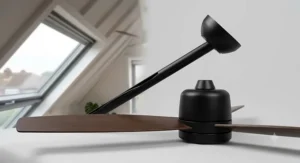
“Vaulted” and “sloped” get used almost interchangeably, but there’s a practical distinction worth understanding before you shop. A sloped ceiling typically has one consistent angled plane, like the underside of a loft conversion roofline. A vaulted ceiling often has two angled planes meeting at a central ridge, creating a much higher central point — which changes both the downrod length you’ll need and how much clearance exists around the fan blades.
On paper this means vaulted ceiling fan installation often needs a longer downrod in addition to an angled adapter, since the peak of a vault sits considerably higher than a standard 8-foot ceiling. Reviewers installing fans in genuinely vaulted rooms consistently flag downrod length as the detail most often overlooked — an adapter alone corrects the angle, but doesn’t address the extra vertical drop needed to bring the fan blades down to a sensible, effective height above head level.
Pitched Roof Ceiling Fan: Matching Fan to Roof Pitch
For loft conversions specifically, the relevant number is your roof’s actual pitch in degrees, not a rough visual estimate. UK roof pitches commonly range from around 30 to 45 degrees for traditional designs, though older or converted properties can vary considerably. This matters directly for a pitched roof ceiling fan setup because most standard adapters — including several on this list — are rated up to 45 degrees; anything steeper genuinely needs specialist equipment rather than a standard universal kit.
Here’s what most buyers overlook: measuring pitch accurately with a simple angle finder or even a smartphone app before shopping saves a wasted purchase. Based on the spec comparison across this list, budget universal adapters like the Sofucor Ceiling Fan Slope Ceiling Kit and AICWIOO Universal Sloped Ceiling Fan Mount Adapter cover the vast majority of typical UK loft conversion pitches, while only genuinely unusual, very steep pitches push you toward a specialist solution beyond standard retail products.
Sloped Ceiling Adapters: How They Actually Work
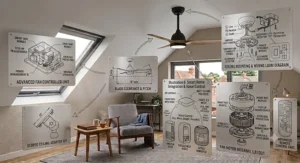
Most sloped ceiling adapters rely on the same basic mechanical principle: an angled ball-and-socket or hinged bracket assembly that sits between the ceiling’s angled surface and the fan’s downrod, correcting the geometry so the downrod — and therefore the fan itself — hangs perfectly vertical regardless of the slope above it. The adapter effectively absorbs the angle, so the fan doesn’t need to “know” it’s on a sloped ceiling at all.
Reviewers across multiple adapter brands note that installation quality hinges on how securely the bracket clamps to the original ceiling fixing point — a loose or poorly tightened adapter is the most common cause of wobble complaints, not the fan itself. On the technical side, weight rating matters more than most buyers initially assume: an adapter rated for a lighter fan than you’re actually hanging is a genuine safety issue, not just a performance one, since the extra torque from a heavier rotating fan puts more stress on the bracket than a static fixture ever would.
Best Ceiling Fan for Sloped Ceiling by Room & Use Case
Different rooms and roof shapes call for different solutions from this list.
The loft conversion bedroom: For a typical single-pitch loft bedroom, a budget universal adapter like the Sofucor Ceiling Fan Slope Ceiling Kit paired with a fan you already like covers most standard pitches without overspending.
The vaulted living room extension: Where the ceiling has real height and a central ridge, the Fantasia Blade with a compatible adapter and a longer downrod makes a genuine style statement while handling the extra vertical drop a vault demands.
The rustic barn conversion: For period or characterful spaces, the Westinghouse Nevada‘s antique iron and reversible wood-tone blades suit the aesthetic far better than a stark modern fan would.
The simple utility loft space: Where function matters more than looks, the Westinghouse Cyclone paired with the AICWIOO Universal Sloped Ceiling Fan Mount Adapter delivers reliable airflow without paying for styling you won’t notice in a box room.
The existing Hunter or Minka-Aire fan owner: Don’t replace a fan you already like — the brand-specific Hunter 22170 or Minka-Aire A245 adapters solve the sloped-ceiling problem without a full replacement purchase.
Angled Mounting Systems: Setting Up & Maintaining Yours
Getting a genuinely level, stable result from angled mounting systems takes a bit more care than a standard flush installation. In the first weeks after fitting, the most common avoidable mistakes are under-tightening the adapter bracket because the angle makes it awkward to access fully, skipping a spirit-level check once the fan is hung, and forgetting to run the fan through a full speed cycle before finishing the job to check for wobble while everything is still accessible.
For proper setup, start by confirming the ceiling joist location behind the fixing point — angled surfaces can make joists harder to locate by eye, so a stud finder is worth the extra five minutes. Once the adapter bracket is fitted, use a spirit level against the downrod itself, not just against the canopy, since a level canopy doesn’t guarantee a level downrod on an angled surface. After installation, run the fan on its lowest speed first and gradually increase, watching specifically for wobble at the blade tips rather than at the motor housing, since blade-tip wobble is the more reliable early warning sign. For long-term maintenance, revisit the adapter’s fixing screws after the first few weeks of use — vibration from a new installation can work fixings slightly loose even when the initial fit was solid — and check again every six months or so as part of general fan cleaning.
Pitched Installation Solutions: Real-World Scenarios
Scenario one — the loft conversion with a single 40-degree pitch. A homeowner converting a loft into a home office needs airflow without an obvious retrofit look. A finish-matched option like the Minka-Aire A245, paired with an existing or new Minka-Aire fan, avoids the mismatched-bracket look a budget universal kit can sometimes have.
Scenario two — the vaulted extension with a steep central ridge. A new-build extension with a genuinely high, vaulted ceiling needs both angle correction and extra downrod length. The Fantasia Blade on a compatible adapter, paired with a longer drop rod, handles both the angle and the height in one coherent setup.
Scenario three — the budget-conscious loft bedroom renovation. Someone renovating a modest loft bedroom on a tight budget doesn’t need premium finish-matching. The Sofucor Ceiling Fan Slope Ceiling Kit paired with a simple existing fan solves the practical problem without unnecessary spend.
On the regulatory side, it’s genuinely worth understanding what counts as DIY-friendly electrical work before starting. In England and Wales, Approved Document P covers electrical safety in dwellings, and broadly distinguishes between like-for-like replacements — generally fine for a competent DIYer — and new circuit work, which should go to a registered electrician. Swapping an existing light fitting for a fan on the same circuit is typically non-notifiable work, but if you’re at all unsure, it’s genuinely worth getting a professional opinion before touching the wiring.
Common Mistakes When Buying a Ceiling Fan for Sloped Ceiling
The most frequent misstep is assuming any fan marketed as “dual mount” automatically works on a sloped ceiling — as the analysis above on the Fantasia Blade shows, dual mount actually refers to flush-versus-drop-rod flexibility on level ceilings, not angled compatibility, and genuinely sloped surfaces still need a dedicated adapter. A close second is skipping the angle measurement entirely and assuming a room “looks about 30 degrees,” when a proper reading might reveal it’s closer to the 45-degree ceiling most standard adapters are rated for — or beyond it. Buyers also frequently underestimate the importance of the junction box rating, fitting a fan to a box designed only for a static light fixture, which is a genuine safety hazard given the extra torque a rotating fan generates. Finally, choosing a universal adapter purely on price without checking bracket and downrod compatibility leads to returns and wasted time — a five-minute measurement check avoids this entirely.
Long-Term Cost & Maintenance
Thinking beyond the purchase price matters here, since a properly installed sloped-ceiling fan setup is a multi-year fixture rather than a disposable accessory. Budget universal adapters like the Sofucor Ceiling Fan Slope Ceiling Kit and AICWIOO Universal Sloped Ceiling Fan Mount Adapter carry the lowest upfront cost, and lighter-gauge construction is a reasonable trade-off for most typical domestic loads, provided the weight rating genuinely matches the fan you’re hanging. Branded adapters like the Hunter 22170 and Minka-Aire A245 cost more but benefit from tighter manufacturing tolerances and finish-matching that ages better visually over several years of use.
| Product Tier | Typical Price Range | Long-Term Value Notes |
|---|---|---|
| Budget universal adapters | Under £25-£40 | Lowest upfront cost; check weight rating carefully |
| Branded finish-matched adapters | £30-£55 | Better visual integration, tighter tolerances |
| Complete budget/mid fans | £80-£160 | No adapter compatibility guesswork |
| Premium UK-built fan | £200-£320 | Longest warranty, best aftersales support |
The analysis here is straightforward: for a rarely-used loft space, a budget adapter is genuinely sensible value, while a fan that will run daily in a main living space justifies the premium tier’s longer warranty — the Fantasia Blade‘s 10-year motor warranty in particular reflects real confidence in longevity that budget unbranded parts simply don’t offer. Maintenance costs stay low across the tiers provided fixings are checked periodically and blades are kept dust-free, which is the main driver of both noise and reduced airflow efficiency over time.
Features That Actually Matter (And Those That Don’t)
Cutting through the spec sheets, a handful of features genuinely affect how well a sloped-ceiling setup performs: the rated maximum angle, the weight rating of the adapter, and whether the kit reuses or replaces the fan’s existing canopy. Bracket material — cast aluminium versus steel — is a real durability factor worth checking rather than a cosmetic detail, since it affects long-term resistance to fatigue from constant rotational torque.
On the other hand, some heavily marketed extras matter less than they sound: an adapter’s colour range mostly affects how invisible it looks rather than how well it performs, and “universal compatibility” claims are worth verifying against your specific bracket and downrod measurements rather than taking at face value. A fan’s number of blades has surprisingly little bearing on cooling performance compared with motor quality and blade pitch — the Fantasia Blade‘s patented single-blade design is a genuine engineering point of difference, but a five-blade fan isn’t inherently “better” than a three-blade one just by blade count.
Safety & Regulations: Installing Safely on a UK Ceiling
Sloped ceiling installations often mean working at a genuine height, sometimes on a ladder positioned awkwardly against an angled surface — which makes this a sensible moment to think about physical safety, not just electrical compliance. The HSE’s guidance on safe ladder use is aimed primarily at workplaces, but the core principles — a stable, level base, secured positioning, and avoiding tasks that keep you up a ladder for extended periods — apply just as much to a DIY loft conversion project at home.
On the electrical side, the general rule for UK homes is that like-for-like replacements — swapping an existing light fitting for a fan on the same circuit — are typically non-notifiable DIY work, but any new circuit, or work you’re not confident about, should go to a registered, competent electrician. A ceiling fan is meaningfully heavier and generates more mechanical stress than a standard light fitting; the junction box it’s mounted to needs to be rated specifically for that additional load, which is a detail worth confirming before you assume an existing fitting can simply be reused. For anyone genuinely uncertain about wiring colours, circuit isolation, or whether their specific job counts as notifiable work, getting a qualified opinion before starting is a sensible, low-cost safeguard against a much larger problem later.
✨ Don’t Miss These Exclusive Deals!
🔍 Take your sloped ceiling fan project to the next level with the picks above. Click through to check current pricing and availability before you buy — matching the right adapter to your actual ceiling angle is the difference between a clean installation and a wobbling headache.
Frequently Asked Questions
❓ Can any ceiling fan be installed on a sloped ceiling?
❓ What angle is too steep for a standard sloped ceiling adapter?
❓ Do I need an electrician to fit a sloped ceiling fan adapter?
❓ Is a longer downrod needed for vaulted ceilings?
❓ Do universal sloped ceiling adapters fit any fan brand?
Conclusion
A ceiling fan for sloped ceiling installation doesn’t need to be complicated once you understand the core mechanics: something has to correct the angle between the ceiling’s pitch and the fan’s need to hang perfectly level, whether that’s a dedicated adapter or a fan engineered with angled compatibility built in. Budget-conscious loft conversions are well served by universal adapters like the Sofucor Ceiling Fan Slope Ceiling Kit or AICWIOO Universal Sloped Ceiling Fan Mount Adapter, brand loyalists get a cleaner finish-matched result from the Hunter 22170 or Minka-Aire A245, and anyone wanting a genuine style statement in a vaulted space should look at the Fantasia Blade or Westinghouse Nevada.
Whichever route you take, measure your actual ceiling angle before shopping, check the weight rating against your specific fan, and don’t skip the junction box question — it’s the detail most likely to cause a real problem later. Get the geometry right, and a sloped ceiling stops being an obstacle and just becomes another room with a cooling breeze in it.
Recommended for You
- 7 Best Ceiling Fans for Loft Conversion UK (2026 Guide)
- Reversible Motor Ceiling Fan: 7 Best UK Picks for 2026
- Large Conservatory Ceiling Fans: 7 Best UK Picks for 2026
Disclaimer: This article contains affiliate links. As an Amazon Associate, I earn from qualifying purchases. If you purchase products through these links, we may earn a small commission at no additional cost to you.
✨ Found this helpful? Share it with your friends! 💬🤗
