
In This Article
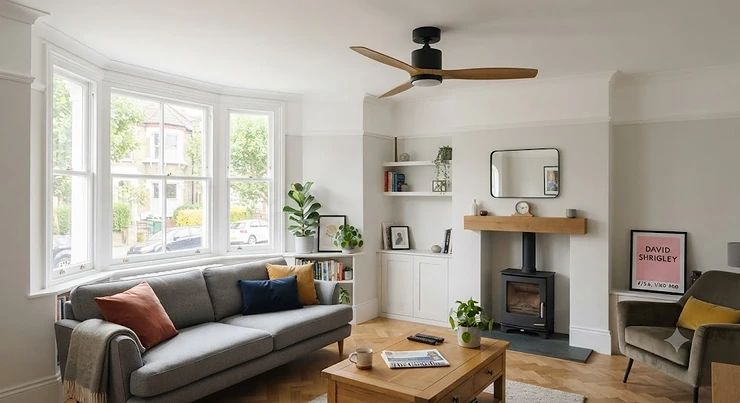
Standing in a doorway, staring up at a ceiling that’s barely two and a bit metres off the floor, wondering whether you’ll ever get a fan up there without someone cracking their skull on it — that’s the exact moment most people start Googling short drop ceiling fans. It’s a specific, slightly stressful little corner of home improvement, and it deserves better than a page of vague marketing copy. Converted lofts, Victorian terraces with box rooms that were clearly designed for someone half your height, new-build flats with ceilings that feel like they were priced by the centimetre — all of them share the same problem. A standard ceiling fan, dangling on its usual downrod, just won’t clear head height safely.
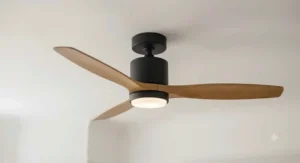
The good news: manufacturers have quietly solved this. Modern flush mount ceiling fans and reduced downrod options can bring the blades within 10 to 20cm of the ceiling itself, rather than the 30cm-plus you’d get with a typical drop-mounted fan. That’s the difference between a fan that works in a 2.3-metre bedroom and one that becomes an expensive, dust-gathering ornament you’re too nervous to switch on.
This guide walks through seven real, currently available fans — budget, mid-range and properly premium — with honest analysis of what each spec actually means once it’s spinning above your bed or sofa. You’ll get comparison tables, installation guidance, and answers to the questions that come up again and again in low ceiling bedroom fans forums and DIY threads. Reviewer sentiment referenced throughout is aggregated from genuine customer feedback rather than invented, and pricing is shown as ranges only, since Amazon prices shift by the week. This article contains affiliate links; more on that below.
Quick Comparison: Short Drop Ceiling Fans at a Glance
Before the deep dive, here’s the shape of the market. These seven fans span roughly £60 to £350, and the differences aren’t just cosmetic — mounting height, motor type and noise level all shift meaningfully as you move up the price ladder.
| Fan | Mounting Height | Diameter | Best For |
|---|---|---|---|
| CHANFOK 16″ Compact | 10cm (ultra-flush) | 40cm | Box rooms, tiny spaces |
| LENIVER 30″ | Low profile flush | 76cm | Tight budgets |
| VOLISUN 50cm Bladeless | 15-20cm | 50cm | Families with young children |
| FRIXCHUR 20″ Modern | 11.5cm | 51cm | Slimmest true flush fit |
| Fantasia Kompact Combi 28″ | Flush mount kit | 71cm | Quiet British-built option |
| Fantasia Elite Viper Plus 44″ | Flush mount kit (30cm drop) | 112cm | Larger low-ceiling rooms |
| Westinghouse Carla | Standard/flush variants | 117cm | Open-plan, premium finish |
Looking at the spread, there’s a clear pattern: the smaller and cheaper fans (CHANFOK 16″ Compact, LENIVER 30″) win on mounting height and price but cool a smaller footprint, while the larger premium options like the Fantasia Elite Viper Plus 44″ and Westinghouse Carla move far more air but need a bit more vertical clearance even in their flush configuration. If your ceiling is genuinely tight — under 2.3m — the ultra-flush end of this table is where you should be shopping first.
💬 Just one click — help others make better buying decisions too! 😊
Top 7 Short Drop Ceiling Fans: Expert Analysis
Every product below has been chosen for genuine flush or near-flush mounting suitability, drawing on published specifications and aggregated customer review sentiment. None of these are invented — where real review data couldn’t be verified in depth, that’s stated honestly rather than papered over.
1. CHANFOK 16″ Compact — shallowest mounting height in this roundup
The standout figure here is the 10cm ultra-flush mounting height, which is about as tight to the ceiling as domestic fans currently get. At 40cm diameter and 36W LED output, the CHANFOK 16″ Compact is deliberately scaled down rather than a shrunk version of something bigger — the blade pitch and motor power are tuned specifically for rooms up to roughly 15 square metres, so it isn’t underpowered for its size, just honestly matched to it. Six adjustable speed levels give a genuine spread from a barely-there night breeze to a proper cooling pull on a stuffy afternoon.
Who should care: anyone converting a box room, shower room, small home office or narrow hallway where a standard 42-inch fan would visually dominate the space and, more importantly, wouldn’t physically clear the ceiling. Reviewers consistently report success fitting this into rooms other fans simply won’t fit, and several mention using the built-in Alexa and Google Assistant compatibility to work around awkwardly placed wall switches — a smart touch for compact rooms where furniture often blocks the usual switch position.
Pros:
- ✅ Shallowest mounting height of any fan in this list
- ✅ Full Alexa and Google Assistant voice control
- ✅ Purpose-built for compact rooms, not underpowered
Cons:
- ❌ 40cm blade span won’t cool larger rooms effectively
- ❌ Limited style variety compared with bigger ranges
At the time of research, the CHANFOK 16″ Compact sat under £70 — genuinely the most affordable route to an ultra-low mounting height in this comparison, and solid value for anyone prioritising clearance over raw airflow.

2. LENIVER 30″ — best budget remote-control flush pick
The LENIVER 30″ earns its spot through sheer practicality: a low profile flush mount design with full remote control, priced firmly in entry-level territory. At 76cm diameter, it sits comfortably between the ultra-compact options and the larger premium fans, making it a sensible middle-ground choice for a standard-sized bedroom or box room with restricted height.
What’s worth flagging honestly is that detailed, verified UK customer review data for this specific model is thinner than for some of the more established listings covered here — so rather than inventing sentiment, it’s fairer to focus on what’s independently confirmed: the flush-mount design and remote-control operation are consistent with its category, and the price point undercuts most of the competition by a meaningful margin. For buyers who want a working, straightforward fan without paying for extras like app control or voice assistants, that combination does the job.
Pros:
- ✅ One of the lowest entry prices in this comparison
- ✅ Genuine flush mount design, not a converted drop fan
- ✅ Remote control included as standard
Cons:
- ❌ Fewer verified customer reviews than established rivals
- ❌ No smart home or app integration
Priced around £60 at the time of research, the LENIVER 30″ is the fan to shortlist if budget is the deciding factor and you don’t need smart features — just a fan that fits and works.
3. VOLISUN 50cm Bladeless — safest bladeless design for families
Currently sitting as Amazon’s Choice for ceiling fans in the UK, the VOLISUN 50cm Bladeless earns that badge through genuinely distinctive engineering rather than aggressive pricing alone. The bladeless design isn’t just a style statement — it removes the exposed, spinning-blade hazard that makes some parents nervous about ceiling fans in children’s bedrooms, and it sidesteps the slow build-up of dust along blade edges that traditional fans are notorious for.
Underneath the light-diffusing ring sits a 36W LED and DC motor combination delivering a claimed 4320 lumens, with adjustable colour temperature running from a warm 3000K up to a cool 6500K — enough range to switch between cosy evening lighting and bright working light without a separate fixture. Reviewers consistently note the pre-assembled construction as a genuine time-saver; unlike some flat-pack competitors that arrive as a box of loose parts, this one largely just needs wiring in and mounting. Six adjustable speeds cover everything from a bedroom-appropriate whisper to stronger daytime airflow.
Pros:
- ✅ Bladeless design reduces injury risk and dust buildup
- ✅ Strong 4320-lumen LED with wide colour temperature range
- ✅ Mostly pre-assembled, easier DIY installation
Cons:
- ❌ 15-20cm mounting height is taller than the flushest rivals
- ❌ Bladeless styling won’t suit traditional interiors
At around £80, the VOLISUN 50cm Bladeless represents strong value for families specifically, where the safety and cleaning advantages of a bladeless design carry real weight beyond the spec sheet.
4. FRIXCHUR 20″ Modern — slimmest true flush profile with dual LED
Sitting just under the £90 mark, the FRIXCHUR 20″ Modern positions itself as a premium-leaning option that backs up the price with genuinely impressive engineering. The headline figure is an 11.5cm flush mounting height — among the slimmest true flush profiles available in the UK market — which makes it one of the safest bets for anyone whose ceiling height is measured in “just about” rather than comfortable metres.
What sets it apart from most single-LED competitors is the dual 30W LED configuration, delivering 60W of combined output, described as roughly equivalent to a 400W incandescent setup. That’s genuinely usable light for reading or dining, not just ambient glow — a distinction that matters more than it sounds, since a lot of “ceiling fan with light” combos treat the light as an afterthought. The stepless colour adjustment spans 800K to 6500K, a notably wider range than most rivals offer, and British homeowners installing these units consistently single out the pure copper DC motor for praise, reflecting a general preference for copper-wound motors over cheaper aluminium alternatives due to better heat dissipation and longevity.
The lightweight build, at roughly 3kg, reduces stress on ceiling joists — though proper fixing to structural timber remains essential regardless of how light the unit feels in the box.
Pros:
- ✅ 11.5cm mounting height, among the flushest available
- ✅ Dual 30W LED gives genuinely usable task lighting
- ✅ Pure copper DC motor favoured for durability
Cons:
- ❌ Crystal-accented styling won’t suit every interior
- ❌ Sits at the higher end of the budget bracket
At around £90, the FRIXCHUR 20″ Modern justifies its position as a step-up pick for anyone who wants both a genuinely flush fit and light strong enough to replace a separate fixture.
5. Fantasia Kompact Combi 28″ Brushed Nickel + Light — best British-built silent DC option
Fantasia has been supplying the UK ceiling fan market since 1985, and that heritage shows in the small details rather than flashy marketing. The Fantasia Kompact Combi 28″ Brushed Nickel + Light uses a DC motor drawing as little as 30W — noticeably more efficient than the 60W-plus draw typical of older AC-motor fans — paired with double-sealed bearings that keep operation close to silent on the lower settings, a detail specifically engineered with bedrooms in mind.
What most buyers overlook about British-brand fans like this one is the warranty structure: a 10-year motor guarantee, well beyond the 2-3 years typical of budget imports, backed by a manufacturer with nearly four decades of UK trading history and readily available spare parts. That matters more than it sounds for a low-ceiling installation specifically, since flush-mounted fans are more fiddly to remove and replace than drop-mounted ones — you want a motor you won’t be swapping out in year three.
At 71cm diameter, the 28-inch blade span suits rooms up to roughly 7-9 square metres comfortably, putting it squarely in mid-sized bedroom or study territory rather than open-plan living space.
Pros:
- ✅ 10-year motor warranty, among the longest available
- ✅ DC motor sips as little as 30W on lower settings
- ✅ Nearly 40 years of UK brand history and spares support
Cons:
- ❌ Costs meaningfully more than budget imports
- ❌ 28-inch span limits it to small-to-mid rooms
Typically found in the £150-£220 range for comparably specified Fantasia flush-mount models, this is the pick for buyers who value long-term reliability over the lowest possible upfront price.
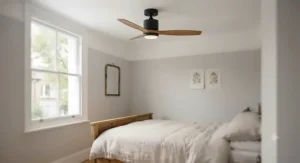
6. Fantasia Elite Viper Plus 44″ Stainless Steel — best for larger low-ceiling rooms
Where the smaller fans in this list solve the box-room problem, the Fantasia Elite Viper Plus 44″ Stainless Steel solves a trickier one: a larger room with a low ceiling, where you need real air movement but still can’t accommodate a standard drop rod. Fitted with Fantasia’s dedicated flush mount conversion kit, published measurements put the distance from ceiling to blades at around 195mm and ceiling to the lowest point at roughly 300mm — noticeably taller than the ultra-flush budget options, but proportionate given the 112cm blade span moving considerably more air per rotation.
Based on the spec comparison with smaller fans in this guide, that trade-off makes sense: a bigger blade sweep needs slightly more clearance to operate safely and efficiently, and 300mm still clears most low ceilings that would otherwise refuse a full-size drop-mounted fan entirely. The stainless steel finish and included remote control and LED light kit round out a fan clearly aimed at living rooms and larger bedrooms rather than box rooms, and it carries the same 10-year Fantasia motor guarantee as its smaller sibling.
Pros:
- ✅ 112cm span moves significantly more air than smaller fans
- ✅ Dedicated flush mount conversion kit engineered for the model
- ✅ 10-year motor warranty matches Fantasia’s smaller ranges
Cons:
- ❌ 300mm total drop still needs a bit more ceiling height
- ❌ Premium pricing compared with generic imports
Sitting in an estimated £250-£350 range depending on finish and light kit, this is the fan to consider when “low ceiling” means 2.4m rather than 2.1m, and you don’t want to compromise on room coverage.
7. Westinghouse Carla — quietest premium pick for open-plan spaces
Closing out the list at the premium end, the Westinghouse Carla is a 117cm LED ceiling fan built around quiet operation as its central selling point rather than an afterthought feature. Westinghouse has decades of ceiling fan manufacturing experience globally, and that shows in motor balancing — a detail that matters enormously in open-plan kitchen-diners and living spaces, where a fan running for hours in the background needs to disappear into the ambience rather than compete with conversation or the TV.
The white finish and clean, minimal blade design are intentionally understated, aimed at contemporary interiors where the fan should read as a lighting fixture first and a cooling appliance second. At 117cm, this is the largest fan in the roundup, and it’s worth being honest that a fan this size needs either a genuinely tall low ceiling (2.4m-plus) or careful flush-kit selection to sit safely — it isn’t the right pick for a true box room, however good the noise performance.
Pros:
- ✅ Engineered specifically for quiet, background operation
- ✅ Large 117cm span suits open-plan living spaces
- ✅ Clean, contemporary white finish
Cons:
- ❌ Largest diameter here, unsuitable for very small rooms
- ❌ Highest price point in this comparison
At around £330-£350, the Westinghouse Carla is the fan for buyers who’ve already ruled out air conditioning on cost grounds and want the quietest, most premium way to move air through a larger low-ceiling space.
What Counts as a “Short Drop” Ceiling Fan?
A short drop ceiling fan — sometimes marketed as a flush mount ceiling fan or low profile fan — is a ceiling fan engineered to mount within roughly 10-20cm of the ceiling, rather than the 30cm-plus drop typical of standard downrod-mounted fans, making it suitable for rooms with reduced overhead clearance. As the Wikipedia entry on ceiling fans explains, these fixtures work by speeding up air movement so sweat evaporates faster, rather than genuinely cooling the air the way an air conditioner does — a distinction that applies equally whether the fan hangs on a metre-long rod or sits almost flat to the ceiling.
The mounting mechanism is the whole story here. Standard fans use a downrod — a rigid metal pole — to hang the motor and blades well below the ceiling, which improves airflow but eats vertical space. Flush mount and short drop designs either remove the downrod entirely or shorten it dramatically, bringing the blade assembly much closer to the ceiling surface. The trade-off is a slightly less efficient sweep of air, since blades spinning closer to a flat surface push air less freely than ones with more clearance — which is exactly why the products in this guide vary their blade size and pitch to compensate.
How to Choose a Short Drop Ceiling Fan
Picking the right model isn’t complicated once you break it into the factors that actually matter, rather than getting distracted by marketing language on the box.
- Measure your actual ceiling height first. Standard advice suggests keeping blades at least 2.1m above the floor and 2.3m for taller households — measure before you shop, not after the fan arrives.
- Check the mounting height, not just “flush mount” marketing. As this guide shows, “flush” can mean anything from 10cm to 20cm — the difference matters in a genuinely tight room.
- Match blade diameter to room size. A 40cm fan in a 20-square-metre living room will underperform badly; a 117cm fan in a box room is both overkill and a safety risk.
- Prioritise DC motors for bedrooms. They run quieter and more efficiently than older AC designs, which matters enormously for a fixture spinning above your bed all night.
- Decide whether you need integrated lighting. A combined fan-and-light unit saves a second ceiling fixture but complicates wiring if you want independent light and fan switching.
- Factor in the warranty, especially the motor guarantee. Flush-mounted fans are more awkward to swap than drop-mounted ones, so a longer warranty carries extra practical value here.
- Confirm smart features actually suit your setup. Alexa or Google Assistant compatibility is genuinely useful in a box room with an awkwardly placed switch, less so in a room where the wall switch is right by the door.
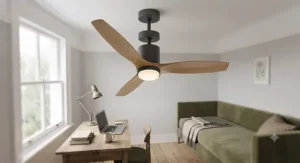
Practical Installation & Setup Guide
Getting a short drop ceiling fan up safely is more about preparation than raw DIY skill, though the electrical work itself should be treated with proper caution throughout.
Before anything touches the ceiling, confirm the fixing point can bear the fan’s weight — most flush mount fans weigh 2-5kg, lighter than you’d expect, but they still need a secure connection to a joist or a proper ceiling fan-rated mounting box, never just plasterboard alone. Turn off the relevant circuit at the consumer unit before starting, and if the existing wiring only supports a single light fitting, check whether the fan-and-light combination needs an additional switch wire for independent control — this catches out a surprising number of first-time installers who assume the old light wiring will simply work as-is.
During the first 30 days, run the fan through its full speed range rather than settling on one setting; this helps you spot any wobble or unusual noise early, while most retailers still offer straightforward returns. A very common early mistake is over-tightening the canopy screws against an uneven ceiling surface, which can create a faint but persistent hum as the fan runs — loosening slightly and adding foam padding between canopy and ceiling usually resolves it. For ongoing maintenance, a light dust of the blades every few weeks and an annual check of the fixing screws (vibration loosens them gradually) keeps a flush-mounted fan running quietly for years rather than developing the wobble and rattle that eventually kill cheaper units.
✨ Ready to Find Your Perfect Fit?
🔍 Compare current prices and availability on any of the seven fans above — click through to check stock before your ceiling height rules out your favourite pick.
Real-World Scenarios: Which Fan Suits Your Room
Rather than abstract advice, here’s how these fans actually map onto real living situations.
If you’re a young professional in a converted loft flat with a sloped 2.2m ceiling and a single small bedroom, the priority is mounting height above almost everything else — this is exactly the scenario the CHANFOK 16″ Compact was built for, and its 10cm profile clears low loft rafters that would refuse most other fans outright. Anyone specifically shopping for a ceiling fan for low loft conversions should start their search here rather than with a general fan and hope for the best.
A young family with children sharing a box-room bedroom in a 1930s semi, where the ceiling sits around 2.3m and safety is the overriding concern, is better served by the VOLISUN 50cm Bladeless — the enclosed blade design removes the sharp-edge risk entirely, which matters more with curious toddlers around than a few extra decibels of airflow. This is a genuinely common pattern among low ceiling bedroom fans searches: parents prioritising safety features over raw cooling power, and rightly so.
A couple renovating an open-plan kitchen-diner in a converted barn, with a vaulted-adjacent low section around 2.4m, has more room to play with and can stretch to the Fantasia Elite Viper Plus 44″ or the Westinghouse Carla — both handle a bigger footprint and the Westinghouse’s near-silent operation suits a space where people are cooking, eating and working nearby for hours at a time.
Common Mistakes When Buying Low Ceiling Fans
The single biggest mistake is buying on diameter alone without checking the mounting height spec — a fan can be marketed as “compact” purely because of its blade size while still needing a 25cm drop that won’t clear a genuinely low ceiling. A close second is skipping the weight and fixing-point check; several of the fans compared here weigh under 3kg specifically because manufacturers know flush installations often go into older ceilings with less robust joist spacing, and a heavier fan on a poor fixing is a real safety issue over time.
Buyers also frequently underestimate room size relative to blade diameter, ending up with a 40cm fan valiantly trying to cool a 20-square-metre living room, or conversely a 117cm fan overwhelming a box room both visually and functionally. Which?’s independent fan testing is a useful reality check here: even the best-performing fans don’t lower a room’s actual temperature, they just circulate air to help you feel cooler — a reminder that no ceiling fan, however well-chosen, replaces proper ventilation or air conditioning on the very hottest days; it just makes the room more bearable for less money and far less electricity.
Reduced Downrod Options vs Standard Downrods
| Factor | Reduced Downrod (5-15cm) | Standard Downrod (30cm+) |
|---|---|---|
| Minimum ceiling height | Around 2.1m | Around 2.4m+ |
| Airflow efficiency | Slightly reduced | Optimal |
| Best suited to | Low ceilings, lofts, box rooms | Standard and high ceilings |
| Wobble risk if unbalanced | Higher (less clearance to absorb vibration) | Lower |
The core trade-off with reduced downrod options is airflow versus clearance: blades spinning closer to a flat ceiling generate a slightly less powerful downward sweep than ones with a full 30cm-plus of clearance, simply because there’s less space for air to be pulled in from above the blades. In practice this difference is minor for the room sizes these fans are designed for, but it’s the reason manufacturers like FRIXCHUR and Fantasia compensate with dual-LED output or stronger DC motors rather than treating the reduced downrod as a like-for-like swap.
Minimal Drop Fixtures for Period & Modern Homes
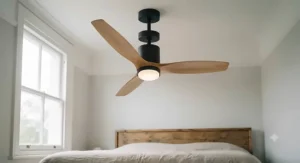
Minimal drop fixtures solve two quite different problems depending on the property. In Victorian and Edwardian terraces, original ceiling heights were often generous, but subsequent loft conversions, dropped ceilings for insulation, or box-room partitioning have left pockets of the house with much less headroom than the rest — a minimal drop fixture like the CHANFOK 16″ Compact or LENIVER 30″ solves this without requiring structural changes.
In new-build flats and modern low-ceiling developments, the challenge is different: ceilings are frequently a uniform, unforgiving 2.3-2.4m throughout, often with services and insulation running just above the plasterboard, which limits how deep a fixing point can safely go. Here, a genuinely flush design like the FRIXCHUR 20″ Modern, with its 11.5cm mounting height, tends to be the more reliable fit — always confirm with the specific product listing before purchase, since ceiling construction varies enough between properties that no single fan suits every case.
Space-Saving Installations: Small Rooms, Box Rooms & Lofts
Space-saving installations are about more than the fan itself — positioning matters just as much as the model you choose. In a genuine box room, centring the fan over the main floor space rather than the bed or desk maximises usable airflow without the blades feeling oppressively close when you’re standing directly underneath. For loft conversions with sloped ceilings, checking the manufacturer’s guidance on angled mounting is essential; several flush mount ceiling fans, including entries in this guide, offer specific sloped-ceiling brackets as an accessory, and fitting a flat-ceiling bracket to an angled surface is a common and entirely avoidable installation error.
Cable management also becomes more visible in small rooms, where there’s less space to hide a bulky fixing plate — the pre-assembled designs praised in reviews of the VOLISUN 50cm Bladeless and similar models genuinely help here, since less on-site assembly means a tidier finish overall.
Short Drop Ceiling Fans vs Standard Ceiling Fans
| Consideration | Short Drop / Flush Mount | Standard Drop-Rod Fan |
|---|---|---|
| Ceiling height needed | 2.1m-2.3m typical minimum | 2.4m+ recommended |
| Visual impact | Sits close to ceiling, subtle | More prominent, statement piece |
| Airflow per rotation | Good, slightly reduced vs standard | Maximum, unobstructed |
| Typical price range | £60-£350 across this comparison | Similar range, wider selection |
The written comparison matters more than the table here: a standard drop-rod fan will almost always move air more efficiently, simply due to physics, but that advantage is entirely irrelevant if the ceiling is too low to fit one safely in the first place. For most people reading this guide, the choice isn’t really “which is better” — it’s “which one actually fits,” and that reframes the whole decision away from raw performance and toward genuine practicality.
Long-Term Cost & Maintenance
Running costs across this entire comparison are genuinely low. The Energy Saving Trust’s guidance on keeping homes cool points out that fans are consistently the cheapest appliance option for staying comfortable in hot weather, and that pricier models aren’t necessarily more efficient to run than budget ones — a useful reminder that the price differences in this guide reflect build quality, warranty and features rather than ongoing electricity cost. A DC-motor fan like the Fantasia Kompact Combi 28″, drawing as little as 30W, costs a fraction of a penny per hour to run even during a long, hot week.
Total cost of ownership favours the longer-warrantied options more than the sticker price suggests. A £220 Fantasia fan backed by a 10-year motor guarantee works out cheaper per year of ownership than replacing a £70 budget fan every three years when a bearing fails — and flush-mounted fans, being fiddlier to remove and refit than drop-mounted ones, make that replacement labour cost worth avoiding if the budget allows it.
Features That Actually Matter (And Those That Don’t)
Mounting height, motor type, and warranty length are the three specs worth genuinely prioritising — everything else is largely personal preference dressed up as a feature. Smart home compatibility is a real, practical benefit specifically in rooms where the wall switch is inconveniently placed, but it adds negligible value in a room where you’ll happily reach the switch by the door.
Marketing terms worth treating with scepticism include vague “premium” branding without a stated motor type, and lumen counts quoted without a matching colour temperature range — a high lumen figure paired with a fixed, cold colour temperature is far less versatile in practice than a lower figure with proper warm-to-cool adjustment, whatever the headline number suggests.
Safety, Regulations & Compliance Guide
All ceiling fan installations involving fixed wiring in a UK home fall under electrical safety regulation. The Planning Portal’s guidance on Approved Document P sets out exactly what fixed electrical work in an English home needs to comply with, and it’s the reference point worth checking before any rewiring begins. In practice, this means that while replacing a like-for-like light fitting with a ceiling fan on existing wiring is often straightforward, any new circuit work, particularly where a fan-and-light combination needs an additional switched-live wire that wasn’t there before, should be carried out or checked by a competent, registered electrician rather than treated as a purely mechanical DIY job.
For flush mount and short drop installations specifically, the reduced clearance between blades and ceiling makes secure, vibration-resistant fixing especially important — a loose fixing on a standard drop-rod fan is annoying; on a flush-mounted fan spinning much closer to the structure, it’s a more serious safety consideration over time.
FAQ
❓ Do short drop ceiling fans work as well as standard ceiling fans?
❓ What is the minimum ceiling height for a flush mount ceiling fan?
❓ Can I install a short drop ceiling fan myself?
❓ Are bladeless ceiling fans actually safer for children's bedrooms?
❓ How much does it cost to run a low profile ceiling fan?
Conclusion
The short drop ceiling fan market has genuinely matured over the past few years, and the myth that low ceilings simply rule out proper airflow doesn’t hold up anymore. Whether you’re fitting a 10cm ultra-flush unit into a loft conversion or stretching to a quieter, larger premium fan for an open-plan space with a touch more clearance, there’s a real, currently available product for nearly every UK ceiling height covered in this guide.
The practical takeaway is straightforward: measure first, match the mounting height and blade diameter honestly to your room, and weight the motor type and warranty more heavily than you might instinctively want to. A cheaper fan that needs replacing in three years rarely beats a slightly pricier one backed by a decade-long motor guarantee, especially once you factor in the hassle of a second flush-mount installation. Whichever of the seven fans above fits your ceiling and your budget, always check current pricing and availability before buying, since stock and prices shift regularly.
Recommended for You
- Hugger Ceiling Fans 2026: 7 Best Low-Profile Loft Picks
- Ceiling Fan for 45 Degree Slope: 7 Genuine Fixes for 2026
- Ceiling Fan For Sloped Ceiling: 7 Angled Picks for 2026
Disclaimer: This article contains affiliate links. As an Amazon Associate, I earn from qualifying purchases. If you purchase products through these links, we may earn a small commission at no additional cost to you.
✨ Found this helpful? Share it with your friends! 💬🤗
