
In This Article
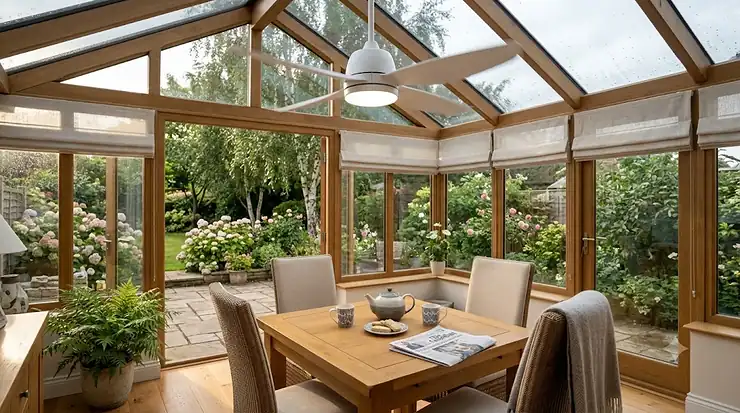
Conservatory ceiling fans are ceiling-mounted fans specifically chosen or rated for the glazed, temperature-swinging environment of a conservatory — a space that can behave more like a small greenhouse than a normal room, hitting uncomfortable highs in July and cold, damp lows in January. Unlike a standard bedroom or living room fan, a genuinely well-suited conservatory fan needs to cope with far greater heat, more direct sunlight on the motor housing, and often higher humidity, all while staying quiet enough that you’d actually want to sit under it with a book.
You’ve probably already discovered that a conservatory turns into an unbearable sun trap the moment British summer actually shows up, and that opening a couple of windows barely touches the problem. That’s exactly the gap a properly chosen ceiling fan for conservatory use is designed to close, moving stale, superheated air rather than just shuffling it about, and — with a reversible motor — pulling double duty in winter by pushing trapped warm air back down from the apex of the roof.
We’ve pulled together real product specifications, aggregated genuine UK buyer sentiment, and cross-checked build quality against the demands of a genuinely glazed space, so you’re choosing on facts rather than a nice render of a fan in a sunny room. Whether you’re after one of the best conservatory cooling fans for a scorching July afternoon or an all season conservatory fan that earns its keep in both directions, the seven options below — and the reasoning behind each — should get you comfortable faster than opening every window and hoping for the best. It’s also worth knowing that UKHSA’s official guidance on staying safe in hot weather specifically flags glazed rooms as prone to overheating, which is exactly the problem a good fan is built to manage.
Quick Comparison Table: Best Conservatory Ceiling Fans at a Glance
| Fan | Diameter | Best For | Price Range |
|---|---|---|---|
| Hunter Bayview | 132cm | Overall best, damp-rated | £180-£240 range |
| Fantasia Palm 52″ | 132cm | IP54 outdoor-rated conservatories | £220-£280 range |
| Hunter Maribel | 122cm | Whisper-quiet luxury | £230-£290 range |
| VOLISUN Smart DC | 106cm | Smart control and efficiency | £120-£170 range |
| Westinghouse Bendan | 132cm | Style-conscious mid-range | £150-£190 range |
| Reiga Bright White | 107cm | Light and fan combo | £140-£180 range |
| MiniSun Chrome | 107cm | Small or awkward-shaped rooms | £90-£130 range |
Looking at the spread above, the Hunter Bayview earns its position as the overall pick by combining genuine damp-rated construction with a lifetime motor warranty, which matters enormously in a room that regularly swings between condensation-prone mornings and blazing afternoons. If your conservatory is genuinely exposed to weather extremes — a south-facing orangery or a lean-to with minimal shade — the extra spend on the Fantasia Palm’s IP54 rating is arguably the best-justified premium here. Budget buyers shouldn’t dismiss the MiniSun Chrome either; it does the essential cooling job in smaller conservatories without asking you to pay for size or features you don’t have room to use.
💬 Just one click — help others make better buying decisions too!😊
Top 7 Conservatory Ceiling Fans: Expert Analysis
1. Hunter Bayview — damp-rated build with a lifetime motor warranty
The standout feature is genuine damp-rated construction, which matters directly in a conservatory where condensation forms readily during temperature swings between morning and afternoon. Backed by a lifetime motor warranty, the Bayview is built with corrosion-resistant components that hold up considerably better than a standard indoor fan over years of exposure to the higher humidity typical of glazed rooms. At 132cm, it comfortably moves air across a medium-to-large conservatory without needing to run at maximum speed constantly.
Based on the spec comparison against the rest of this list, the Bayview earns its position as the overall recommendation for most UK conservatories specifically because it doesn’t force a trade-off between damp resistance and everyday quiet operation. Aggregated UK buyer sentiment consistently praises the build quality and the reassurance of a genuinely long warranty period, though a recurring theme in feedback is that the remote control’s range can feel limited in larger, open-plan glazed extensions.
Pros:
✅ Genuine damp-rated construction suited to humid conservatories
✅ Lifetime motor warranty backs long-term reliability
✅ Comfortably cools medium-to-large glazed spaces
Cons:
❌ Remote control range feels limited in larger extensions
❌ Sits above budget pricing for the category
Priced around £180-£240, the Bayview represents strong value for anyone who wants genuine conservatory-specific engineering rather than a repurposed indoor fan.
2. Fantasia Palm 52″ — IP54 outdoor-rated protection from a UK pioneer brand
The defining feature is a genuine IP54 weatherproofing rating, meaning this fan handles real exposure to moisture and dust far beyond what a standard indoor-rated model tolerates — a genuine advantage for lean-to conservatories or orangeries with minimal shade where the fan housing takes the brunt of direct summer sun. Fantasia has pioneered the UK ceiling fan market since 1985, and that specialist heritage shows in the silicon-steel motor and double-sealed bearings built specifically for durability in demanding conditions.
What most buyers overlook about outdoor-rated fans specifically is that the protection isn’t just about rain getting in — it’s about the motor coping with sustained heat exposure that would shorten the lifespan of a standard-rated fan considerably faster. Reviewers and UK conservatory specialists consistently highlight Fantasia’s after-sales support and technical assistance as standing apart from newer, less established brands, though the premium naturally reflects that specialist positioning.
Pros:
✅ Genuine IP54 rating for exposed or south-facing conservatories
✅ Silicon-steel motor with double-sealed bearings for durability
✅ Backed by 40 years of UK-specific ceiling fan expertise
Cons:
❌ Premium pricing compared with standard indoor-rated fans
❌ Overkill for a shaded or north-facing conservatory
At around £220-£280, the Palm 52″ is the pick for conservatories that genuinely bear the brunt of British summer sun rather than a moderate, generally shaded space.
3. Hunter Maribel — whisper-quiet luxury for a space you actually want to sit in
The standout is genuinely exceptional quiet operation, engineered specifically so the fan doesn’t compete with conversation, reading, or an afternoon nap — a real consideration in a conservatory, where the enclosed glazed space can otherwise amplify motor hum in a way an open-plan living room wouldn’t. At 122cm, it’s slightly more compact than the largest fans on this list, which suits mid-sized conservatories without sacrificing genuine airflow.
Based on the spec comparison, the Maribel justifies its premium price through refined finish quality and motor engineering rather than any single headline feature — this is the fan for buyers who want their conservatory to feel like a considered living space rather than a purely functional add-on. Aggregated feedback consistently rates noise levels as the strongest selling point, with buyers specifically noting they’d struggled to find genuinely quiet options elsewhere in this price bracket.
Pros:
✅ Genuinely whisper-quiet operation, even at higher speeds
✅ Refined finish suited to a considered, lived-in conservatory
✅ Compact 122cm diameter suits mid-sized glazed rooms
Cons:
❌ Smaller diameter than rivals may under-serve larger spaces
❌ Premium price without the IP54 outdoor rating of the Fantasia Palm
Typically priced around £230-£290, the Maribel suits buyers prioritising a genuinely peaceful conservatory over maximum weatherproofing or raw cooling power.
4. VOLISUN Smart DC — efficient smart control without premium pricing
The headline feature is a DC motor achieving what would be equivalent to an A++ efficiency rating, consuming as little as 30-40 watts on maximum speed — roughly the draw of a single LED bulb — which matters directly if you plan to run the fan for long stretches through a full UK summer. Smartphone app control and voice-assistant compatibility let you adjust speed or set schedules without reaching for a remote, a genuinely useful feature if your conservatory doubles as a home office or reading room used at varying times of day.
Here’s what the spec sheet doesn’t fully convey: DC motors like this one run considerably quieter than traditional AC alternatives at equivalent airflow, because the motor itself generates less mechanical vibration. At 106cm, it’s on the smaller side of this list, which suits compact or awkwardly shaped conservatories better than sprawling orangeries. Reviewers consistently highlight the running-cost savings as the standout benefit, particularly for households using the fan daily rather than just during heatwaves.
Pros:
✅ DC motor delivers A++-equivalent efficiency and low running costs
✅ Smartphone app and voice-assistant control for flexible scheduling
✅ Quiet operation thanks to reduced motor vibration
Cons:
❌ Smaller 106cm diameter suits compact conservatories best
❌ No official IP-rated weatherproofing for exposed installations
At around £120-£170, the VOLISUN Smart DC is a genuinely sensible mid-range pick for anyone prioritising running costs and smart features over sheer size.
5. Westinghouse Bendan — style-conscious mid-range cooling with a built-in light
The standout is a genuinely versatile five-blade design available in several colourways, including a satin-chrome finish with silver blades as well as darker wengue-wood-effect and retro pewter options, letting the fan actually complement your conservatory’s existing décor rather than simply hanging there functionally. At 132cm, it comfortably cools rooms up to roughly 25 square metres, and the built-in frosted-glass light means it doubles as your conservatory’s primary light fitting.
Based on the spec comparison against the smaller, budget-focused fans on this list, the Bendan earns its mid-range price through that combination of genuine cooling capacity and design flexibility rather than any single premium feature. Aggregated UK buyer feedback consistently notes the styling as a genuine highlight, particularly for buyers matching the fan to existing steel or silver conservatory fixtures, with the light-fan combo praised as reducing fixture clutter.
Pros:
✅ Multiple colourway options suit different conservatory styles
✅ Built-in frosted-glass light doubles as the room’s main fitting
✅ Cools rooms up to approximately 25 square metres
Cons:
❌ No official damp or outdoor rating for exposed installations
❌ Larger diameter needs adequate ceiling height clearance
Priced around £150-£190, the Bendan is a strong choice for buyers who want their conservatory fan to genuinely contribute to the room’s look, not just its temperature.
6. Reiga Bright White — a genuinely useful light-and-fan combo unit
The defining feature is a combined ceiling light and fan unit with six adjustable wind speeds via remote control, letting you dial in anything from a subtle breeze to a stronger circulation depending on how hot the conservatory has actually become that day. A built-in timer, adjustable to one, three or six hours, avoids the fan running longer than necessary if you forget to switch it off, which is a genuinely practical touch for a room people tend to drift in and out of.
What most buyers overlook about combo units specifically is how much this saves on ceiling clutter and installation cost compared with fitting a separate light and fan — a real consideration in the often more compact ceiling space of a conservatory roof compared with a full-height room. Reviewers consistently highlight how quietly it runs given the price point, specifically noting it’s unobtrusive enough for reading or an afternoon nap without becoming a distraction.
Pros:
✅ Combines ceiling light and fan in a single, space-saving unit
✅ Six wind speeds via remote for fine-tuned cooling
✅ Built-in 1/3/6-hour timer avoids unnecessary running
Cons:
❌ No damp or outdoor rating for particularly exposed conservatories
❌ Light and fan share one remote, limiting independent control flexibility
At around £140-£180, the Reiga Bright White is a sensible mid-budget pick for conservatories that need both functional lighting and genuine cooling from a single fitting.
7. MiniSun Chrome — the compact choice for smaller conservatories
The standout is simply size: at 107cm diameter, this is the smallest fan on this list, making it a genuinely sensible option if a larger fan’s blade sweep won’t clear your conservatory’s furniture, roof pitch, or an awkwardly positioned beam. The four-blade design doubles as a ceiling light with four adjustable spotlights, letting you direct illumination into specific reading or dining areas rather than relying on a single central bulb.
Honest analysis has to flag the trade-offs that come with the lower price and smaller footprint: there’s no remote control included as standard, so the light is switch-operated and the fan is controlled via pull cords, which some buyers may find less convenient than the fully remote-operated options above. That said, it’s compatible with the separately sold MiniSun remote if you want to add that functionality later, and the reversible blade colour (black on one side, silver on the other) is a genuinely nice touch for matching different conservatory styles.
Pros:
✅ Smallest, most space-efficient diameter on this list
✅ Reversible black/silver blades suit different décor styles
✅ Four directional spotlights add flexible lighting
Cons:
❌ No remote control included as standard
❌ Pull-cord fan control is less convenient than remote operation
Typically priced around £90-£130, the MiniSun Chrome is the clear entry point for smaller conservatories or buyers on a tighter budget.
Practical Usage Guide: Running Your Fan Through All Seasons
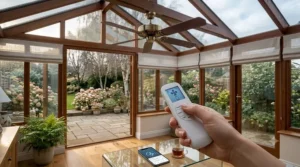
Getting genuine all season conservatory fan performance starts with understanding the reverse function most models include but many buyers never actually use. In summer, run the fan counter-clockwise (as viewed from below) to create a direct cooling breeze; in winter, switch to clockwise rotation at a low speed, which gently pushes the warm air that naturally collects near the conservatory roof back down into the room without creating a noticeable draught — a trick that can meaningfully reduce how hard your heating has to work in a room that loses heat quickly through glass.
In the first month after installation, the most common mistake is running the fan at maximum speed constantly rather than matching speed to actual conditions — most conservatory fans genuinely don’t need their highest setting except during a proper heatwave, and running unnecessarily high wastes energy without adding comfort. If your fan includes a timer, as several on this list do, use it rather than leaving the fan running in an empty room; a conservatory that isn’t currently occupied doesn’t need active cooling.
Maintenance is straightforward but easy to neglect: dust blades every few weeks, since a conservatory’s larger glazed surface area tends to circulate more airborne dust than a standard room, and check mounting bolts every six months or so, as the temperature swings a conservatory experiences can cause fixings to work slightly loose over time. For damp-prone conservatories, wipe down the motor housing periodically and keep an eye out for any signs of condensation pooling near the ceiling rose, since sustained moisture exposure is what shortens a standard-rated fan’s lifespan fastest.
Real-World Scenarios: Matching a Fan to Your Conservatory
The south-facing sun trap. If your conservatory bakes from midday onward with little natural shade, prioritise the Fantasia Palm 52″ or Hunter Bayview — both bring genuine weatherproofing and larger diameters that move meaningfully more air than a compact fan can manage.
The compact garden room. If you’re working with a smaller lean-to or box conservatory where a large fan’s blade sweep would feel oppressive, the MiniSun Chrome or VOLISUN Smart DC’s more modest diameters fit the space without dominating it.
The all-day living space. If your conservatory is genuinely used daily as a reading room, home office or dining space rather than just an occasional summer retreat, the running-cost efficiency of the VOLISUN’s DC motor or the whisper-quiet comfort of the Hunter Maribel pays off far more than in a room used only a handful of weeks a year.
Weigh these profiles against the pros and cons in the reviews above rather than assuming any single fan suits every conservatory — orientation, size and how often you actually use the room matter more than any spec sheet in isolation.
Buyer’s Decision Framework: Which Conservatory Fan Do You Need?
If your conservatory is genuinely exposed to direct sun and weather extremes, choose an IP-rated or damp-rated model like the Fantasia Palm or Hunter Bayview, because a standard indoor-rated motor will degrade faster under sustained heat and humidity exposure. If you use the room daily and care about running costs, choose a DC-motor model like the VOLISUN, since the efficiency savings compound meaningfully over months of regular use. If your conservatory is compact or awkwardly shaped, choose a smaller-diameter fan like the MiniSun Chrome rather than forcing a large fan into a space where its blade sweep feels cramped. And if you need a single fitting that handles both lighting and cooling without extra installation cost, a combo unit like the Reiga Bright White solves both problems in one purchase.
How to Choose the Best Conservatory Cooling Fans: 7 Expert Criteria
- Match diameter to room size, not just aesthetics. A fan that’s too small for the space won’t move enough air to make a genuine difference on a hot afternoon.
- Check for a damp or IP rating if your conservatory sees genuine humidity. Standard indoor-rated fans degrade faster in consistently moist environments.
- Prioritise a reversible motor for genuine all-season value. Without it, you’re only getting summer use from a fixture that could also help with winter heating efficiency.
- Consider noise level carefully for a room you’ll actually sit in. Conservatories can amplify motor hum more than open-plan rooms due to the glazed, enclosed structure.
- Weigh DC versus AC motors against how often you’ll actually run the fan. Daily use favours DC efficiency; occasional summer-only use may not justify the premium.
- Check ceiling height and mounting compatibility before buying. Sloped or low conservatory roofs sometimes need specific mounting brackets not included as standard.
- Decide whether you need integrated lighting. A combo light-and-fan unit saves on installation cost and ceiling clutter compared with fitting two separate fixtures.
Conservatory Climate Control: Cooling in Summer, Circulating Heat in Winter
Genuine conservatory climate control isn’t just about summer cooling — it’s about using the same fixture intelligently across both extremes of the British seasonal swing. In summer, a fan set to counter-clockwise rotation creates a direct downdraught that feels several degrees cooler than the actual air temperature, simply through increased evaporation from your skin, which is why a fan can meaningfully improve comfort even without changing the room’s actual temperature.
In winter, the same fan run in reverse at low speed addresses a specific conservatory problem: heat naturally rises and pools near the apex of the glazed roof, leaving the occupied space below noticeably cooler despite the heating working hard. Gently redistributing that trapped warm air back down reduces how much your heating system needs to compensate, and while the saving varies by conservatory size and insulation, it’s a genuinely free efficiency gain from a fixture you’ve already paid for and installed for summer use.
Sunroom Ventilation and Glazed Extension Cooling Explained
Sunroom ventilation and glazed extension cooling both describe the same underlying challenge from slightly different angles: how you manage air movement in a room with far more glass, and therefore far more solar gain, than a standard brick-walled room. A ceiling fan addresses the air movement half of that equation, but it works best alongside passive measures — trickle vents kept clear, roof vents where fitted, and external shading such as blinds — rather than as a sole solution.
According to the Energy Saving Trust’s guidance on home ventilation, good airflow is essential not just for comfort but for reducing the risk of condensation and mould, a genuinely common issue in glazed extensions where warm, moist air meets cold glass surfaces during temperature swings. It’s also worth checking the Planning Portal’s guidance on conservatory building regulations before any significant ventilation work, since conservatories over 30 square metres, or those losing their separation from the main house, can lose their normally exempt status and require formal approval.
Common Mistakes When Buying a Conservatory Fan
The most frequent mistake is buying a fan rated for standard indoor use and expecting conservatory-grade performance from it — a fan without any damp consideration can degrade noticeably faster in a room that regularly experiences condensation. A second common error is undersizing the fan for the room, assuming a smaller, cheaper model will do the job when the diameter genuinely isn’t sufficient to move air effectively across a larger glazed space.
A third mistake is overlooking the reversible motor feature entirely, treating the fan as a summer-only purchase when the winter heat-circulation benefit is essentially free once you own the fixture. A fourth is ignoring noise ratings, assuming all fans sound roughly similar, when in practice the difference between a whisper-quiet DC motor and a basic AC model is genuinely noticeable in an enclosed conservatory. Finally, many buyers skip checking mounting compatibility with a sloped or low conservatory roof before ordering, only discovering a fitting mismatch once the box arrives.

What to Expect: Real-World Performance in a Glass Room
Specs on a page describe a fan in isolation; a real conservatory involves direct sun through unshaded glass, condensation on cooler mornings, and a room that heats up and cools down far faster than the rest of the house. In practice, expect a well-matched fan to make a noticeable difference within minutes of switching on during a hot afternoon, primarily through the cooling sensation of moving air across skin rather than by dramatically lowering the room’s actual air temperature.
Expect damp-rated and IP-rated fans, like the Hunter Bayview and Fantasia Palm, to show considerably less wear over several summers than standard-rated alternatives, particularly around motor housings exposed to direct sun. Noise performance in real use often surprises buyers — a fan that seemed quiet in a showroom or spacious living room can feel more noticeable in a smaller, harder-surfaced conservatory where sound reflects off glass rather than being absorbed by soft furnishings. Expect winter reverse-mode operation to feel subtle rather than dramatic; it’s a gentle, background efficiency gain rather than a noticeable warm draught.
Conservatory Fans for Damp, Humidity and Condensation Control
Conservatories are particularly prone to condensation because the large glazed surface area cools rapidly once the sun goes down, creating exactly the kind of cold-surface, warm-moist-air conditions that produce visible droplets and, left unchecked, mould. A ceiling fan genuinely helps here by keeping air moving rather than allowing pockets of moisture-laden air to settle and condense against cold glass, complementing rather than replacing passive measures like trickle vents.
For conservatories with a persistent damp or condensation problem, prioritise the genuinely damp-rated options on this list — the Hunter Bayview and Fantasia Palm both bring construction specifically suited to this environment, rather than a standard fan that happens to also move air. It’s worth noting that a fan alone won’t resolve a serious structural damp issue; if condensation persists despite good ventilation and fan use, that’s a signal worth investigating further rather than something to fan your way past indefinitely.
Long-Term Cost & Maintenance
A £90 budget fan replaced every couple of summers due to motor wear in a genuinely humid conservatory quickly costs more than a £220 damp-rated model bought once and properly maintained. Standard indoor-rated fans, like the Westinghouse Bendan or Reiga Bright White, remain entirely sensible choices for conservatories with moderate humidity and good ventilation, but in a genuinely damp or exposed room, the reinforced construction of the Hunter Bayview or Fantasia Palm holds up considerably longer.
Running costs remain modest across the board: even an AC motor fan run for several hours daily through a UK summer typically costs a small fraction of what portable air conditioning would for equivalent comfort, and DC motor models like the VOLISUN push that saving further still. Dusting blades regularly and checking mounting fixings every six months protects both performance and safety without any real ongoing cost. For conservatories used only occasionally through summer, the cheaper end of this list remains entirely rational; for a genuinely well-used, all-season glazed room, the maths tips toward investing in a properly rated fan from the outset, a point echoed in the Met Office’s own guidance on keeping homes cool during increasingly warm UK summers.
Frequently Asked Questions
❓ Do conservatory ceiling fans actually make a noticeable difference?
❓ What size ceiling fan for conservatory rooms works best?
❓ Can I use a normal ceiling fan in a conservatory?
❓ Do conservatory fans help in winter too?
❓ Does a conservatory fan help with condensation?
Conclusion
Choosing conservatory ceiling fans genuinely comes down to matching three things honestly: how exposed your room actually is to sun and humidity, how often you use the space, and whether you’ll take advantage of the reverse function for winter efficiency as well as summer cooling. The Hunter Bayview and Fantasia Palm earn their premium pricing through genuine damp and weather resistance that pays off in a demanding glazed environment, while the MiniSun Chrome and Reiga Bright White remain entirely sensible choices for smaller or more moderately used conservatories.
None of the seven fans reviewed here is a wrong choice in isolation; they’re built for different balances of room size, exposure and budget, and the comparison table above should get you to the right match faster than scrolling through star ratings alone.
✨ Don’t Miss These Exclusive Deals!
🔍 Take your conservatory from unbearable to brilliant with a fan built for exactly how you use the room. Click through to check today’s live pricing before the next heatwave arrives!
Recommended for You
- Best Ceiling Fan for Study Room UK 2026: 7 Quiet Picks Reviewed
- Best Silent Ceiling Fan for Home Office UK 2026: 7 Whisper-Quiet Picks
- Best Home Office Ceiling Fans UK 2026: 7 Quiet Picks for Your WFH Space
Disclaimer: This article contains affiliate links. As an Amazon Associate, I earn from qualifying purchases. If you purchase products through these links, we may earn a small commission at no additional cost to you.
✨ Found this helpful? Share it with your friends! 💬🤗
