
In This Article
Walk into any shop on a warm Saturday afternoon and you’ll feel it before you see it: that thick, stagnant air that makes customers linger by the door instead of browsing the rails. Retail space ceiling fans are large-diameter, ceiling-mounted fans engineered to move air across wide, open-plan commercial floors, keeping shoppers and staff comfortable without the running costs or ductwork of full air conditioning. For UK retailers, they’re quietly becoming one of the cheapest fixes for a genuinely expensive problem — customers who cut their visit short because the shop floor feels airless.

This isn’t a niche concern either. According to the Health and Safety Executive, employers have a legal duty to keep workplace temperatures reasonable, and a stuffy retail environment affects staff wellbeing just as much as customer dwell time. The trouble is that most advice online is either generic (buy “a fan”) or lifted straight from a manufacturer’s spec sheet with zero context for what those numbers mean on an actual shop floor.
We’ve gone the other way. Below you’ll find seven real, currently available ceiling fans — spanning budget high-street picks through to serious high-volume, low-speed units built for warehouse-style retail — with honest analysis of who each one suits, what the aggregated reviews say, and where the value genuinely sits. Whether you’re kitting out a boutique, a garden centre, or a big-box unit, there’s a retail space ceiling fans option here that fits your footprint and your budget. Let’s get into it.
Quick Comparison Table
| Category | Best Option | Blade Span | Ideal Floor Size | Price Range |
|---|---|---|---|---|
| Budget commercial | Westinghouse Industrial 122cm White | 122 cm | Up to 20 m² | £140–£190 |
| Lights included | HOMCOM 62cm Ceiling Fan with Lights and App Control | 62 cm | Up to 15 m² | £90–£150 |
| Best value British brand | Fantasia 48 Inch Commercial Ceiling Fan | 122 cm | Up to 25 m² | £90–£130 |
| Destratification specialist | Vent-Axia Hi-Line Plus 1200mm | 120 cm | 30–60 m² | £300–£450 |
| Large-format HVLS | ZASTION iLiving 108-Inch HVLS Big Ceiling Fan | 274 cm | 80 m²+ | £700–£1,000 |
Looking at this snapshot, the split is really about ceiling height and floor size rather than brand loyalty — a small boutique and a converted warehouse unit have almost nothing in common when it comes to airflow needs. Budget commercial units from Westinghouse Industrial 122cm White and Fantasia 48 Inch Commercial Ceiling Fan cover the vast majority of standard high-street units comfortably, while anyone running a big-box floor or a former industrial unit should be looking straight at the destratification and HVLS end of the table. Price ranges here are approximate and can shift with stock and season, so always check current pricing before you commit.
💬 Just one click — help others make better buying decisions too!😊
Top 7 Retail Space Ceiling Fans: Expert Analysis
Choosing between these seven comes down to three things: your ceiling height, your floor area, and how much of the “shop floor experience” you want the fan itself to contribute to (a striking light fitting versus an invisible workhorse tucked into a stockroom). Every model below is a real, currently listed product — we’ve deliberately avoided anything that reads suspiciously like a rebadge with no verifiable track record.
1. Fantasia 48 Inch Commercial Ceiling Fan — best British-built value pick for shop floors
Fantasia has been designing ceiling fans in Kent since 1985, and the 48-inch commercial model is the one that turns up again and again in independent shops and small retail units across the country. The 122 cm blade span is calibrated for rooms up to roughly 25 m², which covers a huge slice of the UK’s standalone high-street units without needing a second fan.
What you’re actually buying here is a metal-bladed AC motor built for continuous commercial duty rather than the lighter DC motors found in most domestic fans, plus forward and reverse settings so the same unit works for summer cooling and winter heat redistribution. Based on the spec comparison against similarly priced imports, the standout here is the ten-year motor warranty Fantasia backs its commercial range with — a meaningful signal of build confidence rather than marketing fluff.
This one’s for independent retailers who want dependable commercial-grade air movement without paying warehouse-fan money, and who value buying from a manufacturer with three decades of UK trading history behind it. Aggregated feedback on Fantasia’s commercial range consistently highlights straightforward installation and quiet running on lower speeds, though a handful of reviewers note the remote control (sold separately on some variants) is worth adding from day one rather than as an afterthought.
Pros:
- ✅ Ten-year motor warranty from an established British brand
- ✅ AC motor rated for continuous commercial use
- ✅ Reversible airflow for year-round comfort
Cons:
- ❌ Remote control often sold as a separate accessory
- ❌ Metal blades add weight versus lighter aluminium HVLS designs
Sitting around the £90–£130 range at the time of research, the Fantasia 48 Inch Commercial Ceiling Fan represents strong value if your unit falls within its coverage window — check current price before ordering, as commercial stock fluctuates more than domestic lines.
2. Westinghouse Industrial Cromo — sleekest chrome finish for boutique counters
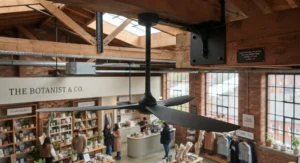
Westinghouse’s Industrial Cromo takes the same durable commercial chassis as the rest of the range and wraps it in a polished chrome finish with matching chrome steel blades — a deliberate move toward retail spaces where the fan itself is part of the visual merchandising, not just a utility fixture. It’s rated for rooms up to around 20 m², making it a natural fit for boutiques, jewellers, and smaller concept stores.
The four-position wall switch keeps operation simple for retail staff who don’t have time to fumble with a remote between customers, and the built-in summer/winter reverse function means the same fixture earns its keep across the whole year rather than sitting idle from October to March. What most buyers overlook about chrome-finish commercial fans is that the reflective surface actually helps bounce shop lighting around the space, subtly brightening displays underneath — a small but genuine secondary benefit beyond airflow.
This is the pick for retailers who’ve invested in a polished interior and don’t want a utilitarian grey fan undoing that work. Reviewers consistently note the chrome finish holds up well against fingerprints and dust compared to matte alternatives, though as with most chrome fixtures, it does show smudges under close inspection more readily than a brushed finish would.
Pros:
- ✅ Chrome finish suits premium or boutique retail interiors
- ✅ Simple four-position wall switch for staff use
- ✅ Reversible motor for summer and winter modes
Cons:
- ❌ Chrome surface shows fingerprints more than matte finishes
- ❌ Coverage capped at around 20 m², limiting it to smaller units
Expect to pay in the £150–£220 range for the Westinghouse Industrial Cromo at the time of research, positioning it as a mid-tier choice where finish matters as much as function.
3. Westinghouse Industrial 122cm White — toughest budget workhorse for stockrooms
If the Cromo is the front-of-house option, the white-finish Industrial model from the same Westinghouse range is its practical sibling — designed for stockrooms, staff areas, and shop floors where a clean, unfussy white housing blends into the ceiling rather than drawing attention. At 122 cm across with three white steel blades, it covers spaces up to roughly 20 m², and the four-speed wall control with reverse switch is included as standard rather than sold separately.
Here’s what the spec sheet won’t tell you, but the enduring popularity of this exact model does: it’s become something of a default choice for bars, cafés, and back-of-house retail areas precisely because it’s unremarkable in the best sense — silent enough not to interfere with ambient sound, and built from cold-rolled steel that shrugs off the knocks a stockroom fan inevitably takes. On paper this means slightly less visual drama than the Cromo, but a lower price point to match.
Best suited to retailers prioritising function over form, or anyone furnishing a stockroom, back office, or staff break area where budget matters more than aesthetics. Aggregated customer sentiment for this model skews heavily toward reliability over the long haul, with several reviewers specifically mentioning years of continuous use without motor issues.
Pros:
- ✅ Four-speed wall control included as standard
- ✅ Cold-rolled steel construction built for durability
- ✅ Neutral white finish blends into most ceilings
Cons:
- ❌ Less visually distinctive than the chrome Cromo variant
- ❌ Non-returnable on some retailers once purchased, so measure twice
The Westinghouse Industrial 122cm White typically sits in the £140–£190 range, making it one of the more dependable mid-budget picks on this list for anyone who wants Westinghouse’s commercial-grade motor without the chrome premium.
4. HOMCOM 62cm Ceiling Fan with Lights and App Control — best for shop ceiling fans with lights
For retailers specifically hunting shop ceiling fans with lights, this HOMCOM model solves two problems in one fixture: ambient overhead lighting and airflow, controlled either via a physical remote or the Smart Life app. The 62 cm diameter suits smaller retail footprints — think concept stores, salons, or boutique fitting areas — up to around 15 m², and the three colour temperature settings let staff match lighting to different times of day or seasonal displays.
Six speed settings paired with a reversible DC motor give this fixture genuinely fine-grained control, and the app integration means a shop manager can adjust airflow and lighting from a phone rather than a wall switch mounted somewhere inconspicuous. Based on the spec comparison with similarly priced fan-light combinations, the DC motor here is worth flagging specifically: it draws meaningfully less power than the AC motors used in most budget commercial fans, which matters if you’re running the fixture for ten-plus hours a day, every day the shop’s open.
This is the right call for smaller retail units where a single fixture needs to double as a design feature and a cooling solution, particularly in spaces without room for separate light fittings and fans. Reviewers consistently flag the app control as intuitive, though a recurring theme in aggregated feedback is that Wi-Fi connectivity setup can be fiddly on the first attempt — budget ten extra minutes for pairing.
Pros:
- ✅ Combines lighting and airflow in one fixture
- ✅ Six speeds plus app and remote control
- ✅ Energy-efficient reversible DC motor
Cons:
- ❌ Smaller 15 m² coverage limits it to compact retail spaces
- ❌ App pairing can be fiddly on first setup
Priced around the £90–£150 range at the time of research, the HOMCOM 62cm Ceiling Fan with Lights and App Control offers strong value for retailers who want a genuine two-in-one fixture rather than separate lighting and cooling installations.
5. Amazon Basics 56-Inch Industrial Style Ceiling Fan — classic industrial look without the industrial price
Amazon’s own commercial-style fan brings the exposed-blade, brushed nickel aesthetic that’s become shorthand for “industrial retail” — think exposed brick, concrete floors, and open ductwork — without the price tag of dedicated warehouse fan brands. At 56 inches (142 cm), it comfortably covers larger single rooms, and the included wall control with three steel blades keeps the installation straightforward.
The honest analytical take here is that this fan trades brand pedigree for price: you’re not getting Fantasia’s three decades of UK commercial fan manufacturing or Vent-Axia’s engineering heritage, but you are getting a genuinely large blade span at a price point that undercuts most dedicated commercial brands. What most buyers overlook is that “industrial style” doesn’t always mean industrial-grade motor durability — this is better suited to standard retail hours than round-the-clock warehouse operation.
Ideal for retailers converting industrial-look units into shop floors — think furniture showrooms, plant and garden retailers, or lifestyle stores leaning into raw, exposed interiors — where the fan itself needs to look the part as much as perform. Aggregated review sentiment is broadly positive on airflow and appearance, with a recurring caveat that assembly instructions could be clearer for first-time installers.
Pros:
- ✅ Large 56-inch span suits bigger single rooms
- ✅ Genuine industrial-style aesthetic at a lower price
- ✅ Wall control and reversible blades included
Cons:
- ❌ Assembly instructions criticised as unclear by some buyers
- ❌ Motor not rated for the continuous-duty cycles of dedicated commercial brands
At around £110–£160, the Amazon Basics 56-Inch Industrial Style Ceiling Fan is the pragmatic choice for retailers chasing an industrial look on a mid-range budget, rather than a warehouse-grade duty cycle.
6. Vent-Axia Hi-Line Plus 1200mm — best for store ventilation and winter heat recovery
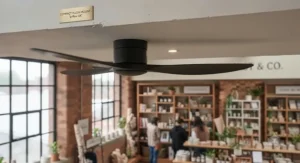
Vent-Axia has been manufacturing ventilation equipment in Britain since 1933 — the company even supplied fans for 10 Downing Street during the Second World War — and the Hi-Line Plus range is its purpose-built answer to destratification in commercial spaces. Rather than a decorative fan that happens to move air, this is engineered specifically for stores, foyers, warehouses and workshops where warm air pools near a high ceiling and needs actively pushing back down to shopper level.
The 1200mm sweep is designed for spaces in the 30–60 m² bracket with elevated ceilings, and it’s built to run continuously through winter as much as summer: the whole point of destratification is recovering the heat that’s already risen to the ceiling rather than letting it escape, which the NHS’s own facilities guidance on destratification fans notes is standard practice for large halls and retail stores with high ceilings. Here’s what the spec sheet won’t tell you: destratification fans like this one are typically sold through trade and commercial suppliers rather than general retail, reflecting their status as genuine building-services equipment rather than a lifestyle purchase.
This is squarely for retail units with high or vaulted ceilings — converted warehouses, former industrial units, garden centres — where standard ceiling fans simply can’t reach the stratified hot air layer. Aggregated feedback from commercial installers consistently praises the infinitely variable speed controller, which lets facilities managers dial in exactly the right amount of air movement for the space rather than being locked into three fixed speeds.
Pros:
- ✅ Purpose-built for destratification in high-ceilinged retail units
- ✅ Backed by a British manufacturer with 90+ years of heritage
- ✅ Infinitely variable speed control for precise tuning
Cons:
- ❌ Premium price reflects its trade/commercial positioning
- ❌ Overkill for standard-height, smaller retail floors
Expect a price in the £300–£450 range for the Vent-Axia Hi-Line Plus 1200mm, which is a genuine investment rather than an impulse buy — but for the right high-ceilinged retail space, it’s solving a problem that decorative ceiling fans simply can’t touch.
7. ZASTION iLiving 108-Inch HVLS Big Ceiling Fan — best for warehouse-style retail and big-box floors
At 108 inches (274 cm) across, this is a different category of product entirely from the rest of this list — a High Volume, Low Speed fan built to move enormous quantities of air slowly and quietly across expansive floor plans, rated for up to 20,000 CFM depending on configuration. It’s the kind of fixture you’ll spot in cash-and-carry warehouses, garden centres, and big-box retail units where a handful of standard ceiling fans simply couldn’t cover the square footage.
The brushless DC motor is the real story here: rather than spinning fast and loud like a traditional fan, HVLS units rotate at a fraction of the speed while moving vastly more air per rotation, which translates to a gentler, more even breeze across the whole shop floor rather than one gusty zone directly underneath. Based on the spec comparison against multiple smaller fans covering the same area, a single HVLS unit like this one typically replaces ten to twenty standard ceiling fans while consuming meaningfully less total energy — a genuine long-term cost consideration for larger retail operators.
This is exclusively for large-format retail: warehouse conversions, DIY sheds, garden centres, and any unit where ceiling height and floor area outstrip what a standard fan range can handle. Reviewers consistently highlight how quiet the unit runs at low speed given its size, though several note that professional installation is strongly advisable given the fan’s weight and the structural mounting it requires.
Pros:
- ✅ One unit can replace 10–20 standard ceiling fans
- ✅ Whisper-quiet operation despite its scale
- ✅ Brushless DC motor built for energy efficiency
Cons:
- ❌ Requires professional structural installation
- ❌ Significant upfront cost compared to standard commercial fans
Priced in the £700–£1,000 range at the time of research, the ZASTION iLiving 108-Inch HVLS Big Ceiling Fan is a serious capital purchase — but for genuinely large retail floors, it can replace an entire bank of smaller fans and their combined running costs.
Setting Up Your Retail Space Ceiling Fan: A Practical Guide
Getting a fan onto the ceiling is the easy part; getting it working properly for a retail environment takes a bit more thought. Retail floors have different airflow needs to a living room — you’ve got open doors letting in draughts, till areas that shouldn’t feel like a wind tunnel, and stock that shouldn’t be disturbed by a gale-force setting.
Start by mapping your ceiling height against the fan’s minimum clearance — most commercial units, including the Fantasia 48 Inch Commercial Ceiling Fan and both Westinghouse models above, need at least 2.4–2.7 metres of clearance to move air effectively without creating an uncomfortable downdraught directly beneath the blades. In the first thirty days, run the fan on its lowest setting during quiet hours to let staff get used to the airflow pattern before ramping up for busy periods, and check that nothing on display — paper signage, lightweight stock, hanging displays — is positioned to catch a direct blast.
Maintenance is refreshingly low-effort if you stay ahead of it: wipe blades monthly to prevent dust building into visible clumps (a bigger issue on a shop floor customers can see than in a private office), and switch the reverse function to clockwise once autumn arrives to redirect risen warm air back down to shopper level rather than letting it sit uselessly at ceiling height. The most common first-month mistake retailers make is running the fan on maximum speed constantly, which both wastes energy and creates the exact “wind tunnel” effect that puts customers off lingering near a display — moderate, continuous airflow beats intermittent full blast every time.

Real-World Scenarios: Matching Fans to Your Shop Type
Abstract specs only get you so far — here’s how the maths plays out for three genuinely common UK retail set-ups.
Picture an independent boutique on a converted Georgian high street, ceilings around 2.6 metres, floor space roughly 20 m². This is precisely the bracket the Westinghouse Industrial Cromo was built for: compact enough not to dominate a period ceiling, chrome finish that complements a premium retail fit-out, and coverage that matches the room without wasted capacity. A shop this size genuinely doesn’t need — and shouldn’t pay for — HVLS-grade airflow.
Now picture a garden centre or DIY retailer occupying a converted agricultural or industrial shed, ceilings pushing five metres or more, floor space well past 100 m². Here the maths flips entirely: the ZASTION iLiving 108-Inch HVLS Big Ceiling Fan, potentially paired with the Vent-Axia Hi-Line Plus 1200mm for destratification in the highest sections, is the only combination on this list actually capable of moving meaningful air across that volume. A handful of standard 48-inch fans would leave huge dead zones untouched.
Finally, picture a mid-sized independent gift shop or lifestyle store, 30–40 m², standard 2.7-metre ceiling, where the fan is as much a design statement as a utility. The HOMCOM 62cm Ceiling Fan with Lights and App Control earns its place here specifically because it does double duty as a lighting fixture, saving the cost and ceiling clutter of installing separate lights and fans in a space where every fixture is visible to browsing customers.
Common Retail Ventilation Problems (And How to Fix Them)
Even with the right fan installed, most retail ventilation complaints trace back to a handful of recurring issues — and each has a specific fix rather than a vague “try adjusting the settings.”
Problem: Hot air pools near the till or fitting rooms. This usually means the fan is positioned centrally but the problem zone is off to one side. Solution: a second, smaller fan — even a budget option like the Westinghouse Industrial 122cm White — positioned directly over the affected area, rather than relying on one central unit to push air across an irregular floor plan.
Problem: Customers complain of draughts near the entrance. This is almost always a fan running on too high a setting too close to an external door. Solution: drop to the lowest or second speed setting near entrances, saving higher speeds for the depth of the shop floor where the air genuinely needs the extra push.
Problem: Winter heating bills creep up despite the fan sitting idle. Reverse-mode functionality exists precisely for this, yet it’s the single most under-used feature across every fan on this list. Solution: physically flip the reverse switch (or app setting on the HOMCOM 62cm Ceiling Fan with Lights and App Control) to clockwise rotation each autumn, pulling risen warm air back down instead of letting the ceiling sit ten degrees warmer than the shop floor.
Problem: A large unit still has noticeable dead spots. This typically means the space has genuinely outgrown standard ceiling fan coverage. Solution: step up to destratification or HVLS-class equipment like the Vent-Axia Hi-Line Plus 1200mm or ZASTION iLiving 108-Inch HVLS Big Ceiling Fan rather than adding more standard fans, which only compounds the uneven-coverage problem.
How to Choose Retail Space Ceiling Fans
Here’s a structured, seven-step approach that cuts through spec-sheet noise and gets you to the right fan for your specific floor.
- Measure your ceiling height first. Anything under 2.4 metres rules out most commercial fans entirely on safety grounds — you’ll need a low-profile or flush-mount model instead.
- Calculate your actual floor area, not just the footprint. Alcoves, fitting rooms, and stockrooms behind the main floor often need separate consideration rather than assuming one fan covers everything.
- Decide whether you need shop ceiling fans with lights or dedicated lighting. Combination units like the HOMCOM 62cm Ceiling Fan with Lights and App Control save installation cost in smaller spaces but limit your lighting design flexibility.
- Match motor type to your running hours. DC motors cost more upfront but use meaningfully less power if the fan runs most of your trading day, every day.
- Check the warranty term against how central the fan is to your operation. A ten-year commercial warranty, like Fantasia’s, matters more if a fan failure means a genuinely uncomfortable shop floor rather than a minor inconvenience.
- Consider destratification separately from standard cooling if your ceilings are high. These are different jobs, and a standard fan simply cannot do what a Hi-Line-style unit is built for.
- Budget for professional installation on anything above standard domestic scale. Commercial and HVLS units, in particular, need proper structural mounting rather than a simple ceiling rose fitting.
Common Mistakes When Buying Retail Space Ceiling Fans
The single biggest mistake retailers make is buying purely on price without checking the coverage rating against their actual floor area — a budget 48-inch fan rated for 20 m² installed in a 45 m² unit will never feel adequate, regardless of how good the individual product is. The second most common error is ignoring ceiling height entirely and discovering, post-purchase, that the minimum clearance requirement rules the fan out for safe installation.
A third pitfall worth flagging explicitly: buying a decorative domestic-style fan for a genuinely commercial application. Fans rated for residential bedrooms simply aren’t built for the duty cycles of a shop running ten or more hours a day, seven days a week — motors designed for occasional evening use will wear considerably faster under continuous commercial operation. Finally, retailers frequently skip the reverse-mode feature entirely, treating the fan as a summer-only purchase when, used correctly, it earns its keep across both hot and cold months by redistributing warm air in winter.
Ceiling Fans vs Other Retail Cooling Solutions
Ceiling fans aren’t the only retail cooling solutions on the table, and it’s worth being honest about where they win and where they don’t. Air conditioning actively lowers ambient temperature; ceiling fans don’t — they create a wind-chill effect that makes occupied space feel cooler without changing the thermometer reading. For a shop floor where customers are moving and staff are active, that distinction matters less than it sounds, because perceived comfort is what actually keeps people browsing.
| Solution | Upfront Cost | Running Cost | Installation Complexity | Best For |
|---|---|---|---|---|
| Retail ceiling fans | Low–Moderate | Low | Moderate | Most standard retail units |
| Air conditioning | High | High | High (ductwork/refrigerant) | Extreme heat, sealed environments |
| Pedestal/floor fans | Very Low | Low | None | Temporary or backup cooling |
| Destratification (Vent-Axia style) | Moderate–High | Low | Moderate | High-ceilinged retail units |
The table makes the trade-off fairly clear: air conditioning wins on raw cooling power but loses badly on both upfront and running cost, plus the installation disruption of retrofitting ductwork into an existing retail unit. Pedestal fans are cheap and instant but do nothing for the stratified warm air sitting at ceiling height, which is precisely the gap that destratification and ceiling fan solutions fill. For the vast majority of UK retail spaces without extreme heat problems, a well-chosen ceiling fan delivers most of the comfort benefit of air conditioning at a fraction of the total cost of ownership.

What to Expect: Real-World Performance in Shops
Specs on a box rarely translate cleanly into what a fan actually feels like on a working shop floor, so here’s the honest translation. A standard commercial fan like the Fantasia 48 Inch Commercial Ceiling Fan on medium speed produces a gentle, near-constant breeze that customers register as “comfortable” rather than “windy” — the goal isn’t to feel the fan, it’s to not notice the air is stagnant.
Building a genuine customer comfort system means thinking beyond a single fixture: airflow direction, door position, and till placement all interact. A fan positioned directly above a till point on high speed will send loose receipts and small stock items flying — better to run entrance-adjacent units gently and reserve higher speeds for the depth of the floor. HVLS units like the ZASTION iLiving 108-Inch HVLS Big Ceiling Fan perform noticeably differently in practice: because they move air slowly across a huge radius rather than in a direct downward column, staff and customers in a warehouse-style unit often don’t consciously feel a “breeze” at all, just a general absence of the stuffiness that would otherwise build up. That’s the point — the best-performing units in a retail context are often the ones nobody comments on, because the alternative (a stuffy, airless shop floor) is what actually gets noticed and complained about.
Store Ventilation Ceiling Fans for Different Retail Environments
Not every retail environment has the same airflow challenge, and treating “store ventilation ceiling fans” as a single category misses genuinely important differences. Fitting rooms and changing areas need particularly gentle, well-distributed airflow — nobody wants a gust while getting changed, so lower-speed settings from smaller units like the HOMCOM 62cm Ceiling Fan with Lights and App Control suit these enclosed spaces better than a single large fan positioned to cover the whole floor.
Open-plan supermarkets and large-format grocers face a different problem entirely: chilled cabinets and freezer units create localised cold pockets that can conflict with overhead fan airflow if positioned poorly, so retail environment control in these settings often means zoning fan coverage away from refrigeration rather than blanket coverage across the whole store. Garden centres and DIY retailers, meanwhile, frequently have semi-outdoor or partially covered sections where humidity as much as heat is the issue — here, continuous air movement from a destratification-class unit like the Vent-Axia Hi-Line Plus 1200mm does double duty, discouraging condensation build-up on high ceilings while keeping the shop floor comfortable below.
Long-Term Cost & Maintenance: Shopping Area Ventilation Economics
The upfront price tag is only part of the shopping area ventilation cost equation — running costs and maintenance over a five-to-ten-year horizon usually matter more for a retail operator than the initial purchase. DC motor units, including the HOMCOM 62cm Ceiling Fan with Lights and App Control, typically draw a fraction of the wattage of older AC motor designs when run for the same number of hours, and given most shops operate fans for eight-plus hours daily across the warmer months, that difference compounds meaningfully over a year.
According to the Energy Saving Trust’s guidance on cooling homes efficiently, fans remain among the cheapest cooling appliances to run compared to air conditioning — a principle that scales directly to commercial floors, where the gap between fan running costs and AC running costs widens further given the larger areas involved. Maintenance costs stay low across this whole list provided basic upkeep is followed: annual bearing checks on commercial-duty AC motors like those in the Westinghouse range, and periodic blade cleaning to prevent dust imbalance, which over time can cause audible wobble and, eventually, motor strain. The Fantasia 48 Inch Commercial Ceiling Fan‘s ten-year warranty is a useful proxy here too — a manufacturer backing a motor for a decade is implicitly telling you what its realistic maintenance-free lifespan looks like under commercial use.
Safety, Regulations & Retail Environment Control Compliance
UK retailers have specific legal obligations around workplace temperature that make ceiling fans more than a comfort nice-to-have. The Workplace (Health, Safety and Welfare) Regulations 1992 require indoor temperatures to be “reasonable” during working hours, and the HSE’s Approved Code of Practice sets out practical guidance for demonstrating compliance — ventilation and air movement, including ceiling fans, feature explicitly among the recommended interventions for warm workplaces.
Beyond temperature law, any ceiling fan sold in the UK needs to carry UKCA marking (or CE marking under current transitional arrangements) confirming it meets essential electrical safety requirements, and commercial-scale units — particularly HVLS fans like the ZASTION iLiving 108-Inch HVLS Big Ceiling Fan — should always be installed by a qualified electrician given the structural mounting loads and wiring involved. Retail environment control also extends to practical safety: blades need adequate clearance from any mezzanine, high shelving, or display fixtures, and destratification units mounted at height, such as the Vent-Axia Hi-Line Plus 1200mm, require secure ceiling or beam fixing rather than standard plasterboard fittings.
Frequently Asked Questions
❓ Do retail spaces legally need ceiling fans?
❓ What size ceiling fan does a shop need?
❓ Can ceiling fans replace air conditioning in a shop?
❓ Are shop ceiling fans with lights worth it?
❓ How much does it cost to run a retail ceiling fan?
Conclusion
Choosing between these seven retail space ceiling fans really comes down to an honest assessment of your floor: measure the ceiling height, work out the genuine square footage, and decide whether lighting needs to live in the same fixture as the fan. Independent shops with standard ceilings are well served by commercial mid-range options like the Fantasia 48 Inch Commercial Ceiling Fan or either Westinghouse Industrial model, while larger, higher-ceilinged retail units genuinely need the specialist engineering behind the Vent-Axia Hi-Line Plus 1200mm or the sheer coverage of the ZASTION iLiving 108-Inch HVLS Big Ceiling Fan.
None of this needs to be an expensive, disruptive project. A well-matched ceiling fan is one of the fastest, least invasive comfort upgrades a retail unit can make, and the difference in customer dwell time on a warm afternoon is often more noticeable than retailers expect. Take the floor measurements, match them against the comparison table above, and check current pricing before you commit — stock and pricing on commercial fan ranges shift more often than the domestic market.
✨ Don’t Miss These Exclusive Deals!
🔍 Take your shop floor comfort to the next level with the models covered above. Click through to check current pricing and availability on whichever option matches your space — a cooler, more comfortable retail environment for your customers starts with a single well-chosen fixture!
Recommended for You
- Office Ceiling Fans Bulk Buy: 7 Best Picks for 2026
- Commercial Ceiling Fans UK: 7 Best Picks for 2026
- Garage Ceiling Fans 2026: 7 Best Picks for UK Workshops
Disclaimer: This article contains affiliate links. As an Amazon Associate, I earn from qualifying purchases. If you purchase products through these links, we may earn a small commission at no additional cost to you.
✨ Found this helpful? Share it with your friends! 💬🤗
