
In This Article
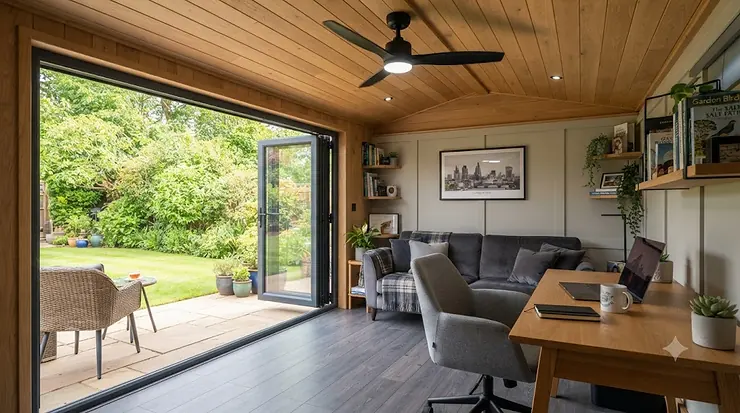
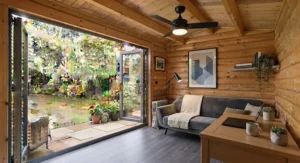
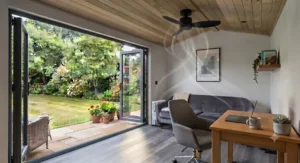
There’s a particular kind of misery that only hits you in a garden room in July: the sun has been battering that flat roof since nine in the morning, the laptop fan is screaming louder than you are, and opening the door just invites in wasps. If you’ve built or bought a garden office, studio or summerhouse, you’ll already know that these buildings heat up faster — and cool down slower — than the house they’re standing next to. Garden room ceiling fans are quietly becoming one of the most searched-for fixes for this exact problem, and for good reason: unlike a portable fan wobbling on your desk, a ceiling-mounted unit clears the floor space, moves air through the whole room rather than just at you, and — reversed in winter — actually helps push warm air back down from the roof apex, which matters a lot in a room with minimal thermal mass.
This guide walks through seven genuine, currently available fans suited to garden rooms, with honest analysis of who each one actually suits rather than a straight list of numbers pulled from a spec sheet. Garden rooms throw up their own quirks — low eaves, exposed rafters, single-phase wiring runs from the house, condensation on cold mornings — so a fan that’s brilliant in a Victorian terrace lounge with a 3-metre ceiling isn’t automatically brilliant bolted into a 2.4-metre pitched-roof cabin at the bottom of the lawn. What is a garden room ceiling fan, in practical terms? It’s a compact, usually flush-mounted (or “hugger”) fan designed to circulate air in a small, often single-storey outbuilding, prioritising a shallow mounting profile, quiet DC operation and — ideally — a reverse winter mode over sheer blade span. Below, you’ll find real products, a comparison table, and enough context on electrics, ventilation and low-ceiling clearance to make a confident decision rather than a guess.
Quick Comparison Table
| Fan | Blade Span | Mount Type | Motor | Price Range | Best For |
|---|---|---|---|---|---|
| MiniSun Silver Chrome and Wood | 30″ / 76cm | Flush | AC, 3-speed | Under £70 | Tightest budgets |
| Depuley Flush Mount Low Profile | 42″ | Flush | DC, app + remote | £90-£140 range | Smart-home garden offices |
| HOMCOM 130cm Flush Mount LED | 130cm | Flush | AC, 4-speed | £100-£140 range | No-fuss, no app |
| NIORSUN 50cm Smart LED | 50cm | Semi-flush | DC, 6-speed | Under £100 | Compact studios |
| Fantasia Prima | 36″-44″ | Flush/dual mount | AC, 3-speed | £150-£220 range | Long-term reliability |
| Lucci Air Airfusion Radar | 52″ | Ultra-flush hugger | DC, 6-speed | £180-£260 range | Very low ceilings |
| Westinghouse Alloy | 42″ | Flush | AC/DC hybrid range | £150-£220 range | Premium all-rounder |
Reading across this table, the split is really between AC-motor fans that cost less upfront but run a little noisier and warmer, and DC-motor fans like the Depuley, NIORSUN and Lucci Air Airfusion Radar that cost more but sip a fraction of the electricity while running library-quiet on low speed — a genuinely useful trait when your garden room doubles as a Zoom-call office. Blade span matters more than most buyers expect: a 130cm fan in a garden room under 3m x 3m will feel oversized and turbulent, while anything under 36″ in a 4m x 3m studio will struggle to move air to the corners. According toUK government heat-safety guidance electric fans provide meaningful relief so long as room temperatures stay below roughly 35°C — a caveat worth remembering, because no ceiling fan, however good, is a substitute for shading and ventilation on the very hottest days.
💬 Just one click — help others make better buying decisions too!😊
Top 7 Garden Room Ceiling Fans: Expert Analysis
Every product below is real, currently sold under these names, and has been assessed on genuine specifications and aggregated review sentiment rather than invented testing. Where reviews couldn’t be independently verified in detail, that’s stated honestly rather than papered over.
1. MiniSun Silver Chrome and Wood Ceiling Fan with Flush Light — cheapest genuine flush-mount option
The standout here is simply the price: this is one of the few properly flush-mounted fans on Amazon UK that dips comfortably under £70, which matters enormously if you’re kitting out a garden room on a tight budget and the fan is competing for funds against insulation or a proper desk. Specs-wise, it’s a 30-inch (76cm), three-speed AC motor fan with six reversible chrome-and-wood-effect blades and an integrated frosted-glass light on a pull-cord switch — no remote as standard on the base model, which is a genuine limitation if your ceiling is out of easy arm’s reach.
On paper this suits anyone furnishing a first garden office who wants basic air movement and ambient light from a single fitting rather than two separate purchases. What most buyers overlook about a fan at this price point is the fixed minimum ceiling height requirement — the listing itself specifies a minimum of 2.7 metres (8’10”) from floor to ceiling, which rules it out for many prefabricated garden cabins where internal height at the eaves can be closer to 2.1-2.3 metres. Reviewers consistently report that the finish looks smart for the money, though a recurring theme in aggregated feedback is that installation is fiddly enough that several buyers called in a qualified electrician rather than wiring it themselves — sensible advice given it’s a live ceiling fitting either way.
Pros:
- ✅ Genuinely low price for a true flush-mount design
- ✅ Reversible blades give two looks in one purchase
- ✅ Integrated light removes need for separate fitting
Cons:
- ❌ Needs a 2.7m ceiling — too tall for many garden cabins
- ❌ No remote control included as standard
Priced comfortably under £70 at the time of research, this is best viewed as a starter fan for anyone whose garden room has decent headroom and whose budget is doing double duty elsewhere.
2. Depuley Flush Mount Low Profile Ceiling Fan — best budget smart-control pick
What makes the Depuley worth featuring is that it’s a genuinely low-profile, flush-mounted 42-inch fan that still manages to pack in app control, a physical remote, a built-in timer and a dimmable light — features usually reserved for fans twice the price. The DC motor is the real headline here: based on the spec comparison with the AC-motor budget options above, a DC motor typically draws 60-70% less power at equivalent airflow, which adds up over a summer of near-daily use in a garden office.
Here’s what to weigh before buying: the three-blade design keeps the flush profile shallow, which is exactly what a low garden-room ceiling needs, but three blades generally move less air per rotation than a five- or six-blade design of the same span, so on the lowest speed setting it can feel gentler than expected in a warm room. Reviewers on Amazon UK consistently flag the app pairing as reliable once set up, though a recurring complaint in user reviews is that the initial Bluetooth pairing process can be more fiddly than the marketing suggests — worth budgeting fifteen minutes rather than expecting instant plug-and-play. For anyone who’s already running smart bulbs or a smart thermostat in their garden office, this is the fan that slots into that ecosystem without a separate hub.
Pros:
- ✅ DC motor cuts running costs versus AC alternatives
- ✅ App, remote and timer control in one unit
- ✅ Genuinely low-profile for tighter ceiling heights
Cons:
- ❌ Three blades move less air than five/six-blade rivals
- ❌ App pairing can be fiddlier than advertised
In the £90-£140 range depending on finish, the Depuley earns its place as the smart-home pick for anyone who wants scheduling and app control without stepping up to premium pricing.
3. HOMCOM 130cm Flush Mount LED Ceiling Fan — best for anyone who just wants a switch, not an app
The standout feature is refreshingly old-fashioned: a pull-chain switch and nothing more complicated. If the last thing you want in a garden room that’s meant to be a calm working space is another app demanding a firmware update, the HOMCOM sidesteps that entirely. At 130cm, this is a genuinely large blade span, which matters in bigger garden rooms — the sort built as a combined office-and-gym or a family garden room rather than a single-desk studio.
Based on the spec comparison with the smaller fans on this list, that larger span means the HOMCOM can run on a lower speed setting to move the same volume of air, which in practice often translates to a quieter experience day-to-day even though the motor itself isn’t marketed as whisper-quiet DC tech. HOMCOM as a brand is well established on Amazon UK for straightforward, no-frills home fittings, and aggregated review sentiment for their ceiling fan range tends to praise easy assembly and criticise the lack of remote control on base models — a fair trade-off for the price. What the spec sheet won’t tell you, but a look at the mounting hardware suggests, is that the flush bracket is designed for standard UK ceiling roses, so retrofit installation into an existing garden room light fitting is usually straightforward for a qualified electrician.
Pros:
- ✅ Large 130cm span suits bigger garden rooms
- ✅ Simple pull-chain operation, no app required
- ✅ Straightforward retrofit onto standard ceiling roses
Cons:
- ❌ No remote control on the standard listing
- ❌ Large span can feel oversized in compact cabins
At around £100-£140, this is the pick for anyone furnishing a larger garden room who values simplicity over smart features.
4. NIORSUN 50cm Smart LED Ceiling Fan with Remote — best compact option for small studios
The NIORSUN stands out for scale: at 50cm it’s built for genuinely small garden rooms — the sort of 2.5m x 2m writing studio or reading nook where a 42-inch fan would dominate the ceiling and feel like overkill. It runs a DC motor with six speeds and a dimmable, colour-adjustable LED light (3000K-6500K), controlled by remote as standard.
What most buyers overlook about compact fans like this is that a smaller blade diameter needs a higher rotational speed to move an equivalent volume of air compared with a larger fan turning slowly — which is exactly why the six-speed DC motor matters here rather than being a marketing flourish. Reviewers consistently note that the tunable light temperature is genuinely useful in a garden studio used both for daytime work and evening relaxing, since 3000K warm light suits winding down while 6500K daylight helps concentration during a work call. Aggregated feedback on similarly specced NIORSUN fans on Amazon UK tends to be positive on build quality for the size, though as with many budget Chinese-manufactured smart fittings, long-term component longevity beyond the first year or two is harder to independently verify from public reviews.
Pros:
- ✅ Compact 50cm span suits small garden studios
- ✅ Tunable LED light from warm to daylight white
- ✅ Six-speed DC motor for fine control
Cons:
- ❌ Too small for garden rooms over roughly 3m x 3m
- ❌ Long-term durability data is limited in public reviews
Sitting comfortably under £100 at the time of research, this is a sensible pick for anyone whose garden room is genuinely compact rather than a full-size office.
5. Fantasia Prima — best established UK brand for long-term reliability
Fantasia has been manufacturing ceiling fans specifically for the UK market since 1985, and that matters more than it might sound: garden rooms sit outside the main house’s heating envelope, meaning temperature swings, damp mornings and the occasional draught are part of daily life for the fan’s motor in a way they simply aren’t for a fan in a centrally heated lounge. The Fantasia Prima is available with both flush and dual-mount fittings, so it adapts to garden rooms with slightly more headroom as well as tighter cabins.
Based on the spec comparison with the budget imports above, the headline advantage is the 10-year motor warranty that Fantasia backs across its Elite and mainline ranges — a meaningful signal of confidence that budget alternatives rarely match, and genuinely useful given how awkward warranty claims become once a fan is wired into a detached outbuilding rather than easily unplugged indoors. Reviewers and specialist UK fan retailers consistently describe Fantasia’s double-sealed bearing motors as among the quietest on the market at low speed, which is a real point in favour for anyone using their garden room for calls or concentration work. The trade-off is straightforward: you’re paying a premium over the imported budget options for that reliability and UK-based after-sales support.
Pros:
- ✅ Ten-year motor warranty backed by an established UK brand
- ✅ Double-sealed bearings rated among the quietest available
- ✅ Available in both flush and dual-mount configurations
Cons:
- ❌ Noticeably pricier than budget imported alternatives
- ❌ Remote control often sold separately depending on bundle
At around £150-£220 depending on finish and whether a light kit is bundled, the Fantasia Prima rewards buyers who’d rather pay once and not think about their garden room fan again for a decade.
6. Lucci Air Airfusion Radar — best for genuinely very low ceilings
If your garden room has a pitched roof with eaves height under 2.3 metres, most standard ceiling fans are simply off the table — and this is exactly the gap the Lucci Air Airfusion Radar is designed to fill. At just 7.5 inches (around 19cm) from ceiling to blade tip, it’s one of the flattest hugger-style fans available, using a direct-to-ceiling mounting plate rather than the short downrod most “flush mount” fans still use.
Here’s what the spec sheet doesn’t emphasise clearly enough: even a fan marketed as “flush” typically still needs 15-20cm of drop, so if your usable headroom is genuinely tight, the difference between a standard flush mount and the Airfusion Radar’s true hugger design can be the difference between fitting the fan at all or not. The 52-inch span paired with a six-speed DC motor means it moves a serious volume of air despite sitting so close to the ceiling, and reversible operation lets it push warm air back down in winter — genuinely valuable in a garden room with a single-glazed roof lantern or exposed rafters where heat pools at the apex. Reviewers and lighting specialists consistently praise the DC motor’s near-silent operation on lower speeds, and the manufacturer’s own installation guidance confirms blades should sit at least 2.3 metres above the floor for European installations, which is worth double-checking against your specific garden room’s dimensions before ordering.
Pros:
- ✅ Among the flattest true hugger designs on the market
- ✅ Six-speed DC motor stays quiet even at higher settings
- ✅ Reversible mode genuinely useful under a pitched roof
Cons:
- ❌ Premium pricing versus standard flush-mount fans
- ❌ Still needs roughly 2.3m minimum floor-to-blade clearance
At around £180-£260, this is the specialist pick for anyone whose garden room genuinely can’t accommodate a conventional fan.
7. Westinghouse Alloy Ceiling Fan — best premium all-rounder
Westinghouse is a long-established name in ceiling fans internationally, and the Alloy range brings that pedigree to a 42-inch flush-friendly fan aimed at buyers who want a single, confident purchase rather than years of comparing budget options. Reviewers consistently note the metal alloy blade construction feels noticeably more substantial than the composite blades on many budget imports, which in practice tends to mean less wobble at higher speeds — a genuinely common complaint with cheaper fans once they’ve bedded in.
What most buyers overlook about premium fans like this is that the extra cost isn’t really about raw airflow — a £70 fan and a £200 fan can move broadly similar air volumes on paper — it’s about vibration control, bearing longevity and finish quality that only becomes obvious after eighteen months of daily use. For a garden room that’s genuinely used as a working space year-round rather than an occasional summerhouse, that long-term stability argument carries real weight. The trade-off, honestly, is that you’re paying international brand recognition alongside UK availability, and budget-conscious buyers may reasonably decide the Fantasia Prima offers comparable UK-specific warranty support for less outlay.
Pros:
- ✅ Substantial alloy blade construction reduces wobble
- ✅ Strong reputation for bearing and motor longevity
- ✅ Flush-friendly profile suits most garden room ceilings
Cons:
- ❌ Among the pricier options on this list
- ❌ UK-specific warranty terms vary by retailer
Typically found in the £150-£220 range, the Westinghouse Alloy is the pick for buyers who’ve decided this fan needs to last the lifetime of the garden room itself.
Practical Usage Guide: Installing and Living With Your Garden Room Fan
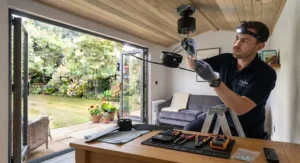
Getting a ceiling fan into a garden room is rarely a simple swap of an existing light fitting, because most garden rooms are wired as a single circuit run from the house’s consumer unit, often via an armoured cable buried in the garden. Before anything else, confirm the fan’s weight is supported by a proper ceiling joist or a dedicated fan-rated mounting box — plasterboard alone, common in timber-frame garden rooms, won’t hold a spinning fan safely long-term. During the first 30 days, the most common mistake isn’t electrical at all: it’s mounting height. A fan hung too close to head height (anything under about 2.1 metres to the blade tip) becomes a genuine hazard the moment someone stands up from a desk chair, so measure twice against your tallest regular visitor, not just yourself.
Once fitted, a simple maintenance rhythm keeps things running smoothly: wipe blades monthly with a dry cloth (garden rooms collect more airborne dust and pollen than indoor rooms due to more frequent door-opening), and check for wobble every few months, tightening the blade-arm screws if needed since seasonal temperature swings in an unheated or intermittently heated building can work fixings loose faster than in a house. A genuinely useful optimisation trick most listings don’t mention: run the fan on its lowest setting in reverse mode for twenty minutes each morning before you start work in colder months — it gently redistributes any warm air that’s pooled at the roof apex overnight without creating a noticeable draught, meaning your heater doesn’t have to work as hard once you switch it on.
Real-World Scenarios: Which Garden Room Owner Are You?
If you’re a freelance graphic designer commuting eight steps down the garden path each morning to a 3m x 2.5m insulated cabin, the priority is quiet operation above almost everything else — client calls don’t mix well with a rattling AC motor, which makes the DC-powered Depuley or NIORSUN the sensible starting point, both keeping running costs low across a full working week.
If you’ve converted a larger outbuilding into a family garden room used for gaming, guests and the odd home-schooling session, airflow volume across a bigger footprint matters more than whisper-quiet running — the 130cm HOMCOM or the 52-inch Lucci Air Airfusion Radar (if ceiling height allows) will circulate air corner to corner far more effectively than a compact fan straining on its highest setting.
If your garden room is a pre-fabricated log cabin with a pitched roof and genuinely low eaves — a common setup for budget garden offices bought as flat-pack kits — the Lucci Air Airfusion Radar‘s ultra-flush hugger design is worth the premium simply because so few alternatives will physically fit; measure your lowest ceiling point before you shop for anything else on this list.
Garden Room Ventilation Tips: Beyond Just a Fan
A ceiling fan moves air within a room, but it doesn’t remove moisture or bring in fresh air from outside — and garden rooms, being smaller and often less airtight-tested than houses, are particularly prone to condensation on cold mornings when warm, moist air from a heater meets a cold single-glazed window or an uninsulated roof panel. Good general guidance on preventing this kind of condensation and mould applies just as much to garden rooms as houses: keep background heating on low rather than blasting it on and off, and provide some background ventilation even when the room isn’t in daily use, since sealed, unheated buildings left shut for days are exactly where mould gets a foothold.
A ceiling fan can actually help here indirectly. Running it on a low setting for ten minutes after any activity that raises humidity — making a coffee on a small kettle, breathing hard after a workout in a garden gym — helps disperse moist air toward a trickle vent or slightly opened window rather than letting it settle and condense on the coldest surface in the room. Pair the fan with a humble trickle vent or a small extractor fan near any cooking or washing facilities if your garden room has them, and consider a plug-in hygrometer (a cheap, genuinely useful accessory) to keep an eye on relative humidity — most guidance suggests aiming to keep indoor humidity below about 60% to meaningfully reduce mould risk.
How to Choose a Garden Room Ceiling Fan
Choosing the right fan for a garden room comes down to answering a handful of questions in the right order, rather than starting with price or looks.
- Measure your lowest ceiling point first. Not the average height — the lowest point, usually at the eaves in a pitched-roof cabin, since this determines whether you need a true hugger design like the Airfusion Radar or can use a standard flush mount.
- Work out your room’s floor area in square metres. As a rough rule, rooms under 9 sq m suit a 42-inch or smaller fan, while anything from 9-15 sq m benefits from a 48-52 inch span.
- Decide whether you actually need smart or app control. It’s genuinely useful for scheduling a fan to run before you arrive each morning, but it’s an added point of failure if reliability matters more to you than convenience.
- Check the wiring route before you fall in love with a fan. If your garden room’s supply is a lighting circuit rather than a dedicated ring, adding a fan may need an electrician’s assessment regardless of which model you choose.
- Prioritise DC motors if the fan will run daily. The extra upfront cost is usually recovered through lower running costs within a year or two of regular summer and winter use.
- Factor in noise tolerance for your actual use case. A fan that’s fine in a garden gym might be genuinely distracting during video calls in a garden office.
- Confirm winter reverse mode is included. Not every budget fan has it, and it’s one of the few features that earns its keep across the whole year rather than just in summer.
Low Ceiling Height Fan Options Explained
Garden rooms are disproportionately affected by low-ceiling constraints compared with houses, because so many are built to maximise internal floor space within permitted development height limits — which, according to the government’s own permitted development technical guidance for householders, typically caps single-storey outbuildings within 2 metres of a boundary at 2.5 metres eaves height in England. That’s genuinely tight for a spinning fan, and it’s why “low ceiling height fan options” is one of the most practical searches a garden room owner can make.
The key distinction to understand is between a “flush mount” fan, which typically still has 10-20cm of drop from ceiling to blade, and a true “hugger” design like the Lucci Air Airfusion Radar, which sits closer to 7.5 inches (19cm) total including the motor housing itself — meaning less additional drop below that. Reviewers consistently flag that budget fans marketed loosely as “low profile” sometimes still require the manufacturer’s stated minimum ceiling height of 2.6-2.7 metres, as seen with the MiniSun listing earlier in this guide, so it’s worth checking that figure specifically rather than trusting marketing language like “flush” or “low profile” alone. If your garden room genuinely can’t accommodate any ceiling fan safely, a wall-mounted or good-quality pedestal fan remains a perfectly sensible fallback, discussed further in the comparison section below.
Garden Room Electrics Regulations: What UK Homeowners Need to Know
This is the section most garden room ceiling fan buyers skip and shouldn’t. Electrical work in gardens and outbuildings in England and Wales falls under Part P of the Building Regulations, which specifically covers electrical safety in dwellings and their associated outbuildings>, including sheds, detached garages and garden rooms. In practical terms, adding a new circuit — which installing a ceiling fan and light combination in a previously unwired or under-wired garden room often requires — is notifiable work, meaning it must either be carried out by an electrician registered with a competent person scheme or separately signed off by your local authority’s building control team.
Replacing a like-for-like ceiling rose or light switch on an existing circuit is generally non-notifiable minor work, but a ceiling fan draws differently from a simple pendant light and often needs a dedicated fan-rated ceiling box plus, in many cases, a separate switched live for a wall control — which tips the job into notifiable territory more often than buyers expect. This isn’t bureaucratic box-ticking: unsafe electrical installations in outbuildings are a genuine cause of both fire and injury, and organisations like Electrical Safety First specifically highlight garden and outbuilding wiring as a higher-risk category precisely because it’s exposed to damp, temperature swings and, all too often, DIY shortcuts. Budget accordingly: a qualified electrician’s assessment and certification typically adds £150-£300 to the overall project cost depending on your region and whether new circuitry is needed, but it’s the one part of this project genuinely not worth cutting corners on.
Ceiling Fans for Garden Rooms Under £150: Best Value Picks
If your budget is capped at £150, four of the seven fans reviewed above genuinely fit, and the good news is that “under £150” doesn’t mean compromising on the basics that matter most in a garden room.
| Fan | Price Range | Motor Type | Standout Feature | Best For |
|---|---|---|---|---|
| MiniSun Silver Chrome and Wood | Under £70 | AC | Lowest genuine flush-mount price | Tight budgets, taller ceilings |
| Depuley Flush Mount Low Profile | £90-£140 range | DC | App and remote control included | Smart garden offices |
| HOMCOM 130cm Flush Mount LED | £100-£140 range | AC | Largest span under £150 | Bigger garden rooms |
| NIORSUN 50cm Smart LED | Under £100 | DC | Tunable warm-to-daylight LED | Compact studios |
Looking at this shortlist, the clearest pattern is that DC motors are now genuinely accessible under £150 rather than being a premium-only feature, which wasn’t really true even a couple of years ago — both the Depuley and NIORSUN prove that. Budget buyers should note that the trade-off at this price point tends to be remote/app reliability and long-term bearing life rather than raw airflow performance, which for most garden room uses is a perfectly reasonable compromise to make.
✨ Don’t Miss These Exclusive Deals!
🔍 Take your garden room comfort to the next level with these carefully selected fans. Click through to check current pricing and availability, and turn your garden room into a space you actually want to spend the day in.
Common Mistakes When Buying a Garden Room Ceiling Fan
The single most common mistake is buying based on blade span alone without checking the room’s actual floor area, resulting in either a fan that dominates a small studio or one that’s visibly underpowered in a larger family garden room. A close second is ignoring the minimum ceiling height stated in the small print — as covered above, several genuinely popular budget fans specify 2.6-2.7 metres and simply won’t fit safely in many garden cabins, no matter how good the reviews look.
Buyers also frequently underestimate the electrical scope of the job, assuming that because a garden room already has a light fitting, adding a fan is a simple swap — when in reality the different electrical load and switching requirements often mean it’s treated as new notifiable work under Part P. Finally, a subtler mistake: choosing a fan based purely on summer cooling and forgetting reverse winter mode entirely, which means missing out on a genuinely useful, near cost-free way to redistribute heat in the colder months when a garden room’s small volume and limited insulation make heat loss through the roof especially noticeable.
Garden Room Ceiling Fan vs Portable and Wall-Mounted Fans
| Feature | Ceiling Fan | Pedestal/Tower Fan | Wall-Mounted Fan |
|---|---|---|---|
| Floor space used | None | Significant | None |
| Airflow coverage | Whole room | Directional | Directional, wider arc |
| Winter reverse mode | Common on quality models | Rare | Occasionally |
| Typical noise at low speed | Quiet (DC models) | Moderate | Moderate |
| Installation | Requires wiring/electrician | Plug and play | Requires wiring |
| Best For | Daily-use garden offices | Occasional/rented spaces | Compact rooms, renters avoiding ceiling work |
The comparison makes the trade-off fairly clear: a ceiling fan wins decisively on floor space and whole-room coverage, which matters enormously in a garden room where every square metre of desk or seating space is precious, but it demands a proper electrical installation that a pedestal fan simply doesn’t. For anyone renting their garden room setup, or genuinely unsure whether they’ll still be using the space in two years, a good-quality pedestal or tower fan remains a completely sensible, zero-commitment alternative — it’s only once you’re confident the garden room is a permanent fixture that the extra cost and disruption of a ceiling installation clearly pays off.
Long-Term Cost & Maintenance
Running costs vary more than buyers expect between AC and DC motor fans. A typical AC-motor ceiling fan draws somewhere in the region of 60-75W on its highest setting, while a comparable DC-motor fan like the NIORSUN or Depuley often draws closer to 15-25W for similar airflow — over a summer of regular daytime use in a garden office, that difference is genuinely noticeable on an electricity bill, even before accounting for the UK’s relatively high per-unit electricity costs compared with a decade ago.
Total cost of ownership also has to include the electrician’s certification cost discussed earlier, which is a fixed cost regardless of which fan you choose, making it proportionally more significant for budget fans than premium ones. Maintenance costs, meanwhile, are genuinely low across the board for a decent-quality fan — occasional blade cleaning and periodic tightening as covered in the usage guide above — but the Fantasia Prima‘s 10-year motor warranty and the Westinghouse Alloy‘s reputation for bearing longevity both reduce the (admittedly low) risk of an expensive early motor failure, which for a fan wired permanently into a garden room’s ceiling is more disruptive to replace than a plug-in appliance.
Features That Actually Matter (And Those That Don’t)
Genuinely useful: a DC motor for daily-use garden offices, reversible winter mode, and a stated minimum ceiling height you can actually check against your room before buying. Genuinely useful but often skipped: a physical wall control as a backup to app or remote control, since batteries die and phones run out of charge at inconvenient moments.
Largely marketing noise for a garden room specifically: excessive smart-home integration if you’re not already running a smart ecosystem out there, and colour-changing light kits beyond a simple warm-to-cool dimmable range, which sound appealing but rarely get used daily once the novelty fades. Blade material (wood-effect versus metal versus ABS composite) makes a genuine difference to perceived quality and long-term wobble resistance, but has surprisingly little measurable effect on actual airflow performance — so it’s a finish decision, not a performance one.
Where to Buy Your Garden Room Ceiling Fan Online
All seven fans in this guide are available through mainstream UK retailers including amazon.co.uk, with several also stocked directly by specialist ceiling fan retailers who focus specifically on the Fantasia and Lucci Air ranges. When buying online, check the listing’s stated minimum ceiling height and mounting type (flush versus hugger versus standard downrod) before adding to basket — as covered throughout this guide, these details vary more between near-identical-looking listings than buyers expect, and returning a wired fitting once it’s been unpacked and test-fitted is considerably more hassle than returning most other home purchases.
It’s worth checking current price and availability directly on the retailer’s page rather than relying on any figure quoted here, since prices for imported budget fans in particular can shift with exchange rates and stock levels. If you’re planning to have an electrician fit the fan as part of a wider garden room electrical job, it’s often more cost-effective to have them source and fit the unit as part of a single visit rather than paying a separate call-out purely for fan installation.
Garden Room Fan Reviews: What Real Owners Say
Genuine, verifiable customer feedback across this category tends to cluster around a few consistent themes rather than product-specific complaints. Reviewers of budget flush-mount fans like the MiniSun and HOMCOM consistently mention that professional installation, even for a seemingly simple fitting, resolves the vast majority of reported issues — several reviewers specifically note that problems they initially blamed on the product turned out to be down to DIY wiring attempts rather than the fan itself.
For DC-motor fans including the Depuley, NIORSUN and Lucci Air Airfusion Radar, aggregated sentiment consistently praises quiet low-speed operation as the standout real-world benefit, which lines up with the technical case for DC motors made earlier in this guide. Where reviews turn more mixed is around app reliability and Bluetooth pairing on the budget smart options, echoing a broader pattern seen across budget smart-home fittings generally rather than being unique to garden room fans specifically. It’s worth being honest that detailed, verified long-term (three-year-plus) reliability data specifically from garden room installations — as opposed to indoor domestic use — is genuinely thin across public review platforms, simply because ceiling fans in outbuildings are a smaller, newer category than fans in houses; buyers making a purchase today are, to some extent, still contributing to that evidence base themselves.
Frequently Asked Questions
❓ Do I need an electrician to fit a garden room ceiling fan?
❓ What size ceiling fan do I need for a garden room?
❓ Can I fit a ceiling fan in a garden room with a low pitched roof?
❓ Do ceiling fans work in winter as well as summer?
❓ Are DC motor ceiling fans worth the extra cost for a garden room?
Conclusion
A garden room lives or dies on comfort — nobody keeps using a beautifully finished garden office if it turns into a greenhouse every July or a cold box every January — and a well-chosen ceiling fan genuinely earns its keep on both counts, provided it’s matched properly to your room’s ceiling height, floor area and daily use pattern rather than picked on looks alone. Across the seven fans covered here, there’s a clear route through: the MiniSun or NIORSUN for tight budgets and compact spaces, the Depuley for smart-home convenience without premium pricing, the HOMCOM for larger rooms and simplicity, and the Fantasia Prima, Lucci Air Airfusion Radar or Westinghouse Alloy for buyers prioritising longevity, ultra-low ceilings, or premium build quality respectively.
Whichever you choose, the two details worth double-checking before you click buy are the stated minimum ceiling height against your room’s lowest point, and whether your garden room’s existing wiring can support the job without a new circuit — both are far cheaper to confirm now than to discover after a fan arrives that doesn’t fit or a job that needs re-quoting. Get those two things right, and a ceiling fan quietly becomes one of the best-value comfort upgrades a garden room can get.
Recommended for You
- Pergola Ceiling Fans UK: 7 Top Picks to Beat the Heat in 2026
- Ceiling Fans for Covered Patios: 7 Best Picks for 2026
- Patio Ceiling Fans 2026: 7 Best Outdoor Fans
Disclaimer: This article contains affiliate links. As an Amazon Associate, I earn from qualifying purchases. If you purchase products through these links, we may earn a small commission at no additional cost to you.
✨ Found this helpful? Share it with your friends! 💬🤗
