

In This Article
There’s a very British kind of tragedy that plays out every June: you finally get the barbecue going, the deckchairs are out, and then the one warm week of the year turns your gazebo into something closer to a greenhouse. Everyone’s sitting under cover, sweating politely, pretending the wasp circling the Pimm’s isn’t also feeling the heat. This is precisely the gap gazebo ceiling fans exist to fill — a fixed or hanging fan built to survive rain, damp and the occasional slug that mistakes it for a climbing frame, while pushing actual air around a space that would otherwise just trap it.

Unlike a standing fan you drag out from the shed and prop against a table leg, a gazebo ceiling fan mounts overhead, out of the way of kids, dogs and wine glasses, and moves a genuinely useful volume of air across the whole footprint rather than just blasting whoever’s sitting closest. Get the wrong one, though — underpowered, not properly wet-rated, or simply too heavy for a flimsy pop-up frame — and you’ve spent money on a fan that either does nothing or ends up on the lawn after the first proper gust.
This guide walks through seven real, currently available models spanning solar, battery and mains-plug options, explains what the specs actually mean once you’re sitting under one on a sticky August evening, and covers the practical stuff nobody tells you: what your gazebo frame can actually hold, when you need an electrician rather than a screwdriver, and which size suits which structure. As always, we’re working from real product listings and genuine aggregated review sentiment — no invented five-star raves here, just honest analysis you can actually use.
Quick Comparison Table
| Fan | Power Type | Best For | Price Range |
|---|---|---|---|
| Coolbull Plug and Play 20″ Fan | Mains plug-in | All-round budget pick | £50-£70 range |
| 28W Commercial-Grade IP65 Fan | Mains plug-in | Large or hospitality-style gazebos | £120-£160 range |
| 60″ Wood Outdoor Ceiling Fan | Mains plug-in | Big permanent gazebos, no light needed | £150-£200 range |
| Solar Rechargeable Ceiling Fan | Solar + battery | No nearby socket | £40-£60 range |
| NRVTRE 20″ 12V Fan | Battery/12V | Tightest budget, camping crossover | Under £30 |
| Solar Foldable Ceiling Fan | Solar | Sheds, greenhouses, tents | Under £35 |
| Solar Football-Design Fan | Solar | Kids’ play areas, novelty appeal | Under £40 |
Looking at the spread above, the split really comes down to power source before anything else. If your gazebo sits within reach of an outdoor socket, the mains-plug models — the Coolbull Plug and Play 20″ Fan, the 28W Commercial-Grade IP65 Fan and the 60″ Wood Outdoor Ceiling Fan — will always out-perform anything solar-powered on raw airflow. But if you’re kitting out a gazebo at the bottom of the garden with no power run anywhere near it, the NHS notes that electric fans are one of the simplest ways to keep cool in hot weather, and a solar option like the Solar Rechargeable Ceiling Fan gets you there without an extension lead trailing across the lawn.
💬 Just one click — help others make better buying decisions too! 😊
Top 7 Gazebo Ceiling Fans: Expert Analysis
Picking a fan for a gazebo isn’t quite the same job as picking one for a bedroom. Outdoor structures move in the wind, they’re exposed to rain blowing in sideways, and the fixing point is often a flimsier bit of aluminium than anyone would like to admit. With that in mind, here’s the honest rundown on seven real products currently listed for the UK market, covering solar, battery and mains options across budget, mid-range and premium price points.
1. Coolbull Plug and Play 20″ Fan — sturdiest budget cage frame
The standout feature here is the frame itself: Coolbull specifies a 5mm metal bar diameter on the cage, roughly 2mm thicker than the norm on similarly priced fans, which matters more than it sounds like it should when you’re hanging something overhead in a structure that flexes in the wind. The wet-rated build handles a 20-inch blade span with a reversible DC motor, six speeds, and a dimmable three-colour LED built into the centre, all run through a 16-foot plug-in cord that gives you some genuine flexibility over where the socket actually is relative to the gazebo frame.
What most buyers overlook about a fan at this price is that “wet rated” and “waterproof” aren’t quite the same promise — wet rated means it’s designed to cope with driving rain hitting it directly, which is exactly the situation an open-sided gazebo puts a fan in. Coolbull’s spec sheet leans into this explicitly, positioning the fan for uncovered outdoor spaces rather than just damp porches, and the manufacturer states the frame supports loads up to roughly 140lb, giving a decent margin for anyone nervous about hanging weight from a pop-up structure.
Aggregated buyer feedback on this model consistently flags the remote and app control as genuinely useful rather than gimmicky — being able to nudge the speed down from your seat without getting up is one of those small conveniences that ends up mattering a lot over a season. A recurring theme in reviews is appreciation for the noise level, described repeatedly as noticeably quieter than older AC-motor fans people had previously tried.
Pros:
- ✅ Reinforced 5mm cage frame for extra stability
- ✅ Six-speed reversible DC motor with dimmable light
- ✅ Long 16ft cord gives real installation flexibility
Cons:
- ❌ 20-inch blade span limits airflow in larger gazebos
- ❌ Wood-tone finish won’t suit every garden style
At around £50-£70, the Coolbull Plug and Play 20″ Fan sits comfortably as the sensible default for a standard 3m x 3m gazebo with power nearby — solid value without cutting corners on the weatherproofing that actually matters.
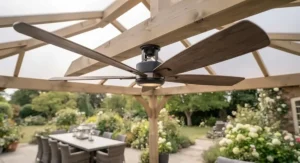
2. 28W Commercial-Grade IP65 Fan — most airflow for hospitality-scale spaces
This one’s built for a different job entirely. The standout feature is the motor: a 28W DC unit rated to push up to 3700 CFM of airflow across six speed settings, reaching up to 1150rpm, which is a genuinely different category of performance from the smaller 15-20 inch fans aimed at a single seating area. Paired with a 45W integrated LED, it’s explicitly positioned by the listing for spaces between 100 and 270 square feet — think garden bars, café terraces, or a gazebo that regularly hosts more than four people at once.
The 3700 CFM figure means something specific in practice: it’s roughly double what a typical 20-inch domestic ceiling fan manages, so instead of feeling a light stir of air near the fan itself, you get noticeable movement across most of the seating underneath. Based on the spec comparison with the smaller models on this list, this is the fan to pick if your “gazebo” is really more of a semi-permanent garden room that gets used daily through summer rather than for the occasional Sunday lunch.
Reviewers consistently note the fan runs quieter than its output would suggest, a common trait of well-engineered DC motors versus the cheaper AC units still knocking around at the budget end of the market. Where feedback gets more mixed is on the size and weight of the unit itself — it’s not something you casually hang from a single hook, and buyers report needing a genuinely solid fixing point.
Pros:
- ✅ 3700 CFM output suits large or busy gazebos
- ✅ IP65 rating built for genuinely exposed spots
- ✅ Six-speed DC motor stays quiet at high output
Cons:
- ❌ Overkill and pricier for a small single-table gazebo
- ❌ Needs a robust fixing point given the unit’s size
Priced in the £120-£160 range, this is the premium pick for anyone whose outdoor space functions more like an extra room than an occasional shelter — a real jump in capability, and priced accordingly.
3. 60″ Wood Outdoor Ceiling Fan — biggest blade span, farmhouse styling
The heading feature says it all: a 60-inch blade span is enormous by gazebo-fan standards, more commonly seen on indoor farmhouse-style fans repurposed for covered outdoor structures. This model skips the light kit entirely, focusing purely on air movement, with a claimed maximum airflow figure of 7216 CFM and a “natural wind” mode that varies speed and direction to mimic an actual breeze rather than one flat blast.
Here’s what the spec sheet won’t spell out clearly: with blades this long, you don’t need anywhere near top speed for most gazebo-sized spaces, which is actually the point — a 60-inch fan running gently moves more total air, more evenly, than a small fan running flat out, and does it with noticeably less blade-tip noise. The three-blade design and curved tail profile are there to reduce turbulence, which reviewers describe as making the airflow feel less like a wind tunnel and more like standing under a large tree on a breezy day.
The trade-off is obvious and significant: this needs a properly substantial gazebo, ideally one with real structural rafters rather than a pop-up frame, and a mounting point that can take both the size and the leverage a 60-inch blade span generates in gusty conditions. It’s a fan for a permanent timber gazebo, not a fold-away weekend one.
Pros:
- ✅ 60-inch span moves large volumes of air gently
- ✅ Natural wind mode reduces that “wind tunnel” feel
- ✅ Six-speed reversible DC motor, quiet at low settings
Cons:
- ❌ Needs a solid permanent structure, not a pop-up frame
- ❌ No integrated light, so you’ll need separate lighting
Sitting in the £150-£200 range, this is a considered purchase for a genuinely large, sturdily built gazebo — not a fan you buy on impulse for a bank holiday weekend.
4. Solar Rechargeable Ceiling Fan with Light — no wiring required, anywhere
The headline advantage is independence from mains power altogether: a 25W solar panel charges a 32Wh battery, which the listing states can keep the fan and adjustable-colour light running for hours after dark without a single cable run across the lawn. For anyone whose gazebo sits well away from the house — down by a vegetable patch, at the back of a long garden, or in a rented property where running new sockets isn’t an option — that’s the whole appeal in one sentence.
Based on the spec comparison, a 32Wh battery is a fairly modest capacity, so this suits intermittent evening use rather than running all day at top speed; it’s built more for topping up cool air over a few hours after sunset than for constant daytime operation in peak summer heat. The remote control lets you adjust both fan speed and light colour, and the unit is explicitly marketed for gazebos, chicken coops, greenhouses and sheds alike, which tells you it’s designed to be genuinely weather-tolerant rather than a delicate solar gadget.
What most buyers overlook when going solar is charging position: performance depends entirely on how much direct sun the panel gets, so a fan mounted under a dense gazebo roof with the solar panel poorly angled will underperform compared with one where the panel’s been positioned to catch open sky. Aggregated feedback reflects this split, with users in sunnier, more open positions reporting strong results and those in shadier spots noting reduced runtime.
Pros:
- ✅ Zero wiring needed — genuinely go-anywhere installation
- ✅ Adjustable light colour plus remote speed control
- ✅ Doubles up for sheds, coops and greenhouses too
Cons:
- ❌ Runtime and power depend heavily on sun exposure
- ❌ Smaller battery limits sustained daytime running
At roughly £40-£60, the Solar Rechargeable Ceiling Fan with Light earns its keep purely on flexibility — for a gazebo with no realistic mains access, it’s arguably the only sensible option on this list.
5. NRVTRE 20″ 12V Fan — cheapest way to test the waters
This is the entry point, and it knows it. Running off a 12V supply — either battery pack or adapter — at just 8W, with a claimed 300rpm rotation speed, it’s a genuinely lightweight, low-power unit that started life as much as a camping and grow-tent fan as a garden one, and the listing is upfront about crossover uses including RV outages and hiking trips.
Key specs with real-world meaning: 8W is a fraction of the power draw of the mains-plug options on this list, which means correspondingly modest airflow — this isn’t going to cool a crowded gazebo on a proper heatwave afternoon, but for a single seat, a reading nook, or as a stopgap while you decide whether you actually want to invest in something bigger, it does the job at minimal outlay. The detachable six-blade design and basic hook mounting keep things simple, with no app, no remote, no light kit to worry about.
Reviewers consistently frame this fan around its price rather than its performance — nobody’s claiming it rivals a proper wet-rated commercial unit, and the honest aggregated sentiment is that it’s a decent, no-frills fan for light duty rather than a serious cooling solution for a full-sized family gazebo.
Pros:
- ✅ Genuinely low entry price for testing the concept
- ✅ Lightweight and simple to hang and remove
- ✅ Doubles as a camping or grow-tent fan
Cons:
- ❌ 8W output is modest for a full gazebo
- ❌ No app, remote or light kit included
At under £30, the NRVTRE 20″ 12V Fan is best understood as a starter fan or a secondary unit for a small corner, rather than the main event.
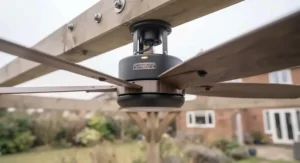
6. Solar Foldable Ceiling Fan — pack-flat design for occasional use
The standout feature is portability: this fan folds down for storage and travel, runs on solar power with a listed mains-adaptable option too, and includes a three-colour variable light alongside a fixed white setting at 6500K. It’s aimed squarely at people who don’t want a fan mounted permanently — campers, allotment holders, anyone who moves a pop-up gazebo between the shed and the garden a few times a season.
Based on the spec comparison with the fixed-mount options above, folding designs inevitably trade some rigidity and airflow for that packability, and the listing itself frames the product across a wide range of settings — greenhouses, warehouses, barns, caravans — which suggests general-purpose light-and-breeze duty rather than dedicated high-performance cooling. The compact 23cm x 19cm folded size means it genuinely fits in a rucksack pocket or the same bag as a pop-up gazebo itself.
Where honest analysis matters here is temperature colour accuracy — the listing notes screen and lighting variance can affect how the colour appears versus photos, a minor point but worth flagging so buyers aren’t surprised. Aggregated sentiment on foldable solar fans in this category generally centres on convenience over raw cooling power, which tracks with the spec sheet.
Pros:
- ✅ Folds flat for easy storage and transport
- ✅ Solar powered with a mains-compatible option
- ✅ Multi-colour light adds usable evening lighting
Cons:
- ❌ Smaller build trades off some raw airflow
- ❌ Best suited to occasional rather than daily use
Priced under £35, this is the pick for anyone whose gazebo itself is portable — matching a pack-away fan to a pack-away structure just makes sense.
7. Solar Football-Design Ceiling Fan — playful pick for family spaces
The heading feature is entirely aesthetic and entirely deliberate: a folding, football-shaped fan and light unit aimed at family gardens, playrooms and canopy spaces where a novelty design adds more value than another plain black cage fan would. Underneath the shape, the specification mirrors the other solar-foldable option on this list — climate-adaptive build, hook-mount installation, and light-plus-fan functionality suited to camping, patios, gazebos and sheds alike.
What most buyers overlook with novelty-shaped fans is that the design compromise is almost always cosmetic rather than functional — this isn’t a weaker fan because it’s shaped like a football, it’s simply built to the same modest solar-power budget as similar foldable units, which means sensible expectations around output rather than commercial-grade airflow. For a kids’ play gazebo, a garden party marquee, or anywhere a bit of personality matters more than maximum CFM, that’s a fair trade.
Because it’s a newer, more niche listing, verified review volume is thinner than for the established brands on this list; where genuine feedback exists, it centres on the design appeal and ease of folding for storage rather than detailed cooling performance data, so treat that aspect as reasonably unverified until more reviews accumulate.
Pros:
- ✅ Distinctive design suits kids’ and family spaces
- ✅ Solar powered with folding storage design
- ✅ Doubles as decorative lighting after dark
Cons:
- ❌ Limited verified review history so far
- ❌ Novelty shape won’t suit every garden aesthetic
At under £40, the Solar Football-Design Ceiling Fan is a fun, low-stakes pick where charm counts for as much as raw performance.
Top 7 Products: Full Comparison
| Fan | Blade Span | Motor Power | Light Included | Best For |
|---|---|---|---|---|
| Coolbull Plug and Play 20″ Fan | 20″ | 6-speed DC | Yes, dimmable | Standard budget gazebos |
| 28W Commercial-Grade IP65 Fan | 20″ | 28W DC, 3700 CFM | Yes, 45W | Large hospitality-style spaces |
| 60″ Wood Outdoor Ceiling Fan | 60″ | 6-speed DC, 7216 CFM | No | Big permanent timber gazebos |
| Solar Rechargeable Ceiling Fan | Compact | 25W solar/32Wh battery | Yes, adjustable colour | Off-grid, no nearby socket |
| NRVTRE 20″ 12V Fan | 20″ | 8W, 12V | No | Entry-level, single seat |
| Solar Foldable Ceiling Fan | Compact | Solar/mains option | Yes, tri-colour | Portable pop-up gazebos |
| Solar Football-Design Fan | Compact | Solar | Yes, tri-colour | Kids’ and family spaces |
Reading across this table, the clearest split isn’t really about price at all — it’s about whether your gazebo is a permanent fixture or something you move around the garden. The 60″ Wood Outdoor Ceiling Fan and the 28W Commercial-Grade IP65 Fan both assume a structure that isn’t going anywhere, while the two folding solar units are built for exactly the opposite scenario. Anyone still weighing up battery versus mains power should note that the mains-plug fans consistently deliver more airflow per pound spent, but only where a socket is genuinely accessible.
Installing and Living With Your Gazebo Ceiling Fan
Getting a fan up and running properly is less about tools and more about sequence. Start by confirming your gazebo’s structural fixing point — a solid cross-beam or purlin, not the thin fabric roof panel or a single guy rope — since every fan on this list, however light, applies constant downward load plus sideways stress once the blades are spinning in a breeze. For plug-in models, route the cable so it can’t pool water at any low point, and always run mains-powered garden equipment through an RCD; Electrical Safety First’s own research found that one in ten UK adults with a garden has experienced a shock or accident using electrical equipment outdoors, which makes that £10-£20 plug-in RCD one of the cheapest insurance policies you’ll ever buy.
Once it’s mounted, the first 30 days are where most avoidable mistakes happen. Check the fixing bolts after the first week — timber and even some metal frames settle slightly under new load, and a quarter-turn tightening pass catches this before it becomes a rattle. Run the fan on a mid-speed setting rather than maximum for the first few uses to let any bearings or brushes bed in, and get into the habit of a quick monthly wipe-down of the blades; a light film of pollen and garden dust builds an imbalance faster than most people expect, and an unbalanced fan wears its bearings out early. Over winter, unplug mains models and store solar units indoors if the gazebo itself isn’t staying up, since UK frost cycles are harder on plastics and seals than the rain the fans are actually rated for.
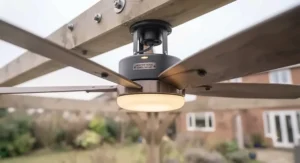
Who Actually Needs a Gazebo Fan? Three Real-World Scenarios
Picture a young family with a 3m pop-up gazebo that comes out every dry weekend from May onward, kids running in and out, a paddling pool a few feet away. For this household, weight and safety dominate the decision — a lightweight, lower-profile fan like the Coolbull Plug and Play 20″ Fan or, for a bit of family fun, the Solar Football-Design Ceiling Fan makes more sense than anything heavy or expensive, since a flimsier frame simply can’t take much overhead load and small children are constantly underneath it.
Now consider a couple who’ve built a proper 4m x 3m permanent timber gazebo as an extension of their garden, used most evenings through summer for dinner and drinks with friends. Budget is less of a constraint here than genuine performance, and the structure itself can take real weight — this is exactly the buyer the 28W Commercial-Grade IP65 Fan or the 60″ Wood Outdoor Ceiling Fan was specified for, both delivering enough airflow to keep a full table of guests comfortable rather than just the person sitting directly underneath.
Finally, think about a renter or allotment holder with a gazebo pitched somewhere without power — down the plot, in a shared communal garden, or simply too far from the house to trail a cable. Here the entire calculation changes: mains fans, however good on paper, aren’t usable at all, which makes the Solar Rechargeable Ceiling Fan with Light or the pack-flat Solar Foldable Ceiling Fan the only realistic options, frequency of use and sun exposure at the pitch being the deciding factors between them.
How to Choose a Gazebo Ceiling Fan
What is a gazebo ceiling fan? A gazebo ceiling fan is a wet-rated or weatherproof fan designed to mount overhead in an open-sided outdoor structure, moving air across the whole seating area rather than relying on a portable standing fan positioned at floor level.
Working through the decision in order genuinely helps, since each step narrows the field before you even start comparing brands:
- Check your power source first. If there’s no socket within safe cable reach, solar or battery options are your only realistic category — don’t fall in love with a mains fan you can’t actually run.
- Measure your gazebo’s footprint. A fan sized for a small 3m gazebo will underwhelm in a 4m x 4m space, and an oversized fan in a small structure just wastes money and looks disproportionate.
- Confirm the weatherproof rating. “Wet rated” means the fan is built for direct rain exposure, exactly what an open-sided gazebo delivers; “damp rated” alone isn’t enough for that setting.
- Assess your frame’s structural strength. A pop-up gazebo and a permanent timber structure have wildly different weight tolerances — match the fan’s weight and mounting requirements to what you actually own.
- Decide if you need integrated lighting. A combined fan-and-light unit saves a separate purchase and installation job, but adds weight and cost if you don’t actually need the light.
- Think about noise at the speeds you’ll actually use. DC motors are consistently quieter than older AC ones, and quoted CFM figures mean little if the fan is too loud to sit under comfortably.
- Set a realistic budget band and stick to it. As the comparison table above shows, there’s a genuine, honest difference in capability between a sub-£30 fan and a £150+ commercial-grade one — decide which tier your actual usage justifies.
Hardwiring a Permanent Gazebo: What You Need to Know
For a genuinely permanent gazebo — timber-framed, on a base, staying put for years — some owners consider hardwiring a fan directly rather than relying on an extension lead and plug. This is where the legal picture gets more serious than most people expect. Electrical work carried out in UK gardens falls under Part P of the Building Regulations, and the Institution of Engineering and Technology confirms that Part P covers land around dwellings such as garden structures, with any new circuit classed as notifiable work — meaning it must either be carried out by a registered competent-person electrician who can self-certify the job, or formally signed off by local authority building control.
In practice, this means running a brand-new circuit out to a gazebo — burying an armoured cable, fitting a new outdoor socket or a fixed fan connection point — is not a sensible DIY weekend project, regardless of how confident you feel with a screwdriver. What most homeowners overlook is that even “simple” outdoor wiring must still fully comply with BS 7671, the underlying wiring regulations, whether or not the specific job happens to be notifiable; RCD protection on any outdoor circuit is non-negotiable either way. The honest, safe advice for permanent installations is straightforward: use a qualified, registered electrician for any new circuit or fixed wiring to a gazebo, and reserve the plug-in fans covered in this guide for anywhere you’re using an existing, already-protected outdoor socket.
Gazebo Frame Weight Limits: What Your Structure Can Actually Hold
This is the section most buying guides skip entirely, and it’s arguably the most important one here. Not all gazebos are built equal, and the difference in load-bearing capacity between structure types is enormous. Lightweight pop-up gazebos — the kind that fold into a wheeled carry bag — are typically only rated to handle somewhere in the region of a few hundred pounds distributed across the whole frame, which sounds like plenty until you remember that’s shared between the roof fabric, any wind loading, and whatever you hang from the central point. Permanent timber or steel-framed gazebos, by contrast, are engineered for substantially higher loads, often multiple times that of a pop-up frame, precisely because they’re built to stay outdoors year-round and take real structural stress.
The practical takeaway, based on the spec comparison across manufacturer guidance generally cited in this space, is to treat any fan under roughly 15lb as the safer ceiling for a lighter pop-up-style gazebo, and to always fix the hanging point to the strongest cross-member available rather than the centre of a roof panel, which typically isn’t designed to carry weight at all. For anything heavier — including the 60″ Wood Outdoor Ceiling Fan or the 28W Commercial-Grade IP65 Fan — you genuinely need a permanent structure with proper rafters, and ideally a fan-rated mounting bracket bolted directly into solid timber or steel rather than relying on a single hook. If you’re at all unsure what your specific gazebo can take, the manufacturer’s own instructions or a quick message to their support line will settle it far more reliably than guesswork.
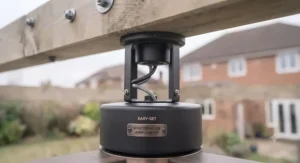
Gazebo Size Guide: Matching Fan Size to Your Space
Fan sizing follows a fairly intuitive rule once you see it laid out: smaller gazebos need proportionally less blade span, and oversizing wastes money without meaningfully improving comfort. For a compact 2.5m x 2.5m pop-up gazebo covering a single small table, a 15-20 inch fan like the NRVTRE 20″ 12V Fan or the Coolbull Plug and Play 20″ Fan comfortably covers the space. Step up to a standard 3m x 3m gazebo, the most common size sold in the UK, and a 20-24 inch fan with genuine airflow output — the sort delivered by the 28W Commercial-Grade IP65 Fan — starts to make a noticeable difference across the whole seating area rather than just directly underneath.
For larger permanent structures, anything from 4m x 4m upward, or gazebos that regularly host six or more people, the equation shifts toward either a genuinely large single fan, such as the 60″ Wood Outdoor Ceiling Fan, or in some cases two smaller fans mounted at either end of the space. On the topic of overall structure height and footprint, it’s worth noting that the Planning Portal, delivered in partnership with the UK Government, confirms most domestic garden gazebos fall under permitted development provided they stay under 2.5 metres in height within two metres of a boundary, so anyone building or buying a genuinely large permanent gazebo alongside their fan purchase should check those limits before committing to a bigger structure.
Gazebo Ceiling Fans Under £100: What You Actually Get
There’s a real, honest difference between fans priced under £100 and the commercial-grade options above that threshold, and it’s worth being upfront about where the compromises sit. In this bracket you’ll typically find the Coolbull Plug and Play 20″ Fan, the Solar Rechargeable Ceiling Fan with Light, the NRVTRE 20″ 12V Fan, the Solar Foldable Ceiling Fan and the Solar Football-Design Ceiling Fan — five of the seven fans covered in this guide, which tells you the sub-£100 market is genuinely well served rather than being an afterthought.
What you’re generally not getting under £100 is the raw airflow of a proper commercial-grade DC motor; CFM output scales fairly directly with price once you cross into fans built for larger, busier spaces. What you are getting, based on aggregated review sentiment across this price band, is solid build quality on the weatherproofing side specifically — manufacturers seem to prioritise not letting water in over maximising airflow, which makes sense given a soaked motor is a warranty claim while merely modest airflow is just a mild disappointment. For most standard-sized UK gazebos used for typical garden entertaining rather than daily hospitality-style use, a sub-£100 fan genuinely covers the job without needing to stretch to the premium end of the market.
Buy Gazebo Fan: Where and How to Shop Smart
Buying a gazebo fan online rather than in person means leaning more heavily on spec sheets and genuine review patterns than on physically feeling the build quality, so a few habits pay off. Always check the stated IP rating or “wet rated” wording explicitly, rather than assuming any outdoor-marketed fan is automatically suitable for an open-sided structure — some products marketed loosely for “patios and gazebos” are actually only damp-rated for covered porches. Cross-check the blade span against your actual gazebo footprint using a tape measure rather than guesswork, since photos on listings rarely convey scale accurately.
It’s also worth checking current price and stock directly on the retailer’s page before deciding, since prices on outdoor and seasonal products can move around noticeably as summer approaches and stock tightens; treat every figure in this guide as a general range at the time of research rather than a locked-in number. Reading through the most recent genuine reviews, rather than just the overall star rating, tends to surface any pattern of issues — connector durability, remote range, or motor noise creeping in over time — far more reliably than a headline score alone.
Common Mistakes When Buying a Gazebo Ceiling Fan
The single most common error, based on recurring patterns across aggregated buyer feedback for this product category, is buying on blade size alone without checking the wet-rating or IP rating, which leaves buyers with a fan that looks the part but degrades quickly once it’s actually exposed to driving rain rather than just damp air. A close second is underestimating fixing-point strength — hanging even a modest fan from a single decorative hook rather than a structural cross-member, which risks the whole unit coming down in a strong gust.
Buyers also frequently overlook cable routing at the point of purchase, only realising after installation that the plug-in cord isn’t long enough to reach a socket without an unsightly (and less safe) extension lead running across a path. On the solar side, a recurring mistake is assuming any “solar” fan will run all day regardless of shade — panel positioning genuinely determines performance, and a fan mounted under a dense gazebo roof with a poorly angled panel will consistently underperform its stated runtime. Finally, plenty of buyers skip checking their specific gazebo’s weight tolerance entirely, assuming “it’s just a fan” without registering that continuous overhead load plus wind-induced sideways force is a meaningfully different stress than the frame was originally designed around.
Gazebo Ceiling Fans vs Standing Fans
| Factor | Gazebo Ceiling Fan | Standing/Pedestal Fan |
|---|---|---|
| Coverage | Even airflow across whole seating area | Directional, strongest near the unit |
| Space use | Overhead, floor stays clear | Takes up floor space, trip hazard |
| Weather resistance | Built for rain exposure (if wet-rated) | Rarely rated for direct rain |
| Setup effort | Requires mounting/fixing | Just needs a flat surface |
| Best For | Fixed or semi-permanent gazebos | Occasional or portable outdoor use |
The clearest advantage a gazebo ceiling fan holds over a standing fan is coverage — because it’s mounted centrally overhead, air moves across the whole space fairly evenly, rather than blasting whoever happens to be sitting closest while leaving the far end of the table untouched. Standing fans do win on flexibility, since you can simply pick one up and move it between the patio, the gazebo and indoors as needed, something none of the fixed-mount options on this list can match. For anyone torn between the two, the practical answer is usually about permanence: if the gazebo is staying put for the season or longer, a ceiling fan earns its installation effort; if it’s an occasional weekend structure, a decent standing fan may genuinely serve you better.
✨ Don’t Miss These Exclusive Deals!
🔍 Take your outdoor gazebo setup to the next level with these carefully selected fans. Click on any highlighted model to check current pricing and availability. Whichever you choose, you’ll be creating a genuinely cooler, more comfortable garden your family will actually want to use all summer long!

FAQ
❓ Can I use any outdoor fan in a gazebo?
❓ How much does a gazebo ceiling fan cost in the UK?
❓ Do gazebo fans need to be hardwired?
❓ What size fan does a standard gazebo need?
❓ Are solar gazebo fans powerful enough for hot weather?
Conclusion
Choosing between these seven fans really comes down to answering three honest questions about your own setup rather than chasing the single “best” model in the abstract: what power source can you actually reach, how much genuine weight and wind-loading can your gazebo frame take, and how large is the space you’re actually trying to cool. A young family with a lightweight pop-up structure and small children underneath is better served by something like the Coolbull Plug and Play 20″ Fan or the playful Solar Football-Design Ceiling Fan than by chasing maximum CFM figures they don’t need. Someone with a permanent timber gazebo used daily through summer, on the other hand, gets genuinely better value stretching to the 28W Commercial-Grade IP65 Fan or the 60″ Wood Outdoor Ceiling Fan, where the extra spend buys real, noticeable comfort rather than marginal gains.
Whichever fan you land on, the fundamentals covered throughout this guide matter more than any single spec figure: confirm the wet rating, check what your frame can genuinely hold, route cables sensibly and safely, and — for anything approaching a permanent installation — bring in a qualified electrician rather than improvising. Get those basics right and even a budget fan will earn its keep through a proper British summer, sputtering heatwave included.
Recommended for You
- Summer House Ceiling Fans: 7 Best Cooling Picks for 2026
- Garden Room Ceiling Fans: 7 Best Picks for UK Owners 2026
- Pergola Ceiling Fans UK: 7 Top Picks to Beat the Heat in 2026
Disclaimer: This article contains affiliate links. As an Amazon Associate, I earn from qualifying purchases. If you purchase products through these links, we may earn a small commission at no additional cost to you.
✨ Found this helpful? Share it with your friends! 💬🤗
