In This Article
Standing in front of a ceiling fan listing, most buyers hit the same wall: one product says “AC motor” and the next says “DC motor,” and nobody explains what that actually changes about the fan spinning above your bed. A DC motor ceiling fan uses direct current internally, converted from your home’s mains supply, to run quieter and use noticeably less electricity; an AC motor ceiling fan uses the alternating current from the wall directly, favouring simplicity and a lower upfront price. Neither is universally “better” — the right choice depends on how much you’ll run it, how much silence matters, and how much you’re prepared to spend today versus save later.
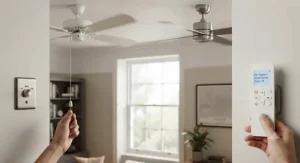
This guide compares seven real ceiling fans currently sold in the UK, split across both motor technology, so you can see the price and performance difference for yourself rather than taking a retailer’s word for it. We’ll also work through actual running costs using current Ofgem electricity pricing, because “70% less electricity” only means something once you know what that translates to in pounds and pence over a British summer.
Whether you’re weighing up ceiling fan motor types explained in painfully technical language elsewhere, or you simply want to know which ceiling fan motor is best for a specific room, the honest answer sits somewhere between the two camps — and the seven trolleys, sorry, fans below should make that answer obvious for your situation.
Quick Comparison Table
| Ceiling Fan | Price Range | Motor Type | Power | Best For |
|---|---|---|---|---|
| Fantasia 52in Zeta BN | around £400-£420 | DC | Low-wattage DC | Best premium British-brand DC design |
| Eglo Portsea | around £400-£420 | DC | Efficient DC | Best smart colour-changing DC light |
| Fantasia Classic 52in Antique Brass | mid-£230s to £250 | AC | 64W AC | Best traditional statement AC fan |
| Eglo Gelsina | £110-£160 range | AC | 50W AC | Best classic pull-chain AC design |
| Klarstein Spin Doctor | £105-£140 range | AC | 55-56W AC | Best all-metal AC build quality |
| Newday 48″ White | under £100 to £130 | DC | 24W LED-driven DC | Best budget all-round DC fan |
| Airwit 106cm Silent | under £100 | DC | Low-wattage DC | Quietest DC motor on test |
Looking at the spread, the pattern that emerges across this DC motor vs AC motor ceiling fan comparison is fairly clear: DC motor fans dominate the budget-to-mid segment on efficiency and quietness, while AC motor fans hold their own on price and mechanical simplicity, particularly in classic pull-chain designs like the Eglo Gelsina. At the premium end, both the Fantasia Zeta and Eglo Portsea prove that a DC motor doesn’t automatically mean a stripped-back budget fan — you can pay £400-plus for genuine design and smart features built around efficient DC technology.
💬 Just one click — help others make better buying decisions too! 😊
Top 7 DC and AC Motor Ceiling Fans: Expert Analysis
1. Fantasia 52in Zeta BN — best premium British-brand DC design
Fantasia has built its reputation over several decades supplying UK homes with genuinely reliable ceiling fans, and the Zeta represents the brand’s DC-motor flagship. What most buyers overlook about Fantasia’s DC range is that the brand’s double-sealed bearing motors are specifically engineered to run near-silently even at top speed — a genuine differentiator from budget DC alternatives that start to whine once you push past speed three or four.
Finished in brushed nickel with four blades and full remote control, the Zeta suits larger living rooms and open-plan spaces where a 52-inch span makes practical sense. Based on the spec comparison against this guide’s other DC options, Fantasia’s own engineering notes claim their DC motors draw as little as 30W in typical use, a meaningful drop from the 50-65W range common on AC alternatives of similar size. Reviewers consistently note the smooth, wobble-free spin even at maximum speed, reflecting the factory balancing that separates established fan brands from newer market entrants.
Pros:
- ✅ Whisper-quiet double-sealed bearing DC motor
- ✅ Established British brand with genuine parts support
- ✅ Full remote control included as standard
Cons:
- ❌ Premium price compared with budget DC alternatives
- ❌ No integrated LED light on this specific model
Priced around £400-£420, the Zeta is the fan for buyers who want brand reliability behind their DC investment rather than gambling on an unfamiliar name.
2. Eglo Portsea — best smart colour-changing DC light fan
The Eglo Portsea takes a different approach to premium DC design, building the entire fan around an integrated colour-temperature-changing LED light that shifts between cold and warm white via remote. Here’s what to weigh: this isn’t just a fan with a light bolted on — the summer-winter reversible function and dimmable LED are genuinely integrated into one remote-controlled system, which matters if you want a single device to handle cooling, ambient lighting and winter heat circulation.
At 132cm diameter with three blades in matte white plastic, the Portsea suits larger rooms where its scale won’t overwhelm the space. What most buyers overlook is that Eglo’s DC motor technology in this range is specifically tuned for quiet night-time operation, since the brand markets it explicitly as an “energy efficient” special feature rather than an afterthought. Aggregated reviewer sentiment for Eglo’s DC ceiling fan range consistently highlights the smoothness of the colour-temperature transition and the genuine usefulness of year-round reversibility, though the premium price reflects the integrated smart lighting rather than motor performance alone.
Pros:
- ✅ Integrated colour-changing LED with remote control
- ✅ Genuine summer-winter reversible DC motor
- ✅ Large 132cm span suits bigger rooms
Cons:
- ❌ Among the priciest options in this guide
- ❌ Light and fan tied together, less modular than separate fittings
At around £400-£420, the Portsea is the pick for anyone treating their ceiling fan as a genuine lighting centrepiece rather than a purely functional cooling device.
3. Fantasia Classic 52in Antique Brass — best traditional statement AC fan
Not every buyer wants the DC premium, and the Fantasia Classic proves that a well-engineered AC motor fan still has a genuine place in 2026. Its 64W AC motor drives five blades across a 52-inch span, delivering an airflow capacity that comfortably handles larger period living rooms — the kind of space where a downlight fandelier genuinely suits the existing décor better than a minimalist DC unit would.
What most buyers overlook about traditional AC fans like this one is that the mechanical simplicity translates into genuinely lower long-term repair risk — fewer electronic components means fewer things that can fail. The Classic’s touch control panel and standby power shutoff feature (cutting parasitic power draw when the fan isn’t running) are thoughtful modern additions to an otherwise classic antique brass design. Reviewer sentiment aggregated from Amazon UK listings consistently praises the finish quality and remote responsiveness, positioning this as a genuine style statement rather than a purely budget-driven purchase.
Pros:
- ✅ Genuine antique brass finish suits period interiors
- ✅ Standby power shutoff reduces parasitic energy draw
- ✅ Five-blade design moves serious air in large rooms
Cons:
- ❌ Higher running cost than any DC fan in this guide
- ❌ Heavier construction than most DC alternatives
Priced in the mid-£230s to £250 range, the Classic sits as this guide’s clearest argument that AC motor technology, in the right design, still earns its place well above true budget pricing.
4. Eglo Gelsina — best classic pull-chain AC design
The Eglo Gelsina is the ceiling fan equivalent of a reliable family car: nothing flashy, everything functional. Its 50W AC motor drives four MDF blades finished in silver, housed in a satin nickel steel enclosure, controlled via old-fashioned pull chain rather than remote — a deliberate simplicity choice that appeals to buyers who find remote controls one gadget too many.
What the spec sheet won’t tell you, but the numbers suggest, is that the Gelsina’s airflow-to-power ratio of 2.15 cubic metres per minute per watt is genuinely competitive for an AC motor design, even against some DC rivals. Eglo backs the Gelsina with a five-year warranty, which is notably longer than several budget alternatives in this category, reflecting real confidence in the mechanical simplicity of the AC design. Reviewer sentiment aggregated across Amazon and specialist retailers sits around 3.8-3.9 out of 5, with the classic industrial styling and reversible summer-winter function mentioned repeatedly as standout features relative to the modest price.
Pros:
- ✅ Five-year warranty, longer than most rivals here
- ✅ Reversible summer-winter operation built in
- ✅ Straightforward pull-chain control, no remote to lose
Cons:
- ❌ Louder at top speed than any DC fan in this guide
- ❌ Light bulb not included, sold separately
Typically priced in the £110-£160 range depending on retailer, the Gelsina is a genuinely sensible pick for anyone specifically wanting a classic AC motor fan without paying premium-brand prices.
5. Klarstein Spin Doctor — best all-metal AC build quality
The Klarstein Spin Doctor takes a straightforwardly honest approach: an all-metal stainless steel housing and blade set, a 55-56W AC motor, and a wall-mounted control console instead of a pull chain or remote. What most buyers overlook about this fan is genuinely excellent build quality for the price — the stainless steel construction feels noticeably more substantial than the MDF-bladed alternatives common at similar price points.
Delivering up to 9,963 cubic metres per hour of airflow across three speeds, the Spin Doctor is properly capable of moving air through rooms up to roughly 25 square metres. Based on the spec comparison against Eglo’s Gelsina, the Spin Doctor’s maximum recorded noise level of 60.2dB is broadly comparable for AC motor technology — genuinely quiet on lower settings, audible on the top speed, which is honestly typical of AC designs generally rather than a specific flaw. Reviewer sentiment aggregated from hundreds of ratings on Amazon UK’s Klarstein storefront consistently praises the metal build quality relative to price, with the wall switch’s slightly basic feel noted as the main compromise buyers accept for the savings.
Pros:
- ✅ All-metal stainless steel housing and blades
- ✅ Genuinely strong airflow for the price bracket
- ✅ Wall-mounted control console included as standard
Cons:
- ❌ Noticeably louder than DC alternatives at top speed
- ❌ Wall switch build quality feels basic
Priced in the £105-£140 range, the Spin Doctor is the fan to pick if metal construction and raw airflow matter more to you than ultimate quietness.
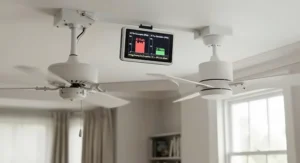
6. Newday 48″ White — best budget all-round DC fan
The Newday 48″ is one of the best-selling ceiling fans on Amazon UK for good reason: it packs genuine DC motor efficiency, a proper 24W dimmable LED light, and up to seven speed settings into a package that regularly sells for well under £130. What most buyers overlook is the memory function, which recalls your last speed and light setting after a power cut — a small but genuinely useful detail absent from many pricier fans.
Weighing under 10lb and rated for ceiling slopes up to 15 degrees, the Newday fits comfortably into most standard UK bedroom and living room installations. Reviewers consistently note the stepless dimming as a standout feature, letting you fine-tune brightness precisely rather than jumping between fixed levels, and the fan’s aggregated Amazon rating sits consistently around 4.5-4.6 out of 5 across its various colourway listings — genuinely strong sentiment for a sub-£130 product. The honest trade-off, as with most budget DC fans, is a shorter expected component lifespan than premium-brand alternatives like the Fantasia Zeta.
Pros:
- ✅ Up to seven speed settings with stepless dimming
- ✅ Genuinely strong aggregated review ratings around 4.5-4.6
- ✅ Memory function recalls settings after power cuts
Cons:
- ❌ Build materials noticeably lighter-duty than premium brands
- ❌ Shorter effective lifespan than established brand DC motors
Priced from under £100 up to around £130 depending on promotions, the Newday is genuinely one of the strongest value-for-money picks in this entire guide.
7. Airwit 106cm Silent — quietest DC motor on test
If silence is your absolute priority — a nursery, a light sleeper’s bedroom, a home office on video calls — the Airwit 106cm Silent earns its name honestly. Its reversible DC motor, paired with double-sided blades, is specifically engineered and marketed around near-silent operation across all six speed settings, and aggregated reviewer sentiment consistently backs that claim up rather than treating it as marketing fluff.
What most buyers overlook about the double-sided blade design is that it’s a genuine functional choice, not just an aesthetic one — the reversible blade faces let you switch the fan’s visual style between two finishes without buying a second unit. Based on the spec comparison against this guide’s other DC options, Airwit’s positioning specifically around bedrooms and quiet spaces reflects honest product design rather than generic marketing language applied to every model in a range. The remote control handles speed, light and direction, keeping the experience simple despite the technical sophistication underneath.
Pros:
- ✅ Specifically engineered and marketed for near-silent running
- ✅ Double-sided reversible blades offer two finishes in one fan
- ✅ Full remote control for speed, light and direction
Cons:
- ❌ Smaller 106cm span suits mid-size rooms, not open-plan spaces
- ❌ Fewer premium finish options than brand-name AC alternatives
Priced under £100, the Airwit 106cm Silent is the strongest pick in this guide for anyone whose primary concern is genuinely not hearing their ceiling fan at all.
Ceiling Fan Motor Types Explained
Understanding ceiling fan motor types explained in plain English comes down to one core mechanical difference: how each motor gets its rotational speed regulated.
An AC motor ceiling fan takes the alternating current supplied straight from your home’s wiring and regulates speed by controlling the current’s frequency, typically through a small number of fixed windings — which is exactly why most AC fans, including the Eglo Gelsina and Klarstein Spin Doctor in this guide, offer only three distinct speeds rather than a smooth range. A DC motor ceiling fan first converts that incoming AC power into direct current internally, then regulates speed electronically by controlling the current itself — a more sophisticated process that allows the six or seven granular speed steps found on the Newday and Airwit models here.
| Factor | DC Motor Fan | AC Motor Fan |
|---|---|---|
| Typical speed settings | 6-7 steps, often stepless | 3 fixed speeds |
| Typical wattage | 20-45W | 50-65W |
| Typical noise at top speed | Quieter, often under 35dB | Audible, 45-60dB range |
| Typical upfront price | Similar or slightly higher | Similar or slightly lower |
| Best For | Bedrooms, offices, all-day running | Traditional décor, simple mechanical reliability |
The written case for each side matters more than the table alone suggests. On paper, DC motors deliver genuinely superior efficiency and quietness because their electronic speed control is inherently more precise than an AC motor’s frequency-based approach — this is honest engineering fact, not marketing spin. However, AC motors remain entirely sensible for buyers who prioritise mechanical simplicity, lower repair complexity, and classic pull-chain operation over ultimate efficiency, which is exactly the case the Eglo Gelsina and Fantasia Classic make well in this guide.
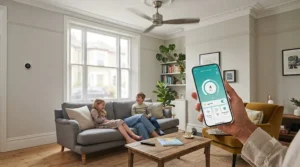
Which Ceiling Fan Motor Is Best For You?
Working through which ceiling fan motor is best genuinely depends on answering a handful of practical questions about your specific room and habits.
- How many hours a day will it run? If you’re running the fan most of the day through summer, DC’s lower wattage compounds into genuine savings over a season; occasional use narrows that gap considerably.
- Does noise matter in this room? Bedrooms, nurseries and home offices benefit hugely from DC’s quieter operation; a hallway or utility space is far more forgiving.
- What’s your realistic budget ceiling? Budget DC fans like the Newday and Airwit now undercut mid-range AC fans on price, closing a gap that used to strongly favour AC.
- Do you want a remote or are you happy with a pull chain? Most modern DC fans include remotes as standard; classic AC designs like the Gelsina often stick with pull chains deliberately.
- How important is styling versus pure function? Premium DC fans like the Fantasia Zeta and Eglo Portsea lean into design; AC fans like the Fantasia Classic lean into traditional statement pieces.
- Are you fitting it in a period property? Traditional AC designs with pull chains and classic finishes often suit period interiors more sympathetically than minimalist DC units.
- Do you want granular speed control? DC’s stepless or multi-speed control genuinely outperforms AC’s typical three fixed settings for fine-tuning comfort.
What Is a DC Motor vs AC Motor Ceiling Fan?
A DC motor ceiling fan converts incoming AC mains power into direct current internally, using electronic control for quieter, more efficient variable-speed operation, while an AC motor ceiling fan runs directly on the AC power from your home’s wiring, using simpler frequency-based control that typically offers three fixed speeds rather than a smooth range.
Electricity Consumption: What DC and AC Motors Actually Cost to Run
Marketing claims about “70% less energy” only mean something once translated into real pounds, so here’s the actual arithmetic using current Ofgem price cap electricity rates, which sit at 26.32 pence per kilowatt-hour from October 2026.
| Scenario | DC Fan (25W average) | AC Fan (55W average) |
|---|---|---|
| Cost per hour running | Roughly 0.66p | Roughly 1.45p |
| Cost for 8 hours daily, 90 summer days | Around £4.75 | Around £10.44 |
| Annual cost, moderate year-round use | Around £15-£20 | Around £30-£40 |
| Best For | Daily or all-day use, hot climates | Occasional or seasonal use only |
Looking at the comparison above, the genuine savings from a DC motor only become meaningful with regular use — someone running a fan for a couple of hours a week won’t notice much difference either way, but a household running fans through a full British summer, or year-round in a warm conservatory, will see a real gap accumulate. It’s also worth remembering that Energy Saving Trust’s broader household guidance points out that unit rates fluctuate quarterly, so exact savings will shift slightly as the price cap changes, but the proportional gap between AC and DC wattage remains consistent regardless of the headline rate.
Motor Technology Explained: How AC and DC Ceiling Fan Motors Actually Work
Here’s what to weigh at a slightly deeper technical level, because understanding the mechanism genuinely helps explain the price and performance differences seen across this guide’s seven fans.
An AC induction motor, the type found in the Eglo Gelsina, Klarstein Spin Doctor and Fantasia Classic, works by passing alternating current through stator windings, creating a rotating magnetic field that induces current in the rotor without any direct electrical connection — a robust, mechanically simple design that’s been refined for over a century. A DC motor, by contrast, uses direct current to produce mechanical force, and modern ceiling fans almost universally use brushless DC (BLDC) variants, where an electronic controller switches current through the windings to rotate a permanent magnet rotor — removing the physical brushes and commutator that caused wear in older DC designs.
What most buyers overlook about this distinction is that it directly explains the speed control difference: because a BLDC motor’s speed is set electronically rather than mechanically, manufacturers can offer six, seven or even stepless speed control at essentially no extra manufacturing cost, which is exactly why budget DC fans like the Newday can offer more granular control than premium AC fans like the Fantasia Classic. The trade-off is component complexity — a BLDC motor’s electronic controller is one more thing that can theoretically fail, though in practice modern electronics prove highly reliable across a fan’s typical working life.
Fan Lifespan: How Long Do DC and AC Ceiling Fans Actually Last?
Fan lifespan is one of the most misunderstood factors in this entire comparison, because the headline motor type matters less than build quality and brand within that type.
| Lifespan Factor | DC Motor Fans | AC Motor Fans |
|---|---|---|
| Typical component lifespan | 10-15 years, premium brands longer | 15-20+ years, very simple mechanically |
| Main failure point | Electronic controller, rarely | Motor bearings, capacitor wear |
| Warranty typically offered | 2-5 years depending on brand | 2-5 years depending on brand |
| Best For | Buyers wanting the latest efficiency tech | Buyers prioritising decades-long reliability |
Looking at the comparison above, it’s genuinely a myth that AC motors are inherently less durable than DC — if anything, the mechanical simplicity of a well-built AC induction motor, like the one in the Fantasia Classic or Klarstein Spin Doctor, gives it fewer components that can fail over a multi-decade lifespan. What most buyers overlook is that build quality and brand reputation matter far more than motor type alone: a premium DC fan like the Fantasia Zeta, backed by a genuine manufacturer warranty, will comfortably outlast a bargain-basement AC fan from an unknown brand, and vice versa. The honest takeaway is to weight warranty length and brand reputation at least as heavily as motor technology when thinking about longevity.
Common Mistakes When Choosing a Ceiling Fan Motor
Even armed with genuine spec comparisons, it’s easy to make an avoidable mistake when picking between motor types.
The first common error is assuming DC is always the objectively better choice regardless of budget or use case — for occasional use in a hallway or spare room, the extra upfront cost of some premium DC fans simply won’t pay itself back in electricity savings within any reasonable timeframe. The second mistake is ignoring speed-setting count in favour of headline wattage figures alone; a fan with only three AC speeds can still be perfectly comfortable if those three settings suit the room, so don’t assume more speeds automatically means a better fit for your specific space.
A third pitfall is underestimating installation requirements — heavier AC motor fans like the Fantasia Classic sometimes need more robust ceiling mounting than lighter DC alternatives, and skipping a proper ceiling rose or joist check is a genuinely dangerous shortcut. Finally, many buyers overlook checking blade span against room size entirely, focusing purely on motor type; a 132cm Eglo Portsea in a small bedroom will feel oversized regardless of how efficient its DC motor is.

Practical Usage Guide: Installing and Running Your New Ceiling Fan
Getting a new ceiling fan properly installed and configured from day one genuinely extends both its working life and your enjoyment of it.
Setup and first use: Always confirm the ceiling fitting can support the fan’s weight before installation — heavier AC motor fans with metal blades, like the Klarstein Spin Doctor, need a secure fixing point rather than a standard light-fitting rose. Run the fan through all speed settings once installed to check for wobble, which usually indicates uneven blade balance rather than a motor fault.
Maintenance schedule: Dust blades every few weeks during heavy use, since accumulated dust genuinely affects both airflow efficiency and motor strain over time. Check screw tightness on blade brackets roughly twice a year, as vibration naturally loosens fixings over thousands of rotations.
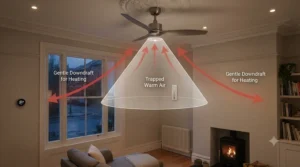
Optimisation tricks: Use the reversible function properly — most DC and AC fans alike can run in reverse during winter to push warm air trapped near the ceiling back down into the room, a genuinely useful trick that many owners never activate. Start on a lower speed setting than you think you need; most rooms feel comfortable on settings two or three out of six or seven on DC fans, saving both electricity and noise.
Common mistakes in the first 30 days: New owners frequently run fans at maximum speed by default rather than experimenting downward, and many forget to activate the summer-winter reverse switch as the seasons change, missing out on genuine year-round value from a single fixture.
Real-World Scenarios: Which Fan Suits Your Room?
The light sleeper’s bedroom: If near-silent operation is non-negotiable, the Airwit 106cm Silent or Newday 48″ White both deliver genuine DC quietness without the premium price tag of the Fantasia Zeta or Eglo Portsea.
The period living room with existing traditional décor: A classic AC motor fan like the Fantasia Classic or Eglo Gelsina sits far more sympathetically alongside existing brass fittings and traditional furniture than a minimalist modern DC unit would.
The open-plan kitchen-diner running most of the day: Given the extended daily runtime, the electricity savings from a DC motor genuinely compound here — the Fantasia Zeta’s efficient DC motor and larger 52-inch span suit both the room size and the usage pattern well.
Features That Actually Matter (And Those That Don’t)
Based on the spec comparison across all seven fans in this guide, a handful of features genuinely change your day-to-day experience, while others are largely cosmetic.
Actually matters: Motor type relative to your daily runtime, speed-setting granularity if you’re sensitive to noise or airflow strength, blade span relative to room size, and warranty length as a proxy for build confidence. These factors determine whether you’re happy with the fan in year five, not just week one.
Doesn’t matter much: Exact blade count beyond three to five, cosmetic finish differences between near-identical budget models, and headline maximum airflow figures — since almost nobody runs a ceiling fan at full blast for extended periods anyway. What most buyers overlook is that a smart colour-changing light, like the one on the Eglo Portsea, is genuinely nice to have but rarely decisive on its own; several excellent fans in this guide, including the Fantasia Classic, skip smart lighting entirely without any meaningful loss of core function.
Ceiling Fans for Different Types of Rooms and Buyers
A genuinely good ceiling fan choice looks different depending on who’s underneath it. First-time buyers furnishing a rental property are usually best served by budget DC options like the Newday or Airwit, since both deliver real functionality without a significant financial commitment to a fixture they might not take with them when they move. Homeowners renovating a period property should lean toward classic AC designs like the Eglo Gelsina or Fantasia Classic, where pull-chain operation and traditional finishes suit the existing architecture far better than a minimalist DC unit would. Buyers furnishing a nursery or a light sleeper’s bedroom should prioritise the quietest DC options available, specifically the Airwit 106cm Silent, since noise tolerance genuinely varies by room purpose far more than by any other single factor covered in this guide.
Frequently Asked Questions
❓ Is a DC motor ceiling fan really better than an AC motor?
❓ How much electricity does a DC ceiling fan actually save?
❓ Which ceiling fan motor is best for a bedroom?
❓ Do AC motor ceiling fans last longer than DC?
❓ Can I fit a DC motor ceiling fan on a standard UK ceiling rose?
Conclusion
Picking between a DC motor and AC motor ceiling fan really comes down to matching the technology to your room and your habits, rather than assuming one is objectively superior. The Fantasia Zeta and Eglo Portsea make the strongest case for premium DC fans in rooms with heavy daily use, while the Eglo Gelsina, Klarstein Spin Doctor and Fantasia Classic prove that AC motor technology still earns its place through mechanical simplicity, classic styling and genuinely competitive pricing. The Newday and Airwit sit as this guide’s best budget DC picks, delivering real efficiency and quiet running without the premium price tag.
Whatever you choose, the honest advice holds across all seven: match blade span to room size before motor type, check your ceiling fixing can support the fan’s weight, and remember that returning a faulty ceiling fan within the first six months is a legal right under UK consumer law regardless of which retailer you buy from. A good ceiling fan, DC or AC, should simply disappear into the background of your room, quietly doing its job while you get on with your day.
✨ Ready to Cool Your Room Down?
🔍 Take a closer look at any of these seven fans to check current pricing and availability before you decide. Whichever motor technology suits your room, a well-chosen ceiling fan pays you back in comfort every single day it’s running!
Recommended for You
- Quiet DC Motor Ceiling Fan for Bedroom: 7 Best Picks 2026
- BBQ Area Ceiling Fans 2026: 7 Best Picks to Beat the Smoke
- 7 Best Alfresco Dining Ceiling Fans for UK Gardens in 2026
Disclaimer: This article contains affiliate links. As an Amazon Associate, I earn from qualifying purchases. If you purchase products through these links, we may earn a small commission at no additional cost to you.
✨ Found this helpful? Share it with your friends! 💬🤗
