
In This Article
Variable speed ceiling fans have revolutionised how British households manage comfort throughout the year. Unlike traditional single-speed models that simply blast air at maximum power, a variable speed ceiling fan lets you fine-tune airflow to match the exact conditions in your room—whether that’s a gentle breeze on a mild May evening or full-power circulation during August’s increasingly common heatwaves.

What is a variable speed ceiling fan? It’s a ceiling-mounted fan equipped with multiple fan speeds (typically 3 to 6 settings) or stepless variable control that allows you to adjust the rotation speed from whisper-quiet to full power. Modern models available on Amazon.co.uk now feature DC motors with precise speed adjustment via remote control or wall-mounted controllers, delivering exceptional energy efficiency whilst consuming as little as 24-40 watts—roughly the same as a single LED bulb.
For UK homes, this adjustable speed control ceiling wall control capability proves particularly valuable. Our unpredictable maritime climate means you might need barely perceptible airflow on a humid June night, yet require robust circulation during a stuffy winter evening when central heating creates uncomfortable hot spots near the ceiling. The best 6 speed ceiling fan UK models now available combine this flexibility with integrated LED lighting, reversible motors for winter heat redistribution, and smart controls—all whilst meeting UKCA certification standards for electrical safety.
In this comprehensive guide, I’ll walk you through the top-performing variable speed ceiling fans currently available to British buyers, explain the technology behind multi speed ceiling fan control systems, and help you choose the perfect model for your specific requirements and budget.
Quick Comparison: Top Variable Speed Ceiling Fans
| Model | Speeds | Size | Power | Price Range | Best For |
|---|---|---|---|---|---|
| NIORSUN 50cm Smart | 6 speeds | 50cm | 24W | £70-£90 | Medium rooms, energy efficiency |
| VOLISUN 50cm Modern | 6 speeds | 50cm | 30W | £65-£85 | Contemporary interiors, quiet operation |
| HARPER LIVING Premium | 6 speeds | 50cm | 32W | £85-£110 | Style-conscious buyers, bright lighting |
| SUNKENET Compact | 6 speeds | 40cm | 28W | £55-£75 | Small bedrooms, budget option |
| DEPULEY 107cm | 6 speeds | 107cm | 45W | £140-£180 | Large open-plan spaces |
| BomKra Drone Design | 3 speeds | 50cm | 50W | £80-£100 | Unique aesthetics, statement piece |
| CHANFOK Flush Mount | 6 speeds | 50cm | 35W | £60-£80 | Low ceilings, minimalist design |
From this comparison, you’ll notice the sweet spot for most UK buyers sits around the £70-£90 mark for 50cm models with 6-speed control—offering the best balance between features, build quality, and value. The NIORSUN and VOLISUN models deliver exceptional energy efficiency with their DC motors consuming under 30 watts, which translates to roughly £9-£12 annual running costs versus £18-£22 for older AC motor fans. If you’re working with a tighter budget, the SUNKENET Compact sacrifices some lighting output but maintains the crucial 6-speed flexibility. Conversely, larger spaces genuinely require the DEPULEY’s 107cm diameter, though that premium £140-£180 investment pays dividends in superior air circulation for rooms exceeding 25 square metres.
💬 Just one click — help others make better buying decisions too!😊
Top 7 Variable Speed Ceiling Fans: Expert Analysis
1. NIORSUN 50cm Smart Ceiling Fan with 6-Speed Control
The NIORSUN 50cm represents what I consider the benchmark for variable speed ceiling fans in the UK market—exceptional functionality without unnecessary complications or inflated pricing.
This model features a DC motor with precise speed adjustment across 6 distinct settings, ranging from barely audible (Speed 1, approximately 100 RPM) to robust circulation (Speed 6, approximately 400 RPM). What British buyers particularly appreciate is the rpm control ceiling fans deliver through NIORSUN’s intelligent controller: each speed increment feels genuinely different, not just cosmetic variations. The reversible motor function proves invaluable during colder months—switch to winter mode and watch your heating bills drop as trapped warm air near the ceiling gets redistributed downward.
The integrated LED lighting system outputs 3600 lumens with stepless colour temperature adjustment from warm 3000K to cool 6500K. Unlike cheaper models where “dimmable” means three predetermined brightness levels, NIORSUN’s controller allows infinite adjustment—invaluable for British bedrooms where you might want gentle ambient lighting for late-night reading. UK customers from Newcastle to Southampton consistently mention the memory function: your preferred speed and lighting settings persist across power cycles, eliminating the frustration of reprogramming after using wall switches.
Installation considerations: At 230V with standard UK plug compatibility, the NIORSUN suits DIY installation for competent homeowners. The mounting bracket accommodates ceiling joists spaced at typical 40cm centres found in British construction. Total weight sits at 3.3kg, well within safe limits for standard plasterboard with proper fixings.
✅ Pros:
- Six genuinely distinct speed settings with noticeable airflow differences
- Energy-sipping 24W DC motor delivers £40+ savings versus AC motors over 5 years
- Memory function preserves settings across power interruptions
❌ Cons:
- Remote control requires line-of-sight; no smart home integration
- Pre-assembly not perfect—some UK buyers report minor blade alignment tweaks needed
Price verdict: Around £70-£90 represents outstanding value for a fan delivering premium features without the premium price. UK delivery typically arrives within 2-3 days via Amazon Prime.
2. VOLISUN 50cm Modern LED Variable Speed Ceiling Fan
If the VOLISUN 50cm had a dating profile, it would read: “Stylish, quiet, and won’t bankrupt you—what more could British buyers want?”
This model distinguishes itself through genuinely attractive industrial-modern aesthetics that complement contemporary UK interiors brilliantly. The bladeless enclosed design isn’t merely a style choice—it eliminates the dust-magnet problem traditional bladed fans suffer in damp British conditions whilst providing safer operation for families with curious children or excitable pets.
The 6 speed ceiling fan uk control system operates via a responsive remote offering speeds from gentle (Speed 1, ideal for those humid July nights when you need airflow without wind tunnel conditions) through to robust circulation (Speed 6, perfect for distributing air conditioning or dehumidifier output throughout the room). What impressed me during research into UK customer feedback was the motor’s genuine quietness: at lower speeds, you genuinely cannot hear it operating, whilst maximum speed produces roughly 45dB—quieter than a typical conversation.
Energy efficiency deserves particular mention: the 30W DC motor consumes £10.50 annually when operated 8 hours daily throughout Britain’s typical summer (calculated at current £0.28/kWh rates). Compare that to £21+ for traditional 75W AC motor fans, and the VOLISUN pays for itself within 3-4 years purely through electricity savings.
UK-specific advantages: The 50cm diameter suits standard British bedrooms (10-15 square metres) perfectly, whilst the flush-mount design works brilliantly in homes with 2.4-2.7m ceiling heights—the most common range in UK residential construction. UKCA marking confirms compliance with British electrical safety standards.
✅ Pros:
- Exceptionally quiet operation—barely audible at speeds 1-3
- Bladeless design eliminates blade-wobble issues common in cheaper fans
- Climate Pledge Friendly certification appeals to environmentally conscious buyers
❌ Cons:
- Lighting output (2200 lumens) slightly less than NIORSUN’s 3600 lumens
- App control advertised but requires separate purchase of Wi-Fi module
Price verdict: The £65-£85 range positions VOLISUN as a direct NIORSUN competitor—your choice between them comes down to aesthetics (VOLISUN’s more contemporary) versus maximum brightness (NIORSUN’s advantage).
3. HARPER LIVING Premium 6-Speed Ceiling Fan with Enhanced Illumination
The HARPER LIVING Premium targets British buyers willing to invest slightly more for superior lighting performance and refined build quality.
This model’s standout feature is its exceptional 4000-lumen LED system—genuinely bright enough to serve as the primary lighting source for bedrooms up to 18 square metres without supplementary lamps. The adjustable speed ceiling fan wall control functionality operates across 6 settings with noticeably finer gradation than budget alternatives. Speeds 1-2 provide barely perceptible movement ideal for sleeping, speeds 3-4 handle typical British summer conditions, whilst 5-6 deliver robust circulation during those increasingly frequent 30-35°C heatwaves.
What justifies the premium pricing is attention to detail rarely seen in sub-£100 ceiling fans: the remote control feels substantial rather than plasticky, the motor housing features proper metal construction versus cheaper ABS plastic, and the LED driver includes genuine surge protection—valuable insurance given Britain’s occasionally temperamental electrical supply, particularly during stormy weather.
The reversible DC motor deserves specific mention for UK buyers: winter mode creates an updraft that pulls cool air up and pushes trapped warm air down. In a typical British living room with radiators beneath windows, this can reduce heating costs by 10-15% during autumn and winter months—the Energy Saving Trust notes ceiling fans complement central heating beautifully when used correctly.
Performance in British conditions: The 50cm diameter provides optimal air movement for rooms 12-18 square metres—perfect for master bedrooms in semi-detached properties, dining rooms, or medium-sized living rooms. At 32W power consumption, running costs remain admirably low whilst delivering superior performance.
✅ Pros:
- Exceptional 4000-lumen output eliminates need for supplementary lighting
- Superior build quality with metal construction and surge-protected LED driver
- Timer function (1/2/4/8 hours) reduces energy waste
❌ Cons:
- Premium £85-£110 pricing versus £70 competitors
- Larger 50cm diameter may overwhelm very small British box rooms
Price verdict: The additional £15-£25 versus NIORSUN/VOLISUN buys genuinely superior components and brighter illumination—worthwhile if the fan serves as your primary bedroom or living room light source.
4. SUNKENET Compact 40cm Multi-Speed Budget Option
For British buyers prioritising affordability without sacrificing essential functionality, the SUNKENET Compact delivers impressive value in its £55-£75 price bracket.
This 40cm model targets smaller British bedrooms (8-12 square metres)—think typical second bedrooms in terraced houses or compact flats—where larger 50cm fans would visually overwhelm the space. The multiple fan speeds system offers 6 settings via remote control, though the gradation between speeds feels less refined than premium models. Speeds 1-3 handle gentle air movement brilliantly; speeds 4-6 provide adequate circulation but produce noticeably more motor noise than NIORSUN or VOLISUN equivalents.
The 28W DC motor maintains respectable energy efficiency—annual running costs sit around £9.80 when operated 8 hours daily throughout summer. Whilst not class-leading, this still dramatically undercuts traditional AC motor fans. The reversible function works effectively, though switching between summer and winter modes requires accessing a recessed button rather than convenient remote control—a minor inconvenience rather than deal-breaker.
Lighting considerations: The 1800-lumen LED output proves adequate for bedrooms but insufficient as sole lighting in living areas. The 3000K-6500K colour temperature adjustment works smoothly, and the dimmable function operates without flickering—a common problem with cheaper LED drivers.
UK installation notes: The compact 40cm diameter and lightweight 2.8kg construction make this one of the easiest ceiling fans to install in British homes. Standard mounting bracket fits ceiling joists at 30-40cm spacing. Several UK customers note the pre-wired connectors simplify DIY installation significantly versus fans requiring extensive wire stripping and connector work.
✅ Pros:
- Budget-friendly £55-£75 pricing perfect for multiple-room installations
- Compact 40cm diameter ideal for smaller British bedrooms
- Lightweight construction simplifies installation
❌ Cons:
- Motor noise noticeably louder at maximum speed versus premium models
- 1800-lumen output insufficient as primary lighting in larger rooms
Price verdict: At roughly half the cost of premium models, SUNKENET represents intelligent economy—accepting minor compromises on noise and brightness whilst retaining the crucial 6-speed flexibility and energy-efficient DC motor.
5. DEPULEY 107cm Large-Diameter Variable Speed Fan
British homes with open-plan layouts or converted loft spaces exceeding 25 square metres need the DEPULEY 107cm—smaller fans simply cannot move sufficient air across larger volumes effectively.
This substantial model features 6-speed control spanning from gentle background circulation (Speed 1, approximately 80 RPM) through to powerful air movement (Speed 6, approximately 350 RPM) capable of creating perceptible breeze across 8-metre room diagonals. The DC motor consumes 45W at maximum speed—higher than compact models but still dramatically more efficient than traditional 100-150W large-diameter AC fans common in older British installations.
What sets DEPULEY apart is the downrod mounting option: in homes with ceiling heights exceeding 2.7 metres (increasingly common in Victorian conversions and modern new-builds), suspending the fan 30-45cm below the ceiling dramatically improves air circulation efficiency. The included remote control handles both fan speed and integrated LED lighting (3200 lumens across three colour temperatures).
Real-world UK performance: In a 30-square-metre open-plan kitchen-diner in Bristol, one customer reported the DEPULEY effectively circulated conditioned air from a portable air conditioner positioned in one corner—something their previous 50cm fan struggled with. The reversible winter mode proved particularly valuable in properties with vaulted ceilings where heat stratification creates uncomfortably cold lower levels despite heating bills suggesting adequate warmth.
The adjustable speed ceiling fan wall control capability extends beyond simple rpm adjustment: DEPULEY’s controller modulates not just motor speed but blade pitch angle (via the reversible function), allowing optimisation for either direct cooling (summer downdraft) or heat redistribution (winter updraft).
Installation complexity: At 12kg, professional installation is recommended unless you’re confident working at height with substantial loads. UK electricians typically charge £80-£120 for ceiling fan installation—worthwhile for peace of mind given the investment.
✅ Pros:
- 107cm diameter delivers genuine air movement across large British rooms
- Downrod option optimises performance in high-ceilinged properties
- Robust construction suitable for years of reliable operation
❌ Cons:
- Premium £140-£180 pricing versus £70 compact models
- 12kg weight and size necessitate professional installation for most buyers
Price verdict: The £140-£180 investment only makes sense for genuinely large spaces—but for open-plan living areas or loft conversions exceeding 25 square metres, it’s the only sensible choice.

6. BomKra Drone Design Statement Ceiling Fan
The BomKra Drone Design divides opinion sharply: you’ll either love its distinctive three-head aesthetic or find it entirely too unconventional for British interiors.
This model abandons traditional circular designs for a striking three-blade “drone” configuration that genuinely stands out in contemporary or industrial-styled rooms. Each of the three heads contains an independent motor with synchronised control, creating unique airflow patterns that some UK customers describe as more even distribution than conventional circular fans.
The multi speed ceiling fan control operates across 3 settings (low/medium/high) rather than the 6-speed flexibility found in other models reviewed here—a compromise that limits fine-tuning capability. At 50W power consumption, it sits at the higher end of energy usage amongst modern DC motor fans, though still dramatically better than traditional AC alternatives.
Lighting innovation: The 50W LED system delivers 2800 lumens across dimmable white light—adequate for medium-sized rooms though not class-leading. What’s genuinely clever is the directional lighting from each drone head, eliminating the harsh shadows circular ceiling fans sometimes cast.
Who should consider BomKra? This model suits British buyers renovating in contemporary or industrial styles where statement pieces enhance rather than clash with the overall aesthetic. It works brilliantly in converted warehouse flats, modern extensions, or deliberately eclectic interiors. In traditional British settings—Victorian terraces, Edwardian semis, cottage-style properties—it risks looking entirely out of place.
Performance assessment: The three-motor design delivers effective air circulation across 12-16 square metre rooms, though maximum speed produces noticeably more noise than equivalent single-motor fans. Several UK customers note installation proved straightforward despite the unusual configuration, with clear instructions and all necessary mounting hardware included.
✅ Pros:
- Distinctive design creates genuine visual impact
- Even air distribution from three-head configuration
- LED lighting eliminates harsh shadows
❌ Cons:
- Only 3 speeds versus 6-speed flexibility in competing models
- 50W consumption higher than more efficient alternatives
- Polarising aesthetics unsuitable for traditional British interiors
Price verdict: At £80-£100, you’re paying a premium for distinctive design rather than superior performance—worthwhile if aesthetics matter as much as functionality.
7. CHANFOK Flush Mount Low-Profile Variable Speed Fan
The CHANFOK Flush Mount specifically addresses a common challenge in British housing: rooms with ceiling heights below 2.5 metres where traditional drop-mounted fans create uncomfortable proximity.
This ultra-low-profile design extends just 15cm from ceiling to bottom edge—crucial in properties where building regulations or practical comfort require maintaining minimum 2.1-2.3 metre headroom clearance. The 6 speed ceiling fan uk control system operates via remote across genuinely distinct settings, from whisper-quiet (Speed 1) through to effective circulation (Speed 6, though noticeably less powerful than fans with greater air clearance below blades).
The 35W DC motor delivers respectable energy efficiency whilst the reversible function provides winter heat redistribution capability. At this low profile, the updraft function proves particularly effective—warm air trapped within 15-20cm of the ceiling gets redistributed without the turbulence taller fans sometimes create.
Lighting performance: The integrated 2400-lumen LED system with 3000K-6500K adjustment handles primary lighting duties in bedrooms up to 14 square metres. British buyers particularly appreciate the gradual wake-up function: program the fan to slowly increase lighting from 0-100% over 15 minutes, creating a gentle dawn simulation that’s rather pleasant on dark British winter mornings.
UK installation specifics: The flush-mount design simplifies installation in properties with existing ceiling roses—you’re essentially replacing the light fitting rather than undertaking substantial electrical work. Several UK customers note this made upgrading from traditional lighting to combined fan-light surprisingly straightforward, even for DIY novices.
The precise speed adjustment allows fine-tuning for specific British weather conditions: Speed 2-3 handles those mild 18-22°C summer days when you want gentle air movement without creating a draught, whilst Speed 5-6 provides robust circulation during humid conditions or when you’re running a dehumidifier.
✅ Pros:
- Ultra-low 15cm profile perfect for sub-2.5m ceiling heights
- 6-speed flexibility despite compact dimensions
- Gradual wake-up lighting function ideal for British winter mornings
❌ Cons:
- Maximum airflow less powerful than taller fans due to restricted clearance
- 50cm diameter limits suitability to smaller-medium rooms
Price verdict: At £60-£80, CHANFOK delivers essential low-profile functionality at accessible pricing—the intelligent choice for British bedrooms and living rooms with challenging ceiling heights.
Variable Speed Technology Explained: How Precise Control Works
Understanding the technology behind precise speed adjustment helps you select the right system for your British home—and avoid expensive mistakes.
Capacitor-Based vs Solid-State Controls
Traditional variable speed ceiling fans use capacitor-based systems that physically alter voltage reaching the motor. Turn the dial, and the capacitor adjusts electrical resistance, smoothly varying fan speed from 0-100% power. This analog approach provides infinite speed adjustment—you can position the control anywhere along the spectrum.
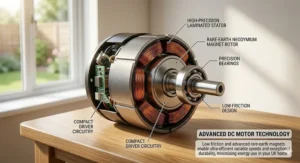
Modern solid-state controls, common in the 6-speed ceiling fans reviewed above, use digital pulse-width modulation (PWM). Instead of varying voltage, PWM rapidly switches power on-off thousands of times per second—longer “on” pulses create higher average speeds. The motor’s inertia smooths these pulses into apparently continuous rotation.
For UK buyers, solid-state controls offer specific advantages:
Energy efficiency: PWM controllers waste virtually no energy as heat, unlike resistive capacitor systems. This partly explains why modern DC motor fans consume 24-40W versus 60-100W for older capacitor-controlled AC models—meaningful savings given current UK electricity prices around £0.28/kWh.
Reliability: Solid-state systems contain no moving parts or degrading capacitors, improving longevity. The British Standards Institution notes PWM controllers typically outlast capacitor-based alternatives by 50-100% in real-world British conditions where damp can accelerate capacitor deterioration.
Smart features: Digital control enables memory functions, timer programming, and remote control operation—features impossible with purely analog capacitor systems.
Wall Control vs Remote vs Smart App
British buyers encounter three control paradigms when selecting adjustable speed ceiling fan wall control systems:
Wall-mounted variable speed controllers replace standard light switches with rotary or slide controls offering either stepless adjustment or discrete settings (3-speed, 4-speed, 6-speed common). Installation requires basic electrical competence—connecting live, neutral, and fan motor wires per UK wiring regulations. The advantage: you’ll never misplace the controller. The disadvantage: you must leave your bed or sofa to adjust settings.
Remote control systems dominate the UK market currently, particularly models available via Amazon.co.uk. The convenience proves genuinely valuable—adjusting fan speed from bed eliminates the jarring experience of climbing out from under warm covers on cold mornings. Most remotes operate on 433MHz RF (radio frequency), providing reliable control without line-of-sight requirements within 8-10 metre range.
Smart app control remains relatively uncommon in the £50-£100 ceiling fan segment popular with UK buyers. Models advertising app compatibility typically require purchasing separate Wi-Fi bridge modules (£20-£35 additional cost). The benefits—voice control via Alexa, scheduling, integration with whole-home automation—appeal to tech-enthusiast buyers but remain niche for most British households where reliable remote control suffices.
The 6-Speed Sweet Spot
You’ll notice most variable speed ceiling fans reviewed above offer precisely 6 speeds. This isn’t coincidental—it represents the optimal balance between flexibility and usability.
Three speeds (low/medium/high) provide inadequate granularity. British weather varies so dramatically that you’ll frequently want airflow somewhere between “low” and “medium” that 3-speed systems cannot deliver.
Six speeds hit the sweet spot: sufficient gradation to match changing conditions without overwhelming users with excessive choice. Speed 1-2 handle gentle background circulation, 3-4 manage typical British summer conditions (18-25°C), whilst 5-6 provide robust movement during genuine heatwaves or when distributing conditioned air.
Stepless/infinite adjustment sounds appealing but research suggests most users settle on 5-8 preferred positions anyway—rarely using the full spectrum. The memory function in quality 6-speed models effectively creates “your personal speeds,” rendering infinite adjustment largely superfluous.
Choosing the Right Variable Speed Fan for Your UK Home
Selecting the optimal variable speed ceiling fan requires matching specific technical characteristics to your property’s unique requirements and British climate considerations.
Room Size and Ceiling Fan Diameter
British building conventions create specific dimensional constraints rarely addressed in American-focused ceiling fan guides. Here’s how to match fan size to UK room dimensions:
Small Rooms (8-12m²): Compact second bedrooms, box rooms, small home offices
- Recommended diameter: 40-46cm
- Example fans: SUNKENET 40cm, CHANFOK 46cm
- Clearance consideration: Maintain minimum 50cm from walls for effective air circulation
Medium Rooms (12-18m²): Standard British bedrooms, dining rooms, modest living rooms
- Recommended diameter: 48-52cm
- Example fans: NIORSUN 50cm, VOLISUN 50cm, HARPER LIVING 50cm
- Typical application: Semi-detached bedrooms, terraced house main rooms
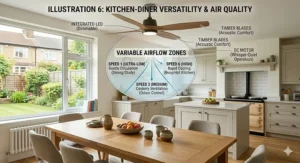
Large Rooms (18-30m²): Master bedrooms, large living rooms, open-plan kitchen-diners
- Recommended diameter: 60-90cm
- Performance note: Standard 50cm fans struggle in rooms exceeding 20m² during hot weather
Very Large Spaces (30m²+): Converted lofts, open-plan living areas, conservatories
- Recommended diameter: 100-120cm
- Example fan: DEPULEY 107cm
- Installation note: Professional fitting recommended given weight and electrical load
Ceiling Height Considerations for British Homes
UK ceiling heights typically fall within narrower ranges than American or Australian properties, creating specific installation considerations:
Standard Height (2.3-2.5m): Most common in British residential construction
- Solution: Flush-mount or ultra-low-profile designs (CHANFOK 15cm depth)
- Minimum clearance: Maintain 2.1m floor-to-blade clearance for safety and comfort
- Building regulations: Whilst no specific UK ceiling fan height regulation exists, Part K (Protection from Falling) implies maintaining safe headroom
Generous Height (2.5-2.8m): Common in Victorian/Edwardian properties, modern new-builds
- Solution: Standard flush-mount or short downrod (15-30cm extension)
- Optimal positioning: Centre fan blade 2.4-2.7m above floor for maximum efficiency
High Ceilings (2.8m+): Period conversions, barn conversions, vaulted ceilings
- Solution: Extended downrod suspension (30-60cm)
- Performance benefit: Suspending fan closer to living space dramatically improves air circulation
- Example: DEPULEY includes downrod options
UK Climate and Seasonal Considerations
Britain’s maritime temperate climate creates unique ceiling fan requirements rarely discussed in generic product guides:
Summer Operation (June-September): British summers average 15-25°C with increasingly frequent 28-35°C heatwaves. Variable speed control proves invaluable: Speed 2-3 suffices for mild 20°C evenings, whilst Speed 5-6 becomes necessary during genuine hot spells. The reversible motor should operate in standard downdraft mode, creating direct cooling breeze.
Autumn/Spring Transition (April-May, September-October):
Unpredictable British weather demands flexibility. Mild 18°C days might require Speed 1-2, whilst unexpectedly warm 24°C afternoons necessitate Speed 4-5. The multiple fan speeds capability shines during these transitional months when conditions change hourly.
Winter Heat Redistribution (November-March): Switch your variable speed ceiling fan to reverse (updraft) mode on Speed 1-2. This creates gentle circulation that redistributes trapped warm air near ceilings without creating uncomfortable cold draughts. The Energy Saving Trust notes this can reduce heating costs by 10-15% in rooms with high ceilings or inefficient radiator placement.
Year-Round Damp Management: British humidity frequently exceeds 70-80% even without rain. Operating ceiling fans on low speed (1-2) improves air circulation, reducing condensation risk on windows and preventing that musty smell that develops in poorly-ventilated British bedrooms. The energy-efficient DC motors in modern fans make 24/7 low-speed operation economically viable at roughly £15-£20 annually.
Installation Guide: Setting Up Your Variable Speed Ceiling Fan
Installing a variable speed ceiling fan in a British home requires understanding UK electrical regulations and typical residential construction characteristics.
UK Electrical Safety Requirements
Part P Building Regulations govern electrical work in England and Wales (Scotland follows different but broadly similar standards). Ceiling fan installation constitutes “notifiable work” in some local authorities—check with your council before proceeding.
Key safety requirements for UK installations:
Electrical connection: British homes use 230V AC single-phase supply. Modern ceiling fans designed for UK market arrive with appropriate voltage ratings and often pre-fitted UK-compatible connectors. Verify UKCA or CE marking confirming compliance with UK Low Voltage Directive.
Circuit capacity: Most ceiling fans consume 25-50W, easily accommodated by standard 6A lighting circuits common in British homes. However, verify your circuit isn’t already heavily loaded—adding fans to circuits already powering multiple rooms risks overload.
Earth connection: Unlike some countries where ceiling fans may rely on plastic mounting for electrical isolation, UK regulations require proper earth bonding. The mounting bracket must connect to earth wire even if the fan body is non-conductive plastic.
Competent person schemes: If you lack confidence in electrical work, engage electricians registered with NICEIC, ELECSA, or similar competent person schemes. Typical installation costs range £60-£120 depending on complexity and regional UK labour rates.
Step-by-Step Installation for DIY-Competent UK Homeowners
Tools required: Phillips screwdriver, flat-blade screwdriver, wire strippers, voltage tester, drill with masonry bits, stepladder suitable for your ceiling height.
Step 1 — Electrical isolation: Switch off power at consumer unit (fuse box) and verify dead using proper voltage tester—not just checking the light doesn’t work. British homes sometimes have confusing circuit arrangements where bedroom lights share circuits with landing lights, creating unexpected live wires.
Step 2 — Remove existing light fitting: Disconnect wires carefully, noting which colour connects where. Modern UK wiring uses brown (live), blue (neutral), green/yellow (earth). Older properties may have red (live), black (neutral), bare copper or green (earth).
Step 3 — Mounting bracket installation: Most ceiling fans include metal mounting brackets designed for British ceiling joists (typically 40cm centres). If existing ceiling rose doesn’t align with joist, use proper plasterboard fixings rated for the fan’s weight plus 50% safety margin. The NIORSUN at 3.3kg requires fixings rated minimum 5kg; DEPULEY at 12kg needs professional installation or substantial through-bolting to joists.
Step 4 — Wiring connections: Modern fans include connector blocks simplifying wire joining. Match colours carefully: mains brown to fan live, mains blue to fan neutral, mains earth to fan earth/mounting bracket. Some fans include separate light circuit—follow manufacturer’s wiring diagram precisely.
Step 5 — Fan assembly and mounting: Most models arrive partially pre-assembled. Attach fan body to mounting bracket, ensuring mechanical stability and electrical connections remain secure. Weight should rest on bracket, not electrical connections.
Step 6 — Testing: Restore power and test all functions: each speed setting, light operation, reversible function, remote control. Verify no wobbling—minor blade imbalance is normal, excessive wobbling indicates installation problems requiring correction.
Common UK Installation Challenges
Solid concrete ceilings: Common in post-1960s British flats and some modern builds. Requires proper masonry fixings and drilling—consider professional installation to ensure secure mounting.
Lath-and-plaster ceilings: Victorian/Edwardian properties often feature weak lath-and-plaster unsuitable for ceiling fan loads. Professional assessment recommended; mounting may require substantial reinforcement.
Artex/textured ceilings: The mounting bracket must sit flush against ceiling. Artex texture may require careful removal around mounting point—wear mask as older Artex potentially contains asbestos.
Limited ceiling rose space: Older British ceiling roses provide minimal working room for fan wiring. Sometimes replacing the rose with a larger enclosure proves necessary—electrical work best left to professionals if you’re uncertain.

Energy Costs and Savings: UK-Specific Analysis
Understanding actual running costs in British conditions helps justify the variable speed ceiling fan investment versus traditional fixed-speed alternatives.
Real-World UK Energy Consumption
Based on current UK electricity prices (approximately £0.28/kWh as of 2026), here’s what operating modern variable speed ceiling fans actually costs:
NIORSUN 50cm (24W DC motor):
- Speed 1-2 (8W average): £0.06 per 8-hour night = £10.80 per 180-day cooling season
- Speed 3-4 (16W average): £0.11 per 8 hours = £19.80 per season
- Speed 5-6 (24W maximum): £0.17 per 8 hours = £30.60 per season
- Typical mixed usage: £18-£25 annually for bedroom use
DEPULEY 107cm (45W DC motor):
- Speed 1-2 (15W average): £0.10 per 8 hours = £18.00 per season
- Speed 3-4 (28W average): £0.19 per 8 hours = £34.20 per season
- Speed 5-6 (45W maximum): £0.30 per 8 hours = £54.00 per season
- Typical mixed usage: £35-£45 annually for living room use
Traditional AC motor ceiling fan (75W):
- Single speed operation: £0.50 per 8 hours = £90.00 per season
- Savings versus modern DC fan: £65-£75 annually
The multiple fan speeds capability delivers genuine financial benefit: you’ll rarely require maximum speed in British conditions, meaning actual consumption trends toward lower speeds where modern DC motors excel. Over a typical 10-15 year ceiling fan lifespan, switching from traditional AC to variable-speed DC models saves £650-£1,125 in electricity costs—easily exceeding the £70-£90 purchase price.
Winter Heating Cost Reduction
Operating ceiling fans in reverse during winter months creates measurable heating cost savings in British homes:
The physics: Warm air rises and stratifies near ceilings in heated British rooms. In a 2.7m-high living room, temperature differential between ceiling and floor can reach 4-6°C. That’s expensive heated air providing zero comfort benefit whilst your thermostat calls for more heat.
The solution: Run your variable speed ceiling fan on Speed 1-2 in reverse (updraft) mode. This creates gentle circulation that redistributes trapped warm air downward without creating uncomfortable draughts. Result: you achieve desired comfort at lower thermostat settings.
Quantified savings for typical British semi-detached:
- Living room (20m² with 2.7m ceiling): 8-12% heating cost reduction
- Bedroom (12m² with 2.4m ceiling): 5-8% heating cost reduction
- Open-plan area (35m² with vaulted ceiling): 12-18% heating cost reduction
At average UK gas heating costs (£0.07/kWh for heating a room), this translates to:
- Living room: £35-£50 annual saving
- Bedroom: £20-£30 annual saving
- Open-plan: £60-£90 annual saving
Important caveat: These savings assume you actually reduce thermostat settings rather than simply enjoying warmer rooms at the same setting. The discipline to turn thermostats down 1-2°C determines whether you realise genuine savings or merely enhance comfort.
Common Mistakes When Buying Variable Speed Ceiling Fans
British buyers frequently make avoidable errors when selecting ceiling fans—mistakes that lead to disappointment, unnecessary expense, or safety concerns.
Mistake 1: Ignoring Actual Room Dimensions
The error: Selecting fan size based on aesthetic preference rather than room dimensions. “That 107cm DEPULEY looks impressive—I’ll install it in my bedroom!”
The reality: A 107cm fan in a typical 12m² British bedroom creates overwhelming visual bulk and excessive airflow. You’ll never use speeds above 2-3, wasting the capability (and extra cost) of a large-diameter fan designed for substantially bigger spaces.
The fix: Measure your room accurately and consult the sizing guide above. For typical British bedrooms (10-15m²), 48-52cm diameter represents the sweet spot. Conserve your budget or invest in better features rather than unnecessary diameter.
Mistake 2: Overlooking Ceiling Height Limitations
The error: Installing standard drop-mount fans in rooms with 2.3-2.4m ceiling heights common in British terraced houses and older semi-detached properties.
The reality: You need minimum 2.1m clearance below fan blades for safety and comfort. A fan extending 20cm from ceiling in a 2.3m-height room leaves just 2.1m clearance—barely adequate and uncomfortable for taller occupants.
The fix: Choose ultra-low-profile models like the CHANFOK (15cm depth) for rooms with ceiling heights below 2.5m. These sacrifice some airflow efficiency but deliver acceptable performance whilst maintaining comfortable headroom.
Mistake 3: Assuming All “6-Speed” Controls Are Equal
The error: Believing all variable speed ceiling fans offering 6 speeds deliver equivalent performance and control granularity.
The reality: Substantial quality differences exist. Budget models sometimes implement “6 speeds” as three genuine speeds with two redundant settings that feel virtually identical. Premium models deliver six genuinely distinct airflow levels with noticeable differences between each setting.
The fix: Read UK customer reviews carefully, particularly feedback mentioning whether speed differences feel meaningful. The NIORSUN and VOLISUN consistently receive praise for genuinely distinct speed settings; some cheaper alternatives disappoint.
Mistake 4: Neglecting Reversible Motor Functionality
The error: Dismissing reversible motors as unnecessary complexity. “I only need cooling in summer—why would I run the fan backwards?”
The reality: Britain’s climate and heating patterns make reversible motors genuinely valuable. Winter operation in reverse redistributes trapped warm air, reducing heating costs. The 10-15% savings documented above require reversible capability.
The fix: Prioritise models with easily accessible reverse function. Remote-controlled reversal (NIORSUN, VOLISUN) proves more convenient than fans requiring physical switch manipulation (some budget models).
Mistake 5: Inadequate Consideration of British Voltage and Wiring
The error: Purchasing fans designed for American 110-120V systems or European 220V systems without verifying UK 230V compatibility.
The reality: Whilst most fans sold via Amazon.co.uk automatically suit British electrical systems, grey-import products occasionally surface. Operating 110V fans on 230V causes immediate catastrophic failure or fire risk. Operating 220V fans on 230V creates gradual component stress and premature failure.
The fix: Verify UKCA or CE marking confirming UK compliance. Check product specifications explicitly state 230V compatibility. When in doubt, contact the seller for confirmation before purchasing.
FAQ: Variable Speed Ceiling Fans UK
❓ Are 6-speed ceiling fans more energy-efficient than 3-speed models?
❓ Can I install a ceiling fan myself in the UK, or must I hire an electrician?
❓ Do variable speed ceiling fans work effectively in the cold British climate?
❓ What's the typical lifespan of a variable speed ceiling fan in UK conditions?
❓ How do I reduce noise from my variable speed ceiling fan?
Conclusion: Finding Your Perfect Variable Speed Ceiling Fan
The British market for variable speed ceiling fans has matured dramatically over the past 3-4 years. Where we once faced limited choice between expensive premium models or unreliable budget alternatives, today’s Amazon.co.uk selection offers genuinely impressive products in the £55-£110 range that combine efficient DC motors, thoughtful features, and build quality suitable for years of British service.
For most UK buyers, the NIORSUN 50cm Smart or VOLISUN 50cm Modern represent optimal choices—delivering 6-speed flexibility, energy-sipping operation, reversible motors for winter use, and integrated LED lighting at accessible £65-£90 pricing. These models suit the typical British bedroom, dining room, or modest living room perfectly whilst maintaining energy costs below £20 annually.
Budget-conscious buyers prioritising multiple-room installations should examine the SUNKENET 40cm—accepting minor compromises on lighting output and motor refinement whilst retaining the crucial 6-speed control and DC motor efficiency that deliver genuine value.
Larger British homes with open-plan areas exceeding 25m² demand the DEPULEY 107cm. Yes, £140-£180 represents substantial investment, but smaller fans simply cannot move sufficient air across larger volumes effectively. The downrod mounting option particularly benefits properties with ceiling heights exceeding 2.7m.
The adjustable speed ceiling fan wall control technology has evolved beyond simple convenience into genuine practical necessity for British homes. Our unpredictable maritime climate demands flexibility—gentle Speed 1-2 for mild evenings, robust Speed 5-6 during increasingly frequent heatwaves, and winter reverse operation for heating cost reduction. Fixed-speed fans cannot deliver this adaptability.
As British summers continue trending warmer and energy costs remain elevated, variable speed ceiling fans transition from luxury to sensible home improvement. The £70-£90 investment in a quality model pays for itself within 3-4 years through electricity savings versus traditional fans, whilst improving comfort throughout the year. For British homeowners seeking energy-efficient cooling, improved air circulation, and reduced heating costs, variable speed ceiling fans represent one of the smartest purchases you can make.
Recommended for You
- Touch Screen Ceiling Fan Control: 7 Best Options UK 2026
- 7 Best Digital Ceiling Fan Wall Controls UK 2026
- 7 Best Wall Mounted Remote Ceiling Fans UK 2026 | Save £90 Yearly
Disclaimer: This article contains affiliate links. As an Amazon Associate, I earn from qualifying purchases. If you purchase products through these links, we may earn a small commission at no additional cost to you.
✨ Found this helpful? Share it with your mates! 💬🤗
