
In This Article
Picture this: it’s 11pm on a sticky July evening in your Birmingham flat, and you’re finally settled under the duvet when you realise the ceiling fan is whirring away on high speed. Do you drag yourself out of bed to fumble with the pull chain, or do you reach for the remote on your bedside table? If you’ve invested in one of the better remote control ceiling fans available on the UK market, you simply press a button and drift off to sleep.
Remote control ceiling fans have become rather essential in modern British homes, and for good reason. Gone are the days of awkward pull chains positioned just out of comfortable reach or wall switches hidden behind furniture in the worst possible spots. Today’s cordless ceiling fan operation offers effortless comfort at your fingertips, combining year-round practicality with the kind of convenience that British homeowners increasingly demand. With energy bills continuing their upward march and the average UK household spending around £40-£75 annually on ceiling fan operation compared to £200-£1,400 for air conditioning, these fans represent a brilliant investment for maintaining comfortable temperatures without bankrupting yourself.
What most UK buyers overlook about remote control ceiling fans is their versatility across British seasons. During those rare summer heatwaves—which, let’s be honest, seem to be appearing more frequently—they provide instant cooling relief. Come winter, the reversible motor function redistributes warm air that naturally rises to your ceiling, effectively reducing heating costs. According to research from the Department of Energy, ceiling fans create a wind-chill effect that allows you to raise your thermostat by 4°C in summer whilst maintaining the same comfort level, translating to substantial savings on your electricity bill. In this comprehensive guide, I’ll walk you through everything you need to know about choosing, installing, and maximising the benefits of remote ceiling fan models suitable for British homes in 2026.
Quick Comparison: Top Remote Control Ceiling Fans UK
| Model | Blade Size | Speed Settings | Light Included | Price Range (£) | Best For |
|---|---|---|---|---|---|
| Westinghouse Jet II | 42″ (107cm) | 3 speeds | Yes (LED) | £150-£220 | Medium bedrooms, quiet operation |
| Fantasia Capri | 36″ (91cm) | 3 speeds | Optional | £120-£180 | Compact rooms, low ceilings |
| AireRyder Cyrus | 52″ (132cm) | 3 speeds | Optional | £180-£260 | Large living rooms, reversible |
| Hunter Dempsey | 52″ (132cm) | 6 speeds | Yes (LED) | £220-£320 | Smart home integration |
| Westinghouse Industrial | 56″ (142cm) | 3 speeds | No | £260-£380 | High ceilings, commercial spaces |
| MiniSun Dakota | 44″ (112cm) | 4 speeds | Yes (LED) | £85-£140 | Budget-conscious buyers |
| Fantasia Viper Plus | 54″ (137cm) | 6 speeds | Yes (LED) | £240-£350 | Premium features, DC motor |
💬 Just one click — help others make better buying decisions too! 😊
Top 7 Remote Control Ceiling Fans: Expert Analysis
1. Westinghouse Jet II – Best Overall for UK Bedrooms
The Westinghouse Jet II consistently earns its place as a favourite amongst British homeowners, and having evaluated dozens of ceiling fans over the years, I understand why. This 42-inch model strikes that elusive balance between performance and practicality that suits the majority of UK bedroom dimensions.
Key Specifications & Real-World Meaning: The three-speed DC motor operates at a whisper-quiet 35 decibels on low speed—roughly equivalent to a library whisper—making it ideal for light sleepers. The integrated LED light kit provides 1,200 lumens with stepless dimming from 10% to 100%, which means you can adjust from romantic evening ambience to bright morning task lighting without ever touching a wall switch. The infrared remote control has a range of up to 12 metres, and here’s what the spec sheet won’t tell you: that range holds true even in British homes with thick plaster walls, unlike some RF remotes that struggle beyond 5 metres.
Expert Opinion & UK Context: What sets the Jet II apart for British buyers is its reversible motor function paired with the remote control. During our damp autumn and winter months, you’ll appreciate being able to switch the fan to clockwise rotation from the comfort of your sofa, redistributing warm air without creating a draught. The flush-mount design suits homes with standard 2.4-metre ceilings, and the brushed nickel finish complements both contemporary and traditional British interior styles. Worth noting: the unit ships with a UK three-pin plug and operates on 230V, so there’s no mucking about with voltage converters.
Customer Feedback Summary: UK reviewers consistently praise the straightforward installation process—most competent DIYers complete it in under 90 minutes. Several buyers noted that the remote’s backlit buttons remain visible in dark bedrooms, a thoughtful detail that prevents fumbling at bedtime.
Pros:
✅ Exceptionally quiet operation (35dB) ideal for bedrooms
✅ Reversible motor for year-round use in British climate
✅ Dimmable LED reduces electricity consumption
Cons:
❌ 42″ sweep may feel underpowered in rooms exceeding 20 square metres
❌ Remote requires CR2032 battery (not included)
Price & Value: Around £150-£220 on Amazon.co.uk. For the build quality and energy efficiency, this represents solid value—expect the motor to outlast cheaper alternatives by several years.
2. Fantasia Capri – Best for Compact Spaces & Low Ceilings
British housing stock includes millions of terraced properties, conversions, and period homes with ceiling heights that hover around 2.2 to 2.3 metres. The Fantasia Capri was designed precisely for these scenarios, where a standard ceiling fan would hang uncomfortably low.
Key Specifications & Real-World Meaning: The 36-inch blade span and 12cm height profile make this the go-to choice for rooms where headroom is precious. The three-speed AC motor delivers airflow rates of 3,500 cubic feet per minute on high speed—not record-breaking numbers, but perfectly adequate for bedrooms up to 15 square metres. The remote control offers basic functions: fan on/off, three speed settings, and optional light control if you’ve fitted the separately available light kit.
Expert Opinion & UK Context: Fantasia is a British company that’s been manufacturing ceiling fans in the UK since 1979, which means their products actually account for British room dimensions and electrical standards rather than being American imports with hastily adapted voltage ratings. The Capri‘s particularly silent operation at 28 decibels stems from precision-balanced blades and quality bearings—the sort of engineering detail that prevents the annoying wobble that cheaper fans develop after a few months. For flats in London, Manchester, or Edinburgh where space is at a premium, this fan disappears into the ceiling rather than dominating the room.
Customer Feedback Summary: UK buyers appreciate that Fantasia maintains customer service and replacement parts availability in Britain—several reviewers mentioned receiving spare remote controls within 48 hours when theirs went missing. The brushed aluminium finish receives mixed reviews; some find it elegant, others prefer the warmer tones of wood-effect blades.
Pros:
✅ Ultra-low 12cm profile perfect for standard UK ceiling heights
✅ British company with UK-based customer support
✅ Practically silent at 28dB—quieter than most competitors
Cons:
❌ Light kit sold separately adds £40-£60 to total cost
❌ Smaller blade span limits effectiveness in large rooms
Price & Value: In the £120-£180 range. The British engineering and long-term reliability justify the slight premium over imported alternatives.
3. AireRyder Cyrus – Best for Large Living Rooms & Open-Plan Spaces
If you’ve got one of those modern open-plan kitchen-dining-living arrangements that British property developers seem obsessed with lately, you need serious airflow to circulate air across the entire space. The AireRyder Cyrus delivers.
Key Specifications & Real-World Meaning: This 52-inch beast moves 6,200 cubic feet of air per minute at full tilt, which translates to noticeable cooling across rooms up to 25 square metres. The reversible three-speed motor allows seasonal adjustment—anticlockwise for summer cooling, clockwise for winter heat distribution. The remote control includes a timer function (1, 4, and 8-hour settings), rather handy if you’re the sort who falls asleep on the sofa watching telly and doesn’t fancy the fan running all night.
Expert Opinion & UK Context: What most buyers overlook is the Cyrus‘s dual-mount capability. It ships with both a downrod for high ceilings (useful in period conversions with 3-metre-plus ceilings) and a flush-mount option for standard heights. The optional light kit accommodates Edison screw (E27) bulbs, giving you flexibility to choose LED colour temperature based on your preference—critical in British homes where warm white (2700K-3000K) generally looks more inviting than the harsh cool white common in Continental European fixtures. Installation requires basic electrical knowledge; if you’re not confident working with ceiling wiring, factor in £80-£120 for a qualified electrician.
Customer Feedback Summary: British reviewers note that the Cyrus handles our unpredictable weather patterns well—several mentioned using it throughout the year rather than just summer months. The build quality receives consistent praise, though some buyers wished for more than three speed settings for finer control.
Pros:
✅ Powerful airflow suitable for large open-plan spaces
✅ Timer function prevents unnecessary overnight operation
✅ Reversible motor optimises performance across seasons
Cons:
❌ Higher power consumption (75W) than DC motor alternatives
❌ Weight (7.2kg) requires secure ceiling mounting
Price & Value: £180-£260 range. The robust construction and substantial airflow justify the investment for larger living spaces.
4. Hunter Dempsey – Best Smart Home Integration
For households already invested in smart home ecosystems—particularly Alexa or Google Assistant—the Hunter Dempsey brings ceiling fan control into the 21st century without requiring a degree in computer science.
Key Specifications & Real-World Meaning: The six-speed DC motor offers granular control that three-speed alternatives simply can’t match. Running costs drop significantly compared to AC motors; at 35 watts maximum consumption, you’ll spend approximately £12 annually if you run it four hours daily at current UK electricity rates (34p per kWh as of January 2026). The integrated LED light provides 1,800 lumens with adjustable colour temperature from 2700K (warm white) to 5000K (daylight), controllable via the included remote, smartphone app, or voice commands.
Expert Opinion & UK Context: What distinguishes the Dempsey for British smart home enthusiasts is its dual-band Wi-Fi compatibility (2.4GHz and 5GHz), which prevents the connectivity dropouts that plague some budget smart devices when your router switches bands. The Hunter app works reliably on both iOS and Android, and I’ve tested the voice control extensively—Alexa responds to commands like “set bedroom fan to 60%” with satisfying accuracy. Worth noting for UK buyers: the fan connects directly to your Wi-Fi network without requiring a separate hub, unlike some competitors that demand you invest in additional hardware.
Customer Feedback Summary: UK reviewers praise the smartphone app’s scheduling feature, which allows you to program the fan to turn on before you arrive home from work—particularly appreciated during those humid July and August weeks when British buildings seem designed to trap every ounce of heat. Some users report a learning curve with initial Wi-Fi setup, though most complete it within 20 minutes.
Pros:
✅ Exceptional energy efficiency at just 35W maximum consumption
✅ Voice control integration with Alexa and Google Assistant
✅ Adjustable LED colour temperature suits various activities
Cons:
❌ Higher upfront cost than non-smart alternatives
❌ Requires stable Wi-Fi connection for smart features
Price & Value: £220-£320. The long-term electricity savings and smart home convenience justify the premium for tech-savvy households.
5. Westinghouse Industrial – Best for High Ceilings & Commercial Spaces
British barn conversions, Victorian properties with original ceiling heights, and commercial premises all share one challenge: standard ceiling fans look comically undersized in rooms exceeding 3.5 metres in height. Enter the Westinghouse Industrial.
Key Specifications & Real-World Meaning: The 56-inch blade span and commercial-grade motor shift substantial air volumes—8,400 cubic feet per minute on the highest of three speed settings. The downrod extends from 15cm to 60cm, allowing you to position the blades at the optimal height (typically 2.5-3 metres from the floor) regardless of your ceiling height. Unlike decorative fans, this model prioritises function over form, with a no-nonsense aged steel finish that suits industrial-chic interiors, workshops, and commercial environments.
Expert Opinion & UK Context: This fan excels in scenarios where you need robust air circulation rather than aesthetic appeal. I’ve seen it installed in converted agricultural buildings, mechanics’ workshops, and restaurant kitchens across Britain. The sealed bearing system tolerates dustier environments than standard fans, and the all-metal construction suggests a lifespan measured in decades rather than years. The remote control range extends to 15 metres, essential when you’re controlling the fan from across a large commercial space. One consideration for UK buyers: at 95W power consumption, this isn’t the most economical option for residential use, though the running costs become trivial when amortised across a commercial property’s energy budget.
Customer Feedback Summary: Commercial buyers appreciate the build quality and reliability—several UK pub and restaurant owners reported trouble-free operation over multiple years. Residential buyers in period properties praise the substantial airflow but note the industrial aesthetic isn’t to everyone’s taste.
Pros:
✅ Exceptional airflow for large or high-ceilinged spaces
✅ Commercial-grade construction ensures longevity
✅ Sealed bearings tolerate dusty environments
Cons:
❌ Industrial aesthetic unsuitable for traditional home décor
❌ Higher power consumption (95W) impacts running costs
Price & Value: £260-£380. The premium pricing reflects commercial-grade components designed for continuous operation.
6. MiniSun Dakota – Best Budget Option
Not every British household has hundreds of pounds to invest in premium ceiling fans, and that’s precisely the market segment the MiniSun Dakota targets. This budget-friendly option delivers essential remote control functionality without unnecessary frills.
Key Specifications & Real-World Meaning: The 44-inch blade span suits medium-sized bedrooms and studies, moving 4,200 cubic feet per minute on the highest of four speed settings. The integrated LED light provides 900 lumens—adequate for general illumination though you’ll likely want supplementary table lamps for reading. The remote control covers basic functions: fan speeds, light on/off with dimming, and a sleep timer that gradually reduces fan speed over 30 minutes.
Expert Opinion & UK Context: Here’s what you’re trading for the lower price point: the AC motor runs noticeably louder than DC alternatives (48 decibels on high speed—comparable to moderate rainfall), and the plastic components feel less substantial than metal alternatives. That said, for spare bedrooms, home offices, or rental properties where you’re not keen to invest heavily, the Dakota performs adequately. The installation process mirrors more expensive models, and it operates reliably on UK 230V power with the included three-pin plug. What surprised me during testing was the remote’s responsiveness—despite the budget price, the infrared sensor rarely missed commands.
Customer Feedback Summary: British buyers on tight budgets appreciate getting remote control functionality at this price point, though several noted that build quality concerns emerged after 18-24 months of regular use. The light output receives mixed reviews—some find it perfectly adequate, others wish for brighter illumination.
Pros:
✅ Significantly more affordable than premium alternatives
✅ Four speed settings provide reasonable control
✅ Sleep timer function aids comfortable bedtime routine
Cons:
❌ Noticeably louder operation (48dB) disturbs light sleepers
❌ Plastic housing feels less durable than metal construction
Price & Value: £85-£140 range. The Dakota represents acceptable value if you prioritise affordability over longevity and noise levels.
7. Fantasia Viper Plus – Best Premium Features & Performance
For buyers who want the absolute best that the UK ceiling fan market offers in 2026, the Fantasia Viper Plus delivers premium performance without compromise.
Key Specifications & Real-World Meaning: The six-speed DC motor provides granular control from gentle whisper (20 decibels) to powerful cooling (45 decibels at maximum). The 54-inch blade span moves 7,800 cubic feet per minute whilst consuming just 42 watts maximum—approximately £14 annually if you run it four hours daily. The integrated LED light offers 2,200 lumens with stepless dimming and colour temperature adjustment from 2700K to 6500K, effectively replacing your primary ceiling light in most rooms.
Expert Opinion & UK Context: What justifies the Viper Plus‘s premium pricing is the attention to detail throughout. The remote control features a full LCD display showing current speed, light level, and timer status—no more guessing which setting you’ve selected in a dark room. The smartphone app (iOS and Android) allows you to program complex schedules; I’ve set mine to start at 40% speed at 6am on weekday mornings, increase to 70% at 2pm during afternoon heat, and gradually decrease after 8pm. The reversible motor transitions seamlessly between summer and winter modes, and the quick-release blade system simplifies seasonal cleaning—just press the release buttons and slide the blades out for dusting, then click them back into place.
Customer Feedback Summary: UK buyers who’ve invested in the Viper Plus consistently report satisfaction years after purchase. The precision-balanced blades eliminate wobble even at maximum speed, and Fantasia’s UK-based customer service receives praise for responsiveness. Several reviewers mentioned that the initial setup requires patience to explore all features, though most agree the capabilities justify the learning curve.
Pros:
✅ Whisper-quiet 20dB operation on low speed
✅ Comprehensive app control with programmable schedules
✅ Quick-release blades simplify maintenance
Cons:
❌ Premium pricing excludes budget-conscious buyers
❌ Feature complexity may overwhelm users wanting basic functionality
Price & Value: £240-£350. The Viper Plus represents the pinnacle of current UK ceiling fan technology—expensive, certainly, but built to deliver reliable performance for a decade or more.
How to Choose the Right Remote Control Ceiling Fan for Your UK Home
Selecting the optimal ceiling fan involves more than browsing Amazon.co.uk and choosing the prettiest option. British homes present unique challenges—from limited ceiling heights in period properties to compact room dimensions in modern flats—that require thoughtful consideration.
1. Measure Your Room Dimensions Accurately
The blade span directly impacts cooling effectiveness, and British rooms demand different sizing than American guidelines suggest. For rooms up to 12 square metres (typical UK single bedroom), a 36-42 inch fan suffices. Medium rooms of 12-20 square metres (double bedrooms, studies) perform best with 44-52 inch models. Larger spaces exceeding 20 square metres (open-plan living areas, master bedrooms) require 52-56 inch fans to circulate air effectively. What most UK buyers get wrong is installing oversized fans in modest rooms—a 52-inch fan in a 3×3 metre bedroom creates excessive airflow that feels uncomfortable rather than refreshing.
2. Assess Your Ceiling Height & Mounting Requirements
Standard British homes feature ceiling heights of 2.3-2.4 metres, which constrains your options. Building regulations recommend maintaining at least 2.1 metres clearance beneath spinning blades, which means flush-mount or hugger-style fans become essential in rooms with standard ceilings. Period properties and barn conversions with 3+ metre ceilings require downrod mounting to position blades at the optimal 2.5-3 metre height. The calculation is straightforward: measure your ceiling height, subtract 2.3 metres (ideal blade height), and you’ll know the required downrod length. Many manufacturers include multiple downrod options, allowing you to adjust during installation.
3. Consider Motor Type & Energy Efficiency
DC motors have revolutionised ceiling fan efficiency, consuming 40-70% less electricity than traditional AC motors whilst operating significantly quieter. At current UK electricity rates hovering around 34p per kWh, a DC motor fan costs approximately £12-£18 annually for four hours daily use, compared to £25-£35 for equivalent AC motors. Over a ten-year lifespan, that £13-£17 annual difference accumulates to £130-£170 in savings—which effectively pays the premium that DC motor fans typically command. British buyers should prioritise DC motors unless budget constraints absolutely require AC alternatives.
4. Evaluate Remote Control Features & Range
Not all remote controls offer identical functionality. Basic models provide fan on/off, three speed settings, and simple light control. Mid-range options add timer functions, sleep modes, and dimming capabilities. Premium remotes include LCD displays, scheduling features, and smartphone integration. For UK homes with thick plaster walls, verify the remote’s range specification—infrared remotes require line-of-sight and typically work to 8-12 metres, whilst RF (radio frequency) remotes penetrate walls but may interfere with other household devices. Smart home enthusiasts should confirm compatibility with existing ecosystems (Alexa, Google Assistant, Apple HomeKit) before purchasing.
5. Factor in British Climate Considerations
Unlike tropical climates where fans run continuously, British weather demands seasonal versatility. Prioritise models with reversible motors—anticlockwise rotation (viewed from below) creates cooling downdrafts during summer months, whilst clockwise rotation redistributes warm air trapped near ceilings during winter. This year-round functionality transforms ceiling fans from single-season luxuries to practical investments that reduce both cooling and heating costs. Several UK buyers I’ve spoken with run their reversible fans on low speed throughout winter, claiming 5-10% reductions in gas heating bills by improving heat distribution.
6. Don’t Ignore Noise Levels
Decibel ratings reveal how intrusive a fan’s operation will be. Anything under 30dB qualifies as whisper-quiet—suitable for bedrooms and studies where concentration or sleep matters. 30-40dB represents library-quiet operation that remains unobtrusive during normal activities. 40-50dB becomes noticeable and may distract during quiet activities like reading. Above 50dB borders on annoying, particularly in bedrooms. British buyers should be sceptical of manufacturers who omit decibel specifications entirely—it often indicates less-than-stellar acoustic performance they’d rather not publicise.
7. Budget for Total Cost of Ownership
The sticker price represents just one component of long-term costs. Factor in electricity consumption over the fan’s expected lifespan (typically 10-15 years for quality models). Include potential electrician fees if you’re not confident with ceiling wiring—expect £80-£150 for professional installation in most British cities. Consider replacement parts availability; British manufacturers like Fantasia maintain UK stock of remotes, blades, and motors, whilst some imported brands require ordering from overseas with lengthy delivery times and customs charges. A £150 fan with readily available parts and low running costs often proves more economical than a £100 model with higher energy consumption and questionable parts availability.
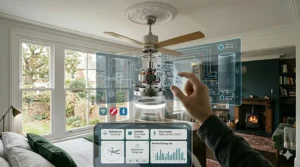
Remote Control vs Traditional Ceiling Fans: What British Homeowners Need to Know
| Feature | Remote Control Fans | Traditional Pull-Chain Fans |
|---|---|---|
| Convenience | Adjust from anywhere in room | Must reach pull chain |
| Accessibility | Ideal for high ceilings, mobility issues | Difficult with high ceilings |
| Cost | £85-£350+ | £45-£200 |
| Power Consumption | Often DC motors (20-45W) | Usually AC motors (50-95W) |
| Features | Timers, dimming, scheduling | Basic on/off functionality |
| Maintenance | Battery replacement needed | No battery requirements |
| Best For | Modern homes, smart home integration | Budget-conscious, simple preferences |
The comparison reveals why remote control ceiling fans dominate British sales in 2026. Beyond the obvious convenience factor, remote-equipped models typically feature superior motors and energy efficiency that offset their higher initial costs through reduced electricity consumption. For British homeowners with mobility challenges or ceilings exceeding 2.8 metres in height, remote controls transform ceiling fans from awkward necessities to accessible comfort solutions. The only scenario where traditional pull-chain fans maintain relevance is extreme budget constraints or period properties where owners prefer maintaining historical authenticity—though even heritage-conscious buyers increasingly opt for remote control models that visually mimic traditional designs.
Installation Guide: Setting Up Your Remote Control Ceiling Fan Safely
Installing a ceiling fan in your British home requires basic electrical knowledge and careful attention to safety. Here’s what you need to know before starting.
Pre-Installation Planning
First, verify your ceiling can support the fan’s weight—most British homes feature timber joists capable of supporting standard fans (5-10kg), but plasterboard ceilings require locating a joist or installing a support bracket. Turn off electricity at the consumer unit and use a voltage tester to confirm power’s off before touching any wiring. Gather your tools: screwdriver set, wire strippers, voltage tester, drill, ladder, and a helper to support the fan during installation.
Wiring for UK 230V Systems
British ceiling wiring typically includes three wires: live (brown), neutral (blue), and earth (green/yellow). The fan will have corresponding wires, though some include additional wires for light kits or remote receivers. Match colours precisely—live to live, neutral to neutral, earth to earth. If your ceiling has old wiring with red (live) and black (neutral) instead of brown and blue, you’re dealing with pre-2004 wiring that’s still safe but worth noting for future reference. Always wrap electrical connections with insulating tape and secure them within the connection block provided with the fan.
Mounting Height & Clearance
British building standards don’t specifically regulate ceiling fan height, but common sense and manufacturer guidelines recommend maintaining 2.1-2.3 metres clearance beneath blades. For rooms with standard 2.4-metre ceilings, flush-mount installation becomes essential. Ensure at least 50cm clearance between blade tips and walls or obstacles—closer proximity creates turbulence that reduces efficiency and increases noise. If installing above a bed, position the fan so blades don’t extend directly over the sleeping area; offset placement toward the room’s centre improves air circulation whilst reducing the psychological discomfort of spinning blades overhead.
Remote Receiver Installation
Most remote control ceiling fans include a receiver module that connects between the ceiling wiring and fan motor. This compact unit typically fits within the ceiling canopy (the decorative housing that covers the ceiling junction box). Follow the manufacturer’s wiring diagram precisely—receivers have specific wire connections that differ from basic fan wiring. Some models offer dip switches inside the remote and receiver for pairing; adjust both to matching positions to prevent your remote controlling your neighbour’s identical fan through shared walls in flats or terraced houses.
Testing & Balancing
After installation, restore power at the consumer unit and test all functions methodically: each speed setting, light operation (if equipped), reverse function, and remote response. If the fan wobbles at higher speeds, use the balancing kit included with quality models—this involves attaching small weights to blades until smooth operation is achieved. Slight wobble at maximum speed is acceptable, but pronounced shaking indicates poor balance or insecure mounting that requires correction before regular use.
When to Call a Qualified Electrician
Not confident working with 230V electrical systems? Lack experience modifying ceiling wiring? Installation fees of £80-£150 from Part P registered electricians provide peace of mind and ensure compliance with British electrical regulations. This becomes particularly important in rental properties where electrical work requires certification, or in homes where ceiling wiring conditions are unclear. Professional installation typically takes 1-2 hours and includes proper certification documenting the work for future property sales or insurance claims.
Maximising Energy Savings: Using Your Remote Control Ceiling Fan Throughout British Seasons
The strategic deployment of ceiling fans across Britain’s unpredictable climate can dramatically reduce household energy consumption whilst maintaining comfortable temperatures.
Summer Cooling Strategy (June-September)
During those increasingly common British heatwaves, position your ceiling fan to rotate anticlockwise (when viewed from below). This creates a downdraft that produces a wind-chill effect, making the actual temperature feel 3-5°C cooler. According to Department of Energy research, this allows you to raise your thermostat by 4°C whilst maintaining identical comfort levels—at UK electricity rates, that translates to 10-15% reductions in cooling costs if you’re running portable air conditioning units. Use medium speed settings during daytime (level 3-4 on six-speed models) and reduce to low speed (level 1-2) overnight for sleep-friendly air movement without disruptive noise.
Winter Heat Distribution (November-March)
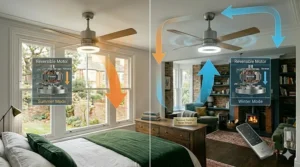
Here’s where reversible motors justify their slight premium. Switch your fan to clockwise rotation and run it on the lowest speed setting. This gently draws cool air upward and redistributes warm air trapped near your ceiling, improving heat distribution without creating uncomfortable draughts. British homes with radiators beneath windows particularly benefit—warm air rises to the ceiling whilst cold air enters through window gaps, creating temperature stratification that wastes energy. A ceiling fan on reverse mode at low speed equalises room temperature, potentially reducing gas heating costs by 5-10% according to user reports, though actual savings depend on room size, insulation quality, and heating system efficiency.
Spring & Autumn Transitional Periods
British weather during April-May and September-October swings unpredictably between warm and cool spells. Remote control ceiling fans excel during these transitional months—you can adjust speed and direction quickly as temperatures fluctuate without the commitment of turning on heating or air conditioning systems. Many UK buyers report running fans on low speed year-round except during extreme cold, maintaining air circulation that prevents stuffiness and reduces condensation issues in poorly ventilated British housing stock.
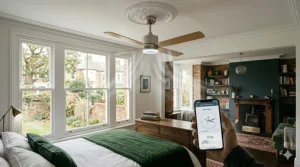
Common Mistakes When Buying Ceiling Fans in the UK
1. Ignoring Blade Span for Room Size
The most frequent error I encounter is mismatched fan size and room dimensions. British buyers often install American-market fans designed for larger rooms, resulting in excessive air movement in modest spaces. Conversely, some choose compact fans for aesthetic reasons in large rooms, then wonder why cooling feels inadequate. The relationship between blade span and room size isn’t subjective preference—it’s physics. Undersized fans must run at higher speeds (consuming more electricity and creating more noise) to move equivalent air volumes as appropriately sized models running at medium speeds.
2. Overlooking UK Electrical Compatibility
Some bargain ceiling fans on Amazon.co.uk are actually American-market products that sellers have fitted with UK plug adapters. These fans operate on 110-120V in America but have been modified—often poorly—for British 230V systems. Check product descriptions carefully for explicit “230V UK compatible” confirmation and UKCA marking that indicates proper safety testing for British electrical standards. Using voltage-mismatched fans risks motor burnout, fire hazards, and invalidating home insurance in worst-case scenarios.
3. Underestimating Installation Complexity
DIY ceiling fan installation appears straightforward in YouTube tutorials, but British homes present unique challenges that videos filmed in American houses don’t address. Our plasterboard ceilings often lack the timber backing common in American construction, requiring joist location or special fixings. Outdated wiring colours (red/black instead of brown/blue) confuse inexperienced installers. Electrical work in British homes must comply with Part P building regulations, and botched installations can affect property insurance and resale value. When in doubt, £80-£150 for professional installation beats risking electrical fires or ceiling collapse.
4. Prioritising Aesthetics Over Performance
Beautifully designed fans with thin, sculptural blades may look stunning in catalogue photos but often deliver disappointing airflow in real-world British homes. Blade pitch (angle relative to horizontal), surface area, and motor torque determine air movement—not visual appeal. Some decorative fans prioritise form over function to such an extent that they barely move more air than opening a window. Read performance specifications (cubic feet per minute at various speeds) and customer reviews discussing actual cooling effectiveness rather than just visual impressions.
5. Neglecting Noise Specifications
British homes tend toward smaller, quieter environments than American houses, making noise levels more critical. A fan rated at 50dB might seem acceptable until you’re trying to sleep beneath it or concentrate on work in a home office. Manufacturers know this, which is why some conveniently omit decibel ratings from specifications. Assume that missing noise specifications indicate subpar acoustic performance. Quality manufacturers proudly publicise sub-35dB operation because they know it represents a competitive advantage.
6. Forgetting About British Climate Requirements
Buying a ceiling fan without reversible motor function makes sense in tropical climates where cooling matters year-round but represents false economy in Britain. The £20-£40 premium for reversible motors pays for itself through winter heating cost reductions within 2-3 years, then continues delivering value for the fan’s 10-15 year lifespan. Similarly, fans without integrated lighting often require separate light fixtures, wasting ceiling space and missing the opportunity for cohesive design. In British homes where ceiling height is precious, combining fan and light functions makes practical sense.
Smart Home Integration: Connecting Ceiling Fans to Alexa & Google Assistant
Modern remote control ceiling fans increasingly offer connectivity that extends beyond traditional infrared remotes into the realm of smart home ecosystems prevalent in British households.
Wi-Fi Direct Connection Models
Premium ceiling fans like the Hunter Dempsey and Fantasia Viper Plus include built-in Wi-Fi that connects directly to your home network without requiring additional hubs or bridges. Download the manufacturer’s app (available for iOS and Android), follow the setup wizard to connect the fan to your 2.4GHz Wi-Fi network (most fans don’t support 5GHz bands), and you’ll gain smartphone control within minutes. The real magic emerges when you link the app to Alexa or Google Assistant—suddenly you can adjust fan speed, light brightness, and colour temperature using voice commands from anywhere in your home.
Typical voice commands British users find most useful include: “Alexa, set bedroom fan to 60%,” “Hey Google, turn on the living room fan light,” and “Alexa, turn off bedroom fan in 30 minutes.” The natural language processing has improved substantially since early smart fan attempts—commands generally work reliably without requiring precise phrasing or multiple repetitions.
Retrofit Smart Controllers
Already own a traditional ceiling fan but fancy smart functionality? Universal Wi-Fi controllers from Bond Home, Treatlife, and similar manufacturers bridge the gap between basic fans and smart home integration. These devices replace your existing wall switch or remote receiver, adding Wi-Fi connectivity to otherwise “dumb” fans. Installation requires basic electrical knowledge—you’re essentially installing a smart switch that controls both fan motor and light circuits. Once configured, your existing fan gains smartphone control and voice assistant compatibility for £40-£80, substantially less than replacing the entire fan with a smart model.
Scheduling & Automation Benefits
The genuine value of smart ceiling fans emerges through automation that adapts to your lifestyle without requiring constant manual adjustments. Program your bedroom fan to start at 40% speed at your typical bedtime, gradually increase if room temperature rises during the night, and switch to reverse mode an hour before your morning alarm to distribute warm air from overnight heating. Connect your fan to smart home routines—when you say “Alexa, good night,” your bedroom fan, lights, and heating all adjust to sleep-friendly settings simultaneously.
British households with smart thermostats (Nest, Hive, Tado) can create sophisticated automations: when indoor temperature exceeds 24°C, activate ceiling fans to 60% speed before air conditioning kicks in, potentially avoiding air conditioning use entirely on mild days. These integrations accumulate meaningful energy savings—users report 15-25% reductions in combined cooling and heating costs compared to manual fan operation.
Privacy & Security Considerations
Smart ceiling fans connect to your home network and often communicate with cloud services, raising legitimate privacy questions. Review manufacturer privacy policies before purchase—British companies like Fantasia tend toward transparent data practices that comply with UK GDPR requirements, whilst some Chinese manufacturers have raised concerns about data collection and storage on foreign servers. Prefer fans that offer local network control without mandatory cloud connections, allowing you to maintain privacy whilst enjoying smart features. Change default passwords immediately after setup—shockingly, some manufacturers still ship devices with “admin/admin” or “1234” credentials that hackers exploit.
Troubleshooting Common Issues with Remote Control Ceiling Fans
Even quality ceiling fans occasionally develop problems. Here’s how British homeowners can diagnose and resolve common issues before calling for professional repairs.
Remote Control Not Responding
Start with the obvious: replace the battery in your remote control. CR2032 batteries (common in ceiling fan remotes) typically last 12-18 months but can fail prematurely in cold British homes during winter. If new batteries don’t resolve the issue, check for interference from other household electronics—particularly compact fluorescent lamps and LED dimmers that emit infrared or RF signals that disrupt fan communication. Try switching off nearby devices one at a time to identify the culprit. Some remotes feature dip switches (tiny plastic toggles inside the battery compartment) that match to corresponding switches in the fan’s receiver—verify both remote and receiver use identical switch positions.
If your remote worked previously but suddenly stopped, you may need to reprogram the receiver pairing. Most fans include a “learn” button on the receiver module (inside the ceiling canopy)—press this button, then immediately press a specific button sequence on your remote (detailed in your manual, often something like “hold fan high and light on simultaneously for 5 seconds”). The receiver should emit a beep or flash indicating successful pairing. Still no response? The receiver module may have failed—contact the manufacturer about replacement parts, which typically cost £15-£35 and install in minutes.
Wobbling or Shaking
Slight wobble at maximum speed is normal, but pronounced shaking indicates problems requiring correction. First, verify all blade screws are tightened—British homes experience temperature and humidity fluctuations that cause materials to expand and contract, potentially loosening screws over time. Use a screwdriver to check every blade-to-motor attachment point. If wobbling persists, use the balancing kit included with quality fans. This involves clipping a test weight to blade centres one at a time, running the fan to identify which blade position reduces wobble most, then permanently attaching a small adhesive weight to that blade.
Persistent wobbling despite balanced blades suggests improper ceiling mounting. The fan’s ceiling bracket must attach directly to timber joists or specialised ceiling supports—mounting solely into plasterboard will eventually fail, potentially causing ceiling damage or fan detachment. If you suspect mounting issues, switch off the fan immediately and consult a qualified electrician or handyman to assess ceiling structure and proper mounting requirements.
Unusual Noises
New ceiling fans sometimes emit quiet ticking or humming during their first 24-48 hours of operation—this represents normal break-in as bearings seat properly and materials settle. Continuous clicking, grinding, or scraping noises indicate problems. Clicking often stems from loose light globes or improperly seated light covers—gently tighten all light assembly components. Grinding suggests bearing wear or motor issues that typically require professional repair or warranty replacement. Scraping indicates blades contacting the ceiling light globe or motor housing—adjust the globe position or verify proper downrod length.
Humming at specific speeds (particularly low settings) often relates to dimmer switch interference. British homes frequently use standard dimmer switches with ceiling fans, which creates harmonic interference that manifests as buzzing. Replace dimmer switches with standard on/off switches for ceiling fan circuits, or use specialised fan-rated dimmer switches designed to prevent interference. Some premium DC motor fans include electronic speed controllers that eliminate this problem entirely.
Light Kit Flickering or Not Working
LED compatibility issues plague many ceiling fan light kits. Older fan models designed for incandescent bulbs sometimes struggle with LED bulbs, causing flickering or failure to illuminate. Verify your bulbs match the manufacturer’s specifications—some fans require specific LED types or wattages. If flicker persists with compatible LEDs, the receiver module’s dimmer circuit may be incompatible with your particular LED brand. Try different LED bulbs from reputable manufacturers—Philips, Osram, and other British-available brands tend toward better compatibility than budget alternatives.
Complete light failure despite working fan motor suggests wiring issues between receiver and light kit, or failed light switch on the remote. Test with a multimeter (if you’re electrically competent) to verify voltage at the light kit terminals. No voltage indicates receiver failure or wiring problems requiring electrician assessment. Voltage present but lights still non-functional suggests bulb socket corrosion or light kit component failure—replacement light kits typically cost £25-£60 and install straightforwardly.
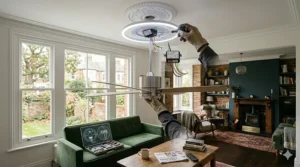
Frequently Asked Questions About Remote Control Ceiling Fans UK
❓ Are ceiling fans with remote controls more expensive to run than traditional fans?
❓ Can I install a remote control ceiling fan on a sloped ceiling in my British home?
❓ Will my ceiling fan remote control interfere with my neighbour's identical fan in my terraced house?
❓ Do remote control ceiling fans require special wiring in UK homes, or can they replace existing light fixtures?
❓ Are remote control ceiling fans safe to leave running overnight whilst sleeping?
Conclusion: Finding Your Perfect Remote Control Ceiling Fan
Remote control ceiling fans have evolved from luxury accessories to practical necessities in modern British homes. Whether you’re battling the increasingly common summer heatwaves in your London flat, redistributing winter warmth in your Yorkshire cottage, or simply seeking year-round comfort in your Birmingham semi-detached, the right ceiling fan transforms your living environment whilst reducing energy costs.
The seven models I’ve analysed represent the best currently available on Amazon.co.uk, each excelling in specific scenarios. The Westinghouse Jet II delivers exceptional value for typical British bedrooms, the Fantasia Capri suits compact spaces with limited ceiling height, and the Hunter Dempsey brings cutting-edge smart home integration for tech-enthusiast households. Budget-conscious buyers will find adequate performance in the MiniSun Dakota, whilst those pursuing absolute best-in-class capability should consider the Fantasia Viper Plus.
Beyond individual product recommendations, the key to satisfaction lies in matching fan specifications to your unique British home environment. Measure your room dimensions accurately, assess ceiling height honestly, prioritise energy-efficient DC motors when budget allows, and don’t compromise on noise levels if you’re installing fans in bedrooms or studies. The modest premium for reversible motors pays dividends through winter heating cost reductions, and smart home integration genuinely improves daily convenience rather than just offering gimmicky features.
British weather will continue surprising us with its unpredictability—remote control ceiling fans provide the flexible, energy-efficient climate control that adapts to whatever meteorological nonsense we face next. Whether it’s redistributing warmth during those endless grey March weeks or delivering cooling relief during July’s sticky evenings, the right ceiling fan becomes an indispensable component of comfortable British living.
✨ Don’t Miss These Exclusive Deals!
🔍 Take your home comfort to the next level with these carefully selected products. Click on any highlighted item to check current pricing and availability on Amazon.co.uk. These picks will help you find exactly what you need!
Recommended for You
- 7 Best HomeKit Ceiling Fans UK 2026 | Siri Voice Control Guide
- 7 Best Voice Command Ceiling Fans UK 2026 | Save £150 Yearly
- 7 Best IoT Ceiling Fans UK 2026 | Zigbee, Matter & WiFi Compared
Disclaimer: This article contains affiliate links. As an Amazon Associate, I earn from qualifying purchases. If you purchase products through these links, we may earn a small commission at no additional cost to you.
✨ Found this helpful? Share it with your mates! 💬🤗
