In This Article
A reversible ceiling fan for living room use is a ceiling-mounted fan whose motor spins both ways. It runs anticlockwise for a cooling breeze in summer and clockwise at low speed in winter, mixing warm air back down from the ceiling. Most add LED lighting and a remote, so one fitting does two jobs.
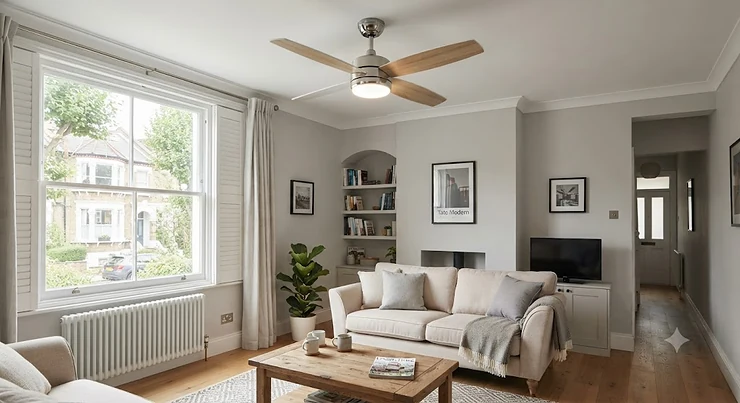
British homes are brilliant at trapping heat and hopeless at releasing it. After a few sweaty summers, more of us are eyeing the ceiling and wondering why we left it empty. The clever bit is that a good living room ceiling fan doesn’t retire in September. Warm air rises and pools near the ceiling, a layering effect known as thermal destratification. A reversed fan at gentle speed helps push it back into the seating zone where you actually live.
This guide covers seven real fans sold on Amazon UK, from a budget woodgrain three-blade to a sprawling 153cm statement piece. Along the way you’ll find honest room size guidance and tips on choosing a stylish reversible fan that passes your interior design fit test. You’ll also get a plain-English answer to the eternal question: what’s the best fan for lounge life in your house?
A quick note on method. Everything below comes from desk research: manufacturer specifications, retailer listings and the themes that recur in published customer reviews. I haven’t fitted any of these fans in a lounge of my own, so expect analysis rather than anecdote. I’ll flag where the evidence is thin.
Quick Comparison: 7 Reversible Ceiling Fan for Living Room Picks at a Glance
| Fan | Blade span | Motor | Reversing method | Price bracket* | Best for |
|---|---|---|---|---|---|
| DREO 1.3m Smart | 132cm | DC | App / remote | Upper | Smart-home lounges, large rooms |
| Willa 153cm | 153cm | AC | Manual switch on housing | Upper | Big open-plan spaces, ceilings 2.4m+ |
| Airwit 106cm | 106cm | DC | Remote | Around £110–£125 | Style-led medium lounges |
| Newday 46-inch | c.117cm | DC | Remote | Around £130 | Everyday medium-to-large lounges |
| Aigostar 52-inch | 132cm | DC | Remote | Mid | Dual-finish looks, bright lighting |
| CJOY 42-inch | 107cm | DC | Remote | Budget to mid | Compact lounges, tight budgets |
| MiniSun 122cm | 122cm | AC | Remote (directional motor) | Budget | Traditional interiors |
*Indicative brackets at the time of research: budget is roughly under £100, mid roughly £100–£160, upper above that. Prices vary by colour and variant, so check current price.
Read across the table and a pattern jumps out. The DC fans cluster in the middle, while the two AC models sit at opposite ends: Willa for premium span and MiniSun for low cost. For a lounge of around 20 m² where you want quiet running and a proper remote, Airwit and Newday look like the sweet spot. Budget buyers should note that CJOY delivers DC-motor refinement in a smaller span, while MiniSun trades refinement for a lower entry price.
💬 Just one click — help others make better buying decisions too!😊
Top 7 Reversible Ceiling Fan for Living Room Picks: Expert Analysis
1. DREO 1.3m Smart Ceiling Fan — app, Alexa and RGB glow
The headline act here is control. DREO treats the fan as smart-home kit rather than a cable-and-remote afterthought, which suits a lounge where the fan, light and mood change by the hour.
The UK listing describes a 132cm span, a quiet DC motor and twelve speeds via the app. It also lists four modes, a timer of up to 12 hours, and dimmable LED lighting with an RGB ambient accent. Twelve steps let you find the whisper setting that stirs the air without lifting the newspaper, and the timer means it can switch itself off after the film. The brand markets noise at roughly 22 to 25 dB across its range. Treat that as a best-case figure, not a promise.
Based on the spec comparison, this is the reversible ceiling fan for living room duty in a large, well-used space where the fan runs most evenings. The RGB glow will delight some households and irritate others, so judge it against your interior design fit before paying for it. One reviewer on the brand’s own site wished it handled separate wall circuits for fan and light, so check how your ceiling is wired.
Amazon UK shows about 4.6 out of 5 across more than 500 ratings for this fan family at the time of research. Reviewers keep returning to quiet running and easy fitting, and a few mention plastic parts.
Pros:
- ✅ Twelve app-controlled speeds for fine-tuned airflow
- ✅ Quiet DC motor with manufacturer-quoted 22–25 dB
- ✅ Voice, app and remote control in one package
Cons:
- ❌ A few reviewers mention plastic components
- ❌ Smart features add complexity if you want a simple switch
Price bracket: upper. It’s good value if you’ll use the app and timer, and a poor one if you won’t.
2. Westinghouse Willa 153cm — widest span in the line-up
The Willa goes big on purpose. At 153cm, it’s built for rooms where a normal fan would look like a hair dryer on a football pitch.
The spec sheet lists a three-speed motor drawing roughly 24, 43 or 77W at 77 to 150 rpm, with an 11° blade pitch. Maximum airflow is around 11,000 cfm, maximum noise is 48 dB(A), and there’s an integrated 17W LED. A remote handles speeds and dimming. The two-tone blades flip between wenge and beech, a second sense of “reversible” that’s handy for a stylish reversible fan look. The motor itself reverses via a manual switch on the housing.
What the spec sheet implies is this. Three speeds sounds basic, but at this span the lowest setting still moves plenty of air. The 48 dB(A) ceiling is louder than the whisper-quiet DC crowd, so you’ll live at lower speeds. Winter mode means a stepladder twice a year, a fair trade for a fan suited to lounges of 30 m² and up. The blades hang about 29.5cm below the ceiling, so with the usual 2.1m clearance you need roughly 2.4m of ceiling height or more.
I couldn’t verify a UK review count for this model. UK lighting retailers position it for large living rooms and open-plan kitchen-diners, and Westinghouse runs an official Amazon.co.uk storefront, so check the listing’s availability.
Pros:
- ✅ Enormous 153cm span for open-plan rooms
- ✅ Two-tone blades suit wood-and-metal schemes
- ✅ Low speed draws only around 24W
Cons:
- ❌ Manual reversing switch means ladder time
- ❌ Louder at maximum than DC rivals
Price bracket: upper. It’s strong value only if your room is genuinely big.
3. Airwit 106cm — flip-side blades for instant restyling
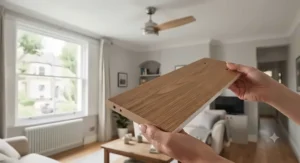
The Airwit is the stylish reversible fan of this group, and it’s reversible twice over. The motor changes direction, and each blade has a matte black side and a wood-grain side.
The listings describe a 106cm span, a 14° blade tilt and six speeds. There are three colour temperatures (roughly 3000K, 4500K and 6000K) and a 1/2/4-hour timer with memory. Two extension rods (about 12.7cm and 25.4cm) are supplied, and the fan tolerates tilting up to around 15° for sloping ceilings. That makes it unusually adaptable for attic conversions and older houses with quirky ceilings. Noise is quoted at 20 to 25 dB, again a manufacturer figure.
One review site suggests 106cm suits rooms up to roughly 20 m², which matches typical terraced and semi-detached lounges. In an open-plan space, room size becomes its limit. I couldn’t verify a UK review count, though overseas listings of the same fan report quiet running and straightforward fitting.
Pros:
- ✅ Double-sided blades change the look without tools
- ✅ Two downrods included for varied ceiling heights
- ✅ Warm-to-cool light with memory function
Cons:
- ❌ 106cm is modest for open-plan lounges
- ❌ UK review volume was hard to verify
Price: around £110–£125, which looks good value for a design-led DC fan.
4. Newday 46-inch — the sleep-mode all-rounder
Newday is the fan for people who want no drama. The 46-inch model (around 117cm) is a sensible middle size with the features that matter.
The UK listing describes a quiet reversible DC motor, stepless dimmable LED, sleep mode and three timer settings. Stepless dimming means you glide from bright to lamp-like rather than jumping between fixed steps, which matters more in a lounge than a bedroom. Per the listing, summer mode turns anticlockwise for a downward breeze and winter mode turns clockwise for a gentler upward flow.
A review site suggests it copes with rooms up to 30 m², including conservatories. I’d treat that as a ceiling rather than a target, and stay nearer 20 to 25 m² for comfort. The UK listing carried around 196 ratings at the time of research. One UK buyer who fitted two units reported being thoroughly impressed. Reviewers also single out the remote’s sleep mode.
Pros:
- ✅ Stepless dimming suits evening lounge lighting
- ✅ Sleep mode and three timer settings
- ✅ Well-reviewed by UK buyers on a modest sample
Cons:
- ❌ Mid-size span limits very large rooms
- ❌ Fewer design finishes than double-sided rivals
Price: around £130. That’s fair for the feature set.
5. Aigostar 52-inch — five dual-finish blades
Aigostar brings five blades and a black-and-wood-grain double-sided finish, giving you a flexible stylish reversible fan at 132cm.
Listing details include six speeds spanning 116 to 170 rpm, a DC motor and an 18W LED with adjustable colour temperature. The LED is rated at about 2,050 lumens, roughly what a 150W incandescent bulb once delivered, so it can be the main light in a modest lounge. Memory function and independent fan and light control mean you can run the light without the breeze. The brand claims 28 dB on the sleep setting.
Five blades tend to move air gently rather than aggressively, which suits a lounge where papers and pets share the space. That makes it a thoughtful choice for anyone who dislikes a draught but wants circulation. I couldn’t verify review counts, and the quiet claims rest mostly on listing text, so weigh them accordingly.
Pros:
- ✅ Dual-sided blades match black or wood schemes
- ✅ Bright 2,050-lumen adjustable LED
- ✅ Independent fan and light control
Cons:
- ❌ Noise figures come from manufacturer text
- ❌ Review evidence was thin to verify
Price bracket: mid. Good value if the lighting will do real work.
6. CJOY 42-inch — woodgrain DC on a budget
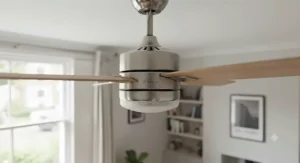
The CJOY is the pick when the room is compact and the wallet is tight. It pairs a three-blade woodgrain look with a DC motor at 107cm.
The listing describes six speeds, three colour temperatures, memory, a sleep mode and a noise claim under 35 dB. Timer options run 1, 3 or 6 hours, and a dedicated remote button switches to winter mode. A wall bracket for the remote is included, which sounds trivial until you’ve lost one down a sofa. The fan can tilt up to around 15° on a related listing.
For lounges up to about 15 to 20 m², 107cm is sensible. Bigger than that, you’d want the span of the Aigostar or DREO. Amazon’s review summary on a closely related CJOY 42-inch listing says buyers find it quiet, well made and easy to install. One buyer there wished fan and light could be controlled separately from a single remote. I couldn’t isolate reviews for this exact woodgrain DC variant.
Pros:
- ✅ DC motor refinement at an accessible price
- ✅ Remote button for winter mode
- ✅ Wall bracket keeps the remote findable
Cons:
- ❌ 107cm span suits smaller lounges only
- ❌ Review evidence relates to a sister listing
Price bracket: budget to mid. It’s a strong value pick for a small lounge.
7. MiniSun 122cm — traditional and budget-friendly
MiniSun is the classic approach: a traditional AC-style fan with four blades that flip between chrome and dark wood, at 122cm.
Listings describe a directional motor (forward and reverse), three speeds, a full-function remote and a frosted opal glass shade. The diameter is 122cm and the height around 38cm. One stockist notes that two E14 bulbs are needed and not supplied, so add bulbs to your budget and check the listing. Three speeds means less fine control than a six- or twelve-speed DC fan, and AC motors are generally less efficient. For a room used occasionally, that hardly matters.
The four-blade, chrome-and-wood combination suits traditional interiors, period properties and anywhere a modern black fan would feel out of place. I couldn’t verify a UK review count for this listing, so buy with normal caution.
Pros:
- ✅ Classic look suits traditional lounges
- ✅ Blades flip between chrome and dark wood
- ✅ Lowest entry cost in this list
Cons:
- ❌ Only three speeds, AC motor
- ❌ Bulbs may not be included
Price bracket: budget. Fair value if you need the look more than the finesse.
✨ Ready to upgrade your lounge?
🔍 Click any highlighted fan name above to check current pricing and availability on Amazon.co.uk, and pick the one that suits your ceiling, your budget and your style.
Your First 30 Days: Setup, Winter Mode and Maintenance for a Living Room Ceiling Fan
Fitting a living room ceiling fan is a job that takes an afternoon and causes a fortnight of muttering. Here’s the order that avoids the drama.
Before you start: Isolate the circuit at the consumer unit. Confirm the fan is fixed to a joist or a fan-rated support box, never plain plasterboard, because a moving fan puts different stress on a fixing than a static light does.
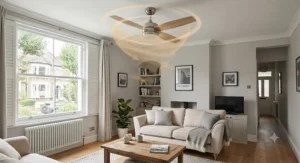
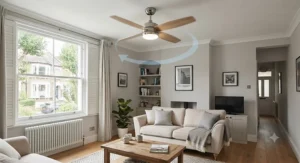
Week one: Check blade balance and run the fan through every speed. Set the direction for the season. Listings describe anticlockwise (viewed from below) as summer mode and clockwise as winter mode, and clockwise should always be at low speed. A Harvard Graduate School of Design study compared forward and reverse operation at three ceiling heights. It suggested reversing isn’t automatically the most efficient route to destratification, though it tested specific US fan models. I’d read that as a nuance rather than a reason to skip winter mode: keep speed low and avoid a chilly draught.
Week two: Tune the light. Warm white (around 3000K) suits evenings and cooler tones suit daytime tasks. Store your remote settings where the fan has memory, and use sleep mode on Newday or CJOY for the evening wind-down.
Week four: Tighten canopy and blade screws, since vibration loosens things as they settle. Wipe the blades before you reverse the fan for a new season so dust doesn’t rain down. After that, a monthly wipe and a twice-yearly screw check is plenty.
Real-World Scenarios: Which Reversible Ceiling Fan for Living Room Suits You?
Specs matter less than your actual life, so here are three profiles matched to picks with reasoning.
The renter, 14 m² flat lounge, 2.4m ceiling, budget under about £100, evening use. Get landlord permission first, since this is fixed wiring. The CJOY fits the span, gives you DC-motor quiet, and comes with a remote bracket. It’s the best fan for lounge life on a tight budget and modest ceiling.
The family, 28 m² open-plan lounge-diner in a 1990s semi, 2.5m ceilings, fan on five to six hours most days. Here the DREO or Aigostar makes sense for span and airflow. Running costs are pennies. At Ofgem’s October to December 2026 price cap, average electricity is about 26.32p per kWh, and VAT on electricity is removed until 31 March 2027. A 30W DC fan for six hours therefore costs around five pence a day.
The Victorian terrace owner, 18 m² lounge, 3m ceilings, draughty bay window, heating on from October. Higher ceilings mean the warm-air-pooling problem is real. The Airwit, with two downrods supplied, lets you drop the blades into a useful zone. Its 106cm span suits the room size, and the flip-side blades help with period decor.
If you’d rather stay traditional and thrifty, the MiniSun does the same job with chrome and dark wood.
Problem → Solution: Wobble, Hum, Cold Ceilings and Clashing Light
Problem: it wobbles. Check that the canopy screws and blade brackets are tight, then confirm the fixing is solid. A blade with a slightly different weight can also cause the shake, so clean all blades evenly.
Problem: it hums at low speed. Wall dimmers and DC fan receivers are rarely friends. Avoid putting the fan’s light or motor behind a standard dimmer switch, and use the remote’s dimming instead. If the hum persists, try a different speed step.
Problem: the room still feels stuffy. Check the direction first, then check the span. A 107cm fan in a 30 m² lounge will feel underpowered whatever the speed. Move up a size, or look at the DREO or Aigostar.
Problem: the ceiling is still warm and the floor is still cold. Winter mode needs low speed. Set it clockwise and give it an hour to mix the air. If you can feel a breeze, go lower.
Problem: the light feels harsh or clinical. Drop to 3000K warm white and dim it. On fans with memory, such as Aigostar and Airwit, the setting sticks.
How to Choose a Reversible Ceiling Fan for Living Room
The short answer is to match blade span to your floor area, check ceiling height, choose the motor type, and confirm how the fan reverses. Then pick lighting and controls that fit your evenings. Here are seven steps.
- Measure the room. Floor area in square metres sets the span: roughly 91–107cm for small lounges, 107–122cm for medium and 132–153cm for large.
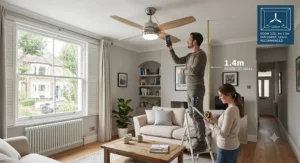
- Check ceiling height. Blades should sit at least 2.1m above the floor, ideally with 25–30cm between blades and ceiling for airflow. Low ceilings need flush-mount designs.
- Choose the motor. DC motors are quieter, more efficient and usually offer more speeds, while AC motors are cheaper and simpler.
- Confirm the reversing method. A remote or app switch is convenient, while a manual switch on the housing (like the Willa) means a stepladder.
- Decide on the light. Look for integrated LED, adjustable colour temperature and smooth dimming, and remember a lounge wants warm light.
- Check controls and wiring. Confirm whether the fan and light need separate switched feeds.
- Read the small print. Look at warranty, noise claims and conformity marking on the documentation.
Room Size: Matching Blade Span to Your Lounge
Getting room size wrong is the classic mistake. Too small and the fan can’t move enough air, too big and it dominates the ceiling.
| Lounge floor area | Suggested blade span | Fans from this list |
|---|---|---|
| Up to about 15 m² | 91–107cm | CJOY 42-inch |
| About 15–25 m² | 107–122cm | Airwit 106cm, Newday 46-inch, MiniSun 122cm |
| About 25–36 m² and open-plan | 132–153cm | DREO 1.3m, Aigostar 52-inch, Willa 153cm |
Retailer guidance broadly supports these bands. One suggests 106cm suits rooms up to about 20 m², while another says a 132cm span can cover up to 36 m². Note that Airwit sits at the edge of its band, so if your lounge is 20 m² or more, look one size up.
Ceiling height is the other half of room size. A big span on a low ceiling is a recipe for a bumped head, so measure vertically as carefully as you measure the floor.
Living Room Ceiling Fan vs Tower Fans and Air Conditioning
A living room ceiling fan wins on floor space, since it takes none. It also wins on running cost and winter usefulness, because tower fans and portable air conditioners can’t reverse.
| Feature | Reversible ceiling fan | Tower or pedestal fan | Portable air conditioner |
|---|---|---|---|
| Floor space | None | Takes a corner | Takes a corner plus hose |
| Winter use | Yes, reverse mode | No | No |
| Running cost | Low | Low | Typically much higher |
| Noise | Low on DC models | Varies | Often noticeable |
| Fitting | Fixed wiring | None | Window kit |
Read the table as a trade-off. A ceiling fan is a fitting, not an appliance, so it needs installation, but it repays that effort every season. A fan doesn’t lower the room’s temperature, it just makes you feel cooler, so for a genuine heatwave a portable unit is the only true “cooler”. For everyday lounge comfort, though, the ceiling fan is the better long-term buy.
Stylish Reversible Fan: Getting the Look Without the Regret
A stylish reversible fan should look like it belongs, not like it was bolted on in a hurry. The trick is to treat the fan as a light fitting that happens to move.
Double-sided blades, as on the Airwit and Aigostar, are the easiest win. You get two looks from one purchase, and flipping the blades later refreshes the room without a new fan. The Willa‘s wenge-and-beech blades and the MiniSun‘s chrome-and-dark-wood finish give a stylish reversible fan effect in warmer, more traditional palettes. The DREO leans modern, with its RGB accent as an optional extra.
A few rules keep it stylish. Match the metal finish to nearby fixtures such as curtain poles and lamp bases. Keep blade colours within the room’s palette. Avoid coloured RGB effects in a lounge that’s already busy. Ask whether you’d pick this fan if it were a pendant light, because if not, the moving part won’t rescue it.
Interior Design Fit: Blending a Fan Into Your Lounge Scheme
Good interior design fit starts with visual weight. Five blades read as busier than three, and a matte black fan in a white room becomes a feature whether you like it or not.
For Scandi or minimalist lounges, beech or pale wood finishes on the Willa or Airwit disappear pleasantly. Industrial schemes suit matte black, which the Aigostar and CJOY can deliver. Traditional homes want the MiniSun‘s chrome and dark wood, while mid-century looks favour warm walnut tones.
Then consider sightlines. If you sit on a sofa looking up at the fan, the shade and blade edge become part of your daily view, so check how the light diffuser looks in photos taken from below. The best interior design fit also respects your lighting layers: a fan light should complement lamps, not replace them, so choose a colour temperature that matches your bulbs.
Best Fan for Lounge: Matching Picks to Your Home Type
The best fan for lounge use depends on the building as much as the person.
Open-plan new build: you need span and airflow. The DREO, Aigostar or Willa cope with big shared spaces and make the most of the ceiling.
Victorian or Edwardian terrace: high ceilings and draughts make winter mode valuable. The Airwit, with its downrods, and the MiniSun suit period charm.
Small flat lounge with a low ceiling: measure carefully. The CJOY is the most compact option here.
Family room with a conservatory link: reviewers suggest Newday copes with conservatory-adjacent spaces. It’s a sensible best fan for lounge and glazed-room duty alike, though very hot glazed rooms can overwhelm any fan.
If you can’t choose, start with room size and ceiling height, then pick the fan that fits both, because that pairing rules out most of the wrong answers.
Long-Term Cost & Running Costs
Running costs are small, but let’s do the sums at the same 26.32p per kWh average used above. The Willa‘s published wattages give us real numbers, and I’ve assumed 30W for a typical DC fan.
| Scenario | Power | Energy for 8 hours | Approx. cost |
|---|---|---|---|
| Willa lowest speed | 24W | 0.19 kWh | About 5p |
| Willa medium speed | 43W | 0.34 kWh | About 9p |
| Willa highest speed | 77W | 0.62 kWh | About 16p |
| Typical DC fan (assumed) | 30W | 0.24 kWh | About 6p |
| 17W LED light, 4 hours | 17W | 0.07 kWh | About 2p |
Even at maximum, the fan costs pennies per evening. The bigger cost is upfront, so buy once and buy sensibly. Over the years, a quieter DC motor and a decent warranty do more for value than any speed setting. Check the warranty period on the listing, since one Airwit-related listing mentions a long motor warranty, which is worth confirming before purchase.
✨ Found a fan that fits?
🔍 Tap the highlighted names above to check current pricing and availability on Amazon.co.uk, then measure once more before you buy!
Safety, Regulations and Compliance for UK Living Rooms
Fitting a fan is fixed electrical work, so treat it seriously. Under Approved Document P, installing fixed electrical equipment falls within the scope of Part P even when the final connection is a plug. It’s notifiable only for specific kinds of work, and as I read it, simple replacements and repairs outside special locations are generally non-notifiable. New circuits are a different story. This is general information, not professional electrical advice, so if you’re unsure, hire a registered electrician.
Beyond Part P, check the product documentation for UKCA or CE conformity marking and the relevant safety standards. Confirm the fixing is rated for a moving load, and keep the blades at least 2.1m above the floor. Avoid wet or splash zones unless the IP rating says otherwise. If the fan and light share a switch or circuit, check the listing’s wiring notes, because wiring assumptions vary between manufacturers.
FAQ
❓ Is a reversible ceiling fan for living room use worth it in the UK?
❓ Can I fit a living room ceiling fan in a rented home?
❓ What if I lose the remote for my stylish reversible fan?
❓ Are reversible ceiling fans safe around pets and children?
❓ How long does a reversible ceiling fan for living room use last?
Conclusion
A reversible ceiling fan for living room duty earns its keep in every season. It sends a breeze down in July, mixes warm air back into the room in January, and doubles as the main light in between.
For most lounges, I’d shortlist by room size first. In a medium lounge, Airwit and Newday balance quiet DC running with sensible size and features. For large open-plan spaces, DREO, Aigostar and Willa bring span and character. On a budget, CJOY and MiniSun get you the essentials, in a modern woodgrain finish or a traditional chrome-and-wood look respectively.
Pair the right span with the right ceiling height, choose a stylish reversible fan that respects your interior design fit, and set winter mode to low. Do that and even the best fan for lounge life will feel like it was always meant to be there.
Recommended for You
- Ceiling Fan With Heating Mode: 7 Best Picks For UK Homes (2026)
- Reversible Ceiling Fans: 7 Best Dual-Mode Picks For UK Homes (2026)
- Reversible Ceiling Fan: 7 Brilliant UK Picks For 2026
Disclaimer: This article contains affiliate links. As an Amazon Associate, I earn from qualifying purchases. If you purchase products through these links, we may earn a small commission at no additional cost to you.
✨ Found this helpful? Share it with your friends! 💬🤗
