In This Article
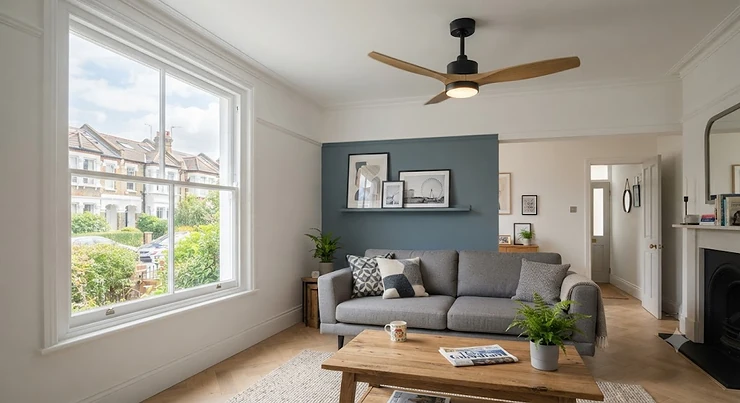
Somewhere between “just crack a window” and “install full air conditioning,” there’s a much cheaper, much quieter answer sitting on a lot of Amazon wish lists: the BLDC ceiling fan. If you’ve spent a July night in a Victorian terrace with single glazing and a loft that behaves like a pizza oven, you already know why this matters. A BLDC ceiling fan uses a brushless direct-current motor rather than the old AC induction motor found in bargain-bin fans, and that one swap changes almost everything — how much it costs to run, how loud it is at 2am, and how long it lasts before something inside it grinds to a halt.
What is a BLDC ceiling fan? It’s a ceiling fan built around a brushless DC motor instead of a conventional AC motor, using electronic commutation rather than mechanical brushes to spin the blades — the result is lower power draw, near-silent operation, and finer speed control across multiple settings.
This guide digs into seven real models sold on amazon.co.uk, spanning budget to premium, so you can work out which one actually suits your ceiling rose, your electricity bill and your patience for a fan that hums all summer. We’ll also cover brushless motor technology in plain English, what torque efficiency really means for airflow, and the maintenance requirements you can expect over a decade of use — because, as the Energy Saving Trust points out, small efficiency gains in everyday appliances add up meaningfully across a UK household’s annual energy use. Let’s get into it.
Quick Comparison Table
| Fan Type | Typical Running Cost | Noise Level | Speed Control | Best For |
|---|---|---|---|---|
| BLDC ceiling fan | Low (15-35W typical) | Very quiet | Stepless/multi-speed via remote | Bedrooms, nurseries, home offices |
| Standard AC ceiling fan | Moderate (60-90W typical) | Noticeable hum/buzz | 3-speed pull cord or wall switch | Utility rooms, garages, budget buys |
| Pedestal/desk fan | Low-moderate | Variable, often whiny at high speed | 3-6 speed dial | Small rooms, temporary cooling |
Reading across that table, the gap between a brushless motor ceiling fan and its AC-motor cousin isn’t marginal — it’s the difference between forgetting the fan is even on and needing the telly turned up two notches to compensate. The pedestal fan comparison matters too, because plenty of shoppers land on a BLDC ceiling fan after tiring of a floor fan that eats desk space and still can’t cool a whole bedroom evenly. Where the ceiling-mounted brushless option wins decisively is in circulating air across an entire room rather than just blasting whoever’s sitting directly in front of it.
💬 Just one click — help others make better buying decisions too!😊
Top 7 BLDC Ceiling Fans: Expert Analysis
Coverage below spans budget, mid-range and premium territory, plus a couple of less obvious picks worth knowing about. Every product name appears in bold throughout so you can scan the page and match faces to prices without re-reading paragraphs.
1. Newday 48 Inch White Ceiling Fan — quietest budget pick with stepless dimming
The Newday 48 Inch White Ceiling Fan leads with something budget fans rarely nail: a genuinely quiet DC motor rather than a “quiet-ish” one. Specs-wise, it runs a 48-inch blade span with two-colour interchangeable blades, stepless dimming on the paired LED light, and full remote operation — practical details that matter more once you’re actually living with the thing than they do on a spec sheet. Based on the spec comparison against similarly priced AC alternatives, the stepless (rather than fixed 3-speed) control is the standout: you can dial in exactly the airflow you want instead of choosing between “nothing” and “hurricane.”
Reviewers consistently note that assembly is straightforward for a two-person job and that the remote’s range comfortably covers a standard UK bedroom. This is a solid entry point for anyone testing whether they even like ceiling fans before committing to a pricier model — first-timers, renters furnishing a starter flat, or anyone replacing a broken pull-cord light fitting.
Pros:
- ✅ Genuinely low noise floor for its price bracket
- ✅ Stepless dimming and speed control via remote
- ✅ Two-tone reversible blades suit multiple décor styles
Cons:
- ❌ Smaller 48-inch span underperforms in larger rooms
- ❌ Limited smart-home integration compared with pricier rivals
Priced in the £70-£90 range at the time of research, this is a sensible starter buy for anyone dipping a toe into brushless motor ceiling fans without a big upfront outlay.

2. VONLUCE 52 Inch Ceiling Fan with Lights — best value for larger rooms
Stepping up in blade span, the VONLUCE 52 Inch Ceiling Fan with Lights pairs a reversible six-speed DC motor with a five-blade design intended for bigger living rooms and open-plan spaces. What most buyers overlook about this model is the reverse function — running the blades clockwise in winter gently pushes warm air (which naturally rises) back down into the room, which can shave a little off heating costs when paired with central heating rather than fighting against it.
The wider 52-inch sweep genuinely earns its keep here: a fan this size moves noticeably more air per rotation than a 42-48 inch model at the same speed setting, so it can run on a lower, quieter setting and still deliver comparable airflow. Aggregated review sentiment on Amazon points to strong satisfaction with build quality relative to price, though a handful of buyers flag that the remote’s LED display is bright enough to notice in a fully darkened bedroom.
Pros:
- ✅ Larger 52-inch span suits open-plan or bigger rooms
- ✅ Reversible motor helps in both summer and winter
- ✅ Six speeds allow fine-tuned airflow control
Cons:
- ❌ Remote display can be distracting in a dark bedroom
- ❌ Light kit’s colour temperature isn’t adjustable on base model
Expect this one in the £100-£130 range, making it a strong middle-ground pick if the 48-inch Newday feels too small for your space.
3. reiga Low Profile Ceiling Fan with Remote Control — smart home integration star
The reiga Low Profile Ceiling Fan with Remote Control has quietly built one of the stronger review track records in this category on amazon.co.uk, sitting around 4.4 stars across several thousand ratings at the time of research — a review pool large enough to actually mean something, unlike some newer listings with a handful of reviews. Its low-profile flush mount matters more than it sounds: rooms with standard UK ceiling heights (2.4m is common in post-war housing) can feel cramped with a fan hanging on a long downrod, and this design sits close to the ceiling instead.
On paper, the summer/winter reverse mode, dimmable LED and app/voice control (Alexa compatible on relevant listings) put it ahead of fans at a similar price that only offer a basic remote. Reviewers consistently report that the timer function is genuinely used day-to-day rather than ignored, which suggests it’s a feature people actually reach for rather than marketing filler.
Pros:
- ✅ Large, well-established review base backs up reliability claims
- ✅ Low-profile mount suits standard UK ceiling heights
- ✅ Smart voice control adds genuine everyday convenience
Cons:
- ❌ Voucher-dependent pricing can make budgeting tricky
- ❌ App setup reportedly fiddly on first attempt for some buyers
Typically found in the £150-£200 range before any applicable voucher, this is worth cross-shopping against the smart-control Ohniyou below if home-automation features are a priority for you.
4. MSHENUED 52″ Wood Ceiling Fan — top energy rating in its class
If BLDC fan energy efficiency is your main motivation for switching, the MSHENUED 52″ Wood Ceiling Fan deserves a proper look — it carries an A+++ energy efficiency rating on its Amazon listing, sitting at the top end of what’s achievable for a ceiling fan under current labelling conventions. Six-speed reversible operation and a timer function round out a spec sheet that reads more like a premium fan than its price suggests.
What the spec sheet won’t tell you, but reviewers note, is that the wood-effect blades manage to look genuinely convincing rather than obviously plastic — a detail that matters if the fan’s going in a room where it’ll be on permanent display rather than tucked above a bed. With an average around 4.8 stars from a modest but consistent review pool, early sentiment is strongly positive, though the smaller number of reviews compared with the reiga above means it’s worth treating that rating with slightly more caution until a larger sample builds up.
Pros:
- ✅ A+++ energy rating among the best in this fan category
- ✅ Convincing wood-effect blade finish for the price
- ✅ Full remote timing and six-speed control
Cons:
- ❌ Smaller review pool than more established rivals
- ❌ No app or voice control included
At around £185-£195, it sits at the upper end of mid-range, justified largely by that energy rating and finish quality.
5. Ohniyou 52″ Ceiling Fan with LED Lights and App Control — most flexible smart controls
The Ohniyou 52″ Ceiling Fan with LED Lights and App Control targets buyers who want their ceiling fan to sit alongside smart bulbs and smart plugs rather than as an isolated gadget. Dimmable LED lighting, a quiet reversible DC motor and both app and remote control give it genuine flexibility — useful if you’re the type who schedules lighting scenes rather than just flicking a switch.
Based on the spec comparison with the reiga above, the Ohniyou leans slightly more towards lighting sophistication (dimmable, tunable output) while the reiga leans towards voice-assistant depth — a genuinely useful distinction if one matters more to your existing smart-home setup than the other. Review volume on this specific listing is still fairly small at the time of research, so early ratings (hovering around 5 stars) should be read as encouraging rather than conclusive; it’s the kind of listing worth revisiting in six months once more buyers have weighed in.
Pros:
- ✅ Strong app-based control for smart-home households
- ✅ Dimmable, flush-mount LED light integration
- ✅ Quiet reversible DC motor performance
Cons:
- ❌ Limited review history to verify long-term reliability
- ❌ Premium features add roughly £20-£30 over comparable rivals
Priced around £170-£190, this is one for buyers who specifically want tight app integration rather than the widest possible track record.
6. Philips Olas Ceiling Fan — most trusted brand pedigree
Few names in home electronics carry as much general trust in the UK as Philips, and the Philips Olas Ceiling Fan trades on exactly that. Its three-blade, 42-inch design pairs a 24W tunable LED light (3000K-6500K, dimmable to 5%) with a DC motor and remote control — a genuinely premium lighting spec wrapped around a fairly compact fan.
Here’s what to weigh: the 42-inch blade span is smaller than most of the other entries here, meaning it’s better suited to bedrooms and home offices than large living rooms, but the tunable white lighting is a genuine step up if you want the fan doubling as your main room light rather than an afterthought. Aggregated feedback highlights the light’s colour-temperature range as the standout feature, more so than the fan’s airflow, which reviewers describe as competent rather than exceptional at this size.
Pros:
- ✅ Trusted, widely recognised brand with UK support presence
- ✅ Tunable white LED light spans warm to cool tones
- ✅ Compact 42-inch size suits smaller rooms neatly
Cons:
- ❌ Smaller blade span limits airflow in larger rooms
- ❌ Premium branding carries a modest price premium
Sitting in the £150-£170 range, this is the pick for buyers who want a recognisable name and prioritise lighting quality alongside the fan function.
7. FARO BARCELONA PEMBA LED Ceiling Fan — best design-led premium pick
Rounding out the list, the FARO BARCELONA PEMBA LED Ceiling Fan brings genuine European design pedigree to a category that’s often dominated by generic-looking imports. FARO Barcelona has manufactured lighting and fans since the 1990s, and the PEMBA’s white finish and integrated LED reflect that design-first approach rather than a spec-sheet-first one.
On paper, this means a DC motor built into a fixture designed to look intentional on the ceiling rather than merely functional — genuinely useful in open-plan kitchen-diners or statement living rooms where the fan is on permanent visual display. What most buyers overlook about design-led fans like this is that the payoff isn’t airflow performance (which is competitive but not class-leading) — it’s that you won’t feel the urge to swap it out again in three years when you redecorate.
Pros:
- ✅ Distinctive European design suits statement interiors
- ✅ Integrated LED avoids bulky bolt-on light kits
- ✅ Established manufacturer with long lighting heritage
Cons:
- ❌ Commands a premium versus generic-brand alternatives
- ❌ Fewer aggregated UK customer reviews to draw on
Expect a price in the £180-£220 bracket, positioning it as the design-conscious alternative to the more feature-dense reiga and Ohniyou models above.
Top 7 Products at a Glance
| Product | Blade Span | Motor Speeds | Price Range | Best For |
|---|---|---|---|---|
| Newday 48 Inch White Ceiling Fan | 48″ | Stepless | £70-£90 | First-time buyers, small bedrooms |
| VONLUCE 52 Inch Ceiling Fan | 52″ | 6-speed | £100-£130 | Larger rooms, value seekers |
| reiga Low Profile Ceiling Fan | 52″ (low profile) | 6-speed + app/voice | £150-£200 | Smart-home households |
| MSHENUED 52″ Wood Ceiling Fan | 52″ | 6-speed | £185-£195 | Energy-efficiency priority |
| Ohniyou 52″ Ceiling Fan | 52″ | 6-speed + app | £170-£190 | App-based lighting scenes |
| Philips Olas Ceiling Fan | 42″ | Remote, tunable light | £150-£170 | Brand trust, smaller rooms |
| FARO BARCELONA PEMBA | Standard | Remote | £180-£220 | Design-led statement pieces |
Looking at this table, the clearest split is between fans chasing raw airflow for bigger rooms (VONLUCE, MSHENUED, reiga) and fans chasing lighting or design credentials in smaller spaces (Philips Olas, FARO BARCELONA PEMBA). Budget-focused readers should note that the Newday delivers most of the core brushless-motor benefits — quiet running, low power draw — without paying for smart features you might never actually use.
Practical Usage Guide: Setup, First 30 Days and Maintenance
Getting a BLDC ceiling fan onto your ceiling correctly matters more than most buyers expect, largely because these fans are lighter than old AC models but still need proper joist or crossbar fixing — plasterboard alone won’t hold one safely over time. If you’re not confident with ceiling wiring, it’s worth budgeting for a qualified electrician rather than treating this as a weekend DIY job, particularly in older UK properties where existing wiring may not match modern fan requirements.
In the first 30 days, the most common mistake is running a new fan flat-out on its highest setting to “test” it — brushless motors typically perform best, and quietest, in the mid-range of their speed settings, so start there and adjust. Dust the blades every few weeks with a dry microfibre cloth (not a wet one, which can affect balance if moisture seeps into the blade material), and check after the first month that all mounting screws remain fully tight, since a small amount of settling is normal as the fixture beds in.
Ongoing maintenance requirements for a BLDC ceiling fan are refreshingly light compared with brushed AC alternatives — there’s no brush wear to worry about, so the main task is periodic dusting and an annual check of the mounting hardware. Most manufacturers recommend avoiding direct water contact with the motor housing, which matters if yours is going in a bathroom or conservatory rather than a standard living space.
Real-World Scenarios: Who Actually Benefits from Switching to BLDC
Consider a University student renting a small ensuite bedroom with a single window that barely opens — for them, the Newday 48 Inch White Ceiling Fan makes sense precisely because it’s compact, cheap to run overnight, and quiet enough not to disturb sleep in a small room where a floor fan would otherwise dominate the space.
A young family in a semi-detached house with an open-plan kitchen-diner faces a different problem: circulating air across a much bigger footprint without a noisy hum competing with dinner-table conversation. Here, the VONLUCE 52 Inch Ceiling Fan or reiga Low Profile Ceiling Fan make more sense, given their wider blade spans and reversible winter mode that works alongside central heating rather than against it.
Finally, picture a couple renovating a period home who want every fixture to look deliberate rather than functional-only — for them, the FARO BARCELONA PEMBA LED Ceiling Fan or Philips Olas Ceiling Fan earn their higher price tags through design and lighting quality that a generic import simply won’t match.
How to Choose a BLDC Ceiling Fan
- Measure your room first. A fan under 44 inches struggles in rooms over roughly 20 square metres, so match blade span to floor area before anything else.
- Check your ceiling height. Standard UK ceilings (around 2.4m) usually suit a flush or low-profile mount rather than a long downrod design.
- Decide how much smart control you actually want. App and voice control add convenience but also add price — and a small amount of setup friction, based on reviewer feedback.
- Prioritise motor speeds over headline wattage. Six-speed reversible control usually matters more day-to-day than a marginally lower wattage figure.
- Factor in the light kit separately from the fan. If you want tunable white lighting, models like the Philips Olas Ceiling Fan are worth the premium; if not, a simpler dimmable LED suffices.
- Read the review count, not just the star rating. A 5-star rating from four reviews (like some newer smart listings) tells you less than a 4.4-star rating from several thousand.
- Confirm reversibility for winter use. Not every model reverses direction, and this feature is what delivers the winter heating-cost benefit.
Common Mistakes When Buying a BLDC Ceiling Fan
A frequent error is assuming “DC motor” automatically means whisper-quiet — bearing quality and blade balance matter just as much as motor type, so it’s worth checking aggregated reviews specifically for noise complaints rather than trusting the word “quiet” on a listing alone. Another common slip-up is buying based on blade span alone without checking downrod length or mounting type, which can leave a large fan sitting uncomfortably close to a low UK ceiling.
Shoppers also frequently underestimate how much smart features cost relative to their actual daily use — app control sounds appealing in the abstract, but if you’d genuinely just use the remote 95% of the time, that premium is better spent on a larger blade span or a better light kit instead. Finally, don’t ignore energy labelling: under UK energy information regulations, appliance labels are there specifically to let you compare running costs fairly, and it’s worth actually reading them rather than assuming all BLDC motors perform identically on efficiency. Independent testers such as Which? also publish comparative fan reviews worth cross-checking before you commit to a specific model.
BLDC Ceiling Fan vs Traditional AC Ceiling Fan
The core distinction in brushless motor technology comes down to how the motor is driven: a traditional AC induction motor spins based on the mains supply frequency and uses physical brushes for commutation, which generates friction, heat and eventual wear. A BLDC (brushless DC) motor instead uses electronic commutation controlled by a small circuit board, meaning no brushes to wear out and considerably finer control over speed.
In practice, this translates into three real advantages: lower running costs (BLDC motors commonly draw 15-35W versus 60-90W for comparable AC motors), meaningfully quieter operation since there’s no brush friction generating noise, and stepless or multi-speed control rather than the blunt 3-speed pull-cord found on older AC designs. The trade-off is usually price — brushless motor ceiling fans typically cost more upfront than basic AC equivalents, though the running-cost savings can offset that difference over several years of regular use, particularly if the fan runs most nights through a UK summer.
Torque Efficiency and Real-World Performance
Torque efficiency is one of those specs that sounds technical but has a genuinely simple real-world translation: it’s how much rotational force a motor delivers per watt consumed, and a higher figure means a fan can push more air without needing a bigger, hungrier motor to do it. This is exactly why a well-designed BLDC ceiling fan on a mid-range speed setting can feel like it’s moving as much air as a cheaper AC fan running flat-out, while drawing a fraction of the power.
What most buyers overlook about torque efficiency is that it also affects longevity — a motor working harder than it needs to at a given speed generates more heat and wears components faster over time. Reviewers consistently note that better-engineered BLDC fans, including several featured above, “feel” smoother rather than just quieter, particularly noticeable when switching between speeds rather than running at a single fixed setting throughout the day.
Long-Term Cost and Maintenance
Running a typical BLDC ceiling fan for eight hours a night through a three-month UK summer, at roughly 25W average draw, costs a modest amount on electricity compared with even a small portable air conditioning unit, which can draw ten times that figure. Over a projected 10-15 year lifespan — reasonable for a brushless motor with no brushes to wear down — the total cost of ownership typically favours the BLDC option once you factor in both the lower running cost and the reduced likelihood of motor failure versus a cheap AC alternative.
Maintenance requirements stay minimal throughout that lifespan: periodic blade dusting, an annual mounting-hardware check, and — for models with removable LED modules — an occasional bulb or driver replacement rather than a full fixture swap. This compares favourably with older ceiling fans that required grease points or bearing replacement every few years, a maintenance burden that’s largely disappeared with brushless designs.
Features That Actually Matter (And Those That Don’t)
Six-speed control, reversible rotation and genuine remote range all matter in daily use — they’re the features you’ll interact with every single day the fan is switched on. Tunable white lighting matters if you actually want the fan doubling as your main room light; if you’ve already got separate ceiling spotlights, it’s a nice-to-have rather than essential.
App and voice control, by contrast, sit firmly in “matters for some, irrelevant for others” territory — genuinely useful if you’re already running a smart-home ecosystem, largely pointless if you’re not. Marketing terms like “aerodynamic blade design” deserve healthy scepticism too; without independent test data behind the claim, it’s difficult to verify any real-world airflow benefit over a standard blade profile, and it’s the kind of phrase worth reading past rather than being swayed by.
✨ Don’t Miss These Exclusive Deals!
🔍 Take your search for the perfect ceiling fan to the next level with these carefully selected picks. Click on any highlighted product to check current pricing and availability on amazon.co.uk. A good BLDC ceiling fan will keep your home comfortable through every UK summer to come!
Safety, Regulations and Sensible Fan Use
Any ceiling-mounted electrical fixture in the UK should be installed in line with Part P of the Building Regulations where rewiring is involved, and it’s genuinely worth using a qualified electrician rather than risking a DIY job on anything beyond swapping a like-for-like fitting. It’s also worth remembering that fans work by promoting evaporation of sweat rather than actually lowering room temperature — the NHS heatwave guidance notes that fans are most effective below around 35°C and can be counterproductive above that threshold, since they simply circulate hot air rather than cooling it.
For households with young children or elderly relatives, it’s worth checking blade clearance carefully in rooms with low ceilings or raised furniture like bunk beds, and confirming the fan’s minimum mounting height against your room’s actual ceiling height before ordering rather than after installation.
Frequently Asked Questions
❓ What is a BLDC ceiling fan?
❓ How much electricity does a BLDC ceiling fan use?
❓ Are BLDC ceiling fans worth the extra cost?
❓ Can a ceiling fan replace air conditioning in the UK?
❓ Do BLDC ceiling fans need much maintenance?
Conclusion
Choosing a BLDC ceiling fan really comes down to matching motor efficiency and blade span to your actual room, rather than chasing the longest spec sheet available. If you want the simplest possible entry point, the Newday 48 Inch White Ceiling Fan covers the fundamentals without overcomplicating things. If your priority is a larger room and reliable performance backed by a substantial review history, the reiga Low Profile Ceiling Fan and VONLUCE 52 Inch Ceiling Fan both make a strong case. And if design or brand trust matters as much as airflow, the Philips Olas Ceiling Fan and FARO BARCELONA PEMBA LED Ceiling Fan deliver that without sacrificing the core brushless-motor benefits this whole category is built on.
Whichever you land on, the underlying appeal of brushless motor technology stays consistent: lower running costs, genuinely quieter nights, and considerably less to think about in terms of upkeep than the ceiling fans of a decade ago. For a purchase that sits above your bed for the next ten-plus years, that’s not a small thing.
Recommended for You
- DC Motor vs AC Motor Ceiling Fan: 7 Real Picks Compared 2026
- Quiet DC Motor Ceiling Fan for Bedroom: 7 Best Picks 2026
- BBQ Area Ceiling Fans 2026: 7 Best Picks to Beat the Smoke
Disclaimer: This article contains affiliate links. As an Amazon Associate, I earn from qualifying purchases. If you purchase products through these links, we may earn a small commission at no additional cost to you.
✨ Found this helpful? Share it with your friends! 💬🤗
